
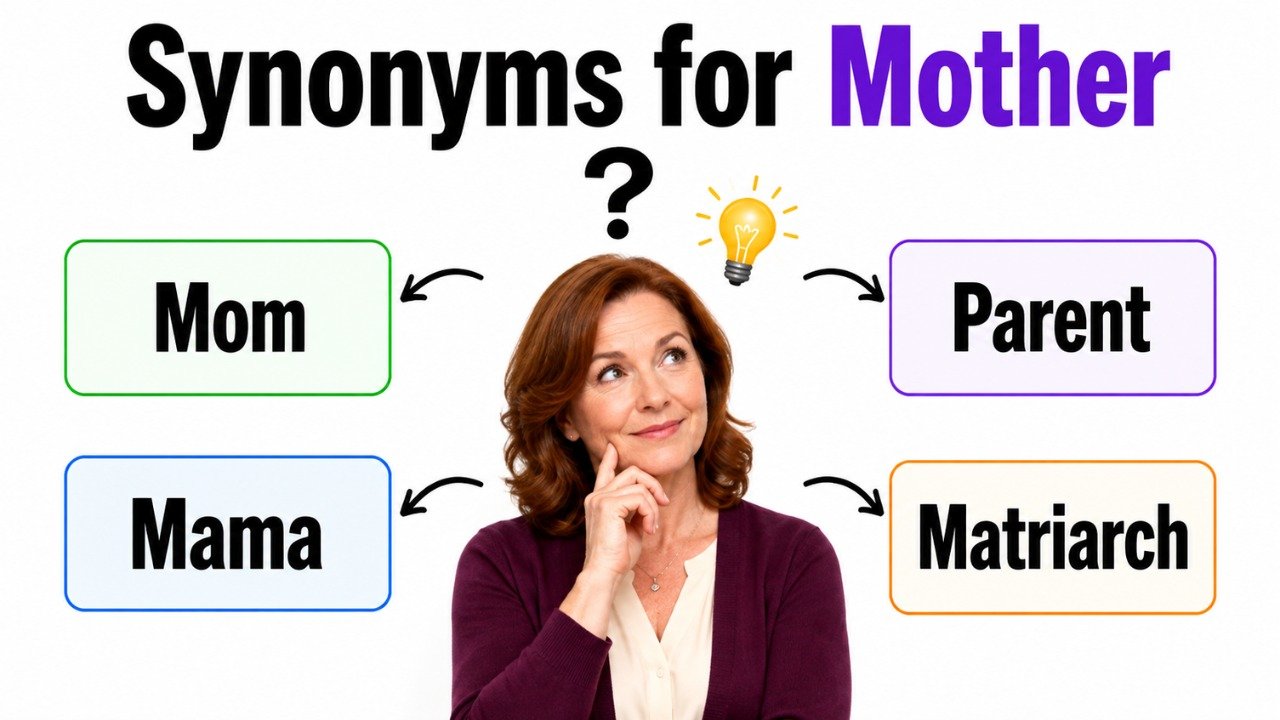
Quick Answer: The best synonyms for mother include mom, mum, mama, mommy, parent, female parent, maternal parent, caregiver, mother figure, and matriarch. Use mother or female parent in formal writing, mom or mama in warm and casual speech, and maternal parent when biological or family roles need precise wording. Caregiver is best when care matters more than biological relationship, while matriarch describes a respected woman who leads a family.
Pronunciation and Word Details
Word: Mother.
Pronunciation: /ˈmʌðər/
Part of Speech: Noun and verb.
Meaning: As a noun, mother means a female parent or a woman who raises and cares for a child. As a verb, it means to care for, protect, or treat someone in a motherly way.
US Pronunciation:
UK Pronunciation:
What Does “Mother” Mean?
Mother most commonly means a female parent or a woman who has a maternal role in someone’s life. It is primarily a noun, although it can also function as a verb.
A mother may be connected to a child through birth, biology, adoption, marriage, guardianship, or long term caregiving. The exact meaning depends on the family and sentence context.
Biological Meaning: A mother may be the person who gave birth to a child or contributed genetic material.
Example: Her biological mother provided important family health information.
Parenting Meaning: A mother may be the woman who raises, protects, teaches, and supports a child.
Example: His adoptive mother encouraged him throughout his education.
Social Meaning: Mother can describe a woman who performs a caring and guiding role without being a legal or biological parent.
Example: The teacher became a mother figure to many students.
Title Meaning: Mother can be used as a form of address or as a family title.
Example: I asked Mother whether she needed any help.
Figurative Meaning: The word can describe the source, origin, or creator of something.
Example: Necessity is often described as the mother of invention.
Verb Meaning: To mother someone means to care for, protect, or watch over that person closely.
Example: She tended to mother every new member of the team.
When mother is used as a name or direct title, it is usually capitalized. When it is used as a general family relationship, it normally begins with a lowercase letter.
Title Use: Mother will arrive this evening.
General Use: My mother will arrive this evening.
Meaning, Tone, and Context of “Mother”
Mother is a neutral and widely understood word, but it often carries warm, emotional, respectful, or affectionate associations. Its tone changes according to the relationship and situation.
Formal Tone: Mother is appropriate in essays, reports, legal descriptions, biographies, family records, and professional communication.
Affectionate Tone: In personal writing, the word can communicate love, gratitude, comfort, and emotional closeness.
Neutral Tone: It can simply identify a family relationship without expressing emotion.
Conversational Tone: Mom, mum, mama, and mommy are often preferred in casual family conversations.
Respectful Tone: Mother may sound more respectful or traditional than mom.
Emotional Context: The word commonly appears in messages about family bonds, childhood, care, sacrifice, guidance, grief, and appreciation.
Legal Context: More specific terms such as legal mother, adoptive mother, birth mother, or custodial mother may be necessary when legal relationships matter.
Medical Context: Biological mother, birth mother, or genetic mother may be used when discussing pregnancy, genetics, or family health history.
Academic Context: Mother may appear in discussions of family structures, parenthood, child development, history, culture, and literature.
Figurative Context: It can describe an origin, source, homeland, creator, or foundational influence.
Animal Context: Mother is understandable for animals, but dam is a more specific term for the female parent of certain animals.
Writers should select a synonym carefully because terms such as birth mother, adoptive mother, foster mother, and stepmother describe different relationships. They should not be treated as interchangeable.
When and How to Use “Mother”
For a Female Parent
Explanation: Use mother as a general and respectful word for a female parent.
Example: Her mother taught her how to prepare the family recipe.
For Everyday Family Conversation
Explanation: Mom, mum, mama, ma, and mommy often sound warmer and more natural in casual speech.
Example: I called my mom after work.
For Formal Writing
Explanation: Mother, female parent, and maternal parent are suitable in formal descriptions, reports, and academic discussions.
Example: A parent or guardian must sign the form for the child.
For a Biological Relationship
Explanation: Use biological mother or genetic mother when the biological connection is relevant.
Example: The doctor asked about the medical history of his biological mother.
For the Person Who Gave Birth
Explanation: Birth mother is useful when discussing adoption, birth records, or the circumstances of a child’s birth.
Example: She later contacted her birth mother to learn more about her early history.
For Adoption
Explanation: Adoptive mother describes a woman who becomes a child’s legal parent through adoption.
Example: His adoptive mother supported his interest in music.
For Temporary Care
Explanation: Foster mother describes a woman who cares for a child through a foster care arrangement.
Example: The child formed a trusting relationship with his foster mother.
For a Blended Family
Explanation: Stepmother describes the wife of a person’s parent when she is not the person’s biological or adoptive mother.
Example: Her stepmother attended every school event.
For a Caregiving Role
Explanation: Use caregiver, guardian, mother figure, or maternal figure when care and guidance matter more than biology.
Example: Her aunt became her primary caregiver and mother figure.
For Family Leadership
Explanation: Use matriarch or materfamilias for a respected woman who leads or strongly influences a family.
Example: The family matriarch organized the annual gathering.
For an Origin or Source
Explanation: Mother can be used figuratively for something that creates, begins, or inspires another thing.
Example: The region is considered the birthplace and mother of several artistic traditions.
For Animals
Explanation: Mother is suitable in general language, while dam is used more precisely in animal breeding and records.
Example: The young horse remained close to its dam.
As a Verb
Explanation: Use mother as a verb when someone provides protective, nurturing, or sometimes excessive care.
Example: She mothered the injured bird until it recovered.
Best Synonyms for Mother
Mom
Synonym: Mom is a warm and common informal word for mother.
Example: My mom helped me prepare for the interview.
Mum
Synonym: Mum is a familiar and affectionate word for mother, especially in British usage.
Example: Her mum packed lunch for the trip.
Mama
Synonym: Mama is an affectionate and emotionally warm word for mother.
Example: The child ran to his mama for comfort.
Mommy
Synonym: Mommy is a loving term for mother commonly used by young children.
Example: The little girl asked her mommy to read a story.
Parent
Synonym: Parent is a neutral term for a mother or father.
Example: Each parent received a copy of the school schedule.
Female Parent
Synonym: Female parent is a formal and descriptive term for a mother.
Example: The form requested information about the child’s female parent.
Maternal Parent
Synonym: Maternal parent identifies the parent connected with the mother’s side or maternal role.
Example: The record included details about the maternal parent.
Caregiver
Synonym: Caregiver means a person who regularly provides care, protection, and support.
Example: Her grandmother became her main caregiver.
Mother Figure
Synonym: Mother figure means a woman who provides maternal care or guidance without necessarily being a parent.
Example: The coach became a trusted mother figure to the younger athletes.
Matriarch
Synonym: Matriarch means a respected or powerful woman who leads a family or social group.
Example: The family matriarch preserved stories from several generations.
50 Synonyms for Mother With Short Meanings
- Mom: A common and affectionate informal word for mother.
- Mum: A familiar word for mother used especially in British English.
- Mama: A warm and affectionate name for a mother.
- Mommy: A loving term often used by young children.
- Mummy: An affectionate term for mother in British English.
- Mamma: A traditional spelling of an affectionate name for mother.
- Ma: A short and informal term for mother.
- Momma: An affectionate variation of mama or mom.
- Parent: A mother or father who raises or cares for a child.
- Female Parent: A formal description of a mother.
- Maternal Parent: A parent identified with the maternal role or side of a family.
- Birth Mother: The woman who gave birth to a child.
- Biological Mother: A mother biologically related to a child.
- Genetic Mother: A woman who contributed genetic material to a child.
- Adoptive Mother: A woman who becomes a legal parent through adoption.
- Foster Mother: A woman who cares for a child through a foster arrangement.
- Stepmother: The wife of a person’s parent who is not that person’s biological mother.
- Surrogate Mother: A woman who carries a pregnancy for another person or family.
- Intended Mother: A woman who plans to become a parent through a surrogacy arrangement.
- Legal Mother: A woman legally recognized as a child’s mother.
- Custodial Mother: A mother who has primary or significant legal custody of a child.
- Primary Caregiver: The person who provides most of a child’s daily care.
- Guardian: A person legally or practically responsible for a child’s care.
- Caregiver: Someone who regularly provides care and support.
- Caretaker: A person responsible for another person’s practical needs and safety.
- Maternal Figure: A woman who offers care and guidance associated with motherhood.
- Mother Figure: A woman who acts in a caring maternal role.
- Matriarch: A leading and respected woman within a family.
- Family Matriarch: The senior woman who guides or influences a family.
- Materfamilias: A formal word for the female head of a family.
- Nurturer: A person who encourages growth, safety, and development.
- Protector: Someone who keeps another person safe from harm.
- Provider: A person who supplies necessary care, resources, or support.
- Guide: Someone who offers direction and advice.
- Mentor: A trusted person who teaches and supports another person.
- Ancestress: A female ancestor from an earlier generation.
- Foremother: A female ancestor or influential woman from the past.
- Progenitor: A parent, ancestor, or person from whom others descend.
- Founding Mother: A woman who helps establish a family, movement, institution, or tradition.
- Originator: A person who begins or creates something.
- Founder: A person who establishes an organization, tradition, or system.
- Creator: A person or force that brings something into existence.
- Source: The place, person, or cause from which something begins.
- Origin: The beginning or starting point of something.
- Root: The basic source or foundation of something.
- Wellspring: A rich and continuing source of ideas, strength, or activity.
- Cradle: A place where an important activity, culture, or movement began.
- Birthplace: The place where a person, idea, or tradition began.
- Motherland: A person’s native or ancestral country.
- Dam: The female parent of certain animals.
Read Also:
Synonyms for Lessons

Synonyms for Mother by Context
When Mother Means an Affectionate Family Name
Mom, mum, mama, mommy, mummy, ma, mamma, and momma are affectionate alternatives.
Example With Mother: I asked my mother for advice.
Example With Mom: I asked my mom for advice.
Example With Mama: I asked Mama for advice.
Mom is widely used in American English. Mum is common in British English. Mama and ma may sound especially warm, regional, traditional, or personal.
When Mother Means a Parent
Parent, female parent, and maternal parent work when the family role matters more than emotional tone.
Example With Mother: The mother signed the permission form.
Example With Parent: The parent signed the permission form.
Example With Female Parent: Information about the female parent was included in the record.
Parent is inclusive and neutral. Female parent is more formal and descriptive, but it may sound clinical in personal writing.
When Mother Means the Person Who Gave Birth
Birth mother is the clearest alternative when the act of giving birth is the important detail.
Example With Mother: She hoped to learn more about her mother.
Example With Birth Mother: She hoped to learn more about her birth mother.
Birth mother is often used in adoption related contexts. It should be used respectfully and only when the distinction is relevant.
When Mother Means a Biological Relation
Biological mother and genetic mother emphasize biological or genetic connection.
Example With Mother: His mother had the same eye color.
Example With Biological Mother: His biological mother had the same eye color.
Example With Genetic Mother: The report included information about his genetic mother.
Biological mother is more common in general writing. Genetic mother is more precise when genetic contribution is the specific focus.
When Mother Means an Adoptive Parent
Adoptive mother identifies a woman who became a child’s legal parent through adoption.
Example With Mother: His mother adopted him as an infant.
Example With Adoptive Mother: His adoptive mother encouraged him to explore his family history.
In many everyday situations, mother is enough. Adoptive should be added only when the information is relevant.
When Mother Means a Temporary Caregiver
Foster mother describes a woman caring for a child through a formal foster arrangement.
Example With Mother: The child lived with a caring mother during that period.
Example With Foster Mother: The child lived with a caring foster mother during that period.
Foster mother does not automatically mean adoptive mother or permanent legal parent.
When Mother Means a Parent Through Marriage
Stepmother describes a woman married to a person’s parent.
Example With Mother: She developed a close bond with her mother.
Example With Stepmother: She developed a close bond with her stepmother.
A stepmother may have a strong parenting role, but the word describes a specific family relationship.
When Mother Means a Caring Adult
Caregiver, guardian, mother figure, maternal figure, nurturer, and protector focus on care rather than biology.
Example With Mother: Her aunt was like a mother to her.
Example With Mother Figure: Her aunt became an important mother figure in her life.
Example With Caregiver: Her aunt served as her primary caregiver.
Mother figure is emotional and relational. Caregiver is practical and neutral. Guardian may describe legal responsibility.
When Mother Means a Family Leader
Matriarch, family matriarch, and materfamilias refer to a leading woman in a family.
Example With Mother: The mother held the extended family together.
Example With Matriarch: The matriarch held the extended family together.
Matriarch emphasizes authority, seniority, influence, or respect rather than simply parenthood.
When Mother Means a Female Ancestor
Ancestress, foremother, and progenitor are useful in historical or family lineage contexts.
Example With Mother: The tradition was passed down by the mothers of earlier generations.
Example With Foremothers: The tradition was passed down by their foremothers.
Foremother often carries a respectful historical tone. Ancestress specifically means a female ancestor.
When Mother Means a Founder or Creator
Founding mother, originator, founder, creator, and progenitor can describe a woman who begins something important.
Example With Mother: She was considered the mother of the educational movement.
Example With Founding Mother: She was considered a founding mother of the educational movement.
Example With Originator: She was the originator of the teaching method.
Founding mother recognizes a woman’s foundational role. Originator focuses on the creation of an idea or practice.
When Mother Means a Source or Beginning
Source, origin, root, wellspring, cradle, and birthplace are figurative alternatives.
Example With Mother: The city was known as the mother of the artistic style.
Example With Birthplace: The city was known as the birthplace of the artistic style.
Example With Cradle: The region became the cradle of the new movement.
Use birthplace or cradle for a place where something began. Use source or root for an underlying cause or foundation.
When Mother Refers to a Native Country
Motherland, mother country, homeland, and native land may express connection to a country of birth or ancestry.
Example With Mother: She remained deeply connected to her mother country.
Example With Motherland: She remained deeply connected to her motherland.
Motherland often carries emotional or patriotic meaning. Homeland is usually more neutral.
When Mother Refers to an Animal
Dam is a precise alternative for the female parent of certain animals.
Example With Mother: The foal followed its mother across the field.
Example With Dam: The foal followed its dam across the field.
Dam is common in breeding, farming, and animal records. Mother sounds more natural in general storytelling.
Another Word for Mother
Mom is the best everyday replacement for mother in warm and informal communication. However, the strongest alternative depends on the relationship and context.
Use parent for neutral language, caregiver when care is the main focus, and matriarch when describing family leadership.
Original: My mother called me this morning.
Better Option: My mom called me this morning.
Original: The mother must complete the registration form.
Better Option: The parent must complete the registration form.
Original: Her grandmother acted as her mother for many years.
Better Option: Her grandmother was her primary caregiver and mother figure for many years.
Original: The mother of the family preserved every important tradition.
Better Option: The family matriarch preserved every important tradition.
When Not to Use “Mother”
Mother is clear in many situations, but it can sound vague, inaccurate, overly formal, or emotionally unsuitable when a more specific word is needed.
When the Exact Parental Role Matters
Use a precise term when adoption, fostering, birth, genetics, or guardianship is relevant.
Weak: She met her mother after searching for her adoption records.
Better: She met her birth mother after searching for her adoption records.
The original sentence may confuse readers about which mother is being discussed.
When Gender Neutral Language Is Better
Use parent when the person’s gender is unknown, irrelevant, or intentionally unstated.
Weak: Every mother or father must attend the meeting.
Better: Every parent must attend the meeting.
When Care Does Not Equal Parenthood
Do not automatically call every caregiver a mother.
Weak: The nurse became the child’s mother during the hospital stay.
Better: The nurse became a trusted caregiver during the hospital stay.
Mother figure may work when a lasting emotional relationship exists, but it should not be assumed.
When the Tone Is Too Formal
Mother can sound formal in relaxed conversation.
Weak: I am going shopping with my mother this afternoon.
Better: I am going shopping with my mom this afternoon.
The original is grammatically correct, but mom may sound more natural in casual speech.
When an Informal Term Is Unsuitable
Mommy or mama may sound too personal in formal documents.
Weak: The student’s mommy must sign the official form.
Better: The student’s parent or guardian must sign the official form.
When Matriarch Is More Accurate
Mother does not necessarily communicate leadership or seniority.
Weak: She was the mother who guided the entire extended family.
Better: She was the matriarch who guided the entire extended family.
When Discussing an Animal Formally
Dam may be more precise in animal records.
Weak: The horse’s mother had a strong racing history.
Better: The horse’s dam had a strong racing history.
When the Figurative Meaning Is Unclear
Use source, origin, founder, or birthplace when mother creates ambiguity.
Weak: The town was the mother of the movement.
Better: The town was the birthplace of the movement.
When Repetition Weakens the Sentence
Repeated use of mother can make a paragraph sound awkward.
Weak: The mother spoke to the other mother about the mother’s concerns.
Better: The parent spoke to the other caregiver about her concerns.
Words Commonly Confused With Mother
Mother vs Mom: Mother is neutral and suitable for formal or general writing. Mom is informal, affectionate, and common in everyday speech.
Mother vs Parent: Mother identifies a maternal or female parent. Parent is gender neutral and can refer to a mother, father, or other legally recognized parent.
Mother vs Caregiver: A mother is a type of family relationship. A caregiver is anyone who regularly provides care, whether or not that person is a parent.
Mother vs Guardian: A mother may be a guardian, but guardian specifically emphasizes legal or practical responsibility for another person.
Mother vs Birth Mother: Mother can refer to any woman recognized in a maternal role. Birth mother specifically means the woman who gave birth to the child.
Mother vs Biological Mother: Biological mother emphasizes biological relationship. Mother may refer to a biological, adoptive, legal, or social parent.
Mother vs Genetic Mother: Genetic mother refers specifically to genetic contribution. It may not always describe the person who carried the pregnancy or raised the child.
Mother vs Adoptive Mother: Mother is the general relationship. Adoptive mother specifies that the legal parent child relationship was formed through adoption.
Mother vs Foster Mother: An adoptive mother is a permanent legal parent. A foster mother provides care through a foster arrangement, which may be temporary.
Mother vs Stepmother: Mother is a general maternal term. Stepmother specifically describes the wife of a person’s parent.
Mother vs Matriarch: A mother is a female parent or maternal caregiver. A matriarch is a powerful, senior, or respected woman who leads a family.
Mother vs Maternal: Mother is a noun or verb. Maternal is an adjective describing something related to a mother or motherhood.
Mother vs Mummy: Mummy can be an affectionate word for mother in British English. In another context, it can also mean a preserved human or animal body.
Mother vs Dam: Mother is the common general term. Dam is a technical term for the female parent of certain animals.
Which Synonym Should You Choose?
Choose mom for warm, natural, and informal conversation in American English.
Choose mum for affectionate everyday speech in British English.
Choose mama when you want an especially loving, traditional, or emotional tone.
Choose mommy or mummy when representing the speech of a young child or a close family relationship.
Choose mother for neutral, respectful, formal, academic, or general writing.
Choose parent when gender is unknown, unimportant, or intentionally inclusive.
Choose female parent when a formal description is required and gender is relevant.
Choose maternal parent when discussing the maternal side of a family or distinguishing parental roles.
Choose birth mother when referring specifically to the woman who gave birth to a child.
Choose biological mother when the biological relationship is important.
Choose genetic mother when genetic contribution is the precise subject.
Choose adoptive mother when the legal parent relationship was created through adoption.
Choose foster mother when describing a foster care relationship.
Choose stepmother when referring to the wife of a person’s parent.
Choose surrogate mother when discussing a woman who carries a pregnancy for another person or family.
Choose intended mother when discussing the person planning to become the mother through a surrogacy arrangement.
Choose caregiver when the focus is daily care rather than family status.
Choose guardian when legal responsibility or protection is the main idea.
Choose mother figure when a woman provides emotional support and maternal guidance without being a parent.
Choose matriarch when describing a senior or influential female family leader.
Choose foremother or ancestress in historical, genealogical, or ancestry related writing.
Choose founding mother when honoring a woman who helped establish a movement, institution, community, or tradition.
Choose originator or creator when mother is used figuratively for the person who began something.
Choose source, origin, or root when discussing the cause or beginning of an idea.
Choose birthplace or cradle when referring to the place where a culture, movement, or tradition began.
Choose motherland or homeland when referring to a native or ancestral country.
Choose dam in technical descriptions of animal parentage.
Real Life Examples of “Mother” in Sentences
Original: My mother taught me how to cook.
Better Option: My mom taught me how to cook.
Original: The mother signed the child’s permission form.
Better Option: The parent signed the child’s permission form.
Original: She contacted her mother through the adoption service.
Better Option: She contacted her birth mother through the adoption service.
Original: His mother joined the family when he was five.
Better Option: His stepmother joined the family when he was five.
Original: Her aunt became like a mother after the family moved.
Better Option: Her aunt became a trusted mother figure after the family moved.
Original: The mother led every important family gathering.
Better Option: The family matriarch led every important gathering.
Original: She was called the mother of the community project.
Better Option: She was recognized as the founding mother of the community project.
Original: The region is considered the mother of the artistic tradition.
Better Option: The region is considered the birthplace of the artistic tradition.
Original: The young horse stayed beside its mother.
Better Option: The young horse stayed beside its dam.
Original: His mother cared for him throughout his recovery.
Better Option: His primary caregiver supported him throughout his recovery.
Synonym Groups and Usage Differences
Informal Family Group
This group includes mom, mum, mama, mommy, mummy, ma, mamma, and momma.
These words communicate affection, familiarity, and closeness. Their naturalness depends on personal preference, age, family tradition, and regional usage.
Example: She called her mum to share the good news.
General Parent Group
This group includes mother, parent, female parent, and maternal parent.
These terms identify a parenting relationship in neutral, formal, or descriptive language.
Example: Each parent received information about the new schedule.
Birth and Biology Group
This group includes birth mother, biological mother, and genetic mother.
These terms describe different aspects of a child’s biological or birth history.
Example: The medical form requested information about the biological mother’s health history.
Legal and Family Structure Group
This group includes adoptive mother, foster mother, stepmother, legal mother, and custodial mother.
These alternatives describe specific legal, caregiving, or family relationships.
Example: His adoptive mother supported his search for information about his early childhood.
Pregnancy and Surrogacy Group
This group includes surrogate mother and intended mother.
These terms appear in discussions of pregnancy arrangements and planned parenthood roles.
Example: The intended mother attended the medical appointment with the surrogate mother.
Caregiving Group
This group includes caregiver, primary caregiver, caretaker, guardian, mother figure, maternal figure, nurturer, protector, and provider.
These alternatives emphasize care, safety, guidance, and emotional support.
Example: Her older sister became her primary caregiver.
Family Leadership Group
This group includes matriarch, family matriarch, and materfamilias.
These terms describe a woman with significant authority, influence, or seniority in a family.
Example: The matriarch encouraged younger family members to preserve their traditions.
Ancestry Group
This group includes ancestress, foremother, and progenitor.
These words refer to women from whom later generations descend or draw influence.
Example: The family honored the foremothers who established the original settlement.
Founding and Creation Group
This group includes founding mother, originator, founder, creator, and progenitor.
These terms describe someone who begins, establishes, or develops something.
Example: She became known as the founding mother of the educational program.
Origin and Source Group
This group includes source, origin, root, wellspring, cradle, and birthplace.
These figurative alternatives describe where an idea, movement, culture, or activity began.
Example: The valley became the cradle of a distinctive artistic tradition.
Homeland Group
This group includes motherland, mother country, homeland, and native land.
These expressions refer to a person’s country of birth, ancestry, or emotional belonging.
Example: He remained connected to his homeland through language and family traditions.
Animal Parent Group
Dam is the main technical alternative for the female parent of certain animals.
Example: The calf remained close to its dam.
Antonyms of Mother
Mother has no single exact antonym because it describes a family relationship, caregiving role, or figurative source. Its contextual opposites and counterparts depend on the intended meaning.
Father: The male parent counterpart to a mother.
Child: A person viewed in relation to a parent.
Son: A male child in relation to a parent.
Daughter: A female child in relation to a parent.
Offspring: A child or young animal produced by a parent.
Descendant: A person related to an ancestor through later generations.
Dependent: A person who relies on a parent, guardian, or provider.
Care Recipient: A person who receives support from a caregiver.
Ward: A person placed under the legal protection of a guardian.
Nonparent: A person who does not hold a parental role.
Neglector: A person who fails to provide necessary care, in contrast with a nurturer.
Abandoner: A person who leaves someone without expected care or support.
Follower: A person who receives direction rather than providing it as a guide.
Learner: A person who receives knowledge from a mentor or teacher.
Creation: Something produced by a creator.
Result: An outcome produced by a source or cause.
Effect: Something created by an earlier cause.
Destination: The ending point, in contrast with an origin.
Branch: Something that grows from a root or source.
Colony: A later settlement connected with a mother country.
Comparison: Mother vs Related Words
Mother vs Mom
Mother is neutral and works in both formal and informal writing. Mom is more affectionate and conversational.
Example With Mother: Her mother attended the ceremony.
Example With Mom: Her mom attended the ceremony.
Mother vs Parent
Mother identifies a specific maternal role. Parent is broader and gender neutral.
Example With Mother: His mother helped him complete the application.
Example With Parent: A parent helped him complete the application.
Mother vs Caregiver
Mother describes a family or maternal relationship. Caregiver describes the act and responsibility of providing care.
Example With Mother: His mother prepared his meals and helped with schoolwork.
Example With Caregiver: His caregiver prepared his meals and helped with schoolwork.
Mother vs Birth Mother
Mother may describe the woman who raises or is legally recognized as a parent. Birth mother specifically means the woman who gave birth.
Example With Mother: Her mother raised her in a supportive home.
Example With Birth Mother: She later learned more about her birth mother.
Mother vs Biological Mother
Mother can describe biological, adoptive, legal, or emotional parenthood. Biological mother emphasizes biological relationship.
Example With Mother: His mother encouraged his interest in science.
Example With Biological Mother: His biological mother shared important family health information.
Mother vs Adoptive Mother
Mother is the general relationship term. Adoptive mother adds information about how the legal relationship was formed.
Example With Mother: His mother read to him every evening.
Example With Adoptive Mother: His adoptive mother preserved documents about his early history.
Mother vs Foster Mother
A mother may be a permanent legal parent. A foster mother cares for a child through a foster arrangement.
Example With Mother: Her mother made long term educational decisions for her.
Example With Foster Mother: Her foster mother supported her during a temporary placement.
Mother vs Stepmother
Mother is a general maternal term. Stepmother identifies the wife of a person’s parent.
Example With Mother: Her mother helped organize the celebration.
Example With Stepmother: Her stepmother helped organize the celebration.
Mother vs Matriarch
Mother focuses on parenthood or maternal care. Matriarch emphasizes leadership, authority, influence, or seniority.
Example With Mother: The mother cared for her children.
Example With Matriarch: The matriarch guided several generations of the family.
Mother vs Mother Figure
Mother usually describes an actual parental relationship. Mother figure describes a woman who offers maternal care or guidance.
Example With Mother: His mother supported him throughout childhood.
Example With Mother Figure: His teacher became a mother figure during a difficult period.
Mother vs Maternal
Mother is usually a noun. Maternal is an adjective.
Example With Mother: The mother held the baby.
Example With Maternal: The baby received maternal care.
Mother vs Dam
Mother is the everyday word for a female parent. Dam is a technical term used for the female parent of certain animals.
Example With Mother: The puppy stayed close to its mother.
Example With Dam: The breeder recorded information about the puppy’s dam.
Common Phrases and Expressions With Mother
Mother Figure: A woman who provides maternal care, support, or guidance.
Example: Her grandmother became an important mother figure in her life.
Mother Tongue: The first language a person learns or the language connected with early family life.
Example: He speaks his mother tongue at home.
Mother Country: A person’s native country or a country connected with another territory.
Example: She maintained strong cultural ties with her mother country.
Mother Nature: A personification of nature as a powerful creative and controlling force.
Example: The changing weather reminded everyone of the power of Mother Nature.
Mother Earth: A traditional expression presenting the earth as a nurturing source of life.
Example: The poem describes Mother Earth as a generous provider.
Mother Hen: A person who is highly protective and caring toward others.
Example: She acts like a mother hen whenever the younger students travel.
Expectant Mother: A woman who is pregnant and preparing for the birth of a child.
Example: The class provided useful information for each expectant mother.
Working Mother: A mother who combines paid work with parenting responsibilities.
Example: The flexible schedule supported every working mother on the team.
Single Mother: A mother raising a child without a parenting partner in the household.
Example: The program offered practical support to each single mother.
First Time Mother: A woman experiencing motherhood for the first time.
Example: The guide answered common questions from a first time mother.
Common Mistakes to Avoid
Capitalizing Mother Incorrectly
Capitalize Mother when it replaces a person’s name or is used as a direct title. Use lowercase when it follows a possessive word or functions as a general noun.
Incorrect: I asked my Mother for advice.
Correct: I asked my mother for advice.
Correct: I asked Mother for advice.
Treating Every Synonym as Interchangeable
Mom, parent, caregiver, birth mother, and matriarch have different meanings.
Incorrect: The legal form must be signed by the child’s matriarch.
Correct: The legal form must be signed by the child’s parent or guardian.
Confusing Mother With Maternal
Mother is usually a noun, while maternal is an adjective.
Incorrect: She provided mother support.
Correct: She provided maternal support.
Using Parent When Maternal Identity Matters
Parent is useful and inclusive, but it may remove necessary detail.
Weak: The patient reported a condition affecting her parent.
Better: The patient reported a condition affecting her biological mother.
Assuming a Mother Is Always Biological
A mother may be biological, adoptive, legal, social, or connected through long term caregiving.
Weak: Only a biological parent can be called a mother.
Better: Mother can describe several forms of legal, emotional, and family parenthood.
Using Birth Mother and Adoptive Mother Carelessly
These terms describe different relationships and should be used only when the distinction is relevant.
Incorrect: His birth mother adopted him when he was a baby.
Correct: His adoptive mother adopted him when he was a baby.
Confusing Foster Mother With Adoptive Mother
Foster care and adoption are not the same relationship.
Incorrect: His foster mother became his permanent legal parent as soon as the placement began.
Correct: His foster mother cared for him during the foster placement.
Using Matriarch for Every Mother
A matriarch is usually a leading or senior woman within a family.
Weak: Every woman with a child is a matriarch.
Better: The eldest woman became the family matriarch because of her leadership and influence.
Using Mommy in Formal Writing
Mommy is affectionate but usually too informal for reports, forms, and academic writing.
Weak: The child’s mommy completed the legal document.
Better: The child’s mother or guardian completed the legal document.
Using Dam for People
Dam is used for animals, not as a respectful synonym for a human mother.
Incorrect: The student attended the event with his dam.
Correct: The student attended the event with his mother.
Repeating Mother Too Often
Use clear alternatives when several maternal roles appear in one paragraph.
Repetitive: The mother asked the other mother whether the mother could attend.
Improved: The parent asked the other caregiver whether she could attend.
Using Figurative Mother Without Context
The figurative meaning may confuse readers unless the relationship is clear.
Vague: She was the mother of the idea.
Clear: She was the originator of the idea and developed its first practical form.
Conclusion
The best synonyms for mother depend on relationship, tone, and context. Use mom, mum, or mama for affectionate speech, parent for neutral language, and birth mother, biological mother, or adoptive mother when precision matters. Caregiver and mother figure emphasize care, while matriarch highlights family leadership. In figurative writing, founder, source, cradle, and birthplace can replace mother when describing an origin. Choosing the correct term makes family, formal, historical, and emotional writing clearer and more respectful.
FAQs About Synonyms for Mother
What Is the Best Synonym for Mother?
Mom is the most natural informal synonym. Parent is best for neutral language, while female parent is suitable for more formal descriptions.
What Is a Loving Word for Mother?
Mama, mommy, mummy, momma, and ma are loving alternatives. The most natural choice depends on family preference and regional usage.
What Is a Formal Synonym for Mother?
Formal alternatives include female parent, maternal parent, biological mother, legal mother, and primary caregiver.
Can Parent Replace Mother?
Yes, when gender is unimportant or neutral language is preferred. Parent is broader because it can refer to any person holding a parental role.
What Is Another Word for a Mother Figure?
Useful alternatives include maternal figure, caregiver, nurturer, guardian, mentor, protector, and primary caregiver.
What Is the Difference Between a Mother and a Matriarch?
A mother is a female parent or maternal caregiver. A matriarch is a senior, respected, or influential woman who leads a family.
What Is a Synonym for Mother in a Figurative Sense?
Source, origin, creator, founder, root, wellspring, cradle, and birthplace can replace mother when referring to the beginning of an idea, tradition, or movement.
