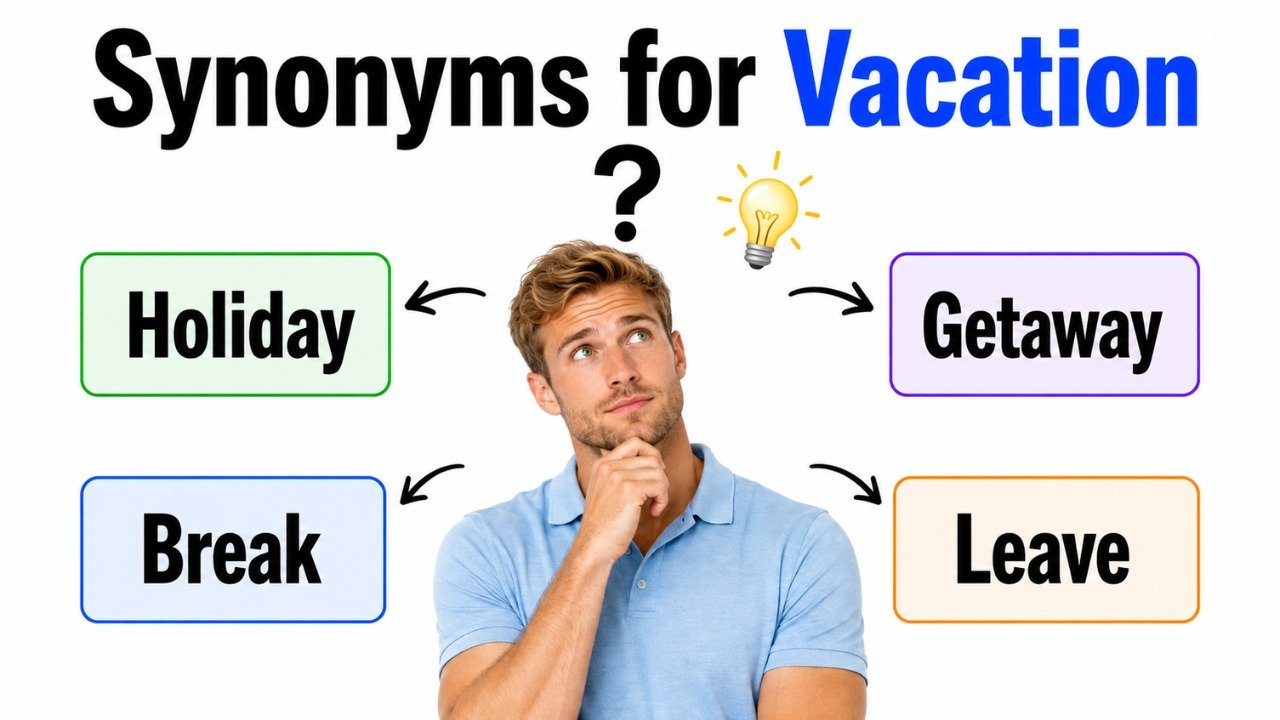
Quick Answer: The best synonyms for vacation include holiday, break, leave, getaway, trip, retreat, respite, time off, recess, and escape. Use holiday for a general period of travel or rest, break for a short pause from work or study, and leave for officially approved time away from employment. Getaway suits a brief enjoyable trip, while retreat suggests a quiet place for rest or reflection. Among synonyms for vacation, the most accurate choice depends on the length, purpose, setting, and level of formality.
Pronunciation and Word Details
Word: Vacation.
Pronunciation: /veɪˈkeɪʃən/
Part of Speech: Noun and verb.
Meaning: A period of time spent away from work, school, or regular duties for rest, travel, or enjoyment.
US Pronunciation:
UK Pronunciation:
What Does “Vacation” Mean?
Vacation means a period of time when someone is away from work, school, or normal responsibilities. It is most commonly used as a noun, but it can also function as a verb meaning to spend time on vacation.
As a noun, vacation may describe a planned trip, a school break, approved time away from work, or a period devoted to rest. A vacation can last a weekend, several days, or several weeks.
Travel Context: A vacation may involve visiting another city, region, or country.
Example: They planned a vacation near the coast.
Work Context: Vacation can mean approved time away from a job.
Example: She is taking a week of vacation in September.
School Context: Vacation may describe a period when classes are not held.
Example: The children returned to school after their summer vacation.
Rest Context: A vacation can be spent at home without travel.
Example: He used his vacation to rest and complete a few personal projects.
As a verb, vacation means to spend a vacation somewhere.
Example: The family vacationed in the mountains.
The word is especially common in American English. In many British English contexts, holiday is the more natural word for time spent away from work or school.
Meaning, Tone, and Context of “Vacation”
Vacation usually has a positive, neutral, and conversational tone. It often creates associations with rest, freedom, travel, enjoyment, and relief from ordinary responsibilities.
In casual conversation, vacation is a natural word for personal travel or time away from work.
Example: We are going on vacation next month.
In workplace communication, vacation can sound neutral and professional when referring to approved leave.
Example: I will be on vacation from Monday through Thursday.
In school settings, vacation can refer to a longer break between terms or semesters.
Example: Students received reading assignments for the winter vacation.
In travel writing, vacation often suggests an enjoyable journey, destination, or leisure experience.
Example: The island is a peaceful vacation destination.
The word can also carry an emotional sense of escape or renewal. Someone may describe a quiet weekend as a vacation from stress, even when no formal trip is involved.
Vacation is not usually academic or technical, although it may appear in formal documents about employment policies, school calendars, or tourism. In highly formal workplace writing, annual leave, paid leave, or approved leave may be more precise.
Casual Tone: Vacation is common in everyday speech about travel and rest.
Professional Tone: It is suitable for routine workplace messages, especially when dates are clear.
Positive Tone: It often suggests relaxation, pleasure, and personal freedom.
Neutral Tone: It can simply describe scheduled time away without expressing emotion.
Formal Tone: Leave or annual leave may be better in policies, contracts, and official notices.
When and How to Use “Vacation”
For Time Away From Work
Use vacation when discussing planned time away from a job for rest, travel, or personal activities.
Example: I have requested vacation for the first week of July.
For Leisure Travel
Use vacation when the main purpose of a trip is enjoyment rather than business, study, or medical care.
Example: They took a vacation to explore several coastal towns.
For School Breaks
Use vacation when describing an extended period during which a school or educational institution is closed.
Example: The students visited their grandparents during the summer vacation.
For Rest at Home
A vacation does not always require travel. Use it for time spent resting at home or enjoying local activities.
Example: We are staying home for our vacation this year.
For a Temporary Escape
Vacation can be used figuratively for a welcome break from pressure, routine, or responsibility.
Example: Reading felt like a short vacation from her worries.
For Workplace Emails
Use vacation when the message is clear and conversational. Include dates when informing coworkers or clients.
Example: I will be on vacation from August 10 through August 14.
As a Verb
Use vacation as a verb when describing where someone spent a period of leisure.
Example: They vacationed beside the lake last summer.
For Longer Periods of Rest
Vacation usually suggests more than a very brief pause. For a few minutes or hours, break or rest is often more accurate.
Example: After a demanding year, she needed a proper vacation.
Best Synonyms for Vacation
Holiday: A period spent away from work or school for rest, celebration, or travel.
Example: They booked a seaside holiday for early June.
Break: A pause from regular work, study, or responsibility.
Example: Everyone needed a break after the busy season.
Leave: Officially approved time away from employment or duty.
Example: He applied for leave to attend a family event.
Getaway: A short enjoyable trip taken for relaxation.
Example: The couple planned a weekend getaway in the countryside.
Trip: A journey taken for leisure, work, or another purpose.
Example: Our summer trip included several historic towns.
Retreat: A quiet place or period used for rest, reflection, or renewal.
Example: She spent three days at a peaceful writing retreat.
Respite: A temporary period of relief from difficulty, work, or stress.
Example: The short visit provided a welcome respite from daily pressure.
Time Off: A period when someone is not required to work or study.
Example: I am taking some time off at the end of the month.
Recess: A scheduled break in school, government, or formal activity.
Example: The students returned after the winter recess.
Escape: A temporary departure from routine, stress, or an unpleasant situation.
Example: The cabin offered a quiet escape from city life.
50 Synonyms for Vacation with Short Meanings
- Holiday: Time away from work or school for rest or travel.
- Break: A pause from regular duties or activity.
- Leave: Official permission to be absent from work or duty.
- Getaway: A short trip taken for pleasure and relaxation.
- Trip: A journey to another place for a particular purpose.
- Retreat: A quiet period or place for rest and reflection.
- Respite: Temporary relief from stress, work, or difficulty.
- Time Off: Time when a person is not working or studying.
- Recess: A scheduled pause in school or formal activity.
- Escape: A temporary departure from routine or pressure.
- Rest: A period of relaxation after effort or activity.
- Pause: A temporary stop in work or another activity.
- Breather: A short informal period of rest.
- Intermission: A break between parts of an event or activity.
- Interval: A period separating two activities or events.
- Hiatus: A pause in a regular activity or process.
- Furlough: An authorized period away from work or service.
- Sabbatical: An extended period away from regular professional duties.
- Annual Leave: Approved yearly time away from employment.
- Paid Leave: Authorized time away while continuing to receive pay.
- Personal Leave: Approved absence for private or family reasons.
- Leave of Absence: A formally approved extended period away from work or study.
- Downtime: Time when work or normal activity stops.
- Rest Period: A set amount of time used for recovery.
- Relaxation Period: Time specifically devoted to becoming calm and rested.
- School Break: A period when classes are not held.
- Summer Break: The long school holiday during summer.
- Winter Break: A school or work break during winter.
- Spring Break: A scheduled school holiday during spring.
- Term Break: A pause between periods of academic study.
- Weekend Away: A short leisure trip lasting a weekend.
- City Break: A brief vacation spent visiting a city.
- Beach Break: A short vacation near the sea.
- Country Escape: A relaxing trip away from an urban area.
- Road Trip: A journey made mainly by road for enjoyment.
- Leisure Trip: Travel undertaken mainly for pleasure.
- Pleasure Trip: A journey made for enjoyment rather than business.
- Sightseeing Trip: Travel focused on visiting interesting places.
- Tour: A journey that includes visits to several places.
- Excursion: A short organized journey for pleasure or education.
- Outing: A brief trip taken for enjoyment.
- Sojourn: A temporary stay in another place.
- Stay: A period spent temporarily at a destination.
- Staycation: A vacation spent at home or close to home.
- Voyage: A long journey, especially by sea.
- Adventure: An exciting or unusual travel experience.
- Expedition: An organized journey with a particular purpose.
- Holiday Trip: Travel taken during a period away from work or school.
- Restful Stay: A temporary visit focused on relaxation.
- Leisure Break: A pause from normal duties used for enjoyment.
Read Also:
Synonyms for Sarcasm
Synonyms for Vacation by Context
When Vacation Means Time Away From Work
The strongest alternatives include leave, annual leave, paid leave, personal leave, leave of absence, time off, and furlough.
Example: She requested a vacation for the final week of May.
Alternative: She requested annual leave for the final week of May.
Leave is the most flexible formal alternative. Annual leave is more specific when the time is part of an employee’s yearly allowance. Paid leave makes it clear that the employee will continue receiving pay.
When Vacation Means a Leisure Trip
Useful alternatives include holiday, trip, getaway, leisure trip, pleasure trip, tour, excursion, and road trip.
Example: We are planning a vacation through the northern valleys.
Alternative: We are planning a road trip through the northern valleys.
Trip is broad and neutral. Getaway suggests a short relaxing journey. Tour implies visiting several places, while road trip focuses on travel by car or another road vehicle.
When Vacation Means a Short Rest
Choose break, breather, pause, respite, interval, rest, or downtime.
Example: I need a vacation from these constant meetings.
Alternative: I need a break from these constant meetings.
Break is the most natural choice for a short pause. Respite sounds more formal and emphasizes relief from something difficult or tiring.
When Vacation Means a School Holiday
The best options include school break, summer break, winter break, spring break, term break, and recess.
Example: The family traveled during the school vacation.
Alternative: The family traveled during the school break.
School break is clear and widely understood. Recess can refer to a short pause during a school day or a longer formal break, depending on context.
When Vacation Means a Quiet Escape
Suitable synonyms include retreat, escape, country escape, restful stay, getaway, and respite.
Example: The cottage was the perfect place for a peaceful vacation.
Alternative: The cottage was the perfect place for a peaceful retreat.
Retreat suggests privacy, calm, and reflection. Escape emphasizes leaving behind noise, pressure, or routine.
When Vacation Means Staying Close to Home
Use staycation, time off, home break, rest period, or leisure break.
Example: We are taking a vacation at home this year.
Alternative: We are planning a staycation this year.
Staycation is the most specific word for vacation time spent at home or in nearby places.
When Vacation Means an Extended Professional Break
The strongest choices include sabbatical, leave of absence, extended leave, and furlough.
Example: The professor took a long vacation to complete her book.
Alternative: The professor took a sabbatical to complete her book.
Sabbatical is more precise when a professional takes an extended period away to study, research, write, or recover.
Another Word for Vacation
Holiday is often the best single replacement for vacation because it can describe time away from work or school that is used for travel, rest, or enjoyment. However, the best alternative depends on the context.
Use break for a shorter pause, leave for approved workplace absence, getaway for a brief leisure trip, and retreat for a quiet restorative visit.
Original: We are going on vacation in October.
Better Option: We are going on holiday in October.
Original: I need a vacation from work.
Better Option: I need some time off from work.
Original: They planned a vacation for the weekend.
Better Option: They planned a weekend getaway.
Original: She took a vacation to focus on her health.
Better Option: She took a leave of absence to focus on her health.
When Not to Use “Vacation”
Vacation is a useful word, but it may sound vague or inaccurate when the type of absence or journey matters.
When You Mean a Short Pause
Vacation usually suggests a longer period than a few minutes or hours.
Weak: Let us take a vacation before the next meeting.
Better: Let us take a short break before the next meeting.
When You Mean Formal Employee Leave
In policies, contracts, and official notices, leave or annual leave may be more precise.
Weak: Employees receive twenty vacation days.
Better: Employees receive twenty days of annual leave.
When You Mean a Business Journey
Vacation normally suggests leisure. Use business trip when work is the main purpose.
Weak: She went on a vacation to attend a professional conference.
Better: She went on a business trip to attend a professional conference.
When You Mean One Short Activity
An excursion or outing may be better for a journey that lasts only part of a day.
Weak: We took a vacation to the botanical garden.
Better: We took an outing to the botanical garden.
When You Mean a Long Academic Absence
Sabbatical may be more accurate when the period has a professional or research purpose.
Weak: The lecturer took a vacation to conduct research abroad.
Better: The lecturer took a sabbatical to conduct research abroad.
When Repetition Makes the Sentence Weak
Repeating vacation several times can make writing sound dull.
Weak: Our vacation plan includes a vacation home and several vacation activities.
Better: Our holiday plan includes a rented cottage and several leisure activities.
When the Destination Matters More Than the Time Off
Trip, tour, journey, or stay may provide more detail.
Weak: Their vacation included five cities in twelve days.
Better: Their tour included five cities in twelve days.
Words Commonly Confused With Vacation
Vacation vs Holiday: Vacation usually means time away from work or school, especially in American English. Holiday can mean the same thing, but it can also refer to a public or religious day of celebration.
Vacation vs Trip: A vacation is a period of leisure, while a trip is any journey. A trip may be for business, education, medical care, or pleasure.
Vacation vs Leave: Vacation often suggests rest or travel. Leave is official permission to be absent from work, school, military service, or another duty.
Vacation vs Break: Vacation usually lasts longer and may involve travel. Break can describe anything from a few minutes to several weeks.
Vacation vs Getaway: A getaway is usually short, enjoyable, and planned as an escape from routine. Vacation is broader and may be longer.
Vacation vs Retreat: A retreat usually emphasizes peace, privacy, reflection, wellness, or focused activity. A vacation may involve sightseeing, entertainment, or family travel.
Vacation vs Sabbatical: A vacation is usually taken for leisure. A sabbatical is an extended absence often used for study, research, writing, professional development, or recovery.
Vacation vs Staycation: Vacation is any period of leisure away from ordinary duties. A staycation is specifically spent at home or near home.
Vacation vs Excursion: A vacation is an extended period of rest or travel. An excursion is usually a short trip completed within a day.
Vacation vs Voyage: Vacation describes the period of leisure. Voyage describes a long journey, especially one made by sea.
Which Synonym Should You Choose?
Choose holiday for a general period of travel, leisure, or rest, especially when writing for readers who commonly use British English.
Choose break for a short or informal pause from work, study, routine, or stress.
Choose leave for formal workplace communication about approved absence.
Choose annual leave when discussing an employee’s yearly vacation allowance in policies, reports, or professional emails.
Choose time off for natural workplace conversation that does not require a formal tone.
Choose getaway for a short, enjoyable trip, especially one lasting a weekend or a few days.
Choose trip when the journey or destination matters more than the period away from work.
Choose retreat when the purpose is rest, reflection, creativity, wellness, or privacy.
Choose respite in formal writing when emphasizing temporary relief from pressure, hardship, or responsibility.
Choose recess for scheduled pauses in schools, courts, legislatures, or other formal institutions.
Choose sabbatical for an extended professional or academic absence.
Choose staycation when a person spends vacation time at home or close to home.
Choose excursion for a short organized journey, especially one lasting less than a day.
Choose tour when the traveler visits several places according to a plan.
Choose escape in emotional or descriptive writing when emphasizing freedom from stress or routine.
Choose downtime for casual workplace or technical discussion about a period without normal activity.
Real Life Examples of “Vacation” in Sentences
Original: We are taking a vacation near the sea.
Better Option: We are taking a seaside holiday.
Original: She needs a vacation after completing the project.
Better Option: She needs a break after completing the project.
Original: He requested a vacation for the first week of June.
Better Option: He requested annual leave for the first week of June.
Original: They planned a vacation for their anniversary weekend.
Better Option: They planned a weekend getaway for their anniversary.
Original: The family enjoyed a vacation through several historic cities.
Better Option: The family enjoyed a tour through several historic cities.
Original: The cabin gave us a vacation from the noise of city life.
Better Option: The cabin gave us an escape from the noise of city life.
Original: Students returned after the winter vacation.
Better Option: Students returned after the winter break.
Original: The professor took a vacation to complete her research.
Better Option: The professor took a sabbatical to complete her research.
Original: We spent our vacation at home and explored nearby parks.
Better Option: We spent our staycation exploring nearby parks.
Original: The weekend vacation helped her feel calm again.
Better Option: The weekend retreat helped her feel calm again.
Synonym Groups and Usage Differences
Work Absence Group
This group includes leave, annual leave, paid leave, personal leave, leave of absence, time off, and furlough.
These terms focus on a person’s absence from employment or official duties. Leave is broad and formal. Time off is more conversational. Annual leave refers to a yearly workplace allowance, while leave of absence usually describes a longer approved period.
Example: He arranged two weeks of annual leave for the family trip.
Leisure Travel Group
This group includes holiday, trip, getaway, tour, excursion, road trip, leisure trip, and pleasure trip.
Holiday emphasizes time away for enjoyment. Trip focuses on the journey. Getaway suggests a brief escape, while tour describes travel through several places.
Example: Their road trip followed the coastline for several days.
Rest and Relief Group
This group includes break, respite, rest, pause, breather, downtime, and rest period.
Break is the most flexible word in this group. Respite sounds more formal and often follows a difficult situation. Breather is informal and usually describes a short rest.
Example: The quiet afternoon provided a welcome respite from work.
School Break Group
This group includes recess, school break, summer break, winter break, spring break, and term break.
These expressions describe scheduled periods without classes. Summer break usually refers to the longest school closure, while recess may describe either a short daily pause or a formal institutional break.
Example: The children joined a sports program during the summer break.
Quiet Escape Group
This group includes retreat, escape, country escape, restful stay, and getaway.
Retreat suggests calm and reflection. Escape highlights freedom from pressure, and restful stay emphasizes comfort and recovery at a destination.
Example: The small village became their favorite country escape.
Extended Absence Group
This group includes sabbatical, leave of absence, extended leave, and furlough.
These alternatives usually describe longer periods away from normal work. A sabbatical often has an academic or professional purpose, while a furlough may be required or officially arranged.
Example: She used her sabbatical to study traditional architecture.
Local Vacation Group
This group includes staycation, home break, local getaway, and time off.
These phrases suit vacations that do not involve long distance travel. Staycation is the most widely recognized option.
Example: Their staycation included museums, parks, and local restaurants.
Antonyms of Vacation
Vacation has no single exact antonym because it can mean leisure time, travel, rest, or absence from work. Its opposites depend on the context.
Work: Regular effort performed as part of a job or duty.
Labor: Physical or mental effort, especially demanding work.
Employment: The state of having and performing a paid job.
Duty: A task or responsibility that must be completed.
Routine: The usual pattern of daily activities.
Obligation: Something a person is required to do.
Attendance: Being present at work, school, or another required place.
Term Time: The part of the academic year when classes are held.
Workday: A day on which a person performs regular employment duties.
Shift: A scheduled period of work.
Busyness: A state of having many tasks or responsibilities.
Activity: A state of action rather than rest.
Service: The performance of official or professional duties.
Commitment: A responsibility that requires time, effort, or presence.
Regular Schedule: A normal timetable of work, study, or responsibilities.
Comparison of Vacation and Related Words
Vacation vs Holiday
Vacation commonly refers to time away from work or school for leisure. Holiday can have the same meaning, but it can also refer to a recognized celebration or public day off.
Example With Vacation: We are taking a vacation in the mountains.
Example With Holiday: We are spending the holiday with relatives.
Vacation vs Break
Vacation usually suggests a planned and fairly extended period away. Break can be short or long and does not necessarily involve travel.
Example With Vacation: She took a ten day vacation after the project ended.
Example With Break: She took a short break after lunch.
Vacation vs Leave
Vacation emphasizes leisure or rest. Leave emphasizes formal permission to be absent from a responsibility.
Example With Vacation: Their vacation included swimming and sightseeing.
Example With Leave: He received leave to care for a family member.
Vacation vs Getaway
Vacation is a broad term for leisure time. Getaway usually describes a short, pleasant trip intended as an escape from routine.
Example With Vacation: We spent our vacation visiting three regions.
Example With Getaway: We booked a quiet weekend getaway.
Vacation vs Trip
Vacation describes leisure time, while trip describes the journey itself. A trip can be personal, professional, educational, or medical.
Example With Vacation: I need a vacation after this busy month.
Example With Trip: I have a business trip on Thursday.
Vacation vs Retreat
Vacation may include entertainment, travel, or sightseeing. Retreat usually focuses on calm, reflection, learning, creativity, or personal renewal.
Example With Vacation: They chose a busy resort for their vacation.
Example With Retreat: She attended a silent retreat in the countryside.
Vacation vs Sabbatical
A vacation is usually a relatively short leisure period. A sabbatical is a longer professional absence often connected with study, research, writing, or renewal.
Example With Vacation: The teacher took a vacation after the school term.
Example With Sabbatical: The teacher took a sabbatical to write a textbook.
Vacation vs Staycation
A vacation may involve travel to a distant destination. A staycation is spent at home or close to home.
Example With Vacation: They flew abroad for their vacation.
Example With Staycation: They planned a staycation filled with local activities.
Common Phrases and Expressions With “Vacation”
Go on Vacation: To begin a period of travel, rest, or leisure.
Example: We go on vacation at the end of June.
Take a Vacation: To use time away from work or school for rest or travel.
Example: She plans to take a vacation after the busy season.
Be on Vacation: To currently be away from work or regular responsibilities.
Example: The manager is on vacation this week.
Vacation Time: Time officially available for an employee to take away from work.
Example: He saved his vacation time for a longer trip.
Vacation Days: Individual workdays that an employee may use for leave.
Example: I have five vacation days remaining.
Summer Vacation: A long period away from school or work during summer.
Example: The children spent their summer vacation with their grandparents.
Family Vacation: A leisure trip taken with family members.
Example: Their family vacation included hiking and camping.
Dream Vacation: An ideal trip that someone strongly wishes to take.
Example: A quiet island stay would be her dream vacation.
Vacation Destination: A place people visit for rest, travel, or enjoyment.
Example: The town has become a popular vacation destination.
Vacation Home: A property used mainly during leisure trips or periods of rest.
Example: They rented a small vacation home near the lake.
Common Mistakes to Avoid
Using the Wrong Preposition
The natural expression is on vacation, not in vacation or at vacation.
Incorrect: She is in vacation this week.
Correct: She is on vacation this week.
Saying Go to Vacation
Use go on vacation when describing the start of a leisure period.
Incorrect: We are going to vacation next Monday.
Correct: We are going on vacation next Monday.
You may use vacation as a verb when a location follows.
Correct: We plan to vacation near the coast.
Confusing Vacation With Trip
A vacation is not always a journey, and a trip is not always for leisure.
Unclear: His vacation to the office lasted two hours.
Clear: His trip to the office lasted two hours.
Using Vacation for a Very Short Pause
A few minutes away from work is normally a break, not a vacation.
Unnatural: I took a vacation to drink some water.
Natural: I took a break to drink some water.
Using Vacation Instead of Formal Leave
In official employment documents, leave may be clearer and more professional.
Vague: Employees must submit vacation documents.
Clear: Employees must submit annual leave requests.
Repeating Vacation Too Often
Use related terms when the meaning remains accurate.
Repetitive: Our vacation guide explains vacation costs and vacation activities.
Improved: Our travel guide explains holiday costs and leisure activities.
Choosing Getaway for a Long Journey
Getaway usually suggests a short trip. Use vacation, tour, or extended trip for longer travel.
Weak: Their three month getaway included twelve countries.
Better: Their three month tour included twelve countries.
Confusing Vacation and Holiday
Holiday can mean either a leisure period or a special celebration. Make the context clear.
Unclear: The office is closed for vacation.
Clear: The office is closed for the public holiday.
Forgetting That Vacation Can Be a Verb
Vacation can describe the act of spending a vacation somewhere.
Noun: Their vacation lasted ten days.
Verb: They vacationed near the lake.
Using a Broad Word When Details Matter
A more specific alternative often makes writing stronger.
Vague: She took a vacation from the university.
Specific: She took a leave of absence from the university.
Conclusion
The most useful synonyms for vacation include holiday, break, leave, getaway, trip, retreat, respite, and time off. Choose holiday for general leisure, leave for formal workplace absence, getaway for a short enjoyable journey, and retreat for quiet rest or reflection. Break works best for a brief pause, while sabbatical describes a longer professional absence. Selecting the right alternative makes your writing clearer by showing whether the person is traveling, resting, leaving work, or escaping routine.
FAQs About Synonyms for Vacation
What Is the Best Synonym for Vacation?
Holiday is the broadest synonym for vacation. Break, leave, getaway, trip, and time off may be more accurate in specific contexts.
Is Holiday Another Word for Vacation?
Yes. Holiday often means a period away from work or school for travel and rest. It can also refer to a public or religious celebration.
What Is a Formal Synonym for Vacation?
Leave, annual leave, paid leave, and leave of absence are formal alternatives used in workplace and official writing.
What Is a Casual Synonym for Vacation?
Break, getaway, trip, time off, and escape are natural choices in casual conversation.
What Is Another Word for a Short Vacation?
Getaway, weekend away, city break, excursion, and short break are useful alternatives for a brief vacation.
What Is Another Word for a Relaxing Vacation?
Retreat, respite, restful stay, escape, and leisure break all emphasize rest, calm, and recovery.
What Is the Difference Between Vacation and Trip?
Vacation describes leisure time away from normal duties. Trip describes a journey and can be taken for business, study, family needs, or pleasure.
