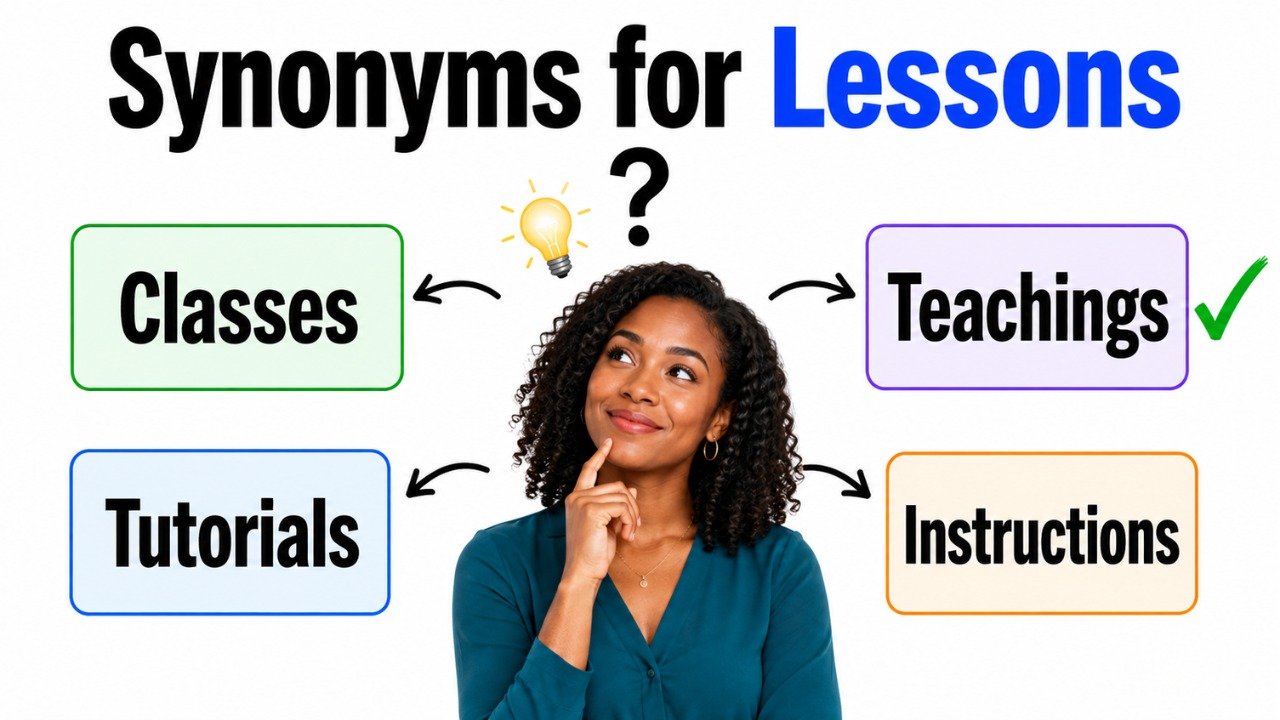
Quick Answer: The best synonyms for lessons include classes, instruction, teaching, tutorials, lectures, sessions, courses, guidance, insights, and takeaways. Use classes for scheduled periods of study, instruction for formal teaching, tutorials for focused learning, and lectures for spoken academic presentations. When lessons means knowledge gained from experience, use insights, takeaways, principles, or learning. The best replacement depends on whether you mean educational activities, practical training, moral messages, warnings, or ideas learned from past events.
Pronunciation and Word Details
Word: Lessons.
Pronunciation: /ˈles.ənz/
Part of Speech: Plural noun.
Meaning: Teaching periods, units of instruction, or useful ideas learned from study and experience.
US Pronunciation:
UK Pronunciation:
What Does “Lessons” Mean?
Lessons means periods of teaching or useful knowledge gained through study, practice, observation, or experience.
Lessons is the plural form of lesson. It is most commonly used as a noun. A lesson may be a scheduled teaching period, a section of a course, a practical activity, a moral message, or an idea learned from an event.
Educational Meaning: The students completed three grammar lessons.
Instructional Meaning: She takes driving lessons every Saturday.
Experiential Meaning: The project taught us valuable lessons about preparation.
Moral Meaning: The story contains important lessons about honesty.
Corrective Meaning: The mistake became a difficult but useful lesson.
In schools and training programs, lessons usually refer to organized periods of learning. A teacher, instructor, coach, tutor, or trainer may plan and deliver them.
In everyday conversation, lessons can also mean knowledge acquired from success, failure, hardship, relationships, work, or personal experience.
Example: One of the most important lessons from the journey was to remain patient.
The exact meaning is determined by the words around it. Cooking lessons are instructional sessions, while life lessons are truths learned through experience.
Meaning, Tone, and Context of “Lessons”
Lessons is a neutral and widely used word. It is suitable for formal writing, casual conversation, education, training, academic discussion, workplace communication, personal reflection, and storytelling.
In educational contexts, lessons has a practical and organized tone.
Example: The course includes twelve reading lessons.
In professional training, it may refer to structured instruction or skill development.
Example: Employees attended lessons on workplace safety.
In reflective writing, lessons can sound thoughtful or emotional.
Example: She shared the lessons she learned while caring for her family.
In historical, business, and analytical writing, lessons often means conclusions that can guide future decisions.
Example: The report identifies several lessons from the failed campaign.
In moral or religious discussion, lessons may describe principles about right behavior, responsibility, kindness, courage, or honesty.
Example: The tale offers lessons about compassion and forgiveness.
The word can also carry a corrective tone. A painful result may be described as a lesson when it changes future behavior.
Example: Losing the opportunity was a lesson in the importance of preparation.
Lessons is not usually technical, but it can appear in specialized phrases such as lesson plan, lessons learned, practical lessons, language lessons, and instructional lessons.
When and How to Use “Lessons”
For Scheduled Teaching Periods
Use lessons for organized periods during which a teacher or instructor helps someone learn.
Example: The children have music lessons every Tuesday.
Classes is often a suitable synonym when the sessions happen regularly.
For Units of Study
Use lessons for individual parts of a book, course, program, or learning plan.
Example: The first five lessons introduce basic sentence structure.
Units or modules may be more precise when discussing a formal course design.
For Skill Development
Use lessons when someone is learning a practical skill through guided practice.
Example: He enrolled in swimming lessons before the summer holiday.
Training, coaching, or instruction may fit when the activity is professional or performance based.
For Academic Instruction
Use lessons when referring to teaching in subjects such as mathematics, science, language, history, or art.
Example: The science lessons included experiments and group discussions.
Classes and instruction are strong alternatives in academic writing.
For Knowledge Gained From Experience
Use lessons when discussing ideas learned from success, failure, hardship, or observation.
Example: The experience taught her important lessons about trust.
Insights, takeaways, and learning are useful alternatives in this context.
For Moral Messages
Use lessons for principles about good behavior, values, or responsibility.
Example: The story teaches lessons about courage and generosity.
Morals, principles, or messages may provide greater precision.
For Warnings From Past Events
Use lessons when past mistakes provide guidance for the future.
Example: Leaders should remember the lessons of previous failures.
Warnings and cautions work when the emphasis is danger rather than general knowledge.
For Workplace Learning
Use lessons when discussing knowledge gained from projects, decisions, or professional experience.
Example: The team recorded the lessons from the product launch.
Lessons learned is a common phrase for conclusions that may improve future work.
For Personal Growth
Use lessons when describing ideas that influence attitudes, decisions, or behavior.
Example: Travel gave him lasting lessons in patience and adaptability.
Life lessons is a natural phrase for this meaning.
Best Synonyms for Lessons
Classes
Synonym: Scheduled periods of teaching for a group or individual.
Example: She attends evening classes in creative writing.
Classes is one of the best alternatives when lessons refers to regular educational meetings.
Instruction
Synonym: The process of teaching someone knowledge or skills.
Example: The course provides clear instruction in basic accounting.
Instruction is more formal than lessons and often refers to teaching as a whole.
Teaching
Synonym: The activity or practice of helping others learn.
Example: Effective teaching encourages students to ask questions.
Teaching focuses on the act of education rather than separate study periods.
Tutorials
Synonym: Focused teaching sessions that explain a subject or skill.
Example: The students attended tutorials before the final examination.
Tutorials often involve individual attention, small groups, or detailed guidance.
Lectures
Synonym: Formal talks given to teach an academic subject.
Example: The professor delivered lectures on modern history.
Lectures are mainly spoken presentations and may involve less interaction than lessons.
Sessions
Synonym: Scheduled periods devoted to learning, practice, or discussion.
Example: The training sessions lasted ninety minutes.
Sessions is flexible and works in educational, professional, and therapeutic contexts.
Courses
Synonym: Organized programs of study covering a subject over time.
Example: The center offers courses in writing and communication.
A course usually contains several lessons, so the terms are related but not always interchangeable.
Guidance
Synonym: Advice or direction that helps someone learn or make decisions.
Example: New employees received guidance from experienced team members.
Guidance works when lessons involves support rather than formal classroom teaching.
Insights
Synonym: Clear and useful understandings gained through thought or experience.
Example: The discussion produced valuable insights about customer behavior.
Insights is best when lessons means deeper understanding.
Takeaways
Synonym: The main ideas or conclusions remembered after an experience.
Example: The speaker summarized the key takeaways from the workshop.
Takeaways is common in conversational and workplace writing.
50 Synonyms for Lessons with Short Meanings
- Classes: Scheduled periods of organized teaching.
- Instruction: The process of teaching knowledge or skills.
- Teaching: The activity of helping people learn.
- Tutorials: Focused sessions that explain a subject or skill.
- Lectures: Formal educational talks presented to learners.
- Sessions: Planned periods for learning or practice.
- Courses: Organized programs of study.
- Units: Separate sections within a course or subject.
- Modules: Structured parts of a larger learning program.
- Studies: Activities involving learning and academic work.
- Schooling: Education received through formal study.
- Education: The process of developing knowledge and understanding.
- Training: Instruction designed to develop practical ability.
- Coaching: Personal guidance aimed at improving performance.
- Tutoring: Individual or small group teaching support.
- Workshops: Interactive sessions focused on practical learning.
- Seminars: Group meetings for study and discussion.
- Demonstrations: Practical displays showing how something is done.
- Exercises: Activities completed to develop knowledge or skill.
- Practice: Repeated activity intended to improve ability.
- Drills: Repeated exercises used to strengthen a skill.
- Assignments: Tasks given to support learning.
- Activities: Planned tasks that encourage participation and learning.
- Guidance: Advice and direction that support understanding.
- Mentoring: Developmental support from an experienced person.
- Tuition: Teaching provided to an individual or group.
- Directions: Explanations of what to do or how to proceed.
- Explanations: Statements that make ideas easier to understand.
- Briefings: Concise sessions providing important information.
- Presentations: Organized talks used to communicate information.
- Discussions: Exchanges of ideas that support learning.
- Learning: Knowledge or skill gained through study and experience.
- Knowledge: Information and understanding gained over time.
- Wisdom: Good judgment developed through experience.
- Insights: Valuable understandings about a subject or situation.
- Takeaways: Main ideas remembered from an experience.
- Findings: Conclusions reached through study or observation.
- Conclusions: Judgments formed after considering information.
- Principles: Basic truths or rules that guide behavior.
- Morals: Messages about right and wrong behavior.
- Messages: Ideas communicated through events or stories.
- Teachings: Ideas or principles presented for others to learn.
- Truths: Important facts or realities learned through experience.
- Realizations: Moments of understanding something clearly.
- Discoveries: New knowledge gained through study or experience.
- Experiences: Events that provide practical knowledge.
- Warnings: Lessons that alert people to possible danger.
- Cautions: Advice encouraging care and good judgment.
- Examples: Cases that demonstrate a rule or principle.
- Reminders: Ideas that help someone remember what matters.
Read Also:
Synonyms for Vacation

Synonyms for Lessons by Context
When Lessons Means Classes
When lessons refers to scheduled teaching periods, use classes, sessions, tutorials, lectures, workshops, or seminars.
Classes is the most general replacement. Tutorials suggests focused support, while lectures describes formal spoken instruction.
Original: She takes language lessons twice a week.
Alternative: She takes language classes twice a week.
Original: The instructor organized extra lessons before the test.
Alternative: The instructor organized extra tutorials before the test.
When Lessons Means Units of Study
Use units, modules, chapters, activities, or exercises for separate parts of a course.
A unit usually covers one topic. A module may include several activities, readings, and assessments.
Original: The course contains ten lessons on grammar.
Alternative: The course contains ten units on grammar.
Original: Students can complete the lessons in any order.
Alternative: Students can complete the modules in any order.
When Lessons Means Formal Instruction
Use instruction, teaching, tuition, education, schooling, or training.
Instruction emphasizes the delivery of information. Teaching describes the broader activity. Training focuses on developing practical or professional skills.
Original: The lessons prepared workers to use the equipment safely.
Alternative: The training prepared workers to use the equipment safely.
Original: The lessons were clear and well organized.
Alternative: The instruction was clear and well organized.
When Lessons Means Practical Skill Development
Use training, coaching, practice, drills, demonstrations, or workshops.
Coaching often includes personal feedback. Practice and drills emphasize repetition. Demonstrations show learners how to perform an action.
Original: The team received lessons in emergency response.
Alternative: The team received training in emergency response.
Original: The beginners needed lessons in basic technique.
Alternative: The beginners needed coaching in basic technique.
When Lessons Means Knowledge From Experience
Use insights, takeaways, learning, wisdom, realizations, or discoveries.
Insights suggests deep understanding. Takeaways refers to key points. Wisdom often develops through long experience.
Original: The failure taught the team valuable lessons.
Alternative: The failure gave the team valuable insights.
Original: She shared the lessons from her first year in business.
Alternative: She shared the main takeaways from her first year in business.
When Lessons Means Moral Principles
Use morals, principles, teachings, truths, or messages.
Morals focuses on right and wrong. Principles are general rules that guide decisions. Teachings often refers to ideas passed from one person or tradition to another.
Original: The story contains lessons about kindness.
Alternative: The story contains morals about kindness.
Original: His advice included lessons about personal responsibility.
Alternative: His advice included principles of personal responsibility.
When Lessons Means Warnings
Use warnings, cautions, reminders, examples, or findings.
Warnings emphasize danger. Cautions encourage careful action. Reminders help people remember past knowledge.
Original: The accident offered serious lessons about safety.
Alternative: The accident offered serious warnings about safety.
Original: Officials ignored the lessons of earlier emergencies.
Alternative: Officials ignored the warnings from earlier emergencies.
When Lessons Means Conclusions From Analysis
Use findings, conclusions, insights, takeaways, or observations.
These alternatives are useful in essays, reports, research, and business reviews.
Original: The report explains the lessons from the project.
Alternative: The report explains the findings from the project.
Original: The final section presents lessons for future planning.
Alternative: The final section presents conclusions for future planning.
Another Word for Lessons
The best single replacement for lessons is classes when the word refers to scheduled periods of teaching. When lessons means knowledge gained from experience, insights is often the strongest alternative.
The correct choice depends on whether the sentence describes education, training, moral guidance, or personal learning.
Original: She attends piano lessons every Friday.
Better Option: She attends piano classes every Friday.
Original: The workshop offered useful lessons about leadership.
Better Option: The workshop offered useful insights about leadership.
Original: The story teaches important lessons about honesty.
Better Option: The story teaches important morals about honesty.
Original: The team reviewed the lessons from the failed project.
Better Option: The team reviewed the key takeaways from the failed project.
When Not to Use “Lessons”
When a More Specific Educational Term Is Needed
Lessons can be too general when the exact type of learning activity matters.
Weak: The students attended lessons at the university.
Better: The students attended lectures at the university.
Lectures is clearer when the students listened to formal academic presentations.
When Referring to an Entire Program
A course contains multiple lessons, so lesson may be too narrow for a complete program of study.
Weak: She completed a six month lesson in graphic design.
Better: She completed a six month course in graphic design.
When Describing Professional Skill Development
Training may sound more accurate than lessons in workplace or technical contexts.
Weak: Employees received lessons in operating the machinery.
Better: Employees received training in operating the machinery.
When Referring to Personal Conclusions
Insights or takeaways may sound clearer when describing knowledge gained from an experience.
Weak: The meeting produced several lessons.
Better: The meeting produced several useful insights.
When the Meaning Is Too Vague
Specify whether the lessons were classes, warnings, findings, principles, or experiences.
Weak: We learned many lessons from the event.
Better: We learned several important safety principles from the event.
When the Word Is Repeated Too Often
Repeated use can make a paragraph sound dull.
Weak: The lessons were helpful. The lessons were practical. The lessons also included group activities.
Better: The classes were helpful and practical, and each session included group activities.
When the Tone Is Too Casual
Takeaways may sound conversational in a formal research paper.
Weak: The study presents three takeaways about memory.
Better: The study presents three findings about memory.
When the Tone Is Too Formal
Instruction may sound unnecessarily formal in relaxed conversation.
Weak: I received instruction in painting from my aunt.
Better: My aunt gave me painting lessons.
Words Commonly Confused With Lessons
Lessons vs Classes: Lessons may refer to individual periods or units of teaching. Classes usually refers to scheduled group meetings or an entire subject.
Lessons vs Courses: A lesson is one part of learning, while a course is a complete program containing several lessons.
Lessons vs Lectures: Lessons may include explanation, discussion, and practice. Lectures are mainly formal talks delivered to learners.
Lessons vs Tutorials: Lessons is a broad term. Tutorials usually provide focused explanation, individual support, or small group guidance.
Lessons vs Training: Lessons can develop general knowledge or skills. Training usually prepares someone for a practical task, role, or profession.
Lessons vs Education: Lessons are separate learning activities. Education is the larger process through which knowledge, values, and skills develop.
Lessons vs Teachings: Lessons may be classroom periods or knowledge from experience. Teachings usually refers to ideas, beliefs, or principles communicated by a person or tradition.
Lessons vs Insights: Lessons can refer to teaching sessions. Insights are valuable understandings gained through reflection, observation, or experience.
Lessons vs Morals: Lessons is broader. Morals specifically communicate ideas about right and wrong behavior.
Lessons vs Takeaways: Lessons may be complex ideas learned over time. Takeaways are usually the main points remembered from an event, meeting, or presentation.
Which Synonym Should You Choose?
Choose classes when referring to regular periods of education at a school, center, or private learning setting.
Choose instruction when discussing the formal process of teaching.
Choose teaching when focusing on the methods or work of an educator.
Choose tutorials when learners receive focused explanation or additional support.
Choose lectures for formal spoken presentations in academic settings.
Choose sessions when referring to scheduled periods of learning, practice, or discussion.
Choose courses for complete programs of study that contain several lessons.
Choose units or modules for separate parts of a structured curriculum.
Choose training for professional, technical, physical, or practical skill development.
Choose coaching when personal feedback and performance improvement matter.
Choose workshops for interactive learning involving discussion and practice.
Choose seminars for advanced group study or discussion.
Choose insights when describing valuable understanding gained from experience.
Choose takeaways for the main ideas remembered from a meeting, event, or presentation.
Choose findings for conclusions produced by research or analysis.
Choose morals when discussing messages about right and wrong.
Choose principles when referring to rules or beliefs that guide decisions.
Choose warnings when past events reveal possible danger.
Choose reminders when previous experiences reinforce something already known.
In essays and reports, instruction, findings, insights, and principles often sound precise. In conversation, classes, sessions, lessons, and takeaways usually sound natural. In professional emails, training, guidance, and key takeaways are often clear choices.
Real Life Examples of “Lessons” in Sentences
School Example
Original: The teacher prepared lessons on sentence structure.
Better Option: The teacher prepared units on sentence structure.
Language Learning Example
Original: She takes English lessons in the evening.
Better Option: She takes English classes in the evening.
University Example
Original: The lessons introduced students to economic theory.
Better Option: The lectures introduced students to economic theory.
Workplace Example
Original: The employees completed safety lessons.
Better Option: The employees completed safety training.
Music Example
Original: He started guitar lessons last month.
Better Option: He started guitar instruction last month.
Business Example
Original: The failed launch taught the company several lessons.
Better Option: The failed launch gave the company several valuable insights.
Meeting Example
Original: The manager summarized the lessons from the discussion.
Better Option: The manager summarized the key takeaways from the discussion.
Story Example
Original: The story contains lessons about loyalty and courage.
Better Option: The story contains morals about loyalty and courage.
Historical Example
Original: Leaders should remember the lessons of the past.
Better Option: Leaders should remember the warnings of the past.
Personal Growth Example
Original: Her travels taught her lasting lessons about patience.
Better Option: Her travels gave her lasting wisdom about patience.
Synonym Groups and Usage Differences
Classroom Learning Group
This group includes classes, tutorials, lectures, sessions, seminars, and workshops.
Classes is the broadest term. Tutorials provide focused support. Lectures are formal presentations. Workshops encourage participation and practice.
Example: The students attended weekly tutorials to improve their writing.
Curriculum Group
This group includes units, modules, activities, assignments, and exercises.
Units and modules organize subject content. Activities and exercises help learners apply knowledge. Assignments measure or extend learning.
Example: Each module includes a reading activity and a written assignment.
Teaching Group
This group includes instruction, teaching, education, schooling, tuition, and tutoring.
Instruction emphasizes the delivery of knowledge. Teaching describes the educator’s work. Education covers the entire learning process. Tutoring usually provides personal support.
Example: Individual tutoring helped the learner understand difficult concepts.
Practical Development Group
This group includes training, coaching, practice, drills, and demonstrations.
Training develops practical ability. Coaching improves personal performance. Practice and drills build skill through repetition. Demonstrations show how a task is completed.
Example: The instructor used demonstrations before allowing independent practice.
Experience Group
This group includes insights, wisdom, realizations, discoveries, experiences, and learning.
These words describe knowledge gained outside formal classrooms. Insights and realizations involve clear understanding. Wisdom develops through reflection and experience.
Example: Years of leadership gave her valuable wisdom about communication.
Main Idea Group
This group includes takeaways, findings, conclusions, messages, and observations.
Takeaways are memorable points. Findings come from investigation. Conclusions result from analysis. Messages communicate a central idea.
Example: The report ends with three conclusions about future planning.
Moral Guidance Group
This group includes morals, principles, truths, teachings, and guidance.
Morals concern right and wrong. Principles guide action. Truths express important realities. Teachings communicate established ideas or beliefs.
Example: The story presents a clear moral about treating others fairly.
Warning Group
This group includes warnings, cautions, reminders, and examples.
Warnings identify danger. Cautions encourage care. Reminders reinforce something previously known. Examples demonstrate what may happen.
Example: The earlier failure served as a warning against rushed decisions.
Antonyms of Lessons
Lessons has no single exact antonym because it has several meanings. Its opposites depend on whether it refers to education, knowledge, experience, or guidance.
Ignorance: A lack of knowledge or understanding.
Confusion: An inability to understand something clearly.
Misinformation: Incorrect or misleading information.
Forgetfulness: Failure to remember knowledge or experience.
Inexperience: A lack of practical knowledge gained through action.
Unawareness: Lack of recognition or understanding.
Neglect: Failure to provide attention, guidance, or instruction.
Misguidance: Advice or teaching that leads someone in the wrong direction.
Error: A mistaken belief, decision, or action.
Misunderstanding: An incorrect interpretation of information.
Disregard: Failure to consider advice or knowledge.
Unpreparedness: Lack of readiness caused by insufficient learning or practice.
Illiteracy: Inability to read or write, or lack of knowledge in a field.
Deception: The act of causing someone to believe something false.
Oblivion: A state in which something is forgotten or no longer remembered.
Comparison of Lessons and Related Words
Lessons vs Classes
Lessons can refer to individual periods, activities, or ideas learned. Classes usually describes scheduled educational meetings.
Example With Lessons: The book contains twelve reading lessons.
Example With Classes: She attends reading classes every Monday.
Lessons vs Courses
A lesson is usually one part of a course. A course is a complete program of study.
Example With Lessons: The first three lessons explain basic grammar.
Example With Courses: The school offers several language courses.
Lessons vs Instruction
Lessons are separate teaching periods or units. Instruction is the overall process of teaching.
Example With Lessons: The lessons included reading and writing activities.
Example With Instruction: The program provides instruction in reading and writing.
Lessons vs Tutorials
Lessons may be designed for any number of learners. Tutorials often provide focused help to individuals or small groups.
Example With Lessons: The class completed two mathematics lessons.
Example With Tutorials: Students attended tutorials for additional mathematics support.
Lessons vs Lectures
Lessons may involve interaction, activities, and feedback. Lectures usually involve a speaker presenting information to an audience.
Example With Lessons: The lessons included experiments and discussions.
Example With Lectures: The lectures introduced major scientific theories.
Lessons vs Training
Lessons may cover academic or general knowledge. Training prepares learners to perform practical tasks.
Example With Lessons: The students completed lessons on communication theory.
Example With Training: The employees completed training in emergency communication.
Lessons vs Insights
Lessons may refer to classes or ideas learned. Insights are deeper understandings gained from thought or experience.
Example With Lessons: The experience taught us several lessons.
Example With Insights: The experience gave us valuable insights into teamwork.
Lessons vs Takeaways
Lessons may require reflection and may influence behavior over time. Takeaways are the main points remembered immediately after an activity.
Example With Lessons: The failure taught lasting lessons about preparation.
Example With Takeaways: The presenter listed three takeaways at the end.
Lessons vs Morals
Lessons has a broad meaning. Morals specifically concern proper behavior or right and wrong.
Example With Lessons: The story offers lessons about friendship and trust.
Example With Morals: The story presents a moral about honesty.
Lessons vs Teachings
Lessons can be individual teaching sessions. Teachings are ideas or principles passed to others.
Example With Lessons: The students completed their lessons before lunch.
Example With Teachings: The book explores traditional teachings about compassion.
Common Phrases and Expressions With “Lessons”
Learn Lessons: Gain useful knowledge from study or experience.
Life Lessons: Important truths learned through living and personal experience.
Valuable Lessons: Useful knowledge that improves future decisions.
Important Lessons: Knowledge or principles that deserve special attention.
Hard Lessons: Knowledge gained through difficulty, failure, or pain.
Lessons Learned: Conclusions gained after completing or reviewing an experience.
Teaching Lessons: Organized periods or activities used to educate learners.
Private Lessons: Individual teaching sessions provided to one learner.
Practical Lessons: Instruction based on action, demonstration, or direct experience.
Moral Lessons: Messages concerning right behavior and ethical choices.
Common Mistakes to Avoid
Using Lessons and Courses as Exact Synonyms
A course is normally a complete program, while a lesson is one part of it.
Incorrect: I completed a two year lesson in engineering.
Correct: I completed a two year course in engineering.
Using Lessons When Training Is More Precise
Professional or technical skill development is often called training.
Weak: The workers received machinery lessons.
Better: The workers received machinery training.
Confusing Lessons With Lectures
A lecture is a specific type of educational presentation. Not every lesson is a lecture.
Weak: The children listened to an interactive lecture with games and group practice.
Better: The children participated in an interactive lesson with games and group practice.
Choosing an Unnatural Synonym
Do not replace lessons with a word that changes the meaning.
Unnatural: She attends piano morals every Friday.
Natural: She attends piano lessons every Friday.
Morals relates to ethical messages, not scheduled music instruction.
Repeating Lessons Too Often
Use suitable alternatives when the context remains clear.
Repetitive: The lessons were short. The lessons were useful. The lessons included practical tasks.
Improved: The lessons were short and useful, and each session included practical tasks.
Using Takeaways in Very Formal Writing
Takeaways may sound conversational in academic or technical reports.
Casual: The main takeaways from the research were significant.
Formal: The main findings from the research were significant.
Using Morals for General Knowledge
Morals should refer to right and wrong, not every type of learning.
Incorrect: The science experiment taught several morals about heat.
Correct: The science experiment taught several principles about heat.
Using Lesson With Incorrect Number Agreement
Use lesson for one and lessons for more than one.
Incorrect: The teacher prepared three lesson.
Correct: The teacher prepared three lessons.
Using Learnings Unnaturally
Learning is often more natural than learnings in general English.
Unnatural: We discussed our learnings from the project.
Natural: We discussed what we learned from the project.
Natural: We discussed the lessons from the project.
Being Vague About the Type of Lesson
Use a specific synonym when readers need more detail.
Vague: The event gave us lessons.
Clear: The event gave us important warnings about emergency planning.
Conclusion
The most useful synonyms for lessons depend on whether you mean teaching periods, practical instruction, or knowledge gained through experience. Classes, tutorials, lectures, and sessions work well in educational settings. Training and coaching suit skill development, while insights, takeaways, and findings describe ideas learned from events or analysis. Morals and principles fit stories and ethical guidance. Choosing a precise alternative makes your sentence clearer while preserving the intended meaning and tone.
FAQs About Synonyms for Lessons
What Is the Best Synonym for Lessons?
Classes is the best general synonym when lessons refers to scheduled teaching. Insights is often best when lessons means knowledge gained from experience.
Can Classes Replace Lessons?
Classes can replace lessons when referring to regular educational sessions. However, a class may include several lessons, so the words are not always identical.
What Is a Formal Synonym for Lessons?
Instruction is a formal synonym in educational contexts. Findings, insights, and conclusions are suitable when discussing lessons gained from research or experience.
What Is Another Word for Life Lessons?
Useful alternatives include wisdom, insights, truths, principles, realizations, and personal learning. The best choice depends on the sentence.
Are Lessons and Tutorials the Same?
Not exactly. Lessons is a broad term for teaching periods, while tutorials usually provide focused explanation or additional support.
What Synonym Should Be Used for Lessons Learned?
Useful alternatives include key takeaways, findings, insights, conclusions, and practical knowledge. Findings works well in formal reports.
What Is the Opposite of Lessons?
There is no single exact opposite. Depending on the meaning, possible antonyms include ignorance, confusion, inexperience, misinformation, and forgetfulness.
