
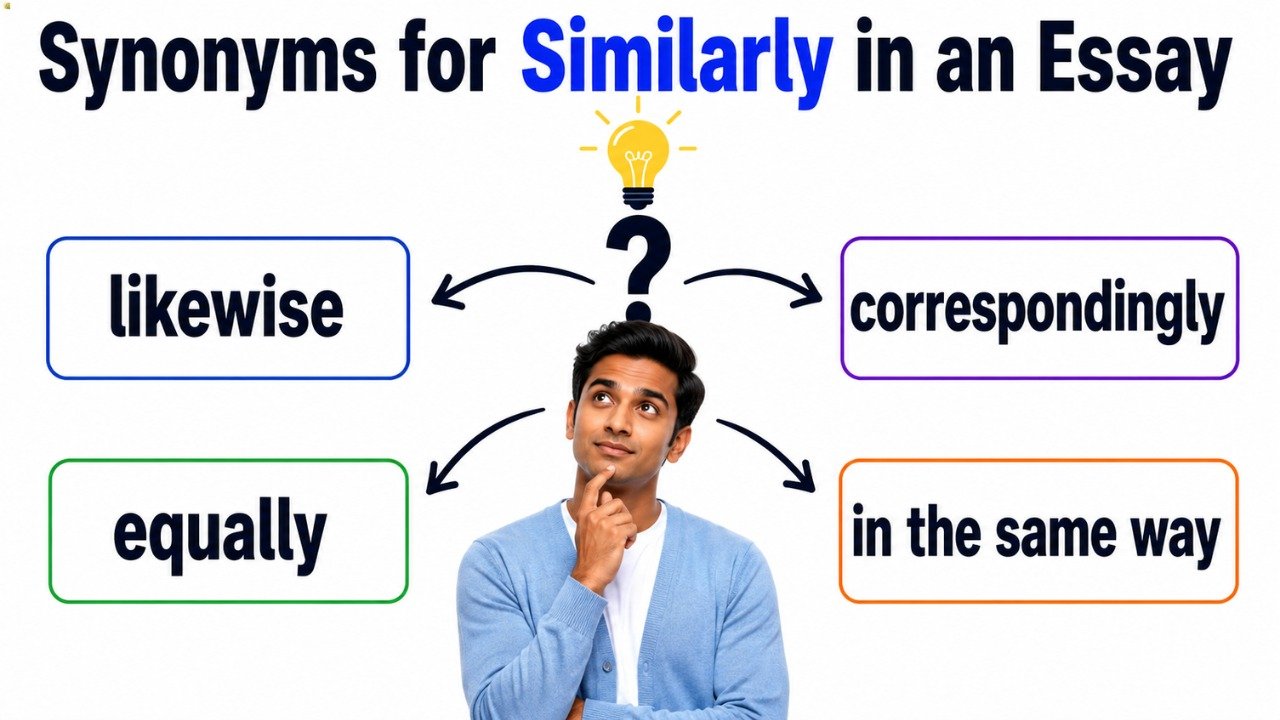
Quick Answer: The best synonyms for similarly in an essay include likewise, equally, correspondingly, comparably, in the same way, by the same token, in a similar manner, analogously, in parallel, and along the same lines. Use likewise for a clear academic transition, comparably when comparing qualities or results, correspondingly when one fact changes in relation to another, equally when giving two ideas similar importance, and in the same way when you want the clearest and most natural wording.
Pronunciation and Word Details
Word: Similarly.
Pronunciation: /ˈsɪmələrli/
Part of Speech: Adverb.
Meaning: In a way that is similar to something already mentioned or discussed.
US Pronunciation:
UK Pronunciation:
What Does “Similarly” Mean?
Similarly means in a comparable, related, or nearly identical way. It is an adverb commonly used to connect two ideas, situations, arguments, examples, or results that share important characteristics.
In essays, similarly often functions as a transition word. It tells the reader that the next statement has something meaningful in common with the previous statement.
Example: The first study showed improved concentration. Similarly, the second study reported better attention levels.
The word can appear at the beginning, middle, or occasionally near the end of a sentence depending on sentence structure.
Beginning: Similarly, both approaches require careful planning.
Middle: The second group similarly experienced positive results.
Similarly is especially useful when writing comparisons because it creates a clear connection without claiming that two things are completely identical.
Meaning, Tone, and Context of “Similarly”
Similarly has a neutral to formal tone. It is especially common in essays, academic assignments, reports, analytical writing, explanations, and professional communication.
In academic writing, similarly is useful when presenting related evidence or showing that two arguments produce comparable conclusions.
Academic Context: Similarly, both theories emphasize the importance of social interaction.
It can also appear in ordinary conversation, although phrases such as “in the same way” often sound more natural in casual speech.
Conversational Context: I felt nervous before the interview, and she felt similarly.
The word is generally polite and objective. It does not express strong emotion. Instead, it helps organize ideas logically.
When and How to Use “Similarly”
For Comparing Two Ideas
Use: Similarly connects ideas that share important qualities.
Example: Reading strengthens vocabulary. Similarly, regular writing improves language control.
For Connecting Evidence
Use: It can introduce evidence that supports a pattern already established.
Example: Students in the first class improved their scores. Similarly, students in the second class showed measurable progress.
For Comparing Results
Use: Similarly helps show that two outcomes are alike.
Example: The northern region experienced increased demand. Similarly, the southern region recorded higher sales.
For Developing an Essay Argument
Use: It helps writers move from one supporting point to another related point.
Example: Public transport reduces traffic congestion. Similarly, cycling infrastructure can decrease reliance on private vehicles.
For Comparing Behaviors
Use: It can describe people or groups acting in comparable ways.
Example: Younger participants preferred flexible schedules. Older participants similarly valued greater control over their working hours.
For Showing Parallel Situations
Use: Similarly works when two events or circumstances follow comparable patterns.
Example: The earlier reform faced strong opposition. Similarly, the later proposal was criticized by several groups.
Best Synonyms for Similarly
Likewise: In the same or a comparable way.
Example: The first method reduces costs. Likewise, the second approach improves efficiency.
Comparably: In a way that can reasonably be compared.
Example: Both systems performed comparably under normal conditions.
Correspondingly: In a related way that matches a change, situation, or pattern.
Example: Production increased, and demand rose correspondingly.
Equally: To the same degree or with the same importance.
Example: Clear evidence is important, and logical reasoning is equally necessary.
Analogously: In a way that shows a useful similarity between two different situations.
Example: The human brain can be understood analogously as a complex information network.
In the same way: Using a similar method, pattern, or manner.
Example: Exercise strengthens the body. In the same way, reading strengthens the mind.
In a similar manner: In a way resembling something already described.
Example: The second experiment was conducted in a similar manner.
By the same token: For the same reason or according to the same logic.
Example: Education creates opportunity. By the same token, limited access to education can restrict social mobility.
In parallel: At the same time or in a comparable pattern.
Example: Employment increased while consumer confidence improved in parallel.
Along the same lines: Following a similar idea, argument, or method.
Example: The second proposal develops the argument along the same lines.
50 Synonyms for Similarly with Short Meanings
- Likewise: In the same or a comparable way.
- Equally: To the same degree or importance.
- Comparably: In a way suitable for comparison.
- Correspondingly: In a related or matching way.
- Analogously: Through a meaningful comparison.
- Identically: In exactly the same way.
- Equivalently: In a way having equal meaning or value.
- Parallelly: In a corresponding or parallel manner.
- Relatedly: In connection with a related idea.
- Consistently: In a similar or unchanged manner over time.
- Concurrently: At the same time in a related situation.
- Conformably: In accordance with a similar pattern.
- Comparatively: In relation to another thing being compared.
- Uniformly: In the same manner throughout.
- Symmetrically: In a balanced or corresponding way.
- Proportionately: In a corresponding amount or degree.
- Proportionally: According to a comparable relationship.
- Concordantly: In agreement or harmony.
- Correspondent: In a matching or related manner.
- Equivalent: In a way equal in effect or value.
- In the same way: By a comparable method or manner.
- In a similar way: In a manner that closely resembles another.
- In a similar manner: By using a comparable approach.
- In like manner: In much the same fashion.
- In the same manner: By following the same general approach.
- By the same token: According to the same reasoning.
- Along the same lines: Following a similar idea or approach.
- In much the same way: In a strongly comparable manner.
- In a comparable way: In a manner suitable for comparison.
- In parallel: In a corresponding pattern.
- On similar grounds: For comparable reasons.
- For the same reason: Because of comparable causes or logic.
- In the same sense: With a similar meaning or interpretation.
- To the same extent: To an equal degree.
- To a similar extent: To a comparable degree.
- In equal measure: To approximately the same amount.
- In corresponding fashion: In a matching manner.
- In comparable fashion: In a similarly structured way.
- In analogous fashion: In a way based on analogy.
- In parallel fashion: In a corresponding pattern.
- On the same principle: According to similar reasoning.
- By similar reasoning: Using a comparable logical process.
- In agreement: In a way that supports the same conclusion.
- In harmony: In a consistent or compatible manner.
- Consistently with this: In a way matching the previous point.
- In keeping with this: In accordance with the same idea.
- Following the same pattern: Developing in a comparable manner.
- Using the same approach: Applying a comparable method.
- In related fashion: In a connected and similar manner.
- Much the same: Very similar in nature or effect.
Read Also:
Synonyms for Timely
Synonyms for Similarly by Context
When Similarly Introduces a Comparable Idea
Likewise, in the same way, in a similar manner, and along the same lines are useful when a writer wants to connect two ideas that have clear similarities.
Example: Urban parks improve public health. Likewise, community gardens can support physical and mental wellbeing.
When Similarly Compares Results
Comparably, equally, to a similar extent, and in equal measure work well when comparing outcomes, measurements, or levels.
Example: Both teaching methods performed comparably during the assessment.
When Similarly Shows a Related Change
Correspondingly, proportionally, proportionately, and in parallel are useful when one development relates to another.
Example: As production increased, operating expenses rose correspondingly.
When Similarly Connects Academic Arguments
Likewise, by the same token, analogously, on the same principle, and by similar reasoning can connect arguments and explanations.
Example: Governments benefit from accurate data. By the same token, businesses need reliable information to make informed decisions.
When Similarly Describes Methods
In the same manner, using the same approach, in like manner, and following the same pattern are useful for procedures and processes.
Example: The control group was examined in the same manner as the experimental group.
Another Word for Similarly
The best single replacement for similarly in most essays is likewise because it clearly connects two related ideas without changing the basic meaning. However, the best alternative depends on what kind of similarity you are describing.
Original: The first strategy improves efficiency. Similarly, the second strategy reduces unnecessary work.
Better Option: The first strategy improves efficiency. Likewise, the second strategy reduces unnecessary work.
Original: Both groups responded similarly during the experiment.
Better Option: Both groups responded comparably during the experiment.
Original: As income increased, spending increased similarly.
Better Option: As income increased, spending increased correspondingly.
Original: The second theory explains the issue similarly.
Better Option: The second theory explains the issue along the same lines.
When Not to Use “Similarly”
Avoid similarly when the relationship between two ideas is not actually based on similarity. Using the word simply to introduce another point can create a false connection.
Weak: The city expanded its transport network. Similarly, the mayor announced a new education policy.
Better: The city expanded its transport network. In addition, the mayor announced a new education policy.
Similarly can also become repetitive when it appears several times in the same essay.
Weak: Similarly, the first study found positive results. Similarly, another study supported the finding. Similarly, a third study reported improvement.
Better: Likewise, the first study found positive results. Another study produced comparable findings, while a third reported similar improvement.
Avoid similarly when you mean that two things are exactly identical.
Weak: The two documents were similarly worded in every detail.
Better: The two documents were identically worded in every detail.
Words Commonly Confused With Similarly
Similarly vs Likewise: Both introduce comparable ideas, but likewise often works more smoothly as an essay transition.
Similarly vs Comparably: Similarly is broader, while comparably is especially useful when evaluating results, qualities, or performance.
Similarly vs Correspondingly: Similarly shows general resemblance, while correspondingly often describes related changes or matching developments.
Similarly vs Equally: Similarly means in a comparable way, while equally means to the same degree or level.
Similarly vs Identically: Similarly allows some differences, while identically means exactly the same.
Similarly vs Analogously: Similarly states resemblance directly, while analogously introduces a comparison between situations that are different but structurally alike.
Similarly vs Conversely: Similarly introduces resemblance, while conversely introduces contrast or an opposite relationship.
Which Synonym Should You Choose?
Choose likewise when you need a smooth, formal transition between related essay points.
Choose comparably when discussing performance, results, measurements, quality, or statistical observations.
Choose correspondingly when one development changes in relation to another.
Choose equally when two qualities, arguments, or factors have the same importance or degree.
Choose in the same way when clarity is more important than formality.
Choose analogously when explaining one situation through comparison with another.
Choose by the same token when the second argument follows from the same reasoning as the first.
Choose along the same lines when discussing related ideas, proposals, arguments, or interpretations.
Choose in a similar manner when describing methods, procedures, or actions.
Choose in parallel when two processes develop together or follow comparable paths.
Real Life Examples of “Similarly” in Sentences
Original: The first survey revealed strong public support. Similarly, the second survey produced positive results.
Better Option: The first survey revealed strong public support. Likewise, the second survey produced positive results.
Original: Both students performed similarly during the assessment.
Better Option: Both students performed comparably during the assessment.
Original: The two departments responded similarly to the policy change.
Better Option: The two departments responded in much the same way to the policy change.
Original: Costs increased, and prices rose similarly.
Better Option: Costs increased, and prices rose correspondingly.
Original: The second experiment was conducted similarly.
Better Option: The second experiment was conducted in the same manner.
Original: Both arguments are similarly important.
Better Option: Both arguments are equally important.
Original: The later research explains the process similarly.
Better Option: The later research explains the process along the same lines.
Original: The two economies developed similarly during the period.
Better Option: The two economies developed in parallel during the period.
Original: The author similarly emphasizes the importance of education.
Better Option: The author likewise emphasizes the importance of education.
Original: The second situation can be understood similarly.
Better Option: The second situation can be understood analogously.
Synonym Groups and Usage Differences
Comparison Group
Words such as similarly, comparably, in a similar way, and in much the same way emphasize resemblance without claiming complete identity.
Example: The two programs performed comparably despite differences in structure.
Academic Transition Group
Likewise, similarly, by the same token, and along the same lines help connect related arguments in essays.
Example: Economic security improves wellbeing. Likewise, access to education can strengthen long term opportunity.
Equality Group
Equally, to the same extent, and in equal measure focus more strongly on degree or importance.
Example: Cost and reliability are equally important when evaluating the proposal.
Correspondence Group
Correspondingly, proportionally, proportionately, and in parallel describe matching changes or relationships.
Example: As demand declined, production decreased correspondingly.
Method Group
In the same manner, in like manner, and using the same approach describe comparable procedures.
Example: Each sample was tested in the same manner.
Analogy Group
Analogously, on the same principle, and by similar reasoning are useful when explaining relationships between different situations.
Example: The organization can analogously be viewed as a system of interconnected parts.
Antonyms of Similarly
The opposite of similarly depends on whether you are discussing similarity, agreement, method, or comparison.
Differently: In a way that is not the same.
Dissimilarly: In an unlike manner.
Conversely: In an opposite or reversed relationship.
Contrastingly: In a way that emphasizes differences.
Distinctly: In a clearly different manner.
Oppositely: In a directly contrary way.
Unequally: To different degrees or amounts.
Independently: Without following the same pattern or influence.
Inconsistently: Without maintaining a comparable pattern.
Divergently: In ways that move apart or develop differently.
Comparison: Similarly vs Related Words
Similarly vs Likewise
Similarly and likewise are close synonyms, especially when connecting related ideas. Likewise often sounds slightly more concise as a transition, while similarly emphasizes resemblance more directly.
Example With Similarly: The first theory emphasizes social influence. Similarly, the second theory recognizes the importance of group behavior.
Example With Likewise: The first theory emphasizes social influence. Likewise, the second theory recognizes the importance of group behavior.
Similarly vs Comparably
Similarly can describe almost any form of resemblance. Comparably is more useful when assessing performance, quality, size, value, or results.
Example With Similarly: The two organizations responded similarly to the crisis.
Example With Comparably: The two organizations performed comparably during the crisis.
Similarly vs Correspondingly
Similarly describes resemblance. Correspondingly suggests that one event, level, or change relates closely to another.
Example With Similarly: Both regions experienced similarly difficult conditions.
Example With Correspondingly: Demand increased, and production rose correspondingly.
Similarly vs Equally
Similarly refers to manner or resemblance. Equally refers more strongly to degree, amount, importance, or status.
Example With Similarly: Both arguments are similarly structured.
Example With Equally: Both arguments are equally important.
Similarly vs Analogously
Similarly directly states that two things resemble each other. Analogously is used when comparing different situations that share an underlying pattern.
Example With Similarly: Both systems operate similarly.
Example With Analogously: The transportation network can be understood analogously to the circulation system of the human body.
Common Phrases and Expressions With Similarly
Similarly Important: Important to a comparable degree.
Similarly Sized: Having approximately the same size.
Similarly Structured: Organized according to a comparable pattern.
Similarly Designed: Created using related design principles.
Similarly Affected: Influenced in a comparable way.
Similarly Situated: Existing under comparable circumstances.
Similarly Worded: Expressed using comparable language.
Similarly Priced: Offered at approximately the same price level.
Similarly Ranked: Placed at a comparable position or level.
Similarly Successful: Achieving roughly comparable levels of success.
Common Mistakes to Avoid
One common mistake is using similarly when two sentences do not actually express similar ideas. A transition should reflect the real relationship between the statements.
Another mistake is repeating similarly at the beginning of several consecutive sentences. Academic writing sounds more natural when transitions vary according to meaning.
Writers should also avoid replacing similarly with a synonym that changes the intended relationship. Correspondingly, for example, suggests a related change, while equally focuses on degree.
Do not confuse similarly with conversely. These words perform opposite functions. Similarly connects comparable ideas, while conversely introduces an opposing relationship.
Writers should also be careful with word placement. At the beginning of a sentence, similarly is normally followed by a comma.
Correct: Similarly, the second study found a significant improvement.
Less Natural: Similarly the second study found a significant improvement.
Finally, do not assume that similar means identical. If two items are exactly the same, words such as identically may be more precise.
Conclusion
The best synonyms for similarly in an essay depend on the relationship between the ideas being connected. Likewise is one of the strongest general replacements for academic transitions, while comparably suits results and performance, correspondingly suits related changes, and equally emphasizes the same degree or importance. Phrases such as in the same way, along the same lines, and by the same token also create natural variation. Choosing a synonym according to meaning makes essay writing clearer, more precise, and less repetitive.
FAQs About Synonyms for Similarly
What is the best synonym for similarly in an essay?
Answer: Likewise is usually the best general synonym because it clearly connects two related ideas and works naturally in formal writing.
What can I use instead of similarly in academic writing?
Answer: You can use likewise, comparably, correspondingly, analogously, equally, in the same way, or along the same lines depending on the context.
Is likewise more formal than similarly?
Answer: Both are suitable for formal writing. Likewise often works particularly well as a concise transition between related arguments.
Can I use “in the same way” instead of similarly?
Answer: Yes. In the same way is a clear and natural replacement when two actions, methods, or situations follow comparable patterns.
What is a formal synonym for similarly?
Answer: Comparably, correspondingly, analogously, and likewise are useful formal alternatives.
What transition word means the same as similarly?
Answer: Likewise is the closest general transition word. By the same token and along the same lines can also work when the surrounding logic supports them.
How do I avoid repeating similarly in an essay?
Answer: Vary your wording according to meaning. Use likewise for related ideas, comparably for results, correspondingly for related changes, equally for degree, and in the same way for clear general comparison.
