
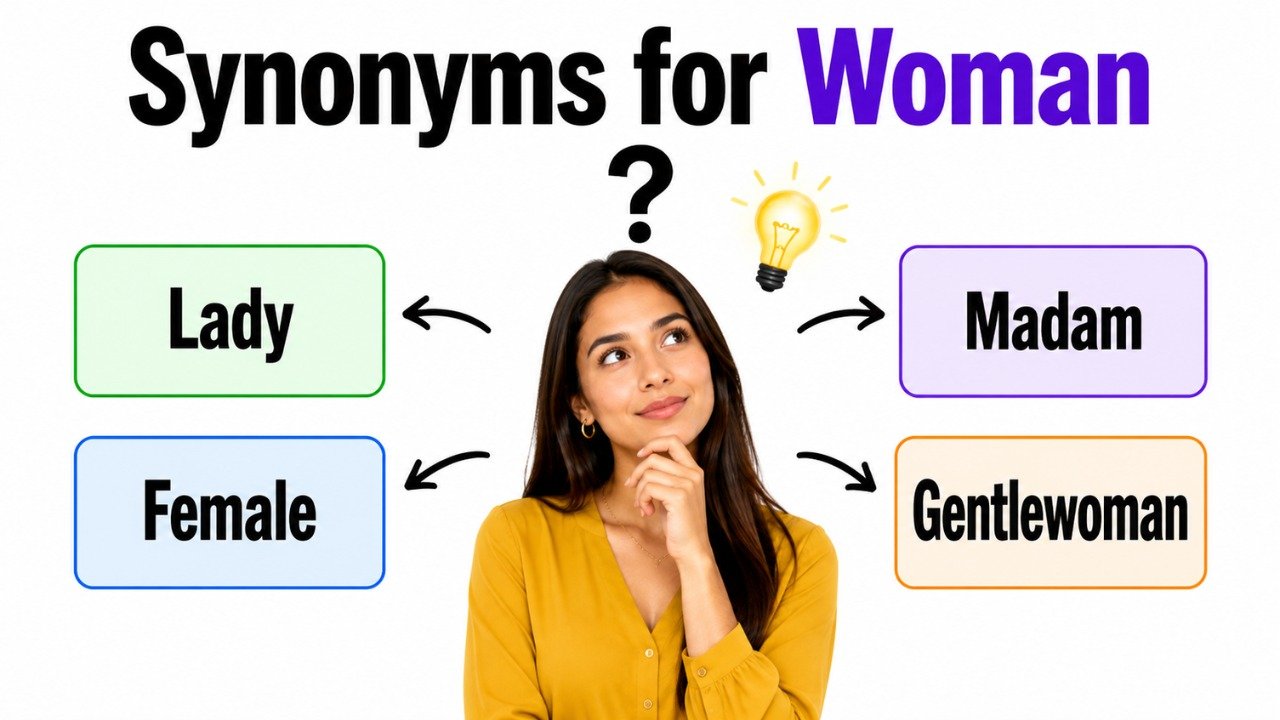
Quick Answer: The best synonyms for woman include lady, adult female, female adult, female person, individual, gentlewoman, matron, madam, gal, and lass. Use lady when you want a polite or respectful term, adult female in scientific or demographic writing, and individual or person when gender is not important. Madam is appropriate as a respectful form of address, while gal and lass are informal or regional. These synonyms for woman are not always interchangeable because some describe age, social role, relationship, occupation, or level of formality.
Pronunciation and Word Details
Word: Woman.
Pronunciation: /ˈwʊm.ən/
Part of Speech: Noun.
Meaning: An adult female human being.
US Pronunciation:
UK Pronunciation:
What Does “Woman” Mean?
Woman means an adult female human being.
The word is a countable noun. Its plural form is women, pronounced /ˈwɪm.ɪn/. Woman may identify an adult by gender, describe a person in a social or family role, or appear in expressions connected with work, character, age, and achievement.
Singular Example: A woman was waiting near the entrance.
Plural Example: Several women attended the workshop.
Woman is often used when age and gender are relevant to the sentence. It can refer to a specific person, an unknown person, or women as a group.
Specific Person: The woman in the blue coat offered to help.
Unknown Person: A woman called earlier and left a message.
General Group: Women have contributed to every area of public and private life.
The word can also modify another noun in certain expressions.
Example: She became the first woman director of the organization.
In many situations, a more precise role is better than the general word woman. Depending on the context, a person may be described as a teacher, mother, engineer, customer, passenger, neighbor, colleague, or leader.
Meaning, Tone, and Context of “Woman”
Woman is a neutral, standard, and widely accepted noun. It can be used in casual conversation, formal writing, academic discussion, reports, stories, biographies, and everyday descriptions.
The tone depends largely on the surrounding sentence. The word itself is neither strongly formal nor strongly casual.
Neutral Context: A woman asked for directions.
Formal Context: The report examined the experiences of women in the workplace.
Personal Context: She is a kind and thoughtful woman.
Historical Context: The woman became an influential writer and reformer.
Lady is sometimes used as a more polite or traditional alternative, although it may sound overly formal in some settings. Female is more common as an adjective and may sound clinical or impersonal when used alone as a noun for a person.
Person and individual are gender neutral alternatives. They work well when the person’s gender is unknown, irrelevant, or unnecessary.
Some alternatives for woman carry additional meanings. Matron may suggest maturity, authority, or a particular institutional role. Gal is informal. Lass is regional and usually refers to a young woman. Madam is mainly a form of respectful address rather than a direct synonym in every sentence.
Respectful word choice depends on context. In most ordinary writing, woman is clear, direct, and appropriate.
When and How to Use “Woman”
For an Adult Female Person: Use woman when referring to an adult female human being.
Example: The woman introduced herself as the new instructor.
For an Unknown Person: Use woman when the person’s name is not known but gender is relevant.
Example: A woman found the missing wallet and returned it.
For a Specific Description: Use woman with identifying details when distinguishing one person from others.
Example: The woman near the window is waiting for her appointment.
For a General Group: Use women when discussing adult females collectively.
Example: The program supports women who are starting new careers.
For a Personal Quality: Use woman after an adjective to describe someone’s character or manner.
Example: She is a confident and compassionate woman.
For a Family Role: Use a more specific term such as mother, wife, sister, or daughter when the relationship matters.
Example: The woman is my sister.
For a Professional Role: Use the person’s job title when occupation is more relevant than gender.
Example: The engineer presented her design to the committee.
For Respectful Address: Use madam or ma’am when directly addressing an unknown woman in a formal or service setting.
Example: Excuse me, ma’am, you left your umbrella.
For Gender Neutral Writing: Use person or individual when gender does not affect the meaning.
Example: The person responsible should submit the completed form.
For Demographic Writing: Use adult female or female adult when precise classification is necessary.
Example: The survey included adult female participants from several age groups.
Best Synonyms for Woman
Lady: A polite or traditional term for a woman.
Example: The lady at the front desk answered our questions.
Adult Female: A precise term for a female human who has reached adulthood.
Example: The study focused on adult female participants.
Female Adult: A formal classification for an adult female person.
Example: Each female adult completed a separate questionnaire.
Female Person: A descriptive term that identifies a person as female.
Example: The witness described the visitor as a female person in her thirties.
Person: A gender neutral term for any human being.
Example: The person beside the door offered assistance.
Individual: A formal and gender neutral word for one person.
Example: Each individual received written instructions.
Gentlewoman: A traditional or literary term for a refined or socially respected woman.
Example: The story describes her as a generous gentlewoman.
Matron: A mature or dignified woman, sometimes one holding an official role.
Example: The respected matron welcomed the guests.
Madam: A respectful form of address for a woman.
Example: Madam, your table is ready.
Gal: An informal word for a woman or girl.
Example: She is a friendly gal who enjoys meeting new people.
50 Synonyms for Woman with Short Meanings
- Lady: A polite or traditional word for a woman.
- Adult Female: A precise description of a female human adult.
- Female Adult: A formal demographic term for an adult female person.
- Female Person: A descriptive term for a person who is female.
- Female: A formal or biological term that may refer to a woman in limited contexts.
- Person: A gender neutral word for a human being.
- Individual: A formal and gender neutral term for one person.
- Gentlewoman: A traditional term for a refined or respected woman.
- Madam: A respectful title or form of address for a woman.
- Ma’am: A polite spoken form of address for a woman.
- Matron: A mature or dignified woman.
- Dame: A traditional title or literary term for a woman.
- Miss: A title or form of address traditionally used for an unmarried woman.
- Gal: An informal word for a woman or girl.
- Lass: A regional word for a girl or young woman.
- Maiden: An old fashioned or literary term for a young unmarried woman.
- Young Woman: A female adult who is relatively young.
- Mature Woman: An adult woman of greater age or experience.
- Older Woman: A woman who is older than another person or group.
- Senior Woman: A respectful term for an older adult woman.
- Woman of Age: A woman who has reached adulthood.
- Wife: A woman in a marital relationship.
- Spouse: A gender neutral term for a married partner.
- Partner: A person in a romantic or committed relationship.
- Mother: A woman who has a child or parenting role.
- Mom: An informal term for a mother.
- Mum: A common informal term for a mother in British usage.
- Daughter: A female child in relation to her parents.
- Sister: A female sibling.
- Aunt: A woman who is the sister of a parent or related through marriage.
- Grandmother: A woman who is the mother of a parent.
- Granddaughter: A female grandchild.
- Niece: A daughter of a sibling or related family member.
- Bride: A woman who is getting married or has recently married.
- Widow: A woman whose spouse has died.
- Homemaker: A person, often a woman, who manages a household.
- Working Woman: A woman engaged in paid employment.
- Professional Woman: A woman working in a skilled or professional field.
- Career Woman: A woman strongly focused on her occupation or career.
- Businesswoman: A woman involved in business or commerce.
- Stateswoman: A respected woman active in government or public affairs.
- Spokeswoman: A woman who speaks on behalf of a group.
- Chairwoman: A woman who leads a meeting, board, or committee.
- Councilwoman: A woman serving as a member of a council.
- Craftswoman: A woman skilled in making things by hand.
- Saleswoman: A woman whose work involves selling goods or services.
- Policewoman: A woman serving as a police officer.
- Sportswoman: A woman who participates in sports.
- Noblewoman: A woman belonging to a noble family or rank.
- Heroine: A woman admired for courage, achievement, or noble qualities.
Read Also:
Synonyms for Mother
Synonyms for Woman by Context
When Woman Means an Adult Female Person
Lady, adult female, female adult, female person, and woman of age can replace woman when identifying an adult female person.
Adult female and female adult are precise but formal. They are most appropriate in demographic, medical, legal, or scientific contexts. In ordinary conversation, woman sounds more natural.
Example: The survey included two hundred adult female participants.
Example: A lady near the entrance asked for assistance.
When Woman Requires a Polite Term
Lady, madam, ma’am, gentlewoman, and dame can express respect or formality.
Lady is common in polite descriptions. Madam and ma’am are normally used when speaking directly to someone. Gentlewoman and dame have traditional, historical, or literary associations.
Example: The lady at the counter helped me complete the form.
Example: May I assist you, madam?
When Gender Is Not Important
Person, individual, participant, resident, customer, visitor, and employee may be better than woman when gender is irrelevant.
These words describe the person’s role or connection to the situation. They often make writing more precise.
Example: Each participant answered ten questions.
Example: The customer requested a refund.
When Woman Refers to a Family Relationship
Wife, spouse, partner, mother, daughter, sister, aunt, grandmother, granddaughter, and niece identify specific relationships.
These terms should only replace woman when the relationship is known and relevant.
Example: The woman beside me is my sister.
Improved Example: The person beside me is my sister.
When Woman Refers to Age
Young woman, mature woman, older woman, senior woman, lass, and maiden add information about age.
Young woman is neutral and current. Lass is regional and informal. Maiden is literary and old fashioned. Senior woman can sound respectful in suitable contexts.
Example: A young woman volunteered to lead the discussion.
Example: The senior woman shared her experience with the group.
When Woman Refers to Work
Professional woman, working woman, businesswoman, stateswoman, spokeswoman, chairwoman, craftswoman, and sportswoman describe occupational or public roles.
In many cases, a neutral job title may be more natural. For example, police officer is usually more current and direct than policewoman.
Example: The businesswoman expanded her company into several regions.
Example: The spokesperson answered questions after the meeting.
When Woman Is Informal or Regional
Gal and lass are informal alternatives. Gal is conversational and may sound friendly, playful, or old fashioned depending on the sentence. Lass is strongly associated with particular regional varieties of English.
Example: She is a cheerful gal with a quick sense of humor.
Example: The young lass carried a basket through the village.
When Woman Is Admired for Character
Heroine, leader, role model, stateswoman, and woman of courage describe a woman through achievement or personal quality.
These terms are not direct replacements in every sentence. They add praise or explain why the woman is important.
Example: She became a heroine after rescuing the children.
Example: Many students regarded the scientist as a role model.
Another Word for Woman
The best general alternative for woman is lady when a polite tone is desired. However, woman remains the clearest and most neutral term in most situations.
The best replacement depends on context. Use person when gender is irrelevant, adult female in precise demographic writing, madam for direct formal address, and a relationship or job title when that detail matters more.
Original: The woman at reception gave me the correct form.
Better Option: The lady at reception gave me the correct form.
Original: Every woman must present identification before entering.
Better Option: Every person must present identification before entering.
Original: The research included sixty women between the ages of thirty and fifty.
Better Option: The research included sixty adult female participants between the ages of thirty and fifty.
Original: The woman speaking to the audience is responsible for the project.
Better Option: The project manager speaking to the audience is responsible for the project.
When Not to Use “Woman”
Do not use woman when the person’s gender is irrelevant and another noun explains the role more clearly.
Weak: The woman brought our meals to the table.
Better: The server brought our meals to the table.
Weak: A woman repaired the damaged pipe.
Better: A plumber repaired the damaged pipe.
Avoid repeatedly identifying someone as a woman when her name, profession, or role is already known.
Weak: The woman entered the room. The woman opened her folder. The woman began the presentation.
Better: The consultant entered the room, opened her folder, and began the presentation.
Do not use woman for a female child. Girl is the standard term for a child or young teenager, although young woman may be used respectfully for an older teenager in some contexts.
Weak: The seven year old woman carried a red backpack.
Better: The seven year old girl carried a red backpack.
Do not use female as a noun carelessly in ordinary conversation. It can sound clinical, distant, or impersonal when referring to a person.
Weak: A female asked to speak with the manager.
Better: A woman asked to speak with the manager.
Do not use lady automatically when a neutral term is more appropriate. Lady can sound overly polite, traditional, or patronizing in certain contexts.
Weak: The lady engineer explained the safety procedure.
Better: The engineer explained the safety procedure.
Avoid unnecessary gender labels in occupational titles unless the distinction is relevant.
Weak: The woman doctor examined the patient.
Better: The doctor examined the patient.
Do not use outdated terms such as maiden or gentlewoman in ordinary modern writing unless the historical, literary, or stylistic context supports them.
Weak: A maiden called the office about her application.
Better: A young woman called the office about her application.
Words Commonly Confused With Woman
Woman vs Women: Woman is singular, while women is plural. One woman attended the meeting, but several women attended the meeting.
Woman vs Lady: Woman is neutral and direct. Lady is more polite or traditional and may sound overly formal in some contexts.
Woman vs Female: Woman is a noun for an adult female human. Female is commonly an adjective and can also be a biological classification.
Woman vs Girl: Woman refers to an adult. Girl usually refers to a female child or young teenager.
Woman vs Wife: Woman identifies an adult female person. Wife identifies a woman in relation to her spouse.
Woman vs Mother: Woman is a general identity term. Mother describes a parenting or family relationship.
Woman vs Madam: Woman is a noun used to identify someone. Madam is mainly a respectful title or direct form of address.
Woman vs Person: Woman includes gender information. Person is gender neutral and broader.
Woman vs Lady Friend: Woman means any adult female person. Lady friend is an old fashioned expression that may refer to a female friend or romantic partner.
Which Synonym Should You Choose?
Choose woman for neutral, clear, and everyday reference to an adult female person.
Choose lady when you want a polite or traditional tone, especially in service or social situations.
Choose adult female in demographic, scientific, legal, or medical writing where precise classification is necessary.
Choose female adult when the sentence follows formal classification language.
Choose person when gender is unknown or irrelevant.
Choose individual in reports, policies, instructions, and other formal writing.
Choose madam or ma’am when respectfully addressing a woman directly.
Choose young woman when age is relevant and the person is a young adult.
Choose mature woman or older woman when age and experience matter.
Choose gal in relaxed conversation when the tone is clearly friendly and informal.
Choose lass in regional dialogue or writing that intentionally reflects regional speech.
Choose wife, mother, sister, daughter, or another relationship term when family connection is the main point.
Choose manager, teacher, doctor, customer, passenger, resident, or another role when occupation or function matters more than gender.
Choose gentlewoman, dame, or maiden mainly in historical, literary, ceremonial, or intentionally traditional writing.
In essays and reports, woman, adult female, person, individual, participant, and respondent are usually strongest. In emails, woman is rarely needed if a name, title, or role is available. In conversation, woman and lady are the most natural general choices.
Real Life Examples of “Woman” in Sentences
Original: A woman answered the telephone and took my message.
Better Option: A receptionist answered the telephone and took my message.
Original: The woman at the information desk showed us the correct route.
Better Option: The lady at the information desk showed us the correct route.
Original: Every woman who enters must sign the register.
Better Option: Every person who enters must sign the register.
Original: The woman gave a presentation about financial planning.
Better Option: The adviser gave a presentation about financial planning.
Original: The study included fifty women over the age of forty.
Better Option: The study included fifty adult female participants over the age of forty.
Original: The woman sitting next to me is related to my father.
Better Option: The woman sitting next to me is my aunt.
Original: The woman who owns the store greeted every customer.
Better Option: The businesswoman who owns the store greeted every customer.
Original: The woman led the committee through a difficult discussion.
Better Option: The chairwoman led the committee through a difficult discussion.
Original: The woman showed great courage during the emergency.
Better Option: The heroine showed great courage during the emergency.
Original: The woman is waiting to speak with you.
Better Option: The visitor is waiting to speak with you.
Synonym Groups and Usage Differences
Neutral Identity Group
Woman, adult female, female adult, female person, person, and individual identify a human being without describing a personal role.
Woman is the most natural everyday choice. Adult female is more precise and formal. Person and individual remove unnecessary gender information.
Example: Each individual must complete the registration form.
Polite Address Group
Lady, madam, ma’am, miss, gentlewoman, and dame express politeness, title, or traditional social status.
Lady can describe someone politely. Madam and ma’am address someone directly. Miss is a title, while dame may be ceremonial, historical, or literary.
Example: Excuse me, ma’am, is this seat available?
Age Group
Young woman, mature woman, older woman, senior woman, lass, and maiden provide information about age or life stage.
Young woman is current and neutral. Lass is informal and regional. Maiden is old fashioned and mainly literary.
Example: The young woman accepted the award with confidence.
Family Relationship Group
Wife, spouse, partner, mother, daughter, sister, aunt, grandmother, granddaughter, and niece identify relationships.
These words are more informative than woman when the relationship matters to the sentence.
Example: His sister organized the family gathering.
Professional Group
Working woman, professional woman, career woman, businesswoman, stateswoman, spokeswoman, and chairwoman describe work or public responsibility.
Many modern contexts favor a neutral occupational title such as spokesperson, chair, police officer, or business owner. The gendered form may still be useful when gender is relevant.
Example: The spokesperson released a written statement.
Informal and Regional Group
Gal and lass are conversational alternatives.
Gal can sound warm and friendly, but it may also feel dated. Lass is associated with regional speech and generally refers to a younger female person.
Example: She is a capable gal who never avoids a challenge.
Status and Character Group
Matron, noblewoman, heroine, gentlewoman, and stateswoman describe social status, maturity, courage, or public respect.
These words add information beyond gender and should only be used when that additional meaning is accurate.
Example: The stateswoman was admired for her wisdom and integrity.
Antonyms of Woman
Woman does not have a perfect antonym because it names a category of person rather than a quality. However, several words provide useful contrasts based on gender, age, title, or family role.
Man: An adult male human being and the most common gender contrast with woman.
Male Adult: A formal description of an adult male person.
Boy: A male child, contrasting with woman by both age and gender.
Girl: A female child, contrasting with woman mainly by age.
Gentleman: A polite or traditional counterpart to lady.
Sir: A respectful form of address that may contrast with madam.
Husband: A male spouse and common counterpart to wife.
Father: A male parent and common counterpart to mother.
Son: A male child in relation to parents and counterpart to daughter.
Brother: A male sibling and counterpart to sister.
Uncle: A male family relation and counterpart to aunt.
Grandfather: A male grandparent and counterpart to grandmother.
Widower: A man whose spouse has died and counterpart to widow.
Groom: A man who is getting married and counterpart to bride.
Comparison: Woman vs Related Words
Woman vs Lady
Woman is neutral and suitable in almost every context. Lady is more polite, traditional, or socially formal.
Example With Woman: A woman asked whether the seat was available.
Example With Lady: The lady at the front desk welcomed the guests.
Woman vs Female
Woman is a noun referring specifically to an adult female human. Female is most natural as an adjective and may refer to humans, animals, or plants.
Example With Woman: The woman completed the application.
Example With Female: The study included female participants.
Woman vs Girl
Woman refers to an adult female person. Girl generally refers to a female child or young teenager.
Example With Woman: The woman manages a large department.
Example With Girl: The girl started primary school last month.
Woman vs Person
Woman gives information about gender and adulthood. Person is broader and gender neutral.
Example With Woman: A woman found the lost keys.
Example With Person: The person who found the keys returned them immediately.
Woman vs Wife
Woman is a general noun. Wife describes a woman through her marital relationship.
Example With Woman: The woman greeted us at the door.
Example With Wife: His wife greeted us at the door.
Woman vs Mother
Woman identifies an adult female person. Mother identifies a parent.
Example With Woman: The woman attended the school meeting.
Example With Mother: The child’s mother attended the school meeting.
Woman vs Madam
Woman identifies someone in a sentence. Madam is mainly used to address a woman directly and respectfully.
Example With Woman: The woman requested a different table.
Example With Madam: Your table is ready, madam.
Woman vs Matron
Woman is neutral and general. Matron usually suggests maturity, dignity, authority, or a particular institutional role.
Example With Woman: The woman welcomed the visitors.
Example With Matron: The matron supervised the daily routine.
Common Phrases and Expressions With Woman
Young Woman: A female person in early adulthood.
Older Woman: A woman of greater age.
Working Woman: A woman engaged in paid employment.
Woman of Courage: A woman known for bravery.
Woman of Character: A woman with strong moral qualities.
Woman of Her Word: A woman who keeps her promises.
Woman of the World: A woman with broad experience and social knowledge.
Woman in Charge: A woman who has authority or responsibility.
Woman of Distinction: A woman respected for notable achievements.
Woman of Means: A woman who has considerable financial resources.
Woman of Substance: A woman admired for intelligence, character, or achievement.
Woman of Vision: A woman able to imagine and pursue important future goals.
Common Mistakes to Avoid
A common mistake is using woman as an adjective before a plural noun. Woman can modify certain singular nouns, but women is normally used before plural nouns.
Incorrect: Several woman writers attended the event.
Correct: Several women writers attended the event.
Remember that the plural of woman is women.
Incorrect: Three woman applied for the position.
Correct: Three women applied for the position.
Another common mistake is confusing the pronunciations of woman and women. Woman begins with the vowel sound in /ˈwʊm.ən/, while women begins with the vowel sound in /ˈwɪm.ɪn/.
Do not use girl for an adult woman in formal or professional writing. It may sound inaccurate or disrespectful unless the person uses the term for herself or the context is clearly informal.
Weak: The office girls prepared the financial report.
Better: The office staff prepared the financial report.
Avoid using lady when woman is clearer and more neutral. Lady may sometimes sound overly polite, dated, or patronizing.
Weak: The lady scientist published an important paper.
Better: The scientist published an important paper.
Do not use female as a noun unnecessarily when referring to a person.
Weak: The female at the counter asked for identification.
Better: The woman at the counter asked for identification.
Avoid mentioning gender when it adds no useful information.
Weak: A woman accountant reviewed the records.
Better: An accountant reviewed the records.
Do not assume that wife, mother, sister, or daughter can replace woman unless the relationship is known and relevant.
Incorrect Choice: The woman entered the room, so his mother entered the room.
Better Choice: The woman entered the room.
Avoid archaic terms such as maiden, dame, and gentlewoman in ordinary modern contexts. They are most suitable for historical, literary, ceremonial, or humorous writing.
Do not combine woman with unnecessary age descriptions that may sound judgmental. Use age only when it contributes useful information.
Weak: An elderly woman of advanced age answered the door.
Better: An older woman answered the door.
Choose occupational titles consistently. Gender neutral terms such as chair, spokesperson, police officer, and salesperson are often clearer when gender is not relevant.
Less Neutral: The spokeswoman answered the reporters.
More Neutral: The spokesperson answered the reporters.
Conclusion
The most useful synonyms for woman include lady, adult female, female adult, person, individual, gentlewoman, matron, madam, gal, and lass. Woman remains the clearest neutral term for an adult female person. Choose lady for polite reference, adult female for precise formal writing, and person when gender is irrelevant. Relationship terms and professional titles work best when those details matter. Understanding context, tone, age, and social role helps you select accurate and respectful synonyms for woman.
FAQs About Synonyms for Woman
What Is the Best Synonym for Woman?
Lady is the closest polite alternative, but woman is usually the clearest neutral term. The best choice depends on formality, context, and the information being expressed.
Is Female a Synonym for Woman?
Female can refer to a woman in some formal contexts, but it is more natural as an adjective. Adult female is usually more precise than using female alone as a noun.
What Is a Formal Synonym for Woman?
Adult female, female adult, individual, gentlewoman, and madam may work in formal contexts. Each has a different use, so they are not always interchangeable.
What Is a Polite Word for Woman?
Lady is a common polite description. Madam and ma’am are respectful forms of direct address.
What Is an Informal Synonym for Woman?
Gal is an informal alternative. Lass is also informal and regional, and it usually refers to a girl or young woman.
Can Person Replace Woman?
Yes, person can replace woman when gender is unknown, irrelevant, or unnecessary. Person is broader because it can refer to anyone.
What Is the Difference Between Woman and Lady?
Woman is neutral and direct. Lady is more polite or traditional and may carry ideas of social courtesy, refinement, or formality.
