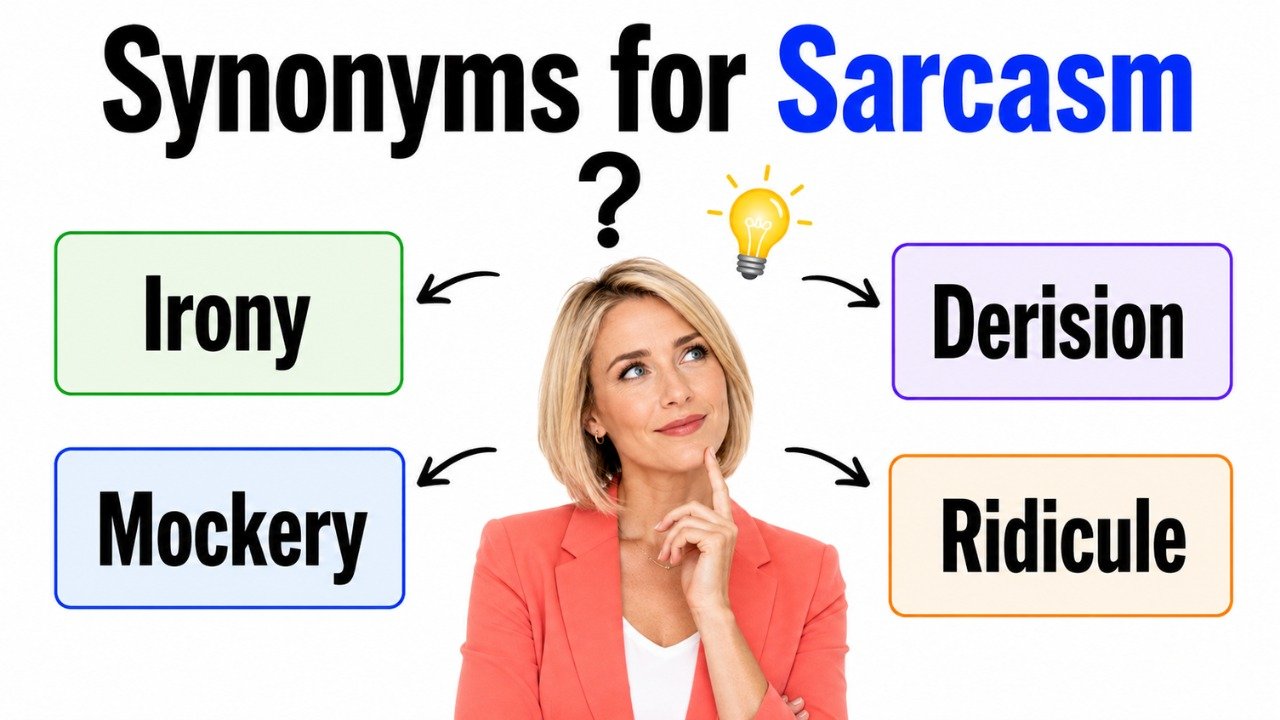
Quick Answer: The best synonyms for sarcasm include irony, mockery, ridicule, derision, scorn, satire, snark, caustic wit, sardonic humor, and teasing. Use verbal irony when someone says the opposite of what they mean. Choose mockery or ridicule when the purpose is to embarrass someone. Snark suits casual speech, while caustic wit and sardonic humor describe sharper or more literary expression. Satire is best when humor criticizes society, behavior, or institutions.
Pronunciation and Word Details
Word: Sarcasm.
Pronunciation: /ˈsɑːr.kæz.əm/.
Part of Speech: Noun.
Meaning: The use of words that often mean the opposite of their literal meaning to mock, criticize, or show irritation.
US Pronunciation:
UK Pronunciation:
What Does “Sarcasm” Mean?
Sarcasm is a form of speech in which someone says something that is often opposite to what they truly mean, usually to mock, criticize, tease, or express frustration.
Sarcasm is a noun. The related adjective is “sarcastic,” and the related adverb is “sarcastically.”
A sarcastic comment may sound positive on the surface while carrying a negative meaning. For example, saying “Wonderful timing” to someone who arrives very late is sarcastic because the speaker does not actually believe the timing was wonderful.
Sarcasm can also be direct rather than opposite in meaning. A cutting statement such as “You have such a talent for creating problems” may be sarcastic because it uses exaggerated praise to deliver criticism.
The meaning of sarcasm often depends on tone of voice, facial expression, context, and the relationship between speakers. Without these signals, a sarcastic remark may be misunderstood as sincere.
Meaning, Tone, and Context of “Sarcasm”
Sarcasm usually has a sharp, mocking, critical, or playful tone. It can be humorous among close friends, but it can also sound rude, bitter, dismissive, or hostile.
In casual conversation, sarcasm may be used for friendly teasing. People who know each other well may understand that the speaker is joking rather than attacking them.
In tense situations, sarcasm can express annoyance or contempt. A sarcastic response may communicate criticism without stating the criticism directly.
In formal writing, the word “sarcasm” is neutral when used to describe a communication style. However, actual sarcastic language is often unsuitable for reports, professional messages, instructions, and serious discussions because readers may misunderstand the intended tone.
In literature, sarcasm can reveal a character’s personality, create humor, expose hypocrisy, or emphasize conflict. It may overlap with irony, satire, parody, and ridicule, but these terms have different meanings.
Sarcasm is usually more personal and pointed than general humor. It often targets a person, action, opinion, mistake, or situation.
When and How to Use “Sarcasm”
For Playful Teasing: Sarcasm can create humor between people who understand each other’s intentions.
Example: After his friend ate the final slice, he said, “Thanks for saving some for everyone.”
For Expressing Annoyance: A sarcastic remark can show frustration without directly stating it.
Example: When the printer stopped again, she said, “This machine is incredibly reliable.”
For Criticism: Sarcasm may expose poor judgment, carelessness, or an obvious mistake.
Example: After the careless decision failed, he remarked, “That was a brilliant plan.”
For Literary Dialogue: Writers can use sarcasm to reveal intelligence, bitterness, confidence, or hostility in a character.
Example: “Your kindness is overwhelming,” the character said after receiving no help.
For Humor: Sarcasm can make an ordinary observation sound sharper or more amusing.
Example: Looking at the pouring rain, she said, “Perfect weather for a picnic.”
For Social Commentary: Sarcasm may criticize behavior, customs, or public attitudes through exaggerated praise.
Example: The essay used sarcasm to question society’s obsession with appearances.
For Deflecting Discomfort: Some people use sarcasm to avoid discussing embarrassment, fear, or disappointment directly.
Example: After forgetting his notes, he said, “Clearly, I came fully prepared.”
For Emphasis: Sarcasm can emphasize how strongly the speaker disagrees with a statement or situation.
Example: “Yes, because ignoring the problem always works so well.”
Best Synonyms for Sarcasm
Irony: Language or a situation in which the intended meaning differs from the literal or expected meaning.
Example: Her comment contained irony because she praised the very mistake she disliked.
Verbal Irony: Saying something that differs from, or is opposite to, the intended meaning.
Example: Calling a freezing day “lovely and warm” is verbal irony.
Mockery: Speech or behavior intended to make someone or something appear foolish.
Example: His imitation sounded more like mockery than friendly humor.
Ridicule: Harsh laughter or criticism intended to embarrass someone.
Example: The speaker used ridicule to dismiss the opposing argument.
Derision: Contemptuous mockery that shows strong disrespect.
Example: Her suggestion was met with derision from the unfriendly audience.
Scorn: Open contempt or disrespect toward someone or something.
Example: He spoke with scorn about people who disagreed with him.
Snark: Informal, sharp, and often sarcastic criticism.
Example: Her response was full of snark but offered no useful solution.
Caustic Wit: Clever humor that is sharply critical and potentially hurtful.
Example: His caustic wit entertained some listeners and offended others.
Sardonic Humor: Grim, mocking humor that often expresses disbelief or bitterness.
Example: She used sardonic humor while describing the failed project.
Teasing: Playful remarks intended to amuse or mildly embarrass someone.
Example: Their teasing was friendly and did not cause offense.
50 Synonyms for Sarcasm with Short Meanings
- Irony: Expression in which the intended meaning differs from the literal meaning.
- Verbal Irony: Saying something different from what is actually meant.
- Mockery: Speech or behavior that makes someone appear foolish.
- Ridicule: Harsh mockery intended to embarrass or dismiss.
- Derision: Contemptuous laughter or mocking criticism.
- Scorn: Strong disrespect expressed through words or attitude.
- Contempt: A feeling that someone or something deserves little respect.
- Disdain: Proud or dismissive lack of respect.
- Taunting: Provoking someone through insulting or challenging remarks.
- Teasing: Playful or mildly mocking comments.
- Jeering: Rude and insulting remarks directed at someone.
- Sneering: Mocking expression or speech showing contempt.
- Scoffing: Speaking with disbelief, disrespect, or ridicule.
- Satire: Humor used to criticize behavior, society, or institutions.
- Parody: Humorous imitation of a style, person, or work.
- Lampooning: Publicly mocking someone or something through humor.
- Banter: Playful exchange of teasing remarks.
- Dry Wit: Subtle humor delivered in a serious manner.
- Caustic Wit: Clever humor that is sharply critical.
- Acerbic Wit: Sharp and biting intelligence expressed through language.
- Biting Humor: Humor that strongly criticizes or wounds.
- Cutting Humor: Humor intended to embarrass or hurt.
- Sardonic Humor: Bitter or grim humor expressing mockery.
- Mordant Humor: Dark, sharp humor about serious or unpleasant subjects.
- Cynicism: Distrustful or negative expression about human motives.
- Snark: Casual, sharp, and sarcastic criticism.
- Snideness: Indirectly insulting or unpleasant speech.
- Gibe: A mocking or insulting remark.
- Barb: A short comment intended to hurt or criticize.
- Quip: A clever and often sharp remark.
- Wisecrack: A quick, clever, and sometimes disrespectful joke.
- Taunt: A remark intended to provoke or insult.
- Insult: A statement that shows disrespect or causes offense.
- Put Down: A remark intended to make someone feel inferior.
- Cutting Remark: A statement that is sharply hurtful.
- Sharp Remark: A direct comment with a critical or unfriendly tone.
- Acid Remark: A bitter and deliberately hurtful comment.
- Ironic Comment: A statement whose intended meaning differs from its wording.
- Backhanded Comment: A statement that appears positive but contains criticism.
- Needling: Repeatedly irritating someone with small critical remarks.
- Ribbing: Friendly teasing, usually among people who know one another.
- Heckling: Interrupting someone with mocking or challenging comments.
- Roasting: Humorously criticizing someone through exaggerated jokes.
- Acerbity: Sharpness or bitterness in speech or manner.
- Mordancy: A biting and sharply critical quality.
- Ironic Humor: Humor based on contrast between words and intended meaning.
- Scathing Humor: Extremely harsh humor used to criticize.
- Contemptuous Humor: Humor that communicates disrespect or superiority.
- Bitter Wit: Clever humor shaped by anger or disappointment.
- Sardonicism: Mocking expression marked by bitterness or disbelief.
Read Also:
Synonyms for Fueled

Synonyms for Sarcasm by Context
When Sarcasm Means Verbal Irony
Verbal irony is the closest alternative when someone intentionally says something different from what they actually mean.
Useful choices include irony, verbal irony, ironic humor, ironic comment, and dry wit.
Original: Her sarcasm was obvious when she called the disastrous meeting productive.
Better Option: Her verbal irony was obvious when she called the disastrous meeting productive.
Example: He looked at the broken chair and said, “That seems perfectly safe.”
Verbal irony does not always attack a person. It may simply highlight the difference between reality and the words being spoken.
When Sarcasm Means Mockery
Use mockery, ridicule, derision, jeering, sneering, or scoffing when the language is intended to make someone appear foolish.
Original: His sarcasm embarrassed the new employee.
Better Option: His mockery embarrassed the new employee.
Example: The audience responded with derision rather than considering the proposal fairly.
“Mockery” is broad and direct. “Ridicule” is stronger and usually causes embarrassment. “Derision” suggests contempt as well as mockery.
When Sarcasm Means Sharp Humor
Use snark, caustic wit, acerbic wit, biting humor, sardonic humor, or mordant humor when the speaker is clever but critical.
Original: Her sarcasm made the review entertaining.
Better Option: Her caustic wit made the review entertaining.
Example: His sardonic humor revealed how little confidence he had in the plan.
“Snark” is casual and modern. “Caustic wit” is sharper and more formal. “Sardonic humor” often contains bitterness or pessimism.
When Sarcasm Means Friendly Teasing
Use teasing, banter, ribbing, quips, or wisecracks when the purpose is playful rather than cruel.
Original: Their sarcasm showed that they were comfortable with each other.
Better Option: Their playful banter showed that they were comfortable with each other.
Example: The teammates exchanged friendly ribbing after the match.
These alternatives suggest warmth and familiarity. They should not be used when the speaker intends to humiliate or harm someone.
When Sarcasm Means Contempt
Use scorn, disdain, contempt, snideness, or a cutting remark when the speech communicates disrespect.
Original: His sarcasm revealed his opinion of the proposal.
Better Option: His scorn revealed his opinion of the proposal.
Example: She dismissed the suggestion with a snide comment.
“Scorn” and “contempt” describe the attitude behind the words. “Snideness” describes an indirect and unpleasant manner of speaking.
When Sarcasm Criticizes Society or Behavior
Use satire, lampooning, sardonic humor, parody, or scathing humor when criticism has a broader target.
Original: The writer used sarcasm to criticize political dishonesty.
Better Option: The writer used satire to criticize political dishonesty.
Example: The story used parody to expose the absurdity of the custom.
Satire usually criticizes society, institutions, behavior, or ideas. Sarcasm is more often aimed at a particular person, action, or statement.
Another Word for Sarcasm
“Verbal irony” is often the closest formal replacement for sarcasm because both may involve saying something different from what is actually meant. However, the best alternative depends on the purpose and tone.
Use “mockery” when the remark is meant to embarrass. Choose “snark” for casual sharpness, “caustic wit” for clever but harsh humor, and “teasing” for playful speech.
Original: Her sarcasm was difficult to detect in the message.
Better Option: Her verbal irony was difficult to detect in the message.
Original: His sarcasm made the student feel foolish.
Better Option: His mockery made the student feel foolish.
Original: The conversation was filled with sarcasm.
Better Option: The conversation was filled with playful banter.
Original: The critic was known for his sarcasm.
Better Option: The critic was known for his caustic wit.
When Not to Use “Sarcasm”
Do not use “sarcasm” when a more precise word clearly explains the speaker’s purpose.
If the language broadly criticizes society or institutions, “satire” may be more accurate. If someone directly humiliates another person, “ridicule” or “mockery” may better describe the behavior.
Weak: The novel uses sarcasm to criticize an entire social system.
Better: The novel uses satire to criticize an entire social system.
Avoid describing all ironic language as sarcasm. Irony may be humorous, surprising, or descriptive without being mocking.
Weak: The fire station burned down, which was sarcasm.
Better: The fire station burned down, which was situational irony.
Do not use sarcasm in serious communication when readers may misunderstand your meaning. Written sarcasm lacks vocal tone and facial expression.
Weak: The manager wrote, “Excellent work,” after an employee made a serious error.
Better: The manager explained the error directly and respectfully.
Avoid sarcasm during sensitive conversations involving grief, fear, failure, conflict, or insecurity. Even playful remarks can sound cruel when someone is emotionally vulnerable.
Weak: “You handled that wonderfully,” she said after her friend received upsetting news.
Better: “I am sorry that happened. How can I support you?”
Do not label friendly teasing as hostile sarcasm unless the remark contains criticism, opposite meaning, or a clear mocking purpose.
Weak: Their harmless jokes were full of cruel sarcasm.
Better: Their harmless jokes were examples of friendly teasing.
Words Commonly Confused With Sarcasm
Sarcasm vs Irony: Sarcasm is usually verbal and intended to mock, criticize, or express irritation. Irony is broader and describes a contrast between appearance and reality, words and meaning, or expectations and results.
Sarcasm vs Verbal Irony: Verbal irony means saying something different from what is intended. Sarcasm is a type of verbal irony when the purpose is mocking or critical.
Sarcasm vs Satire: Sarcasm usually targets a person, remark, action, or immediate situation. Satire uses humor, exaggeration, or irony to criticize wider social behavior, ideas, or institutions.
Sarcasm vs Mockery: Sarcasm often works through opposite or exaggerated wording. Mockery includes any speech, imitation, or behavior intended to make someone appear foolish.
Sarcasm vs Ridicule: Sarcasm may be playful or indirect. Ridicule is usually harsher and aims to embarrass or discredit someone.
Sarcasm vs Cynicism: Sarcasm is a style of expression. Cynicism is an attitude of distrust toward people’s motives or sincerity.
Sarcasm vs Wit: Wit is clever and amusing language. Sarcasm may be witty, but it also contains criticism, mockery, irritation, or contempt.
Sarcasm vs Teasing: Sarcasm can be sharp or hostile. Teasing is often playful, although it may become hurtful when it continues after someone is uncomfortable.
Which Synonym Should You Choose?
Choose “verbal irony” in formal analysis when a speaker says something different from the intended meaning.
Choose “irony” when discussing a general contrast between words, expectations, events, or reality.
Choose “mockery” when someone tries to make another person, idea, or action appear foolish.
Choose “ridicule” when the language is harsh, humiliating, and publicly dismissive.
Choose “derision” when mockery also communicates deep contempt.
Choose “snark” in casual conversation when the tone is sharp, clever, and slightly rude.
Choose “teasing” when the remarks are playful and shared between people who understand the humor.
Choose “banter” when two or more people exchange light and witty remarks.
Choose “caustic wit” in essays, reviews, or literary descriptions when the humor is intelligent but severe.
Choose “sardonic humor” when the speaker’s mockery reflects bitterness, pessimism, or disbelief.
Choose “satire” when humor criticizes social customs, public behavior, systems, or institutions.
Choose “scorn” when the main idea is disrespect rather than humor.
Choose “cutting remark” when describing one specific statement intended to hurt.
Choose “backhanded comment” when apparent praise contains a hidden insult.
Real Life Examples of “Sarcasm” in Sentences
Original: She used sarcasm when the meeting began an hour late.
Better Option: She used verbal irony when the meeting began an hour late.
Original: His sarcasm made the new student uncomfortable.
Better Option: His mockery made the new student uncomfortable.
Original: The friends exchanged sarcasm throughout dinner.
Better Option: The friends exchanged playful banter throughout dinner.
Original: The review was filled with sarcasm about the poor service.
Better Option: The review was filled with caustic wit about the poor service.
Original: Her sarcasm showed that she did not believe his excuse.
Better Option: Her sardonic response showed that she did not believe his excuse.
Original: The writer used sarcasm to expose unfair social expectations.
Better Option: The writer used satire to expose unfair social expectations.
Original: His sarcasm sounded cruel rather than amusing.
Better Option: His ridicule sounded cruel rather than amusing.
Original: She answered the obvious question with sarcasm.
Better Option: She answered the obvious question with a sharp quip.
Original: Their sarcasm was harmless because both understood the joke.
Better Option: Their teasing was harmless because both understood the joke.
Original: He responded to the criticism with sarcasm.
Better Option: He responded to the criticism with snark.
Synonym Groups and Usage Differences
Irony Group
Irony, verbal irony, ironic humor, ironic comment, and dry wit involve a contrast between words and intended meaning.
These words are useful when the speaker’s literal statement does not match the real message. They do not always imply cruelty.
Example: Calling the crowded room “peaceful” was an example of verbal irony.
Mockery Group
Mockery, ridicule, derision, jeering, sneering, and scoffing focus on making a person or idea appear foolish.
“Mockery” is the broadest choice. “Ridicule” suggests humiliation. “Derision” expresses contempt. “Jeering” often involves loud or public insults.
Example: The proposal deserved fair discussion rather than ridicule.
Sharp Humor Group
Caustic wit, acerbic wit, biting humor, cutting humor, snark, sardonic humor, and mordant humor combine humor with criticism.
“Snark” is informal. “Caustic wit” and “acerbic wit” sound more literary. “Mordant humor” often addresses serious or unpleasant subjects.
Example: Her caustic wit made the criticism memorable.
Friendly Humor Group
Teasing, banter, ribbing, quips, and wisecracks can describe light, playful exchanges.
The relationship between speakers determines whether these remarks feel friendly or insulting.
Example: Their banter made the long journey more enjoyable.
Contempt Group
Scorn, contempt, disdain, snideness, and sneering emphasize disrespect.
These terms may describe the speaker’s attitude even when no humor is intended.
Example: He spoke with open disdain about the suggestion.
Insult Group
Taunts, insults, put downs, barbs, acid remarks, and cutting remarks are direct or indirect attacks.
A barb is usually brief and clever. A put down aims to reduce someone’s confidence or status. An acid remark is deliberately bitter.
Example: Her backhanded comment sounded like praise but functioned as a put down.
Literary Criticism Group
Satire, parody, lampooning, sardonicism, and scathing humor are useful when describing creative or public criticism.
Satire has a corrective or critical purpose. Parody imitates a recognizable style. Lampooning openly attacks a target through humor.
Example: The play uses satire to expose selfish behavior.
Antonyms of Sarcasm
Sarcasm can express mockery, indirect criticism, or insincerity. Its opposites therefore include words connected with honesty, kindness, praise, and direct communication.
Sincerity: Honest expression of genuine feelings or beliefs.
Earnestness: Serious and truthful communication without mockery.
Praise: Positive words expressing approval or admiration.
Respect: Considerate treatment that recognizes another person’s value.
Kindness: Friendly and thoughtful behavior toward others.
Encouragement: Supportive words intended to build confidence.
Admiration: Warm approval of someone or something.
Politeness: Courteous and respectful communication.
Straightforwardness: Clear and direct expression without hidden meaning.
Literalness: Use of words according to their direct meaning.
Honesty: Truthful communication without deception or disguise.
Compliment: A sincere statement of approval or appreciation.
Comparison: Sarcasm vs Related Words
Sarcasm vs Irony
Sarcasm is usually a spoken or written remark intended to mock or criticize. Irony is a broader contrast between what is said, expected, or presented and what is actually true.
Example With Sarcasm: Looking at the messy room, she said, “You are clearly very organized.”
Example With Irony: The safety expert forgot to wear protective equipment.
Sarcasm vs Verbal Irony
Verbal irony occurs whenever a speaker’s intended meaning differs from the literal wording. Sarcasm is verbal irony used for mockery, criticism, irritation, or humor.
Example With Sarcasm: After the computer crashed, he said, “This program works beautifully.”
Example With Verbal Irony: On a cold morning, she said, “What lovely warm weather.”
Sarcasm vs Satire
Sarcasm is usually brief and directed at a person, action, or immediate situation. Satire is a broader form of criticism that may use irony, parody, exaggeration, and humor.
Example With Sarcasm: “Excellent decision,” she said after the plan failed.
Example With Satire: The story exaggerates social behavior to reveal its foolishness.
Sarcasm vs Mockery
Sarcasm often depends on opposite wording or exaggerated praise. Mockery includes any imitation, comment, gesture, or behavior that makes someone appear foolish.
Example With Sarcasm: “You are a true expert,” he said after the obvious mistake.
Example With Mockery: They copied his voice to make the group laugh at him.
Sarcasm vs Ridicule
Sarcasm can be playful, subtle, or indirect. Ridicule is usually openly humiliating and more clearly intended to damage someone’s confidence or reputation.
Example With Sarcasm: She called the untidy desk “a model of organization.”
Example With Ridicule: The group laughed loudly at his honest mistake.
Sarcasm vs Cynicism
Sarcasm is a communication method. Cynicism is a belief that people are mainly selfish, dishonest, or insincere.
Example With Sarcasm: “I am sure everyone will follow the rules perfectly,” he said.
Example With Cynicism: He believed that people only followed rules when they benefited personally.
Sarcasm vs Teasing
Sarcasm may communicate criticism or contempt. Teasing is usually lighter and more affectionate, although it can still become hurtful.
Example With Sarcasm: “That was helpful,” she said after he caused another problem.
Example With Teasing: She joked about her friend’s habit of arriving ten minutes early.
Sarcasm vs Sardonic Humor
Sarcasm may be playful, annoyed, or hostile. Sardonic humor usually reflects bitterness, disbelief, or a grim view of a situation.
Example With Sarcasm: “Perfect timing,” he said when the lights went out.
Example With Sardonic Humor: She joked bitterly that the failed system was performing exactly as expected.
Common Phrases and Expressions With Sarcasm
A Touch of Sarcasm: A small amount of mocking or ironic expression.
Example: His answer contained a touch of sarcasm.
Heavy Sarcasm: Very obvious and strongly expressed sarcasm.
Example: Her heavy sarcasm made her true opinion clear.
Biting Sarcasm: Sarcasm that is especially sharp and hurtful.
Example: The argument ended with several examples of biting sarcasm.
Dry Sarcasm: Subtle sarcasm delivered without obvious emotion.
Example: His dry sarcasm was easy to miss.
Obvious Sarcasm: Sarcasm that listeners can recognize immediately.
Example: Her exaggerated praise was obvious sarcasm.
Subtle Sarcasm: Sarcasm expressed indirectly or with limited emotional signals.
Example: The subtle sarcasm in his reply confused some readers.
Sarcastic Tone: A manner of speaking that communicates mockery or opposite meaning.
Example: Her sarcastic tone showed that she did not agree.
Dripping With Sarcasm: Filled with very noticeable sarcasm.
Example: His response was dripping with sarcasm.
Use Sarcasm: To communicate through mocking or ironic language.
Example: She tends to use sarcasm when she feels uncomfortable.
Respond With Sarcasm: To answer someone through a mocking or ironic remark.
Example: He responded with sarcasm instead of addressing the concern.
Common Mistakes to Avoid
Treating All Irony as Sarcasm
Sarcasm is one type of verbal irony, but not all irony is sarcastic. Situational irony does not require a speaker or a mocking intention.
Incorrect: A traffic officer received a parking ticket, which was sarcasm.
Correct: A traffic officer received a parking ticket, which was situational irony.
Assuming Sarcasm Is Always Funny
Sarcasm can be humorous, but it can also communicate anger, contempt, bitterness, or hostility.
Weak: His cruel sarcasm was only harmless humor.
Better: His sarcastic remark sounded insulting rather than playful.
Using the Wrong Synonym
Do not replace “sarcasm” with “satire” when describing one short personal remark. Do not use “teasing” when the speaker intends to humiliate someone.
Weak: Her satire hurt her coworker during the conversation.
Better: Her sarcastic comment hurt her coworker during the conversation.
Ignoring Tone and Context
The same words may sound sincere, ironic, or sarcastic depending on tone and situation. Describe the context when the intended meaning is not obvious.
Unclear: He said the plan was brilliant.
Clearer: He sarcastically called the failed plan brilliant.
Overusing Sarcasm in Dialogue
Constant sarcastic dialogue can make every character sound similar, hostile, or emotionally distant. Balance sarcasm with sincere, direct, and neutral speech.
Weak: Every response in the conversation contained a sarcastic insult.
Better: The dialogue used occasional sarcasm to reveal tension between the characters.
Using Sarcasm in Sensitive Situations
Sarcasm can sound dismissive when someone is discussing fear, grief, failure, embarrassment, or personal concerns.
Weak: She answered his serious concern with a sarcastic joke.
Better: She answered his concern with patience and respect.
Confusing the Noun and Adjective Forms
“Sarcasm” is a noun. “Sarcastic” is an adjective. “Sarcastically” is an adverb.
Incorrect: His sarcasm voice annoyed the audience.
Correct: His sarcastic voice annoyed the audience.
Incorrect: She replied sarcasm.
Correct: She replied sarcastically.
Using Unclear Sarcasm in Writing
Readers cannot hear tone of voice or see facial expressions. Sarcasm in written communication may be interpreted literally.
Weak: “Excellent work,” the supervisor wrote after a serious error.
Better: The supervisor clearly explained the error and the required correction.
Repeating the Same Description
Repeatedly using “sarcasm” can make analysis vague. Select words that identify the exact tone or purpose.
Repetitive: The character uses sarcasm, and the sarcasm makes the scene sarcastic.
Better: The character uses caustic wit, which gives the scene a bitter and mocking tone.
Conclusion
The best synonyms for sarcasm depend on whether the language is playful, critical, bitter, literary, or openly insulting. Use verbal irony for opposite meaning, mockery or ridicule for humiliation, snark for casual sharpness, and caustic wit for clever criticism. Sardonic humor suits bitter expression, while teasing and banter describe friendlier exchanges. When choosing among synonyms for sarcasm, consider the speaker’s intention, the target, the tone, and the effect on the listener.
FAQs About Synonyms for Sarcasm
What Is the Closest Synonym for Sarcasm?
Verbal irony is often the closest formal synonym, especially when someone says the opposite of what they mean to criticize or mock.
Is Irony the Same as Sarcasm?
No. Sarcasm is usually mocking verbal irony, while irony can also describe situations, events, and contrasts that contain no mockery.
What Is a Formal Word for Sarcasm?
Verbal irony, derision, acerbity, mordancy, and caustic wit are useful formal choices, depending on the exact tone.
What Is a Casual Synonym for Sarcasm?
Snark is a common casual alternative. Banter, teasing, ribbing, and wisecracks may also fit when the tone is playful.
What Is a Stronger Word Than Sarcasm?
Ridicule, derision, scorn, and contempt are stronger when the language is openly humiliating or disrespectful.
What Is the Difference Between Sarcasm and Satire?
Sarcasm usually targets a particular person, comment, or situation. Satire uses humor and irony to criticize broader behavior, beliefs, or institutions.
Can Sarcasm Be Friendly?
Yes. Sarcasm can be friendly when people understand the joke and feel comfortable with one another. It becomes harmful when it humiliates, excludes, or upsets someone.
