
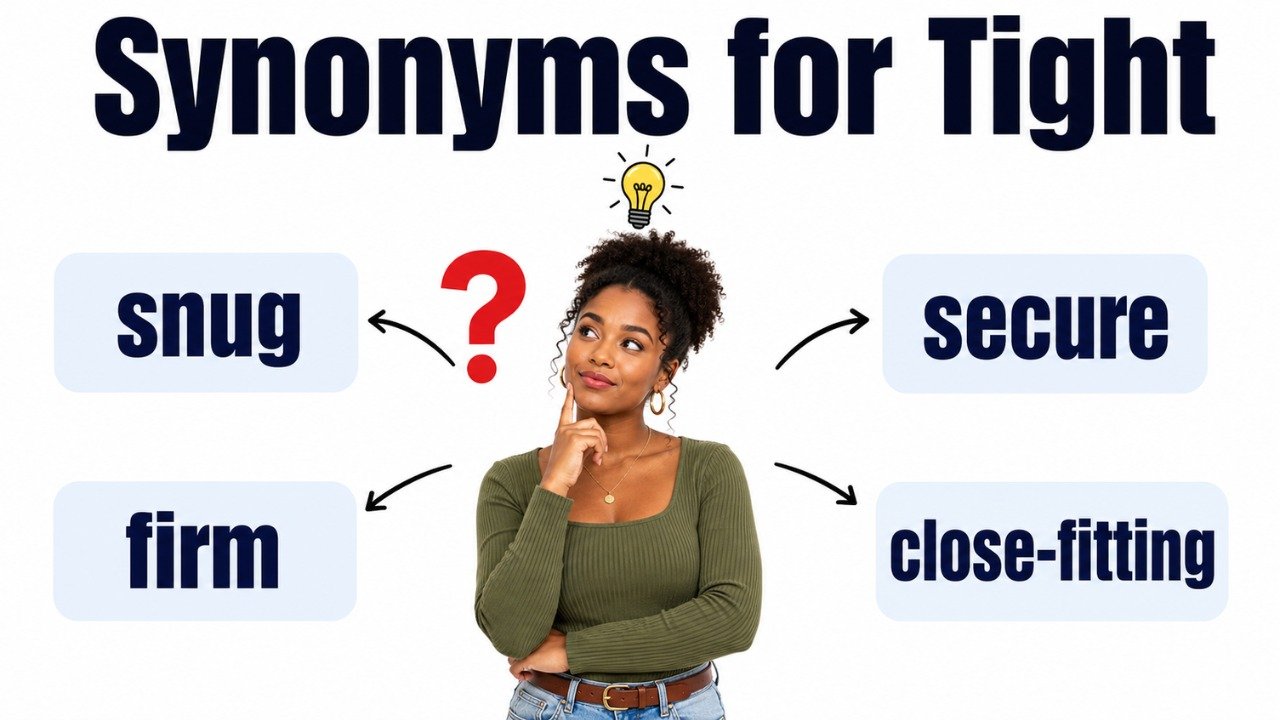
Quick Answer: The best synonyms for tight include snug, close fitting, firm, secure, compact, cramped, restricted, strict, limited, and tense. Among these synonyms for tight, snug is best for clothing that fits closely, secure works for something firmly fastened, compact suits small spaces or arrangements, restricted fits limited access or movement, strict describes firm rules, limited works for money or resources, and tense is best for stressful situations or strained relationships.
Pronunciation and Word Details
Word: Tight.
Pronunciation: /taɪt/
Part of Speech: Adjective and adverb.
Meaning: Firmly fixed, closely fitted, limited in space or resources, strict, tense, or difficult to move through.
US Pronunciation:
UK Pronunciation:
What Does “Tight” Mean?
Tight means closely fitted, firmly secured, limited, restricted, compact, strict, or tense. It is most commonly used as an adjective, although it can also work as an adverb in expressions such as hold tight or close something tight.
The word has several meanings depending on context. Tight clothing fits closely around the body. A tight lid is firmly fastened. A tight space is small and difficult to move through. A tight budget means only a limited amount of money is available.
Tight can also describe strict control or severe restrictions. Tight security means careful and strongly controlled protection. A tight schedule allows little free time between activities.
In emotional or social contexts, tight may describe a close relationship. Two people who are tight may have a strong bond. It can also describe stress, such as a tight situation in which choices, time, money, or space are limited.
Because tight has many meanings, the most accurate synonym depends heavily on the sentence.
Meaning, Tone, and Context of “Tight”
Tight is usually neutral and highly common in everyday English. It appears naturally in conversation, instructions, descriptions, business writing, clothing discussions, sports, finance, travel, and descriptions of physical spaces.
When tight describes clothing or objects, the tone is neutral. A tight shirt, tight knot, or tight seal simply describes how closely something fits or how firmly something is fixed.
When describing money, schedules, or resources, tight often suggests difficulty or limitation. A tight budget means there is little extra money available. A tight deadline means there is little time to complete something.
In formal writing, more specific alternatives such as restricted, limited, secure, stringent, compact, or constrained may communicate the intended meaning more precisely.
In casual speech, tight can also describe a strong friendship or close connection. This meaning is more conversational than formal.
The word can carry emotional force when describing stressful conditions. A tight situation may suggest pressure, danger, or limited choices.
When and How to Use “Tight”
For Clothing: Use tight when clothes fit closely around the body and leave little extra room.
Example: The sleeves were too tight around his arms.
For Secure Fastening: Use tight when something is firmly closed, tied, or fixed in place.
Example: Make sure the cap is tight before moving the bottle.
For Small Spaces: Tight can describe an area with very little room for movement.
Example: The furniture made the hallway feel tight.
For Limited Money: Tight often describes a budget with little extra money available.
Example: Their budget is tight this month.
For Limited Time: Tight can describe a schedule or deadline that leaves little free time.
Example: We are working with a tight deadline.
For Strict Control: Use tight when rules, security, or supervision are firm and carefully enforced.
Example: The building operates under tight security.
For Difficult Competition: Tight can describe a contest, race, or result in which the difference between competitors is small.
Example: The final round remained tight until the last minute.
For Close Relationships: In conversational English, tight can describe people who share a strong relationship.
Example: The two friends have remained tight since childhood.
For Tense Situations: Tight can describe stressful circumstances with little room for error.
Example: Negotiations became tight as the deadline approached.
Best Synonyms for Tight
Snug: Fitting closely in a comfortable or secure way.
Example: The jacket felt snug without being uncomfortable.
Close Fitting: Shaped to fit closely around the body or an object.
Example: She chose a close fitting dress for the event.
Firm: Strongly fixed, solid, or not easily moved.
Example: Keep a firm grip on the handle.
Secure: Firmly fastened, protected, or unlikely to move.
Example: The rope remained secure around the package.
Compact: Closely arranged within a small amount of space.
Example: The apartment has a compact but practical kitchen.
Cramped: Uncomfortably small or lacking enough space.
Example: Four adults found the back seat cramped.
Restricted: Limited by rules, space, access, or conditions.
Example: Entry to the area is restricted after dark.
Strict: Firmly enforcing rules or standards.
Example: The school maintains strict safety procedures.
Limited: Available only in a small amount or range.
Example: We have limited time to finish the task.
Tense: Nervous, strained, or emotionally pressured.
Example: The room became tense during the disagreement.
50 Synonyms for Tight with Short Meanings
- Snug: Fitting closely and securely.
- Close Fitting: Fitting very near the body or surface.
- Fitted: Shaped closely to match something.
- Clinging: Holding closely to a surface or body.
- Constricting: Squeezing or limiting movement.
- Restrictive: Limiting freedom, movement, or choice.
- Firm: Solid, steady, or strongly fixed.
- Secure: Safely and firmly fastened.
- Fastened: Fixed or closed firmly in place.
- Fixed: Securely placed and not easily moved.
- Taut: Stretched firmly without slack.
- Stretched: Pulled firmly across a surface or distance.
- Close: Positioned with little space between things.
- Compact: Arranged within a small space.
- Dense: Closely packed together.
- Compressed: Pressed into less space.
- Packed: Filled closely with people or objects.
- Crowded: Containing too many people or things.
- Cramped: Uncomfortably limited in space.
- Confined: Restricted to a small area.
- Narrow: Having little width or room.
- Restricted: Limited in movement, access, or amount.
- Constrained: Limited by conditions or restrictions.
- Limited: Small in amount, range, or availability.
- Scarce: Available only in small quantities.
- Short: Insufficient in amount or supply.
- Lean: Having very little extra money or resources.
- Strict: Firmly controlled by rules.
- Stringent: Very strict and demanding.
- Rigid: Strict and difficult to change.
- Severe: Strong, strict, or demanding.
- Controlled: Carefully regulated or managed.
- Exacting: Requiring great care or strict standards.
- Demanding: Requiring considerable effort or attention.
- Close Knit: Strongly connected as a group.
- United: Joined closely by common interests or bonds.
- Connected: Closely linked or associated.
- Intimate: Very close and personally connected.
- Close: Sharing a strong relationship or connection.
- Tense: Nervous, strained, or stressful.
- Strained: Difficult, pressured, or lacking ease.
- Pressured: Experiencing strong demands or stress.
- Difficult: Hard to manage or deal with.
- Critical: Serious and requiring careful attention.
- Precarious: Uncertain and potentially difficult.
- Competitive: Involving strong or close competition.
- Narrow: Separated by only a small difference.
- Close Run: Decided by a very small margin.
- Restrained: Kept under careful control.
- Bound: Tied, secured, or held closely.
Read Also:
Synonyms for Supporting

Synonyms for Tight by Context
When Tight Means Closely Fitting
When tight describes clothing or another object that fits closely around something, useful synonyms include snug, close fitting, fitted, clinging, constricting, and restrictive.
Snug often has a more comfortable meaning than tight. Constricting and restrictive usually suggest discomfort or limited movement.
Example: The sweater felt snug around her shoulders.
Example: The close fitting trousers were designed for a neat appearance.
Example: The bandage became constricting as the swelling increased.
When Tight Means Firmly Fastened
When tight describes something fixed or closed securely, useful alternatives include firm, secure, fastened, fixed, taut, and bound.
Secure is particularly useful when something must not move or come loose. Taut works when rope, fabric, or another flexible material is stretched firmly.
Example: Check that every connection is secure before using the equipment.
Example: The rope remained taut between the two posts.
Example: She kept a firm hold on the railing.
When Tight Means Small or Crowded
Tight can describe a space where there is little room to move. Useful alternatives include cramped, compact, confined, narrow, crowded, packed, and compressed.
Compact is often neutral or positive because it suggests efficient use of space. Cramped is usually negative because it suggests discomfort.
Example: The compact room included everything the traveler needed.
Example: The storage area became cramped after more boxes were added.
Example: The narrow passage allowed only one person through at a time.
When Tight Means Limited
Tight frequently describes money, time, resources, or availability that is limited.
Useful synonyms include limited, restricted, scarce, short, constrained, and lean.
Example: Funds are limited, so unnecessary expenses must be avoided.
Example: The team is working with a restricted amount of time.
Example: Resources remained scarce throughout the project.
When Tight Means Strict
Tight can describe firm rules, security, supervision, or control.
Useful alternatives include strict, stringent, rigid, controlled, severe, and exacting.
Example: The laboratory follows strict safety procedures.
Example: New applicants must satisfy stringent requirements.
Example: Access is carefully controlled during the examination.
When Tight Means Close in a Relationship
In casual conversation, tight can describe a close personal connection. Useful alternatives include close, close knit, intimate, connected, and united.
Example: The siblings have remained close throughout adulthood.
Example: The neighborhood has a close knit community.
Example: The group became strongly connected after working together for several years.
When Tight Means Tense or Difficult
Tight can describe a difficult situation involving pressure, stress, or limited choices.
Useful alternatives include tense, strained, pressured, difficult, critical, and precarious.
Example: The atmosphere became tense during the final discussion.
Example: Relations between the two groups remained strained.
Example: The business entered a difficult period after several unexpected expenses.
When Tight Means Close in Competition
A tight race, game, contest, or result is one in which the competitors are separated by very little.
Useful alternatives include close, competitive, narrow, and close run.
Example: The election remained close until the final results were counted.
Example: It was a highly competitive match from beginning to end.
Example: The team won by a narrow margin.
Another Word for Tight
The best single replacement for tight depends strongly on meaning. Snug is often the best alternative for clothing, secure works for fastening, limited works for money or time, strict suits rules, cramped describes uncomfortable spaces, and tense fits stressful situations.
Original: This shirt feels tight around my shoulders.
Better Option: This shirt feels snug around my shoulders.
Original: Make sure the lid is tight.
Better Option: Make sure the lid is secure.
Original: We are working with a tight budget.
Better Option: We are working with a limited budget.
Original: Security around the building is tight.
Better Option: Security around the building is strict.
When Not to Use “Tight”
Tight can be too broad when readers need to understand exactly what type of restriction, pressure, closeness, or firmness you mean. In precise writing, a more specific synonym often improves clarity.
Do not use tight automatically for every small space. Compact can sound positive when the space is small but efficiently organized, while cramped clearly expresses discomfort.
Weak: The apartment has a tight kitchen that uses space efficiently.
Better: The apartment has a compact kitchen that uses space efficiently.
Use limited rather than tight when discussing amounts or availability in formal writing.
Weak: Funding for the project remains tight.
Better: Funding for the project remains limited.
Use strict or stringent when referring specifically to rules or requirements.
Weak: The organization has tight standards for safety.
Better: The organization has stringent standards for safety.
Use secure when the intended meaning is firmly fastened.
Weak: Make the strap tight before lifting the bag.
Better: Make the strap secure before lifting the bag.
Use tense when the sentence focuses on emotional strain.
Weak: The conversation became tight after the disagreement.
Better: The conversation became tense after the disagreement.
Avoid tight in formal descriptions of personal relationships when close is clearer.
Weak: The two researchers are tight after years of working together.
Better: The two researchers are close after years of working together.
Words Commonly Confused With Tight
Tight vs Snug: Tight means closely fitted and may suggest discomfort, while snug usually suggests a close but comfortable fit.
Tight vs Taut: Tight is broad and can describe clothing, spaces, money, rules, or fastening. Taut specifically describes something stretched firmly without slack.
Tight vs Secure: Tight emphasizes firmness or lack of looseness. Secure emphasizes safety, stability, or being firmly fastened.
Tight vs Compact: Tight can imply uncomfortable lack of space. Compact usually describes something small and efficiently arranged.
Tight vs Cramped: Tight may simply mean small, while cramped specifically suggests that there is not enough comfortable space.
Tight vs Limited: Tight can describe a limited budget or schedule in conversational English. Limited is more direct and often better for formal writing.
Tight vs Strict: Tight can describe strong control, but strict specifically refers to firm rules, standards, or discipline.
Tight vs Tense: Tight may describe stressful circumstances, while tense directly describes nervousness, strain, or emotional pressure.
Tight vs Close: Tight can describe a narrow difference in competition. Close is often the more natural choice when scores or results are nearly equal.
Which Synonym Should You Choose?
Choose snug when describing clothing or objects that fit closely but comfortably.
Choose close fitting when you need a clear description of clothing that follows the shape of the body.
Choose constricting when something fits so closely that it restricts movement or causes discomfort.
Choose secure when describing something firmly fastened, closed, or protected.
Choose taut when describing rope, fabric, wire, or another material stretched firmly without slack.
Choose compact when a small space is efficiently organized rather than uncomfortable.
Choose cramped when a space is too small for comfort.
Choose limited when writing formally about money, time, resources, opportunities, or availability.
Choose restricted when movement, access, use, or choice is controlled.
Choose constrained when limitations come from conditions, rules, resources, or circumstances.
Choose strict when writing about firm rules, discipline, security, or procedures.
Choose stringent when standards, requirements, or regulations are especially demanding.
Choose close when describing a strong relationship or a competition with only a small difference between participants.
Choose close knit when describing a group whose members have strong personal connections.
Choose tense when describing emotional pressure, nervousness, conflict, or stressful circumstances.
Choose strained when describing a relationship, conversation, or situation that has become difficult.
In essays and reports, choose precise words such as limited, restricted, stringent, compact, or constrained.
In emails, secure, limited, close, and strict are usually clear and natural.
In casual conversation, snug, cramped, close, and tense often sound natural depending on the situation.
Real Life Examples of “Tight” in Sentences
Original: These shoes feel tight around my toes.
Better Option: These shoes feel snug around my toes.
Original: He pulled the rope tight before moving the load.
Better Option: He pulled the rope taut before moving the load.
Original: Make sure the door is tight before leaving.
Better Option: Make sure the door is secure before leaving.
Original: The family is living on a tight budget.
Better Option: The family is living on a limited budget.
Original: We have a tight schedule this afternoon.
Better Option: We have a demanding schedule this afternoon.
Original: The room felt tight with six people inside.
Better Option: The room felt cramped with six people inside.
Original: The company keeps tight control over confidential information.
Better Option: The company keeps strict control over confidential information.
Original: The two teammates are very tight.
Better Option: The two teammates are very close.
Original: It was a tight race until the final few seconds.
Better Option: It was a close race until the final few seconds.
Original: The atmosphere became tight during the discussion.
Better Option: The atmosphere became tense during the discussion.
Synonym Groups and Usage Differences
Fit and Clothing Group
Snug, close fitting, fitted, clinging, constricting, and restrictive describe how closely clothing or another object fits.
Snug usually suggests comfortable closeness. Close fitting is neutral and descriptive. Constricting suggests uncomfortable pressure.
Example: The gloves were snug enough to stay in place without restricting movement.
Fastening and Security Group
Firm, secure, fastened, fixed, taut, and bound describe things held strongly or firmly in position.
Secure emphasizes stability and safety. Taut applies especially to stretched materials. Firm describes strength or steadiness.
Example: The tent remained secure despite the strong wind.
Space Group
Compact, cramped, confined, narrow, crowded, packed, and compressed relate to limited physical space.
Compact may be positive. Cramped and crowded usually express discomfort. Confined emphasizes restriction within boundaries.
Example: The compact office makes efficient use of a small floor area.
Limitation Group
Limited, restricted, constrained, scarce, short, and lean describe shortages or reduced availability.
Limited is the broadest neutral choice. Scarce indicates that something is difficult to obtain. Constrained suggests that outside conditions create the limitation.
Example: The department has limited resources available for the new project.
Control Group
Strict, stringent, rigid, controlled, severe, and exacting describe strong rules, standards, or regulation.
Strict is the most common general choice. Stringent suggests especially demanding requirements. Rigid often implies that rules allow little flexibility.
Example: The facility maintains stringent safety requirements.
Relationship Group
Close, close knit, intimate, connected, and united describe strong human relationships or group bonds.
Close is the most flexible choice for personal relationships. Close knit is especially useful for families, teams, neighborhoods, and communities.
Example: The small team developed a close knit working relationship.
Stress Group
Tense, strained, pressured, difficult, critical, and precarious describe situations with little room for error or comfort.
Tense emphasizes emotional strain. Pressured emphasizes demands. Precarious suggests uncertainty and possible danger or failure.
Example: The discussion remained tense until both sides agreed on a solution.
Competition Group
Close, competitive, narrow, and close run describe contests where the difference between participants is small.
Close is the most natural general synonym. Narrow usually modifies margin, lead, or victory.
Example: The championship ended with a narrow victory for the visiting team.
Antonyms of Tight
The opposite of tight changes according to meaning. Loose is the clearest opposite for fit or fastening, while spacious opposes tight when describing space. Generous can oppose tight when discussing budgets, and relaxed can oppose tight when describing emotional pressure.
Loose: Not firmly fitted, fastened, or fixed.
Baggy: Fitting loosely around the body.
Slack: Not stretched or held firmly.
Free: Not restricted or confined.
Spacious: Providing plenty of room.
Roomy: Having more than enough comfortable space.
Open: Not confined, closed, or restricted.
Unrestricted: Free from limiting rules or conditions.
Unlimited: Not restricted in quantity or range.
Abundant: Available in large amounts.
Generous: More than sufficient in amount or allowance.
Flexible: Able to change without strict limitations.
Lenient: Not strict in enforcing rules.
Relaxed: Calm or not tightly controlled.
Easy: Not demanding, pressured, or difficult.
Calm: Free from tension or emotional pressure.
Distant: Not personally close or strongly connected.
Separate: Not closely joined or connected.
Wide: Having considerable width or space.
Unfastened: Not secured or firmly closed.
Comparison: Tight vs Related Words
Tight vs Snug
Tight and snug can both describe close fitting clothing, but snug usually has a more comfortable and positive meaning. Tight may suggest that the item presses too strongly or limits movement.
Example With Tight: The collar was too tight around his neck.
Example With Snug: The sweater had a snug fit that kept her warm.
Tight vs Secure
Tight describes something firmly fitted or closed. Secure focuses more strongly on stability, protection, or preventing movement.
Example With Tight: Turn the cap until it is tight.
Example With Secure: Check that the cap is secure before carrying the container.
Tight vs Taut
Tight is a broad word. Taut specifically describes something such as rope, wire, skin, or fabric that has been stretched firmly.
Example With Tight: She tied the rope tight around the box.
Example With Taut: The rope remained taut between the posts.
Tight vs Compact
Tight may suggest that a space lacks room. Compact suggests something small but efficiently arranged.
Example With Tight: The seating arrangement felt tight with ten guests.
Example With Compact: The compact kitchen contains plenty of useful storage.
Tight vs Cramped
Tight may indicate limited space without necessarily implying discomfort. Cramped clearly suggests that the available space is uncomfortable.
Example With Tight: Parking is tight near the entrance.
Example With Cramped: The passengers felt cramped in the small vehicle.
Tight vs Limited
Tight is common in conversational expressions such as tight budget or tight schedule. Limited is usually more precise in formal writing.
Example With Tight: We are on a tight budget this month.
Example With Limited: The department has limited funds for additional equipment.
Tight vs Strict
Tight may describe strong control, while strict directly describes rules or standards that are firmly enforced.
Example With Tight: Security remained tight throughout the event.
Example With Strict: The facility follows strict entry procedures.
Tight vs Stringent
Tight can describe strong restrictions in general language. Stringent is more formal and suggests especially demanding standards or requirements.
Example With Tight: The organization introduced tight spending controls.
Example With Stringent: The organization introduced stringent financial controls.
Tight vs Tense
Tight can indirectly suggest pressure or difficulty. Tense directly describes nervousness, conflict, or emotional strain.
Example With Tight: The situation became tight as time ran out.
Example With Tense: The room became tense as the disagreement continued.
Tight vs Close
Tight may describe a competition with little difference between participants, but close is usually more natural in this meaning.
Example With Tight: It was a tight contest from beginning to end.
Example With Close: It was a close contest from beginning to end.
Common Phrases and Expressions With “Tight”
Tight Fit: A fit with very little extra room.
Tight Grip: A firm and secure hold.
Tight Schedule: A schedule with little free time between activities.
Tight Budget: A financial plan with very little extra money.
Tight Deadline: A deadline that allows little time for completion.
Tight Space: A small area with limited room for movement.
Tight Security: Strong and carefully controlled protection.
Tight Control: Firm regulation or supervision.
Tight Race: A competition in which participants are very close.
Tight Bond: A strong and close relationship.
Common Mistakes to Avoid
A common mistake is treating every synonym for tight as interchangeable. Tight has several meanings, so a synonym that works for clothing may sound unnatural when describing money, time, security, or relationships.
Do not use snug when the meaning is strict.
Incorrect: The building has snug security rules.
Better: The building has strict security rules.
Avoid using cramped for something that is simply small but efficiently designed. Cramped carries a negative sense of discomfort.
Weak: The phone has a cramped design that fits easily in a pocket.
Better: The phone has a compact design that fits easily in a pocket.
Do not use secure when the meaning is limited.
Incorrect: We have a secure budget this month.
Better: We have a limited budget this month.
Avoid using tense as a synonym for physically tight clothing.
Incorrect: These trousers feel tense around my waist.
Better: These trousers feel tight around my waist.
Be careful with tight and taut. Taut is appropriate for something stretched firmly, such as rope or fabric, but not usually for budgets or schedules.
Incorrect: We have a taut schedule today.
Better: We have a tight schedule today.
Avoid unnecessary repetition when tight appears several times in one paragraph.
Repetitive: We had a tight schedule, a tight budget, and tight security.
Improved: We had a demanding schedule, a limited budget, and strict security.
In formal reports and essays, replace vague uses of tight with more exact words such as limited, constrained, stringent, secure, restricted, or compact when precision matters.
In casual conversation, tight is perfectly natural, but readers should still be able to understand whether it refers to fit, space, money, pressure, control, or relationships.
Conclusion
The best synonyms for tight depend on the meaning you want to express. Snug and close fitting work for clothing, secure and firm suit fastening, compact and cramped describe small spaces, limited and constrained fit money or resources, while strict and stringent describe strong rules. Tense works for stressful situations, and close suits relationships or competition. Understanding these distinctions makes synonyms for tight easier to use accurately in essays, reports, emails, descriptions, and everyday conversation.
FAQs About Synonyms for Tight
What is the best synonym for tight?
There is no single synonym that fits every meaning. Snug works for clothing, secure for fastening, limited for resources, strict for rules, and tense for stressful situations.
What is another word for tight clothing?
Snug, close fitting, fitted, clinging, constricting, and restrictive can describe tight clothing. Snug usually suggests a comfortable fit, while constricting suggests discomfort.
What is another word for a tight budget?
Limited, constrained, lean, restricted, and modest can describe a tight budget. Limited is one of the clearest choices in formal writing.
What is another word for a tight space?
Cramped, compact, confined, narrow, crowded, and restricted can describe a tight space. Compact is neutral, while cramped suggests discomfort.
What is a synonym for tight security?
Strict security, stringent security, controlled access, and strong security are useful alternatives. Strict and stringent emphasize firm rules and careful enforcement.
Can tight mean close friends?
Yes. In conversational English, tight can describe people who have a strong bond. Close and close knit are clearer alternatives in more formal writing.
What is the opposite of tight?
Loose is the most common opposite when tight describes fit or fastening. Other antonyms include spacious, unrestricted, generous, flexible, relaxed, and slack depending on context.
