
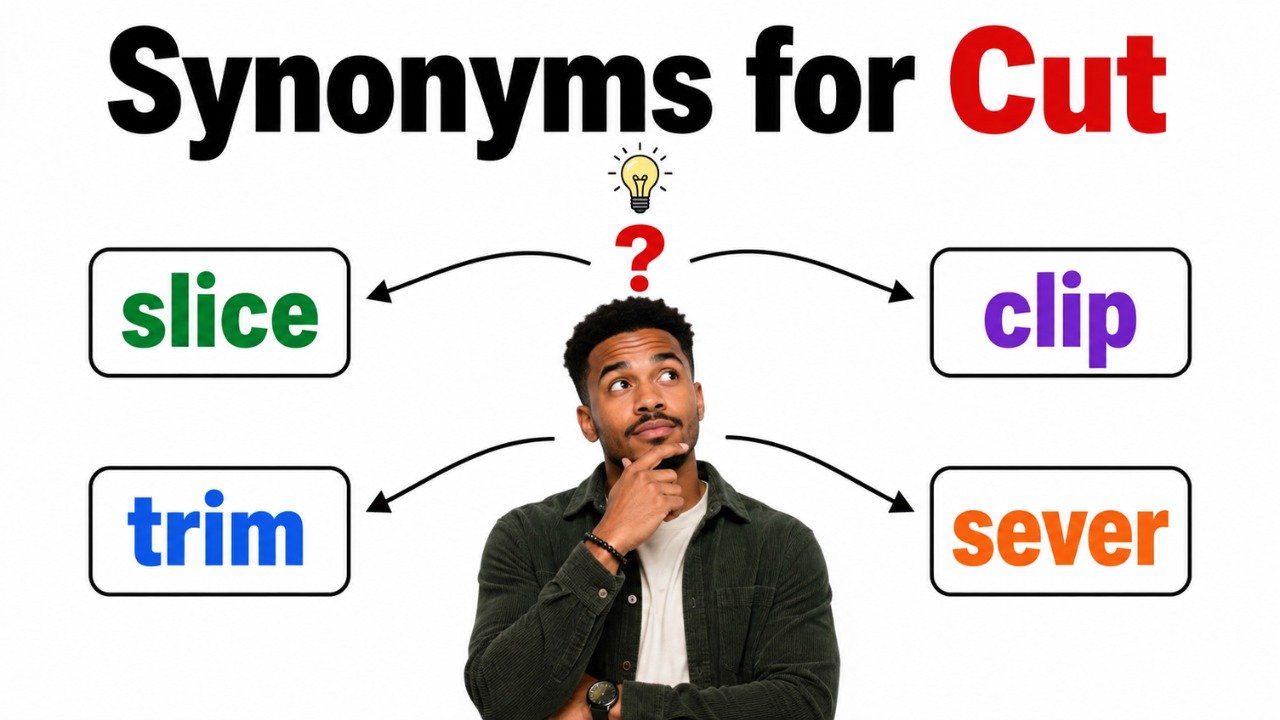
Quick Answer: The best synonyms for cut include slice, trim, chop, sever, shorten, reduce, remove, divide, slash, and edit. Among these synonyms for cut, slice is best for dividing food or material with a blade, trim fits removing small unwanted parts, chop suggests repeated strong cutting, sever means separating completely, shorten works for reducing length, reduce fits lowering an amount, remove suits taking something away, and edit is best when shortening or changing written material.
Pronunciation and Word Details
Word: Cut.
Pronunciation: /kʌt/.
Part of Speech: Verb, noun, and adjective.
Meaning: To divide, shorten, remove, reduce, or separate something, or a mark or result produced by cutting.
US Pronunciation:
UK Pronunciation:
What Does “Cut” Mean?
Cut means to divide, remove, shorten, reduce, or separate something, usually by using a sharp tool or by taking part of something away.
As a verb, cut can describe physical actions, such as cutting paper, vegetables, fabric, or hair. It can also describe reducing prices, expenses, time, staff, or written material.
As a noun, a cut can mean an opening made by something sharp, a reduction in an amount, a particular piece of meat, a share of money, or a style produced by trimming something.
Cut can also function as an adjective in expressions describing something that has already been divided, shaped, or reduced.
Its exact meaning depends heavily on context. A person can cut a cake, cut costs, cut a paragraph, cut contact, cut a branch, or receive a cut on a finger. Because the word has many meanings, choosing the right synonym makes writing clearer.
Meaning, Tone, and Context of “Cut”
Cut is a common, neutral, and highly flexible word. It appears naturally in casual conversation, formal writing, professional reports, instructions, journalism, academic writing, business communication, and technical contexts.
In physical contexts, cut is direct and descriptive. Words such as slice, chop, trim, sever, carve, and snip may provide more detail about how the action happens.
In business or financial writing, cut often means reduce. Writers commonly use alternatives such as lower, decrease, reduce, slash, or curtail depending on the size and tone of the reduction.
In editing, cut means remove or shorten material. Delete, omit, edit, shorten, and condense may be more precise.
The tone can also change with the synonym. Slash sounds strong and dramatic, trim sounds controlled and moderate, sever sounds complete and serious, and reduce sounds neutral and formal.
When and How to Use “Cut”
For Dividing Something: Use cut when separating an object into parts.
Example: She cut the apple into four pieces.
For Removing Unwanted Parts: Use cut when taking away a section of something.
Example: He cut the damaged leaves from the plant.
For Shortening Length: Use cut when making something shorter.
Example: She cut the fabric to the required length.
For Reducing an Amount: Cut can mean lowering costs, prices, time, spending, or quantity.
Example: The organization plans to cut unnecessary expenses.
For Editing Text: Cut can mean removing words, sentences, paragraphs, or scenes.
Example: The editor cut two paragraphs from the introduction.
For Ending Something: Cut can describe stopping communication, services, supplies, or connections.
Example: They decided to cut contact after the disagreement.
For Making an Opening: Cut may describe making an incision, slit, or opening in a surface.
Example: He carefully cut an opening in the cardboard.
For Injury: As a noun, a cut can describe a wound caused by something sharp.
Example: She had a small cut on her finger.
For Reduction: As a noun, cut can refer to a decrease in price, spending, or quantity.
Example: The budget cut affected several departments.
Best Synonyms for Cut
Slice: To divide something into thin or flat pieces.
Example: Slice the tomatoes before adding them to the salad.
Trim: To remove small or unwanted parts to improve shape or size.
Example: She trimmed the edges of the paper.
Chop: To cut something into pieces with strong repeated movements.
Example: He chopped the vegetables for dinner.
Sever: To separate something completely by cutting.
Example: The damaged cable was severed during the repair.
Shorten: To make something less long in length or duration.
Example: She shortened the speech before the event.
Reduce: To make something smaller in amount, size, degree, or quantity.
Example: The team reduced unnecessary spending.
Remove: To take away a part or item.
Example: Remove the damaged section before continuing.
Divide: To separate something into two or more parts.
Example: Divide the dough into equal portions.
Slash: To cut forcefully or reduce something sharply.
Example: The store slashed the price of the remaining items.
Edit: To revise material by changing, removing, or shortening parts.
Example: The writer edited several unnecessary sentences.
50 Synonyms for Cut with Short Meanings
- Slice: To divide something cleanly, often into thin pieces.
- Trim: To remove small or unwanted parts.
- Chop: To cut into pieces with repeated strong movements.
- Sever: To separate something completely.
- Snip: To cut quickly with small movements.
- Clip: To cut off a small part.
- Carve: To cut material into a shape or design.
- Slash: To cut forcefully or deeply.
- Hack: To cut roughly with heavy movements.
- Saw: To cut using a toothed tool or similar motion.
- Shear: To cut closely, especially hair, wool, or vegetation.
- Pare: To cut away an outer layer or unwanted part.
- Shave: To remove a thin layer from a surface.
- Prune: To cut unwanted branches or growth.
- Lop: To cut off a branch or projecting part.
- Cleave: To split or divide something into parts.
- Split: To separate into sections or pieces.
- Divide: To separate into two or more parts.
- Dissect: To cut apart carefully for examination.
- Incise: To make a deliberate cut or opening.
- Score: To make a shallow cut or line on a surface.
- Slit: To make a long narrow opening.
- Nick: To make a small cut or notch.
- Shorten: To make something less long.
- Reduce: To make an amount or level smaller.
- Decrease: To lower an amount, size, or degree.
- Lower: To bring an amount, price, or level down.
- Diminish: To make something smaller or less significant.
- Curtail: To reduce the length, amount, or extent of something.
- Shrink: To make or become smaller.
- Minimize: To reduce something as much as reasonably possible.
- Slash: To reduce sharply or dramatically.
- Trim Down: To reduce an amount carefully.
- Scale Back: To reduce the size or extent of an activity.
- Remove: To take something away.
- Delete: To remove written, recorded, or digital material.
- Omit: To leave something out intentionally.
- Eliminate: To remove something completely.
- Exclude: To leave something out of a group or whole.
- Excise: To cut out or remove a section.
- Edit: To revise by changing or removing material.
- Condense: To make writing or speech shorter.
- Abbreviate: To shorten a word, expression, or piece of writing.
- Abridge: To shorten a text while keeping its main meaning.
- Cancel: To stop or withdraw something planned.
- Stop: To bring an activity or process to an end.
- Discontinue: To stop providing or doing something.
- Interrupt: To break the continuity of something.
- Detach: To separate something from what it is connected to.
- Separate: To divide or move things apart.
Read Also:
Synonyms for Tight

Synonyms for Cut by Context
When Cut Means Slice or Divide
When cut describes physically separating something into pieces, useful synonyms include slice, chop, split, divide, cleave, sever, snip, and shear.
Slice often suggests a smooth motion and relatively even pieces. Chop implies stronger repeated movements. Sever means complete separation.
Example With Cut: She cut the bread into thin pieces.
Example With Slice: She sliced the bread into thin pieces.
Example With Chop: He chopped the carrots into small pieces.
Example With Sever: The damaged rope was completely severed.
When Cut Means Trim
When cut means removing small unwanted portions, trim, clip, snip, pare, prune, shave, and lop may be more specific.
Trim is especially useful for hair, fabric, plants, edges, and unnecessary material.
Example With Cut: She cut the uneven edges of the fabric.
Example With Trim: She trimmed the uneven edges of the fabric.
Example With Prune: The gardener pruned the damaged branches.
Example With Pare: He pared away the rough outer layer.
When Cut Means Reduce
Cut often means reduce when discussing prices, costs, spending, time, staff, quantity, or consumption.
Useful alternatives include reduce, decrease, lower, diminish, curtail, minimize, scale back, and slash.
Example With Cut: The company plans to cut operating expenses.
Example With Reduce: The company plans to reduce operating expenses.
Example With Lower: The changes could lower production costs.
Example With Slash: The retailer slashed prices before clearing the remaining stock.
When Cut Means Shorten
When cut refers to making something shorter, shorten, abbreviate, abridge, condense, and trim down can be stronger choices.
Example With Cut: We need to cut the presentation to twenty minutes.
Example With Shorten: We need to shorten the presentation to twenty minutes.
Example With Condense: She condensed the report into three pages.
Example With Abridge: The editor abridged the original text for younger readers.
When Cut Means Remove
Cut can mean taking a section, item, person, or detail out of something.
Remove, delete, omit, eliminate, exclude, and excise are useful alternatives.
Example With Cut: The editor cut the final paragraph.
Example With Delete: The editor deleted the final paragraph.
Example With Omit: The writer omitted an unnecessary example.
Example With Excise: Several repetitive passages were excised from the manuscript.
When Cut Means Stop
Cut can also mean stopping a service, supply, relationship, activity, or process.
Stop, discontinue, cancel, interrupt, sever, and end are useful alternatives depending on context.
Example With Cut: The supplier cut service to the building.
Example With Discontinue: The supplier discontinued service to the building.
Example With Stop: They stopped production temporarily.
Example With Sever: She severed all professional ties with the organization.
When Cut Means Make an Opening
For a deliberate opening or mark, incise, slit, score, nick, and carve may be more precise.
Example With Cut: Make a small cut in the surface.
Example With Incise: Carefully incise the surface.
Example With Score: Score the dough lightly before baking.
Example With Slit: She slit the envelope carefully.
Another Word for Cut
Slice is one of the best replacements for cut when the sentence describes physically dividing something with a blade. However, the best alternative depends on the intended meaning.
Use trim for removing small portions, reduce for lowering an amount, shorten for decreasing length or duration, and remove or delete when taking material away.
Original: Cut the cucumber into thin pieces.
Better Option: Slice the cucumber into thin pieces.
Original: We need to cut unnecessary expenses.
Better Option: We need to reduce unnecessary expenses.
Original: The editor cut several sentences.
Better Option: The editor removed several sentences.
Original: She cut the presentation by five minutes.
Better Option: She shortened the presentation by five minutes.
When Not to Use “Cut”
Cut is extremely common, but its broad meaning can sometimes make a sentence vague. Avoid it when a more specific verb tells the reader exactly what happened.
In formal business writing, reduce may sound clearer than cut when discussing spending or costs.
In cooking instructions, slice, chop, dice, trim, or carve can give readers more precise directions.
In editing, delete, omit, shorten, condense, or remove may better explain the change.
In technical descriptions, sever, incise, excise, or divide can make the action more exact.
Weak: Cut the vegetables before cooking.
Better: Chop the vegetables into small pieces before cooking.
Weak: The organization will cut expenses.
Better: The organization will reduce expenses.
Weak: Cut the unnecessary information from the report.
Better: Remove the unnecessary information from the report.
Weak: The editor cut the article.
Better: The editor shortened the article by removing repetitive paragraphs.
Words Commonly Confused With Cut
Cut vs Slice: Cut is general, while slice usually means dividing something into relatively thin pieces.
Cut vs Chop: Cut can describe almost any division with a sharp tool. Chop suggests stronger, repeated movements that create smaller pieces.
Cut vs Trim: Cut is broad, while trim specifically means removing small or unwanted portions to improve size, shape, or appearance.
Cut vs Sever: Cut may create only a partial opening. Sever means separating something completely.
Cut vs Reduce: Cut can mean physical cutting or decreasing an amount. Reduce specifically refers to making something smaller, lower, or less.
Cut vs Delete: Cut can mean removing written material, while delete specifically means removing recorded, written, or digital information.
Cut vs Shorten: Cut has several meanings. Shorten specifically means reducing length or duration.
Cut vs Excise: Cut is common and general. Excise is more formal and means removing a section by cutting or deliberate deletion.
Which Synonym Should You Choose?
Choose slice when dividing food or material into thin or even pieces.
Choose chop when cutting food, wood, or similar material with repeated strong motions.
Choose trim when removing small unwanted edges, growth, hair, or excess material.
Choose sever when something is separated completely.
Choose reduce in formal writing about expenses, prices, quantities, consumption, or risk.
Choose lower when discussing prices, rates, levels, or measurements.
Choose slash when describing a large or dramatic reduction.
Choose shorten when reducing length, duration, speeches, presentations, or written material.
Choose delete when removing written or digital content.
Choose omit when intentionally leaving information out.
Choose condense when making writing or speech shorter while preserving the important points.
Choose discontinue when describing the ending of a service, product, activity, or program.
Choose cut in casual conversation when the exact action is already clear.
For reports and essays, reduce, decrease, remove, shorten, and eliminate often provide greater precision.
For emails, cut may sound natural, but remove, shorten, cancel, or reduce may communicate the intended action more clearly.
For instructions, select the most specific physical verb, such as slice, chop, trim, snip, or carve.
Real Life Examples of “Cut” in Sentences
Original: She cut the cake into eight pieces.
Better Option: She sliced the cake into eight pieces.
Original: He cut the vegetables before adding them to the pan.
Better Option: He chopped the vegetables before adding them to the pan.
Original: We need to cut our monthly expenses.
Better Option: We need to reduce our monthly expenses.
Original: She cut the speech by ten minutes.
Better Option: She shortened the speech by ten minutes.
Original: The editor cut three paragraphs from the article.
Better Option: The editor removed three paragraphs from the article.
Original: They cut the damaged branches from the tree.
Better Option: They pruned the damaged branches from the tree.
Original: The store cut the price significantly.
Better Option: The store lowered the price significantly.
Original: He cut the loose thread with small scissors.
Better Option: He snipped the loose thread with small scissors.
Original: The organization cut several unnecessary procedures.
Better Option: The organization eliminated several unnecessary procedures.
Original: She cut communication with the former partner.
Better Option: She severed communication with the former partner.
Synonym Groups and Usage Differences
Physical Cutting Group
Slice, chop, sever, snip, clip, carve, slash, hack, shear, and saw describe physical cutting.
Slice suggests smooth division, while chop and hack imply stronger movements. Sever emphasizes complete separation.
Example: She sliced the fruit into thin pieces.
Trimming Group
Trim, pare, shave, prune, lop, clip, and snip describe removing smaller or unwanted portions.
These words are useful when the purpose is shaping, cleaning, shortening, or improving appearance.
Example: He trimmed the excess fabric from the edge.
Reduction Group
Reduce, decrease, lower, diminish, curtail, minimize, scale back, and slash describe making something smaller in amount or extent.
Reduce is neutral and flexible, while slash suggests a particularly large reduction.
Example: The new process reduced unnecessary waste.
Removal Group
Remove, delete, omit, eliminate, exclude, and excise describe taking something away.
Delete is strongest for written or digital material. Omit means leaving something out, while eliminate suggests complete removal.
Example: The editor omitted several repetitive details.
Shortening Group
Shorten, condense, abbreviate, abridge, and trim down describe reducing length.
Shorten works for time, length, speeches, and documents. Condense emphasizes retaining important information in less space.
Example: She condensed the explanation into one paragraph.
Stopping Group
Stop, discontinue, cancel, interrupt, and sever describe ending or breaking an activity, service, connection, or process.
Discontinue is useful in formal contexts, while stop is the broadest everyday choice.
Example: The organization discontinued the outdated service.
Antonyms of Cut
The opposite of cut depends on which meaning is intended.
Join: To connect things rather than separate them.
Attach: To fasten one thing to another.
Combine: To bring separate things together.
Unite: To join separate parts into one whole.
Connect: To establish a link between things.
Increase: To make an amount larger rather than reducing it.
Raise: To increase a price, level, amount, or rate.
Expand: To make something larger in size or scope.
Lengthen: To make something longer rather than shorter.
Add: To include more rather than remove something.
Include: To keep or place something within a whole.
Continue: To keep something going rather than stop it.
Comparison: Cut vs Related Words
Cut vs Slice
Cut is the general term for dividing something. Slice usually means cutting something into thin, flat, or relatively even pieces.
Example With Cut: She cut the orange in half.
Example With Slice: She sliced the orange into thin rounds.
Cut vs Chop
Cut is neutral and broad. Chop suggests repeated forceful movements, often when preparing food or cutting wood.
Example With Cut: He cut the vegetables.
Example With Chop: He chopped the vegetables into small pieces.
Cut vs Trim
Cut can remove any amount, while trim usually means removing only a small or unwanted portion.
Example With Cut: She cut several inches from the fabric.
Example With Trim: She trimmed the uneven edge of the fabric.
Cut vs Sever
Cut does not necessarily mean complete separation. Sever specifically means separating something entirely.
Example With Cut: The blade cut the rope.
Example With Sever: The blade severed the rope completely.
Cut vs Reduce
Cut may describe physical division or a decrease. Reduce is more precise when discussing amounts, prices, spending, waste, or risk.
Example With Cut: The business cut its expenses.
Example With Reduce: The business reduced its expenses.
Cut vs Shorten
Cut has several meanings. Shorten specifically means making something shorter in length or duration.
Example With Cut: She cut the meeting to thirty minutes.
Example With Shorten: She shortened the meeting to thirty minutes.
Cut vs Delete
Cut can describe removing content in general. Delete is more specific for written, recorded, or digital information.
Example With Cut: He cut the final sentence.
Example With Delete: He deleted the final sentence.
Common Phrases and Expressions With Cut
Cut Into Pieces: To divide something into several separate parts.
Cut in Half: To divide something into two parts.
Cut Short: To end something earlier than expected.
Cut Costs: To reduce spending or expenses.
Cut Prices: To lower the amount charged for something.
Cut Back: To reduce the amount or frequency of something.
Cut Out: To remove something or stop doing something.
Cut Off: To separate, interrupt, or stop a supply or connection.
Cut Down: To reduce an amount or bring something down by cutting.
Cut Through: To pass through something by cutting or to move directly through an obstacle.
Common Mistakes to Avoid
A common mistake is assuming every synonym for cut can replace it in every sentence. Because cut has many meanings, its alternatives must match the specific context.
Do not use slice when the sentence means reduce. Saying a company sliced its spending may sound unusual unless a dramatic or figurative style is intended. Reduce or cut is more natural.
Do not use sever when only a small amount has been trimmed away. Sever implies complete separation and has a stronger tone.
Avoid using chop when precise or delicate cutting is required. Slice, trim, snip, or incise may be more accurate.
Another mistake is repeating cut several times in the same paragraph. Replacing it with reduce, remove, shorten, slice, trim, or delete can improve clarity when those words reflect the intended meaning.
Writers should also distinguish cut from decrease. Cut can be either an action or a noun describing a reduction, while decrease more specifically describes becoming or making something smaller in quantity or degree.
In formal writing, avoid vague statements such as cut things or cut some parts. State what is being reduced, removed, shortened, or divided.
Conclusion
The best synonyms for cut depend on the action or result being described. Slice and chop suit physical division, trim works for removing small portions, and sever describes complete separation. Reduce, decrease, and lower fit amounts, prices, and costs, while shorten, condense, and abridge suit length or written material. Remove, delete, and omit are useful when something is taken away. Understanding these synonyms for cut helps you choose clearer, more precise vocabulary for everyday, formal, academic, and professional writing.
FAQs About Synonyms for Cut
What Is the Best Synonym for Cut?
Slice is a strong synonym when cut means physically dividing something. Reduce is better when discussing amounts, while remove works when taking something away.
What Is Another Word for Cut in Writing?
Delete, remove, omit, edit, shorten, condense, and abridge are useful alternatives when cut refers to written material.
What Is a Synonym for Cut Costs?
Reduce costs, lower costs, decrease expenses, curtail spending, and scale back expenses are natural alternatives.
What Is a Stronger Word Than Cut?
Sever is stronger when something is separated completely. Slash is stronger when describing a forceful action or a dramatic reduction.
What Is Another Word for Cut Into Pieces?
Slice, chop, divide, split, cleave, and dissect can all describe cutting something into pieces, depending on how the action is performed.
What Is the Difference Between Cut and Trim?
Cut is a broad word for dividing or removing something. Trim specifically means removing small or unwanted portions to improve size, shape, or appearance.
What Is a Formal Synonym for Cut?
Reduce, curtail, decrease, excise, remove, sever, discontinue, and abbreviate can serve as formal alternatives, depending on the context.
