
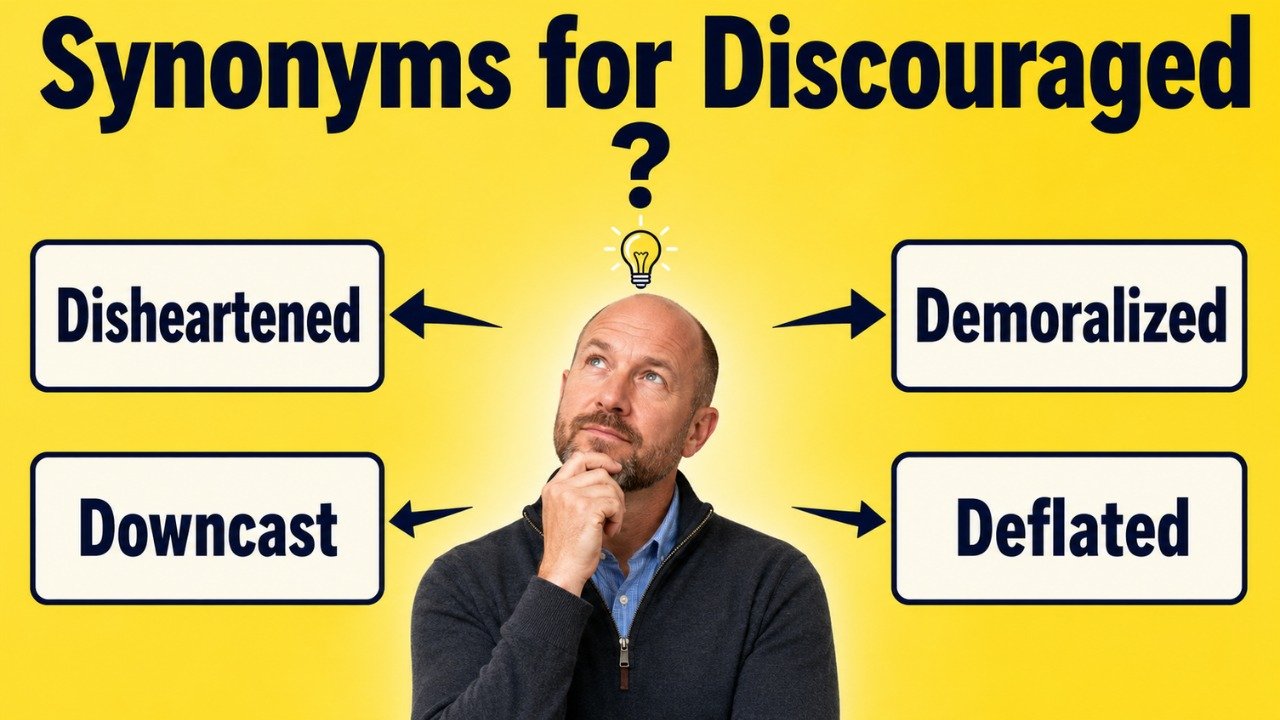
Quick Answer: The best synonyms for discouraged include disheartened, demoralized, dispirited, dejected, disappointed, defeated, dismayed, deflated, deterred, and despondent. Use disheartened when someone has lost hope, demoralized when confidence has been seriously weakened, and disappointed when expectations were not met. Deterred is best when someone has been persuaded not to act. Deflated suits casual conversation, while despondent expresses deep sadness and hopelessness. These synonyms for discouraged vary in emotional strength, formality, and context.
Pronunciation and Word Details
Word: Discouraged.
Pronunciation: /dɪˈskʌr.ɪdʒd/
Part of Speech: Adjective and past tense verb.
Meaning: Having lost confidence, hope, enthusiasm, or willingness to continue.
US Pronunciation:
UK Pronunciation:
What Does “Discouraged” Mean?
Discouraged means feeling less hopeful, confident, enthusiastic, or willing to continue because of difficulty, failure, criticism, or disappointment.
As an adjective, discouraged describes a person’s emotional state.
Example: She felt discouraged after receiving another rejection.
As a verb form, discouraged means that someone or something reduced another person’s confidence or persuaded that person not to take an action.
Example: The high cost discouraged many families from applying.
The word can therefore express two related ideas. It may describe someone who has lost motivation, or it may describe someone who has been deterred from doing something.
Discouraged is often used after setbacks, criticism, slow progress, rejection, poor results, or unexpected problems. It does not always mean that someone has completely lost hope. A discouraged person may still continue, but with less energy or confidence.
The meaning becomes stronger when modified by words such as deeply, greatly, seriously, or completely.
Example: He became deeply discouraged by the lack of progress.
Meaning, Tone, and Context of “Discouraged”
Discouraged has a negative and emotional tone. It usually describes reduced confidence, hope, motivation, or determination.
The word is common in both conversation and formal writing. It sounds natural in personal discussions, workplace communication, educational writing, reports, essays, and descriptions of emotional experiences.
In everyday conversation, discouraged often describes a temporary feeling after something goes wrong.
Example: I was discouraged when my first attempt failed.
In formal or professional writing, discouraged may describe reduced participation or willingness.
Example: Complicated instructions discouraged applicants from completing the form.
In emotional contexts, discouraged can range from mild disappointment to serious loss of hope. The surrounding words reveal the intensity.
Mild Feeling: She felt slightly discouraged by the delay.
Strong Feeling: He became completely discouraged after months of failure.
Discouraged is generally neutral and polite. It does not blame the person for feeling unhappy. It often communicates sympathy and recognizes that difficulties have affected someone’s confidence.
The word can also appear in advice and encouragement.
Example: Do not feel discouraged if progress seems slow.
When and How to Use “Discouraged”
After Failure: Use discouraged when an unsuccessful result reduces someone’s confidence or motivation.
Example: The athlete felt discouraged after losing the qualifying race.
After Rejection: Use discouraged when a refusal or rejection causes someone to doubt future success.
Example: She became discouraged after several employers rejected her applications.
Because of Slow Progress: Use discouraged when improvement is taking longer than expected.
Example: He felt discouraged because his language skills were improving slowly.
After Criticism: Use discouraged when negative comments weaken someone’s confidence.
Example: The harsh feedback left the young writer discouraged.
When Motivation Decreases: Use discouraged when someone loses enthusiasm or willingness to continue.
Example: The repeated technical problems made the team feel discouraged.
When Someone Is Deterred: Use discouraged from when a person is persuaded or prevented from taking an action.
Example: Visitors are discouraged from entering the restricted area.
When Discussing Participation: Use discouraged when rules, costs, or difficulties make people less likely to participate.
Example: Expensive fees discouraged many students from joining the course.
When Offering Support: Use discouraged when encouraging someone not to lose hope.
Example: Do not become discouraged by one disappointing result.
When Expressing Concern: Use discouraged when someone feels uncertain about whether continued effort will succeed.
Example: She sounded discouraged about the future of the project.
Best Synonyms for Discouraged
Disheartened: Having lost hope, confidence, or determination.
Example: The volunteers felt disheartened when the event was canceled.
Demoralized: Having lost confidence, discipline, or enthusiasm after serious difficulty.
Example: The repeated defeats left the team demoralized.
Dispirited: Lacking energy, enthusiasm, or hope.
Example: The workers appeared dispirited after hearing the disappointing news.
Dejected: Sad and disappointed because of failure or rejection.
Example: He looked dejected after his proposal was refused.
Disappointed: Unhappy because something did not meet expectations.
Example: She was disappointed by the final result.
Defeated: Feeling unable or unwilling to continue after difficulty or failure.
Example: He felt defeated after trying every available solution.
Dismayed: Distressed, disappointed, or worried by an unexpected problem.
Example: The residents were dismayed by the sudden increase in costs.
Deflated: Having suddenly lost confidence, excitement, or pride.
Example: Her enthusiasm seemed deflated after the meeting.
Deterred: Persuaded not to do something because of fear, difficulty, or possible consequences.
Example: The warning deterred him from taking the unsafe route.
Despondent: Deeply discouraged and almost without hope.
Example: She became despondent after months of unsuccessful searching.
50 Synonyms for Discouraged with Short Meanings
- Disheartened: Having lost hope or confidence.
- Demoralized: Having lost enthusiasm, discipline, or courage.
- Dispirited: Lacking energy, hope, or enthusiasm.
- Dejected: Sad because of failure or disappointment.
- Disappointed: Unhappy because expectations were not met.
- Defeated: Feeling unable or unwilling to continue.
- Dismayed: Distressed by an unexpected or difficult situation.
- Deflated: Suddenly less confident, excited, or proud.
- Deterred: Persuaded not to take an action.
- Despondent: Deeply unhappy and almost without hope.
- Crestfallen: Sad and embarrassed after disappointment.
- Downcast: Looking or feeling unhappy and discouraged.
- Downhearted: Sad and lacking confidence or hope.
- Demotivated: Having lost the desire to continue working.
- Unmotivated: Lacking the desire or energy to act.
- Disillusioned: Disappointed after discovering an unpleasant truth.
- Disenchanted: No longer enthusiastic because expectations were not fulfilled.
- Dissuaded: Persuaded not to do something.
- Daunted: Made less confident by difficulty or danger.
- Intimidated: Made fearful or less confident.
- Hesitant: Uncertain or unwilling to act confidently.
- Reluctant: Unwilling or less willing to take action.
- Doubtful: Unsure that success is possible.
- Pessimistic: Expecting an unfavorable result.
- Hopeless: Feeling that success or improvement is impossible.
- Gloomy: Sad and expecting negative outcomes.
- Glum: Quietly unhappy and disappointed.
- Miserable: Extremely unhappy or uncomfortable.
- Forlorn: Sad, lonely, and without much hope.
- Troubled: Worried or emotionally disturbed.
- Worried: Concerned that something may go wrong.
- Concerned: Anxious about a situation or outcome.
- Frustrated: Upset because progress is blocked.
- Disappointed: Saddened because a result was worse than expected.
- Disheartened: Weakened in confidence or determination.
- Overwhelmed: Feeling unable to manage a difficult situation.
- Weary: Tired because of prolonged effort or difficulty.
- Drained: Lacking emotional or physical energy.
- Exhausted: Extremely tired and unable to continue effectively.
- Listless: Lacking energy, interest, or enthusiasm.
- Subdued: Quiet and less energetic than usual.
- Shaken: Emotionally disturbed and less confident.
- Crushed: Extremely disappointed or emotionally hurt.
- Heartbroken: Deeply saddened by loss or disappointment.
- Resigned: Accepting an unpleasant result without further resistance.
- Put Off: Made unwilling or less interested.
- Cowed: Made fearful and less confident.
- Dampened: Reduced in enthusiasm, excitement, or hope.
- Low Spirited: Feeling sad and lacking enthusiasm.
- Blue: Informally sad, unhappy, or discouraged.
Read Also:
Synonyms for Productivity

Synonyms for Discouraged by Context
When Discouraged Means Having Lost Hope
Disheartened, despondent, hopeless, downhearted, and dispirited describe a loss of hope or confidence.
Disheartened is the closest general alternative. Despondent is much stronger and suggests deep unhappiness. Hopeless may mean that someone sees no possibility of improvement.
Example: She felt disheartened after another unsuccessful attempt.
Example: Months of uncertainty left him despondent.
When Discouraged Means Disappointed
Disappointed, dejected, crestfallen, downcast, deflated, and crushed work when an unwanted result causes sadness.
Disappointed is broad and neutral. Dejected suggests visible sadness. Crestfallen often describes disappointment that appears in someone’s face or behavior. Crushed is much stronger.
Example: The student looked dejected after seeing the result.
Example: He was crushed when the opportunity disappeared.
When Discouraged Means Lacking Motivation
Demotivated, unmotivated, listless, weary, drained, and dispirited describe reduced energy or willingness to continue.
Demotivated directly refers to lost motivation. Drained suggests emotional or physical exhaustion. Listless describes very little energy or interest.
Example: Repetitive tasks left the employees demotivated.
Example: After weeks of intense work, she felt completely drained.
When Discouraged Means Persuaded Not to Act
Deterred, dissuaded, put off, daunted, and intimidated describe someone becoming less willing to do something.
Deterred is a strong choice in formal writing. Dissuaded means someone was persuaded through advice or argument. Intimidated suggests fear or pressure.
Example: The complicated process deterred many people from applying.
Example: His friends dissuaded him from making a rushed decision.
When Discouraged Means Overcome by Difficulty
Defeated, overwhelmed, daunted, frustrated, weary, and resigned describe a person affected by prolonged or serious challenges.
Defeated suggests that someone feels unable to continue. Overwhelmed means the demands feel too difficult to manage. Resigned suggests acceptance of an unpleasant result.
Example: She felt overwhelmed by the number of unfinished tasks.
Example: After several failed repairs, he began to feel defeated.
When Discouraged Means Worried About the Future
Pessimistic, doubtful, gloomy, troubled, concerned, and worried suit situations involving negative expectations or uncertainty.
Pessimistic means expecting an unfavorable outcome. Doubtful suggests uncertainty rather than complete hopelessness. Troubled describes emotional concern.
Example: Investors became pessimistic about the possibility of rapid improvement.
Example: She remained doubtful that the plan would succeed.
When Discouraged Means Emotionally Hurt
Crushed, heartbroken, shaken, miserable, forlorn, and dismayed express stronger emotional pain.
Crushed describes severe disappointment. Heartbroken is most appropriate for deep personal sadness or loss. Shaken suggests that confidence has been disturbed by a distressing event.
Example: He was heartbroken when the friendship ended.
Example: The unexpected criticism left her shaken.
Another Word for Discouraged
The best general replacement for discouraged is disheartened. Both words describe someone whose confidence, hope, or determination has been weakened.
The most accurate alternative still depends on context. Use disappointed when expectations were not met, demotivated when someone has lost the desire to work, deterred when a person has been persuaded not to act, and despondent when the loss of hope is severe.
Original: She felt discouraged after her first application was rejected.
Better Option: She felt disheartened after her first application was rejected.
Original: The team became discouraged by the lack of recognition.
Better Option: The team became demotivated by the lack of recognition.
Original: The difficult instructions discouraged customers from completing the process.
Better Option: The difficult instructions deterred customers from completing the process.
Original: He was deeply discouraged after months without improvement.
Better Option: He was despondent after months without improvement.
When Not to Use “Discouraged”
Do not use discouraged when a more specific word would explain the emotion or situation more clearly.
Use disappointed when someone is unhappy because an expectation was not met. Use frustrated when progress is blocked. Use exhausted when tiredness is the main problem. Use deterred when someone decides not to act because of a warning, risk, or difficulty.
Weak: She was discouraged because the package arrived late.
Better: She was disappointed because the package arrived late.
Weak: He felt discouraged because the computer kept freezing.
Better: He felt frustrated because the computer kept freezing.
Weak: After working all night, the staff felt discouraged.
Better: After working all night, the staff felt exhausted.
Weak: The dangerous conditions discouraged them from continuing.
Better: The dangerous conditions deterred them from continuing.
Avoid using discouraged when you mean discouraging. Discouraged describes the person who experiences the feeling. Discouraging describes the situation that causes the feeling.
Weak: The results were discouraged.
Better: The results were discouraging.
Weak: The discouraging students needed more support.
Better: The discouraged students needed more support.
Do not use very strong synonyms for mild disappointment. Despondent, crushed, and hopeless can sound excessive when the situation is minor.
Weak: She was despondent because the café had closed early.
Better: She was disappointed because the café had closed early.
Avoid repeating discouraged several times in the same paragraph. Change the wording according to the exact emotion.
Weak: He felt discouraged by the delay, and his discouraged attitude made the others discouraged.
Better: He felt disheartened by the delay, and his lack of confidence lowered the group’s morale.
Words Commonly Confused With Discouraged
Discouraged vs Disappointed: Discouraged means losing hope, confidence, or motivation. Disappointed means feeling unhappy because something did not meet expectations.
Discouraged vs Discouraging: Discouraged describes the person affected by an experience. Discouraging describes the experience that reduces hope or confidence.
Discouraged vs Disheartened: Both describe lost hope or confidence. Disheartened is more emotional, while discouraged can also mean deterred from an action.
Discouraged vs Frustrated: Discouraged means becoming less hopeful or willing to continue. Frustrated means feeling upset because progress is blocked.
Discouraged vs Demoralized: Discouraged can be mild or temporary. Demoralized is stronger and suggests serious damage to confidence, discipline, or group spirit.
Discouraged vs Deterred: Discouraged can describe an emotional state. Deterred specifically means persuaded not to act because of difficulty, fear, or possible consequences.
Discouraged vs Depressed: Discouraged usually describes a temporary reaction to difficulty or disappointment. Depressed may describe severe sadness and can also refer to a medical condition, so the words should not be treated as exact equivalents.
Discouraged vs Pessimistic: Discouraged describes reduced confidence caused by an experience. Pessimistic describes a general expectation that events will turn out badly.
Discouraged vs Defeated: Discouraged suggests weakened motivation. Defeated is stronger and implies that someone feels unable to continue.
Which Synonym Should You Choose?
Choose disheartened when you need the closest general synonym for discouraged.
Choose disappointed when someone’s expectations were not met but the person has not necessarily lost motivation.
Choose demoralized when a person or group has suffered a serious loss of confidence, discipline, or enthusiasm.
Choose dispirited when someone lacks emotional energy, enthusiasm, or hope.
Choose dejected when sadness is visible after rejection or failure.
Choose deflated in casual conversation when confidence or excitement suddenly disappears.
Choose deterred in formal writing when a rule, cost, fear, or difficulty makes someone less likely to act.
Choose dissuaded when advice, reasoning, or persuasion causes someone not to do something.
Choose frustrated when the main problem is blocked progress rather than lost hope.
Choose despondent when someone feels deeply discouraged and almost hopeless.
Choose daunted when a difficult task makes someone feel less confident before beginning or continuing.
Choose pessimistic when someone expects an unfavorable future result.
In essays and reports, disheartened, demoralized, deterred, dissuaded, and pessimistic are precise choices. In professional emails, disappointed, concerned, or disheartened often sound polite and measured. In casual conversation, down, deflated, put off, blue, and fed up may sound more natural, although fed up expresses irritation more than discouragement.
Real Life Examples of “Discouraged” in Sentences
Original: She felt discouraged after receiving another rejection letter.
Better Option: She felt disheartened after receiving another rejection letter.
Original: The players looked discouraged after losing three matches.
Better Option: The players looked demoralized after losing three matches.
Original: He became discouraged because the repairs were taking so long.
Better Option: He became frustrated because the repairs were taking so long.
Original: The expensive fees discouraged many students from registering.
Better Option: The expensive fees deterred many students from registering.
Original: Her confidence seemed discouraged by the harsh criticism.
Better Option: Her confidence seemed shaken by the harsh criticism.
Original: The children appeared discouraged when the trip was canceled.
Better Option: The children appeared disappointed when the trip was canceled.
Original: He felt deeply discouraged after months without progress.
Better Option: He felt despondent after months without progress.
Original: The size of the assignment made her feel discouraged.
Better Option: The size of the assignment made her feel daunted.
Original: Repeated delays left the workers discouraged and tired.
Better Option: Repeated delays left the workers dispirited and weary.
Original: The warning discouraged him from entering the unsafe building.
Better Option: The warning dissuaded him from entering the unsafe building.
Synonym Groups and Usage Differences
Loss of Hope Group
Disheartened, downhearted, despondent, hopeless, and dispirited describe reduced hope or confidence.
Disheartened is broad and natural. Despondent and hopeless are much stronger. Downhearted often sounds personal and emotional.
Example: The repeated setbacks left her disheartened but still willing to continue.
Disappointment Group
Disappointed, dejected, crestfallen, downcast, deflated, and crushed describe sadness after an unwanted result.
Disappointed is neutral. Dejected and crestfallen suggest visible sadness. Crushed expresses intense emotional pain.
Example: He looked crestfallen when his proposal was rejected.
Motivation Group
Demotivated, unmotivated, listless, drained, weary, and subdued describe reduced energy or willingness.
Demotivated is especially useful in work and educational contexts. Listless describes very little energy. Drained suggests emotional exhaustion.
Example: Constant changes left the staff demotivated.
Deterrence Group
Deterred, dissuaded, intimidated, daunted, put off, and cowed describe becoming less willing to act.
Deterred is often caused by risks or obstacles. Dissuaded usually results from advice or persuasion. Intimidated and cowed involve fear or pressure.
Example: The possibility of additional costs deterred several applicants.
Negative Expectation Group
Pessimistic, doubtful, gloomy, worried, concerned, and troubled describe uncertainty or negative expectations.
Pessimistic is the strongest word for expecting bad results. Doubtful expresses uncertainty. Concerned is polite and suitable for professional writing.
Example: The committee remained doubtful that the deadline could be met.
Emotional Pain Group
Heartbroken, crushed, shaken, miserable, forlorn, and dismayed express emotional hurt.
Heartbroken often relates to personal loss. Shaken means an experience has disturbed someone’s emotional stability or confidence. Dismayed combines surprise, worry, and disappointment.
Example: She was dismayed by the sudden cancellation.
Exhaustion Group
Weary, exhausted, drained, overwhelmed, and resigned describe discouragement caused by prolonged effort or pressure.
Weary suggests tiredness after a long struggle. Overwhelmed means the demands feel unmanageable. Resigned suggests that resistance has ended.
Example: After weeks of delays, the group felt weary and resigned.
Antonyms of Discouraged
The opposites of discouraged describe confidence, hope, motivation, courage, or willingness to continue.
Encouraged: Given greater hope or confidence.
Hopeful: Believing that a positive result is possible.
Confident: Certain about one’s abilities or chances of success.
Motivated: Having a strong reason or desire to act.
Inspired: Filled with enthusiasm or creative energy.
Determined: Firmly committed to achieving a goal.
Enthusiastic: Showing strong interest and excitement.
Optimistic: Expecting favorable outcomes.
Cheerful: Noticeably happy and positive.
Energized: Given fresh energy or enthusiasm.
Reassured: Made less worried or doubtful.
Emboldened: Made more confident and willing to act.
Resolved: Firmly decided and committed.
Undeterred: Not prevented or discouraged by difficulty.
Buoyant: Cheerful, lively, and able to recover emotionally.
Comparison: Discouraged vs Related Words
Discouraged vs Disheartened
Discouraged and disheartened both describe reduced hope or confidence. Discouraged is broader because it can also mean persuaded not to act. Disheartened mainly describes an emotional loss of hope.
Example With Discouraged: High costs discouraged them from continuing the project.
Example With Disheartened: They felt disheartened when their first proposal was rejected.
Discouraged vs Disappointed
Discouraged involves reduced motivation or confidence. Disappointed describes unhappiness because expectations were not met.
Example With Discouraged: She felt discouraged and considered giving up.
Example With Disappointed: She was disappointed that the event had been canceled.
Discouraged vs Demoralized
Discouraged may describe a mild or temporary feeling. Demoralized is stronger and often affects a group’s confidence, discipline, or spirit.
Example With Discouraged: The difficult lesson left several students discouraged.
Example With Demoralized: Months of criticism left the entire team demoralized.
Discouraged vs Deflated
Discouraged is neutral and works in formal or casual contexts. Deflated is more conversational and often describes a sudden loss of pride, excitement, or confidence.
Example With Discouraged: He became discouraged by the slow response.
Example With Deflated: He looked deflated after hearing that his idea had been rejected.
Discouraged vs Deterred
Discouraged may refer to an emotional state or reduced willingness. Deterred specifically means prevented or persuaded from taking an action.
Example With Discouraged: She felt discouraged after the unsuccessful interview.
Example With Deterred: The bad weather deterred her from traveling.
Discouraged vs Frustrated
Discouraged means having less hope or willingness to continue. Frustrated means being annoyed or upset because an obstacle prevents progress.
Example With Discouraged: He felt discouraged after several failed attempts.
Example With Frustrated: He felt frustrated when the application repeatedly stopped working.
Discouraged vs Despondent
Discouraged can be mild, moderate, or temporary. Despondent describes deep discouragement and an almost complete loss of hope.
Example With Discouraged: She felt discouraged by the delay.
Example With Despondent: She became despondent after months of disappointing news.
Discouraged vs Pessimistic
Discouraged usually results from a setback or difficulty. Pessimistic means generally expecting negative outcomes.
Example With Discouraged: The latest failure left him discouraged.
Example With Pessimistic: He was pessimistic about the chances of future success.
Common Phrases and Expressions With Discouraged
Feel Discouraged: To experience reduced hope, confidence, or motivation.
Become Discouraged: To gradually or suddenly lose confidence.
Deeply Discouraged: Experiencing a serious loss of hope or enthusiasm.
Easily Discouraged: Likely to lose motivation after small difficulties.
Discouraged by Failure: Made less confident because an attempt was unsuccessful.
Discouraged by Criticism: Made less hopeful because of negative comments.
Discouraged About the Future: Feeling doubtful about future improvement.
Discouraged at the Lack of Progress: Disappointed because improvement is slow or absent.
Discouraged From Applying: Persuaded or prevented from submitting an application.
Do Not Be Discouraged: An expression used to encourage persistence.
Common Mistakes to Avoid
A common mistake is confusing discouraged with discouraging. Discouraged describes the affected person, while discouraging describes the cause.
Incorrect: The students found the results discouraged.
Correct: The students found the results discouraging.
Incorrect: The discouraging students needed additional support.
Correct: The discouraged students needed additional support.
Another mistake is choosing a synonym that is too strong. Despondent, crushed, hopeless, and heartbroken express much deeper emotion than mildly discouraged.
Too Strong: He was heartbroken because his report needed one correction.
Better: He was disappointed because his report needed one correction.
Do not use discouraged and disappointed as exact replacements in every sentence. Disappointed focuses on an unmet expectation. Discouraged includes reduced hope, confidence, or motivation.
Unclear: She was discouraged that the restaurant was closed.
Clearer: She was disappointed that the restaurant was closed.
Use the correct preposition. Someone may be discouraged by an event, discouraged about a situation, discouraged at a result, or discouraged from doing an action.
Correct: She was discouraged by the criticism.
Correct: He felt discouraged about his progress.
Correct: They were discouraged at the lack of support.
Correct: The cost discouraged her from participating.
Avoid the unnatural pattern discouraged to do something when the meaning is prevented from acting.
Unnatural: The warning discouraged him to enter the building.
Natural: The warning discouraged him from entering the building.
Do not overuse discouraged in one paragraph. Choose specific alternatives that explain whether the person is disappointed, tired, frightened, doubtful, or lacking motivation.
Repetitive: The discouraged team gave a discouraged response after the discouraging result.
Improved: The demoralized team gave a subdued response after the disappointing result.
Avoid confusing the adjective discouraged with the simple past verb discouraged.
Adjective: The applicant felt discouraged.
Verb: The complicated form discouraged the applicant from continuing.
Use discouraged carefully when discussing serious or prolonged emotional distress. The word describes a feeling but does not explain its cause, duration, or severity. Precise language is more helpful when those details matter.
Conclusion
The most useful synonyms for discouraged include disheartened, disappointed, demoralized, dispirited, dejected, deflated, deterred, and despondent. Choose disheartened for a general loss of hope, disappointed for unmet expectations, and demotivated for reduced willingness to work. Deterred is best when someone is persuaded not to act, while despondent expresses severe hopelessness. Selecting the right alternative helps you communicate the emotion’s strength, cause, and context with greater clarity and accuracy.
FAQs About Synonyms for Discouraged
What Is the Best Synonym for Discouraged?
Disheartened is usually the best general synonym for discouraged. It describes someone who has lost hope, confidence, or determination.
What Is a Stronger Word for Discouraged?
Despondent, demoralized, crushed, and hopeless are stronger alternatives. The correct choice depends on whether the person has lost hope, confidence, or emotional strength.
Can Disappointed Replace Discouraged?
Disappointed can replace discouraged when the main idea is an unmet expectation. It is less accurate when someone has lost motivation or willingness to continue.
What Is a Formal Synonym for Discouraged?
Demoralized, disheartened, deterred, dissuaded, and dispirited are suitable formal alternatives. Deterred and dissuaded are especially useful when someone is persuaded not to act.
What Is a Casual Synonym for Discouraged?
Deflated, downhearted, blue, put off, and low spirited are natural conversational alternatives. Deflated is useful for a sudden loss of confidence or excitement.
What Is the Opposite of Discouraged?
Encouraged is the direct opposite. Other antonyms include hopeful, confident, motivated, inspired, determined, enthusiastic, and undeterred.
What Is the Difference Between Discouraged and Discouraging?
Discouraged describes a person who has lost confidence or hope. Discouraging describes an event, result, or situation that causes someone to lose confidence or hope.
