
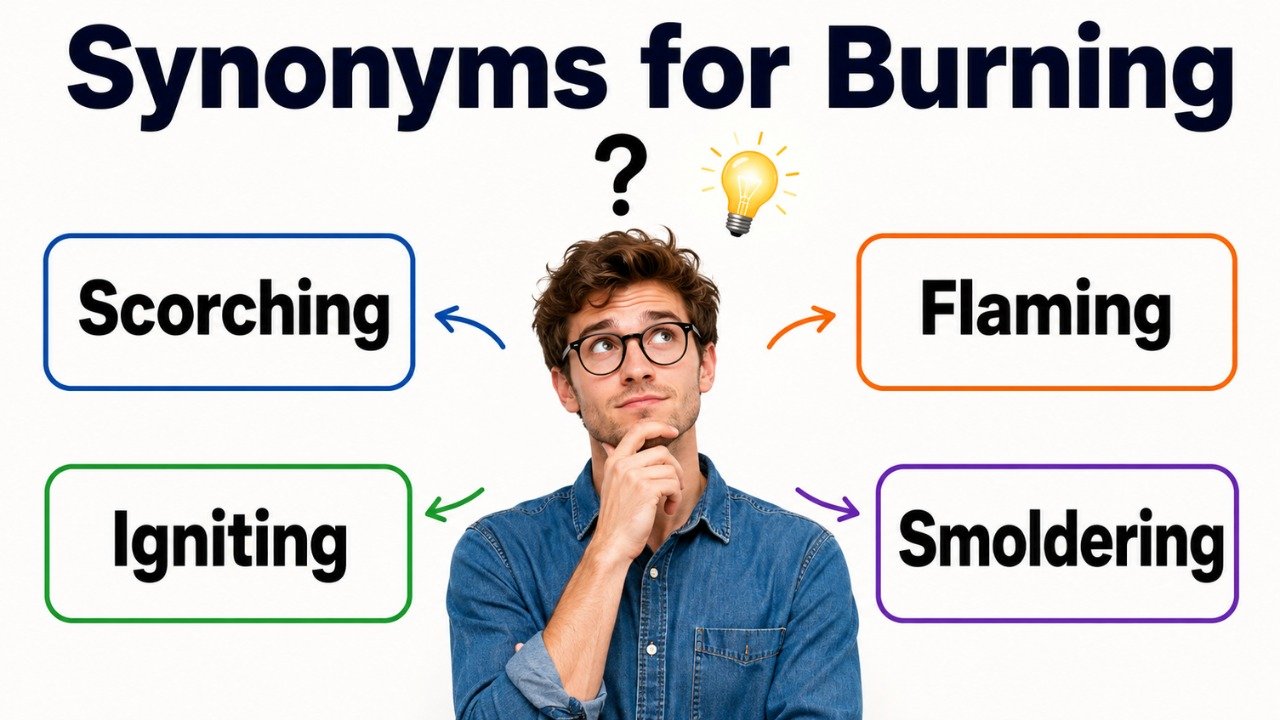
Quick Answer: The best synonyms for burning include blazing, flaming, fiery, scorching, searing, smoldering, intense, urgent, passionate, and stinging. When burning describes fire, blazing or flaming usually works best. For extreme heat, use scorching or searing. For a strong feeling or desire, intense or passionate is more natural. For an important issue that needs immediate attention, urgent is a strong formal choice. For physical discomfort, stinging or searing may provide a more precise meaning.
Pronunciation and Word Details
Word: Burning
Pronunciation: /ˈbɜːrnɪŋ/
Part of Speech: Adjective, noun, and present participle of the verb burn
Meaning: Producing fire or heat, feeling extremely hot or painful, or showing strong intensity, passion, or urgency.
US Pronunciation:
UK Pronunciation:
What Does “Burning” Mean?
Burning means being on fire, producing strong heat, causing a hot or painful sensation, or showing powerful intensity or urgency.
As an adjective, burning can describe something that is physically on fire, such as a burning building. It can also describe extreme heat, as in burning sunlight.
The word frequently has figurative meanings. A burning desire is a very strong desire. A burning question is an important question that someone strongly wants answered. A burning ambition describes an intense determination to achieve something.
As a noun, burning can refer to the process of combustion or to a painful sensation associated with heat or irritation.
As the present participle of burn, it describes an action that is happening, as in “The wood is burning.”
Because burning has several meanings, the best synonym depends heavily on the sentence.
Meaning, Tone, and Context of “Burning”
Burning is a common and versatile word that can have neutral, emotional, dramatic, urgent, or descriptive tones.
Literal Fire Context: Burning is neutral when it simply describes something that has caught fire.
Example: Burning wood filled the fireplace with warmth.
Heat Context: Burning can sound strong and vivid when describing extreme temperature.
Example: They walked across the burning sand.
Physical Sensation Context: Burning describes a hot, sharp, or irritating physical feeling.
Example: She noticed a burning sensation in her eyes.
Emotional Context: Burning can create an intense or passionate tone when describing desires, emotions, ambitions, or curiosity.
Example: He had a burning desire to succeed.
Urgent Context: Burning can emphasize that a question, problem, or issue needs immediate attention.
Example: The discussion focused on the burning issues facing the community.
Literary Context: In descriptive and creative writing, burning often adds vivid emotional or sensory imagery.
The word works naturally in both everyday conversation and formal writing, although more specific synonyms may improve precision in academic, professional, or technical contexts.
When and How to Use “Burning”
For Something on Fire
Use: Burning describes an object or material that is actively producing flames, heat, or smoke.
Example: The firefighters approached the burning shed carefully.
For Extreme Heat
Use: Burning can describe something that feels extremely hot.
Example: The burning pavement made walking barefoot uncomfortable.
For Physical Discomfort
Use: Burning can describe an uncomfortable hot, sharp, or irritating sensation.
Example: He felt a burning sensation after touching the hot surface.
For Strong Desire
Use: Burning emphasizes a desire that feels powerful and difficult to ignore.
Example: She had a burning desire to become a skilled writer.
For Strong Passion
Use: Burning can describe deep enthusiasm, love, determination, or emotional intensity.
Example: His burning passion for music shaped his career.
For Urgency
Use: Burning can describe a question, issue, concern, or problem that requires immediate attention.
Example: Funding became the burning issue at the meeting.
For Curiosity
Use: Burning can emphasize an especially strong need to know something.
Example: Everyone had one burning question about the decision.
For Ambition
Use: Burning can describe exceptionally strong motivation to achieve a goal.
Example: Her burning ambition kept her focused during difficult periods.
Best Synonyms for Burning
Blazing: Burning brightly and strongly with flames.
Example: A blazing fire warmed the entire room.
Flaming: Actively producing visible flames.
Example: The flaming logs crackled in the fireplace.
Fiery: Full of fire, heat, passion, or strong emotion.
Example: The fiery glow could be seen across the field.
Scorching: Extremely hot or intensely heated.
Example: They rested indoors during the scorching afternoon.
Searing: Extremely hot, painful, or emotionally intense.
Example: A searing heat rose from the pavement.
Smoldering: Burning slowly with smoke and little or no visible flame.
Example: The smoldering wood continued producing smoke.
Intense: Extremely strong in degree, feeling, or effect.
Example: She felt an intense desire to understand the mystery.
Urgent: Requiring immediate attention or action.
Example: The committee discussed the most urgent problem first.
Passionate: Showing powerful emotion, enthusiasm, or commitment.
Example: He remained passionate about improving education.
Stinging: Producing a sharp, irritating, or painful sensation.
Example: The cold wind caused a stinging feeling on her face.
50 Synonyms for Burning with Short Meanings
- Blazing: Burning strongly with bright flames.
- Flaming: Producing or covered with visible flames.
- Fiery: Full of fire, heat, or intense energy.
- Scorching: Extremely hot.
- Searing: Intensely hot or painfully strong.
- Smoldering: Burning slowly without strong flames.
- Glowing: Giving off steady heat or light.
- Aflame: Actively on fire.
- Ignited: Set on fire or caused to burn.
- Kindled: Started burning.
- Combusting: Undergoing the process of burning.
- Incandescent: Glowing because of intense heat.
- Red hot: Extremely hot.
- Heated: Made hot or emotionally intense.
- Hot: Having a high temperature.
- Boiling: Extremely hot or intensely emotional.
- Sweltering: Uncomfortably hot.
- Torrid: Extremely hot or emotionally passionate.
- Broiling: Intensely hot.
- Blistering: Extremely hot or severe.
- Fierce: Extremely powerful or intense.
- Intense: Very strong in degree or feeling.
- Powerful: Having great strength or effect.
- Strong: Great in force, feeling, or degree.
- Passionate: Filled with strong emotion or enthusiasm.
- Fervent: Showing deeply felt enthusiasm or belief.
- Ardent: Strongly enthusiastic or passionate.
- Fervid: Intensely passionate or enthusiastic.
- Impassioned: Filled with powerful emotion.
- Enthusiastic: Showing strong interest or excitement.
- Eager: Strongly wanting something to happen.
- Driven: Highly motivated to achieve something.
- Determined: Firmly committed to a goal.
- Urgent: Requiring immediate attention.
- Pressing: Needing prompt action.
- Critical: Extremely important or serious.
- Immediate: Requiring action without delay.
- Compelling: Strongly demanding attention or interest.
- Stinging: Producing a sharp painful sensation.
- Smarting: Feeling a sharp or irritating pain.
- Aching: Experiencing continuous discomfort or pain.
- Painful: Causing physical or emotional suffering.
- Irritating: Causing discomfort or annoyance.
- Raw: Painfully sensitive or irritated.
- Piercing: Extremely sharp or intense.
- Biting: Sharply painful or severe.
- Pungent: Strongly sharp or irritating to the senses.
- Raging: Extremely fierce, powerful, or uncontrolled.
- Devouring: Consuming rapidly and destructively.
- Consuming: Completely absorbing, intense, or overwhelming.
Read Also:
Synonyms for Grimace

Synonyms for Burning by Context
When Burning Means On Fire
When burning refers literally to fire, the closest synonyms describe flames, combustion, heat, or glowing material.
Blazing: Suggests a large, bright, powerful fire.
Example: A blazing fire illuminated the dark field.
Flaming: Emphasizes visible flames.
Example: The flaming torch guided them through the darkness.
Aflame: Means actively on fire.
Example: Within moments, the dry branches were aflame.
Ignited: Describes something that has been set on fire.
Example: The fuel ignited quickly.
Smoldering: Describes slow burning with smoke but few visible flames.
Example: Smoldering branches remained after the fire was controlled.
Glowing: Describes material that produces heat or light without obvious flames.
Example: Glowing coals remained beneath the ashes.
When Burning Means Extremely Hot
Burning can describe something that feels intensely hot even when it is not actually on fire.
Scorching: Extremely hot, especially because of weather or sunlight.
Example: We avoided walking outside during the scorching afternoon.
Searing: Intensely hot and often painful.
Example: Searing heat rose from the metal surface.
Blistering: Extremely hot or severe.
Example: The runners competed in blistering heat.
Broiling: Very hot and uncomfortable.
Example: The room became broiling after the air stopped circulating.
Sweltering: Oppressively hot, especially in weather or enclosed spaces.
Example: They searched for shade during the sweltering afternoon.
When Burning Means Painful
Burning can describe physical discomfort that feels hot, sharp, or irritating.
Stinging: A sharp, irritating pain.
Example: Soap caused a stinging sensation in the small cut.
Smarting: A sharp or persistent irritation.
Example: His eyes were smarting from the smoke.
Searing: Extremely sharp or powerful pain.
Example: A searing pain traveled through his arm.
Raw: Painfully sensitive or irritated.
Example: Her skin felt raw after being exposed to the cold air.
Biting: Sharply painful, usually because of cold, wind, or another strong sensation.
Example: A biting wind made his cheeks hurt.
When Burning Means Passionate
Burning often describes powerful emotions, ambitions, interests, or desires.
Passionate: Filled with strong emotion or enthusiasm.
Example: She was passionate about helping young writers.
Ardent: Deeply enthusiastic or devoted.
Example: He remained an ardent supporter of the project.
Fervent: Showing strong and sincere feeling.
Example: She expressed a fervent desire for improvement.
Impassioned: Expressed with powerful emotion.
Example: He gave an impassioned speech about the issue.
Intense: Extremely strong in degree.
Example: She had an intense desire to learn.
When Burning Means Urgent
Burning can describe an issue, concern, or question that demands attention.
Urgent: Needing immediate action.
Example: Housing became an urgent concern.
Pressing: Important and requiring prompt attention.
Example: The team discussed the most pressing problem first.
Critical: Extremely important to success or safety.
Example: Reliable communication remained a critical issue.
Immediate: Requiring attention without delay.
Example: Their immediate concern was finding a safe location.
Compelling: Strongly attracting or demanding attention.
Example: The investigation raised several compelling questions.
Another Word for Burning
Another word for burning is often blazing when the meaning involves active fire. However, the best replacement depends on what burning means in the sentence.
Use scorching for extreme heat, stinging for physical irritation, passionate for powerful emotion, and urgent for an issue needing immediate attention.
Original: The burning fire filled the room with light.
Better Option: The blazing fire filled the room with light.
Original: We crossed the burning sand quickly.
Better Option: We crossed the scorching sand quickly.
Original: She had a burning desire to improve.
Better Option: She had an intense desire to improve.
Original: They discussed the burning problem immediately.
Better Option: They discussed the urgent problem immediately.
When Not to Use “Burning”
Burning is expressive and versatile, but it is not always the most precise choice.
When Describing Slow Fire
Burning may be too general if an object is producing smoke but few flames.
Weak: Burning logs continued smoking after the flames disappeared.
Better: Smoldering logs continued smoking after the flames disappeared.
When Describing Extreme Weather
Scorching or sweltering may communicate temperature more clearly.
Weak: It was a burning afternoon.
Better: It was a scorching afternoon.
When Describing Professional Urgency
Burning can sound dramatic in highly formal writing.
Weak: The report identifies several burning administrative concerns.
Better: The report identifies several urgent administrative concerns.
When Describing Physical Pain
Burning may be useful for a general sensation, but more specific words can communicate the type of discomfort.
Weak: She experienced burning pain in the cut.
Better: She experienced stinging pain in the cut.
When Describing Passion Repeatedly
Repeated use of burning can make emotional writing sound exaggerated.
Weak: He had a burning passion and a burning ambition to achieve his burning goal.
Better: He had a deep passion and strong determination to achieve his goal.
Words Commonly Confused With Burning
Burning vs Blazing: Burning is a broad term for something producing heat or fire. Blazing usually suggests strong, bright, visible flames.
Burning vs Flaming: Burning can happen with or without visible flames. Flaming specifically emphasizes the presence of flames.
Burning vs Smoldering: Burning is general. Smoldering describes slow combustion with smoke and little visible flame.
Burning vs Scorching: Burning can refer to fire, heat, pain, passion, or urgency. Scorching mainly refers to extreme heat or severe intensity.
Burning vs Searing: Burning is broader. Searing emphasizes extreme heat, severe pain, or emotional intensity.
Burning vs Fiery: Burning usually describes a condition or strong sensation. Fiery can describe literal fire as well as a passionate personality, speech, or emotion.
Burning vs Passionate: Burning can describe intense emotion figuratively. Passionate directly describes strong enthusiasm, love, or commitment.
Burning vs Urgent: A burning issue is one that strongly demands attention. Urgent is usually clearer and more formal when immediate action is required.
Which Synonym Should You Choose?
Choose blazing when describing a strong fire with bright flames.
Choose flaming when visible flames are the most important detail.
Choose smoldering when something burns slowly while producing smoke.
Choose scorching when describing extremely hot weather, sunlight, sand, or surfaces.
Choose searing when the heat, pain, or emotional effect is extremely intense.
Choose stinging when describing sharp physical irritation or discomfort.
Choose passionate when describing strong enthusiasm, love, commitment, or emotion.
Choose intense when you need a neutral and flexible word for powerful feelings or experiences.
Choose urgent in formal writing, reports, emails, essays, and professional discussions when something requires immediate attention.
Choose pressing when an issue is important and should be addressed soon.
Choose ardent or fervent in formal or literary writing when describing deeply held enthusiasm or belief.
Choose eager in casual or neutral conversation when describing strong desire without the dramatic intensity of burning.
Real Life Examples of “Burning” in Sentences
Original: The burning house could be seen from several streets away.
Better Option: The blazing house could be seen from several streets away.
Original: She carefully moved the burning branch.
Better Option: She carefully moved the flaming branch.
Original: We walked across the burning pavement.
Better Option: We walked across the scorching pavement.
Original: He felt a burning sensation in his eyes.
Better Option: He felt a stinging sensation in his eyes.
Original: She had a burning desire to finish the project.
Better Option: She had an intense desire to finish the project.
Original: His burning passion for photography never disappeared.
Better Option: His passionate interest in photography never disappeared.
Original: The committee discussed several burning problems.
Better Option: The committee discussed several urgent problems.
Original: One burning question remained unanswered.
Better Option: One pressing question remained unanswered.
Original: She developed a burning ambition to become a successful researcher.
Better Option: She developed a powerful ambition to become a successful researcher.
Original: Smoke rose from the burning remains of the fire.
Better Option: Smoke rose from the smoldering remains of the fire.
Synonym Groups and Usage Differences
Fire Group
Blazing, flaming, aflame, ignited, kindled, glowing, and smoldering all relate directly to fire.
Blazing suggests powerful flames. Flaming emphasizes visible flames. Smoldering describes slower combustion.
Example: The smoldering wood continued releasing smoke after the flames disappeared.
Heat Group
Scorching, searing, blistering, sweltering, broiling, torrid, and red hot express extreme temperature.
Scorching is especially common for weather and surfaces. Searing adds a sense of painful intensity.
Example: The scorching sun made the afternoon exhausting.
Pain Group
Stinging, smarting, searing, raw, biting, aching, and painful describe different forms of discomfort.
Stinging suggests sharp irritation, while searing suggests exceptionally powerful pain.
Example: Smoke caused a stinging sensation in her eyes.
Passion Group
Passionate, fervent, ardent, fervid, impassioned, intense, and enthusiastic describe powerful emotions or beliefs.
Passionate is versatile and natural. Ardent and fervent sound somewhat more formal.
Example: She remained an ardent advocate for better education.
Desire Group
Eager, driven, determined, intense, passionate, and consuming can replace burning when describing powerful motivation or desire.
Driven emphasizes motivation. Consuming suggests that the feeling occupies much of a person’s attention.
Example: His consuming desire to discover the truth kept him searching.
Urgency Group
Urgent, pressing, critical, immediate, and compelling describe matters that strongly demand attention.
Urgent works well in professional writing. Pressing emphasizes a problem that cannot reasonably be ignored.
Example: Finding additional resources became the most pressing concern.
Antonyms of Burning
The opposite of burning changes according to the intended meaning.
Opposites Related to Fire and Heat
Extinguished: No longer burning.
Cold: Having a low temperature.
Cool: Moderately cold or lacking strong heat.
Frozen: Extremely cold or turned into ice.
Unlit: Not burning or illuminated.
Doused: Put out using water or another substance.
Opposites Related to Passion
Indifferent: Showing little interest or concern.
Apathetic: Lacking enthusiasm or emotion.
Unenthusiastic: Not showing excitement or strong interest.
Detached: Emotionally uninvolved.
Dispassionate: Calm and not strongly influenced by emotion.
Opposites Related to Urgency
Minor: Relatively unimportant.
Nonessential: Not necessary or critical.
Routine: Ordinary and not demanding special attention.
Unpressing: Not requiring immediate attention.
Optional: Left to personal choice rather than necessity.
Comparison: Burning vs Related Words
Burning vs Blazing
Burning is the general condition of being affected by fire. Blazing suggests a stronger and brighter fire with obvious flames.
Example With Burning: The burning wood gave off steady heat.
Example With Blazing: The blazing fire lit the entire campsite.
Burning vs Flaming
Burning does not necessarily mean visible flames are present. Flaming specifically emphasizes active flames.
Example With Burning: The burning material produced thick smoke.
Example With Flaming: The flaming torch illuminated the path.
Burning vs Smoldering
Burning can involve flames, heat, smoke, or combustion generally. Smoldering refers to slow burning that usually produces smoke without large flames.
Example With Burning: The burning branches crackled loudly.
Example With Smoldering: The smoldering branches continued releasing smoke.
Burning vs Scorching
Burning has literal and figurative meanings. Scorching usually refers to extreme heat.
Example With Burning: The burning wood warmed the room.
Example With Scorching: The scorching pavement was uncomfortable to touch.
Burning vs Searing
Burning is broader, while searing suggests an extreme degree of heat, pain, or emotional force.
Example With Burning: She felt a burning sensation on her skin.
Example With Searing: She felt a searing pain in her hand.
Burning vs Fiery
Burning commonly describes something experiencing fire or something figuratively intense. Fiery often describes the quality of being firelike, energetic, passionate, or hot tempered.
Example With Burning: He had a burning desire to succeed.
Example With Fiery: She delivered a fiery speech.
Burning vs Passionate
Burning is figurative when used for powerful emotions. Passionate directly identifies strong emotional involvement or enthusiasm.
Example With Burning: She had a burning interest in history.
Example With Passionate: She was passionate about history.
Burning vs Urgent
Burning can make an issue sound emotionally important or highly relevant. Urgent clearly indicates that immediate attention or action is required.
Example With Burning: The meeting addressed a burning question.
Example With Urgent: The meeting addressed an urgent problem.
Common Phrases and Expressions With “Burning”
Burning Desire: A very strong wish to do, achieve, or obtain something.
Burning Question: An important question that someone strongly wants answered.
Burning Issue: A serious or important matter receiving strong attention.
Burning Passion: Powerful enthusiasm, love, or commitment.
Burning Ambition: An extremely strong desire to succeed or achieve something.
Burning Heat: Extremely strong heat.
Burning Sensation: A feeling of uncomfortable heat, irritation, or pain.
Burning Fire: A fire that is actively producing heat or flames.
Burning Brightly: Producing strong light or flames.
Burning Curiosity: An intense desire to discover or understand something.
Common Mistakes to Avoid
Using One Synonym for Every Meaning
Burning has several meanings, so one synonym cannot replace it in every sentence.
Blazing may replace burning when describing fire, but it would sound unnatural in the phrase “a blazing question” when the intended meaning is urgency.
Always identify the meaning before choosing a replacement.
Confusing Blazing With Smoldering
Blazing describes strong visible flames. Smoldering describes slow combustion with little or no flame.
Incorrect: The blazing ashes produced only a thin line of smoke with no flames.
Better: The smoldering ashes produced only a thin line of smoke with no flames.
Using Scorching for Emotional Desire
Scorching mainly describes extreme heat or severe intensity. It usually does not replace burning naturally when describing ordinary ambition or desire.
Weak: She had a scorching desire to become a doctor.
Better: She had an intense desire to become a doctor.
Overusing Burning in Emotional Writing
Burning is powerful, so repeating it can make writing sound exaggerated.
Weak: His burning ambition came from a burning desire and burning passion for success.
Better: His strong ambition came from a deep desire and genuine passion for success.
Choosing a Dramatic Word in Formal Writing
Burning can occasionally sound too emotional for formal reports.
Weak: The document outlines the company’s burning administrative problems.
Better: The document outlines the most urgent administrative problems.
Confusing Fiery With Burning
Fiery describes something resembling fire or showing strong emotion. Burning describes the actual process of combustion or an intense figurative feeling.
Weak: The wood remained fiery throughout the night.
Better: The wood remained burning throughout the night.
Using Vague Synonyms
General words such as strong or powerful can sometimes replace burning, but they may remove useful detail.
Weak: The pavement felt strong under the afternoon sun.
Better: The pavement felt scorching under the afternoon sun.
Choose a synonym that preserves the exact meaning of the original sentence.
Conclusion
The best synonyms for burning depend on whether the word describes fire, heat, pain, passion, desire, or urgency. Blazing and flaming work well for active fire, while smoldering describes slower combustion. Scorching and searing express extreme heat, while stinging suits physical irritation. Passionate, fervent, and intense describe powerful feelings, while urgent and pressing fit important issues. Understanding these differences makes it easier to choose natural synonyms for burning and create clearer, more precise sentences.
FAQs About Synonyms for Burning
What Is the Best Synonym for Burning?
The best general synonym is blazing when burning refers to strong fire. Scorching is better for extreme heat, intense for strong feelings, and urgent for important issues.
What Is Another Word for Burning Fire?
Blazing, flaming, fiery, aflame, and ignited can describe burning fire. Blazing usually suggests a particularly strong and bright fire.
What Is a Synonym for Burning Hot?
Scorching, searing, blistering, broiling, sweltering, and red hot can describe something that is extremely hot.
What Is Another Word for a Burning Sensation?
Stinging, smarting, searing, irritating, painful, or raw may work, depending on the exact type and intensity of the sensation.
What Is a Synonym for Burning Desire?
Intense desire, passionate desire, fervent desire, strong ambition, eagerness, and determination can express a similar idea.
What Is Another Word for a Burning Issue?
Urgent issue, pressing issue, critical issue, immediate concern, and compelling problem are useful alternatives. Urgent and pressing are especially suitable for professional writing.
Is Fiery a Synonym for Burning?
Yes, fiery can be a synonym for burning in some contexts. It works especially well when describing fire, heat, strong emotion, or an energetic personality, but it cannot replace burning naturally in every sentence.
