
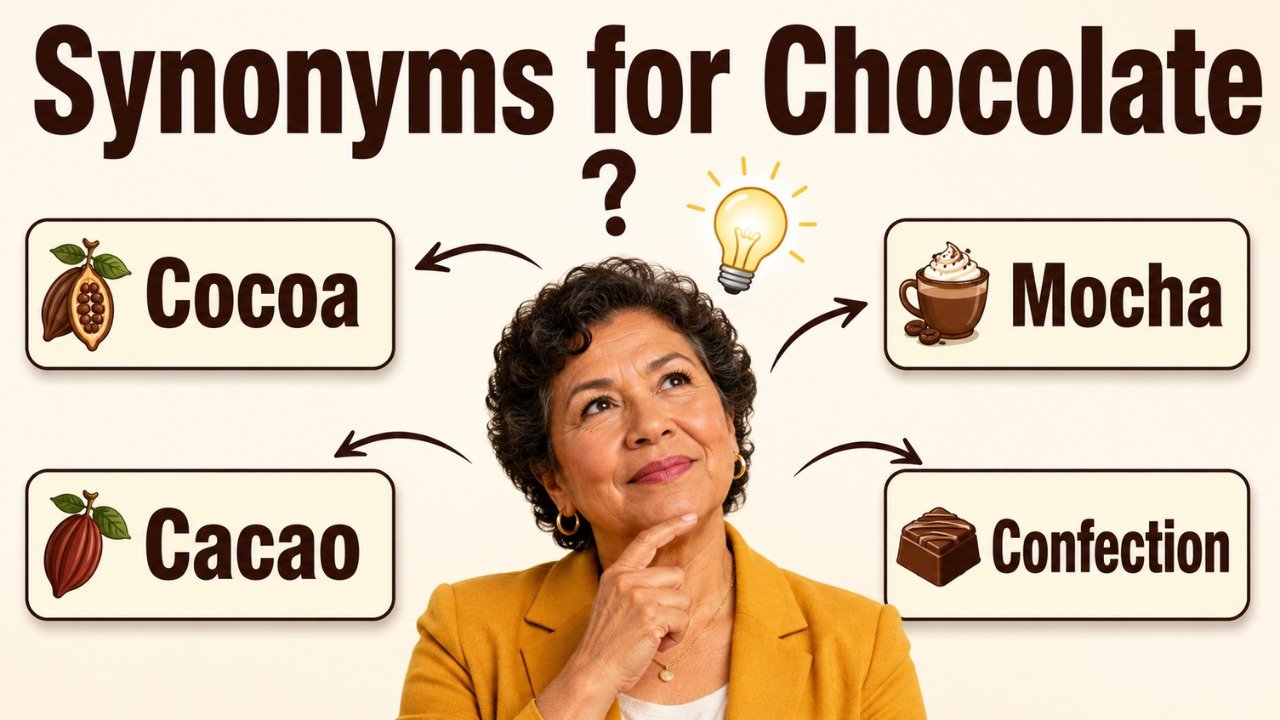
Quick Answer: The best synonyms for chocolate and close alternatives include cocoa, cacao, confection, candy, sweet, fudge, ganache, truffle, praline, and cocoa treat. Cocoa and cacao work best when referring to the ingredient or flavor source. Confection and candy suit general discussions of sweets. Fudge, ganache, truffle, and praline are better when describing specific chocolate preparations or desserts. Because chocolate can describe an ingredient, flavor, color, drink, or sweet food, the most accurate replacement depends on the sentence.
Pronunciation and Word Details
Word: Chocolate
Pronunciation: /ˈtʃɒkələt/
Part of Speech: Noun and adjective
Meaning: A sweet or sometimes bitter food made from processed cacao, or a flavor, color, or food associated with it.
US Pronunciation:
UK Pronunciation:
What Does “Chocolate” Mean?
Chocolate is a food made from cacao ingredients and is commonly used in sweets, desserts, drinks, coatings, and flavorings.
As a noun, chocolate can refer to the food itself, a piece of chocolate candy, a chocolate flavored drink, or a brown color resembling chocolate.
Food Example: She melted chocolate for the cake.
Candy Example: He offered everyone a chocolate after dinner.
Drink Example: She ordered a warm chocolate drink.
Chocolate also works as an adjective when it describes flavor, appearance, or ingredients.
Flavor Example: They served chocolate pudding.
Color Example: She chose a chocolate brown fabric.
The word is broad, which means a synonym must match the intended meaning. Cocoa may replace chocolate in discussions of flavor or powder, while confection or candy may be more suitable when referring to a sweet treat.
Meaning, Tone, and Context of “Chocolate”
Chocolate is a neutral and widely understood word. It works naturally in casual conversation, recipes, menus, food descriptions, product descriptions, and more formal discussions of cooking or ingredients.
Neutral Tone: Chocolate is appropriate in almost any everyday food context.
Casual Use: People commonly use chocolate when talking about candy, desserts, snacks, cakes, drinks, or cravings.
Culinary Use: More specific terms such as couverture, ganache, cacao, cocoa solids, and cocoa mass may appear in professional cooking or technical food contexts.
Descriptive Use: Chocolate can describe a rich brown shade as well as a sweet or bitter flavor.
Emotional Context: The word can sometimes suggest indulgence, comfort, richness, sweetness, or celebration, depending on the sentence.
The best replacement therefore changes according to whether the writer means an ingredient, dessert, candy, flavor, drink, preparation, or color.
When and How to Use “Chocolate”
For a Food Ingredient: Use chocolate when referring generally to the solid or melted ingredient used in cooking and baking.
Example: Melt the chocolate slowly before adding it to the mixture.
For a Sweet Treat: Use chocolate when referring to an individual sweet or a chocolate based confection.
Example: She placed a chocolate beside each cup.
For Flavor: Use chocolate before a food noun when describing its taste.
Example: Chocolate ice cream was the most popular dessert.
For Desserts: Use chocolate when the ingredient or flavor is central to a dessert.
Example: We made chocolate cake for the celebration.
For Drinks: Use chocolate when referring to a beverage flavored with cocoa or melted chocolate.
Example: He enjoyed a warm chocolate drink on the cold evening.
For Color: Use chocolate when describing a deep, rich brown shade.
Example: The room featured chocolate brown curtains.
For More Specific Culinary Writing: Choose a precise term such as ganache, fudge, cocoa, or cacao when the exact preparation or ingredient matters.
Example: The baker covered the cake with smooth ganache.
Best Synonyms for Chocolate
Cocoa: A powder or flavoring made from processed cacao beans and commonly associated with chocolate flavor.
Example: She dusted the dessert with cocoa.
Cacao: The plant, beans, or less processed ingredients from which chocolate and cocoa are produced.
Example: The recipe uses finely ground cacao.
Confection: A prepared sweet food, especially candy or another sugary treat.
Example: Each handmade confection had a rich cocoa center.
Candy: A general term for a sweet treat that can include pieces of chocolate.
Example: A bowl of candy was placed on the table.
Sweet: A general word for a small sugary food or dessert.
Example: She chose a rich sweet after dinner.
Fudge: A soft, dense confection often made with chocolate or cocoa.
Example: The chocolate was replaced with a square of creamy fudge.
Ganache: A smooth mixture commonly made from chocolate and cream.
Example: The cake was covered with glossy ganache.
Truffle: A small rich confection usually made with a chocolate center and coating.
Example: He selected a dark cocoa truffle from the box.
Praline: A sweet confection that may combine chocolate with nuts, sugar, or a soft filling.
Example: She served a delicate praline with coffee.
Cocoa Treat: A descriptive alternative for a sweet food with a chocolate or cocoa flavor.
Example: The small cocoa treat was rich and satisfying.
50 Synonyms for Chocolate with Short Meanings
- Cocoa: A chocolate flavored powder made from cacao ingredients.
- Cacao: The plant or ingredient from which chocolate is produced.
- Confection: A prepared sweet food or candy.
- Candy: A general sweet that may contain chocolate.
- Sweet: A sugary food or small dessert.
- Fudge: A dense and creamy confection often flavored with chocolate.
- Ganache: A smooth chocolate and cream preparation.
- Truffle: A rich bite sized chocolate confection.
- Praline: A sweet confection often combining chocolate, sugar, and nuts.
- Bonbon: A small coated or filled sweet confection.
- Couverture: High cocoa butter chocolate used for professional coating and baking.
- Cocoa Confection: A sweet food made with cocoa.
- Chocolate Confection: A prepared sweet containing chocolate.
- Chocolate Candy: Candy in which chocolate is a main ingredient.
- Chocolate Sweet: A general term for a sweet chocolate treat.
- Cocoa Treat: A sweet snack with cocoa flavor.
- Cacao Treat: A sweet food made with cacao ingredients.
- Chocolate Treat: A pleasant sweet containing chocolate.
- Chocolate Bar: A molded solid piece of chocolate.
- Chocolate Piece: A small portion or individual piece of chocolate.
- Chocolate Morsel: A small piece of chocolate used for eating or baking.
- Chocolate Chip: A small drop shaped piece of chocolate used in recipes.
- Chocolate Filling: A chocolate mixture placed inside pastries or sweets.
- Chocolate Coating: A layer of chocolate covering another food.
- Chocolate Glaze: A smooth chocolate topping placed over baked goods.
- Chocolate Icing: A sweet chocolate topping for cakes and pastries.
- Chocolate Frosting: A soft sweet chocolate topping used on cakes.
- Chocolate Spread: A soft spreadable preparation with chocolate flavor.
- Cocoa Spread: A spread flavored mainly with cocoa.
- Chocolate Dessert: A dessert in which chocolate is the main flavor.
- Cocoa Dessert: A sweet dish made primarily with cocoa flavor.
- Chocolate Drink: A beverage made or flavored with chocolate.
- Cocoa Drink: A beverage flavored with cocoa.
- Hot Cocoa: A warm sweet beverage made using cocoa.
- Drinking Chocolate: A rich beverage prepared with chocolate or cocoa ingredients.
- Chocolate Flavor: The characteristic taste associated with chocolate.
- Cocoa Flavor: The roasted, rich taste associated with cocoa.
- Cacao Flavor: A deeper and often less sweet cacao taste.
- Cocoa Powder: Powder made from processed cacao solids.
- Cocoa Solids: The nonfat cacao components that provide chocolate flavor and color.
- Cocoa Mass: Ground cacao material used to make chocolate.
- Cocoa Liquor: Ground cacao beans in a fluid paste used in chocolate production.
- Dark Chocolate: Chocolate containing cocoa ingredients with little or no milk.
- Milk Chocolate: Chocolate made with cocoa ingredients, sugar, and milk components.
- White Chocolate: A sweet cocoa butter based confection without cocoa solids.
- Bittersweet Chocolate: Dark chocolate with a relatively strong cocoa taste and moderate sweetness.
- Semisweet Chocolate: Chocolate with a balance of cocoa intensity and sweetness.
- Unsweetened Chocolate: Chocolate containing cocoa ingredients without added sugar.
- Baking Chocolate: Chocolate formulated or commonly used in cooking and baking.
- Compound Chocolate: A chocolate style coating made using cocoa ingredients and alternative fats.
Read Also:
Synonyms for Comparison
Synonyms for Chocolate by Context
When Chocolate Means Cocoa Flavor
When chocolate refers mainly to its recognizable flavor, cocoa is often the most natural alternative.
Useful alternatives include cocoa, cacao flavor, cocoa flavor, and chocolate flavor.
Chocolate Example: The cake has a deep chocolate taste.
Alternative Example: The cake has a deep cocoa flavor.
Cocoa works particularly well when the flavor comes from cocoa powder rather than a solid chocolate ingredient.
When Chocolate Means a Sweet
When chocolate refers to an individual piece of candy, words such as confection, candy, sweet, bonbon, truffle, or praline may be more precise.
Chocolate Example: She offered him a chocolate.
Alternative Example: She offered him a truffle.
The replacement should identify the actual type of sweet whenever that information is known.
When Chocolate Means an Ingredient
In recipes, chocolate may sometimes be replaced by a more precise ingredient term.
Useful alternatives include cocoa, cacao, couverture, cocoa mass, baking chocolate, and cocoa powder.
Chocolate Example: Add the chocolate to the mixture.
Alternative Example: Add the cocoa powder to the mixture.
These terms are not interchangeable in every recipe, so ingredient accuracy matters.
When Chocolate Means a Preparation
Specific preparations often communicate more information than the broad word chocolate.
Useful words include ganache, fudge, glaze, frosting, icing, coating, and filling.
Chocolate Example: The cake was covered with chocolate.
Alternative Example: The cake was covered with ganache.
Ganache tells the reader exactly what kind of chocolate preparation is being used.
When Chocolate Means a Drink
Chocolate can also refer to a cocoa flavored beverage.
Useful alternatives include hot cocoa, drinking chocolate, cocoa drink, and chocolate drink.
Chocolate Example: She made chocolate for everyone.
Alternative Example: She made hot cocoa for everyone.
The more specific phrase usually sounds clearer.
Another Word for Chocolate
The best single replacement for chocolate is often cocoa, especially when discussing flavor, powder, baking, or a chocolate like taste. However, cocoa is not an exact substitute in every context.
When chocolate refers to candy, confection may be more accurate. When it refers to a particular dessert preparation, ganache, fudge, truffle, or praline can provide greater precision.
Original: The cookies have a strong chocolate flavor.
Better Option: The cookies have a strong cocoa flavor.
Original: She selected a chocolate from the box.
Better Option: She selected a truffle from the box.
Original: The cake was covered in melted chocolate and cream.
Better Option: The cake was covered in ganache.
Original: He bought several expensive chocolates.
Better Option: He bought several fine confections.
When Not to Use “Chocolate”
Chocolate is useful because it is broad, but that broadness can sometimes make writing vague.
Avoid relying on chocolate when a more precise ingredient, preparation, or type of confection would help the reader understand exactly what you mean.
Weak: Add some chocolate to the recipe.
Better: Add two spoonfuls of cocoa powder to the recipe.
The better version identifies the actual ingredient.
Chocolate can also sound repetitive when used several times in one sentence.
Weak: The chocolate cake had chocolate frosting and chocolate filling.
Better: The cocoa cake had chocolate frosting and a smooth ganache filling.
Do not replace chocolate with cocoa automatically. They can refer to different ingredients.
Weak: Melt the cocoa and pour it over the strawberries.
Better: Melt the chocolate and pour it over the strawberries.
Cocoa powder does not behave like melted solid chocolate.
Avoid a technical term when ordinary readers do not need it.
Weak: She wanted a cocoa solids confection after dinner.
Better: She wanted a piece of chocolate after dinner.
The simpler version is more natural in everyday conversation.
Words Commonly Confused With Chocolate
Chocolate vs Cocoa: Chocolate is a finished food or ingredient made using cacao components, while cocoa commonly refers to cocoa powder, cocoa flavor, or certain processed cacao products.
Chocolate vs Cacao: Cacao usually refers to the plant, beans, or less processed cacao ingredients. Chocolate is a prepared food made from cacao ingredients.
Chocolate vs Fudge: Chocolate is an ingredient and food category, while fudge is a specific soft, dense confection that may contain chocolate or cocoa.
Chocolate vs Ganache: Chocolate is the ingredient, while ganache is a preparation usually combining chocolate with cream or another liquid.
Chocolate vs Truffle: Chocolate is a general food, while a truffle is a specific small confection commonly containing a rich chocolate center.
Chocolate vs Praline: Chocolate is broad, while praline describes a particular confection that often includes nuts, sugar, chocolate, or filling.
Chocolate vs Candy: Candy is a broad category of sweet foods. Chocolate can be a type of candy, but not all candy contains chocolate.
Chocolate vs Cocoa Powder: Chocolate may contain cocoa solids and cocoa butter, while cocoa powder is a powdered ingredient with much of the fat removed.
Which Synonym Should You Choose?
Choose cocoa when discussing cocoa powder, baking flavor, beverages, or a rich chocolate like taste.
Choose cacao when discussing the plant, beans, cacao ingredients, or the origin of chocolate.
Choose confection when formal or descriptive writing needs a general word for a prepared sweet.
Choose candy in casual speech when the exact type of sweet is unimportant.
Choose sweet when writing generally about sugary treats or desserts.
Choose ganache when referring to a smooth chocolate preparation used for filling, glazing, or covering desserts.
Choose fudge when describing a soft and dense sweet made with sugar and often chocolate or cocoa.
Choose truffle when referring to a small rich chocolate confection.
Choose praline when the sweet includes chocolate, nuts, sugar, or a distinctive filling.
Choose couverture in professional culinary writing when referring to chocolate formulated for coating, molding, or fine pastry work.
For essays and general descriptions, chocolate or cocoa will usually sound most natural.
For recipes and technical food writing, use the exact ingredient rather than a broad synonym.
For casual conversation, chocolate, candy, sweet, or treat are usually sufficient.
Real Life Examples of “Chocolate” in Sentences
Original: She added chocolate to the cake batter.
Better Option: She added cocoa to the cake batter.
Original: He chose a chocolate from the dessert box.
Better Option: He chose a truffle from the dessert box.
Original: The chef covered the cake with chocolate.
Better Option: The chef covered the cake with ganache.
Original: We drank warm chocolate after dinner.
Better Option: We drank hot cocoa after dinner.
Original: She bought a box of chocolates for the guests.
Better Option: She bought a box of assorted confections for the guests.
Original: The pastry had chocolate inside.
Better Option: The pastry had a rich chocolate filling inside.
Original: He prefers chocolate with a stronger flavor.
Better Option: He prefers dark chocolate with a stronger cocoa flavor.
Original: The cookies need more chocolate flavor.
Better Option: The cookies need a deeper cocoa flavor.
Original: She decorated the cupcakes with chocolate.
Better Option: She decorated the cupcakes with chocolate frosting.
Original: Each guest received a small chocolate.
Better Option: Each guest received a small bonbon.
Synonym Groups and Usage Differences
Ingredient Group
This group includes cocoa, cacao, cocoa powder, cocoa solids, cocoa mass, baking chocolate, and couverture.
These terms are useful when the exact ingredient matters.
Example: The recipe uses cocoa powder rather than melted chocolate.
Candy and Confection Group
This group includes confection, candy, sweet, bonbon, truffle, praline, and chocolate treat.
These words describe chocolate as something eaten for pleasure rather than as a raw cooking ingredient.
Example: Each guest received a handmade confection.
Dessert Preparation Group
This group includes ganache, fudge, glaze, icing, frosting, filling, and coating.
These words describe specific ways chocolate or cocoa can be prepared and used.
Example: A smooth ganache covered the cake.
Flavor Group
This group includes cocoa flavor, chocolate flavor, and cacao flavor.
Use these phrases when taste is more important than the physical ingredient.
Example: The pudding has a deep cocoa flavor.
Beverage Group
This group includes hot cocoa, drinking chocolate, cocoa drink, and chocolate drink.
These alternatives are useful when chocolate refers to a beverage.
Example: She prepared drinking chocolate for the guests.
Chocolate Type Group
This group includes dark chocolate, milk chocolate, white chocolate, bittersweet chocolate, semisweet chocolate, and unsweetened chocolate.
These terms are not general synonyms, but they are useful precise alternatives when a specific variety matters.
Example: The recipe works best with bittersweet chocolate.
Antonyms of Chocolate
Chocolate does not have one true dictionary opposite because it names a food, flavor, ingredient, and color rather than a quality with a natural opposite. However, contextual contrasts can be useful.
Nonchocolate: Describes something that does not contain or taste like chocolate.
Vanilla: A contrasting flavor often discussed alongside chocolate.
Savory: Describes food that is not primarily sweet, providing a broad contrast to chocolate desserts.
Unflavored: Describes something without an added flavor such as chocolate.
Plain: Describes a food without chocolate or another added flavor in certain contexts.
Light Colored: A contextual contrast when chocolate refers to a deep brown shade.
These are contextual opposites rather than exact antonyms.
Comparison: Chocolate vs Related Words
Chocolate vs Cocoa
Chocolate is a finished food or ingredient, while cocoa often refers to a powdered cacao product or its flavor.
Example With Chocolate: She melted chocolate for the topping.
Example With Cocoa: She stirred cocoa into the cake batter.
Chocolate vs Cacao
Cacao usually refers to the plant, beans, or ingredients closer to their original source. Chocolate refers to a prepared food produced from cacao ingredients.
Example With Chocolate: He ate a square of dark chocolate.
Example With Cacao: The dessert contains roasted cacao pieces.
Chocolate vs Fudge
Chocolate can be eaten alone or used as an ingredient. Fudge is a particular dense and soft confection.
Example With Chocolate: She broke the chocolate into small pieces.
Example With Fudge: She cut the fudge into small squares.
Chocolate vs Ganache
Chocolate is an ingredient. Ganache is a smooth preparation commonly made by combining chocolate with cream or another liquid.
Example With Chocolate: Melt the chocolate carefully.
Example With Ganache: Spread the ganache over the cooled cake.
Chocolate vs Candy
Chocolate describes a particular food and flavor, while candy is a much broader category of sweet foods.
Example With Chocolate: He prefers dark chocolate.
Example With Candy: The bowl contained several kinds of candy.
Chocolate vs Truffle
Chocolate is a general ingredient or food. A truffle is a particular rich confection usually made with a chocolate center.
Example With Chocolate: She bought a bar of chocolate.
Example With Truffle: She bought a box of truffles.
Chocolate vs Praline
Chocolate is broad, while praline refers to a specific type of confection that may contain nuts, sugar, chocolate, or a creamy center.
Example With Chocolate: He melted chocolate for dessert.
Example With Praline: She served a praline beside the coffee.
Common Phrases and Expressions With Chocolate
Dark Chocolate: Chocolate with a strong cocoa character and little or no milk.
Milk Chocolate: Sweet chocolate containing milk ingredients.
White Chocolate: A cocoa butter based sweet without cocoa solids.
Hot Chocolate: A warm beverage flavored with chocolate or cocoa.
Chocolate Cake: A cake in which chocolate or cocoa provides the main flavor.
Chocolate Bar: A solid molded portion of chocolate.
Chocolate Chip: A small piece of chocolate commonly used in baking.
Chocolate Sauce: A pourable chocolate flavored topping.
Chocolate Filling: A chocolate preparation placed inside a pastry, cake, or confection.
Chocolate Brown: A rich dark brown color resembling chocolate.
Common Mistakes to Avoid
One common mistake is assuming every related chocolate word is interchangeable.
Cocoa, cacao, ganache, fudge, and chocolate describe different things. Choose the word that matches the ingredient or food you actually mean.
Another mistake is using cocoa where solid chocolate is required.
Incorrect: Melt the cocoa and dip the fruit into it.
Correct: Melt the chocolate and dip the fruit into it.
Writers may also overuse chocolate in food descriptions.
Repetitive: The chocolate cake had chocolate cream and chocolate decoration.
Improved: The cocoa cake had creamy ganache and a dark chocolate decoration.
Avoid technical vocabulary when it adds no useful detail.
Unnatural: She ate a cocoa solids confection after lunch.
Natural: She ate a piece of chocolate after lunch.
Do not treat cacao and cocoa as identical in every context. They are closely related terms, but their meaning can differ depending on processing, ingredients, and culinary usage.
Avoid using a specific term such as truffle or praline unless the food actually fits that description.
Clear writing comes from choosing the most precise natural word rather than forcing a synonym simply to avoid repetition.
Conclusion
The best synonyms for chocolate depend on what chocolate means in the sentence. Cocoa and cacao are useful for ingredients and flavor, while confection, candy, and sweet work for general treats. Ganache, fudge, truffle, praline, and bonbon provide more precise names for specific preparations and sweets. In recipes, always choose the exact ingredient rather than replacing chocolate automatically. In everyday writing, chocolate remains the clearest general term, while more specific alternatives can add accuracy, variety, and richer description.
FAQs About Synonyms for Chocolate
What Is the Best Synonym for Chocolate?
Cocoa is one of the closest alternatives when referring to flavor or a baking ingredient. For a piece of chocolate candy, confection or sweet may work better.
Is Cocoa Another Word for Chocolate?
Cocoa can be an alternative in some contexts, especially for flavor, powder, or drinks. It is not an exact replacement for solid chocolate in every sentence.
Is Cacao the Same as Chocolate?
No. Cacao refers more directly to the plant, beans, or cacao ingredients from which chocolate is produced. Chocolate is a prepared food made using cacao components.
What Is a Formal Word for Chocolate Candy?
Confection is a useful formal or descriptive term for a prepared sweet. Bonbon, truffle, and praline are more specific alternatives.
What Can I Say Instead of Chocolate in a Recipe?
Use the exact ingredient whenever possible. Depending on the recipe, this could be cocoa powder, dark chocolate, baking chocolate, couverture, or cacao.
What Is Another Word for a Piece of Chocolate?
Possible alternatives include chocolate piece, morsel, bonbon, truffle, praline, confection, or sweet, depending on its form.
Does Chocolate Have an Antonym?
Chocolate has no true lexical antonym. Contextual contrasts may include nonchocolate, vanilla, plain, savory, or unflavored, depending on what chocolate means in the sentence.
