
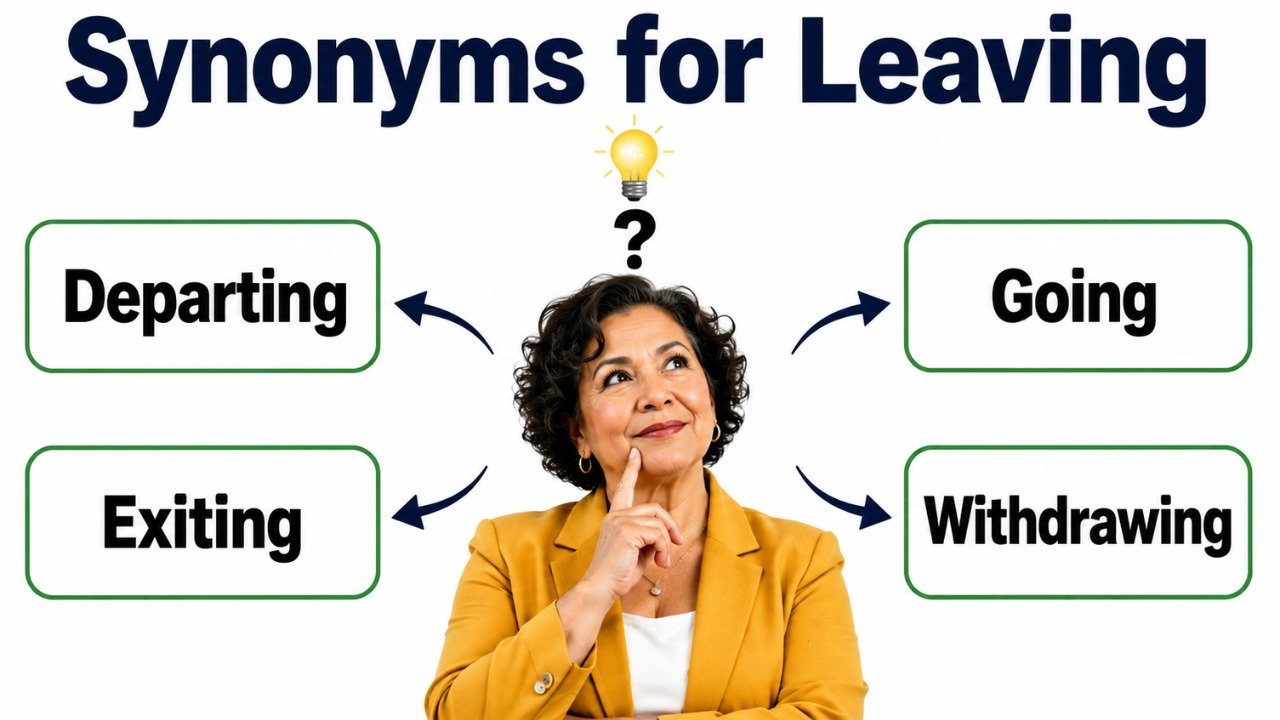
Quick Answer: The best synonyms for leaving include departing, exiting, going, withdrawing, quitting, resigning, vacating, abandoning, relocating, and setting off. Use departing for neutral or formal descriptions of going away, exiting for movement out of a place, quitting or resigning for employment, withdrawing for formal removal from an activity, abandoning for intentionally giving something up, and relocating when someone is moving to another place.
Pronunciation and Word Details
Word: Leaving
Pronunciation: /ˈliːvɪŋ/
Part of Speech: Verb, gerund, or present participle of leave
Meaning: Going away from a place, person, position, activity, or situation.
US Pronunciation:
UK Pronunciation:
What Does “Leaving” Mean?
Leaving means going away from a place, person, position, activity, or situation. It is commonly used as the present participle or gerund form of the verb leave.
The word can describe physical movement, such as leaving a house, office, city, or event. It can also describe ending involvement in something, such as leaving a job, relationship, organization, or project.
Leaving can sometimes express abandonment, omission, or separation. For example, someone may be leaving belongings behind, leaving information out of a report, or leaving one responsibility to focus on another.
Its exact meaning therefore depends heavily on what a person, object, or idea is moving away from.
Meaning, Tone, and Context of “Leaving”
Leaving is usually a neutral and highly flexible word. It appears naturally in everyday conversation, professional communication, narratives, instructions, essays, and formal writing.
In casual speech, leaving commonly means going away.
Example: We are leaving after dinner.
In workplace language, leaving can mean ending employment.
Example: She is leaving the company next month.
In emotional situations, leaving can describe separation from a person or relationship.
Example: He struggled with the decision to leave his family behind.
In formal writing, more precise words such as departing, withdrawing, resigning, vacating, or relocating may communicate the intended meaning more clearly.
The tone also changes according to the synonym. Departing sounds neutral and slightly formal, while quitting can sound more direct. Abandoning has a much stronger negative meaning because it often suggests giving up responsibility or support.
When and How to Use “Leaving”
For Physical Departure: Use leaving when someone is moving away from a place.
Example: The passengers are leaving the station.
For Ending Employment: Leaving can describe a person ending their time in a job or workplace.
Example: Maria is leaving her position at the end of the month.
For Ending Participation: Use leaving when someone stops participating in a project, organization, course, or activity.
Example: Two members are leaving the committee.
For Relationships: Leaving can describe ending or moving away from a personal relationship.
Example: She considered leaving the relationship.
For Relocation: Leaving can describe moving away from a town, city, house, or country.
Example: They are leaving the city for a quieter area.
For Abandonment: Leaving may suggest that someone is giving something up or failing to take it with them.
Example: He regretted leaving his responsibilities to others.
For Omission: Leaving can refer to excluding something.
Example: Leaving that detail out could confuse readers.
Best Synonyms for Leaving
Departing: Going away from a place.
Example: The departing guests thanked their host.
Exiting: Moving out of a place, building, vehicle, or system.
Example: People were exiting the hall quietly.
Going: Moving away or traveling somewhere else.
Example: We are going home after the meeting.
Withdrawing: Removing yourself from an activity, agreement, competition, or situation.
Example: The candidate is withdrawing from the contest.
Quitting: Stopping a job, activity, habit, or responsibility.
Example: He is quitting his job to study full time.
Resigning: Formally giving up a job or official position.
Example: The director is resigning from her position.
Vacating: Leaving a place so that it becomes empty or available.
Example: The tenants are vacating the apartment this weekend.
Abandoning: Leaving something behind with no intention of continuing or returning.
Example: They decided against abandoning the project.
Relocating: Moving from one place to another for living or work.
Example: The family is relocating to another city.
Setting Off: Beginning a journey or departure.
Example: The travelers are setting off before sunrise.
50 Synonyms for Leaving with Short Meanings
- Departing: Going away from a place.
- Exiting: Moving out of an enclosed place.
- Going: Moving away or traveling elsewhere.
- Withdrawing: Removing yourself from participation.
- Quitting: Stopping an activity, job, or commitment.
- Resigning: Formally giving up a position.
- Vacating: Moving out and making a place empty.
- Abandoning: Giving something up and going away.
- Deserting: Leaving someone or something without support.
- Forsaking: Giving up or turning away from something.
- Relocating: Moving to another place.
- Moving: Changing your place of residence or position.
- Moving Out: Permanently or temporarily leaving a residence.
- Going Away: Traveling or moving from a place.
- Heading Out: Beginning to leave in casual language.
- Setting Off: Starting a journey.
- Setting Out: Beginning a trip or planned journey.
- Taking Off: Leaving quickly or beginning a journey.
- Walking Away: Leaving a place or situation voluntarily.
- Stepping Away: Temporarily or permanently withdrawing.
- Pulling Out: Ending involvement or moving away.
- Backing Out: Withdrawing from an agreement or plan.
- Dropping Out: Leaving a course, activity, or program before completion.
- Checking Out: Leaving a hotel or similar place after completing formalities.
- Evacuating: Leaving a dangerous place for safety.
- Escaping: Getting away from danger or restriction.
- Fleeing: Leaving quickly because of danger or fear.
- Retreating: Moving away from a difficult or threatening situation.
- Retiring: Leaving employment or withdrawing from active work.
- Departing From: Moving away from a particular place or standard.
- Going Home: Leaving another place to return home.
- Moving On: Leaving a situation and progressing to something new.
- Breaking Away: Separating from a person, group, or situation.
- Separating: Moving apart from another person or thing.
- Parting: Going away from someone after being together.
- Saying Goodbye: Expressing farewell before leaving.
- Bidding Farewell: Formally saying goodbye before departure.
- Walking Out: Leaving suddenly or deliberately.
- Clearing Out: Leaving a place completely.
- Moving Away: Changing residence to another location.
- Giving Up: Stopping an effort, responsibility, or pursuit.
- Relinquishing: Giving up control, possession, or responsibility.
- Discontinuing: Stopping participation or activity.
- Ending: Bringing involvement or presence to a close.
- Omitting: Leaving something out intentionally or accidentally.
- Excluding: Not including someone or something.
- Skipping: Choosing not to include or participate in something.
- Passing Over: Leaving something unselected or unmentioned.
- Leaving Behind: Going away without taking someone or something.
- Taking Leave: Going away or beginning an authorized absence.
Read Also:
Synonyms for Burning

Synonyms for Leaving by Context
When Leaving Means Departing From a Place
Departing, exiting, going, heading out, setting off, setting out, and going away are useful when describing physical departure.
Example: The visitors are departing after lunch.
Departing sounds slightly more formal than leaving. Heading out sounds natural in conversation.
Example: We are heading out around seven.
When Leaving Means Ending a Job
Resigning, quitting, retiring, stepping away, and moving on can describe ending employment.
Example: She is resigning from her position in September.
Resigning is best when the departure is official and voluntary. Quitting is more direct and conversational.
Example: He is quitting his current job.
When Leaving Means Withdrawing From an Activity
Withdrawing, pulling out, backing out, dropping out, and stepping away describe ending participation.
Example: The organization is withdrawing from the agreement.
Withdrawing works especially well in formal communication.
Example: She decided to step away from the project.
When Leaving Means Abandoning Something
Abandoning, deserting, forsaking, relinquishing, and walking away can suggest giving something up.
Example: They had no intention of abandoning their responsibilities.
These words are generally stronger than leaving. Deserting often carries a negative emotional judgment.
Example: He was accused of deserting his responsibilities.
When Leaving Means Moving Somewhere Else
Relocating, moving, moving away, and moving out are useful when discussing a change of residence or location.
Example: The family is relocating closer to the coast.
Relocating is especially useful in professional or formal writing.
When Leaving Means Omitting Something
Omitting, excluding, skipping, and passing over can replace leaving when the meaning is not including something.
Example: Omitting the final paragraph made the explanation less clear.
Another Word for Leaving
The best single replacement for leaving is often departing when the intended meaning is physically going away. However, the best alternative depends on context. Resigning is more precise for a job, relocating for moving residence, and withdrawing for ending participation.
Original: The guests are leaving after lunch.
Better Option: The guests are departing after lunch.
Original: She is leaving her management position.
Better Option: She is resigning from her management position.
Original: They are leaving the city permanently.
Better Option: They are relocating from the city.
Original: He is leaving the competition.
Better Option: He is withdrawing from the competition.
When Not to Use “Leaving”
Leaving can sound vague when the exact reason or type of departure matters. A more specific synonym often gives readers clearer information.
Weak: She is leaving her position.
Better: She is resigning from her position.
The second sentence clearly explains that she is formally ending her employment.
Avoid leaving when describing official withdrawal if a more precise formal term is available.
Weak: The organization is leaving the agreement.
Better: The organization is withdrawing from the agreement.
Leaving can also be too mild when abandonment is intended.
Weak: He was leaving his responsibilities.
Better: He was abandoning his responsibilities.
Avoid repeatedly using leaving within the same paragraph.
Weak: She is leaving work, leaving the city, and leaving her apartment.
Better: She is resigning from work, moving away from the city, and vacating her apartment.
Words Commonly Confused With Leaving
Leaving vs Departing: Leaving is a broad everyday word, while departing specifically refers to going away and often sounds slightly more formal.
Leaving vs Exiting: Leaving can refer to places, jobs, relationships, and situations. Exiting usually refers more specifically to moving out of a place or system.
Leaving vs Quitting: Leaving is neutral, while quitting emphasizes stopping a job, activity, habit, or commitment.
Leaving vs Resigning: Leaving can describe any workplace departure. Resigning specifically means formally giving up a job or position voluntarily.
Leaving vs Abandoning: Leaving does not necessarily suggest irresponsibility. Abandoning often implies that someone has deserted something they were expected to continue or support.
Leaving vs Withdrawing: Leaving is general. Withdrawing is more precise when someone removes themselves from an activity, agreement, competition, or commitment.
Which Synonym Should You Choose?
Choose departing when describing physical departure in neutral or formal writing.
Choose exiting when someone is moving out of a building, vehicle, room, or enclosed area.
Choose going when you want a simple and conversational alternative.
Choose heading out for relaxed everyday conversation.
Choose resigning when someone formally gives up a professional position.
Choose quitting when someone stops a job, activity, habit, or commitment in direct language.
Choose withdrawing for formal reports, essays, agreements, competitions, applications, or professional emails.
Choose vacating when a person is leaving a house, apartment, office, or occupied space.
Choose relocating when a person, family, or organization moves to another location.
Choose abandoning when you need to emphasize completely giving something up.
Choose omitting when leaving means failing to include information, words, or details.
Real Life Examples of “Leaving” in Sentences
Original: We are leaving the restaurant after dinner.
Better Option: We are departing from the restaurant after dinner.
Original: She is leaving her job next month.
Better Option: She is resigning from her job next month.
Original: The family is leaving the neighborhood.
Better Option: The family is moving away from the neighborhood.
Original: Several people were leaving the building.
Better Option: Several people were exiting the building.
Original: He is leaving the training program.
Better Option: He is withdrawing from the training program.
Original: They are leaving their apartment at the end of the week.
Better Option: They are vacating their apartment at the end of the week.
Original: She was leaving the project before completion.
Better Option: She was stepping away from the project before completion.
Original: The travelers are leaving at sunrise.
Better Option: The travelers are setting off at sunrise.
Original: He regretted leaving his responsibilities behind.
Better Option: He regretted abandoning his responsibilities.
Original: Leaving that information out changed the meaning.
Better Option: Omitting that information changed the meaning.
Synonym Groups and Usage Differences
Departure Group
Departing, exiting, going, heading out, setting off, and going away describe movement from one place to another.
Departing is slightly more formal, while heading out is conversational.
Example: The final passengers are departing now.
Workplace Group
Resigning, quitting, retiring, stepping away, and moving on describe different ways of ending employment or professional involvement.
Resigning is formal. Quitting is direct. Retiring usually means ending a working career.
Example: She is retiring after thirty years of service.
Withdrawal Group
Withdrawing, pulling out, backing out, and dropping out describe ending participation.
Withdrawing is formal and neutral. Backing out can suggest reversing an earlier commitment.
Example: The participant is withdrawing from the program.
Abandonment Group
Abandoning, deserting, forsaking, relinquishing, and walking away describe giving up something or separating from it.
Abandoning and deserting are stronger than ordinary leaving and may suggest neglect.
Example: They refused to abandon the plan after one setback.
Relocation Group
Relocating, moving, moving away, moving out, and vacating relate to changing residence or physical location.
Relocating sounds professional, while moving away is natural in ordinary conversation.
Example: The office is relocating to a larger building.
Omission Group
Omitting, excluding, skipping, and passing over describe leaving information, people, or items out.
Example: Omitting an important fact can weaken an argument.
Antonyms of Leaving
The opposite of leaving depends on the meaning being expressed.
Arriving: Reaching a place rather than departing from it.
Entering: Going into a place instead of exiting.
Staying: Continuing to remain in the same place.
Remaining: Continuing to be present.
Returning: Coming back after being away.
Joining: Becoming involved instead of withdrawing.
Continuing: Keeping an activity or commitment going.
Retaining: Keeping possession or control instead of giving it up.
Including: Adding something rather than omitting it.
Keeping: Holding onto something rather than leaving it behind.
Comparison of Leaving vs Related Words
Leaving vs Departing
Leaving is broad and natural in most situations. Departing focuses specifically on going away and often sounds more formal.
Example With Leaving: We are leaving after the ceremony.
Example With Departing: We are departing after the ceremony.
Leaving vs Exiting
Leaving can refer to any type of separation. Exiting usually focuses on movement out of a physical space or system.
Example With Leaving: She is leaving the building.
Example With Exiting: She is exiting the building through the main door.
Leaving vs Quitting
Leaving does not explain why involvement ends. Quitting directly indicates stopping a job, habit, activity, or responsibility.
Example With Leaving: He is leaving his job.
Example With Quitting: He is quitting his job to pursue another career.
Leaving vs Resigning
Leaving is general, while resigning specifically refers to formally giving up an official position or job.
Example With Leaving: The manager is leaving next month.
Example With Resigning: The manager is resigning next month.
Leaving vs Abandoning
Leaving can be temporary, neutral, or planned. Abandoning usually suggests completely giving something up or failing to continue supporting it.
Example With Leaving: They are leaving the project for another team.
Example With Abandoning: They are abandoning the project before completion.
Leaving vs Withdrawing
Leaving is common in everyday language. Withdrawing is often more suitable for formal participation, applications, agreements, competitions, or commitments.
Example With Leaving: She is leaving the competition.
Example With Withdrawing: She is withdrawing from the competition.
Common Phrases and Expressions With “Leaving”
Leaving Home: Going away from the place where someone lives.
Leaving Work: Departing from a workplace or sometimes ending employment.
Leaving Early: Going away before the expected time.
Leaving Behind: Going away without taking someone or something.
Leaving for Good: Going away permanently.
Leaving Out: Failing to include something.
Leaving a Job: Ending employment with an organization.
Leaving a Message: Providing information for someone to receive later.
Leaving Room: Creating enough available space for something.
Leaving Someone Alone: No longer disturbing or interacting with someone.
Common Mistakes to Avoid
Repeating Leaving Too Often: Repetition can make writing sound plain or monotonous. Use precise alternatives when the meaning changes.
Example: Instead of saying someone is leaving a job and leaving a city, use resigning for the job and relocating for the city.
Choosing an Overly Strong Synonym: Do not replace leaving with abandoning unless the sentence truly suggests desertion or complete surrender.
Example: Someone leaving an office after work is departing, not abandoning the office.
Using Quitting for Every Situation: Quitting works for jobs, habits, and activities, but it is unnatural for ordinary physical departure.
Incorrect: She is quitting the restaurant after dinner.
Correct: She is leaving the restaurant after dinner.
Confusing Resigning With Retiring: Resigning means voluntarily giving up a position. Retiring usually means permanently ending a working career.
Using Vague Language: Leaving may not explain whether someone is resigning, relocating, withdrawing, or simply going home. Select a more precise word when that information matters.
Ignoring Context: A synonym that works for a workplace may not work for a relationship, building, journey, or written document.
Conclusion
Understanding synonyms for leaving makes it easier to express different types of departure clearly and naturally. Departing and exiting work well for physical movement, while resigning and quitting suit employment contexts. Withdrawing is useful for formal participation, relocating describes moving somewhere new, and abandoning expresses a stronger sense of giving something up. When leaving means not including information, omitting is usually more precise. Choose the synonym that communicates the exact reason, setting, and tone of the departure.
FAQs About Synonyms for Leaving
What is the best synonym for leaving?
Departing is one of the best general synonyms when leaving means going away from a place. The best choice still depends on context.
What is a formal synonym for leaving?
Departing, withdrawing, vacating, relocating, and resigning are useful formal alternatives depending on what kind of departure is being described.
What is another word for leaving a place?
Departing, exiting, going away, heading out, and setting off can all describe leaving a place.
What is another word for leaving a job?
Resigning, quitting, retiring, stepping away, and moving on are useful options. Resigning is usually the most precise formal term for voluntarily giving up a position.
Is abandoning a synonym for leaving?
Yes, but abandoning has a stronger meaning. It often suggests leaving something permanently or giving up a responsibility, person, project, or possession.
What is another word for leaving someone?
Parting, separating, walking away, moving on, and abandoning may work depending on the situation and emotional meaning.
What synonym should replace leaving in formal writing?
Use departing for physical departure, resigning for employment, withdrawing for participation, vacating for property, relocating for moving, and omitting when leaving means excluding information.
