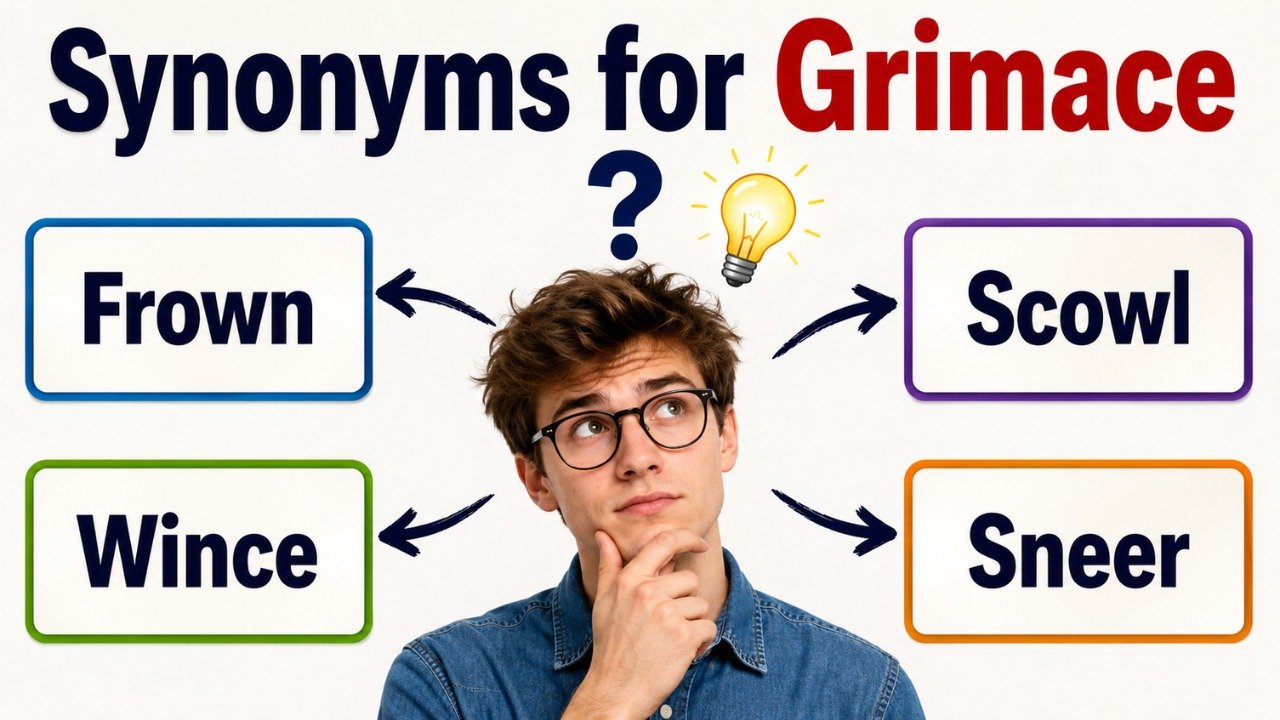
Quick Answer: The best synonyms for grimace include wince, scowl, frown, sneer, cringe, glower, pout, contortion, pained expression, and look of disgust. Use wince when pain or discomfort causes the expression, scowl or glower for anger, frown for displeasure or concern, sneer for contempt, and cringe for embarrassment or emotional discomfort. In descriptive writing, pained expression and look of disgust provide clearer detail when the emotion behind the facial expression matters.
Pronunciation and Word Details
Word: Grimace.
Pronunciation: /ɡrɪməs/
Part of Speech: Noun and verb.
Meaning: A twisted or unpleasant facial expression that shows pain, disgust, embarrassment, disapproval, or discomfort.
US Pronunciation:
UK Pronunciation:
What Does “Grimace” Mean?
Grimace means an unpleasant or twisted facial expression that usually reveals pain, disgust, embarrassment, irritation, or another uncomfortable emotion.
As a noun, grimace refers to the expression itself.
Example: A grimace crossed her face when she tasted the bitter medicine.
As a verb, grimace describes the action of making such an expression.
Example: He grimaced when he tried to stand on his injured foot.
The word is especially useful when a person’s face visibly reacts to an unpleasant physical sensation or emotional experience. Context determines the exact feeling being expressed.
A grimace may show physical pain, but it can also communicate distaste, awkwardness, frustration, fear, embarrassment, or annoyance.
Example: She grimaced at the unpleasant smell.
Here, the expression suggests disgust.
Example: He grimaced as the doctor examined his sore shoulder.
Here, the expression suggests pain.
Meaning, Tone, and Context of “Grimace”
Grimace has a generally neutral descriptive tone, although the emotion it describes is usually negative or uncomfortable. It is common in everyday conversation, fiction, descriptive writing, journalism, personal narratives, and discussions of body language.
The word is neither strongly formal nor strongly casual. It works naturally in both conversational and polished writing.
In stories, grimace helps writers show emotion through facial expression rather than directly naming the feeling.
Example: Instead of saying that Maya disliked the taste, a writer might say that Maya grimaced after taking a sip.
Grimace can describe a quick involuntary reaction or a deliberate facial expression.
Emotional Context: It can communicate embarrassment, disgust, irritation, or awkwardness.
Physical Context: It often describes a reaction to pain, soreness, pressure, or an unpleasant taste.
Descriptive Context: It can help create a vivid image of someone’s facial reaction.
Conversational Context: It can describe someone’s immediate response to something unpleasant.
When and How to Use “Grimace”
Use grimace when you want to describe a facial expression caused by an unpleasant feeling or reaction.
For Physical Pain: Grimace works well when discomfort causes someone to tighten, twist, or distort the face.
Example: He grimaced as he placed weight on his injured ankle.
For Disgust: Use grimace when someone’s expression reveals dislike of a smell, taste, sight, or experience.
Example: She grimaced after tasting the extremely sour fruit.
For Embarrassment: Grimace can describe an awkward facial reaction after an uncomfortable moment.
Example: Daniel grimaced when his mistake was mentioned in front of everyone.
For Irritation: The word can show annoyance without requiring spoken criticism.
Example: She grimaced at the repeated interruption.
For Disapproval: Grimace can suggest that someone finds an idea or situation unpleasant.
Example: His father grimaced when he heard the proposal.
For Descriptive Writing: Grimace helps show emotion visually.
Example: A brief grimace revealed how uncomfortable the chair had become.
Best Synonyms for Grimace
Wince
Synonym: Wince means to make a quick facial movement because of pain, embarrassment, or discomfort.
Example: She winced when the nurse touched the bruise.
Scowl
Synonym: Scowl means an angry or disapproving facial expression, usually involving lowered eyebrows.
Example: He scowled when someone interrupted his presentation.
Frown
Synonym: Frown means an expression showing concern, displeasure, confusion, or disapproval.
Example: She frowned when she noticed the incorrect total.
Sneer
Synonym: Sneer means a facial expression showing contempt, disrespect, or mockery.
Example: He sneered at the suggestion as though it were ridiculous.
Cringe
Synonym: Cringe means to react physically or emotionally to embarrassment, fear, discomfort, or awkwardness.
Example: She cringed when she remembered her embarrassing comment.
Glower
Synonym: Glower means to look at someone with visible anger or strong disapproval.
Example: The frustrated customer glowered at the broken machine.
Pout
Synonym: Pout means to push the lips outward to show disappointment, displeasure, or unhappiness.
Example: The child pouted after hearing that the game was over.
Contortion
Synonym: Contortion means an unusual twisting or distortion of the face or body.
Example: A sudden contortion of his face revealed the intensity of the pain.
Pained Expression
Synonym: Pained expression describes a facial look showing physical or emotional suffering.
Example: A pained expression appeared on her face when she heard the disappointing news.
Look of Disgust
Synonym: Look of disgust means a facial expression showing strong dislike or revulsion.
Example: He gave a look of disgust when he noticed the spoiled food.
50 Synonyms for Grimace with Short Meanings
- Wince: A quick facial reaction to pain or discomfort.
- Scowl: An angry or strongly disapproving facial expression.
- Frown: An expression of concern, displeasure, or confusion.
- Sneer: An expression showing contempt or disrespect.
- Cringe: A physical reaction to embarrassment, fear, or discomfort.
- Glower: An angry or threatening look.
- Pout: An expression showing disappointment or displeasure.
- Moue: A small facial expression showing dissatisfaction or contempt.
- Contortion: A twisted or distorted facial expression.
- Expression: A visible look that communicates emotion.
- Pained Expression: A facial look showing suffering or discomfort.
- Sour Expression: A displeased or unfriendly facial look.
- Wry Expression: A facial look suggesting discomfort, irony, or restrained amusement.
- Strained Expression: A tense facial look caused by effort or discomfort.
- Pinched Expression: A tight facial appearance suggesting pain or worry.
- Twisted Expression: A distorted facial look caused by strong emotion.
- Contorted Expression: A visibly distorted face caused by pain or emotion.
- Disgusted Expression: A facial reaction showing strong dislike.
- Uncomfortable Expression: A look revealing uneasiness or discomfort.
- Displeased Expression: A facial look showing dissatisfaction.
- Distressed Expression: A look showing emotional or physical suffering.
- Tense Expression: A facial appearance showing strain or anxiety.
- Look of Pain: A facial reaction showing physical or emotional suffering.
- Look of Disgust: An expression communicating revulsion or dislike.
- Look of Distaste: A facial expression showing dislike or aversion.
- Look of Discomfort: An expression revealing physical or emotional unease.
- Look of Displeasure: A facial expression showing dissatisfaction.
- Look of Annoyance: An expression revealing irritation.
- Look of Irritation: A facial reaction showing frustration or annoyance.
- Look of Disapproval: An expression showing that something is not accepted or liked.
- Look of Revulsion: A strong facial reaction of disgust.
- Look of Distress: A facial expression showing suffering or anxiety.
- Distorted Face: A face changed by strong emotion or discomfort.
- Twisted Face: A face visibly altered by pain or unpleasant emotion.
- Contorted Face: A face twisted by pain, effort, or emotion.
- Pained Look: An expression showing discomfort or sorrow.
- Sour Look: An unfriendly or displeased expression.
- Dark Look: A facial expression showing anger or disapproval.
- Angry Look: An expression clearly showing anger.
- Disapproving Look: A facial reaction communicating criticism or objection.
- Make a Face: To form an unusual expression showing dislike or emotion.
- Pull a Face: To deliberately form a strange or displeased expression.
- Screw Up One’s Face: To tighten or distort the face because of discomfort.
- Contort One’s Face: To twist facial features because of pain or emotion.
- Wrinkle One’s Nose: To move the nose in a way that often shows disgust.
- Curl One’s Lip: To raise the lip as an expression of contempt or dislike.
- Purse One’s Lips: To tighten the lips, often showing displeasure or thought.
- Tighten One’s Mouth: To make the mouth tense because of irritation or discomfort.
- Flinch: To make a sudden reaction because of fear, pain, or surprise.
- Recoil: To draw away physically or emotionally because of shock or disgust.
Read Also:
Synonyms for Chocolate
Synonyms for Grimace by Context
When Grimace Shows Pain
When grimace describes physical pain, the strongest alternatives are wince, pained expression, pained look, flinch, strained expression, and contorted face.
Wince is especially useful for a sudden response to pain.
Example: She winced as she moved her injured wrist.
Pained expression is better when describing what someone’s face looks like rather than the movement itself.
Example: A pained expression appeared on his face as he climbed the stairs.
When Grimace Shows Disgust
For disgust, useful synonyms include look of disgust, look of distaste, disgusted expression, look of revulsion, wrinkle one’s nose, and curl one’s lip.
Example: She wrinkled her nose at the unpleasant odor.
Look of revulsion suggests a stronger reaction than a simple grimace.
Example: A look of revulsion crossed his face when he opened the container.
When Grimace Shows Anger or Disapproval
Scowl, glower, dark look, frown, disapproving look, and angry look are useful when a grimace communicates anger or criticism.
Example: The manager scowled when he saw the damaged equipment.
Glower is stronger and often suggests sustained anger.
Example: She glowered at the person who had interrupted her repeatedly.
When Grimace Shows Embarrassment or Awkwardness
Cringe, uncomfortable expression, strained expression, wry expression, and wince are useful for embarrassment.
Example: He cringed when the recording of his mistake was played.
A wry expression may work when embarrassment is mixed with reluctant amusement.
Example: She gave a wry expression after realizing she had misunderstood the instructions.
When Grimace Describes Facial Movement
Use contortion, distorted face, twisted face, contorted expression, make a face, pull a face, or screw up one’s face when the physical appearance of the face is most important.
Example: He screwed up his face after tasting the bitter drink.
Another Word for Grimace
Another word for grimace is often wince, especially when the expression results from sudden pain or discomfort. However, the best alternative depends on the emotion involved.
Use scowl for anger, sneer for contempt, frown for concern or displeasure, and cringe for embarrassment or emotional discomfort.
Original: She grimaced when the doctor touched her shoulder.
Better Option: She winced when the doctor touched her shoulder.
Original: He grimaced angrily at the noisy group.
Better Option: He scowled at the noisy group.
Original: She grimaced at the insulting remark.
Better Option: She sneered at the insulting remark.
Original: He grimaced when he remembered his awkward speech.
Better Option: He cringed when he remembered his awkward speech.
When Not to Use “Grimace”
Grimace is useful, but it can become vague if the reader needs to know the exact emotion behind the expression.
If someone is clearly angry, scowl may be more precise.
Weak: He grimaced at the person who had insulted him.
Better: He scowled at the person who had insulted him.
If someone reacts specifically to sudden pain, wince usually communicates the action more accurately.
Weak: She grimaced when the needle touched her skin.
Better: She winced when the needle touched her skin.
If contempt is the central emotion, sneer is stronger.
Weak: He grimaced at their suggestion because he considered it foolish.
Better: He sneered at their suggestion because he considered it foolish.
Avoid repeatedly using grimace for every negative facial expression. Different reactions have different meanings, so choosing a precise synonym makes descriptions clearer and more vivid.
Words Commonly Confused With Grimace
Grimace vs Wince: A grimace is a twisted or unpleasant facial expression caused by many emotions, while a wince is usually a quick reaction to pain, embarrassment, or discomfort.
Grimace vs Scowl: A grimace may show pain, disgust, or discomfort, while a scowl mainly communicates anger or disapproval.
Grimace vs Frown: A frown often indicates concern, confusion, sadness, or displeasure. A grimace usually involves greater distortion of the facial features.
Grimace vs Sneer: A sneer specifically expresses contempt or mockery, while a grimace has a much broader range of emotional causes.
Grimace vs Cringe: Grimace focuses primarily on facial expression. Cringe can involve the entire body and usually suggests embarrassment, fear, or strong discomfort.
Grimace vs Glower: A glower is an angry, intense look directed toward someone or something. A grimace does not necessarily involve anger.
Grimace vs Flinch: A flinch is a quick physical movement away from anticipated pain, fear, or surprise. A grimace is mainly a facial reaction.
Which Synonym Should You Choose?
Choose wince when describing a quick response to physical pain, soreness, embarrassment, or discomfort.
Choose scowl when the facial expression clearly shows anger or strong disapproval.
Choose frown when someone looks concerned, confused, unhappy, or mildly displeased.
Choose sneer when someone expresses contempt, superiority, disrespect, or mockery.
Choose cringe when embarrassment, awkwardness, fear, or emotional discomfort causes the reaction.
Choose glower when someone gives another person a prolonged or intense angry look.
Choose pout when disappointment or unhappiness is shown through the lips.
Choose pained expression in formal, descriptive, or narrative writing when suffering needs to be clearly communicated.
Choose look of disgust when the emotion is specifically revulsion or strong dislike.
Choose contorted expression when the physical distortion of the face matters more than the specific emotion.
In essays and reports, clearer descriptive expressions such as pained expression or look of discomfort may work better when emotional precision is important.
In conversation and storytelling, wince, frown, scowl, cringe, and grimace usually sound natural.
Real Life Examples of “Grimace” in Sentences
Original: She grimaced when she tried to bend her injured knee.
Better Option: She winced when she tried to bend her injured knee.
Original: He grimaced at the rude interruption.
Better Option: He scowled at the rude interruption.
Original: Maria grimaced after tasting the bitter drink.
Better Option: Maria made a face after tasting the bitter drink.
Original: He grimaced when his embarrassing mistake was mentioned.
Better Option: He cringed when his embarrassing mistake was mentioned.
Original: She grimaced at the insulting comment.
Better Option: She sneered at the insulting comment.
Original: The child grimaced when the meal was placed in front of him.
Better Option: The child frowned when the meal was placed in front of him.
Original: He grimaced as the therapist moved his sore arm.
Better Option: A pained expression crossed his face as the therapist moved his sore arm.
Original: She grimaced at the unpleasant smell.
Better Option: She wrinkled her nose at the unpleasant smell.
Original: His face formed a grimace as he lifted the heavy box.
Better Option: His face became strained as he lifted the heavy box.
Original: She grimaced when she saw the spoiled food.
Better Option: A look of disgust appeared on her face when she saw the spoiled food.
Synonym Groups and Usage Differences
Pain Group
Wince, pained expression, pained look, flinch, strained expression, and contorted face belong to the pain group.
These words work when physical discomfort or suffering produces the facial reaction.
Example: He winced as he lowered himself into the chair.
Disgust Group
Look of disgust, look of distaste, look of revulsion, disgusted expression, wrinkle one’s nose, and curl one’s lip communicate dislike or revulsion.
Some are stronger than others. Look of revulsion suggests an especially intense reaction.
Example: She wrinkled her nose when she smelled the spoiled milk.
Anger Group
Scowl, glower, dark look, angry look, and disapproving look often replace grimace when anger is the main emotion.
Scowl is one of the most natural choices for obvious displeasure. Glower usually feels stronger and more intense.
Example: He glowered at anyone who attempted to interrupt.
Embarrassment Group
Cringe, wince, uncomfortable expression, strained expression, and wry expression are useful when awkwardness or embarrassment causes the reaction.
Example: She cringed at the memory of her awkward introduction.
Facial Distortion Group
Contortion, twisted expression, contorted expression, distorted face, make a face, and screw up one’s face emphasize physical appearance.
These choices are useful when the exact emotion is less important than the visible change in facial features.
Example: The bitter taste made him screw up his face.
Antonyms of Grimace
The opposite of grimace depends on whether you mean a facial expression, emotional reaction, or physical response. Because a grimace generally communicates unpleasant feelings, its opposites often express pleasure, calmness, or friendliness.
Smile: A pleasant expression showing happiness or friendliness.
Grin: A broad smile showing pleasure or amusement.
Beam: To smile brightly with obvious happiness.
Relax: To become physically or emotionally less tense.
Calm Expression: A facial look showing peace and emotional control.
Pleasant Expression: A friendly or agreeable facial appearance.
Contented Look: An expression showing satisfaction.
Cheerful Expression: A facial appearance showing happiness.
Delighted Look: An expression communicating pleasure or excitement.
Serene Expression: A peaceful and composed facial look.
Comparison: Grimace vs Related Words
Grimace vs Wince
Grimace describes a broader range of unpleasant facial expressions. Wince describes a quick reaction commonly caused by pain or embarrassment.
Example With Grimace: She grimaced at the strong smell.
Example With Wince: She winced when pressure was applied to her injured hand.
Grimace vs Scowl
A grimace can indicate pain, disgust, embarrassment, or irritation. A scowl primarily communicates anger or disapproval.
Example With Grimace: He grimaced after tasting the medicine.
Example With Scowl: He scowled at the person who interrupted him.
Grimace vs Frown
A grimace is often more physically distorted than a frown. A frown may simply involve lowered eyebrows and can indicate worry, confusion, sadness, or displeasure.
Example With Grimace: She grimaced as she stretched her sore leg.
Example With Frown: She frowned while checking the confusing instructions.
Grimace vs Sneer
A grimace can have several emotional meanings. A sneer specifically expresses contempt, mockery, or disrespect.
Example With Grimace: He grimaced at the unpleasant taste.
Example With Sneer: He sneered at the idea because he considered it foolish.
Grimace vs Cringe
A grimace mainly describes what happens to the face. Cringe describes a broader physical or emotional reaction to embarrassment, fear, awkwardness, or discomfort.
Example With Grimace: She grimaced when the bitter liquid touched her tongue.
Example With Cringe: She cringed when she heard the recording of her old speech.
Grimace vs Glower
Grimace may result from many unpleasant emotions. Glower specifically refers to an intense angry look.
Example With Grimace: He grimaced as he moved his injured shoulder.
Example With Glower: He glowered at the person responsible for the damage.
Common Phrases and Expressions With Grimace
Painful Grimace: A facial expression caused by physical or emotional pain.
Slight Grimace: A small or subtle unpleasant facial reaction.
Brief Grimace: An unpleasant expression that appears for only a short moment.
Visible Grimace: A facial reaction obvious enough for others to notice.
Grimace of Pain: An expression clearly caused by physical suffering.
Grimace of Disgust: A facial reaction caused by something unpleasant or revolting.
Grimace of Discomfort: An expression showing physical or emotional uneasiness.
Grimace of Distaste: A facial expression revealing dislike or aversion.
Face Twisted Into a Grimace: A phrase describing noticeable distortion of facial features.
Suppress a Grimace: To prevent an unpleasant facial reaction from becoming visible.
Common Mistakes to Avoid
One common mistake is treating every unpleasant facial expression as a grimace. The word is broad, but more precise alternatives often create clearer writing.
Use wince when pain causes a sudden reaction. Use scowl for anger, sneer for contempt, and frown for concern or mild displeasure.
Another mistake is confusing grimace with cringe. Grimace mainly describes the face, while cringe may involve a broader physical reaction.
Writers should also avoid repeating grimace several times within the same paragraph.
Weak: She grimaced at the smell, grimaced at the taste, and grimaced again when she saw the food.
Better: She wrinkled her nose at the smell, winced at the bitter taste, and made a face when she saw the food.
Another mistake is choosing a synonym based only on similarity rather than emotional meaning. A sneer and a wince are both facial reactions, but they communicate very different emotions.
Pay attention to what causes the expression before choosing a replacement.
Conclusion
Knowing the right synonyms for grimace can make descriptions more precise, vivid, and natural. Wince is best for sudden pain or discomfort, while scowl and glower communicate anger. Sneer works for contempt, frown for concern or displeasure, and cringe for embarrassment or awkwardness. Pained expression and look of disgust are useful when the emotion needs to be unmistakably clear. The best replacement always depends on what the person’s facial expression is actually communicating.
FAQs About Synonyms for Grimace
What Is the Best Synonym for Grimace?
The best general synonym is wince when the expression is caused by pain or discomfort. Scowl, frown, sneer, and cringe are better for other emotions.
What Is Another Word for Grimace?
Another word for grimace can be wince, scowl, frown, sneer, cringe, contortion, or pained expression, depending on the context.
Is Wince a Synonym for Grimace?
Yes. Wince is a strong synonym when the facial reaction results from pain, embarrassment, fear, or sudden discomfort.
What Is a Synonym for Grimace Caused by Disgust?
Look of disgust, look of distaste, look of revulsion, wrinkle one’s nose, and disgusted expression are useful choices.
What Is the Difference Between Grimace and Scowl?
A grimace can show pain, disgust, embarrassment, or discomfort. A scowl mainly shows anger, irritation, or disapproval.
Can Grimace Be Both a Noun and a Verb?
Yes. As a noun, grimace names the facial expression. As a verb, it describes making that expression.
Noun Example: A grimace appeared on his face.
Verb Example: He grimaced when he moved his injured shoulder.
What Is the Opposite of Grimace?
Common opposites include smile, grin, beam, pleasant expression, calm expression, and contented look because they usually communicate positive or relaxed emotions.
