
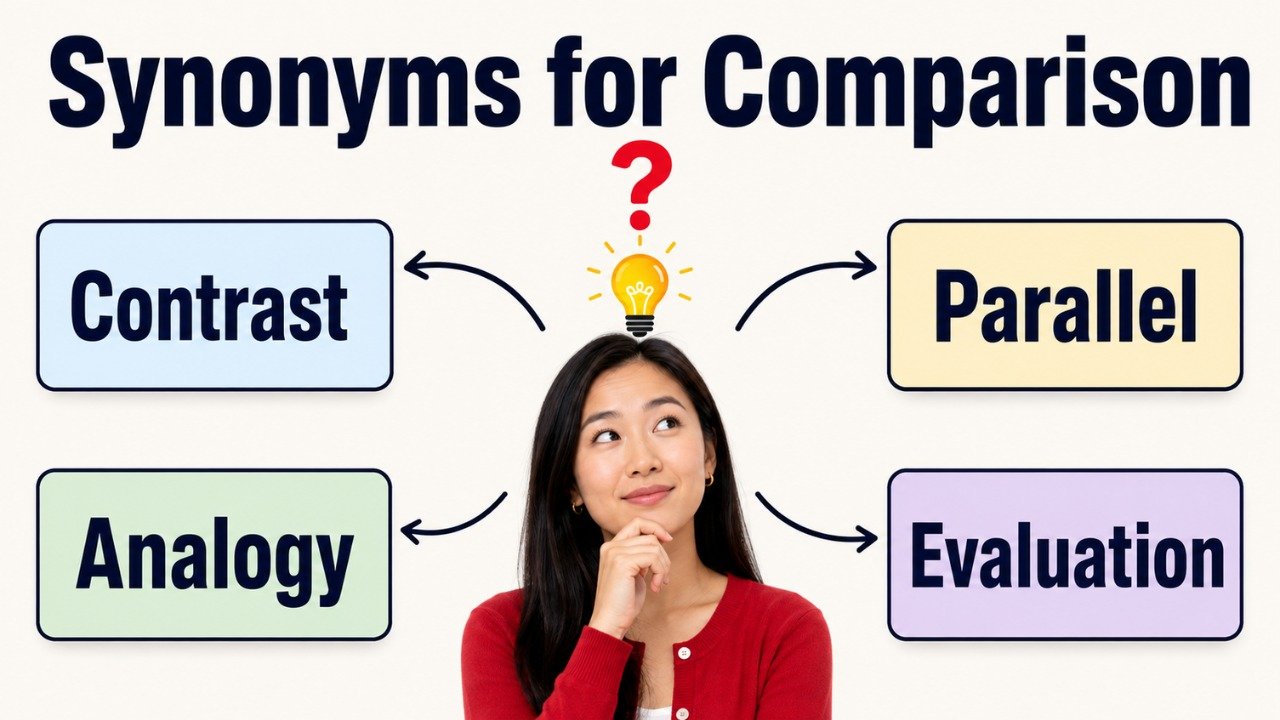
Quick Answer: The best synonyms for comparison include evaluation, assessment, analysis, contrast, examination, review, juxtaposition, analogy, appraisal, and benchmarking. Use evaluation or assessment when judging quality or value, analysis for detailed or academic study, contrast when emphasizing differences, juxtaposition when placing things side by side, analogy when showing a meaningful similarity, review for a general examination, appraisal for judging worth, and benchmarking when measuring performance against a standard. The best choice depends on whether you are discussing similarities, differences, quality, value, performance, or relationships.
Pronunciation and Word Details
Word: Comparison
Pronunciation: /kəmˈpærɪsən/
Part of Speech: Noun
Meaning: The act of examining two or more things to identify their similarities, differences, qualities, or relative value.
US Pronunciation:
UK Pronunciation:
What Does “Comparison” Mean?
Comparison means examining two or more people, things, ideas, results, or situations to understand how they are similar or different.
As a noun, comparison can describe both the process of comparing and the result of that process. It is commonly used when people judge quality, performance, appearance, price, size, value, behavior, or other characteristics.
For example, a comparison of two products may examine their features and costs. A comparison between two ideas may focus on their similarities and differences. In academic writing, comparison can be part of a structured analysis.
The word can also describe an act of likening one thing to another. In this sense, it may be close to analogy, parallel, resemblance, or likeness.
Comparison is therefore a flexible word that works in everyday conversation, business writing, education, research, reports, reviews, and analytical discussions.
Meaning, Tone, and Context of “Comparison”
Comparison usually has a neutral and objective tone. It does not automatically suggest approval or criticism. Its meaning depends on what is being compared and why.
In formal or academic writing, comparison often refers to a systematic examination of similarities, differences, evidence, or results. Words such as analysis, assessment, evaluation, and comparative examination may fit these contexts.
In everyday conversation, comparison can simply mean looking at two options before choosing one. Review, matchup, or side by side look may sound more natural in casual contexts.
When similarities are the main focus, analogy, parallel, resemblance, likeness, or correspondence may be more precise.
When differences are the main focus, contrast, distinction, or differentiation can communicate the intended meaning more clearly.
When value or performance is being judged, evaluation, assessment, appraisal, rating, or benchmarking may work better than the general word comparison.
When and How to Use “Comparison”
For Similarities: Use comparison when examining what two or more things have in common.
Example: The comparison showed several similarities between the two teaching methods.
For Differences: Use comparison when considering how two things differ from each other.
Example: A comparison of the two designs revealed major differences in layout and usability.
For Evaluation: Use comparison when judging which option performs better or provides greater value.
Example: The price comparison helped the family choose the more affordable option.
For Academic Analysis: Comparison works well when discussing two theories, texts, studies, events, or arguments.
Example: Her essay included a detailed comparison of the two historical interpretations.
For Performance: Use comparison when results are measured against another result or a standard.
Example: The performance comparison showed that the revised method produced better results.
For Decision Making: Comparison can help explain why one option is chosen over another.
Example: After a careful comparison, the committee selected the simpler proposal.
For Similarity in Language: Comparison can describe the act of likening one thing to another.
Example: His comparison of memory to a library made the idea easier to understand.
For Visual Examination: Comparison is useful when objects, images, or designs are placed together for inspection.
Example: A side by side comparison made the changes easy to notice.
Best Synonyms for Comparison
Evaluation: A judgment of quality, value, effectiveness, or performance.
Example: The evaluation showed which proposal offered the greatest value.
Assessment: A careful judgment based on information, evidence, or defined criteria.
Example: The assessment considered the strengths and weaknesses of both plans.
Analysis: A detailed examination of information, ideas, characteristics, or relationships.
Example: The analysis explained how the two approaches differed.
Contrast: An examination or presentation of important differences.
Example: The contrast between the two styles became obvious immediately.
Examination: A careful inspection or study of something.
Example: The examination revealed several similarities between the documents.
Review: A general or systematic consideration of information, options, or results.
Example: The review considered both available methods before making a recommendation.
Juxtaposition: The placement of things together so their similarities or differences become noticeable.
Example: The juxtaposition of the two photographs highlighted changes in the landscape.
Analogy: A comparison used to explain a similarity between otherwise different things.
Example: The teacher used an analogy between the heart and a pump.
Appraisal: A judgment of value, quality, condition, or importance.
Example: The appraisal considered the advantages of each option.
Benchmarking: The process of measuring performance against another result, organization, or standard.
Example: Benchmarking helped the team understand how its performance compared with the target.
50 Synonyms for Comparison with Short Meanings
- Evaluation: Judgment of quality, value, or effectiveness.
- Assessment: Careful judgment based on evidence or criteria.
- Analysis: Detailed examination of information or characteristics.
- Contrast: Examination that emphasizes differences.
- Examination: Careful inspection or study.
- Review: Consideration of information, options, or results.
- Juxtaposition: Placement together for easier comparison.
- Analogy: Comparison based on a meaningful similarity.
- Appraisal: Judgment of value or quality.
- Benchmarking: Measurement against a standard or reference point.
- Parallel: A similarity between two situations, ideas, or developments.
- Resemblance: A noticeable similarity between things.
- Similarity: The state of having qualities in common.
- Likeness: Similarity in appearance, character, or nature.
- Correspondence: Agreement or similarity between related things.
- Equivalence: Equality or similarity in value, meaning, or effect.
- Matching: The act of checking how closely things correspond.
- Collation: Careful comparison of information or documents.
- Weighing: Consideration of competing qualities or choices.
- Judgment: A conclusion formed after considering information.
- Inspection: Careful examination of features or condition.
- Scrutiny: Very close and careful examination.
- Study: Detailed consideration of a subject or set of information.
- Investigation: Systematic examination to discover facts or differences.
- Measurement: Determination of size, amount, performance, or degree.
- Rating: Evaluation according to a scale or standard.
- Ranking: Arrangement according to quality, performance, or importance.
- Grading: Evaluation according to defined levels or standards.
- Judging: Forming an opinion after examining alternatives.
- Cross Check: Verification by comparing information with another source or set of facts.
- Side by Side Review: Examination of two or more things together.
- Comparative Analysis: Detailed study of similarities and differences.
- Comparative Review: Examination of several options in relation to one another.
- Comparative Assessment: Judgment of options using shared criteria.
- Comparative Evaluation: Evaluation of relative strengths, weaknesses, or value.
- Relative Assessment: Judgment based on how something performs in relation to another.
- Relative Evaluation: Consideration of quality or value in relation to alternatives.
- Contrastive Analysis: Study focused mainly on differences.
- Differentiation: Identification of features that make things different.
- Distinction: Recognition of a meaningful difference.
- Comparison Test: A test designed to examine relative qualities or results.
- Matchup: A direct comparison between two options, sides, or competitors.
- Check: A basic examination for agreement or difference.
- Audit: A systematic examination of records, processes, or performance.
- Survey: A broad examination of several items, views, or conditions.
- Inquiry: Examination intended to gain greater understanding.
- Likening: Describing one thing as similar to another.
- Association: A connection formed between related ideas or qualities.
- Relation: A connection between two or more things.
- Correlation: A relationship in which two variables or patterns are connected.
Read Also:
Synonyms for Addiction
Synonyms for Comparison by Context
When Comparison Means Examining Similarities and Differences
Analysis, examination, review, comparative analysis, comparative assessment, and study are useful when you want to consider both similarities and differences.
Example: The comparative analysis identified important similarities between the two systems.
Example: A detailed examination revealed where the approaches differed.
Analysis is especially useful in academic, technical, or professional writing because it suggests careful reasoning.
Review is broader and often sounds more accessible.
When Comparison Means Judging Quality or Value
Evaluation, assessment, appraisal, rating, ranking, judging, and benchmarking work well when the purpose is to determine which option is stronger, better, more valuable, or more effective.
Example: The evaluation considered cost, quality, and reliability.
Example: Benchmarking showed how the current results performed against the accepted standard.
Evaluation is a strong general choice. Assessment often suggests structured criteria, while appraisal commonly focuses on value or quality.
When Comparison Means Showing Similarity
Analogy, parallel, resemblance, likeness, similarity, correspondence, and equivalence are useful when the main purpose is to show how two things are alike.
Example: The writer drew a parallel between the two historical events.
Example: There is a strong resemblance between the two designs.
Analogy is especially useful when one familiar idea helps explain another. Resemblance and likeness usually describe similarity rather than the process of comparing.
When Comparison Means Emphasizing Differences
Contrast, differentiation, distinction, and contrastive analysis are stronger choices when differences matter more than similarities.
Example: The contrast between the old and new policies was immediately noticeable.
Example: The analysis made a clear distinction between temporary and permanent changes.
Contrast is the most natural alternative when the writer wants to highlight opposing qualities.
When Comparison Means Placing Things Together
Juxtaposition, side by side review, matching, collation, and cross check are useful when things are physically or conceptually placed together for direct examination.
Example: The juxtaposition of the two images highlighted subtle changes.
Example: A cross check of the figures revealed an inconsistency.
Juxtaposition is particularly useful in literary, artistic, and analytical contexts.
Another Word for Comparison
The best general alternative to comparison is evaluation when the purpose is to judge quality, value, or performance. However, the most accurate replacement depends on the intended meaning.
Use analysis for detailed examination, contrast for differences, analogy for explanatory similarity, assessment for structured judgment, and juxtaposition when items are placed together.
Original: We completed a comparison of the two proposals.
Better Option: We completed an evaluation of the two proposals.
Original: The report provides a comparison of the two economic models.
Better Option: The report provides a comparative analysis of the two economic models.
Original: The photograph creates an interesting comparison between old and new architecture.
Better Option: The photograph creates an interesting juxtaposition between old and new architecture.
Original: Her comparison helped explain how the two ideas were similar.
Better Option: Her analogy helped explain how the two ideas were similar.
When Not to Use “Comparison”
Comparison is useful, but it can sometimes be too general. A more specific synonym often makes writing clearer.
Use analysis when the examination is detailed and systematic. Use evaluation when a judgment is being made. Use contrast when differences are the main point. Use analogy when explaining one thing through its similarity to another.
Repeated use of comparison can also make formal writing sound monotonous.
Weak: The report gives a comparison of the results, followed by another comparison of the methods.
Better: The report analyzes the results and then evaluates the methods.
Comparison may also be vague when the criteria are not explained.
Weak: We made a comparison of the two options.
Better: We assessed the two options for cost, reliability, and ease of use.
Avoid comparison when you are only describing differences and have no interest in similarities.
Weak: The comparison shows that one design is simple while the other is highly detailed.
Better: The contrast shows that one design is simple while the other is highly detailed.
Avoid using comparison when analogy communicates the relationship more precisely.
Weak: The speaker made a comparison between learning and climbing a mountain.
Better: The speaker used an analogy between learning and climbing a mountain.
Words Commonly Confused With Comparison
Comparison vs Contrast: Comparison may examine both similarities and differences. Contrast focuses mainly on differences.
Comparison vs Analogy: Comparison is a broad examination of two or more things. Analogy specifically uses similarity to explain or illustrate an idea.
Comparison vs Evaluation: Comparison considers how things relate to one another. Evaluation judges their quality, value, effectiveness, or suitability.
Comparison vs Similarity: Comparison is an action or process. Similarity is a quality shared by two or more things.
Comparison vs Juxtaposition: Comparison is the act of examining things together. Juxtaposition is the deliberate placement of things next to each other so their relationship becomes noticeable.
Comparison vs Correlation: Comparison examines relationships, similarities, or differences. Correlation describes a relationship between variables or patterns and does not necessarily involve judging which is better.
Comparison vs Assessment: Comparison examines relative qualities. Assessment usually involves forming a judgment according to evidence or criteria.
Which Synonym Should You Choose?
Choose evaluation when judging quality, effectiveness, suitability, or value.
Choose assessment when using defined criteria to judge performance, ability, condition, or quality.
Choose analysis when writing essays, reports, research, or detailed explanations.
Choose contrast when differences are more important than similarities.
Choose analogy when explaining an unfamiliar idea through a familiar similarity.
Choose juxtaposition when two ideas, images, objects, or situations are intentionally placed together.
Choose appraisal when judging value, condition, importance, or overall quality.
Choose benchmarking when performance is measured against an established reference point or standard.
Choose review when you need a broad and flexible term for examining options.
Choose matchup in informal conversation when discussing two directly competing options.
Choose resemblance or likeness when you mean that two things appear or seem similar.
Choose comparative analysis when you need a precise formal expression for a detailed comparison.
Real Life Examples of “Comparison” in Sentences
Original: The comparison of the two plans helped us make a decision.
Better Option: The evaluation of the two plans helped us make a decision.
Original: Her comparison of the research methods was detailed and clear.
Better Option: Her analysis of the research methods was detailed and clear.
Original: The comparison between the old building and the new one was striking.
Better Option: The contrast between the old building and the new one was striking.
Original: The teacher used a comparison to explain how the system worked.
Better Option: The teacher used an analogy to explain how the system worked.
Original: The comparison of the two photographs revealed several changes.
Better Option: The juxtaposition of the two photographs revealed several changes.
Original: We performed a comparison of the available options.
Better Option: We performed an assessment of the available options.
Original: The comparison helped determine which process was more efficient.
Better Option: The benchmarking helped determine which process was more efficient.
Original: The report contains a comparison of the two approaches.
Better Option: The report contains a comparative analysis of the two approaches.
Original: A comparison of their results showed similar patterns.
Better Option: An examination of their results showed similar patterns.
Original: The comparison revealed that both designs shared several features.
Better Option: The review revealed that both designs shared several features.
Synonym Groups and Usage Differences
Evaluation Group
Evaluation, assessment, appraisal, rating, ranking, judging, and benchmarking belong to the evaluation group.
These words work best when the comparison leads to a judgment about quality, value, usefulness, or performance.
Example: The assessment identified the most practical solution.
Evaluation is broad, assessment suggests defined criteria, appraisal often concerns value, and benchmarking focuses on performance against a reference point.
Similarity Group
Analogy, parallel, resemblance, likeness, similarity, correspondence, and equivalence focus on qualities that things share.
Example: The researcher identified a clear parallel between the two patterns.
Analogy often explains an idea, while resemblance and likeness simply indicate similarity.
Contrast Group
Contrast, distinction, differentiation, and contrastive analysis focus mainly on differences.
Example: The contrast between the approaches helped readers understand their separate goals.
Use these words when identifying what makes one thing different from another is more important than identifying shared qualities.
Formal Analysis Group
Analysis, examination, scrutiny, study, investigation, comparative analysis, comparative evaluation, and comparative assessment are suitable for formal and professional writing.
Example: The comparative analysis examined differences in cost, performance, and reliability.
These alternatives suggest greater depth and structure than a basic comparison.
Direct Examination Group
Juxtaposition, side by side review, matching, collation, cross check, check, and inspection describe direct examination of items or information.
Example: A side by side review revealed several small differences in formatting.
These terms are useful when two sets of information, objects, documents, or images are examined together.
Antonyms of Comparison
Comparison itself describes an action, so it does not have one perfect opposite. However, several words express qualities that oppose the similarity, equivalence, or agreement that a comparison may reveal.
Dissimilarity: A lack of similarity between things.
Difference: A quality that makes one thing unlike another.
Disparity: A noticeable or important difference.
Inequality: A lack of equality in amount, status, value, or condition.
Mismatch: A failure of two things to correspond or fit well together.
Divergence: A movement or development in different directions.
Unrelatedness: The absence of a meaningful connection.
Incompatibility: The condition of being unable to exist, function, or work well together.
Separation: The condition of being kept or considered apart.
Distinctness: The quality of being clearly different from something else.
Comparison: Comparison vs Related Words
Comparison vs Contrast
Comparison is broader because it can examine both similarities and differences. Contrast concentrates primarily on differences.
Example With Comparison: The comparison revealed that both plans had similar goals but different costs.
Example With Contrast: The contrast revealed major differences in cost and complexity.
Comparison vs Evaluation
Comparison examines two or more things in relation to each other. Evaluation goes further by judging their quality, value, or effectiveness.
Example With Comparison: The comparison showed how the two methods differed.
Example With Evaluation: The evaluation determined which method was more effective.
Comparison vs Analogy
Comparison can involve any similarities or differences. Analogy specifically highlights a similarity, often to make an idea easier to understand.
Example With Comparison: The comparison examined the structure of the two systems.
Example With Analogy: The analogy described the system as functioning like a network of roads.
Comparison vs Assessment
Comparison examines relative qualities, while assessment usually produces a judgment based on evidence or criteria.
Example With Comparison: The comparison considered the features of both options.
Example With Assessment: The assessment rated each option for cost, reliability, and usability.
Comparison vs Juxtaposition
Comparison is the mental or analytical process of examining things. Juxtaposition is the placement of things together so that their relationship becomes noticeable.
Example With Comparison: The comparison of the two paintings revealed differences in technique.
Example With Juxtaposition: The juxtaposition of the two paintings made the differences in technique easy to see.
Comparison vs Similarity
Comparison is an act of examining things. Similarity is a shared quality discovered through that examination.
Example With Comparison: The comparison focused on the two buildings.
Example With Similarity: One important similarity was their use of natural light.
Comparison vs Correlation
Comparison examines things to identify relationships, similarities, differences, or relative qualities. Correlation refers to a connection between changing variables or patterns.
Example With Comparison: The comparison examined sales results from two periods.
Example With Correlation: The study identified a correlation between increased demand and higher sales.
Common Phrases and Expressions With “Comparison”
Comparison Between: An examination of how two or more things relate.
Comparison With: An examination of one thing in relation to another.
In Comparison: Used to show how something appears relative to something else.
In Comparison With: Used when directly relating one thing to another.
In Comparison To: Another common expression for examining relative qualities.
By Comparison: Used to introduce a contrasting or related observation.
For Comparison: Used when something is provided as a reference.
Direct Comparison: An examination of two things using the same criteria.
Fair Comparison: A comparison based on reasonable and equivalent conditions.
Close Comparison: A detailed examination of similarities and differences.
Common Mistakes to Avoid
One common mistake is using comparison when a more precise word would communicate the intended meaning better.
If you are judging quality, evaluation or assessment may be stronger. If you are emphasizing differences, contrast is usually clearer. If you are explaining similarity, analogy may be more accurate.
Another mistake is repeatedly using comparison in the same paragraph.
Weak: The comparison of the plans led to another comparison of their costs and a final comparison of their benefits.
Better: The assessment of the plans included an evaluation of costs and an analysis of benefits.
Writers also sometimes use comparison without explaining what is being compared.
Weak: The comparison was useful.
Better: The comparison of price, durability, and performance helped buyers understand the differences.
Do not confuse comparison with similarity. A comparison is the process of examining things, while a similarity is something those things share.
Do not assume contrast and comparison are always interchangeable. Every contrast involves considering differences, but a comparison may include both similarities and differences.
Be careful with comparison between, comparison with, and comparison to. The best construction depends on the sentence, but the relationship should always be clear.
Avoid forcing formal synonyms into casual sentences. Comparative assessment may be suitable in a report, but simple words such as review or comparison usually sound more natural in everyday conversation.
Conclusion
The best synonyms for comparison depend on what you are trying to express. Evaluation and assessment are useful for judging quality, analysis suits detailed or academic examination, contrast highlights differences, analogy explains similarity, and juxtaposition shows things placed together for direct observation. Other useful choices include review, appraisal, benchmarking, resemblance, and comparative analysis. Understanding these differences helps you choose synonyms for comparison that make essays, reports, conversations, reviews, and everyday writing more accurate, natural, and specific.
FAQs About Synonyms for Comparison
What is the best synonym for comparison?
Evaluation is one of the strongest general alternatives when comparison involves judging quality or value. Analysis is better for detailed examination, while contrast works when differences are the main focus.
What is a formal synonym for comparison?
Comparative analysis, assessment, evaluation, examination, and appraisal are useful formal alternatives. The best choice depends on whether you are examining, judging, or measuring something.
What is another word for comparison in an essay?
Analysis is often a strong choice in essays. Comparative analysis, contrast, examination, assessment, and evaluation can also work depending on the purpose of the sentence.
Is contrast the same as comparison?
Not exactly. Comparison may examine both similarities and differences, while contrast mainly emphasizes differences.
What synonym for comparison means similarity?
Analogy, resemblance, likeness, parallel, correspondence, and similarity can express the idea of two things sharing qualities.
What is another word for comparison when judging options?
Evaluation and assessment are usually the best choices. Appraisal can work when judging value or quality, while benchmarking is useful for performance against a standard.
What is the difference between comparison and analogy?
Comparison is a broad examination of how things are similar or different. Analogy specifically highlights a meaningful similarity, often to explain an unfamiliar idea more clearly.
