
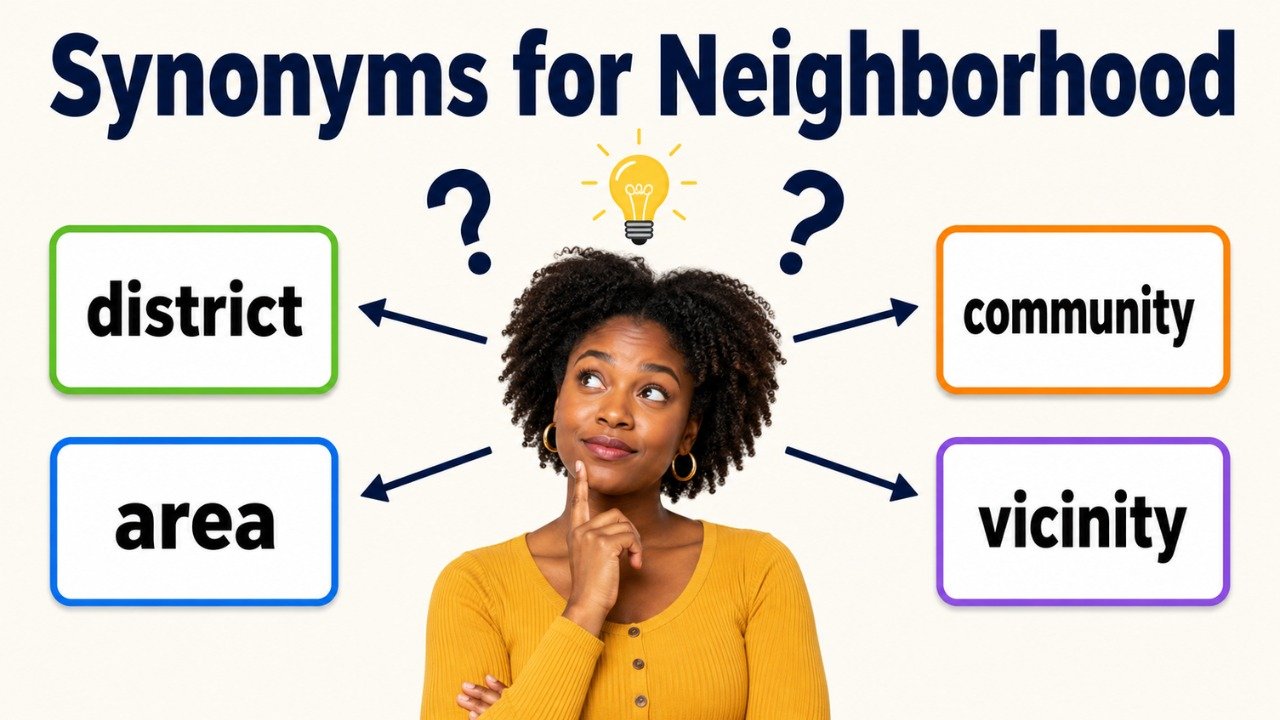
Quick Answer: The best synonyms for neighborhood include area, district, community, locality, vicinity, quarter, surroundings, residential area, suburb, and precinct. Use area as the most flexible replacement for a place. Choose community when referring to residents and shared social life. Use district or precinct for official boundaries, locality for formal geographic writing, vicinity for nearby surroundings, quarter for a distinctive part of a town, and suburb for a residential area outside or near a city. In the phrase in the neighborhood of, use about, around, approximately, or roughly.
Pronunciation and Word Details
Word: Neighborhood.
Pronunciation: /ˈneɪbərˌhʊd/
Part of Speech: Noun.
Meaning: An area of a town or city where people live near one another, or the people who live in that area.
US Pronunciation:
UK Pronunciation:
What Does “Neighborhood” Mean?
Neighborhood means a particular area within a town, city, suburb, or larger community. It often refers to both the physical place and the people who live there.
As a noun, neighborhood can describe streets, homes, parks, shops, schools, and other places located near one another. For example, a person may describe an area as a quiet neighborhood, a residential neighborhood, or a historic neighborhood.
Neighborhood can also have a social meaning. In the sentence, “The whole neighborhood attended the event,” the word refers to the residents rather than the physical location.
The word may also describe nearby surroundings. When someone says a restaurant is in the neighborhood, they mean it is close to the place being discussed.
In the expression in the neighborhood of, neighborhood refers to an approximate number, amount, price, or measurement. For example, “The repairs will cost in the neighborhood of five hundred dollars” means the cost will be about that amount.
Meaning, Tone, and Context of “Neighborhood”
Neighborhood is a neutral and widely understood word. It works naturally in casual conversation, formal writing, news writing, property descriptions, community discussions, geography, urban planning, and local government contexts.
In everyday speech, neighborhood often creates a familiar and personal feeling. It may suggest nearby homes, familiar streets, local shops, shared spaces, and relationships among residents.
In formal writing, neighborhood can describe a defined urban or residential area. However, district, locality, precinct, or residential zone may be more precise when official boundaries or planning categories are important.
The word can carry a positive emotional tone when used in phrases such as friendly neighborhood, close community, or peaceful neighborhood. It can also remain completely neutral when describing location.
When used in the phrase in the neighborhood of, the tone is conversational and slightly informal. Approximately or roughly may be more suitable in academic reports, financial documents, or technical writing.
When and How to Use “Neighborhood”
For a Residential Area: Use neighborhood to describe a part of a town or city where people live.
Example: They moved into a peaceful neighborhood near the river.
For Local Residents: Use neighborhood when referring collectively to the people living in one area.
Example: The neighborhood gathered to clean the community park.
For Nearby Surroundings: Use neighborhood when something is located close to a particular place.
Example: There are several small restaurants in the neighborhood.
For Community Life: Use neighborhood when discussing local relationships, events, services, or shared concerns.
Example: The festival strengthened relationships throughout the neighborhood.
For Urban Description: Use neighborhood to identify a recognizable section of a town or city.
Example: The historic neighborhood is known for its traditional architecture.
For Approximate Amounts: Use in the neighborhood of when giving a general estimate rather than an exact figure.
Example: The renovation will cost in the neighborhood of ten thousand dollars.
For Property and Housing: Use neighborhood when describing the setting around a house, apartment, or building.
Example: The home is located in a residential neighborhood with nearby schools.
For Local Identity: Use neighborhood when a place has its own character, history, culture, or atmosphere.
Example: Each neighborhood has a distinct style and identity.
Best Synonyms for Neighborhood
Area: A general part of a town, city, region, or other place.
Example: The area has several parks and family homes.
District: A defined section of a city or region, often recognized for an official or particular purpose.
Example: The shopping district becomes busy during the afternoon.
Community: A place and the people who live there, especially when shared relationships are important.
Example: The community organized a local food drive.
Locality: A particular place or geographic area, often used in formal writing.
Example: The plant is commonly found throughout this coastal locality.
Vicinity: The area near or surrounding a particular place.
Example: Several schools are located in the vicinity.
Quarter: A recognizable section of a town or city, often known for its culture, history, or activities.
Example: They spent the afternoon exploring the old quarter.
Surroundings: The places and physical features around a person, building, or location.
Example: The house has quiet and attractive surroundings.
Residential Area: A part of a town or city mainly containing homes.
Example: Heavy traffic is restricted in the residential area.
Suburb: A residential community located outside or near the central part of a city.
Example: The family chose to live in a suburb with larger gardens.
Precinct: A defined section of a town or city used for administration, voting, policing, or planning.
Example: The new community center serves the entire precinct.
50 Synonyms for Neighborhood with Short Meanings
- Area: A general part of a place.
- District: A defined section of a town, city, or region.
- Community: A local area and the people living within it.
- Locality: A particular geographic place.
- Vicinity: The area close to a specific location.
- Surroundings: The places and features around something.
- Quarter: A distinctive section of a city or town.
- Zone: An area marked for a particular use or purpose.
- Region: A broad area with shared geographic features.
- Locale: A place connected with particular events or activities.
- Precinct: An officially defined local area.
- Subdivision: A planned residential section divided into properties.
- Residential Area: A place mainly containing homes.
- Residential District: An officially recognized area used mainly for housing.
- Residential Community: A group of homes and residents in one place.
- Housing Development: A planned group of houses or residential buildings.
- Housing Estate: A planned residential area containing multiple homes.
- Suburb: A residential area outside or near a city center.
- Borough: An administrative section of a larger town or city.
- Ward: A local administrative or electoral division.
- Parish: A local administrative or community area in some regions.
- Sector: One section of a larger urban area.
- Enclave: A distinct community or area surrounded by another.
- Block: A group of buildings surrounded by streets.
- Street: A road and the nearby homes considered as a local group.
- Local Area: The place close to where someone lives or works.
- Nearby Area: A place located a short distance away.
- Immediate Area: The space directly surrounding a location.
- Surrounding Area: The wider place around a central point.
- Local Surroundings: Nearby streets, buildings, and public spaces.
- Part of Town: A particular section within a town.
- Section of Town: One recognizable portion of a town.
- City Section: A defined or commonly recognized part of a city.
- Town District: A specific local section of a town.
- Urban District: A developed part of a city or large town.
- Residential Quarter: A part of a city mainly used for housing.
- Village: A small community with homes and local services.
- Settlement: A place where a group of people has established homes.
- Township: A local community or administrative area.
- Local Community: People and places connected within one area.
- Neighboring Area: A place located next to another area.
- Adjacent Area: A section directly beside a particular location.
- Residential Zone: Land officially intended for housing.
- Residential Section: A part of a town containing mainly homes.
- Environs: The surrounding area of a place.
- About: An approximate amount in the phrase in the neighborhood of.
- Around: Close to a stated number, time, or amount.
- Approximately: Nearly correct but not exact.
- Roughly: Giving a general rather than precise figure.
- Close To: Near a particular number, amount, or location.
Read Also:
Synonyms for Going

Synonyms for Neighborhood by Context
When Neighborhood Means a General Local Area
Area is the most flexible synonym for neighborhood. Locality, locale, district, quarter, and zone can also describe a particular part of a town, city, or region.
Area sounds natural in both conversation and formal writing. District is more precise when a place has recognized boundaries or a particular function. Quarter often describes a section with a distinctive culture or history.
Example: The neighborhood has many independent shops.
Better Option: The area has many independent shops.
Example: The neighborhood is famous for its old buildings.
Better Option: The historic quarter is famous for its old buildings.
When Neighborhood Means a Community of People
Community is the strongest alternative when neighborhood refers to residents, relationships, cooperation, or shared identity. Local community and residential community also work well.
Community focuses more on people than physical boundaries. It may describe residents who share local facilities, concerns, traditions, or activities.
Example: The neighborhood supported the new community garden.
Better Option: The local community supported the new garden.
Example: The whole neighborhood attended the celebration.
Better Option: The whole community attended the celebration.
When Neighborhood Means a Residential Place
Residential area, residential district, residential community, suburb, subdivision, and housing development are useful when describing where people live.
Residential area is a neutral term. Suburb usually describes a residential location near or outside a city center. Subdivision refers to a planned area divided into individual properties.
Example: They were searching for a quiet neighborhood.
Better Option: They were searching for a quiet residential area.
Example: The new neighborhood contains eighty homes.
Better Option: The new housing development contains eighty homes.
When Neighborhood Means Nearby Surroundings
Vicinity, surroundings, immediate area, nearby area, environs, and surrounding area describe places close to a particular location.
Vicinity is useful in formal directions, reports, and descriptions. Surroundings refers to the physical environment around a place. Immediate area means the location directly around something.
Example: There are no hospitals in the neighborhood.
Better Option: There are no hospitals in the immediate vicinity.
Example: We explored the neighborhood around the hotel.
Better Option: We explored the surrounding area.
When Neighborhood Means an Official Division
District, precinct, ward, borough, parish, sector, and zone may replace neighborhood when official boundaries matter.
These words are not interchangeable in every location. District is the broadest formal alternative. Precinct often relates to voting, policing, or administration. Ward usually refers to an electoral or administrative division.
Example: The neighborhood elected a new representative.
Better Option: The district elected a new representative.
Example: Additional officers were assigned to the neighborhood.
Better Option: Additional officers were assigned to the precinct.
When Neighborhood Means an Approximate Amount
In the phrase in the neighborhood of, use about, around, approximately, roughly, or close to. These alternatives describe an estimate rather than a physical place.
About and around sound natural in conversation. Approximately is more formal and suitable for reports, essays, and technical information. Roughly emphasizes that the figure is not exact.
Example: The project will cost in the neighborhood of six thousand dollars.
Better Option: The project will cost approximately six thousand dollars.
Example: There were in the neighborhood of two hundred guests.
Better Option: There were around two hundred guests.
Another Word for Neighborhood
Area is usually the best single replacement for neighborhood because it is simple, neutral, and suitable for many contexts. However, the best alternative depends on whether you mean a location, a group of residents, nearby surroundings, an official division, or an approximate amount.
Use community when referring to people. Choose district for a formally defined section. Use vicinity for nearby places and approximately for estimated figures.
Original: This neighborhood has several local parks.
Better Option: This area has several local parks.
Original: The neighborhood worked together after the storm.
Better Option: The community worked together after the storm.
Original: There are several restaurants in the neighborhood.
Better Option: There are several restaurants in the vicinity.
Original: The repairs may cost in the neighborhood of eight hundred dollars.
Better Option: The repairs may cost approximately eight hundred dollars.
When Not to Use “Neighborhood”
Do not use neighborhood when the reader needs to know the official type or exact boundaries of a place. District, precinct, ward, borough, or residential zone may provide greater accuracy.
Avoid using neighborhood when you are discussing only the people and their relationships. Community may communicate the social meaning more clearly.
Do not use neighborhood as a replacement for suburb unless the place is actually located outside or near the central part of a city. A neighborhood can exist in a city center, suburb, town, or village.
The phrase in the neighborhood of may sound too conversational in formal reports. Approximately or roughly is usually more direct.
Avoid repeating neighborhood several times in the same paragraph. Replace it with area, community, district, locality, or surroundings where appropriate.
Weak: The neighborhood has a neighborhood park that serves the neighborhood.
Better: The residential area has a local park that serves the community.
Weak: The neighborhood is divided into three official voting areas.
Better: The district is divided into three official voting precincts.
Weak: The laboratory recorded a temperature in the neighborhood of sixty degrees.
Better: The laboratory recorded a temperature of approximately sixty degrees.
Weak: Everyone in the physical neighborhood supported the proposal.
Better: Everyone in the local community supported the proposal.
Words Commonly Confused With Neighborhood
Neighborhood vs Community: Neighborhood often refers to a physical area, while community focuses more strongly on the people, relationships, and shared identity within that area.
Neighborhood vs District: A neighborhood may have informal or commonly understood boundaries. A district often has official boundaries or a specific purpose, such as a business district or school district.
Neighborhood vs Suburb: A neighborhood is any local area within a town, city, or suburb. A suburb is a larger residential place located outside or near the main part of a city.
Neighborhood vs Vicinity: Neighborhood usually describes a recognizable local area. Vicinity means the space near a particular point and does not necessarily contain homes or residents.
Neighborhood vs Locality: Neighborhood is common in everyday speech. Locality is more formal and may refer to any particular geographic place.
Neighborhood vs Borough: A neighborhood is usually a smaller informal area. A borough is an officially governed or administratively recognized division.
Neighborhood vs Region: A neighborhood is normally small and local. A region is much larger and may include several towns, cities, or districts.
Neighborhood vs Neighbor: Neighborhood refers to a place or local community. Neighbor refers to a person who lives near another person.
Which Synonym Should You Choose?
Choose area when you need a simple and flexible replacement in general writing or conversation.
Choose community when focusing on residents, shared identity, relationships, cooperation, or local activities.
Choose district when writing about official boundaries, city planning, commercial sections, schools, or administration.
Choose locality in formal geographic, scientific, academic, or descriptive writing.
Choose vicinity when referring to places close to a specific building, event, street, or location.
Choose surroundings when describing the environment, scenery, streets, buildings, or physical features around a place.
Choose quarter when discussing a historic, cultural, artistic, or commercial section of a town or city.
Choose residential area when the location mainly contains homes and you want a clear, neutral description.
Choose suburb when referring to a residential community near or outside a city center.
Choose subdivision or housing development when discussing a planned group of homes.
Choose precinct or ward when official voting, policing, or administrative divisions are important.
Choose block or street in casual conversation when referring to a very small local area.
Choose approximately for formal reports, essays, measurements, and estimates.
Choose about, around, or roughly for estimates in normal conversation and informal writing.
Real Life Examples of “Neighborhood” in Sentences
Original: We found a small cafe in the neighborhood.
Better Option: We found a small cafe in the local area.
Original: The neighborhood organized a weekend cleanup.
Better Option: The community organized a weekend cleanup.
Original: The house is in a quiet neighborhood.
Better Option: The house is in a quiet residential area.
Original: The museum is the oldest building in the neighborhood.
Better Option: The museum is the oldest building in the district.
Original: Several schools are located in the neighborhood.
Better Option: Several schools are located in the vicinity.
Original: The neighborhood is known for its traditional markets.
Better Option: The quarter is known for its traditional markets.
Original: They built a new neighborhood near the highway.
Better Option: They built a new housing development near the highway.
Original: The entire neighborhood welcomed the new family.
Better Option: The entire local community welcomed the new family.
Original: The project will require in the neighborhood of fifty workers.
Better Option: The project will require approximately fifty workers.
Original: Property prices have increased throughout the neighborhood.
Better Option: Property prices have increased throughout the surrounding area.
Synonym Groups and Usage Differences
General Place Group
Area, locality, locale, district, region, and zone describe geographic places. Area is the most general choice, while locality and locale sound more formal. District and zone may suggest recognized boundaries or specific purposes.
Example: This area is known for its public gardens.
Community Group
Community, local community, residential community, street, and block can refer to people living close to one another. Community emphasizes social connections, while street and block describe smaller groups in casual speech.
Example: The local community raised funds for the park.
Residential Group
Residential area, residential district, suburb, subdivision, housing development, housing estate, and residential quarter describe places mainly used for housing.
Suburb refers to a larger location near a city. Subdivision and housing development usually describe planned groups of homes.
Example: The family moved into a new residential development.
Official Division Group
District, precinct, ward, borough, parish, sector, and zone describe places with administrative, electoral, planning, or legal boundaries.
The correct word depends on the local system and the purpose of the division.
Example: Each ward elects a local representative.
Nearby Surroundings Group
Vicinity, surroundings, environs, immediate area, nearby area, and surrounding area describe places close to a particular point.
Vicinity is precise and formal. Surroundings and environs focus on the wider environment.
Example: No public transportation is available in the immediate vicinity.
Cultural and Historic Area Group
Quarter, enclave, district, and locale are useful for places known for a particular culture, history, language, activity, or identity.
Enclave suggests a distinct group or area surrounded by a different population or environment.
Example: The old quarter contains narrow streets and historic homes.
Approximation Group
About, around, approximately, roughly, and close to replace in the neighborhood of when discussing estimated amounts, prices, distances, times, or numbers.
Approximately is formal, while about and around are more conversational.
Example: Approximately three hundred people attended the event.
Antonyms of Neighborhood
Neighborhood does not have one exact opposite because it can describe a place, a community, nearby surroundings, or an approximate amount. The most useful antonyms depend on the intended meaning.
Distant Area: A place located far away.
Remote Region: A location separated from populated places.
Faraway Place: A place at a considerable distance.
Outside Area: A location beyond the boundaries being discussed.
Elsewhere: In or to another place.
Isolated Location: A place separated from nearby communities.
Uninhabited Area: A location where no people live.
Wilderness: A natural area with little or no permanent settlement.
Exact Amount: A precise figure rather than an approximate one.
Precise Figure: A clearly measured number instead of a general estimate.
Comparison: Neighborhood vs Related Words
Neighborhood vs Community
Neighborhood describes a local place and may also refer to its residents. Community emphasizes the people, relationships, and shared interests within a place.
Example With Neighborhood: The neighborhood contains several apartment buildings.
Example With Community: The community organized support for older residents.
Neighborhood vs District
Neighborhood often has informal or commonly recognized boundaries. District usually has clearer boundaries or a particular administrative, commercial, educational, or cultural purpose.
Example With Neighborhood: They live in a peaceful neighborhood near the park.
Example With District: The building is located in the financial district.
Neighborhood vs Suburb
Neighborhood is a smaller local area that can exist anywhere within a city, suburb, or town. Suburb describes a larger residential community located near or outside a city center.
Example With Neighborhood: Their neighborhood includes four streets and a park.
Example With Suburb: They moved from the city center to a nearby suburb.
Neighborhood vs Vicinity
Neighborhood suggests a recognizable local place, often containing homes and residents. Vicinity simply means the area close to a particular location.
Example With Neighborhood: The neighborhood has several schools and playgrounds.
Example With Vicinity: No schools are located in the immediate vicinity of the factory.
Neighborhood vs Locality
Neighborhood is natural in everyday conversation. Locality is more formal and often appears in geographic, academic, scientific, or administrative writing.
Example With Neighborhood: This neighborhood becomes busy in the evening.
Example With Locality: The species has not been recorded in this locality.
Neighborhood vs Quarter
Neighborhood is a general term for a local area. Quarter often describes a city section with a particular historic, cultural, commercial, or artistic character.
Example With Neighborhood: We stayed in a central neighborhood.
Example With Quarter: We stayed in the historic quarter.
Neighborhood vs Region
Neighborhood describes a small local area. Region describes a much larger geographic area that may contain several cities, towns, districts, or communities.
Example With Neighborhood: Rain caused flooding in the neighborhood.
Example With Region: Heavy rain affected the entire coastal region.
Common Phrases and Expressions With “Neighborhood”
Residential Neighborhood: An area mainly containing homes.
Quiet Neighborhood: A local area with little noise or disturbance.
Safe Neighborhood: An area considered secure for residents and visitors.
Historic Neighborhood: A local area known for older buildings, traditions, or events.
Friendly Neighborhood: A place where residents are welcoming and helpful.
Local Neighborhood: The area close to where someone lives or works.
Neighborhood Community: The residents and social relationships within a local area.
Neighborhood Residents: The people who live in a particular local area.
Neighborhood Park: A public outdoor space serving nearby residents.
In the Neighborhood Of: Approximately or close to a stated number, price, time, or amount.
Common Mistakes to Avoid
One common spelling mistake is writing neighborhood without the second h. The correct American spelling is neighborhood. Neighbourhood is the standard British spelling, but writers should use one spelling style consistently.
Do not confuse neighborhood with neighbor. Neighborhood is a place or local community, while neighbor is a person who lives nearby.
Avoid treating area, community, district, and suburb as exact synonyms in every sentence. Area is general, community emphasizes people, district may have formal boundaries, and suburb refers to a larger residential location near a city.
Do not use vicinity when referring specifically to local residents. Vicinity describes nearby space, not a group of people.
Avoid using neighborhood when an official boundary matters. Precinct, ward, district, borough, or residential zone may be more precise.
Do not describe every residential place as a suburb. A neighborhood may be located in the center of a city and may not be suburban.
Use in the neighborhood of only for approximate figures. Do not use it when the number must be exact.
Avoid vague sentences such as “The neighborhood changed.” Explain whether the homes, residents, businesses, traffic, culture, or physical surroundings changed.
Do not repeat neighborhood unnecessarily. Use area, community, district, locality, vicinity, or residential section when those words communicate the intended meaning more accurately.
Conclusion
Learning synonyms for neighborhood makes it easier to describe places, residents, official boundaries, nearby surroundings, and approximate amounts accurately. Area is the most flexible general replacement, while community emphasizes people and shared local life. District, precinct, and ward suit official divisions. Vicinity and surroundings describe nearby places, while residential area, suburb, and subdivision work well for housing. In numerical expressions, replace in the neighborhood of with about, approximately, around, or roughly according to the required level of formality.
FAQs About Synonyms for Neighborhood
What Is the Best Synonym for Neighborhood?
Area is the best general synonym for neighborhood. Community, district, locality, vicinity, or residential area may be better in more specific contexts.
Is Community a Synonym for Neighborhood?
Yes. Community is a strong synonym when neighborhood refers to residents, shared identity, relationships, or local activities rather than only the physical place.
What Is a Formal Word for Neighborhood?
Locality and district are useful formal alternatives. Precinct, ward, borough, or residential zone may be more accurate when official boundaries are involved.
What Is Another Word for a Residential Neighborhood?
Residential area, residential district, suburb, subdivision, housing development, and residential community are useful alternatives.
Are Neighborhood and Suburb the Same?
No. A neighborhood is a smaller local area, while a suburb is usually a larger residential community located outside or near a city center.
What Does “In the Neighborhood Of” Mean?
In the neighborhood of means approximately or close to a stated amount, number, price, distance, or time.
What Is the Opposite of Neighborhood?
Depending on the context, possible opposites include distant area, remote region, isolated location, wilderness, or exact amount.
