
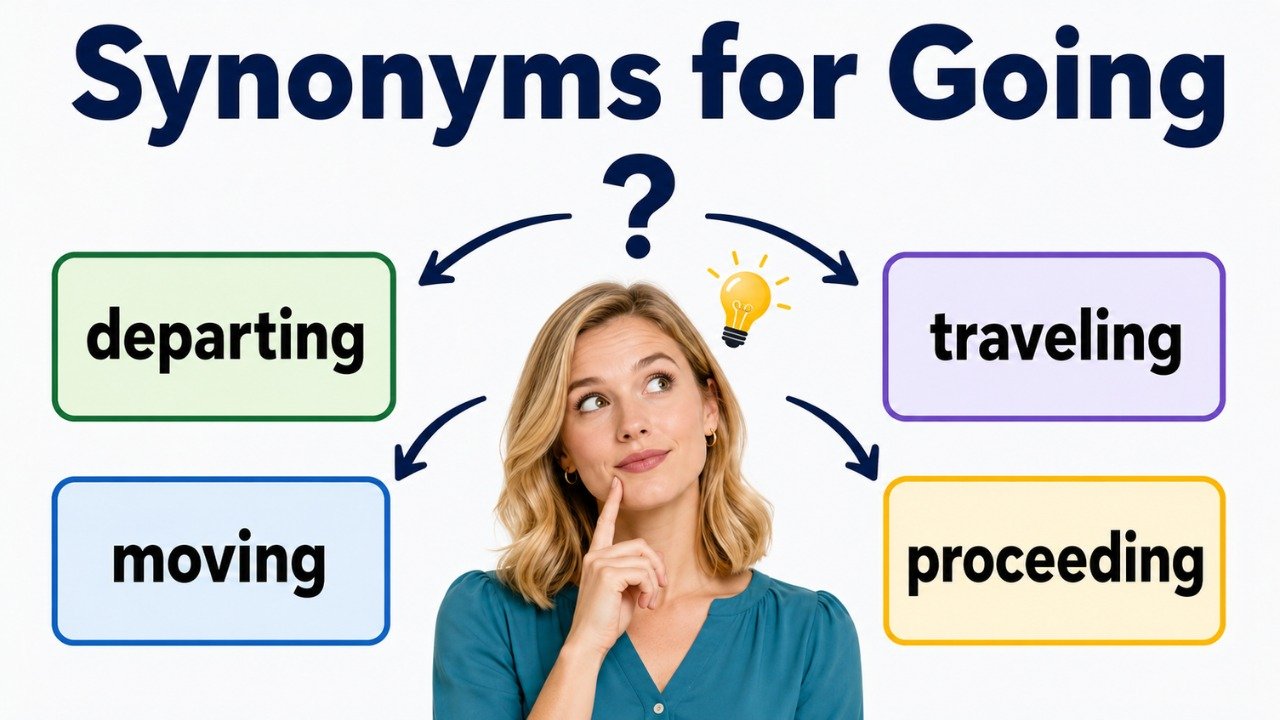
Quick Answer: The best synonyms for going include moving, traveling, heading, leaving, departing, proceeding, continuing, operating, happening, and becoming. Use moving for general physical motion, traveling for longer journeys, heading for movement toward a destination, and departing for formal descriptions of leaving. Continuing works when an action does not stop, operating describes a machine or system that works, happening refers to an event, and becoming describes a change from one state to another.
Pronunciation and Word Details
Word: Going.
Pronunciation: /ˈɡoʊ.ɪŋ/
Part of Speech: Verb form, gerund, adjective, and noun in certain expressions.
Meaning: Moving, traveling, leaving, continuing, functioning, happening, or changing into another state.
US Pronunciation:
UK Pronunciation:
What Does “Going” Mean?
Going means moving from one place to another, leaving a location, continuing an activity, functioning properly, or changing into a different condition.
The word is the present participle and gerund form of the verb “go.” It commonly appears after forms of “be,” as in “She is going home.” It can also function as a noun when it names an activity, as in “Going alone may be difficult.”
In movement contexts, going describes travel or direction. In “We are going to the library,” it means traveling toward a destination.
In departure contexts, it means leaving. In “He is going now,” the speaker is saying that he is about to depart.
Going can also describe continuation. The sentence “The meeting is still going” means that the meeting has not ended.
When used for machines, businesses, or systems, going can mean operating successfully. For example, “The engine is going again” means that it is functioning.
Going may also describe an event that is happening or a condition that is changing. In “What is going on?” it refers to an event or situation. In “The leaves are going brown,” it means becoming brown.
Meaning, Tone, and Context of “Going”
Going is a common, neutral, and highly conversational word. It appears naturally in everyday speech, informal writing, instructions, descriptions, stories, and professional communication.
The word is not usually emotional by itself. Its tone depends on the sentence around it. “I am going home” sounds neutral, while “Everything is going terribly” expresses concern or frustration.
In casual conversation, going is often used because it is simple and flexible. Speakers may say “How is it going?” to ask about someone’s situation, work, health, or progress.
In formal writing, a more precise synonym may be preferable. Moving, traveling, departing, proceeding, operating, developing, or becoming can communicate the intended meaning more clearly.
Going is also common in the structure “going to,” which expresses a plan, intention, prediction, or expected future event. For example, “They are going to renovate the building” describes a future plan.
When and How to Use “Going”
For Physical Movement: Use going when someone or something is moving from one location toward another.
Example: We are going across the field.
For Travel: Use going when discussing a journey, trip, or destination.
Example: She is going to another city for the weekend.
For Departure: Use going when a person is leaving a place.
Example: I am going before the traffic becomes heavy.
For Direction: Use going when describing where movement leads.
Example: This road is going toward the coast.
For Continuation: Use going when an activity, event, or process has not stopped.
Example: The discussion is still going after two hours.
For Operation: Use going when a machine, system, or organization is functioning.
Example: The generator is going again after the repair.
For Events: Use going when asking about or describing something that is happening.
Example: What is going on outside?
For Progress: Use going when describing how well or badly something is developing.
Example: The project is going better than expected.
For Change: Use going when something is becoming different.
Example: Her hair is going gray.
For Future Plans: Use going in the structure “going to” when expressing an intention or expected event.
Example: We are going to review the results tomorrow.
Best Synonyms for Going
Moving: Changing position or traveling from one place to another.
Example: The vehicle is moving slowly through the crowd.
Traveling: Making a journey, especially over a noticeable distance.
Example: They are traveling across the country by train.
Heading: Moving in the direction of a particular place.
Example: We are heading toward the main entrance.
Leaving: Going away from a person, place, or situation.
Example: She is leaving the office at five.
Departing: Leaving a place, especially in formal or scheduled contexts.
Example: The bus is departing from the central station.
Proceeding: Continuing or moving forward in an organized way.
Example: The group is proceeding to the next stage.
Continuing: Remaining in progress without stopping.
Example: The investigation is continuing throughout the week.
Operating: Working or functioning as intended.
Example: The machine is operating at full capacity.
Happening: Taking place or occurring.
Example: Something unusual is happening near the entrance.
Becoming: Changing into a new condition, state, or identity.
Example: The situation is becoming more complicated.
50 Synonyms for Going with Short Meanings
- Moving: Changing position or location.
- Traveling: Making a journey from one place to another.
- Heading: Moving toward a particular destination.
- Leaving: Going away from a place.
- Departing: Leaving in a formal or scheduled manner.
- Proceeding: Moving or continuing forward.
- Advancing: Moving ahead physically or figuratively.
- Progressing: Developing or improving over time.
- Journeying: Traveling over a distance.
- Walking: Moving on foot.
- Running: Moving quickly on foot.
- Driving: Traveling by controlling a vehicle.
- Riding: Traveling on or inside a vehicle or animal.
- Flying: Traveling through the air.
- Sailing: Traveling across water in a boat or ship.
- Commuting: Traveling regularly between home and work.
- Roaming: Moving around without a fixed destination.
- Wandering: Moving without a clear route or purpose.
- Touring: Traveling through several places for interest or work.
- Trekking: Making a long or difficult journey on foot.
- Setting Out: Beginning a journey or task.
- Setting Off: Starting to travel.
- Exiting: Leaving a place or enclosed area.
- Withdrawing: Moving away or removing oneself.
- Escaping: Getting away from danger or confinement.
- Continuing: Remaining active or in progress.
- Persisting: Continuing despite difficulty or opposition.
- Enduring: Lasting through a difficult period.
- Lasting: Continuing for a period of time.
- Carrying On: Continuing an activity or process.
- Operating: Working as intended.
- Functioning: Performing a normal purpose successfully.
- Working: Operating correctly or effectively.
- Running: Functioning or remaining active.
- Active: Currently working, moving, or developing.
- Underway: Already started and continuing.
- Happening: Taking place at the present time.
- Occurring: Coming into existence as an event.
- Unfolding: Developing gradually as events happen.
- Developing: Growing or changing over time.
- Evolving: Changing gradually into a different form.
- Becoming: Changing into a new condition.
- Turning: Changing from one state into another.
- Growing: Gradually becoming more noticeable or developed.
- Changing: Becoming different.
- Thriving: Developing successfully and strongly.
- Flourishing: Growing or operating successfully.
- Bound: Traveling toward a named destination.
- En Route: On the way to a destination.
- In Motion: Currently moving or progressing.
Read Also:
Synonyms for Morals

Synonyms for Going by Context
When Going Means Moving
Moving is the broadest replacement when going refers to a change in position. Advancing suggests forward movement, while walking, running, driving, and riding describe the specific method of movement.
Going: The line is going slowly.
Moving: The line is moving slowly.
Going: The car is going toward the bridge.
Advancing: The car is advancing toward the bridge.
When Going Means Traveling
Traveling is useful when a person makes a journey over a distance. Journeying sounds more descriptive, while commuting refers to regular travel between home and work or study.
Going: They are going across the country.
Traveling: They are traveling across the country.
Going: He is going to work by train.
Commuting: He is commuting to work by train.
When Going Means Heading Toward a Place
Heading is a natural synonym when the destination or direction is important. Bound is more concise and often appears with a destination.
Going: We are going toward the city center.
Heading: We are heading toward the city center.
Going: The train is going to the capital.
Bound: The train is bound for the capital.
When Going Means Leaving
Leaving is the most common replacement when someone goes away from a place. Departing is more formal, while exiting refers to leaving a room, building, vehicle, or enclosed area.
Going: I am going now.
Leaving: I am leaving now.
Going: The guests are going after dinner.
Departing: The guests are departing after dinner.
When Going Means Continuing
Continuing works when an action, process, or event remains in progress. Persisting suggests that something continues despite difficulty.
Going: The work is still going.
Continuing: The work is still continuing.
Going: The problem keeps going despite the repairs.
Persisting: The problem is persisting despite the repairs.
When Going Means Functioning
Operating and functioning are more precise when going describes a machine, system, organization, or service that works.
Going: The heating system is going again.
Operating: The heating system is operating again.
Going: Is the printer going properly?
Functioning: Is the printer functioning properly?
When Going Means Happening
Happening is the most natural replacement when going refers to an event or situation. Occurring is more formal and is common in reports and explanations.
Going: What is going on here?
Happening: What is happening here?
Going: Several changes are going on in the department.
Occurring: Several changes are occurring in the department.
When Going Means Becoming
Becoming is the clearest synonym when going describes a change in condition. Turning is often used for visible changes involving color, weather, mood, or physical condition.
Going: The sky is going dark.
Becoming: The sky is becoming dark.
Going: The leaves are going yellow.
Turning: The leaves are turning yellow.
Another Word for Going
Moving is often the best general replacement for going when physical motion is involved. However, the best alternative depends on whether the sentence describes travel, departure, continuation, operation, an event, or a change.
Original: We are going toward the station.
Better Option: We are heading toward the station.
Original: She is going to another country next month.
Better Option: She is traveling to another country next month.
Original: The conference is still going.
Better Option: The conference is still continuing.
Original: The situation is going from bad to worse.
Better Option: The situation is becoming increasingly serious.
When Not to Use “Going”
Going should not be avoided completely because it is natural, correct, and useful. However, it may sound vague when the reader needs to know the exact type of movement, change, or activity.
When the Direction Is Unclear
Going may be too general if the destination or direction matters.
Weak: The team is going over there.
Better: The team is heading toward the eastern entrance.
When the Method of Travel Matters
Use a more specific verb when readers need to know how someone is traveling.
Weak: She is going to the village.
Better: She is driving to the village.
When Formal Language Is Needed
Departing, proceeding, operating, and occurring may sound more appropriate in formal reports, notices, and instructions.
Weak: The final inspection is going now.
Better: The final inspection is currently underway.
When Describing a Machine
Going may sound too conversational when describing technical operation.
Weak: The cooling system is going properly.
Better: The cooling system is functioning properly.
When Describing a Change
Becoming, turning, growing, or developing usually explains the change more clearly.
Weak: The issue is going serious.
Better: The issue is becoming serious.
When It Creates Repetition
Repeating going several times can make writing sound flat or limited.
Weak: We are going to the store, going through the park, and going home afterward.
Better: We are walking to the store, passing through the park, and returning home afterward.
Words Commonly Confused With Going
Going vs Coming: Going describes movement away from the speaker or toward another place. Coming describes movement toward the speaker or the place being discussed.
Example With Going: I am going to your office now.
Example With Coming: I am coming to your office now.
Going vs Leaving: Going is broad and may describe movement, travel, or direction. Leaving specifically means departing from a place.
Example With Going: She is going to the airport.
Example With Leaving: She is leaving the hotel.
Going vs Traveling: Going may describe any movement or destination. Traveling usually suggests a journey over a greater distance.
Example With Going: I am going downstairs.
Example With Traveling: I am traveling across the country.
Going vs Moving: Going often includes a destination or purpose. Moving mainly describes a change of position or location.
Example With Going: We are going to the meeting.
Example With Moving: The chairs are moving across the floor.
Going vs Becoming: Going can describe change in informal expressions, while becoming states the change directly.
Example With Going: The weather is going cold.
Example With Becoming: The weather is becoming colder.
Going vs Ongoing: Going is a form of the verb go. Ongoing is an adjective meaning continuing or still in progress.
Example With Going: The discussion is going well.
Example With Ongoing: The ongoing discussion concerns the new policy.
Going vs Gone: Going describes movement or change in progress. Gone usually describes something that has already left, disappeared, ended, or been completed.
Example With Going: She is going home.
Example With Gone: She has gone home.
Which Synonym Should You Choose?
Choose moving when describing a general change of position.
Choose traveling when discussing a journey, trip, or movement over a significant distance.
Choose heading when the destination or direction is the main point.
Choose leaving when someone is going away from a place.
Choose departing for schedules, announcements, formal notices, and professional writing.
Choose proceeding when describing orderly movement or progress through steps.
Choose continuing when an action, discussion, event, or process has not stopped.
Choose progressing when describing improvement, development, or movement toward a goal.
Choose operating when discussing machines, systems, businesses, or services.
Choose functioning when emphasizing that something is working correctly.
Choose happening in casual speech when describing an event or situation.
Choose occurring in reports, academic writing, and formal explanations.
Choose developing when a situation is gradually changing.
Choose becoming when something is changing into another condition.
Choose turning for visible changes in color, mood, condition, or direction.
Choose thriving or flourishing when a person, organization, business, or living thing is developing successfully.
Real Life Examples of “Going” in Sentences
Original: We are going to the market before lunch.
Better Option: We are heading to the market before lunch.
Original: She is going abroad for several months.
Better Option: She is traveling abroad for several months.
Original: The last train is going at midnight.
Better Option: The last train is departing at midnight.
Original: The meeting is still going.
Better Option: The meeting is still continuing.
Original: The new employee is going well in the role.
Better Option: The new employee is progressing well in the role.
Original: The machine is going normally again.
Better Option: The machine is operating normally again.
Original: What is going on in the hallway?
Better Option: What is happening in the hallway?
Original: The weather is going colder.
Better Option: The weather is becoming colder.
Original: His small business is going well.
Better Option: His small business is thriving.
Original: The construction work is going according to schedule.
Better Option: The construction work is progressing according to schedule.
Synonym Groups and Usage Differences
Movement Group
Moving, advancing, walking, running, driving, riding, and flying all describe physical motion. Moving is general, while the other words explain the method or speed.
Example: The vehicle is moving carefully through the narrow street.
Travel Group
Traveling, journeying, commuting, touring, trekking, roaming, and wandering relate to travel. Traveling is broad, commuting is regular, touring involves visiting places, and wandering lacks a fixed route.
Example: They are traveling through several mountain regions.
Direction Group
Heading, bound, en route, proceeding, setting out, and setting off emphasize direction or the beginning of a journey.
Example: The group is heading toward the northern trail.
Departure Group
Leaving, departing, exiting, withdrawing, and escaping all involve going away. Departing is formal, exiting means leaving an enclosed place, and escaping suggests getting away from danger.
Example: Visitors are exiting through the main doors.
Continuation Group
Continuing, persisting, lasting, enduring, and carrying on describe something that does not stop. Persisting often suggests difficulty, while enduring emphasizes lasting through hardship.
Example: The noise continued throughout the night.
Operation Group
Operating, functioning, working, running, and active describe machines, systems, organizations, or services that are in use.
Example: All emergency systems are functioning correctly.
Event Group
Happening, occurring, unfolding, and underway describe events or situations in progress. Happening is conversational, while occurring is more formal.
Example: Important changes are occurring within the organization.
Change Group
Becoming, turning, growing, changing, developing, and evolving describe movement from one condition into another.
Example: The discussion is becoming more productive.
Success Group
Thriving and flourishing describe successful growth, strong performance, or healthy development.
Example: The community garden is flourishing during the rainy season.
Antonyms of Going
The opposite of going changes according to the meaning of the sentence. A person who is not going may be staying. A machine that is not going may be stopped or broken. An event that is no longer going may be finished.
Staying: Remaining in the same place.
Remaining: Continuing to be present without leaving.
Arriving: Reaching a destination rather than traveling toward it.
Returning: Going back to an earlier place.
Stopping: Ending movement or activity.
Halting: Coming to a complete stop.
Ceasing: No longer continuing.
Ending: Reaching the final point.
Finishing: Completing an action or process.
Resting: Remaining inactive for a period.
Failing: No longer operating or succeeding.
Breaking Down: Stopping because of a mechanical problem.
Fixed: Not moving or changing.
Stationary: Remaining in one position.
Unchanged: Staying in the same condition.
Comparison: Going vs Related Words
Going vs Moving
Going often includes a destination, plan, or direction. Moving simply describes a change in position.
Example With Going: We are going to the community center.
Example With Moving: The workers are moving the tables.
Going vs Traveling
Going can describe short or long movement. Traveling usually suggests a journey between places, often over a greater distance.
Example With Going: I am going upstairs.
Example With Traveling: I am traveling to another region.
Going vs Heading
Going is general, while heading emphasizes the direction or destination.
Example With Going: They are going across town.
Example With Heading: They are heading toward the western district.
Going vs Leaving
Going may describe movement toward a destination. Leaving focuses on movement away from the starting place.
Example With Going: She is going to the station.
Example With Leaving: She is leaving the office.
Going vs Departing
Going is neutral and conversational. Departing is more formal and commonly appears in schedules, announcements, and travel information.
Example With Going: The bus is going soon.
Example With Departing: The bus is departing in ten minutes.
Going vs Proceeding
Going describes general movement. Proceeding suggests organized, careful, or authorized movement to the next place or stage.
Example With Going: We are going into the hall.
Example With Proceeding: We are proceeding into the hall.
Going vs Continuing
Going can mean remaining in progress, but continuing communicates that meaning more directly.
Example With Going: The lesson is still going.
Example With Continuing: The lesson is continuing after the break.
Going vs Operating
Going is informal when used for machines. Operating is clearer and more professional.
Example With Going: The engine is going again.
Example With Operating: The engine is operating again.
Going vs Happening
Going appears in expressions such as “going on.” Happening directly describes an event that is taking place.
Example With Going: What is going on outside?
Example With Happening: What is happening outside?
Going vs Becoming
Going may express change in casual language. Becoming is more direct and usually more grammatically natural in formal writing.
Example With Going: The sky is going dark.
Example With Becoming: The sky is becoming dark.
Common Phrases and Expressions With “Going”
Going Home: Traveling or returning to one’s home.
Going Away: Leaving a place for a period of time.
Going Out: Leaving home, attending a social activity, or becoming extinguished.
Going On: Happening, continuing, or taking place.
Going Forward: Continuing into the future or advancing to the next stage.
Going Well: Progressing successfully or without major problems.
Going Wrong: Developing problems or producing an unwanted result.
Going Strong: Continuing successfully with energy or strength.
Going Through: Experiencing, examining, or passing from one side to another.
Going Around: Moving from place to place or spreading among people.
Going Back: Returning to a previous place, time, subject, or condition.
Going Too Far: Exceeding an acceptable limit.
Going Under: Failing financially, sinking, or becoming unconscious.
Going Without: Managing without something that is normally needed or desired.
Going to Happen: Expected to occur in the future.
Common Mistakes to Avoid
Using Going Without a Clear Destination: Add a place, direction, or purpose when the sentence might otherwise confuse the reader.
Unclear: She is going later.
Clear: She is going to the clinic later.
Confusing Going and Coming: Use going for movement away from the speaker and coming for movement toward the speaker or discussed location.
Incorrect: I am going to your house, so please open the door when I arrive.
Natural: I am coming to your house, so please open the door when I arrive.
Using the Wrong Verb Form: Going normally follows a form of the verb “be” in continuous constructions.
Incorrect: She going to work.
Correct: She is going to work.
Confusing Going and Gone: Going describes an action in progress, while gone usually describes a completed departure.
Incorrect: He has going home.
Correct: He has gone home.
Using Going for Every Type of Movement: Choose walking, driving, flying, sailing, or traveling when the method matters.
Vague: We are going across the lake.
Precise: We are sailing across the lake.
Using Going for Technical Operation: In formal or technical writing, operating or functioning is usually clearer.
Informal: The safety system is going properly.
Formal: The safety system is functioning properly.
Confusing Going With Ongoing: Going is a verb form. Ongoing is an adjective that describes something continuing.
Incorrect: The going investigation may take several weeks.
Correct: The ongoing investigation may take several weeks.
Overusing Going To: Repeated future constructions can make sentences wordy. A direct future form may sometimes be cleaner.
Wordy: We are going to begin the review, and then we are going to prepare the report.
Clearer: We will begin the review and then prepare the report.
Choosing an Unnatural Synonym: Not every synonym fits every meaning of going. Departing cannot replace going when the word means functioning, and operating cannot replace going when it means traveling.
Incorrect: The event is operating well.
Correct: The event is progressing well.
Conclusion
Synonyms for going depend on the exact meaning of the sentence. Moving, traveling, and heading describe physical direction, while leaving and departing describe going away. Continuing and progressing fit actions that remain active, while operating and functioning describe machines or systems. Happening and occurring refer to events, and becoming or turning describe change. Choosing a precise alternative makes writing clearer, reduces repetition, and helps readers understand whether someone is traveling, leaving, continuing, working, changing, or experiencing an event.
FAQs About Synonyms for Going
What Is the Best Synonym for Going?
Moving is the best general synonym when going refers to physical motion. The best choice may also be traveling, heading, leaving, continuing, operating, or becoming, depending on the sentence.
What Is a Formal Synonym for Going?
Proceeding, departing, traveling, operating, occurring, and continuing are useful formal alternatives. The correct word depends on whether the sentence describes movement, departure, function, or an event.
What Is Another Word for Going Somewhere?
Heading, traveling, moving, journeying, and proceeding can replace going somewhere. Heading is especially useful when a clear destination is mentioned.
What Is a Synonym for Going Away?
Leaving is the most natural synonym for going away. Departing, exiting, withdrawing, escaping, and setting off may also work in specific situations.
What Is a Synonym for Going Well?
Progressing well, succeeding, thriving, flourishing, improving, and developing successfully can replace going well.
Can Going Mean Working?
Yes. In informal contexts, going can mean operating or functioning. For example, “The engine is going” means that the engine is working.
What Is the Difference Between Going and Ongoing?
Going is usually a verb form that describes movement, travel, continuation, or change. Ongoing is an adjective meaning continuing or still in progress.
