
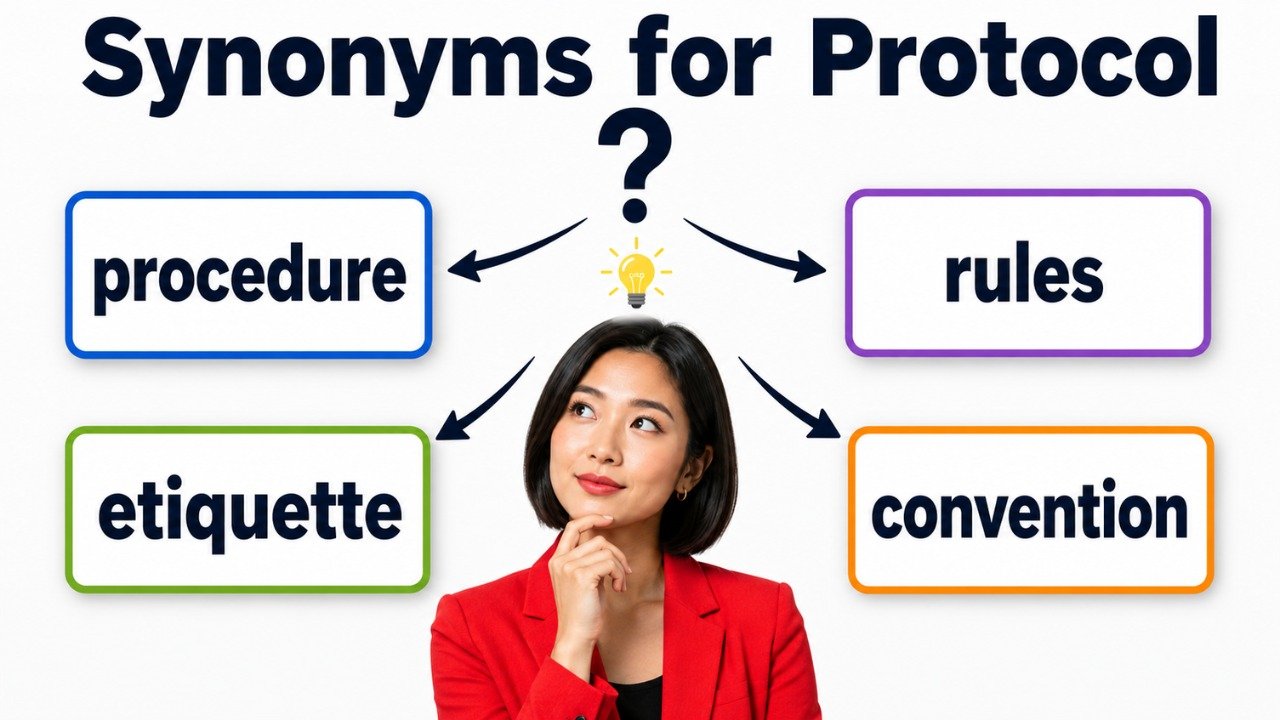
Quick Answer: The best synonyms for protocol include procedure, guideline, standard, rule, convention, code, etiquette, framework, regimen, and specification. Procedure is the strongest general replacement when protocol means an established way of completing a task. Guideline suits flexible instructions, while rule and regulation describe mandatory requirements. Convention and etiquette fit formal or diplomatic behavior. Regimen is useful in medical contexts, specification fits technical details, and standard works well in professional, scientific, and communication settings.
Pronunciation and Word Details
Word: Protocol.
Pronunciation: /ˈproʊ.tə.kɑːl/
Part of Speech: Noun.
Meaning: An established system of rules, procedures, or formal behavior used in a particular situation.
US Pronunciation:
UK Pronunciation:
What Does “Protocol” Mean?
Protocol means an official or accepted set of rules, procedures, or standards for handling a particular activity or situation.
Protocol is mainly used as a noun. It can describe the steps that people must follow, the formal behavior expected during an official event, a planned method used in medicine or research, or a technical standard that allows systems to communicate.
In a workplace sentence, protocol may mean an established procedure. For example, “Employees followed the safety protocol” means they completed the approved safety steps.
In formal or diplomatic contexts, protocol refers to accepted customs, titles, seating arrangements, introductions, and ceremonial behavior.
In medical and scientific contexts, a protocol is a detailed plan that explains how treatment, testing, observation, or research should be conducted.
In technology, protocol means a defined set of communication rules. These rules determine how information is structured, transmitted, received, and interpreted between devices or systems.
The exact meaning of protocol therefore depends on context. It may refer to a procedure, standard, code of conduct, formal convention, treatment plan, or communication system.
Meaning, Tone, and Context of “Protocol”
Protocol is a formal, neutral, and professional word. It is commonly used in workplaces, government communication, healthcare, science, security, diplomacy, education, research, law, emergency planning, and technology.
The word often suggests that an activity must be completed in an organized and approved way. It may imply authority, consistency, safety, accuracy, or respect for established practices.
In everyday conversation, protocol can sound more formal than words such as method, routine, or way. A person might casually say, “What is the usual way to report this?” In a professional setting, the same idea may be expressed as, “What is the reporting protocol?”
Protocol can also sound strict when it refers to mandatory safety, security, or emergency requirements. In other situations, such as ceremony or diplomacy, it emphasizes courtesy, tradition, and appropriate conduct.
In technical and academic writing, protocol is precise rather than emotional. It describes a structured plan, system, or standard that people or systems are expected to follow.
When and How to Use “Protocol”
For Workplace Procedures: Use protocol when describing an approved sequence of actions that employees must follow.
Example: The department introduced a new protocol for reporting equipment damage.
For Safety Requirements: Use protocol for rules and steps designed to prevent injury, loss, or danger.
Example: Everyone must follow the laboratory safety protocol.
For Emergencies: Use protocol when explaining the official response to an urgent or dangerous situation.
Example: The staff activated the emergency evacuation protocol.
For Medical Treatment: Use protocol for a planned course of treatment, testing, monitoring, or patient care.
Example: The physician adjusted the treatment protocol after reviewing the results.
For Scientific Research: Use protocol for a detailed plan that explains how a study or experiment will be conducted.
Example: The research team reviewed the study protocol before collecting data.
For Formal Events: Use protocol for expected ceremonial behavior, introductions, seating, titles, and order.
Example: The organizers followed formal protocol during the official reception.
For Diplomatic Conduct: Use protocol when discussing the customs and procedures observed between official representatives.
Example: Diplomatic protocol determined the order of the introductions.
For Security Measures: Use protocol for approved actions that protect people, information, property, or systems.
Example: The security protocol requires identity verification at the entrance.
For Technical Communication: Use protocol for rules that allow devices, programs, or systems to exchange information.
Example: Both systems must use the same communication protocol.
For Standardized Tasks: Use protocol when consistency and repeatability are important.
Example: The inspection protocol ensures that every unit is checked in the same way.
Best Synonyms for Protocol
Procedure: An established series of actions used to complete a task.
Example: The team followed the approved procedure for handling complaints.
Guideline: A recommended principle or instruction that helps people make decisions.
Example: The document provides a guideline for responding to common questions.
Standard: An accepted level, rule, or method used to ensure consistency.
Example: The new standard applies to every department.
Rule: A clear requirement that controls behavior or action.
Example: The rule requires visitors to sign in before entering.
Convention: An accepted custom or established way of behaving.
Example: Formal convention determines how the guests are introduced.
Code: A system of principles or rules that guides conduct.
Example: Employees are expected to follow the professional code.
Etiquette: Accepted polite behavior in social or formal situations.
Example: Proper etiquette requires respectful introductions.
Framework: A structured system that organizes actions, decisions, or ideas.
Example: The framework explains how incidents should be assessed.
Regimen: A planned program of treatment, exercise, diet, or care.
Example: The patient followed a carefully designed treatment regimen.
Specification: A detailed statement of technical or practical requirements.
Example: The system was built according to the communication specification.
50 Synonyms for Protocol with Short Meanings
- Procedure: An established series of actions.
- Process: A connected set of steps that produces a result.
- Method: A particular way of doing something.
- System: An organized set of connected rules or practices.
- Guideline: A recommendation that directs decisions or behavior.
- Standard: An accepted requirement or level of practice.
- Rule: A requirement that controls actions or conduct.
- Regulation: An official rule created by an authority.
- Policy: A formal principle that guides decisions.
- Convention: An accepted custom or established practice.
- Code: A system of rules or principles.
- Etiquette: Accepted standards of polite behavior.
- Decorum: Proper and respectful behavior.
- Formality: An established requirement of official behavior.
- Custom: A traditional or commonly accepted practice.
- Tradition: A practice passed through repeated use.
- Practice: A usual or accepted way of acting.
- Routine: A regular and repeated method.
- Framework: A structure that organizes actions or decisions.
- Format: An arranged structure or prescribed form.
- Plan: A prepared method for achieving an objective.
- Scheme: An organized arrangement for a particular purpose.
- Program: A planned series of actions or activities.
- Sequence: A fixed order of actions or events.
- Order: An arranged progression or required structure.
- Arrangement: An organized plan or positioning of elements.
- Instruction: A direction explaining what must be done.
- Direction: Guidance about how to act or proceed.
- Requirement: A condition that must be satisfied.
- Specification: A detailed description of required features.
- Criterion: A standard used for judgment or decision.
- Provision: A stated condition within an official plan or document.
- Directive: An authoritative instruction.
- Mandate: An official command or requirement.
- Prescription: A formally stated course of action or treatment.
- Regimen: A planned course of treatment or activity.
- Course: A planned direction or series of actions.
- Pathway: A structured route toward a result.
- Workflow: An organized sequence of work activities.
- Operating Procedure: An approved method for completing a task.
- Safety Procedure: A set of actions designed to prevent harm.
- Emergency Procedure: A planned response to an urgent situation.
- Code of Conduct: Rules governing acceptable behavior.
- Ceremony: A formal activity conducted according to custom.
- Ritual: A fixed series of formal or symbolic actions.
- Observance: The practice of following a custom or requirement.
- Agreement: A shared understanding about rules or action.
- Accord: A formal agreement between parties.
- Communication Standard: Rules governing the exchange of information.
- Technical Standard: An agreed set of technical requirements.
Read Also:
Synonyms for Neighborhood
Synonyms for Protocol by Context
When Protocol Means an Established Procedure
Procedure, process, method, workflow, sequence, and operating procedure work when protocol describes the approved steps for completing a task.
Procedure is usually the strongest general alternative. Process emphasizes connected stages, while workflow focuses on how work moves between people or systems.
Protocol: Follow the protocol for recording customer concerns.
Procedure: Follow the procedure for recording customer concerns.
Protocol: The testing protocol contains five stages.
Process: The testing process contains five stages.
When Protocol Means a Rule or Requirement
Rule, regulation, policy, requirement, directive, and mandate are suitable when protocol establishes what people must do.
Rule is direct and simple. Regulation suggests official authority, while policy describes a broader organizational principle.
Protocol: The security protocol requires all visitors to register.
Rule: The security rule requires all visitors to register.
Protocol: The department changed its reporting protocol.
Policy: The department changed its reporting policy.
When Protocol Means Guidance
Guideline, instruction, direction, framework, and criterion fit situations where protocol helps people make consistent decisions.
Guideline is often less strict than protocol. Framework provides an organized structure but may allow some flexibility.
Protocol: The protocol explains how minor incidents should be handled.
Guideline: The guideline explains how minor incidents should be handled.
Protocol: The assessment protocol supports consistent decisions.
Framework: The assessment framework supports consistent decisions.
When Protocol Means Formal Behavior
Convention, etiquette, decorum, formality, custom, and tradition work when protocol refers to accepted behavior at official or ceremonial events.
Etiquette focuses on polite behavior. Convention emphasizes accepted practice, while decorum describes respectful and appropriate conduct.
Protocol: Official protocol requires guests to be introduced in order.
Convention: Official convention requires guests to be introduced in order.
Protocol: She understood the protocol expected at the ceremony.
Etiquette: She understood the etiquette expected at the ceremony.
When Protocol Means a Medical Plan
Regimen, treatment plan, prescription, course, and care procedure can replace protocol in medical contexts.
Regimen usually refers to an organized program of medicine, exercise, diet, or care. Treatment plan emphasizes decisions made for a particular patient or condition.
Protocol: The clinic introduced a new recovery protocol.
Regimen: The clinic introduced a new recovery regimen.
Protocol: The patient responded well to the treatment protocol.
Treatment Plan: The patient responded well to the treatment plan.
When Protocol Means a Research Plan
Research plan, study design, procedure, method, framework, and program may fit when protocol describes how an investigation will be conducted.
Procedure focuses on practical steps. Study design describes the overall organization of the research.
Protocol: The committee reviewed the research protocol.
Research Plan: The committee reviewed the research plan.
Protocol: Every participant completed the same protocol.
Procedure: Every participant completed the same procedure.
When Protocol Means a Technical Standard
Communication standard, technical standard, specification, format, system, and set of rules fit technical contexts.
Specification emphasizes detailed requirements. Communication standard is useful when systems exchange information according to shared rules.
Protocol: The devices use a common data protocol.
Communication Standard: The devices use a common data communication standard.
Protocol: The software supports the required protocol.
Specification: The software supports the required specification.
When Protocol Means an Emergency Response
Emergency procedure, response plan, safety procedure, action plan, and contingency plan may replace protocol when urgent action is required.
Emergency procedure focuses on exact steps. Response plan may include responsibilities, resources, communication, and recovery measures.
Protocol: The school activated its emergency protocol.
Emergency Procedure: The school activated its emergency procedure.
Protocol: The team reviewed the severe weather protocol.
Response Plan: The team reviewed the severe weather response plan.
Another Word for Protocol
Procedure is usually the best single replacement for protocol when the word describes an established way of completing a task. However, the best alternative depends on whether the context involves rules, formal conduct, medical treatment, research, safety, or technical communication.
Original: The staff followed the protocol for reporting an injury.
Better Option: The staff followed the procedure for reporting an injury.
Original: The guests were unfamiliar with formal protocol.
Better Option: The guests were unfamiliar with formal etiquette.
Original: The patient began a new treatment protocol.
Better Option: The patient began a new treatment regimen.
Original: The devices communicate through the same protocol.
Better Option: The devices communicate through the same technical standard.
When Not to Use “Protocol”
Protocol is useful when rules, procedures, or formal practices are established. It may be less suitable when the situation is casual, flexible, personal, or too simple to require a formal system.
When the Activity Is Informal
Protocol may sound unnecessarily official when describing an ordinary habit or simple action.
Weak: My morning protocol includes drinking water and opening the curtains.
Better: My morning routine includes drinking water and opening the curtains.
When You Mean a Single Rule
Protocol normally suggests a group of steps or rules. Use rule when only one requirement is involved.
Weak: The main protocol is that visitors must remain quiet.
Better: The main rule is that visitors must remain quiet.
When You Mean a Broad Organizational Principle
Policy may be clearer when referring to a general position or decision rather than a sequence of actions.
Weak: The organization has a protocol against discrimination.
Better: The organization has a policy against discrimination.
When You Mean Polite Social Behavior
Etiquette is often more natural when the context involves manners rather than official procedure.
Weak: He did not understand dinner protocol.
Better: He did not understand formal dinner etiquette.
When You Mean a Personal Treatment Plan
Treatment plan or regimen may be more specific when discussing care designed for an individual.
Weak: Her doctor created a personal protocol for recovery.
Better: Her doctor created a personal treatment plan for recovery.
When the Instructions Are Optional
Guideline is more accurate when people are advised rather than required to follow the information.
Weak: The document contains optional protocols for clearer writing.
Better: The document contains optional guidelines for clearer writing.
When Repetition Makes Writing Heavy
Repeating protocol can make professional writing sound mechanical or vague.
Weak: The safety protocol explains the inspection protocol and the reporting protocol.
Better: The safety framework explains the inspection procedure and the reporting process.
Words Commonly Confused With Protocol
Protocol vs Procedure: Protocol is a broader formal system of rules or conduct. Procedure usually refers to the exact steps used to complete a task.
Protocol vs Process: Protocol states how something should be done. Process describes the stages through which something actually develops or is completed.
Protocol vs Policy: Protocol explains actions or behavior in specific situations. Policy expresses a broader organizational principle or position.
Protocol vs Rule: Protocol often includes several related rules and steps. A rule is one specific requirement.
Protocol vs Regulation: Protocol may be created by an organization or professional group. A regulation is usually an official rule established by an authority.
Protocol vs Guideline: Protocol often carries a stronger expectation of compliance. A guideline usually offers recommended advice and may allow flexibility.
Protocol vs Standard: Protocol explains how actions or communication should occur. Standard defines an accepted level, condition, or requirement.
Protocol vs Etiquette: Protocol includes formal customs and procedures. Etiquette mainly concerns polite and socially appropriate behavior.
Protocol vs Convention: Protocol may be written and officially enforced. Convention is often an accepted practice followed because it is traditional or widely recognized.
Protocol vs Regimen: Protocol can refer to an entire medical or research plan. Regimen usually focuses on a repeated course of treatment, exercise, diet, or care.
Which Synonym Should You Choose?
Choose procedure when describing exact steps for completing a task.
Choose process when explaining connected stages that lead to a result.
Choose method when focusing on a particular way of doing something.
Choose guideline when the advice is recommended but not strictly required.
Choose rule when referring to one clear requirement.
Choose regulation when the requirement is official and enforceable.
Choose policy when describing a broad principle used by an organization.
Choose standard when consistency, quality, or accepted requirements are important.
Choose convention when referring to an accepted custom or traditional practice.
Choose etiquette when discussing polite behavior, manners, or formal social conduct.
Choose decorum when emphasizing dignified and respectful behavior.
Choose framework when explaining an organized structure for decisions or action.
Choose regimen when writing about a repeated medical, fitness, diet, or care program.
Choose treatment plan when discussing care created for a particular patient.
Choose specification when technical details and exact requirements matter.
Choose communication standard when describing how systems exchange information.
Choose emergency procedure when writing about immediate safety actions.
Choose code of conduct when defining acceptable professional or organizational behavior.
Choose directive when an authority gives a clear instruction.
Choose protocol in formal reports, professional documents, research writing, security instructions, medical plans, and technical communication when the complete organized system is important.
Real Life Examples of “Protocol” in Sentences
Original: Employees must follow the protocol for reporting accidents.
Better Option: Employees must follow the procedure for reporting accidents.
Original: The laboratory updated its safety protocol.
Better Option: The laboratory updated its safety guidelines.
Original: The reception followed traditional protocol.
Better Option: The reception followed traditional convention.
Original: The official explained the correct diplomatic protocol.
Better Option: The official explained the correct diplomatic etiquette.
Original: The patient completed the treatment protocol.
Better Option: The patient completed the treatment regimen.
Original: The researchers changed the testing protocol.
Better Option: The researchers changed the testing procedure.
Original: The building has a strict visitor protocol.
Better Option: The building has a strict visitor policy.
Original: The emergency protocol was activated immediately.
Better Option: The emergency response plan was activated immediately.
Original: The two systems use different communication protocols.
Better Option: The two systems use different communication standards.
Original: The manager reviewed the complaint protocol with the team.
Better Option: The manager reviewed the complaint process with the team.
Synonym Groups and Usage Differences
Procedure Group
Procedure, process, method, workflow, sequence, and operating procedure describe how a task is completed.
Procedure focuses on approved steps. Process emphasizes connected stages, while workflow describes how work moves through an organization or system.
Example: The updated procedure reduces delays during inspection.
Rules Group
Rule, regulation, requirement, directive, mandate, and provision describe obligations or conditions.
Rule is simple and direct. Regulation suggests official authority, while mandate expresses a strong command.
Example: The regulation requires records to be stored securely.
Guidance Group
Guideline, instruction, direction, criterion, and framework help people decide how to act.
Guideline allows flexibility. Instruction is more direct, while criterion provides a basis for judgment.
Example: The guideline helps staff identify urgent requests.
Organizational Group
Policy, system, framework, plan, program, and scheme organize decisions and activities.
Policy describes a general principle. Framework supplies structure, while program includes planned actions over time.
Example: The organization adopted a clear policy for handling complaints.
Formal Conduct Group
Convention, etiquette, decorum, formality, custom, and tradition describe expected behavior in official or social situations.
Etiquette focuses on manners. Decorum emphasizes dignity, while convention refers to accepted practice.
Example: Proper etiquette was observed throughout the ceremony.
Medical Group
Regimen, prescription, treatment plan, course, pathway, and care procedure describe planned healthcare actions.
Regimen usually involves repeated treatment. A treatment plan is often designed around an individual’s needs.
Example: The patient followed the recommended recovery regimen.
Technical Group
Specification, communication standard, technical standard, format, system, and code describe requirements for technical compatibility or operation.
Specification provides detailed requirements. A communication standard defines how information is exchanged.
Example: Every component must meet the technical specification.
Ceremonial Group
Ceremony, ritual, observance, custom, tradition, and formality describe organized actions with symbolic, official, or cultural importance.
Ritual follows a fixed sequence. Observance refers to respectfully following a recognized practice.
Example: The annual observance followed a traditional order.
Antonyms of Protocol
The opposite of protocol depends on whether protocol means order, formal behavior, rules, or an established procedure.
Disorder: A lack of organization or controlled arrangement.
Chaos: Complete confusion without an effective system.
Improvisation: Action created at the moment without a prepared procedure.
Spontaneity: Natural action without formal planning.
Informality: Behavior that does not follow official conventions.
Irregularity: A departure from an established pattern.
Deviation: Movement away from an approved procedure or standard.
Exception: A case that does not follow the usual rule.
Violation: An action that breaks an established rule.
Breach: A failure to follow a duty, rule, or agreement.
Noncompliance: Failure to follow required standards or instructions.
Disobedience: Refusal to follow a command or rule.
Neglect: Failure to give required care or attention.
Randomness: A lack of planned order or predictable structure.
Confusion: Uncertainty about the correct procedure or action.
Comparison: Protocol vs Related Words
Protocol vs Procedure
Protocol refers to a complete formal system of rules or accepted conduct. Procedure usually means the specific actions used to complete one task.
Example With Protocol: The hospital revised its emergency protocol.
Example With Procedure: The nurse explained the admission procedure.
Protocol vs Process
Protocol describes how something should be done. Process describes the stages through which an activity moves.
Example With Protocol: The team followed the incident protocol.
Example With Process: The approval process took three days.
Protocol vs Policy
Protocol gives practical directions for a particular situation. Policy communicates a broader organizational rule or principle.
Example With Protocol: The protocol explains how to report missing equipment.
Example With Policy: The policy states that equipment must remain on the property.
Protocol vs Guideline
Protocol is usually more formal and may require compliance. Guideline provides advice that can sometimes be adapted.
Example With Protocol: The safety protocol must be followed exactly.
Example With Guideline: The writing guideline can be adjusted for different audiences.
Protocol vs Rule
Protocol usually contains several connected rules or steps. A rule states one specific requirement.
Example With Protocol: The entry protocol includes registration and identity verification.
Example With Rule: The entry rule prohibits unauthorized visitors.
Protocol vs Standard
Protocol explains how actions or communication occur. Standard defines an accepted requirement, level, or specification.
Example With Protocol: The devices exchange data through a shared protocol.
Example With Standard: Every device must meet the required safety standard.
Protocol vs Convention
Protocol is often official, documented, and carefully organized. Convention is an accepted custom that may exist without formal enforcement.
Example With Protocol: The delegates followed official protocol.
Example With Convention: By convention, the senior member spoke first.
Protocol vs Etiquette
Protocol covers formal procedures, order, and conduct. Etiquette focuses mainly on polite behavior and manners.
Example With Protocol: Protocol determined the seating arrangement.
Example With Etiquette: Etiquette required guests to greet the host politely.
Protocol vs Regimen
Protocol may include the full plan for treatment, testing, and monitoring. Regimen usually refers to a repeated course of medication, exercise, diet, or care.
Example With Protocol: The clinic approved a new treatment protocol.
Example With Regimen: The patient followed a daily medication regimen.
Protocol vs Specification
Protocol defines rules for action or communication. Specification states detailed technical or practical requirements.
Example With Protocol: The system uses a secure communication protocol.
Example With Specification: The component meets the required technical specification.
Common Phrases and Expressions With “Protocol”
Safety Protocol: A set of procedures designed to prevent harm or accidents.
Security Protocol: Rules and actions used to protect people, property, information, or systems.
Emergency Protocol: An approved response to danger or an urgent event.
Medical Protocol: A structured plan for treatment, testing, monitoring, or patient care.
Treatment Protocol: A planned course of healthcare actions for a condition.
Research Protocol: A detailed plan explaining how a study will be conducted.
Communication Protocol: Rules that control how information is exchanged.
Diplomatic Protocol: Formal customs and procedures observed in official relations.
Standard Protocol: The usual approved method for handling a situation.
Strict Protocol: A formal procedure that allows little or no variation.
Official Protocol: An authorized system of rules or formal conduct.
Protocol Officer: A person responsible for organizing formal procedures and official etiquette.
Common Mistakes to Avoid
Treating Protocol as a Single Rule: Protocol often describes a complete system of connected steps or expectations. Use rule for one requirement.
Unclear: The protocol is to keep the door closed.
Clearer: The rule is to keep the door closed.
Confusing Protocol With Policy: A policy expresses a broad principle, while a protocol explains what to do in a particular situation.
Incorrect: The organization’s protocol promises equal treatment.
Better: The organization’s policy promises equal treatment.
Using Protocol for Every Routine: Protocol may sound too formal when routine, habit, method, or procedure is sufficient.
Unnatural: My bedtime protocol begins at ten.
Natural: My bedtime routine begins at ten.
Using a Weak Technical Synonym: Method may be too broad when protocol refers to precise communication rules.
Weak: The devices use the same communication method.
Better: The devices use the same communication protocol.
Assuming Guideline and Protocol Are Identical: Guidelines often allow judgment and flexibility. Protocols are usually more structured and may be mandatory.
Confusing Etiquette With the Whole Protocol: Etiquette covers polite conduct, but protocol may also include order, timing, titles, security, and official procedure.
Repeating Protocol Too Often: Replace repeated uses with procedure, policy, framework, standard, or guideline when the meaning remains accurate.
Repetitive: The protocol explains the safety protocol and reporting protocol.
Improved: The framework explains the safety procedure and reporting process.
Using the Wrong Plural Form: The correct plural is protocols.
Incorrect: The departments follow different protocol.
Correct: The departments follow different protocols.
Using Protocol Without Explaining Its Purpose: Readers may not understand whether the word refers to safety, communication, treatment, or formal conduct.
Vague: Staff must follow the protocol.
Clear: Staff must follow the emergency evacuation protocol.
Choosing a Synonym That Changes the Meaning: Regulation, etiquette, regimen, and specification each represent only one possible meaning of protocol. Select the word that matches the context.
Conclusion
Synonyms for protocol include procedure, guideline, standard, rule, convention, framework, etiquette, regimen, and specification. Procedure is the best general choice for an established series of actions. Guideline suits flexible advice, while regulation and rule fit mandatory requirements. Etiquette and convention describe formal conduct, regimen works for treatment plans, and specification fits technical requirements. Choosing the right alternative helps readers understand whether the sentence concerns workplace actions, safety, diplomacy, healthcare, research, or communication systems.
FAQs About Synonyms for Protocol
What Is the Best Synonym for Protocol?
Procedure is the best general synonym when protocol means an established series of steps. Standard, guideline, rule, convention, and regimen may be better in specific contexts.
What Is a Simple Word for Protocol?
Procedure is a simple and clear alternative. Method, process, rule, and guideline may also work depending on the meaning.
What Is a Formal Synonym for Protocol?
Procedure, regulation, directive, convention, framework, specification, and code of conduct are useful formal alternatives.
What Is Another Word for Safety Protocol?
Safety procedure, safety guideline, emergency procedure, protective measure, and response plan are suitable alternatives.
What Is Another Word for Medical Protocol?
Treatment plan, regimen, course of treatment, care pathway, and medical procedure can replace medical protocol in suitable contexts.
Is Protocol the Same as Policy?
No. A policy states a broad principle or organizational position. A protocol explains the specific actions or rules used in a particular situation.
Is Protocol the Same as Procedure?
The words are closely related, but protocol is often broader and more formal. A procedure usually describes the exact steps required to complete a task.
