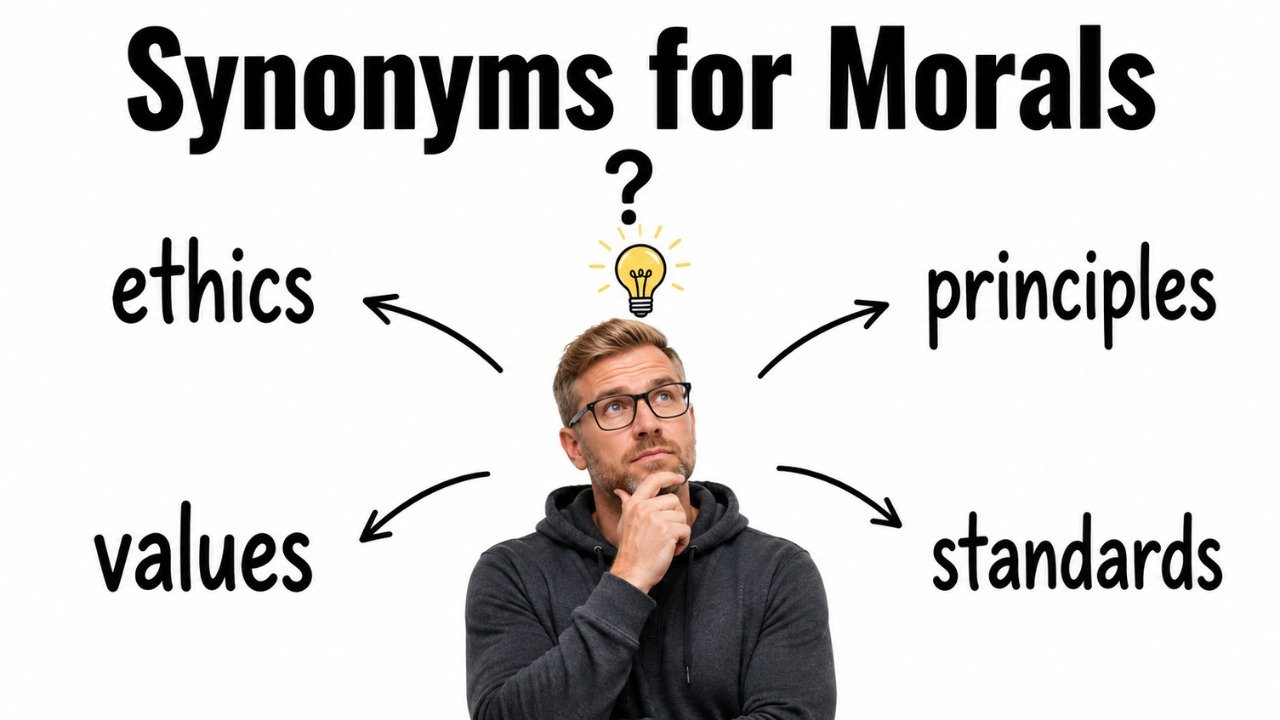
Quick Answer: The best synonyms for morals include ethics, principles, values, standards, virtues, beliefs, ideals, conscience, integrity, and moral code. Use ethics in formal, professional, or academic discussions about right conduct. Principles and values work well for personal beliefs and decisions. Standards suits expected behavior within a group, while virtues describes positive qualities such as honesty and kindness. Conscience refers to an inner sense of right and wrong. When morals means lessons taught by stories or experiences, moral lessons, teachings, wisdom, or life lessons may be better choices.
Pronunciation and Word Details
Word: Morals.
Pronunciation: /ˈmɒrəlz/.
Part of Speech: Plural noun.
Meaning: Beliefs or standards that guide judgments about right and wrong behavior.
US Pronunciation:
UK Pronunciation:
What Does “Morals” Mean?
Morals are beliefs, principles, or standards that guide a person’s understanding of right and wrong.
Morals is a plural noun. It commonly refers to the personal or shared rules people use when deciding whether an action is honest, fair, responsible, kind, or acceptable.
A person’s morals may influence daily choices, relationships, promises, responsibilities, and reactions to difficult situations. For example, someone may refuse to lie because honesty is part of their morals.
The word can also describe the lessons taught by stories, events, or experiences. In this sense, the morals of a story are the ideas readers are expected to learn, such as the importance of patience, courage, or generosity.
Morals can be personal, social, cultural, professional, or traditional. The word often appears in conversations about character, behavior, responsibility, ethics, values, and conscience.
Meaning, Tone, and Context of “Morals”
Morals usually has a neutral or serious tone. It is common in everyday conversation, education, philosophy, literature, professional discussions, and formal writing.
In personal contexts, morals describes an individual’s beliefs about acceptable behavior. Someone may speak about personal morals when explaining why they made a difficult decision.
In social contexts, morals can refer to standards shared by a community or group. These standards may influence expectations about honesty, respect, loyalty, fairness, and responsibility.
In academic or professional writing, ethics is often preferred because it can describe organized systems of conduct. Morals usually feels more personal and connected to individual beliefs or character.
The word may also carry a judgmental tone when one person questions another person’s character. Writers should therefore use it carefully and avoid making unsupported claims about someone’s morals.
When discussing stories, morals has an educational tone. It refers to lessons about behavior, choices, and consequences.
When and How to Use “Morals”
For Personal Beliefs: Use morals when describing a person’s beliefs about right and wrong.
Example: Her morals prevented her from taking credit for someone else’s work.
For Ethical Decisions: Use morals when a decision involves honesty, fairness, responsibility, or harm.
Example: He followed his morals even when the easier choice was dishonest.
For Character: Use morals when discussing the principles reflected in a person’s behavior.
Example: Strong morals shaped the way she treated other people.
For Social Standards: Use morals when referring to shared expectations about proper conduct.
Example: The debate revealed different views about public morals.
For Professional Conduct: Use morals when personal beliefs influence workplace behavior, although ethics is often more precise.
Example: His morals guided him to report the inaccurate figures.
For Story Lessons: Use morals when identifying the lessons taught by a story or experience.
Example: The morals of the tale include patience, courage, and kindness.
For Difficult Choices: Use morals when someone must choose between personal advantage and doing what feels right.
Example: The situation tested her morals and her loyalty.
For Teaching Behavior: Use morals when explaining principles to children, students, or community members.
Example: The stories teach morals through simple examples and consequences.
Best Synonyms for Morals
Ethics: Principles that define right and acceptable conduct.
Example: Professional ethics require employees to protect private information.
Principles: Basic beliefs that guide actions and decisions.
Example: He refused the offer because it conflicted with his principles.
Values: Beliefs about what is important, right, or desirable.
Example: Respect and honesty are central to her values.
Standards: Expected levels of behavior or conduct.
Example: The organization maintains strict standards of fairness.
Virtues: Positive moral qualities such as courage, patience, and generosity.
Example: The story celebrates the virtues of loyalty and compassion.
Beliefs: Ideas accepted as true or important.
Example: Her beliefs influenced how she responded to the conflict.
Ideals: High principles or goals that people try to follow.
Example: Justice and equality were among his strongest ideals.
Conscience: An inner awareness of right and wrong.
Example: His conscience would not allow him to remain silent.
Integrity: The quality of being honest and guided by strong principles.
Example: She demonstrated integrity by admitting the mistake.
Moral Code: A set of rules or beliefs about right conduct.
Example: His moral code emphasized honesty, responsibility, and respect.
50 Synonyms for Morals with Short Meanings
- Ethics: Principles that guide right and responsible conduct.
- Principles: Basic beliefs used to direct behavior and decisions.
- Values: Beliefs about what is important and worthwhile.
- Standards: Expected levels of acceptable behavior.
- Beliefs: Ideas accepted as right, true, or important.
- Ideals: High standards that a person hopes to follow.
- Virtues: Positive qualities associated with good character.
- Convictions: Strongly held beliefs that guide choices.
- Conscience: An inner sense of right and wrong.
- Integrity: Honesty and consistency in following strong principles.
- Morality: The system or quality of right and wrong conduct.
- Righteousness: Behavior considered morally right or just.
- Decency: Respectable, fair, and considerate behavior.
- Goodness: The quality of being kind, honest, or morally right.
- Honor: A commitment to fairness, honesty, and proper conduct.
- Uprightness: Honest and morally responsible character.
- Rectitude: Strict correctness in moral behavior.
- Probity: Complete honesty and strong moral character.
- Scruples: Moral concerns that prevent improper behavior.
- Character: The moral qualities shown through actions.
- Ethos: The guiding beliefs and values of a person or group.
- Code: A set of accepted behavioral rules.
- Code of Conduct: Written standards for proper behavior.
- Moral Code: Personal or shared rules about right and wrong.
- Ethical Code: Formal principles governing responsible conduct.
- Precepts: Rules or principles intended to guide behavior.
- Tenets: Central beliefs accepted by a person or group.
- Doctrines: Established beliefs taught within a system.
- Rules: Directions describing acceptable or required conduct.
- Norms: Commonly accepted standards within a group.
- Customs: Traditional practices that influence behavior.
- Duties: Actions a person is morally expected to perform.
- Obligations: Responsibilities that a person should fulfill.
- Responsibilities: Duties connected to a role, promise, or decision.
- Commandments: Authoritative rules about conduct.
- Teachings: Ideas intended to guide beliefs and behavior.
- Guidance: Advice that helps someone make responsible choices.
- Lessons: Ideas learned from actions, stories, or experiences.
- Life Lessons: Important principles learned through experience.
- Moral Lessons: Teachings about right behavior and good character.
- Wisdom: Good judgment developed through knowledge and experience.
- Principles of Conduct: Beliefs that direct personal behavior.
- Ethical Standards: Accepted expectations for responsible conduct.
- Moral Standards: Measures used to judge right and wrong behavior.
- Social Values: Beliefs considered important within a community.
- Personal Values: Individual beliefs that guide choices and priorities.
- Shared Values: Principles accepted by members of a group.
- Sense of Right and Wrong: Personal awareness of acceptable behavior.
- Ethical Beliefs: Ideas about fairness, duty, and responsible action.
- Standards of Behavior: Expectations about how people should act.
Read Also:
Synonyms for Applicable
Synonyms for Morals by Context
When Morals Means Ethical Principles
Ethics, principles, standards, moral code, ethical code, precepts, and principles of conduct work when morals refers to rules about proper behavior.
Ethics is especially useful in professional, academic, and formal writing. Principles sounds natural in both conversation and formal contexts. Moral code refers to a complete set of personal or shared rules.
Example: Her principles would not allow her to hide the truth.
Example: The profession requires high ethical standards.
Example: His moral code placed fairness above personal gain.
When Morals Means Personal Values
Values, beliefs, ideals, convictions, personal values, and ethical beliefs work when discussing ideas that influence individual decisions.
Values may include honesty, compassion, family, loyalty, freedom, or responsibility. Convictions are usually stronger and more firmly held than ordinary opinions.
Example: Their values influenced the way they raised their children.
Example: She defended her convictions despite strong criticism.
Example: His personal values shaped every major decision.
When Morals Means Good Character
Virtues, integrity, honor, decency, goodness, uprightness, rectitude, probity, and character describe positive moral qualities.
Integrity emphasizes honesty and consistency. Virtues refers to specific qualities such as patience, courage, or generosity. Probity and rectitude are more formal alternatives.
Example: She showed integrity by correcting the error immediately.
Example: Patience and kindness are valuable virtues.
Example: The judge was respected for his probity and fairness.
When Morals Means an Inner Guide
Conscience, scruples, sense of right and wrong, and moral awareness describe the inner judgment that influences behavior.
Conscience is the strongest general choice. Scruples usually refers to moral concerns that make someone hesitate or refuse to do something.
Example: His conscience persuaded him to return the money.
Example: She had no scruples about admitting her part in the mistake.
When Morals Means Social Expectations
Norms, social values, customs, standards, shared values, duties, and obligations describe expectations within a society or group.
Norms are accepted patterns of behavior. Customs are traditional practices. Shared values are beliefs that help unite members of a community.
Example: Social norms can change over time.
Example: Respect for elders was one of the community’s shared values.
Example: The role carried both practical duties and moral obligations.
When Morals Means Lessons
Lessons, moral lessons, life lessons, teachings, wisdom, guidance, and precepts work when morals refers to ideas learned from stories or experience.
Moral lesson is the clearest choice for a story. Life lesson is more natural for personal experience. Teaching can describe a principle communicated by a parent, teacher, leader, or text.
Example: One moral lesson of the story is that greed has consequences.
Example: The experience taught her an important life lesson.
Example: The tale offers guidance about patience and honesty.
Another Word for Morals
Ethics is often the best single replacement for morals in formal discussions about right and wrong conduct.
However, ethics and morals are not identical in every context. Principles is usually better for personal rules, values for deeply held priorities, virtues for positive character traits, and lessons when discussing stories.
Original: His morals prevented him from lying to the customer.
Better Option: His principles prevented him from lying to the customer.
Original: The discussion focused on morals in the workplace.
Better Option: The discussion focused on ethics in the workplace.
Original: Honesty and compassion are important morals in her family.
Better Option: Honesty and compassion are important values in her family.
Original: The morals of the story are easy to understand.
Better Option: The moral lessons of the story are easy to understand.
When Not to Use “Morals”
Do not use morals when a more precise term would explain the intended meaning more clearly.
In professional settings, ethics may be better because it refers to established standards of conduct. In personal discussions, principles or values may sound more natural.
Weak: The employee broke the company’s morals.
Better: The employee violated the organization’s ethical standards.
Avoid using morals to describe every personal preference. A preference for a certain style, food, or routine is not necessarily a moral belief.
Weak: Waking early is one of his morals.
Better: Waking early is one of his personal habits.
Do not use morals when you mean manners. Morals concern right and wrong, while manners concern polite social behavior.
Weak: She showed good morals by greeting every guest politely.
Better: She showed good manners by greeting every guest politely.
Avoid using morals as an unsupported judgment about another person’s character.
Weak: He has no morals because he disagreed with me.
Better: His decision conflicts with my principles.
Do not use morals when discussing a single lesson from a story. Use moral in the singular.
Weak: The morals of the story is that honesty matters.
Better: The moral of the story is that honesty matters.
Avoid repeating morals when clearer alternatives can improve the paragraph.
Weak: Her morals shaped the morals she taught and the morals she expected from others.
Better: Her principles shaped the values she taught and the standards she expected from others.
Words Commonly Confused With Morals
Morals vs Ethics: Morals usually refers to personal or shared beliefs about right and wrong. Ethics often refers to organized standards within a profession, institution, or field of study.
Morals vs Values: Morals specifically concerns right and wrong behavior. Values includes broader beliefs about what is important, such as family, success, creativity, or independence.
Morals vs Principles: Morals is a general term for beliefs about right conduct. Principles are specific rules or beliefs that guide decisions.
Morals vs Virtues: Morals describes standards of behavior. Virtues are positive character qualities such as honesty, courage, patience, and generosity.
Morals vs Conscience: Morals are the beliefs a person follows. Conscience is the inner feeling that judges whether an action agrees with those beliefs.
Morals vs Manners: Morals concerns right and wrong. Manners concerns polite and socially accepted behavior.
Morals vs Morality: Morals are particular beliefs or standards. Morality is the broader system or concept of right and wrong behavior.
Morals vs Moral: Morals is the plural form used for ethical standards or several lessons. Moral can be an adjective or a singular noun meaning one lesson from a story.
Which Synonym Should You Choose?
Choose ethics for formal writing about professional duties, responsible conduct, or systems of right behavior.
Choose principles when describing personal rules that guide decisions.
Choose values when discussing beliefs about what is important in life, relationships, education, or society.
Choose standards when referring to expected behavior within a workplace, profession, school, or community.
Choose virtues when naming positive qualities such as honesty, courage, patience, and compassion.
Choose integrity when emphasizing honesty and consistency between beliefs and actions.
Choose conscience in everyday conversation when discussing an inner feeling about right and wrong.
Choose convictions when describing strongly held beliefs that someone is unwilling to abandon.
Choose moral code when referring to a complete personal or social system of conduct.
Choose norms for reports and essays about commonly accepted behavior within a group.
Choose probity or rectitude in highly formal writing about honesty and upright character.
Choose moral lessons when discussing the messages taught by stories.
Choose life lessons when referring to wisdom gained from personal experience.
Choose shared values when describing principles that unite a family, team, community, or society.
Real Life Examples of “Morals” in Sentences
Original: Her morals would not allow her to deceive the client.
Better Option: Her principles would not allow her to deceive the client.
Original: The course explores morals in professional decision making.
Better Option: The course explores ethics in professional decision making.
Original: His morals were shaped by his family.
Better Option: His values were shaped by his family.
Original: She is respected for her strong morals.
Better Option: She is respected for her integrity.
Original: The decision tested his morals.
Better Option: The decision tested his conscience.
Original: Their morals require them to treat everyone fairly.
Better Option: Their ethical beliefs require them to treat everyone fairly.
Original: Different communities may follow different morals.
Better Option: Different communities may follow different social norms.
Original: The morals of the story focus on kindness and patience.
Better Option: The moral lessons of the story focus on kindness and patience.
Original: He refused to compromise his morals for personal gain.
Better Option: He refused to compromise his convictions for personal gain.
Original: Good morals are important in positions of trust.
Better Option: High ethical standards are important in positions of trust.
Synonym Groups and Usage Differences
Ethical Conduct Group
Ethics, moral code, ethical code, standards, rules, precepts, and principles of conduct describe systems that direct behavior.
Ethics is the broadest formal term. A code is usually a defined collection of rules. Precepts are principles taught as guidance.
Example: The code of conduct explains the standards expected from every member.
Personal Belief Group
Principles, values, beliefs, ideals, convictions, and personal values describe ideas held by an individual.
Principles directly guide actions. Values identify what a person considers important. Convictions are beliefs held with strong confidence.
Example: She remained loyal to her principles during the dispute.
Character Group
Integrity, honor, decency, goodness, uprightness, rectitude, probity, and character describe moral qualities shown through behavior.
Integrity is the most natural choice in professional and everyday writing. Rectitude and probity are more formal.
Example: His honesty during the investigation demonstrated integrity.
Virtue Group
Virtues, righteousness, decency, goodness, honor, and uprightness refer to qualities associated with admirable behavior.
Virtues usually names several qualities. Righteousness may sound stronger because it suggests complete moral correctness.
Example: The lesson emphasizes the virtues of courage and compassion.
Inner Judgment Group
Conscience, scruples, ethical beliefs, and sense of right and wrong describe internal moral guidance.
Conscience is an inner voice or feeling. Scruples are concerns that stop someone from acting improperly.
Example: Her conscience encouraged her to confess the truth.
Social Standards Group
Norms, customs, shared values, social values, standards, duties, obligations, and responsibilities describe group expectations.
Norms are common behavioral patterns. Duties and obligations focus on what a person is expected to do.
Example: Social values influence how communities define responsible behavior.
Lesson Group
Lessons, moral lessons, life lessons, teachings, wisdom, and guidance describe ideas learned from stories or experience.
Moral lessons are connected to right behavior. Wisdom is broader and may include practical judgment as well as ethical understanding.
Example: The story teaches a moral lesson about the dangers of dishonesty.
Antonyms of Morals
The opposites of morals depend on whether the word refers to principles, good character, responsible conduct, or lessons.
Immorality: Behavior that violates accepted standards of right and wrong.
Corruption: Dishonest conduct used for personal advantage.
Dishonesty: A willingness to lie, deceive, or hide the truth.
Deceit: Deliberate behavior intended to mislead someone.
Vice: A harmful or morally wrong habit or quality.
Wickedness: Deliberately cruel or morally wrong behavior.
Unprincipled Behavior: Conduct not guided by firm moral standards.
Unscrupulousness: A lack of moral concern about harmful actions.
Indecency: Behavior considered improper or offensive.
Dishonor: Conduct that damages respect or moral reputation.
Injustice: Unfair treatment or denial of rights.
Cruelty: Willingness to cause pain or suffering.
Selfishness: Excessive concern for personal benefit.
Irresponsibility: Failure to fulfill duties or consider consequences.
Lawlessness: Disregard for laws or accepted rules.
Misconduct: Improper or unacceptable behavior.
Amorality: A lack of concern with moral questions.
Bad Character: Personal qualities associated with dishonest or harmful conduct.
Comparison: Morals vs Related Words
Morals vs Ethics
Morals often refers to personal beliefs about right and wrong. Ethics commonly describes formal standards followed within a profession or organized system.
Example With Morals: Her morals prevented her from hiding the mistake.
Example With Ethics: Professional ethics required her to report the mistake.
Morals vs Values
Morals specifically concerns right and wrong conduct. Values includes everything a person considers important, including achievement, family, freedom, creativity, and loyalty.
Example With Morals: His morals taught him not to deceive others.
Example With Values: His values placed family and education first.
Morals vs Principles
Morals is a broad term for beliefs about proper behavior. Principles are individual rules or beliefs used to guide decisions.
Example With Morals: Her morals influenced every difficult choice.
Example With Principles: One of her principles was to keep every promise.
Morals vs Virtues
Morals describes standards for behavior. Virtues describes admirable personal qualities.
Example With Morals: Their morals emphasized fairness and responsibility.
Example With Virtues: Patience and honesty were among her greatest virtues.
Morals vs Conscience
Morals are learned or accepted beliefs. Conscience is the inner awareness that evaluates actions according to those beliefs.
Example With Morals: His morals taught him that stealing was wrong.
Example With Conscience: His conscience persuaded him to return what he had taken.
Morals vs Standards
Morals may be personal and connected to inner beliefs. Standards are defined expectations used to judge behavior or performance.
Example With Morals: Her morals guided her private decisions.
Example With Standards: The profession follows strict standards of conduct.
Morals vs Manners
Morals concerns ethical right and wrong. Manners concerns courtesy and polite social behavior.
Example With Morals: Returning the lost wallet reflected strong morals.
Example With Manners: Thanking the host reflected good manners.
Common Phrases and Expressions With “Morals”
Strong Morals: Firm beliefs about right and wrong behavior.
Good Morals: Principles associated with honesty, fairness, and responsibility.
Personal Morals: Individual beliefs that guide ethical decisions.
Public Morals: Shared expectations about acceptable behavior in society.
Traditional Morals: Standards of conduct passed through generations.
Moral Values: Beliefs about right behavior and good character.
Moral Standards: Measures used to judge whether conduct is acceptable.
Questionable Morals: Principles or behavior that may be considered unethical.
Compromise Your Morals: Abandon or weaken your principles for an advantage.
Against Your Morals: In conflict with your beliefs about right conduct.
Teach Morals: Help someone learn principles of responsible behavior.
Morals of the Story: Lessons about behavior communicated through a narrative.
Common Mistakes to Avoid
Confusing Morals With Ethics: The words overlap, but ethics is often more suitable for professional rules and formal systems. Morals usually emphasizes personal beliefs.
Using Morals for Preferences: Personal tastes are not automatically moral principles. Preferring quiet places or a particular color is a preference, not a moral.
Confusing Morals With Manners: Politeness and morality are different. A person may have excellent manners but still behave dishonestly.
Using the Wrong Number: Use moral for one lesson and morals for several lessons or ethical standards.
Incorrect: The morals of the story is simple.
Correct: The moral of the story is simple.
Making Vague Accusations: Saying that someone has no morals is a serious judgment. Describe the specific behavior instead of making a broad personal attack.
Vague: He has no morals.
Clearer: He knowingly deceived the people who trusted him.
Repeating Morals Too Often: Replace repeated uses with principles, values, ethics, standards, conscience, or integrity when appropriate.
Choosing an Unnatural Synonym: Conscience is not a direct replacement in every sentence. It refers to an inner judgment, not a complete set of beliefs.
Ignoring Context: Moral code suits a system of beliefs, while moral lesson suits the message of a story. They cannot always replace each other.
Treating All Values as Morals: Values can include goals and preferences that are not connected to ethical behavior. Use morals only when right and wrong are involved.
Conclusion
Understanding synonyms for morals helps you express ethical ideas with greater precision. Use ethics for professional conduct, principles for personal rules, values for important beliefs, and standards for expected behavior. Integrity and virtues describe admirable character, while conscience refers to an inner sense of right and wrong. When discussing stories or experience, moral lessons, teachings, and life lessons are clearer choices. The best alternative depends on whether you mean personal beliefs, social expectations, good character, formal conduct, or educational messages.
FAQs About Synonyms for Morals
What Is the Best Synonym for Morals?
Ethics is a strong formal synonym. Principles and values are often better when discussing personal beliefs.
Are Morals and Ethics the Same?
They are closely related, but morals often refers to personal beliefs, while ethics commonly refers to formal standards or systems of conduct.
What Is Another Word for Strong Morals?
Integrity, strong principles, good character, uprightness, and a firm moral code are useful alternatives.
What Is the Difference Between Morals and Values?
Morals concerns beliefs about right and wrong. Values includes broader beliefs about what is important or desirable.
What Is a Formal Synonym for Morals?
Ethics, ethical standards, principles of conduct, rectitude, and probity are suitable formal alternatives.
What Are Synonyms for the Morals of a Story?
Moral lessons, teachings, messages, wisdom, guidance, and life lessons can describe the ideas taught by a story.
What Is the Opposite of Morals?
Immorality is the closest general opposite. Other antonyms include corruption, dishonesty, vice, misconduct, and unscrupulousness.
