
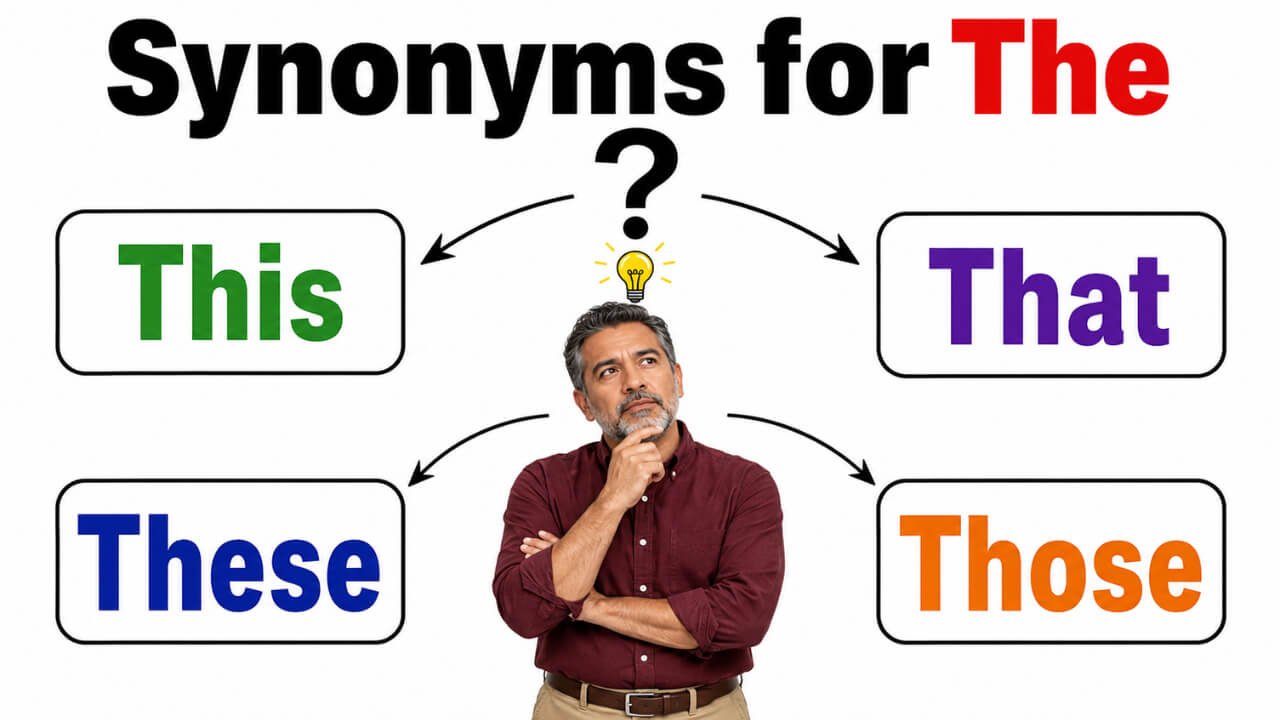
Quick Answer: The keyword synonyms for the does not have a simple list of direct replacements because “the” is a definite article rather than a descriptive word. However, useful alternatives include this, that, these, those, said, aforementioned, specific, particular, stated, and named. Use this or these for nearby or current subjects, that or those for distant or previously discussed subjects, said and aforementioned in formal writing, and specific or particular when identifying an exact person, object, or idea.
Pronunciation and Word Details
Word: The
Pronunciation: /ðə/ before most consonant sounds and /ðiː/ before vowel sounds or for emphasis
Part of Speech: Definite article and determiner
Meaning: A word placed before a noun to identify a specific, known, unique, or previously mentioned person, place, object, or idea.
US Pronunciation:
UK Pronunciation:
What Does “The” Mean?
“The” identifies a particular noun that the speaker or reader can recognize. It is called the definite article because it points to something definite, known, unique, or already mentioned.
The word can appear before singular nouns, plural nouns, and uncountable nouns. For example, “the book” identifies a particular book, “the students” identifies a known group of students, and “the information” refers to specific information.
“The” also appears before unique things, superlatives, ordinal numbers, musical instruments, certain geographical names, and nouns that represent an entire class.
Specific Object: Please close the window.
Previously Mentioned Object: I bought a notebook. The notebook has a blue cover.
Unique Object: The sun provides light and warmth.
Superlative: She gave the best answer.
Ordinal Number: He was the first person to arrive.
Although “the” has no exact synonym in every sentence, demonstratives and descriptive modifiers can sometimes perform a similar function.
Meaning, Tone, and Context of “The”
“The” is neutral in tone. It is used naturally in formal writing, casual conversation, academic work, reports, instructions, descriptions, and everyday communication.
The word itself does not express emotion, politeness, approval, or criticism. Its purpose is grammatical. It tells the reader that the noun is specific or identifiable.
In formal documents, “the” may sometimes be replaced by words such as said, stated, aforementioned, identified, or designated. These alternatives create a more official tone.
In conversation, this, that, these, and those are more natural alternatives because they point directly to people or objects.
Neutral Context: The meeting begins at nine.
Formal Context: Said agreement remains valid.
Conversational Context: That meeting begins at nine.
Specific Context: Please review the selected document.
Known Context: The document we discussed is ready.
Because “the” is one of the most common grammatical words, replacing it unnecessarily can make a sentence sound unnatural or overly formal.
When and How to Use “The”
For a Specific Person or Object
Use “the” when both the speaker and listener know which person or object is being discussed.
Example: Please place the package on my desk.
The sentence refers to a particular package and a particular desk.
For Something Mentioned Earlier
Use “the” when a noun has already appeared in the conversation or text.
Example: We saw a small house. The house had a red door.
The first sentence introduces the house. The second sentence uses “the” because the house is now known.
For Something Unique
Use “the” before a noun that refers to something unique in a situation or in the world.
Example: The moon looked bright tonight.
There is only one moon being discussed in this context.
For Superlatives
Use “the” before superlative adjectives such as best, tallest, fastest, strongest, and most useful.
Example: This is the clearest explanation in the article.
For Ordinal Numbers
Use “the” before ordinal numbers such as first, second, third, and final.
Example: She completed the second task successfully.
For a Defined Group
Use “the” before a plural noun when referring to a specific group rather than all members of that category.
Example: The employees in this office attended the meeting.
This refers only to employees in a particular office.
For an Entire Class
Use “the” with some singular nouns to represent an entire species, invention, or class.
Example: The elephant is known for its intelligence and memory.
For Emphasis
Pronounce “the” as /ðiː/ when strongly emphasizing that someone or something is especially important or well known.
Example: That is the solution we have been searching for.
Best Synonyms for The
There are no perfect synonyms for “the,” but the following words can replace or reproduce its function in certain sentences.
This
Synonym: Identifies one specific person, object, or idea that is nearby, current, or directly connected to the speaker.
Example: This report contains the final results.
That
Synonym: Identifies one specific person, object, or idea that is distant or previously mentioned.
Example: That report contains several useful findings.
These
Synonym: Identifies several nearby, current, or immediately relevant people or objects.
Example: These instructions explain every step clearly.
Those
Synonym: Identifies several distant or previously discussed people or objects.
Example: Those instructions are no longer accurate.
Said
Synonym: Refers formally to a person, object, statement, or document mentioned earlier.
Example: Said document must be signed before submission.
Aforementioned
Synonym: Refers to something already named or discussed in formal writing.
Example: The aforementioned conditions apply to every applicant.
Specific
Synonym: Identifies one exact person, object, detail, or category.
Example: Please choose a specific topic for your report.
Particular
Synonym: Refers to one clearly identified member of a group.
Example: A particular sentence requires further explanation.
Stated
Synonym: Refers to information, rules, or conditions that have already been expressed.
Example: Follow the stated requirements carefully.
Named
Synonym: Identifies a person, place, object, or idea that has already been given a name.
Example: The named candidate will attend the interview.
50 Synonyms for The with Short Meanings
The following words are contextual alternatives rather than exact grammatical synonyms. Each one can reproduce part of the identifying, limiting, or referring function of “the” in an appropriate sentence.
- This: Identifies one nearby or immediately relevant noun.
- That: Identifies one distant or previously discussed noun.
- These: Identifies multiple nearby or current nouns.
- Those: Identifies multiple distant or previously discussed nouns.
- Said: Refers formally to something mentioned earlier.
- Aforementioned: Refers to something previously named in formal writing.
- Previously mentioned: Identifies something introduced earlier.
- Mentioned above: Refers to information appearing earlier in a text.
- Stated: Identifies a condition, fact, or idea already expressed.
- Named: Refers to a person or thing already identified by name.
- Identified: Points to something that has been recognized or specified.
- Indicated: Refers to something shown or pointed out.
- Described: Identifies something explained earlier.
- Discussed: Refers to a subject already examined or mentioned.
- Referenced: Identifies something cited or referred to earlier.
- Noted: Refers to something already observed or recorded.
- Given: Identifies something supplied, assumed, or already known.
- Specific: Refers to one exact person, object, or detail.
- Particular: Selects one member or example from a group.
- Certain: Refers to a particular but sometimes unnamed person or thing.
- Definite: Clearly identifies something fixed or certain.
- Exact: Refers to something completely accurate or specifically identified.
- Precise: Identifies something with careful accuracy.
- Proper: Refers to the correct or appropriate person or thing.
- Intended: Identifies the person, object, or meaning that was planned.
- Relevant: Refers to the person, object, or information connected to the subject.
- Respective: Connects different people or things to their individual places or roles.
- Corresponding: Refers to something that matches another item or category.
- Matching: Identifies something that agrees with or resembles another thing.
- Selected: Refers to something deliberately chosen.
- Chosen: Identifies something picked from several possibilities.
- Designated: Refers to something officially assigned or identified.
- Required: Identifies something necessary under a rule or condition.
- Appropriate: Refers to the suitable person, object, or choice.
- Present: Identifies something existing or happening now.
- Current: Refers to the person, object, or situation existing now.
- Existing: Identifies something already present or established.
- Same: Refers to an identical or previously mentioned person or thing.
- Only: Identifies a single available person, object, or possibility.
- Sole: Refers to one person or thing without another.
- Main: Identifies the most important person, object, or idea.
- Primary: Refers to the first or most important item.
- Known: Identifies something familiar or already recognized.
- Familiar: Refers to something previously experienced or recognized.
- Following: Introduces something that appears next.
- Former: Refers to the first of two previously mentioned items.
- Latter: Refers to the second of two previously mentioned items.
- Each: Identifies every member of a group separately.
- Every: Refers to all members of a group individually.
- Such: Refers to something of the type already mentioned.
Read Also:
Synonyms for Relax
Synonyms for The by Context
When The Identifies a Nearby or Current Noun
Use this for one noun and these for more than one noun. These words are more specific than “the” because they show closeness or immediate relevance.
The: Please examine the document on my desk.
This: Please examine this document on my desk.
The: The examples explain the rule.
These: These examples explain the rule.
When The Identifies a Distant Noun
Use that for one distant noun and those for several distant nouns. Distance may be physical, emotional, or connected to an earlier part of a conversation.
The: The building across the road is empty.
That: That building across the road is empty.
The: The ideas we discussed yesterday were useful.
Those: Those ideas we discussed yesterday were useful.
When The Refers to Earlier Information
Formal alternatives include said, aforementioned, stated, discussed, noted, and previously mentioned.
The: The agreement will remain valid for one year.
Said: Said agreement will remain valid for one year.
The: The conditions must be followed.
Aforementioned: The aforementioned conditions must be followed.
These alternatives are most suitable for formal documents. They often sound unnatural in ordinary conversation.
When The Identifies a Specific Choice
Useful alternatives include specific, particular, selected, chosen, designated, and intended.
The: Please send the file requested by the manager.
Specific: Please send the specific file requested by the manager.
The: She reviewed the candidate for the role.
Selected: She reviewed the selected candidate for the role.
When The Means Only or Unique
Use only, sole, unique, main, or primary when the sentence emphasizes that there is one important or available option.
The: He was the person who understood the problem.
Only: He was the only person who understood the problem.
The: This is the reason for the delay.
Main: This is the main reason for the delay.
When The Connects Matching Items
Use respective, corresponding, matching, or related when several people or objects connect to separate roles, categories, or results.
The: The students returned to the classrooms assigned to them.
Respective: The students returned to their respective classrooms.
The: Match each term with the definition beside it.
Corresponding: Match each term with its corresponding definition.
When The Introduces Information That Follows
Use following when a noun introduces information appearing immediately afterward.
The: Read the instructions below.
Following: Read the following instructions.
The: Consider the examples listed next.
Following: Consider the following examples.
Another Word for The
“That” is often the closest conversational alternative to “the” when identifying one specific noun. However, the best replacement depends on whether the noun is nearby, distant, previously mentioned, formally referenced, selected, unique, or individually assigned.
Original: The folder on that shelf contains the records.
Better Option: That folder on the shelf contains the records.
Original: The points mentioned earlier need clarification.
Better Option: The aforementioned points need clarification.
Original: The applicant chosen by the committee accepted the offer.
Better Option: The selected applicant accepted the offer.
Original: The instructions listed below must be followed.
Better Option: The following instructions must be followed.
Replacing “the” is not always an improvement. In many sentences, “the” remains the clearest and most natural choice.
When Not to Use “The”
Do not use “the” before a noun when speaking generally about plural countable nouns or uncountable ideas.
Weak: The books can teach us about different cultures.
Better: Books can teach us about different cultures.
The better sentence discusses books in general. The first sentence would be correct only if it referred to a specific group of books.
Do not normally use “the” before personal names.
Weak: The Maria completed the assignment.
Better: Maria completed the assignment.
Do not place “the” before a noun that already has a possessive determiner.
Weak: The my laptop needs a new battery.
Better: My laptop needs a new battery.
Do not use “the” before a noun that already follows this, that, these, or those.
Weak: That the document contains an error.
Better: That document contains an error.
Do not use “the” before languages, academic subjects, sports, or meals when discussing them generally.
Weak: She studies the mathematics.
Better: She studies mathematics.
Weak: We ate the breakfast at eight.
Better: We ate breakfast at eight.
However, “the” is correct when the noun is made specific.
Specific Example: The breakfast served at the hotel was excellent.
Avoid replacing “the” with formal alternatives when the original sentence is already clear.
Weak: Please return said book to the shelf.
Better: Please return the book to the shelf.
“Said” sounds unnecessarily official in an ordinary instruction.
Words Commonly Confused With The
The vs A: “The” identifies a specific noun, while “a” introduces one unspecified member of a group.
Example With The: I spoke to the teacher who manages the course.
Example With A: I spoke to a teacher at the school.
The vs An: “The” identifies a known noun, while “an” introduces a nonspecific singular noun before a vowel sound.
Example With The: She ate the apple on the table.
Example With An: She ate an apple after lunch.
The vs This: “The” identifies a known noun without showing distance. “This” points to a nearby or immediately relevant noun.
Example With The: The document is ready.
Example With This: This document is ready.
The vs That: “The” identifies a known noun, while “that” adds a sense of distance or contrast.
Example With The: The chair needs repair.
Example With That: That chair needs repair.
The vs These: “The” can identify singular or plural nouns. “These” identifies plural nouns that are nearby or currently relevant.
Example With The: The questions are difficult.
Example With These: These questions are difficult.
The vs Those: “Those” refers to plural nouns that are distant or previously discussed.
Example With The: The problems require attention.
Example With Those: Those problems require attention.
The vs Said: “The” is neutral and natural. “Said” is formal and refers to something previously mentioned.
Example With The: The contract includes three conditions.
Example With Said: Said contract includes three conditions.
The vs Aforementioned: “The” simply identifies a noun. “Aforementioned” explicitly tells the reader that the noun appeared earlier.
Example With The: The rule applies to everyone.
Example With Aforementioned: The aforementioned rule applies to everyone.
The vs No Article: “The” refers to a specific noun, while no article often expresses a general meaning.
Example With The: The water in this bottle is cold.
Example Without The: Water is essential for life.
Which Synonym Should You Choose?
Choose this when pointing to one nearby, current, or immediately relevant person, object, or idea.
Choose that when pointing to one distant object or referring to an idea discussed earlier.
Choose these when identifying several nearby or current items.
Choose those when identifying several distant or previously discussed items.
Choose said in legal, official, or highly formal writing when a noun has already been mentioned.
Choose aforementioned when formally referring back to information that appeared earlier.
Choose specific when the reader must identify one exact item from several possibilities.
Choose particular when focusing on one individual example, detail, reason, or preference.
Choose stated when referring to an expressed rule, condition, opinion, or requirement.
Choose selected or chosen when an item has been deliberately picked from a group.
Choose designated when a person, place, time, or object has been officially assigned.
Choose respective when matching different people or objects with their individual roles or positions.
Choose following when introducing a list, explanation, instruction, or example that appears next.
Choose only or sole when emphasizing uniqueness or the absence of alternatives.
Choose main or primary when identifying the most important subject, reason, goal, or responsibility.
In most essays, emails, reports, and conversations, keep “the” unless another word adds useful meaning. A replacement should clarify the reference rather than make the sentence longer or more formal.
Real Life Examples of “The” in Sentences
Original: The report on my desk contains the updated figures.
Better Option: This report on my desk contains the updated figures.
Original: The house across the street was recently sold.
Better Option: That house across the street was recently sold.
Original: The conditions mentioned earlier remain unchanged.
Better Option: The aforementioned conditions remain unchanged.
Original: The employee chosen for the role begins work tomorrow.
Better Option: The selected employee begins work tomorrow.
Original: Please follow the instructions listed below.
Better Option: Please follow the following instructions.
Original: The students returned to the classrooms assigned to them.
Better Option: The students returned to their respective classrooms.
Original: The rule described in the previous section is important.
Better Option: The stated rule is important.
Original: The answer requested by the examiner appears in paragraph two.
Better Option: The specific answer requested by the examiner appears in paragraph two.
Original: She is the person who can approve the request.
Better Option: She is the only person who can approve the request.
Original: The reason for the change was a lack of time.
Better Option: The main reason for the change was a lack of time.
Synonym Groups and Usage Differences
Demonstrative Group
This group includes this, that, these, and those. These words identify nouns while also showing number, distance, or immediate relevance.
Use this and these for nearby or current subjects. Use that and those for distant or previously discussed subjects.
Example: These notes explain the topic more clearly than those notes.
Previous Reference Group
This group includes said, aforementioned, previously mentioned, mentioned above, stated, discussed, referenced, and noted.
These alternatives refer back to information that has already appeared. They are common in reports, agreements, policies, and formal explanations.
Example: The aforementioned requirement applies to every participant.
Specificity Group
This group includes specific, particular, certain, exact, precise, identified, and indicated.
These words narrow the meaning of a noun and help the reader understand exactly which person, object, or detail is intended.
Example: Please provide the specific date of the meeting.
Selection Group
This group includes selected, chosen, designated, intended, required, and appropriate.
These words show that a person or object has been picked, assigned, expected, or judged suitable.
Example: Submit the completed form to the designated office.
Matching Group
This group includes respective, corresponding, matching, and related.
These alternatives are useful when multiple people or objects connect to separate categories, positions, or results.
Example: Place each answer beside its corresponding question.
Uniqueness Group
This group includes only, sole, unique, main, and primary.
These words identify one item or emphasize that something is especially important.
Example: Cost was the primary reason for the decision.
Time and Position Group
This group includes present, current, existing, following, former, and latter.
These words identify nouns by time, position, or order in a discussion.
Example: The current system is more efficient than the former system.
Familiarity Group
This group includes known, familiar, given, and recognized.
These alternatives show that the information or object is already understood by the reader.
Example: The known facts support the conclusion.
Antonyms of The
“The” has no direct antonym because it is a grammatical article. However, several determiners and sentence patterns express contrasting meanings.
A: Introduces one unspecified singular noun.
An: Introduces one unspecified singular noun before a vowel sound.
Some: Refers to an indefinite amount or number.
Any: Refers to an unrestricted or unidentified amount or choice.
Another: Introduces an additional or different person or object.
Either: Refers to one of two possible choices.
Neither: Excludes both of two possible choices.
No: Shows the complete absence of a noun.
Every: Refers generally to all individual members of a group.
No Article: Expresses a general meaning rather than a specific reference.
Specific Reference: The students in this room completed the task.
General Reference: Students often learn through practice.
Comparison: The vs Related Words
The vs This
“The” identifies a noun that is already known. “This” identifies a singular noun that is nearby, current, or immediately relevant.
Example With The: The article contains useful advice.
Example With This: This article contains useful advice.
“This” creates a stronger connection to the object currently being discussed.
The vs That
“The” identifies a specific noun without showing distance. “That” normally suggests physical, emotional, or conversational distance.
Example With The: The idea deserves consideration.
Example With That: That idea deserves consideration.
“That” may also show contrast or disapproval depending on tone.
The vs A
“The” is definite, while “a” is indefinite. Use “the” when the identity is known and “a” when the noun is introduced for the first time.
Example With The: I returned the book you lent me.
Example With A: I bought a book yesterday.
The vs Said
“The” is suitable for almost every style of communication. “Said” is limited mainly to formal references.
Example With The: The agreement contains an additional condition.
Example With Said: Said agreement contains an additional condition.
“Said” should not be used merely to make ordinary writing sound more advanced.
The vs Aforementioned
“The” assumes that the noun is identifiable. “Aforementioned” directly states that the noun appeared earlier.
Example With The: The problem requires further investigation.
Example With Aforementioned: The aforementioned problem requires further investigation.
“Aforementioned” is more explicit but also more formal.
The vs Specific
“The” identifies a known noun. “Specific” emphasizes exact identity, detail, or selection.
Example With The: Please send the file.
Example With Specific: Please send the specific file requested yesterday.
The vs Particular
“The” points to an identifiable noun. “Particular” emphasizes one member, case, reason, or detail.
Example With The: She asked about the issue.
Example With Particular: She asked about a particular issue.
The vs Only
“The” identifies a noun. “Only” adds the meaning that no other person, object, or option exists.
Example With The: He was the applicant who met every requirement.
Example With Only: He was the only applicant who met every requirement.
Common Phrases and Expressions With The
The Same: Identical or unchanged.
Example: We reached the same conclusion.
The Best: Better than every other available option.
Example: She chose the best solution.
The Only: One person, object, or option without another.
Example: This is the only available seat.
The First: In the earliest position or order.
Example: He was the first person to respond.
The Last: In the final position or remaining after all others.
Example: She completed the last task.
The Most: Greater in amount, degree, or importance than others.
Example: Communication is the most important skill for this role.
The Least: Smaller in amount, degree, or importance than others.
Example: This was the least difficult question.
The Following: Introduces information that comes next.
Example: Read the following instructions carefully.
The Former: Refers to the first of two previously mentioned people or things.
Example: Tea and coffee were offered, but she preferred the former.
The Latter: Refers to the second of two previously mentioned people or things.
Example: Reading and writing require practice, but the latter often takes more time.
Common Mistakes to Avoid
One common mistake is searching for a direct synonym that can replace “the” in every sentence. No such synonym exists. “The” performs a grammatical function, while most alternatives add meaning related to distance, formality, selection, or specificity.
Avoid replacing every use of “the” with this, that, said, or aforementioned. These words can change the tone or meaning.
Unnatural: Said chair beside the table is broken.
Natural: The chair beside the table is broken.
Do not use “the” with another central determiner such as my, your, this, that, each, or every.
Incorrect: The my answer was correct.
Correct: My answer was correct.
Incorrect: The this report needs revision.
Correct: This report needs revision.
Avoid using “the” when discussing plural nouns or uncountable nouns generally.
Incorrect: The patience is important.
Correct: Patience is important.
Correct Specific Use: The patience she showed was admirable.
Do not confuse “the” with “a” or “an.” Use “a” or “an” when introducing an unidentified singular noun. Use “the” when the noun is known or clearly defined.
First Mention: I saw a dog in the garden.
Later Mention: The dog was playing with a ball.
Avoid vague uses of “the” when the reader cannot identify the noun.
Vague: Send me the document.
Clearer: Send me the document titled “Monthly Results.”
Choose a synonym only when it adds useful detail. In most cases, “the” is already the shortest, clearest, and most natural option.
Conclusion
The keyword synonyms for the requires careful explanation because “the” has no perfect direct synonym. It is a definite article used to identify known, specific, unique, or previously mentioned nouns. This, that, these, and those work well when pointing to objects, while said and aforementioned suit formal references. Specific, particular, selected, and designated add clearer identification. Choose an alternative only when it improves meaning, tone, or precision. In most ordinary sentences, “the” remains the most natural grammatical choice.
FAQs About Synonyms for The
What Is the Best Synonym for The?
“That” is often the closest alternative in conversation, but it adds a sense of distance. The best replacement depends on the sentence and intended meaning.
Does The Have a Direct Synonym?
No. “The” is a definite article, so no other word can replace it correctly in every context.
Can This Replace The?
Yes, when the noun is nearby, current, or immediately relevant. However, “this” is more specific and demonstrative than “the.”
Can Said Be Used Instead of The?
“Said” can replace “the” before a previously mentioned noun in formal writing. It usually sounds unnatural in casual communication.
What Is a Formal Alternative to The?
Said, aforementioned, stated, designated, identified, and previously mentioned are useful formal alternatives in suitable contexts.
When Should The Be Removed From a Sentence?
Remove “the” when discussing plural or uncountable nouns generally, or when the noun already has a possessive or demonstrative determiner.
Is The an Adjective?
“The” is traditionally called a definite article. In modern grammar, it is also classified as a determiner because it introduces and identifies a noun.
