
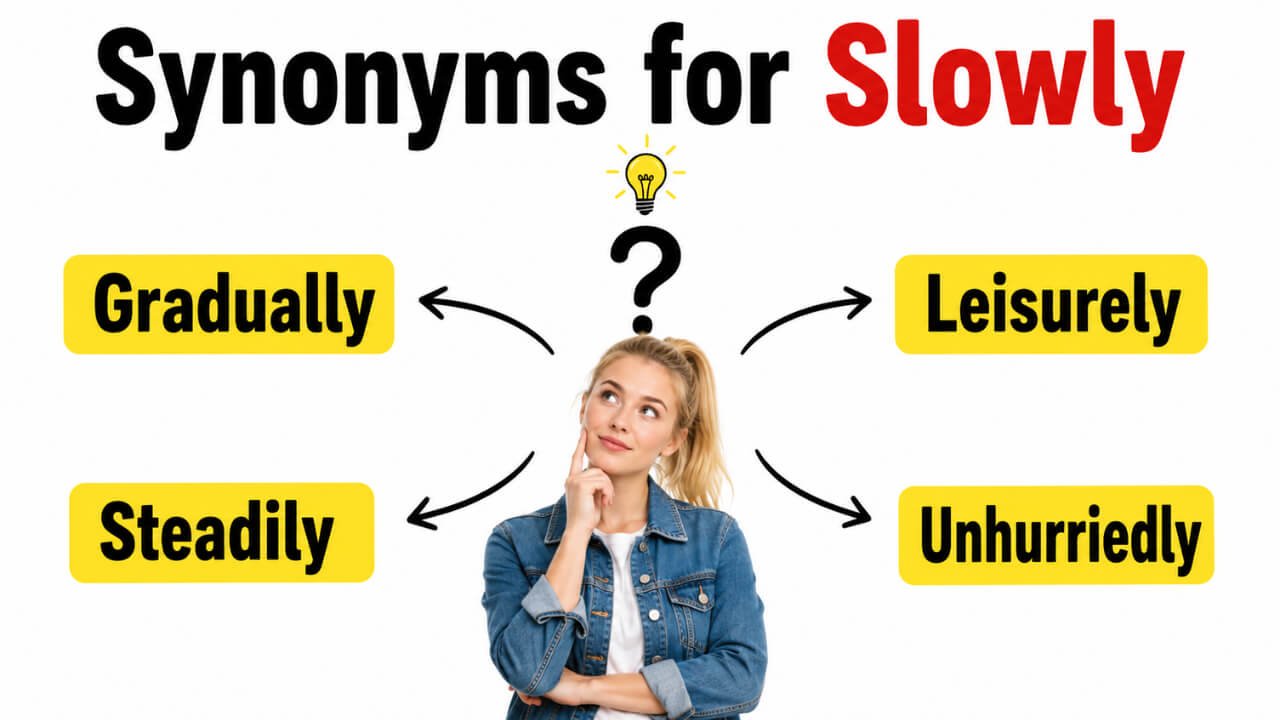
Quick Answer: The best synonyms for slowly are gradually, steadily, unhurriedly, leisurely, gently, deliberately, cautiously, patiently, sluggishly, and methodically. The exact keyword synonyms for slowly covers words for gradual change, relaxed movement, careful action, and delayed progress. Use gradually for change over time, steadily for consistent progress, unhurriedly for calm movement, cautiously for actions requiring care, deliberately for intentional slowness, and sluggishly when the pace is unusually slow or lacking energy.
Pronunciation and Word Details
Word: Slowly
Pronunciation: /ˈsloʊ.li/
Part of Speech: Adverb
Meaning: At a low speed or in a gradual, careful, or unhurried manner.
US Pronunciation:
UK Pronunciation:
What Does “Slowly” Mean?
Slowly means moving, happening, developing, or performing an action at a low speed. It is an adverb because it usually describes how a verb or action occurs.
The word can refer to physical movement, gradual change, careful behavior, speech, thought, or progress. Someone may walk slowly, speak slowly, recover slowly, or slowly understand an idea.
In movement, slowly describes reduced speed. In processes, it suggests that something develops over time. In careful actions, it may show patience or caution. The exact meaning therefore depends on the verb and the surrounding sentence.
Movement: The elderly man walked slowly across the room.
Development: The small business slowly became successful.
Careful Action: She slowly opened the damaged box.
Understanding: He slowly realized that he had made a mistake.
Meaning, Tone, and Context of “Slowly”
Slowly is a neutral and widely used word. It appears naturally in casual conversation, formal writing, instructions, stories, reports, and academic explanations.
Its tone changes according to context. When used with growth or improvement, it can suggest patience and steady progress. When used with movement, it simply describes speed. When used with words such as respond, recover, or work, it may suggest delay or poor performance.
Slowly can sound positive when it shows care, control, or thoughtful progress. It can sound negative when it describes sluggish service, delayed results, or weak movement.
Neutral Tone: The train moved slowly through the station.
Positive Tone: Her confidence slowly improved with practice.
Careful Tone: He slowly removed the glass from the frame.
Negative Tone: The outdated system processed information slowly.
Emotional Tone: She slowly accepted that the friendship had ended.
When and How to Use “Slowly”
For Physical Movement
Use slowly when a person, animal, vehicle, or object moves at a low speed.
Example: The car moved slowly through the crowded street.
For Gradual Change
Use slowly when a condition, feeling, situation, or process changes over time.
Example: The weather slowly became warmer during the afternoon.
For Careful Action
Use slowly when an action requires control, attention, or caution.
Example: Turn the handle slowly to avoid damaging the lock.
For Speech
Use slowly when someone needs to speak at a pace that is easier to understand.
Example: Please speak slowly so that everyone can follow the instructions.
For Progress
Use slowly when improvement or development happens over an extended period.
Example: The patient slowly regained strength after the operation.
For Realization
Use slowly when someone begins to understand or notice something over time.
Example: She slowly realized why the plan had failed.
For Emotional Change
Use slowly when feelings develop, disappear, or become accepted gradually.
Example: His disappointment slowly turned into determination.
For Delayed Performance
Use slowly when a machine, service, person, or process performs below the expected speed.
Example: The computer was running slowly because too many programs were open.
Best Synonyms for Slowly
Gradually
Synonym: Happening in small stages over time.
Example: The pain gradually disappeared after several days.
Steadily
Synonym: Continuing at a regular and consistent pace.
Example: The water level steadily increased throughout the night.
Unhurriedly
Synonym: Moving calmly without rushing.
Example: She walked unhurriedly through the quiet garden.
Leisurely
Synonym: Moving at a relaxed and comfortable pace.
Example: They took a leisurely walk beside the lake.
Gently
Synonym: Acting with soft, controlled, or careful movement.
Example: He gently lowered the child into the chair.
Deliberately
Synonym: Acting slowly because the action is intentional and controlled.
Example: She deliberately placed each document in the correct folder.
Cautiously
Synonym: Acting slowly to avoid danger, risk, or error.
Example: The driver cautiously entered the narrow tunnel.
Patiently
Synonym: Continuing calmly without becoming frustrated by delay.
Example: He patiently worked through each difficult question.
Sluggishly
Synonym: Moving or operating more slowly than normal because of low energy.
Example: The old machine responded sluggishly to every command.
Methodically
Synonym: Working in an organized and careful sequence.
Example: The investigator methodically examined every piece of evidence.
50 Synonyms for Slowly with Short Meanings
- Gradually: In small stages over time.
- Steadily: At a regular and consistent pace.
- Unhurriedly: Without rushing or feeling pressure.
- Leisurely: At a relaxed and comfortable speed.
- Gently: With soft and controlled movement.
- Deliberately: With intentional care and control.
- Carefully: With attention to possible mistakes or danger.
- Cautiously: In a way that avoids risk.
- Methodically: In an organized and systematic manner.
- Patiently: With calm acceptance of delay.
- Sluggishly: With less speed or energy than usual.
- Languidly: With relaxed, weak, or tired movement.
- Lazily: Without much energy or urgency.
- Tardily: Later or more slowly than expected.
- Ploddingly: With slow, heavy, or regular steps.
- Laboriously: With considerable effort and difficulty.
- Ponderously: In a heavy and awkward manner.
- Hesitantly: With pauses caused by uncertainty.
- Reluctantly: Without eagerness or willingness.
- Calmly: Without hurry, fear, or excitement.
- Smoothly: With controlled and even movement.
- Incrementally: Through small increases or changes.
- Progressively: Developing through continuing stages.
- Little by Little: Through many small changes.
- Bit by Bit: One small amount at a time.
- Step by Step: Through an ordered series of stages.
- By Degrees: Gradually rather than suddenly.
- In Stages: Through separate parts of a process.
- Piece by Piece: One part at a time.
- One Step at a Time: Through patient individual actions.
- At a Measured Pace: At a controlled and carefully judged speed.
- At an Easy Pace: At a comfortable speed without pressure.
- At a Gentle Pace: At a soft and relaxed speed.
- At a Steady Pace: At a consistent and controlled speed.
- At a Controlled Pace: At a speed kept under careful control.
- At a Reduced Speed: More slowly than the usual rate.
- At Low Speed: Moving without much speed.
- Without Hurry: Calmly and without rushing.
- In No Rush: Without feeling a need to move quickly.
- Taking Time: Using enough time to act carefully.
- Over Time: Developing during an extended period.
- Over a Long Period: Happening across a considerable length of time.
- In Slow Motion: Moving or appearing to move very slowly.
- At a Crawl: At an extremely low speed.
- At a Snail’s Pace: Extremely slowly.
- Inch by Inch: Through very small amounts of movement or progress.
- In Gradual Stages: Through several slow phases.
- With Measured Steps: With controlled and deliberate movement.
- At a Restrained Pace: At a speed intentionally kept low.
- With Patience: Slowly and calmly without frustration.
Read Also:
Synonyms for The
Synonyms for Slowly by Context
When Slowly Means Gradually
Gradually, incrementally, progressively, by degrees, little by little, and over time describe a change that happens through small stages.
These words work well with improvement, growth, recovery, understanding, development, and emotional change.
Example: Her confidence gradually increased as she gained more experience.
Example: The damaged forest recovered little by little.
Example: Public interest increased progressively during the campaign.
When Slowly Means Without Hurry
Unhurriedly, leisurely, calmly, at an easy pace, and in no rush describe relaxed movement or action.
These alternatives often suggest comfort, peace, or freedom from pressure.
Example: They walked leisurely through the market.
Example: He unhurriedly finished his breakfast before leaving.
Example: She completed the task at an easy pace.
When Slowly Means Carefully
Carefully, cautiously, deliberately, gently, methodically, and at a controlled pace describe slow action caused by attention or concern.
These words work well in instructions, safety guidance, professional procedures, and detailed tasks.
Example: The technician cautiously removed the damaged wire.
Example: She methodically reviewed every paragraph of the report.
Example: He gently placed the glass ornament on the shelf.
When Slowly Means Sluggishly or With Delay
Sluggishly, tardily, laboriously, ploddingly, and at a crawl describe movement or progress that is slower than expected.
These alternatives often carry a negative meaning.
Example: Traffic moved at a crawl during the storm.
Example: The application loaded sluggishly on the old device.
Example: The team advanced ploddingly through the difficult project.
When Slowly Means Through Separate Stages
Step by step, in stages, piece by piece, and one step at a time describe an organized process completed through smaller parts.
Example: The building was restored piece by piece.
Example: The instructor explained the process step by step.
Example: The company introduced the new system in stages.
Another Word for Slowly
Gradually is often the best single replacement for slowly when describing change, progress, growth, recovery, or understanding. However, the strongest alternative depends on the intended meaning.
Use unhurriedly for relaxed movement, cautiously for avoiding risk, steadily for consistent progress, and sluggishly for an unusually low or weak pace.
Original: The sky slowly became darker.
Better Option: The sky gradually became darker.
Original: She slowly walked toward the gate.
Better Option: She walked unhurriedly toward the gate.
Original: He slowly opened the damaged container.
Better Option: He cautiously opened the damaged container.
Original: The business slowly increased its sales.
Better Option: The business steadily increased its sales.
When Not to Use “Slowly”
Slowly is clear and useful, but it can become repetitive or too general. A more specific synonym may explain why an action is slow or how the process develops.
Avoid slowly when the sentence needs to communicate caution, relaxation, consistency, difficulty, or gradual change more precisely.
Weak: The injured dog slowly approached the stranger.
Better: The injured dog cautiously approached the stranger.
Weak: The company slowly expanded into new areas.
Better: The company gradually expanded into new areas.
Weak: The machine slowly responded to each command.
Better: The machine sluggishly responded to each command.
Weak: She slowly examined every financial record.
Better: She methodically examined every financial record.
Slowly may also sound unnecessary when the verb already expresses slow movement.
Weak: The child slowly crept toward the door.
Better: The child crept toward the door.
Creep already suggests slow and quiet movement, so slowly adds little meaning.
Words Commonly Confused With Slowly
Slowly vs Gradually: Slowly describes a low speed, while gradually describes change through small stages. A person may walk slowly, but a situation usually changes gradually.
Slowly vs Steadily: Slowly refers to speed, while steadily refers to consistency. Something can move slowly but steadily without stopping.
Slowly vs Sluggishly: Slowly is neutral, while sluggishly usually suggests low energy, poor performance, or an undesirable delay.
Slowly vs Carefully: Slowly describes speed, while carefully describes attention. A person can work carefully without working slowly.
Slowly vs Leisurely: Slowly is neutral, while leisurely often suggests relaxation, enjoyment, or freedom from urgency.
Slowly vs Deliberately: Slowly describes the pace of an action. Deliberately suggests that the pace or action was intentional.
Slowly vs Cautiously: Slowly describes reduced speed, while cautiously explains that the reduced speed is caused by concern about danger or error.
Slowly vs Tardily: Slowly describes how an action happens. Tardily means that something occurs later than expected.
Which Synonym Should You Choose?
Choose gradually when describing change, growth, recovery, understanding, or development over time.
Choose steadily when progress continues at a regular and consistent pace.
Choose unhurriedly when someone moves calmly and does not feel rushed.
Choose leisurely when the action is relaxed, comfortable, and possibly enjoyable.
Choose cautiously when an action is slow because of danger, uncertainty, or possible error.
Choose deliberately when the slow pace is intentional and controlled.
Choose methodically when someone follows an organized process in a careful order.
Choose gently when the movement is soft and designed to avoid damage or discomfort.
Choose sluggishly when describing poor performance, low energy, or an undesirable lack of speed.
Choose incrementally in reports, essays, technical writing, and discussions of measurable change.
Choose step by step when explaining instructions, procedures, or learning processes.
Choose at a crawl when emphasizing extremely slow traffic, movement, or progress.
Real Life Examples of “Slowly” in Sentences
Original: The river slowly rose after several hours of rain.
Better Option: The river gradually rose after several hours of rain.
Original: The woman slowly crossed the icy road.
Better Option: The woman cautiously crossed the icy road.
Original: The project slowly moved toward completion.
Better Option: The project steadily moved toward completion.
Original: He slowly reviewed the legal documents.
Better Option: He methodically reviewed the legal documents.
Original: The old computer slowly opened the file.
Better Option: The old computer sluggishly opened the file.
Original: The family slowly walked along the beach.
Better Option: The family walked leisurely along the beach.
Original: She slowly placed the sleeping baby in the bed.
Better Option: She gently placed the sleeping baby in the bed.
Original: The student slowly became more confident.
Better Option: The student gradually became more confident.
Original: He slowly explained every stage of the process.
Better Option: He explained every stage of the process step by step.
Original: The workers slowly removed the damaged structure.
Better Option: The workers carefully removed the damaged structure.
Synonym Groups and Usage Differences
Gradual Change Group
Gradually, progressively, incrementally, little by little, and by degrees describe change that happens through small amounts or stages.
Gradually is the most common general option. Incrementally is more formal and often refers to measurable increases. Progressively suggests continued development.
Example: The symptoms gradually became less severe.
Relaxed Pace Group
Unhurriedly, leisurely, calmly, at an easy pace, and in no rush describe actions performed without pressure.
Leisurely often suggests enjoyment, while unhurriedly simply means that someone is not rushing.
Example: The visitors explored the museum at a leisurely pace.
Careful Action Group
Carefully, cautiously, deliberately, gently, and methodically describe slow actions performed with attention.
Cautiously highlights risk, gently highlights softness, and methodically highlights an organized process.
Example: The scientist methodically recorded each result.
Delayed Progress Group
Sluggishly, tardily, laboriously, ploddingly, and at a crawl describe unwanted or difficult slowness.
These words are usually more negative than slowly.
Example: Traffic moved at a crawl near the construction area.
Controlled Movement Group
Steadily, smoothly, at a measured pace, at a controlled pace, and with measured steps describe movement that remains controlled.
Steadily emphasizes consistency, while smoothly emphasizes the absence of sudden interruptions.
Example: The boat moved steadily toward the shore.
Staged Process Group
Step by step, in stages, piece by piece, and one step at a time describe a process divided into manageable parts.
These expressions are useful for instructions, plans, learning, construction, and problem solving.
Example: The team introduced the changes in stages.
Antonyms of Slowly
The opposite of slowly depends on whether the sentence refers to speed, timing, development, or action.
Quickly: At a high speed or within a short time.
Rapidly: At a very fast rate.
Swiftly: With fast and smooth movement.
Speedily: In a quick and efficient manner.
Briskly: At an energetic and active pace.
Promptly: Without unnecessary delay.
Immediately: At once and without waiting.
Suddenly: Quickly and unexpectedly.
Hastily: With too much speed and insufficient care.
Abruptly: Suddenly and sometimes without smoothness.
Energetically: With considerable activity and force.
Instantly: At the exact moment something happens.
Comparison: Slowly vs Related Words
Slowly vs Gradually
Slowly describes an action performed at a low speed. Gradually describes a process that changes in small stages.
Example With Slowly: The bus moved slowly through the narrow street.
Example With Gradually: The street gradually became busier.
Slowly vs Steadily
Slowly focuses on speed. Steadily focuses on regular, continuous movement or progress.
Example With Slowly: The climber moved slowly up the hill.
Example With Steadily: The climber moved steadily without taking a break.
Slowly vs Leisurely
Slowly is neutral and simply describes speed. Leisurely suggests a relaxed and pleasant pace.
Example With Slowly: He slowly walked toward the office.
Example With Leisurely: He took a leisurely walk through the park.
Slowly vs Sluggishly
Slowly is neutral. Sluggishly suggests weak energy, poor performance, or an undesirable delay.
Example With Slowly: The door opened slowly.
Example With Sluggishly: The exhausted athlete moved sluggishly.
Slowly vs Carefully
Slowly refers to reduced speed. Carefully refers to attention and an effort to avoid mistakes.
Example With Slowly: She slowly read the sentence aloud.
Example With Carefully: She carefully checked the sentence for errors.
Slowly vs Cautiously
Slowly describes pace. Cautiously explains that someone acts with concern about possible danger.
Example With Slowly: The driver slowly entered the parking area.
Example With Cautiously: The driver cautiously entered the icy parking area.
Slowly vs Deliberately
Slowly describes how fast something happens. Deliberately suggests that the action or pace is intentional.
Example With Slowly: She slowly closed the book.
Example With Deliberately: She deliberately closed the book to end the discussion.
Common Phrases and Expressions With Slowly
Slowly but Surely: Making reliable progress despite taking considerable time.
Move Slowly: Travel or change position at a low speed.
Walk Slowly: Move on foot without going fast.
Speak Slowly: Talk at a pace that is easy to understand.
Breathe Slowly: Take calm breaths at a controlled pace.
Slowly Changing: Developing into a different condition over time.
Slowly Growing: Increasing gradually in size, amount, or strength.
Slowly Fading: Becoming weaker, lighter, or less noticeable over time.
Slowly Approaching: Coming closer at a low speed.
Slowly Improving: Becoming better through gradual progress.
Slowly Realizing: Beginning to understand something over time.
Slowly Moving Forward: Continuing to make progress at a limited pace.
Common Mistakes to Avoid
One common mistake is repeating slowly several times within the same paragraph. Replace some uses with more precise alternatives such as gradually, cautiously, steadily, or unhurriedly.
Another mistake is choosing a synonym without considering its tone. Sluggishly has a negative meaning and should not replace slowly when the pace is calm or pleasant. Leisurely often sounds relaxed and positive, so it may not suit an emergency or serious delay.
Do not confuse gradual change with slow movement. Gradually works best for development over time, while slowly works naturally with physical actions.
Unnatural: He gradually walked across the room.
Natural: He slowly walked across the room.
Avoid adding slowly when the verb already communicates reduced speed.
Repetitive: The cat slowly crept under the table.
Improved: The cat crept under the table.
Place slowly near the verb it describes so the meaning remains clear.
Unclear: Slowly, she told him that the service was failing.
Clear: She slowly explained why the service was failing.
Finally, avoid vague usage when the reason for the low speed matters. Use cautiously for risk, deliberately for intention, methodically for organization, and sluggishly for poor performance.
Conclusion
The keyword synonyms for slowly includes alternatives for movement, gradual change, careful action, relaxed behavior, and delayed progress. Gradually works best for change over time, steadily for consistent progress, unhurriedly for calm movement, and cautiously for actions involving risk. Deliberately highlights intention, methodically shows an organized process, and sluggishly describes unwanted slowness. Choosing a specific synonym makes a sentence clearer by showing not only that something is slow, but also why it is slow and how the action develops.
FAQs About Synonyms for Slowly
What Is the Best Synonym for Slowly?
Gradually is the best general synonym when describing change over time. For physical movement, unhurriedly or at a measured pace may be more suitable.
What Is a Formal Synonym for Slowly?
Gradually, incrementally, progressively, methodically, and deliberately are useful formal alternatives. The correct choice depends on whether you are describing change, measurement, organization, or intention.
What Is a Casual Way to Say Slowly?
Little by little, bit by bit, at an easy pace, in no rush, and one step at a time are natural casual alternatives.
What Is Another Word for Moving Slowly?
Unhurriedly, leisurely, sluggishly, ploddingly, and at a crawl can describe slow movement. Choose sluggishly or ploddingly when the movement appears weak or difficult.
Is Gradually the Same as Slowly?
Not completely. Slowly refers to low speed, while gradually refers to a change that occurs through small stages over time.
What Word Means Slowly and Carefully?
Cautiously is best when avoiding danger, while methodically suits organized work. Deliberately describes an intentional and controlled action.
What Is the Opposite of Slowly?
Common opposites include quickly, rapidly, swiftly, briskly, promptly, and immediately. The best antonym depends on whether the sentence refers to speed, response time, or sudden change.
