
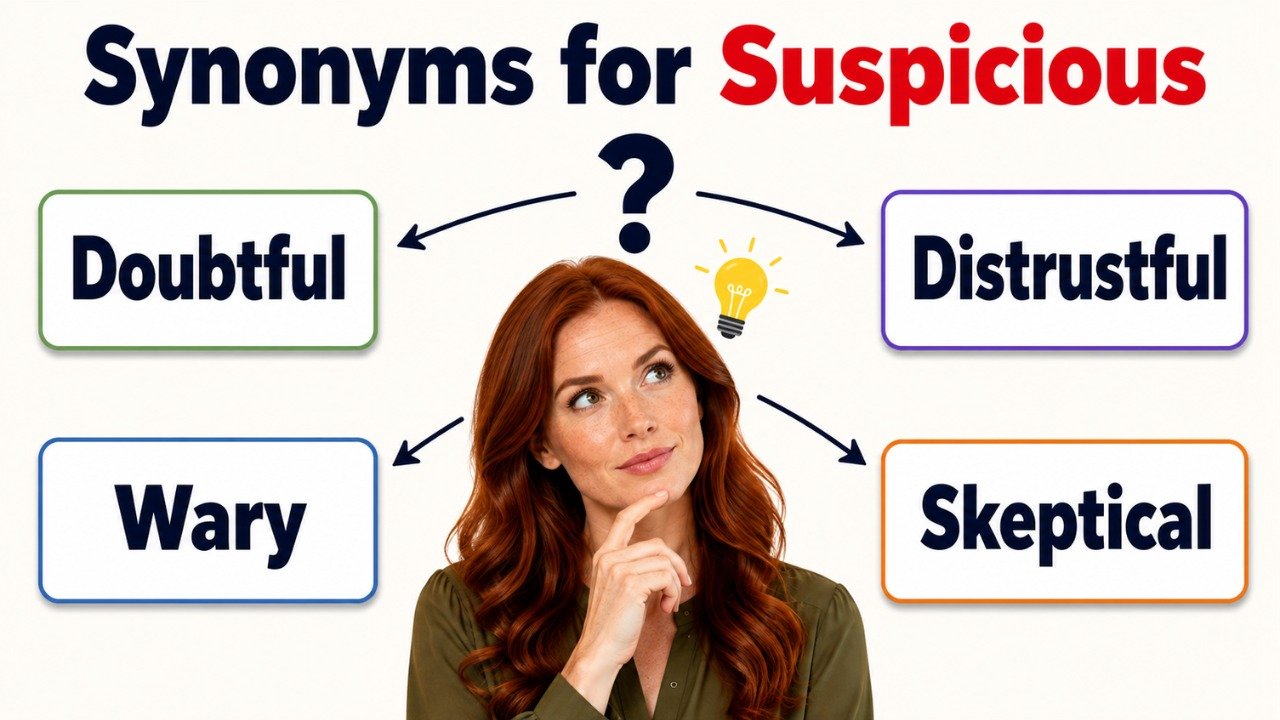
Quick Answer: The best synonyms for suspicious include distrustful, mistrustful, skeptical, doubtful, wary, guarded, suspect, questionable, dubious, and fishy. Use distrustful or mistrustful when a person does not trust someone. Choose skeptical when someone questions whether a claim is true. Wary works best when doubt causes caution. Suspect, questionable, and dubious suit formal reports about something that may be dishonest or unreliable. Fishy and shady are more natural in casual conversation when a situation appears dishonest or strange.
Pronunciation and Word Details
Word: Suspicious.
Pronunciation: /səˈspɪʃəs/.
Part of Speech: Adjective.
Meaning: Feeling distrust toward someone or appearing dishonest, unusual, or likely to involve wrongdoing.
US Pronunciation:
UK Pronunciation:
What Does “Suspicious” Mean?
Suspicious means feeling that someone or something may be dishonest, dangerous, false, or involved in wrongdoing. It can also describe behavior, evidence, activity, or circumstances that create doubt.
Suspicious is an adjective with two closely connected meanings. The first meaning describes a person who does not fully trust someone or something. The second meaning describes something that appears questionable or likely to be wrong.
Feeling Distrust: She became suspicious when his explanation changed.
Causing Doubt: The sudden transfer of money looked suspicious.
Describing Behavior: His secretive behavior seemed suspicious.
Describing Evidence: Investigators found a suspicious document in the file.
Describing Circumstances: The timing of the disappearance was suspicious.
Suspicious can be followed by different structures depending on the intended meaning.
Suspicious Of: She was suspicious of the unfamiliar caller.
Suspicious About: He felt suspicious about the unexpected offer.
Suspicious That: They were suspicious that important details had been hidden.
The word usually carries a negative meaning because it suggests possible dishonesty, danger, or wrongdoing. However, it does not prove that anything wrong has actually happened.
Meaning, Tone, and Context of “Suspicious”
Suspicious has a cautious, doubtful, and often negative tone. It communicates that something does not seem trustworthy, normal, or fully explained.
The word is common in everyday conversation, formal reports, news writing, workplace communication, crime writing, safety instructions, financial discussions, and academic analysis.
Conversational Tone: Suspicious is common and natural in ordinary speech.
Formal Tone: It can be used in reports, investigations, essays, and professional communication.
Emotional Tone: It may express fear, concern, distrust, or uncertainty.
Polite Tone: The word can sound accusatory when used directly about a person.
Legal Context: It may describe activity or circumstances that deserve further examination, but it does not establish guilt.
Financial Context: It often describes unusual transactions, unexplained payments, or questionable records.
Workplace Context: It may refer to inconsistent information, unusual behavior, or possible policy violations.
Personal Context: It can describe doubt about another person’s motives, promises, or explanation.
Technical Context: Security systems may identify unusual patterns as suspicious when those patterns differ from normal activity.
Suspicious is stronger than uncertain because it suggests a possible reason for distrust. It is less definite than guilty, dishonest, or fraudulent because it expresses doubt rather than a proven conclusion.
When and How to Use “Suspicious”
For Distrusting a Person
Use suspicious when someone doubts another person’s honesty, motives, or intentions.
Example: The customer became suspicious when the seller refused to provide basic information.
For Questioning a Claim
Use suspicious when a statement seems incomplete, inconsistent, exaggerated, or false.
Example: She was suspicious of his claim that he had never seen the document.
For Unusual Behavior
Use suspicious when someone acts secretly, nervously, or differently from what is expected.
Example: His repeated visits to the locked office appeared suspicious.
For Questionable Activity
Use suspicious when an action may involve dishonesty, danger, or wrongdoing.
Example: The manager reported suspicious activity near the storage area.
For Unexplained Financial Records
Use suspicious when a payment, withdrawal, transfer, or account change appears unusual.
Example: The auditor noticed several suspicious transactions in the monthly records.
For Doubtful Circumstances
Use suspicious when the timing, location, or surrounding details of an event create concern.
Example: The sudden cancellation under suspicious circumstances raised further questions.
For Safety Concerns
Use suspicious when an object, message, visitor, or situation may present a risk.
Example: Staff were instructed to report any suspicious package immediately.
For Inconsistent Evidence
Use suspicious when information does not match known facts or expected patterns.
Example: The altered dates on the form looked suspicious.
For Questionable Motives
Use suspicious when someone’s reasons for acting appear selfish, dishonest, or hidden.
Example: She was suspicious of his sudden interest in the family property.
For Cautious Uncertainty
Use suspicious when there is enough concern to investigate but not enough evidence to reach a firm conclusion.
Example: The circumstances were suspicious, but no final judgment was made.
Best Synonyms for Suspicious
Distrustful
Synonym: Unwilling to trust someone or something.
Example: The distrustful customer carefully checked every detail of the agreement.
Mistrustful
Synonym: Doubting another person’s honesty, reliability, or intentions.
Example: She remained mistrustful after hearing several conflicting explanations.
Skeptical
Synonym: Not easily convinced that a claim or idea is true.
Example: The committee was skeptical of the unusually optimistic forecast.
Doubtful
Synonym: Uncertain that something is true, reliable, or likely.
Example: He was doubtful about the accuracy of the report.
Wary
Synonym: Careful because something may be dangerous, dishonest, or unreliable.
Example: Buyers should be wary of offers that promise unrealistic results.
Guarded
Synonym: Cautious and unwilling to trust or reveal too much.
Example: She gave a guarded response when asked about the missing records.
Suspect
Synonym: Believed to be questionable, unreliable, or possibly connected with wrongdoing.
Example: The inspector examined several suspect documents.
Questionable
Synonym: Open to doubt because something may be dishonest, incorrect, or unsuitable.
Example: The company used questionable methods to increase its reported earnings.
Dubious
Synonym: Uncertain, doubtful, or not likely to be trustworthy.
Example: The witness provided a dubious explanation for his absence.
Fishy
Synonym: Informally appearing dishonest, strange, or difficult to believe.
Example: Something seemed fishy about the unexpected request for cash.
50 Synonyms for Suspicious With Short Meanings
- Distrustful: Unwilling to trust someone or something.
- Mistrustful: Doubting another person’s honesty or intentions.
- Skeptical: Unconvinced that a statement or claim is true.
- Doubtful: Feeling uncertain about truth, reliability, or probability.
- Wary: Cautious because of possible danger or dishonesty.
- Cautious: Careful to avoid risk, harm, or deception.
- Guarded: Careful about trusting others or revealing information.
- Questioning: Showing doubt and seeking further explanation.
- Unconvinced: Not persuaded that something is true or reliable.
- Incredulous: Unwilling or unable to believe something.
- Apprehensive: Worried that something unpleasant may happen.
- Uneasy: Feeling uncertain, uncomfortable, or concerned.
- Uncertain: Not confident about what is true or likely.
- Hesitant: Slow to believe or act because of doubt.
- Leery: Informally cautious and unwilling to trust.
- Watchful: Carefully observing for possible danger or wrongdoing.
- Vigilant: Alert to possible risk, deception, or trouble.
- Alert: Ready to notice unusual or dangerous activity.
- Concerned: Worried that something may be wrong.
- Cynical: Inclined to doubt the honesty of people’s motives.
- Suspect: Believed to be questionable or possibly improper.
- Questionable: Open to doubt or criticism.
- Dubious: Not clearly trustworthy, reliable, or believable.
- Fishy: Informally appearing dishonest or strange.
- Shady: Informally dishonest, secretive, or questionable.
- Strange: Unusual in a way that may cause concern.
- Odd: Different from what is expected or normal.
- Unusual: Not ordinary and possibly deserving attention.
- Irregular: Not following the normal pattern, rule, or process.
- Peculiar: Unusually strange or difficult to explain.
- Curious: Strange or unexpected in a way that invites questions.
- Troubling: Causing worry, doubt, or concern.
- Concerning: Creating unease or a reason for caution.
- Alarming: Causing fear or serious concern.
- Incriminating: Suggesting possible involvement in wrongdoing.
- Compromising: Likely to create doubt about honesty or reputation.
- Deceptive: Intended to create a false belief.
- Dishonest: Not truthful, fair, or trustworthy.
- Fraudulent: Involving deliberate deception for personal gain.
- Misleading: Giving a false or inaccurate impression.
- Secretive: Hiding information or actions from others.
- Evasive: Avoiding a clear or direct answer.
- Furtive: Acting secretly to avoid being noticed.
- Sneaky: Informally behaving secretly or dishonestly.
- Underhanded: Dishonest and deliberately secretive.
- Covert: Hidden or carried out secretly.
- Clandestine: Secret and often connected with improper activity.
- Unexplained: Not supported by a clear or satisfactory reason.
- Implausible: Difficult to believe because it seems unlikely.
- Untrustworthy: Not deserving confidence or trust.
Read Also:
Synonyms for Progress

Synonyms for Suspicious by Context
When Suspicious Means Distrustful
Distrustful, mistrustful, leery, wary, and guarded describe a person who does not fully trust someone or something.
Distrustful is direct and widely understood. Mistrustful often suggests doubt based on previous experience. Leery is informal, while guarded suggests careful behavior rather than open accusation.
Example: She remained distrustful after discovering several errors in the agreement.
Example: The residents were leery of the stranger’s unexpected questions.
When Suspicious Means Skeptical
Skeptical, doubtful, questioning, unconvinced, incredulous, and uncertain describe doubt about a claim, explanation, prediction, or idea.
Skeptical is useful in essays, reports, and professional communication. Incredulous is stronger and suggests that something is extremely difficult to believe.
Example: The researchers were skeptical of conclusions based on such limited evidence.
Example: He looked incredulous when told that the records had disappeared.
When Suspicious Means Cautious
Wary, cautious, watchful, vigilant, alert, apprehensive, and guarded describe a careful response to possible risk.
Wary combines distrust with caution. Vigilant suggests active observation. Apprehensive focuses more on worry about what may happen.
Example: Customers became wary after receiving several unusual messages.
Example: Security staff remained vigilant throughout the event.
When Suspicious Means Questionable
Suspect, questionable, dubious, irregular, unexplained, and implausible describe information or activity that may not be reliable or proper.
Suspect is concise and formal. Questionable is broad and may describe ethics, accuracy, legality, or quality. Dubious suggests serious doubt about credibility.
Example: The auditor identified several suspect payments.
Example: The report depended on dubious evidence.
When Suspicious Means Strange
Strange, odd, unusual, peculiar, curious, troubling, and concerning describe something that differs from normal expectations.
These words are often less accusatory than suspicious. They work well when the cause of concern is unclear.
Example: The sudden change in his schedule seemed odd.
Example: Investigators noticed a peculiar pattern in the records.
When Suspicious Means Secretive
Secretive, evasive, furtive, sneaky, covert, and clandestine describe actions that are hidden or deliberately difficult to observe.
Secretive does not always mean dishonest. Evasive focuses on avoiding questions. Furtive suggests secret movement or behavior caused by fear of being noticed.
Example: His evasive answers increased their concern.
Example: The visitor made a furtive attempt to enter the restricted room.
When Suspicious Means Dishonest
Shady, deceptive, dishonest, fraudulent, misleading, and underhanded describe conduct that appears deliberately unfair or false.
Shady is informal. Fraudulent is strong and should be used when deliberate deception is established or clearly being discussed. Underhanded describes secret and unfair methods.
Example: The advertisement used misleading language.
Example: They questioned the company’s underhanded sales practices.
When Suspicious Means Connected With Wrongdoing
Incriminating, compromising, suspect, alarming, and troubling describe evidence or circumstances that may connect someone with improper conduct.
Incriminating is stronger than suspicious because it suggests evidence that points toward involvement.
Example: Investigators discovered an incriminating message in the file.
Example: The unexplained payments created troubling questions.
Another Word for Suspicious
Distrustful is often the best single replacement for suspicious when describing a person who does not trust someone. Questionable is often the best choice when describing an action, claim, method, or situation that creates doubt.
The best alternative depends on whether suspicious describes a feeling or something that causes concern. Use skeptical for doubtful thinking, wary for cautious distrust, suspect for formal investigation, and fishy for casual speech.
Original: She was suspicious of the caller’s intentions.
Better Option: She was distrustful of the caller’s intentions.
Original: The committee was suspicious of the proposed figures.
Better Option: The committee was skeptical of the proposed figures.
Original: Several suspicious payments appeared in the account.
Better Option: Several questionable payments appeared in the account.
Original: His explanation sounded suspicious.
Better Option: His explanation sounded dubious.
When Not to Use “Suspicious”
Do not use suspicious when a more precise word can describe the exact type of doubt, risk, dishonesty, or unusual behavior.
When You Mean Simple Uncertainty
Suspicious suggests possible dishonesty or wrongdoing. Uncertain is better when someone simply does not know the answer.
Weak: I am suspicious about whether the meeting begins at nine.
Better: I am uncertain whether the meeting begins at nine.
When You Mean Healthy Skepticism
Skeptical may be more neutral in academic, scientific, or professional writing.
Weak: The reviewers were suspicious of the unsupported conclusion.
Better: The reviewers were skeptical of the unsupported conclusion.
When You Mean Cautious
A cautious person may be careful without distrusting anyone.
Weak: She was suspicious while crossing the icy path.
Better: She was cautious while crossing the icy path.
When Something Is Merely Unusual
Do not imply wrongdoing when an event is only uncommon or unexpected.
Weak: The bird’s unusual color was suspicious.
Better: The bird’s unusual color was remarkable.
When Dishonesty Has Been Proven
Suspicious may be too weak if clear evidence already establishes deception.
Weak: The verified false invoices were suspicious.
Better: The verified false invoices were fraudulent.
When Writing a Polite Message
Directly calling someone suspicious may sound insulting or accusatory. Describe the concern instead.
Weak: Your behavior is suspicious.
Better: Some parts of the situation remain unclear and require further explanation.
When Describing a Person Under Investigation
A suspicious person and a suspect are not always the same. A suspicious person may be someone who distrusts others or someone whose behavior seems questionable. A suspect is a person believed to be connected with an offense.
Weak: Officers questioned the suspicious.
Better: Officers questioned the suspect.
Words Commonly Confused With Suspicious
Suspicious vs Skeptical: Suspicious suggests distrust and possible wrongdoing. Skeptical means unconvinced and often applies to ideas, claims, evidence, or predictions.
Suspicious vs Suspect: Suspicious is an adjective. Suspect can be an adjective, verb, or noun. A suspicious action creates doubt, while a suspect may be a person believed to be involved in wrongdoing.
Suspicious vs Doubtful: Suspicious often includes concern about dishonesty or danger. Doubtful mainly expresses uncertainty about truth, quality, or likelihood.
Suspicious vs Wary: Suspicious describes distrust. Wary describes caution caused by possible risk or distrust.
Suspicious vs Cautious: Cautious means careful to avoid danger or mistakes. A person can be cautious without believing that anyone is dishonest.
Suspicious vs Paranoid: Suspicious can describe reasonable doubt based on circumstances. Paranoid is much stronger and may suggest extreme or unreasonable distrust. It should not be used casually to describe a medical condition.
Suspicious vs Incriminating: Suspicious evidence creates concern. Incriminating evidence more directly suggests involvement in wrongdoing.
Suspicious vs Questionable: Suspicious often suggests hidden dishonesty or danger. Questionable is broader and can describe doubtful quality, accuracy, ethics, or suitability.
Suspicious vs Shady: Suspicious is neutral enough for formal and casual use. Shady is informal and strongly suggests dishonest or secretive conduct.
Suspicious vs Secretive: Secretive means unwilling to share information. Secretive behavior may appear suspicious, but privacy alone does not prove dishonesty.
Which Synonym Should You Choose?
Choose distrustful when a person is unwilling to trust someone’s character, motives, or promises.
Choose mistrustful when doubt has developed through experience or repeated disappointment.
Choose skeptical when evaluating claims, arguments, research, predictions, or unsupported statements.
Choose doubtful when you are uncertain about truth, quality, success, or probability.
Choose wary when distrust leads to careful behavior.
Choose cautious when the main idea is avoiding risk rather than questioning honesty.
Choose guarded when someone is careful about speaking, trusting, or revealing information.
Choose leery in casual conversation when someone feels reluctant to trust a person or offer.
Choose suspect in formal reports when an object, document, payment, or activity may be improper.
Choose questionable when discussing doubtful ethics, accuracy, quality, or methods.
Choose dubious when a statement, explanation, source, or claim is difficult to trust.
Choose fishy in casual speech when a situation seems dishonest or strange.
Choose shady in informal conversation when behavior appears secretive or dishonest.
Choose irregular in reports when records, procedures, or transactions do not follow the expected pattern.
Choose unexplained when the central problem is the absence of a clear reason.
Choose implausible when a story or explanation is difficult to believe.
Choose evasive when someone avoids answering a direct question.
Choose furtive when someone moves or acts secretly to avoid attention.
Choose deceptive when an action or message is intended to create a false belief.
Choose fraudulent when deliberate deception for gain has been established.
Choose incriminating when evidence suggests a connection with wrongdoing.
In formal essays and reports, skeptical, questionable, dubious, suspect, irregular, and unexplained are often precise choices. In emails, use cautious language such as concerning, unclear, or questionable to avoid making an unsupported accusation. In casual conversation, fishy, shady, leery, and odd may sound more natural.
Real Life Examples of “Suspicious” in Sentences
Original: She became suspicious when the caller requested private information.
Better Option: She became wary when the caller requested private information.
Original: The manager was suspicious of the unusually high expense claim.
Better Option: The manager was skeptical of the unusually high expense claim.
Original: Several suspicious payments appeared in the account.
Better Option: Several irregular payments appeared in the account.
Original: His suspicious explanation did not match the available evidence.
Better Option: His dubious explanation did not match the available evidence.
Original: The neighbor noticed suspicious behavior near the empty house.
Better Option: The neighbor noticed furtive behavior near the empty house.
Original: The suspicious offer promised a large reward without any clear conditions.
Better Option: The questionable offer promised a large reward without any clear conditions.
Original: She gave him a suspicious look after hearing his excuse.
Better Option: She gave him a doubtful look after hearing his excuse.
Original: The auditor found a suspicious change in the financial records.
Better Option: The auditor found an unexplained change in the financial records.
Original: His sudden interest in the confidential file seemed suspicious.
Better Option: His sudden interest in the confidential file seemed concerning.
Original: The witness gave a suspicious answer to a simple question.
Better Option: The witness gave an evasive answer to a simple question.
Synonym Groups and Usage Differences
Distrust Group
Distrustful, mistrustful, leery, cynical, and guarded describe a lack of trust in people, motives, or promises.
Distrustful is direct. Mistrustful often reflects previous experience. Cynical suggests a general belief that people act from selfish motives.
Example: Years of broken promises made the residents mistrustful of new proposals.
Doubt Group
Skeptical, doubtful, questioning, unconvinced, incredulous, and uncertain describe a lack of belief in information or claims.
Skeptical is often thoughtful and evidence based. Incredulous expresses much stronger disbelief.
Example: The panel remained skeptical because the report contained no supporting evidence.
Caution Group
Wary, cautious, vigilant, watchful, alert, apprehensive, and guarded emphasize careful behavior.
Wary combines caution with distrust. Vigilant and watchful focus on active observation.
Example: Staff remained vigilant after several unexplained security alerts.
Questionable Appearance Group
Suspect, questionable, dubious, irregular, unexplained, implausible, and peculiar describe something that creates doubt.
Suspect often appears in formal reports. Implausible is best for explanations that seem unlikely.
Example: The inspector identified an irregular pattern in the submitted records.
Strange Circumstances Group
Odd, strange, unusual, curious, peculiar, troubling, and concerning describe events that differ from normal expectations.
These words can raise questions without directly accusing anyone of dishonesty.
Example: The unusual timing of the request caused concern.
Secrecy Group
Secretive, evasive, furtive, sneaky, covert, and clandestine describe hidden actions or information.
Evasive applies to indirect answers. Furtive describes secret behavior intended to avoid notice. Clandestine often describes carefully planned secrecy.
Example: His evasive response made the committee ask further questions.
Dishonesty Group
Deceptive, dishonest, misleading, fraudulent, shady, and underhanded describe false or unfair conduct.
Deceptive and misleading focus on creating a false impression. Fraudulent is stronger and involves deliberate deception.
Example: The advertisement contained misleading claims about the product’s performance.
Evidence Group
Incriminating, compromising, alarming, troubling, and suspect describe evidence or details that may point toward a serious problem.
Incriminating is the strongest because it suggests a connection with wrongdoing.
Example: The deleted message contained incriminating details.
Antonyms of Suspicious
The opposite of suspicious depends on whether the word describes a person’s feelings or the appearance of a situation.
Trusting: Willing to believe that someone is honest and reliable.
Confident: Feeling certain about a person, claim, or situation.
Convinced: Fully persuaded that something is true.
Certain: Having no meaningful doubt.
Unsuspecting: Not expecting danger, dishonesty, or wrongdoing.
Assured: Feeling secure and free from doubt.
Reassured: Made less worried or doubtful.
Credulous: Too willing to believe something without enough evidence.
Open: Honest and willing to share information.
Transparent: Easy to understand and not deliberately hidden.
Straightforward: Clear, direct, and honest.
Honest: Truthful and free from deception.
Trustworthy: Deserving confidence and trust.
Reliable: Consistently accurate, dependable, or honest.
Credible: Believable and supported by reasonable evidence.
Legitimate: Lawful, genuine, and acceptable.
Innocent: Not involved in wrongdoing.
Ordinary: Normal and not likely to create concern.
Reassuring: Making someone feel safer or more confident.
Aboveboard: Open, honest, and conducted properly.
Comparison: Suspicious vs Related Words
Suspicious vs Distrustful
Suspicious may describe a person’s feeling or something that causes concern. Distrustful describes a person who is unwilling to trust.
Example With Suspicious: She was suspicious of the sudden offer.
Example With Distrustful: She was distrustful of people who made unrealistic promises.
Suspicious vs Skeptical
Suspicious suggests possible dishonesty, danger, or hidden motives. Skeptical expresses doubt about whether a claim is true.
Example With Suspicious: The officer found the driver’s behavior suspicious.
Example With Skeptical: The researcher was skeptical of the unsupported conclusion.
Suspicious vs Wary
Suspicious focuses on distrust. Wary focuses on careful behavior caused by possible risk.
Example With Suspicious: He was suspicious of the unfamiliar visitor.
Example With Wary: He remained wary and refused to reveal personal information.
Suspicious vs Doubtful
Suspicious suggests that something may be wrong or dishonest. Doubtful simply means uncertain or unconvinced.
Example With Suspicious: The altered signature looked suspicious.
Example With Doubtful: She was doubtful that the event would begin on time.
Suspicious vs Questionable
Suspicious commonly suggests possible wrongdoing. Questionable can refer to doubtful quality, accuracy, ethics, or suitability.
Example With Suspicious: The unexplained payment appeared suspicious.
Example With Questionable: The report relied on questionable research methods.
Suspicious vs Dubious
Suspicious suggests concern about behavior or circumstances. Dubious often describes something that is difficult to believe or trust.
Example With Suspicious: The timing of the request seemed suspicious.
Example With Dubious: The witness offered a dubious explanation.
Suspicious vs Fishy
Suspicious works in formal and casual communication. Fishy is informal and often describes a situation that feels dishonest or strange.
Example With Suspicious: The transaction appeared suspicious.
Example With Fishy: Something seemed fishy about the request for immediate cash.
Suspicious vs Shady
Suspicious expresses doubt. Shady more strongly suggests dishonest, secretive, or improper behavior.
Example With Suspicious: The agreement contained several suspicious conditions.
Example With Shady: The seller used shady methods to pressure customers.
Suspicious vs Incriminating
Suspicious evidence creates concern but may not prove anything. Incriminating evidence more directly suggests involvement in wrongdoing.
Example With Suspicious: The unexplained receipt was suspicious.
Example With Incriminating: The message contained incriminating details about the plan.
Suspicious vs Secretive
Suspicious describes doubt or questionable appearances. Secretive describes a person who hides information or avoids openness.
Example With Suspicious: His sudden disappearance seemed suspicious.
Example With Secretive: He became secretive whenever anyone asked about the project.
Common Phrases and Expressions With Suspicious
Suspicious Activity: Behavior that may involve danger, dishonesty, or wrongdoing.
Suspicious Behavior: Conduct that appears unusual, secretive, or improper.
Suspicious Circumstances: Conditions surrounding an event that create doubt.
Suspicious Person: Someone whose behavior appears questionable or who tends to distrust others.
Suspicious Package: An object that appears unusual and may present a safety risk.
Suspicious Transaction: A financial action that differs from normal activity or raises concerns.
Suspicious Movement: An action that appears secretive, unusual, or threatening.
Suspicious Look: A facial expression showing doubt or distrust.
Suspicious Timing: The occurrence of an event at a moment that raises questions.
Suspicious Silence: An unusual lack of communication that creates concern.
Suspicious Of Someone: Unwilling to trust a particular person.
Highly Suspicious: Causing a strong level of doubt or concern.
Common Mistakes to Avoid
Confusing Suspicious With Suspect
Suspicious is usually an adjective. Suspect can be a noun, verb, or adjective.
Incorrect: The police interviewed a suspicious in the case.
Correct: The police interviewed a suspect in the case.
Using Suspicious When You Mean Skeptical
Skeptical is often better for ideas, theories, claims, and research conclusions.
Less Precise: The professor was suspicious of the theory.
More Precise: The professor was skeptical of the theory.
Using Suspicious for Ordinary Caution
Not every careful action shows distrust.
Incorrect: He was suspicious when he checked the weather before traveling.
Correct: He was cautious and checked the weather before traveling.
Making an Unsupported Accusation
Suspicious can imply possible dishonesty or wrongdoing. In professional communication, describe the specific facts instead of attacking a person’s character.
Vague: The employee is suspicious.
Clearer: The employee submitted records that contain several unexplained differences.
Repeating Suspicious Too Often
Frequent repetition makes writing sound vague. Choose words that identify the exact concern.
Repetitive: The suspicious visitor made a suspicious request under suspicious circumstances.
Improved: The unfamiliar visitor made a questionable request under unusual circumstances.
Choosing an Overly Strong Synonym
Fraudulent, incriminating, and dishonest are stronger than suspicious. Do not use them unless the context supports that conclusion.
Weak Choice: The unexplained error was fraudulent.
Better Choice: The unexplained error was suspicious and required investigation.
Using Fishy in Formal Reports
Fishy is informal and may sound unprofessional in reports, essays, or official communication.
Informal: The account activity looked fishy.
Formal: The account activity appeared irregular.
Confusing Suspicious With Paranoid
Paranoid is much stronger and may refer to extreme or unreasonable distrust. Avoid using it casually when suspicious, wary, or anxious would be accurate.
Unfair: She was paranoid because she checked the agreement carefully.
Better: She was cautious because she wanted to understand the agreement.
Using the Wrong Preposition
Suspicious is commonly followed by of, about, or that.
Correct With Of: She was suspicious of the caller.
Correct With About: He felt suspicious about the unexpected change.
Correct With That: They were suspicious that information had been removed.
Incorrect: She was suspicious on the caller.
Forgetting the Two Meanings
Suspicious can describe the person feeling doubt or the thing creating doubt.
Person Feeling Doubt: The customer was suspicious.
Situation Creating Doubt: The payment was suspicious.
The surrounding sentence should make the intended meaning clear.
Conclusion
The most suitable synonyms for suspicious depend on whether the word describes distrust, doubt, caution, secrecy, or questionable behavior. Distrustful and mistrustful suit personal doubt, while skeptical works well for claims and ideas. Wary emphasizes caution, and suspect, questionable, or dubious fit formal descriptions of uncertain activity. Fishy and shady are better for casual speech. Choosing a precise alternative makes writing clearer and prevents an unsupported concern from sounding like a proven accusation.
FAQs About Synonyms for Suspicious
What Is the Best Synonym for Suspicious?
Distrustful is a strong replacement when a person does not trust someone. Questionable is often better when an action, claim, or situation creates doubt.
What Is a Formal Synonym for Suspicious?
Suspect, questionable, dubious, irregular, concerning, and unexplained are useful formal alternatives. The correct choice depends on the source of the concern.
What Is a Casual Synonym for Suspicious?
Fishy, shady, odd, and leery are common casual alternatives. Fishy usually describes a questionable situation, while leery describes a cautious person.
Is Skeptical the Same as Suspicious?
Not exactly. Skeptical means unconvinced that something is true. Suspicious suggests possible dishonesty, danger, or hidden motives.
What Is the Difference Between Suspicious and Distrustful?
Suspicious can describe a feeling or a questionable situation. Distrustful specifically describes someone who is unwilling to trust.
What Word Describes Suspicious Behavior?
Questionable, shady, furtive, evasive, secretive, underhanded, and deceptive can describe suspicious behavior. Choose the word that identifies the exact action.
What Is the Opposite of Suspicious?
Trusting is the clearest opposite when describing a person. Credible, trustworthy, transparent, honest, and legitimate are useful opposites when describing information or behavior.
