
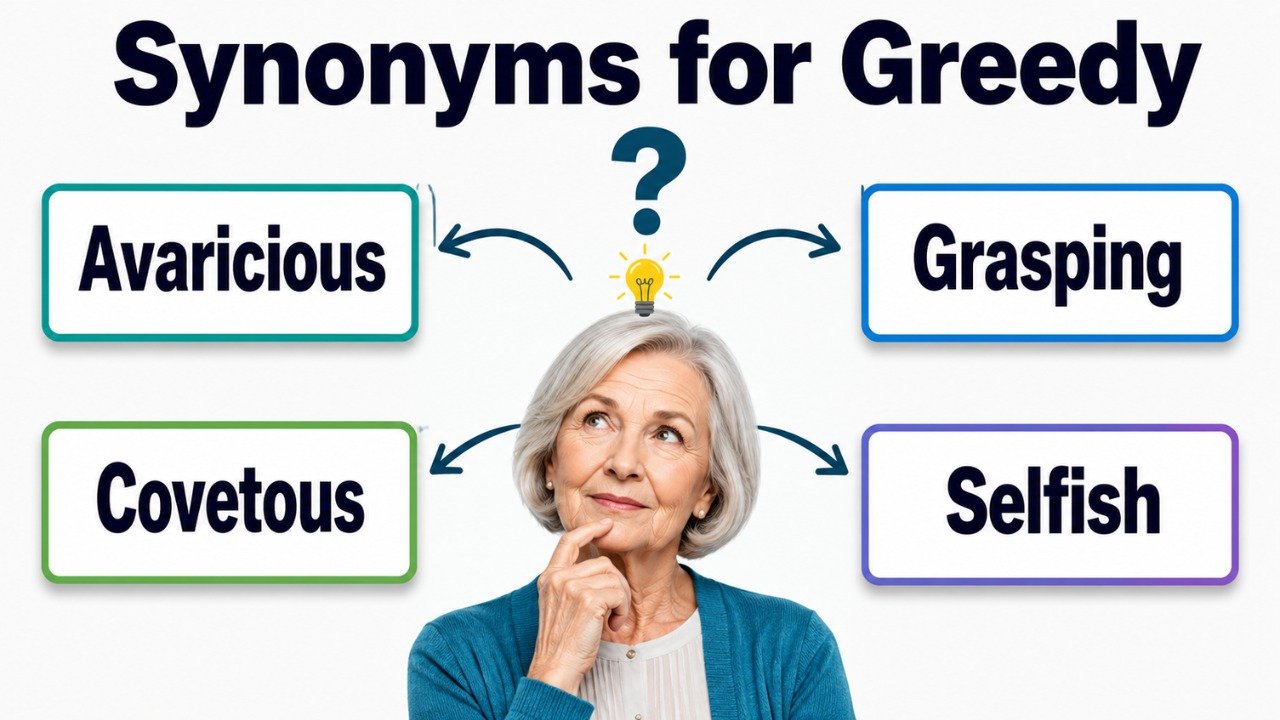
Quick Answer: The best synonyms for greedy include avaricious, covetous, grasping, acquisitive, rapacious, materialistic, mercenary, selfish, insatiable, and voracious. Use avaricious or rapacious in formal writing about excessive desire for wealth. Use covetous for wanting another person’s possessions. Grasping describes someone who constantly tries to gain more. Materialistic suits a strong focus on money and possessions, while voracious and gluttonous are better for excessive hunger or consumption.
Pronunciation and Word Details
Word: Greedy.
Pronunciation: /ˈɡriːdi/.
Part of Speech: Adjective.
Meaning: Having an excessive desire for money, possessions, food, power, attention, or more than one reasonably needs.
US Pronunciation:
UK Pronunciation:
What Does “Greedy” Mean?
Greedy means wanting more money, possessions, food, power, attention, or advantage than is fair or necessary. It is an adjective and usually expresses criticism or disapproval.
A greedy person may refuse to share, take more than a fair amount, or continue seeking personal gain even when others are harmed. The word can describe a person, behavior, appetite, business decision, demand, or desire.
Person: The greedy investor wanted every available share.
Behavior: Taking all the supplies was greedy.
Appetite: The child gave the cake a greedy look.
Desire: His greedy pursuit of power damaged his relationships.
Greedy can also be used in a technical context. A greedy method chooses the option that appears most beneficial at the present moment, even if it may not create the best final result.
Meaning, Tone, and Context of “Greedy”
Greedy normally has a strong negative tone. It suggests that someone wants an unfair, excessive, or unreasonable amount of something.
The word is common in everyday conversation, news writing, essays, stories, workplace discussions, and moral arguments. It is understandable in both casual and formal communication, although more precise synonyms may be better in academic or professional writing.
Casual Tone: Greedy is direct, familiar, and easy to understand.
Formal Tone: Avaricious, acquisitive, rapacious, and mercenary may sound more suitable in formal writing.
Emotional Tone: Greedy often expresses anger, disappointment, or moral criticism.
Financial Context: It may describe an excessive desire for money, profit, or possessions.
Food Context: It may describe eating too much or showing an excessive appetite.
Power Context: It may describe someone who wants increasing control, status, or authority.
Social Context: It may describe someone who demands too much praise, attention, or recognition.
Because greedy is strongly judgmental, it should be used carefully when describing real people. A more specific word may communicate the intended criticism more accurately.
When and How to Use “Greedy”
For Excessive Desire for Money
Use greedy when someone places personal wealth above fairness, honesty, or the needs of others.
Example: The greedy landlord continued raising the rent without improving the building.
For Wanting Too Many Possessions
Use greedy when a person keeps collecting or taking things despite already having enough.
Example: He became greedy and refused to share any of the inherited property.
For Excessive Eating
Use greedy when someone eats more than a reasonable amount or rushes to take the largest portion.
Example: Do not be greedy and take the last three slices of cake.
For Power and Control
Use greedy when someone continually seeks greater authority or influence.
Example: The greedy ruler wanted complete control over every region.
For Attention and Praise
Use greedy when a person wants an unreasonable amount of recognition or admiration.
Example: She appeared greedy for praise and ignored the rest of the team’s contribution.
For Unfair Advantage
Use greedy when someone takes more than a fair share of an opportunity, reward, or resource.
Example: The company’s greedy attempt to control the entire market created public criticism.
For Strong Appetite
Use greedy figuratively for an intense desire to consume information, experiences, or resources.
Example: He was a greedy reader who completed several books each week.
In this positive looking example, greedy still suggests unusually intense consumption. Voracious would usually be more natural and less critical.
For Technical Decision Making
Use greedy to describe a method that selects the most attractive immediate option at each stage.
Example: The program uses a greedy strategy to choose the quickest available route.
Best Synonyms for Greedy
Avaricious
Synonym: Having an extreme desire for money or wealth.
Example: The avaricious merchant valued profit more than fairness.
Covetous
Synonym: Strongly desiring something that belongs to another person.
Example: He cast a covetous glance at his neighbor’s valuable collection.
Grasping
Synonym: Continually trying to obtain more money, power, or advantage.
Example: The grasping executive demanded a larger share of the profits.
Acquisitive
Synonym: Eager to obtain and possess money, property, or valuable objects.
Example: Her acquisitive nature encouraged her to collect items she never used.
Rapacious
Synonym: Aggressively greedy and willing to take from others.
Example: Rapacious officials drained the region’s resources for personal gain.
Materialistic
Synonym: Excessively concerned with money, possessions, and physical comfort.
Example: His materialistic outlook made him judge people by their wealth.
Mercenary
Synonym: Motivated mainly by money or personal reward.
Example: Her mercenary decision was based entirely on the promised payment.
Selfish
Synonym: Concerned mainly with personal needs, benefits, or desires.
Example: It was selfish to keep all the supplies while others had none.
Insatiable
Synonym: Impossible to satisfy, especially when describing desire or appetite.
Example: His insatiable desire for success left him constantly dissatisfied.
Voracious
Synonym: Having an extremely strong appetite or desire for something.
Example: She was a voracious reader who always wanted another book.
50 Synonyms for Greedy With Short Meanings
- Avaricious: Extremely eager to gain money or wealth.
- Covetous: Wanting something that belongs to someone else.
- Grasping: Constantly trying to obtain more wealth or advantage.
- Acquisitive: Strongly interested in gaining possessions.
- Rapacious: Aggressively taking wealth, land, or resources.
- Materialistic: Excessively focused on money and possessions.
- Mercenary: Motivated mainly by financial reward.
- Selfish: Concerned mainly with personal benefit.
- Miserly: Unwilling to spend or share money.
- Stingy: Reluctant to give, spend, or share.
- Tightfisted: Extremely unwilling to spend money.
- Closefisted: Unwilling to give money or assistance.
- Parsimonious: Excessively unwilling to spend money.
- Ungenerous: Unwilling to give or share enough.
- Possessive: Wanting complete control or ownership.
- Hoarding: Collecting and keeping more than is needed.
- Exploitative: Gaining advantage by treating others unfairly.
- Predatory: Seeking profit or power by taking advantage of weakness.
- Opportunistic: Using situations mainly for personal gain.
- Insatiable: Impossible to satisfy.
- Voracious: Having a very strong appetite or desire.
- Gluttonous: Consuming excessive amounts of food or drink.
- Ravenous: Extremely hungry or eager to consume.
- Hungry: Strongly eager for food, success, power, or attention.
- Grabby: Informally eager to take or possess things.
- Venal: Willing to act dishonestly for money.
- Excessive: Greater than what is fair or reasonable.
- Immoderate: Going beyond sensible limits.
- Intemperate: Lacking restraint in appetite or desire.
- Self serving: Intended mainly to benefit oneself.
- Self interested: Guided primarily by personal advantage.
- Money hungry: Extremely eager to obtain money.
- Profit hungry: Excessively focused on increasing profit.
- Wealth hungry: Strongly driven to accumulate riches.
- Power hungry: Desiring excessive authority or control.
- Status hungry: Constantly seeking rank or social importance.
- Attention hungry: Wanting an excessive amount of notice.
- Resource hungry: Requiring or consuming excessive resources.
- Gain seeking: Focused strongly on obtaining personal advantage.
- Profit seeking: Intended to produce financial gain.
- Wealth seeking: Actively pursuing money and possessions.
- Greed driven: Motivated by excessive personal desire.
- Avarice driven: Controlled by an extreme desire for wealth.
- Resource grabbing: Taking control of valuable supplies or assets.
- Never satisfied: Continually wanting more.
- Wanting more: Desiring an additional amount despite having enough.
- Hard to satisfy: Requiring more than is reasonable.
- Consumption obsessed: Excessively focused on buying or using things.
- Possession obsessed: Excessively concerned with ownership.
- Gain obsessed: Unreasonably focused on personal benefit.
Read Also:
Synonyms for Perform

Synonyms for Greedy by Context
When Greedy Means Desiring Money
Avaricious, mercenary, money hungry, wealth hungry, grasping, and acquisitive describe an excessive desire for money or financial gain.
Avaricious is the strongest formal choice. Mercenary suggests that a person makes decisions mainly for payment. Money hungry is more conversational.
Example: The avaricious official used his position to increase his personal wealth.
Example: His mercenary attitude made every decision seem like a financial calculation.
When Greedy Means Wanting Possessions
Covetous, acquisitive, possessive, materialistic, hoarding, and grabby describe someone who constantly wants objects, property, or ownership.
Covetous often refers to wanting what another person already owns. Acquisitive describes a general habit of collecting possessions.
Example: She felt covetous when she saw the valuable artwork in her friend’s home.
Example: His acquisitive habits filled every room with unnecessary objects.
When Greedy Means Unwilling to Share
Selfish, stingy, miserly, tightfisted, closefisted, parsimonious, and ungenerous describe people who keep money or resources for themselves.
Stingy is common in everyday speech. Miserly is stronger and often describes a continuing pattern. Parsimonious is more formal.
Example: It was stingy to contribute so little after receiving such a large reward.
Example: The miserly owner refused to replace even the broken safety equipment.
When Greedy Means Excessively Hungry
Voracious, gluttonous, ravenous, insatiable, intemperate, and immoderate describe excessive appetite or consumption.
Voracious can describe food, reading, knowledge, or experience. Gluttonous usually relates to excessive eating or drinking.
Example: The hikers developed a ravenous appetite after the long climb.
Example: He was a voracious reader with an endless interest in history.
When Greedy Means Wanting Power
Power hungry, grasping, rapacious, predatory, ambitious, and gain obsessed can describe a person who seeks excessive authority or control.
Ambitious is not always negative. It becomes a suitable alternative only when the context clearly shows excessive or harmful ambition.
Example: The power hungry leader removed anyone who questioned his decisions.
Example: Rapacious rulers seized land and resources from weaker communities.
When Greedy Means Wanting Attention
Attention hungry, status hungry, selfish, possessive, and never satisfied describe excessive demands for praise, recognition, or social importance.
Example: His attention hungry behavior prevented others from contributing to the conversation.
Example: She was never satisfied with ordinary praise and constantly demanded more recognition.
When Greedy Means Exploiting Others
Exploitative, predatory, opportunistic, rapacious, venal, and self serving describe behavior that produces personal gain at another person’s expense.
Example: The exploitative agreement placed all the risk on the workers.
Example: Predatory lenders targeted people who had few financial options.
Another Word for Greedy
Avaricious is often the best single formal replacement for greedy when discussing an excessive desire for money or wealth. However, the best alternative depends on what the person wants and how that desire appears.
Use covetous for another person’s possessions, selfish for unfair behavior, voracious for appetite, stingy for refusing to share, and power hungry for excessive ambition or control.
Original: The greedy businessman cared only about increasing his wealth.
Better Option: The avaricious businessman cared only about increasing his wealth.
Original: She was greedy for the property owned by her relatives.
Better Option: She was covetous of the property owned by her relatives.
Original: He was greedy and refused to contribute any money.
Better Option: He was stingy and refused to contribute any money.
Original: The greedy reader completed five novels during the holiday.
Better Option: The voracious reader completed five novels during the holiday.
When Not to Use “Greedy”
Do not use greedy when a more accurate word can explain the exact behavior. Greedy is broad and judgmental, so it may hide an important distinction.
When Someone Is Simply Ambitious
Ambition can be positive, reasonable, and productive. Greedy suggests that the desire has become excessive or unfair.
Weak: She is greedy because she wants a promotion.
Better: She is ambitious because she wants to advance in her career.
When Someone Is Careful With Money
A person who avoids unnecessary spending may be economical or frugal rather than greedy.
Weak: He is greedy because he compares prices before buying anything.
Better: He is frugal because he compares prices before buying anything.
When Someone Is Very Hungry
Greedy can sound insulting when the intended meaning is simply strong physical hunger.
Weak: The athletes were greedy after the match.
Better: The athletes were ravenous after the match.
When Someone Refuses to Spend
Stingy, miserly, or parsimonious may describe this behavior more precisely.
Weak: The manager was greedy about the office budget.
Better: The manager was excessively stingy with the office budget.
When Describing Strong Curiosity
Greedy may sound unnatural when voracious or eager would express the meaning more clearly.
Weak: She had a greedy interest in learning languages.
Better: She had a voracious interest in learning languages.
In Neutral Professional Writing
Greedy can sound emotional or accusatory. Use a factual phrase when evidence does not support a moral judgment.
Weak: The company followed a greedy growth plan.
Better: The company followed an aggressive profit focused growth plan.
Words Commonly Confused With Greedy
Greedy vs Selfish: Greedy focuses on wanting or taking too much. Selfish focuses on placing personal needs above the needs of others. A person can be selfish without wanting money or possessions.
Greedy vs Stingy: Greedy means wanting more. Stingy means refusing to give, spend, or share. Someone may be greedy when acquiring money and stingy when asked to share it.
Greedy vs Miserly: Miserly describes an extreme unwillingness to spend money. Greedy is broader and may involve food, power, property, attention, or profit.
Greedy vs Ambitious: Ambitious usually describes a strong desire to succeed and can be positive. Greedy suggests an excessive desire that may be unfair or harmful.
Greedy vs Materialistic: Materialistic describes an excessive focus on money and possessions. Greedy can also involve food, power, praise, land, or control.
Greedy vs Covetous: Covetous means strongly wanting something owned by another person. Greedy does not require the desired thing to belong to someone else.
Greedy vs Voracious: Voracious describes a very strong appetite for food, reading, knowledge, or activity. It can be positive or neutral. Greedy usually carries moral criticism.
Greedy vs Gluttonous: Gluttonous relates mainly to excessive eating or drinking. Greedy has a much broader meaning.
Greedy vs Acquisitive: Acquisitive describes a strong desire to obtain possessions. Greedy is more openly critical and can apply to many types of desire.
Which Synonym Should You Choose?
Choose avaricious when writing formally about an extreme desire for money or wealth.
Choose covetous when someone wants property or possessions that belong to another person.
Choose grasping when someone continually tries to obtain more money, power, or advantage.
Choose acquisitive when describing a strong habit of collecting possessions.
Choose rapacious when the greed is aggressive, destructive, or harmful to other people.
Choose materialistic when someone gives excessive importance to wealth, objects, and physical comfort.
Choose mercenary when money is the main reason behind a decision or action.
Choose selfish when the central issue is ignoring the needs or rights of others.
Choose stingy when someone refuses to spend, give, or share enough.
Choose miserly when the unwillingness to spend is severe and habitual.
Choose insatiable when a desire cannot be satisfied.
Choose voracious when describing an intense appetite for food, reading, knowledge, or experiences.
Choose gluttonous when discussing excessive eating or drinking.
Choose power hungry when someone wants an unreasonable amount of control or authority.
Choose attention hungry when someone continually demands praise, notice, or recognition.
Choose exploitative when personal gain comes from unfairly using other people.
Choose predatory when a person or organization deliberately targets vulnerable people for profit.
Choose self serving when an action is designed mainly to benefit the person taking it.
In reports and essays, choose the word that identifies the exact form of greed. In casual conversation, greedy, selfish, stingy, and grabby are usually easier to understand.
Real Life Examples of “Greedy” in Sentences
Original: The greedy owner kept most of the profits for himself.
Better Option: The grasping owner kept most of the profits for himself.
Original: She became greedy when she saw her sister’s inheritance.
Better Option: She became covetous when she saw her sister’s inheritance.
Original: The greedy official accepted money in exchange for special treatment.
Better Option: The venal official accepted money in exchange for special treatment.
Original: The greedy child refused to share the box of sweets.
Better Option: The selfish child refused to share the box of sweets.
Original: The greedy investor wanted complete control of the company.
Better Option: The power hungry investor wanted complete control of the company.
Original: His greedy appetite surprised everyone at dinner.
Better Option: His voracious appetite surprised everyone at dinner.
Original: The greedy collector continued buying objects he did not need.
Better Option: The acquisitive collector continued buying objects he did not need.
Original: The greedy lender charged vulnerable borrowers unreasonable fees.
Better Option: The predatory lender charged vulnerable borrowers unreasonable fees.
Original: Her greedy desire for praise made teamwork difficult.
Better Option: Her insatiable desire for praise made teamwork difficult.
Original: The greedy executive reduced employee benefits to increase his own payment.
Better Option: The self serving executive reduced employee benefits to increase his own payment.
Synonym Groups and Usage Differences
Wealth and Money Group
Avaricious, mercenary, money hungry, wealth hungry, grasping, and venal relate to financial greed.
Avaricious describes extreme love of wealth. Mercenary focuses on financial motivation. Venal suggests dishonesty or corruption for money.
Example: The venal inspector accepted payments to ignore serious violations.
Possession Group
Covetous, acquisitive, possessive, materialistic, hoarding, and grabby relate to wanting property or objects.
Covetous focuses on another person’s possessions. Acquisitive describes the urge to obtain more. Hoarding emphasizes keeping excessive quantities.
Example: His acquisitive habits left him surrounded by possessions he rarely used.
Refusal to Share Group
Stingy, miserly, tightfisted, closefisted, parsimonious, and ungenerous relate to keeping money or resources.
Stingy is common and direct. Miserly is stronger. Parsimonious is formal and may sometimes describe extreme economy rather than moral greed.
Example: The tightfisted owner refused to repair essential equipment.
Appetite Group
Voracious, gluttonous, ravenous, insatiable, immoderate, and intemperate relate to excessive hunger or consumption.
Voracious may be positive when describing reading or learning. Gluttonous is strongly negative and usually relates to food or drink.
Example: She had a voracious appetite for knowledge.
Power and Status Group
Power hungry, status hungry, grasping, rapacious, possessive, and gain obsessed relate to authority, rank, or control.
Power hungry is the clearest everyday expression. Rapacious suggests aggressive and harmful acquisition.
Example: The power hungry commander refused to surrender any authority.
Self Interest Group
Selfish, self serving, self interested, opportunistic, and exploitative relate to personal benefit.
Self interested can be neutral in some contexts. Self serving and exploitative are more clearly negative.
Example: The self serving policy protected senior officials while burdening everyone else.
Uncontrolled Desire Group
Insatiable, never satisfied, greed driven, avarice driven, wanting more, and hard to satisfy emphasize desire without a clear limit.
Example: His insatiable demand for recognition damaged his closest friendships.
Antonyms of Greedy
The opposite of greedy depends on whether the context involves money, sharing, appetite, power, or personal behavior.
Generous: Willing to give, spend, or share freely.
Selfless: Concerned more with others than personal benefit.
Charitable: Willing to help people through gifts or support.
Giving: Ready to provide time, money, care, or resources.
Unselfish: Not placing personal desires above everyone else.
Content: Satisfied with what one already has.
Satisfied: No longer wanting or needing more.
Moderate: Staying within sensible limits.
Restrained: Showing control over desire or appetite.
Temperate: Avoiding excessive consumption or behavior.
Altruistic: Motivated by concern for the welfare of others.
Openhanded: Generous in giving money or assistance.
Liberal: Generous in the amount given or provided.
Fair: Taking or giving a reasonable share.
Sharing: Willing to divide resources with others.
Comparison: Greedy vs Related Words
Greedy vs Avaricious
Greedy is common and broad. Avaricious is more formal and specifically emphasizes an extreme desire for money or wealth.
Example With Greedy: The greedy official wanted a larger payment.
Example With Avaricious: The avaricious official built his fortune through corruption.
Greedy vs Covetous
Greedy means wanting too much in general. Covetous specifically means wanting something that belongs to another person.
Example With Greedy: He was greedy for more land.
Example With Covetous: He was covetous of his neighbor’s land.
Greedy vs Selfish
Greedy emphasizes excessive desire or consumption. Selfish emphasizes disregard for other people.
Example With Greedy: She took more food than she could eat.
Example With Selfish: She refused to leave enough food for the other guests.
Greedy vs Stingy
Greedy describes wanting more. Stingy describes giving or spending too little.
Example With Greedy: The owner wanted an even larger share of the income.
Example With Stingy: The owner refused to pay for basic repairs.
Greedy vs Materialistic
Greedy can involve money, food, power, attention, or possessions. Materialistic mainly describes excessive concern with money and physical belongings.
Example With Greedy: His greedy pursuit of authority divided the organization.
Example With Materialistic: His materialistic outlook made wealth seem more important than character.
Greedy vs Voracious
Greedy is normally critical. Voracious describes a powerful appetite and may be positive, neutral, or negative.
Example With Greedy: The greedy guest took most of the meal.
Example With Voracious: The student was a voracious reader.
Greedy vs Rapacious
Greedy is broad and familiar. Rapacious is stronger and suggests aggressive taking that harms others.
Example With Greedy: The company wanted more control of the industry.
Example With Rapacious: The rapacious company destroyed smaller competitors to control the industry.
Greedy vs Acquisitive
Greedy expresses moral criticism. Acquisitive focuses more specifically on the desire to obtain possessions or wealth.
Example With Greedy: He was greedy and always wanted more.
Example With Acquisitive: His acquisitive personality led him to collect expensive objects.
Greedy vs Gluttonous
Greedy may relate to any excessive desire. Gluttonous usually describes excessive eating or drinking.
Example With Greedy: The child reached for another serving before others had eaten.
Example With Gluttonous: His gluttonous eating habits affected his health.
Common Phrases and Expressions With Greedy
Greedy for Money: Having an excessive desire to become richer.
Greedy for Power: Wanting an unreasonable amount of authority or control.
Greedy for Attention: Wanting constant notice, praise, or recognition.
Greedy for Praise: Wanting more approval than is reasonable.
Greedy Appetite: An unusually strong or excessive desire for food.
Greedy Person: Someone who regularly wants or takes too much.
Greedy Behavior: Conduct that shows excessive desire or unfair taking.
Greedy Desire: A powerful wish to gain more than is needed.
Greedy Grab: A sudden attempt to take money, property, power, or opportunity.
Greedy Approach: A method focused on immediate personal gain.
Greedy Strategy: A plan that chooses the most attractive immediate option.
Greedy Algorithm: A technical method that selects the best available choice at each stage.
Common Mistakes to Avoid
Using Greedy for Every Negative Financial Behavior
Greedy is broad. Use stingy for refusing to spend, avaricious for extreme love of wealth, venal for corruption, and mercenary for actions motivated mainly by payment.
Incorrect: The greedy customer searched for a lower price.
Improved: The careful customer searched for a lower price.
Comparing prices does not automatically show greed.
Confusing Greedy With Ambitious
Ambitious people may work hard toward reasonable goals. Greedy people want more than is fair, necessary, or responsible.
Incorrect: She is greedy because she hopes to become a manager.
Improved: She is ambitious because she hopes to become a manager.
Using Greedy When Hungry Is Enough
Physical hunger is not automatically greed.
Incorrect: I missed lunch, so I feel greedy.
Improved: I missed lunch, so I feel extremely hungry.
Repeating Greedy Too Often
Repeated use can make writing sound emotional and imprecise. Replace it with a context specific synonym.
Repetitive: The greedy leader made greedy decisions to satisfy his greedy supporters.
Improved: The power hungry leader made exploitative decisions to satisfy his grasping supporters.
Choosing an Overly Formal Synonym
Avaricious, rapacious, and parsimonious may sound unnatural in a casual conversation.
Unnatural: My brother was parsimonious with the snacks.
Natural: My brother was stingy with the snacks.
Treating Materialistic as an Exact Synonym
Materialistic applies mainly to possessions, money, and physical comfort. It does not usually describe excessive hunger or desire for attention.
Incorrect: The materialistic dog ate all the food.
Improved: The gluttonous dog ate all the food.
Using Voracious as a Moral Judgment
Voracious often describes intensity rather than bad character.
Example: A voracious reader is not necessarily greedy. The phrase usually praises a strong interest in reading.
Using Greedy Without Evidence
Calling a person greedy makes a moral judgment. In formal writing, describe the observable behavior whenever possible.
Vague: The committee made a greedy decision.
Clearer: The committee awarded itself a large payment while reducing support for essential services.
Conclusion
The best synonyms for greedy depend on what someone wants and how that desire affects others. Avaricious and grasping suit excessive desire for wealth, while covetous describes wanting another person’s possessions. Stingy and miserly focus on refusing to share, and voracious or gluttonous describe strong appetite. Power hungry fits excessive ambition for control, while exploitative and predatory describe harmful personal gain. Choosing precise synonyms for greedy makes descriptions clearer, fairer, and more effective.
FAQs About Synonyms for Greedy
What Is the Best Synonym for Greedy?
Avaricious is a strong formal synonym for greedy when the context involves money or wealth. Selfish, grasping, covetous, and insatiable may be better in other contexts.
What Is a Formal Word for Greedy?
Avaricious, acquisitive, rapacious, mercenary, and parsimonious are formal alternatives. The correct choice depends on whether the sentence concerns wealth, possessions, exploitation, motivation, or unwillingness to spend.
What Is a Polite Way to Say Greedy?
Self interested, highly acquisitive, overly focused on gain, and reluctant to share may sound less insulting. These expressions describe the behavior without making the criticism unnecessarily harsh.
Is Selfish a Synonym for Greedy?
Selfish is a close synonym, but the meanings are not identical. Greedy means wanting too much, while selfish means prioritizing personal needs over the needs of others.
What Is the Difference Between Greedy and Stingy?
Greedy describes someone who wants or takes too much. Stingy describes someone who gives, spends, or shares too little.
Can Voracious Replace Greedy?
Voracious can replace greedy when discussing a powerful appetite for food, books, knowledge, or experiences. It is often less negative than greedy.
What Is the Opposite of Greedy?
Generous is the most common opposite. Other antonyms include selfless, charitable, giving, content, moderate, restrained, and unselfish.
