
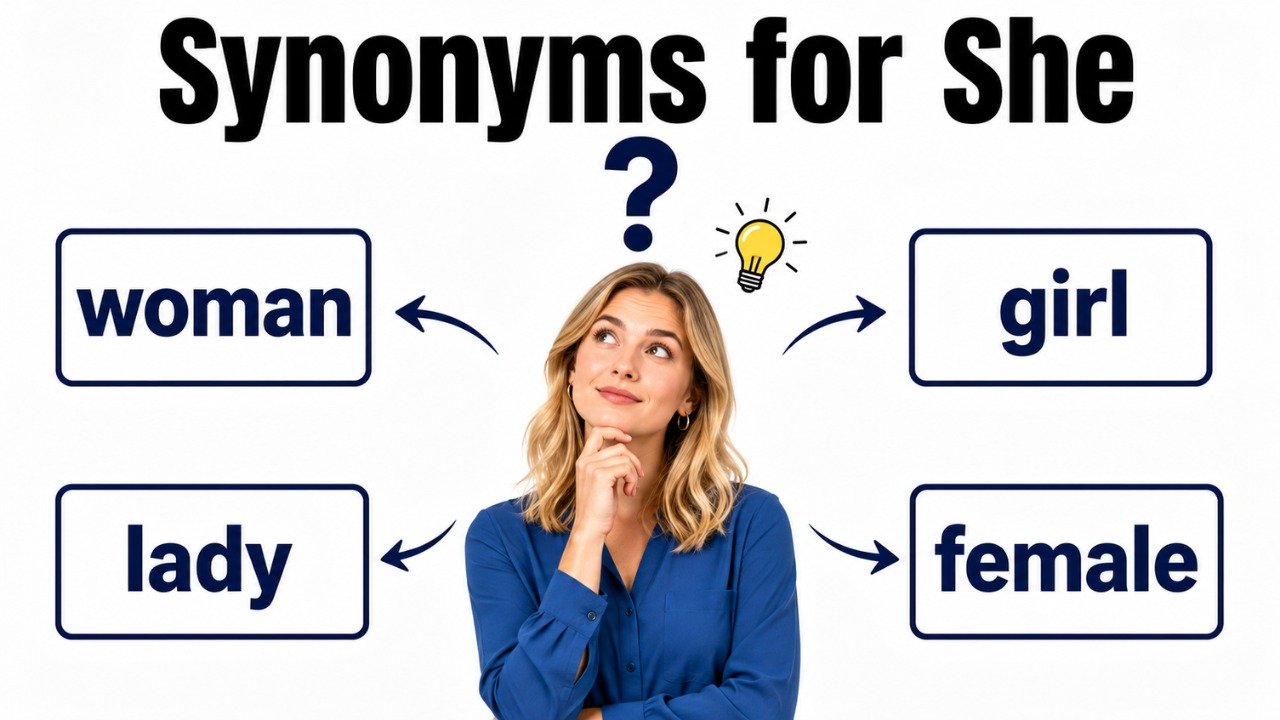
Quick Answer: The best synonyms for she include the woman, the girl, the lady, the person, the individual, they, the subject, the character, the speaker, and the named person. Use the woman or the girl when age and gender are relevant. Use they when gender is unknown, private, or unimportant. In formal writing, a role such as the researcher, the applicant, or the manager is often clearer than repeating she. Because she is a personal pronoun, most alternatives are context based replacements rather than exact synonyms.
Pronunciation and Word Details
Word: She.
Pronunciation: /ʃiː/
Part of Speech: Personal pronoun.
Meaning: A pronoun used as the subject of a sentence to refer to a female person or, in some contexts, a female animal.
US Pronunciation:
UK Pronunciation:
What Does “She” Mean?
She is a third person singular subject pronoun used mainly for a female person who has already been identified or is understood from the context.
The word normally appears before a verb because it functions as the subject of a clause.
Example: She writes clearly.
In this sentence, she is the person performing the action of writing.
She can refer to a woman, a girl, or sometimes a female animal whose sex is known. It may also be used for a fictional character, a country, a ship, or another object that a writer personifies as female. However, personifying objects with she is less common in neutral modern writing.
Referring to a woman: Maria said she would attend the meeting.
Referring to a girl: The child smiled because she liked the gift.
Referring to an animal: The dog stayed close because she was frightened.
Referring to a character: The heroine realizes that she must make a difficult choice.
The meaning of she depends on its antecedent. An antecedent is the noun or name that the pronoun replaces.
Example: Aisha opened the window because she felt warm.
In this example, Aisha is the antecedent of she.
Meaning, Tone, and Context of “She”
She is a neutral and standard English pronoun. It is appropriate in formal writing, casual conversation, academic work, fiction, journalism, reports, emails, and everyday speech.
The pronoun itself usually carries no emotional tone. The surrounding words create the emotion.
Neutral context: She submitted the form.
Positive context: She gave an inspiring performance.
Negative context: She ignored the warning.
Emotional context: She was deeply relieved to see her family.
She is specific because it normally identifies one female person. However, it can become unclear when several female people appear in the same passage.
Unclear: Nadia told Sara that she had received the invitation.
The reader may not know whether she refers to Nadia or Sara.
Clearer: Nadia told Sara, “I received the invitation.”
Clearer: Nadia told Sara that Sara had received the invitation.
In professional or academic writing, repeating a person’s role can sometimes be clearer than using she repeatedly.
Pronoun version: She examined the results and recorded them.
Role based version: The researcher examined the results and recorded them.
Use she only when the person’s gender is known and the person uses that pronoun. When gender is unknown or irrelevant, singular they is often the most natural alternative.
When and How to Use “She”
Referring to a Known Female Person
Use she when the reader already knows which woman or girl is being discussed.
Example: Fatima called this morning. She will arrive at noon.
The name Fatima makes the pronoun clear.
Avoiding Repetition of a Name
She prevents a sentence or paragraph from sounding repetitive.
Repetitive: Emma entered the office, and Emma placed Emma’s bag beside the desk.
Better: Emma entered the office, and she placed her bag beside the desk.
Describing an Action
Use she as the subject before an action verb.
Example: She completed the assignment early.
Here, she performs the action.
Describing a State or Condition
Use she before a linking verb to describe someone’s condition, identity, or quality.
Example: She is confident.
Example: She appears tired.
Reporting Speech or Thoughts
She is common when reporting what a female person said, believed, felt, or thought.
Example: She said the instructions were clear.
Example: She believed the decision was fair.
Referring to a Female Animal
Use she when the animal’s sex is known or when the animal is treated as an individual.
Example: The cat is hungry, so she is waiting beside her bowl.
Writing About Fictional Characters
Use she when discussing a female character in a story, play, film, or poem.
Example: She becomes more independent as the story develops.
For greater clarity in literary analysis, a role or name may sometimes be better.
Clearer: The protagonist becomes more independent as the story develops.
Respecting a Person’s Pronouns
Use she when it is the pronoun a person uses for herself. Do not guess a person’s pronouns from a name, appearance, occupation, or voice.
Respectful use: Leila introduced herself and explained that she would lead the session.
Using a Neutral Alternative
Use they when a person’s gender is unknown, private, or unrelated to the point.
Gender specific: Each female applicant should explain why she is qualified.
Gender neutral: Each applicant should explain why they are qualified.
Best Synonyms for She
Because she is a pronoun, its strongest alternatives depend on the identity, age, role, and context of the person being discussed.
The Woman
Synonym: An adult female person already identified in the context.
Example: The woman thanked everyone for their support.
This is one of the most direct noun phrase alternatives to she.
The Girl
Synonym: A female child or young person.
Example: The girl carried her books into the classroom.
Use girl only when the person is genuinely a child or when the term is clearly appropriate.
The Lady
Synonym: A polite or traditional term for a woman.
Example: The lady at the front desk answered my question.
Lady can sound courteous, but woman is usually more neutral.
The Person
Synonym: A neutral reference to a human being.
Example: The person responsible for the report has corrected the error.
Use person when gender is irrelevant.
The Individual
Synonym: A formal and neutral term for one person.
Example: The individual must provide proof of identity.
Individual is useful in formal, administrative, legal, and academic contexts.
They
Synonym: A gender neutral singular pronoun used when gender is unknown, private, or unimportant.
Example: The applicant said they would respond tomorrow.
They is the closest pronoun alternative when a gender specific reference is unnecessary.
The Subject
Synonym: The person being discussed, studied, photographed, or examined.
Example: The subject explained that she had understood the instructions.
Subject is especially useful in research, analysis, medicine, art, and photography.
The Character
Synonym: A person represented in a story, play, or other narrative.
Example: The character gradually becomes more confident.
Use character when discussing fiction.
The Speaker
Synonym: The person who is speaking or delivering a presentation.
Example: The speaker concluded her talk with a practical example.
This alternative is clearer when a person’s function matters more than gender.
The Named Person
Synonym: The specific person identified earlier by name.
Example: The named person must sign the document.
This phrase is formal and is mainly useful when identifying someone in a document or procedure.
50 Synonyms for She with Short Meanings
The following words and phrases are context based alternatives. They are not all direct grammatical substitutes for she.
- The woman: An adult female person.
- The girl: A female child or young person.
- The lady: A polite or traditional term for a woman.
- The female: A technical reference to a female person or animal.
- The person: A neutral term for a human being.
- The individual: A formal term for one person.
- They: A gender neutral singular pronoun.
- The named person: The person previously identified by name.
- The subject: The person being discussed or studied.
- The speaker: The person who is speaking.
- The writer: The person who wrote a text.
- The author: The creator of a written work.
- The narrator: The voice or person telling a story.
- The character: A person represented in a narrative.
- The heroine: The main female hero in a story.
- The protagonist: The central character in a narrative.
- The woman in question: The particular woman being discussed.
- The girl in question: The particular girl being discussed.
- This woman: A specific nearby or recently mentioned woman.
- That woman: A specific woman at a distance or mentioned earlier.
- The mother: A female parent.
- The daughter: A female child in a family relationship.
- The sister: A female sibling.
- The wife: A married female partner.
- The partner: A person in a personal or professional partnership.
- The friend: A person with whom someone has a close relationship.
- The colleague: A person who works in the same profession or organization.
- The coworker: A person who works with someone else.
- The employee: A person employed by an organization.
- The manager: A person responsible for directing work or staff.
- The teacher: A person who teaches students.
- The student: A person who is learning at a school or institution.
- The doctor: A qualified medical professional.
- The nurse: A professional who provides medical care.
- The researcher: A person who conducts research.
- The participant: A person taking part in an activity or study.
- The respondent: A person who answers questions or a survey.
- The applicant: A person applying for something.
- The candidate: A person being considered for a position or award.
- The customer: A person who purchases goods or services.
- The client: A person receiving professional services.
- The patient: A person receiving medical treatment.
- The witness: A person who observes or gives evidence about an event.
- The visitor: A person visiting a place or another person.
- The guest: A person invited to an event or place.
- The resident: A person who lives in a particular location.
- The neighbor: A person who lives nearby.
- The owner: A person who possesses something.
- The representative: A person acting or speaking for others.
- The leader: A person who guides a group or organization.
Read Also:
Synonyms for Ash

Synonyms for She by Context
When She Refers to a Known Adult Woman
The woman is usually the most direct noun phrase replacement. The lady may be suitable in polite or traditional contexts, while the woman in question works in formal explanations.
Original: She asked to speak with the manager.
Alternative: The woman asked to speak with the manager.
Original: She was waiting near the entrance.
Alternative: The lady was waiting near the entrance.
Use these alternatives when the noun phrase adds clarity. Avoid repeating the woman in every sentence, because that can sound unnatural.
When She Refers to a Girl
Use the girl when referring to a female child or teenager and the person’s age is relevant.
Original: She placed the drawing on the table.
Alternative: The girl placed the drawing on the table.
Do not use girl for an adult woman unless the context clearly supports an informal meaning.
When Gender Is Unknown or Irrelevant
Use they, the person, or the individual when gender does not need to be specified.
Original: Every applicant should explain why she wants the position.
Alternative: Every applicant should explain why they want the position.
Original: She must present identification before entering.
Alternative: The individual must present identification before entering.
They is usually natural in conversation and general writing. Individual is more formal.
When a Professional Role Is More Important
Use the person’s role when it provides useful information.
Original: She reviewed the patient’s test results.
Alternative: The doctor reviewed the patient’s test results.
Original: She collected responses from fifty participants.
Alternative: The researcher collected responses from fifty participants.
Role based alternatives improve clarity in reports, essays, procedures, and workplace writing.
When Discussing a Family Relationship
Use mother, daughter, sister, wife, or partner when the relationship is relevant.
Original: She helped the child prepare for school.
Alternative: The mother helped the child prepare for school.
Original: She called her brother after the ceremony.
Alternative: The sister called her brother after the ceremony.
These terms add information that the pronoun she does not provide.
When Writing About a Story
Use the character, protagonist, heroine, or narrator when analyzing fiction.
Original: She changes greatly by the final chapter.
Alternative: The protagonist changes greatly by the final chapter.
Original: She describes the town as quiet and isolated.
Alternative: The narrator describes the town as quiet and isolated.
These alternatives help readers distinguish between characters and literary roles.
When Referring to a Speaker or Writer
Use speaker, writer, or author when discussing communication.
Original: She supports her argument with several examples.
Alternative: The writer supports her argument with several examples.
Original: She pauses before introducing the final point.
Alternative: The speaker pauses before introducing the final point.
A role based noun is often clearer in essays and analysis.
Another Word for She
The best single replacement for she is often the woman when referring to a known adult female person. However, the best alternative depends on context.
Use they when gender is unknown or irrelevant. Use the person or the individual in neutral and formal writing. Use a specific role when the person’s position or function matters.
Original: She completed the interview.
Better Option: The candidate completed the interview.
Original: She recorded the results carefully.
Better Option: The researcher recorded the results carefully.
Original: Each employee should explain why she needs access.
Better Option: Each employee should explain why they need access.
Original: She becomes the strongest character in the novel.
Better Option: The protagonist becomes the strongest character in the novel.
When Not to Use “She”
When the Antecedent Is Unclear
Avoid she when the reader cannot tell which person it refers to.
Weak: Layla told Hina that she needed more time.
Better: Layla told Hina, “I need more time.”
Better: Layla told Hina that Hina needed more time.
When Gender Is Unknown
Do not automatically use she for an unknown person.
Weak: Every doctor should listen carefully when she speaks with a patient.
Better: Every doctor should listen carefully when they speak with a patient.
When Gender Is Irrelevant
A neutral role or singular they may be more inclusive and precise.
Weak: A customer should keep her receipt.
Better: A customer should keep their receipt.
When the Pronoun Is Repeated Too Often
Frequent repetition can make a paragraph sound monotonous.
Weak: She entered the room. She opened the folder. She read the letter. She placed it on the desk.
Better: She entered the room, opened the folder, read the letter, and placed it on the desk.
When a Role Would Be Clearer
In reports and academic writing, a role may provide more useful information.
Weak: She observed the participants for thirty minutes.
Better: The researcher observed the participants for thirty minutes.
When the Object Form Is Required
Do not use she when the pronoun receives the action.
Incorrect: The teacher praised she.
Correct: The teacher praised her.
When the Possessive Form Is Required
Do not use she before a noun to show ownership.
Incorrect: This is she notebook.
Correct: This is her notebook.
When the Reflexive Form Is Required
Use herself when the action returns to the subject.
Incorrect: She prepared she for the interview.
Correct: She prepared herself for the interview.
Words Commonly Confused With She
She vs Her
She: A subject pronoun used for the person performing an action.
Example: She called the office.
Her: An object pronoun or possessive determiner.
Object Example: The manager called her.
Possessive Example: Her report was accurate.
She vs Hers
She: Refers to a female subject.
Example: She owns the red folder.
Hers: A possessive pronoun that replaces a noun phrase.
Example: The red folder is hers.
Do not place a noun immediately after hers.
Incorrect: Hers folder is red.
Correct: Her folder is red.
She vs Herself
She: Performs the action.
Example: She wrote the speech.
Herself: Refers back to the female subject or adds emphasis.
Reflexive Example: She taught herself to paint.
Emphatic Example: She completed the project herself.
She vs They
She: Refers specifically to one female person.
Example: Amina said she would join us.
They: Refers to multiple people or one person whose gender is unknown, private, or not relevant.
Example: The new employee said they would arrive early.
She vs The Woman
She: A pronoun that avoids repeating a noun.
Example: The woman entered, and she sat beside the window.
The Woman: A noun phrase that identifies an adult female person.
Example: The woman beside the window is the director.
She vs He
She: A pronoun usually associated with a female person.
Example: She is the new manager.
He: A pronoun usually associated with a male person.
Example: He is the new manager.
Neither pronoun should be chosen by guessing. Use the pronoun appropriate for the person being discussed.
Which Synonym Should You Choose?
Choose the woman when referring to a known adult female person and when repeating the noun improves clarity.
Choose the girl when referring to a female child or young person.
Choose the lady when a polite or traditional expression suits the context.
Choose they when gender is unknown, private, mixed, or unimportant.
Choose the person in clear, neutral, everyday explanations.
Choose the individual in formal, legal, administrative, or academic writing.
Choose the researcher, teacher, doctor, manager, or another role when professional identity matters.
Choose the character when discussing a person in fiction generally.
Choose the protagonist when discussing the central figure in a narrative.
Choose the narrator when referring to the voice telling a story.
Choose the speaker when analyzing a speech, presentation, poem, or conversation.
Choose the writer or author when analyzing written arguments, techniques, or ideas.
Choose the applicant or candidate in recruitment and selection contexts.
Choose the participant or respondent in surveys, experiments, and research reports.
In most paragraphs, the best approach is to introduce the person with a name or noun and then use she naturally.
Example: The researcher reviewed the survey. She identified three common themes.
Real Life Examples of “She” in Sentences
Workplace Example
Original: She will present the monthly report tomorrow.
Better Option: The manager will present the monthly report tomorrow.
Academic Example
Original: She collected the data through interviews.
Better Option: The researcher collected the data through interviews.
Recruitment Example
Original: She has completed the final assessment.
Better Option: The candidate has completed the final assessment.
Customer Service Example
Original: She requested a replacement for the damaged item.
Better Option: The customer requested a replacement for the damaged item.
Medical Example
Original: She described the pain as sharp and sudden.
Better Option: The patient described the pain as sharp and sudden.
Literary Example
Original: She learns to trust her own judgment.
Better Option: The protagonist learns to trust her own judgment.
Presentation Example
Original: She introduced the topic with a surprising question.
Better Option: The speaker introduced the topic with a surprising question.
Family Example
Original: She packed lunch for both children.
Better Option: The mother packed lunch for both children.
Neutral Example
Original: Every visitor should show her ticket at the entrance.
Better Option: Every visitor should show their ticket at the entrance.
Formal Example
Original: She must sign the declaration before submitting it.
Better Option: The applicant must sign the declaration before submitting it.
Synonym Groups and Usage Differences
Female Noun Group
This group includes the woman, the girl, the lady, and the female.
The woman is neutral for an adult. The girl refers to a child or young person. The lady can sound polite or traditional. The female is mainly appropriate in biological, medical, scientific, or technical contexts and can sound impersonal when used for a person in everyday speech.
Example: The woman returned the missing wallet.
Gender Neutral Group
This group includes they, the person, and the individual.
They is the most natural pronoun alternative when gender is unknown or irrelevant. The person is neutral and widely understood. The individual sounds more formal.
Example: Each participant should explain what they observed.
Professional Role Group
This group includes the manager, teacher, doctor, researcher, employee, applicant, and candidate.
These words identify what the person does rather than focusing on gender.
Example: The researcher compared the two sets of results.
Literary Group
This group includes the character, protagonist, heroine, and narrator.
Character is general. Protagonist identifies the central character. Heroine traditionally describes a central female hero. Narrator identifies the person or voice telling the story.
Example: The narrator reveals very little about her childhood.
Communication Group
This group includes the speaker, writer, author, and representative.
Use these alternatives when discussing how someone speaks, writes, argues, explains, or communicates for others.
Example: The author presents a balanced argument.
Relationship Group
This group includes mother, daughter, sister, wife, partner, friend, colleague, and neighbor.
These terms explain the person’s relationship to someone else.
Example: The neighbor offered to collect the mail.
Research Group
This group includes the subject, participant, and respondent.
Subject refers to the person being studied or discussed. Participant emphasizes active involvement. Respondent identifies someone who answers questions.
Example: The respondent selected the second option.
Antonyms of She
She does not have a true antonym because pronouns do not normally form opposite pairs. However, several contrasting pronouns may be relevant.
He: A subject pronoun generally used for one male person.
They: A pronoun used for multiple people or as a gender neutral singular form.
It: A subject pronoun normally used for objects, ideas, situations, and some animals.
I: A first person singular pronoun used by a speaker to refer to themselves.
You: A second person pronoun referring to the person or people being addressed.
We: A first person plural pronoun referring to the speaker and at least one other person.
Comparison: She refers to a female third person subject, while he usually refers to a male third person subject.
Comparison: She is singular and gender specific, while they can be singular or plural and does not need to specify gender.
Comparison: She refers to another person, while I refers to the speaker.
Comparison of She and Related Words
She vs Her
She is used as the subject of a verb. Her is used as an object or before a noun to show possession.
Example With She: She answered the question.
Example With Her: The teacher asked her a question.
Possessive Example: Her answer was correct.
She vs Hers
She identifies the female subject. Hers shows that something belongs to her.
Example With She: She selected the larger office.
Example With Hers: The larger office is hers.
She vs Herself
She is the ordinary subject form. Herself is used when the subject and object refer to the same person or when emphasis is needed.
Example With She: She designed the poster.
Example With Herself: She designed the poster herself.
She vs They
She identifies one female person. They can identify more than one person or one person without specifying gender.
Example With She: Noor said she would attend.
Example With They: The guest said they would attend.
She vs The Woman
She is shorter and helps avoid repetition. The woman identifies the person more directly.
Example With She: The woman entered, and she closed the door.
Example With The Woman: The woman near the door is our new instructor.
She vs The Individual
She sounds natural and personal when gender is known. The individual sounds formal and detached.
Example With She: She agreed to answer the questions.
Example With The Individual: The individual agreed to answer the questions.
She vs The Protagonist
She is a general pronoun. The protagonist identifies the central character of a story.
Example With She: She faces several difficult choices.
Example With The Protagonist: The protagonist faces several difficult choices.
Common Phrases and Expressions With “She”
She Is: A common structure used to describe identity, condition, or quality.
Example: She is ready.
She Was: A phrase used to describe a female person in the past.
Example: She was surprised.
She Has: A phrase used to show possession or form a perfect verb tense.
Example: She has completed the task.
She Had: A phrase used for possession or an action completed before another past action.
Example: She had already left.
She Can: A phrase expressing ability or possibility.
Example: She can solve the problem.
She Will: A phrase used for future actions or intentions.
Example: She will contact you soon.
She Said: A common reporting phrase.
Example: She said the meeting was productive.
She Herself: A phrase that adds emphasis to the female subject.
Example: She herself approved the final version.
There She Is: An expression used when noticing or locating a female person.
Example: There she is, beside the main entrance.
So She Says: An expression showing that a statement is based on what a woman claims.
Example: The work will be finished tomorrow, or so she says.
Common Mistakes to Avoid
Confusing She and Her
Use she as the subject and her as the object.
Incorrect: Her is leading the discussion.
Correct: She is leading the discussion.
Incorrect: The director thanked she.
Correct: The director thanked her.
Using She After a Preposition
A preposition normally requires the object form her.
Incorrect: The message was from she.
Correct: The message was from her.
Using She to Show Possession
Use her before a noun and hers without a following noun.
Incorrect: She presentation was excellent.
Correct: Her presentation was excellent.
Incorrect: The presentation is her.
Correct: The presentation is hers.
Repeating She in Every Sentence
Combine related actions or replace some pronouns with a name or role.
Repetitive: She opened the document. She read the first page. She marked three errors. She sent it back.
Improved: She opened the document, read the first page, marked three errors, and sent it back.
Using an Unclear Antecedent
Make sure the reader can identify the person represented by she.
Unclear: Mariam called Sana after she finished work.
Clearer: After Mariam finished work, she called Sana.
Clearer: Mariam called Sana after Sana finished work.
Guessing Someone’s Gender
Do not choose she based only on a name, job, appearance, or assumption. Use the person’s stated pronoun or a neutral alternative.
Uncertain: The new doctor said she would arrive soon.
Neutral: The new doctor said they would arrive soon.
Using Girl for an Adult Woman
Girl usually refers to a child or young person. Woman is generally more accurate and respectful for an adult.
Less Accurate: The girl who manages the department approved the request.
Better: The woman who manages the department approved the request.
Best When Relevant: The department manager approved the request.
Using The Female in Casual Writing
The female can sound clinical or impersonal when referring to a person.
Unnatural: The female asked for directions.
Natural: The woman asked for directions.
Neutral: The visitor asked for directions.
Using a Singular Verb With Plural They
Use a plural verb form with they, even when they refers to one person.
Incorrect: The applicant said they is available.
Correct: The applicant said they are available.
Changing Pronouns Without a Reason
Keep pronoun use consistent when referring to the same person.
Confusing: The manager said she would review the form, but then they requested another copy.
Consistent: The manager said she would review the form, but then she requested another copy.
Conclusion
The best synonyms for she depend on who the person is and why she is being mentioned. The woman and the girl are useful when age and gender matter. They, the person, and the individual provide neutral alternatives. Role based terms such as the researcher, manager, applicant, speaker, and protagonist often make formal or analytical writing clearer. When using synonyms for she, choose an alternative that preserves the original meaning, avoids unnecessary assumptions, and helps readers identify the person without confusion.
FAQs About Synonyms for She
What Is the Best Synonym for She?
The woman is the most direct noun phrase alternative when referring to a known adult female person. They is the best neutral pronoun alternative when gender is unknown or irrelevant.
Is They a Synonym for She?
They can replace she when a gender neutral pronoun is needed. However, they is not identical in meaning because it can refer to one person or several people.
Can I Use Her Instead of She?
No. She is a subject pronoun, while her is an object pronoun or possessive determiner.
Correct With She: She called me.
Correct With Her: I called her.
Is The Woman Always a Good Replacement for She?
No. The woman can improve clarity, but repeating it too often sounds unnatural. Introduce the noun first and then use she where the reference remains clear.
What Can I Use Instead of She in Formal Writing?
Use the individual, the applicant, the participant, the researcher, the employee, or another accurate role. The best choice depends on the person’s function.
What Should I Use When Gender Is Unknown?
Use singular they, the person, or a specific role such as the applicant or customer. Singular they is usually the most natural option.
Does She Have a True Antonym?
No. She has no strict antonym. He is a masculine counterpart, while they, it, I, you, and we differ in gender, number, or grammatical person.
