
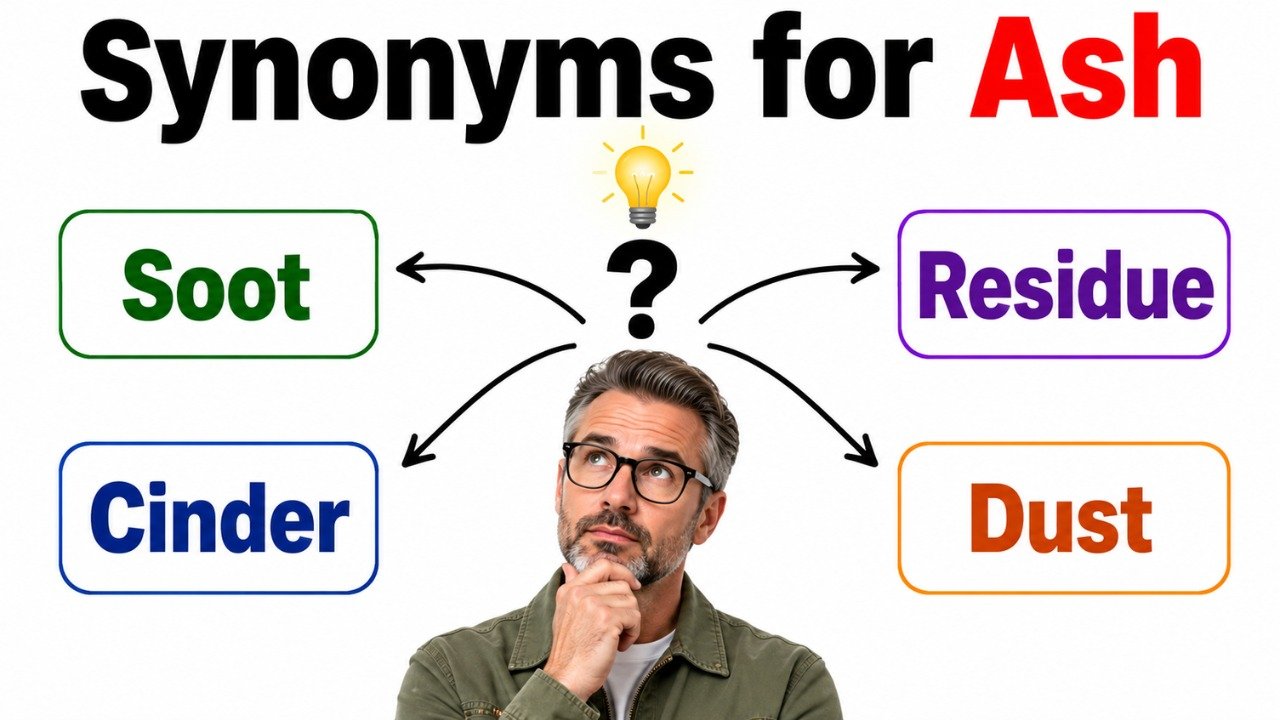
Quick Answer: The best synonyms for ash include cinders, soot, residue, remains, dust, powder, combustion residue, cremains, volcanic dust, and fine tephra. The right alternative depends on meaning. Use cinders for partly burned pieces, soot for black carbon deposits, residue for formal descriptions, cremains for cremated human remains, and fine tephra for scientific discussions of volcanic material. Ash can also refer to an ash tree, ashwood, or an ash gray color, so no single synonym fits every context.
Pronunciation and Word Details
Word: Ash.
Pronunciation: /æʃ/
Part of Speech: Noun, and occasionally a verb.
Meaning: The gray or black powder left after something burns, or a word used for a type of tree and a pale gray color.
US Pronunciation:
UK Pronunciation:
What Does “Ash” Mean?
Ash is the powdery material left after wood, coal, paper, plants, or another substance has burned. It is usually a noun and often functions as an uncountable material word.
For example, the sentence “The fire left a layer of ash” refers to fine burned residue. The plural form ashes may refer to separate deposits of ash, the remains of a destroyed object, or the material left after cremation.
Ash also has other meanings. It can name a group of trees known for strong wood and compound leaves. It may describe the timber obtained from those trees. Ash can also refer to a pale or smoky gray color.
In geology, volcanic ash means tiny fragments of rock, minerals, and volcanic material released during an eruption. It is not the same substance as ash produced by burning wood.
As a verb, ash can mean to remove ash from a cigarette or allow burned material to fall as ash. This use is much less common than the noun.
Meaning, Tone, and Context of “Ash”
Ash is generally a neutral word. Its tone changes according to the subject being discussed.
In everyday conversation, ash commonly describes the soft gray material found after a fire. In scientific or technical writing, it may refer to combustion residue, volcanic particles, industrial waste, or mineral material.
In funeral contexts, ashes refers to cremated remains. This use may carry a respectful, emotional, or solemn tone. Cremains is a more specialized alternative, while cremated remains is usually the clearest formal expression.
In botanical writing, ash refers to a type of tree. Ashwood or ash timber refers to its wood. These meanings are unrelated to burned residue and require different alternatives.
In color descriptions, ash suggests a cool, muted, or pale gray. Expressions such as ash gray, ashen gray, and smoky gray are often used for paint, fabric, hair, stone, or natural surfaces.
Because ash has several meanings, writers should choose alternatives based on context rather than treating every related word as an exact synonym.
When and How to Use “Ash”
For Burned Material: Use ash for the fine powder that remains after something has burned completely.
Example: A thin layer of ash covered the bottom of the fireplace.
For Partly Burned Pieces: Use cinders when referring to small, partly burned fragments rather than fine powder.
Example: Red cinders continued to glow beneath the ash.
For Black Deposits: Use soot when describing fine black carbon that collects on walls, chimneys, or surfaces.
Example: Soot darkened the bricks above the fireplace.
For Formal Descriptions: Use residue or combustion residue in reports, instructions, or technical explanations.
Example: The combustion residue was collected for laboratory testing.
For Cremated Remains: Use ashes, cremated remains, or cremains when discussing material remaining after cremation.
Example: The family placed the cremated remains in a memorial container.
For Volcanic Material: Use volcanic ash, fine tephra, or volcanic particles when discussing eruptions.
Example: Fine tephra settled across the nearby fields.
For Industrial Material: Use fly ash, bottom ash, coal ash, or furnace residue when greater technical detail is required.
Example: The facility stores fly ash in a controlled area.
For a Tree: Use ash tree when referring to the living plant and ashwood when referring to its timber.
Example: The cabinet was made from smooth ashwood.
For a Gray Color: Use ash gray, smoky gray, or ashen gray for a cool and muted gray shade.
Example: She selected an ash gray fabric for the curtains.
Best Synonyms for Ash
Cinders: Small pieces of material that remain after incomplete burning.
Example: The workers poured water over the glowing cinders.
Soot: Fine black carbon produced by incomplete combustion.
Example: A layer of soot covered the inside of the chimney.
Residue: Material left behind after a process such as burning.
Example: The fire left a powdery residue on the metal tray.
Remains: What is left after something has been burned, damaged, or destroyed.
Example: The remains of the wooden structure were removed.
Dust: Fine dry particles resembling ash in texture.
Example: Gray dust rose when the debris was moved.
Combustion Residue: Material remaining after a substance burns.
Example: The report examined the chemical content of the combustion residue.
Cremated Remains: The processed material left after a person or animal is cremated.
Example: The cremated remains were handled with care.
Cremains: A concise term for cremated remains.
Example: The family chose a secure place for the cremains.
Volcanic Dust: A general description of fine material released by a volcano.
Example: Volcanic dust reduced visibility across the region.
Fine Tephra: A scientific term for very small volcanic fragments.
Example: Fine tephra covered the roofs after the eruption.
50 Synonyms for Ash with Short Meanings
Because ash has several meanings, the following entries include direct synonyms and useful contextual alternatives.
- Cinders: Small pieces left after material has partly burned.
- Soot: Fine black carbon produced by incomplete burning.
- Residue: Material remaining after a process.
- Remains: What is left after burning or destruction.
- Dust: Very fine dry particles.
- Powder: A mass of small, loose particles.
- Ashes: The plural form used for deposits or collected remains.
- Burned Remains: Material left after something has burned.
- Burnt Residue: Powder or fragments remaining after burning.
- Fire Residue: Material left behind by a fire.
- Combustion Residue: Matter remaining after combustion.
- Incineration Residue: Material left after high temperature burning.
- Mineral Residue: Nonburning mineral material remaining in ash.
- Carbon Residue: Carbon rich material left after burning.
- Char: Blackened material produced by partial burning.
- Charred Remains: Burned and blackened fragments of material.
- Charcoal Dust: Fine particles produced from charcoal.
- Cinder Dust: Fine particles formed from broken cinders.
- Burned Powder: Powdery material produced by burning.
- Powdery Remains: Fine remains left after destruction or burning.
- Gray Residue: Gray material remaining after a process.
- Fireplace Residue: Ash and related material left in a fireplace.
- Furnace Residue: Material remaining after fuel burns in a furnace.
- Boiler Ash: Ash produced by fuel burned in a boiler.
- Wood Ash: Powder remaining after wood burns.
- Coal Ash: Material remaining after coal combustion.
- Plant Ash: Mineral residue left after plant material burns.
- Biomass Ash: Residue produced by burning organic fuel.
- Fly Ash: Fine airborne particles produced during combustion.
- Bottom Ash: Heavier ash that collects below a furnace.
- Volcanic Ash: Fine volcanic fragments released during an eruption.
- Volcanic Dust: Fine eruption material suspended in the air.
- Fine Tephra: Small volcanic particles classified by size.
- Pyroclastic Dust: Fine fragments produced by volcanic activity.
- Eruption Debris: Material released during a volcanic eruption.
- Volcanic Particles: Small pieces of rock, glass, or mineral matter.
- Ashfall: Volcanic ash that falls and settles on the ground.
- Volcanic Fallout: Airborne volcanic material deposited over an area.
- Cremated Remains: Material left after cremation.
- Cremains: A specialized term for cremated remains.
- Funeral Ashes: Ashes kept or handled after a cremation.
- Mortal Remains: A respectful broader term for a deceased person’s remains.
- Ash Gray: A muted gray color resembling ash.
- Ashen Gray: A pale or lifeless gray shade.
- Smoky Gray: A gray shade with a dark, smoke like quality.
- Pale Gray: A light gray color.
- Charcoal Gray: A deeper gray associated with charcoal.
- Ash Tree: A tree belonging to the ash group.
- Ashwood: Wood obtained from an ash tree.
- Ash Timber: Ash wood prepared for construction or furniture.
Read Also:
Synonyms for Plain

Synonyms for Ash by Context
When Ash Means Burned Powder
Residue, burned remains, fire residue, combustion residue, dust, and powder are suitable when ash means material left after burning.
Residue is especially useful in formal explanations because it does not suggest a particular texture. Dust and powder emphasize the small particle size. Burned remains emphasizes the result of destruction.
Example With Residue: A gray residue remained after the paper burned.
Example With Dust: Fine dust covered the metal surface.
Example With Burned Remains: The burned remains were removed after the fire.
When Ash Means Partly Burned Material
Cinders, char, charred remains, and charcoal dust are related alternatives, but they do not describe exactly the same material.
Cinders are small burned pieces that may still be hot. Char is blackened material formed through incomplete burning. Ash is usually finer and more completely burned.
Example With Cinders: The cinders glowed beneath the cold surface.
Example With Char: The wood had turned to black char.
Example With Charred Remains: Investigators examined the charred remains of the door.
When Ash Means Black Combustion Material
Soot and carbon residue are useful when the material is dark, carbon rich, and produced by incomplete combustion.
Soot commonly sticks to walls, ceilings, cooking surfaces, and chimneys. It differs from ordinary ash because it is usually blacker, finer, and more carbon rich.
Example With Soot: Black soot collected above the flame.
Example With Carbon Residue: Carbon residue formed inside the pipe.
When Ash Means Cremated Remains
Cremated remains, cremains, funeral ashes, and mortal remains may be used in funeral or memorial contexts.
Cremated remains is clear, respectful, and formal. Cremains is shorter and more technical. Mortal remains is broader because it can refer to remains that have not been cremated.
Example With Cremated Remains: The cremated remains were placed in a memorial container.
Example With Cremains: The cremains were transferred according to the family’s wishes.
Example With Mortal Remains: The phrase mortal remains has a solemn and respectful tone.
When Ash Means Volcanic Material
Volcanic ash, fine tephra, volcanic dust, pyroclastic dust, and volcanic particles are useful in geological contexts.
Fine tephra is the most technical alternative. Volcanic dust is understandable in general writing, but volcanic ash is more precise because the particles are fragments of rock, minerals, and volcanic glass rather than burned material.
Example With Fine Tephra: Fine tephra settled several miles from the volcano.
Example With Volcanic Dust: Volcanic dust reduced air quality.
Example With Volcanic Particles: Small volcanic particles entered the atmosphere.
When Ash Means Industrial Residue
Fly ash, bottom ash, coal ash, boiler ash, and furnace residue are used in industrial, environmental, and engineering contexts.
Fly ash consists of fine particles carried with exhaust gases. Bottom ash is heavier and collects near the bottom of a combustion system.
Example With Fly Ash: Fine fly ash was captured before it entered the air.
Example With Bottom Ash: The heavier bottom ash collected beneath the furnace.
Example With Furnace Residue: The furnace residue was removed during maintenance.
When Ash Means a Gray Color
Ash gray, ashen gray, smoky gray, pale gray, and charcoal gray can describe colors related to ash.
Ash gray is usually cool and muted. Ashen gray often suggests paleness. Smoky gray has a darker and softer appearance, while charcoal gray is much deeper.
Example With Ash Gray: The walls were painted ash gray.
Example With Smoky Gray: Smoky gray clouds covered the sky.
Example With Charcoal Gray: He selected a charcoal gray fabric.
When Ash Means a Tree or Wood
Ash tree, ashwood, and ash timber are useful when ash refers to a plant or material rather than burned residue.
Ash tree names the living plant. Ashwood refers to wood from the tree, while ash timber is more suitable when discussing prepared building or furniture material.
Example With Ash Tree: A mature ash tree stood near the gate.
Example With Ashwood: The handle was made from ashwood.
Example With Ash Timber: The workshop stored several pieces of ash timber.
Another Word for Ash
Residue is the best general replacement for ash when the sentence refers to material left after burning. However, it is broader than ash and can describe material left after many other processes.
Cinders is better for partly burned pieces. Soot is better for black carbon deposits. Cremated remains is better in funeral writing. Fine tephra is better in technical volcanic descriptions.
Original: Ash covered the bottom of the fireplace.
Better Option: Burned residue covered the bottom of the fireplace.
Original: Hot ash remained beneath the damaged wood.
Better Option: Hot cinders remained beneath the damaged wood.
Original: Ash had collected around the chimney opening.
Better Option: Soot had collected around the chimney opening.
Original: The volcano released ash into the atmosphere.
Better Option: The volcano released fine tephra into the atmosphere.
When Not to Use “Ash”
Do not use ash when a more specific word is necessary to identify the material accurately.
Ash can be too general in scientific reports, industrial documents, funeral writing, and detailed fire descriptions. It can also cause confusion because wood ash, coal ash, volcanic ash, and cremated remains are different materials.
Use cinders when the material consists of larger, partly burned pieces. Use soot for black carbon deposits. Use cremated remains in respectful formal communication. Use fine tephra when particle classification matters.
Weak: Black ash covered the inside of the chimney.
Better: Black soot covered the inside of the chimney.
Weak: Large pieces of ash were still glowing in the fire.
Better: Large cinders were still glowing in the fire.
Weak: The laboratory tested the ash from the industrial system.
Better: The laboratory tested the combustion residue from the industrial system.
Weak: The family received the ash after the cremation.
Better: The family received the cremated remains after the cremation.
Weak: Ash from the eruption consisted of small fragments of volcanic rock.
Better: Fine tephra from the eruption consisted of small fragments of volcanic rock.
Weak: The table was made from ash.
Better: The table was made from ashwood.
Words Commonly Confused With Ash
Ash vs Ashes: Ash usually refers to the material as an uncountable substance. Ashes can refer to multiple deposits, the remains of something destroyed, or cremated remains.
Ash vs Cinders: Ash is generally fine and powdery. Cinders are larger, partly burned pieces that may remain hot.
Ash vs Soot: Ash is solid residue left after burning. Soot is fine black carbon produced by incomplete combustion and often sticks to surfaces.
Ash vs Embers: Ash is usually cool or fully burned residue. Embers are hot and glowing pieces that can continue to produce heat.
Ash vs Char: Ash is fine material produced after more complete combustion. Char is blackened solid material left after partial burning.
Ash vs Smoke: Ash is solid matter. Smoke is a mixture of gases and suspended particles moving through the air.
Ash vs Dust: Ash is produced by combustion or certain volcanic processes. Dust is any fine dry material from soil, fabric, skin, construction, or other sources.
Ash vs Tephra: Volcanic ash is a fine category of tephra. Tephra is a broader geological term that includes volcanic fragments of different sizes.
Ash vs Cremains: Ash is a general material term. Cremains specifically means processed cremated remains.
Ash vs Ashwood: Ash can mean burned residue or a type of tree. Ashwood refers only to wood taken from an ash tree.
Which Synonym Should You Choose?
Choose residue for formal writing when you mean material left after burning or another process.
Choose combustion residue for scientific reports, technical explanations, laboratory writing, or environmental documents.
Choose cinders when describing larger pieces that have not burned into fine powder.
Choose soot when referring to black carbon on chimneys, walls, cookware, engines, or other surfaces.
Choose char when describing solid material that has become black through partial burning.
Choose dust or powder in casual descriptions when texture matters more than origin.
Choose cremated remains for respectful formal writing about cremation.
Choose cremains for concise funeral, legal, or professional terminology.
Choose volcanic ash for clear general writing about eruptions.
Choose fine tephra for academic, geological, or highly precise scientific writing.
Choose fly ash or bottom ash in engineering and industrial reports.
Choose ash gray or smoky gray when describing color.
Choose ash tree for the plant and ashwood for the material obtained from it.
Real Life Examples of “Ash” in Sentences
Original: Ash covered the floor beneath the fireplace.
Better Option: Fire residue covered the floor beneath the fireplace.
Original: Ash was still glowing under the logs.
Better Option: Cinders were still glowing under the logs.
Original: Ash blackened the wall above the stove.
Better Option: Soot blackened the wall above the stove.
Original: The factory collected ash from the combustion chamber.
Better Option: The factory collected combustion residue from the chamber.
Original: The family placed the ash in a memorial container.
Better Option: The family placed the cremated remains in a memorial container.
Original: The volcano sent ash high into the atmosphere.
Better Option: The volcano sent fine tephra high into the atmosphere.
Original: Ash settled across the surrounding villages.
Better Option: Volcanic fallout settled across the surrounding villages.
Original: She chose an ash color for the bedroom walls.
Better Option: She chose an ash gray color for the bedroom walls.
Original: The chair was constructed from ash.
Better Option: The chair was constructed from ashwood.
Original: The gardener planted an ash near the path.
Better Option: The gardener planted an ash tree near the path.
Synonym Groups and Usage Differences
Fire Residue Group
Residue, fire residue, burned remains, combustion residue, powder, and dust describe material left after burning.
Residue is the broadest and most formal term. Powder and dust describe texture but do not explain how the material formed.
Example: The inspection revealed a fine combustion residue inside the container.
Incomplete Burning Group
Cinders, char, charred remains, charcoal dust, and carbon residue relate to incomplete combustion.
Cinders are often larger and may still glow. Char remains solid, while charcoal dust consists of fine particles.
Example: Glowing cinders remained beneath the charred wood.
Black Deposit Group
Soot and carbon residue describe dark materials rich in carbon.
Soot commonly forms on surfaces when fuel burns inefficiently. It should not automatically replace ash when the residue is pale or mineral rich.
Example: Soot formed a black layer inside the chimney.
Funeral Group
Cremated remains, cremains, funeral ashes, and mortal remains belong to respectful memorial vocabulary.
Cremated remains is usually the clearest choice. Funeral ashes is understandable but less precise, while mortal remains has a wider meaning.
Example: The cremated remains were handled according to the family’s instructions.
Volcanic Group
Volcanic ash, fine tephra, volcanic dust, pyroclastic dust, ashfall, and volcanic fallout describe material from eruptions.
Fine tephra is technical. Ashfall refers to the process or deposit of ash falling from the atmosphere.
Example: Ashfall covered roads and rooftops after the eruption.
Industrial Group
Fly ash, bottom ash, coal ash, boiler ash, furnace residue, and biomass ash identify material by source or collection point.
These terms are not interchangeable because their composition and physical properties may differ.
Example: Fly ash and bottom ash were stored in separate areas.
Color Group
Ash gray, ashen gray, smoky gray, pale gray, and charcoal gray describe different gray shades.
Ash gray is cool and muted. Ashen gray is pale, smoky gray is soft and dark, and charcoal gray is deeper.
Example: The room used ash gray walls with charcoal gray furniture.
Tree and Timber Group
Ash tree, ashwood, and ash timber relate to the botanical meaning of ash.
Ash tree refers to the plant. Ashwood is the natural material, and ash timber refers to wood prepared for practical use.
Example: The craftsperson shaped the ashwood into a smooth handle.
Antonyms of Ash
Ash has no exact antonym because it has several meanings. Practical opposites depend on context.
Fuel: Material that can burn before it becomes ash.
Unburned Material: Matter that has not been damaged or consumed by fire.
Whole Object: An item that remains complete rather than reduced to ash.
Living Material: Organic matter that is alive rather than burned.
Fresh Wood: Wood that has not been burned into ash.
Flame: The visible burning process that may eventually produce ash.
Moisture: Wetness that contrasts with dry powdery ash.
Clean Surface: A surface without ash, soot, or combustion residue.
Bright Color: A vivid shade contrasting with muted ash gray.
Living Tree: A growing plant in contrast with ashwood or burned remains.
Comparison: Ash vs Related Words
Ash vs Cinders
Ash is usually fine and powdery. Cinders are larger fragments left after incomplete burning and may remain hot.
Example With Ash: Cold ash covered the floor of the fireplace.
Example With Cinders: Red cinders glowed beneath the logs.
Ash vs Soot
Ash is residue that falls or collects after burning. Soot is a fine black carbon deposit produced by incomplete combustion.
Example With Ash: The tray contained pale wood ash.
Example With Soot: Black soot covered the chimney wall.
Ash vs Embers
Ash is normally the cool or fully burned remains of a fire. Embers are hot pieces that continue to glow after flames disappear.
Example With Ash: The ash was removed the next morning.
Example With Embers: The embers still produced heat during the night.
Ash vs Char
Ash is fine material left after more complete combustion. Char is a solid black substance formed when material burns only partly.
Example With Ash: The paper had become a pile of ash.
Example With Char: The outer surface of the beam had turned to char.
Ash vs Dust
Ash has a particular origin in fire or volcanic activity. Dust is a broad term for fine dry particles from many sources.
Example With Ash: Wood ash remained inside the stove.
Example With Dust: Construction dust covered the windows.
Ash vs Smoke
Ash is solid residue. Smoke is airborne material made of gases and suspended particles.
Example With Ash: Ash collected beneath the burned paper.
Example With Smoke: Smoke drifted through the open window.
Ash vs Volcanic Ash
Ordinary ash comes from burned material. Volcanic ash consists of tiny fragments of rock, minerals, and volcanic glass.
Example With Ash: The campfire produced a small pile of ash.
Example With Volcanic Ash: Volcanic ash covered the fields after the eruption.
Ash vs Cremated Remains
Ash is a broad term for burned residue. Cremated remains is the clearer and more respectful term for material returned after cremation.
Example With Ash: Ash remained in the fireplace.
Example With Cremated Remains: The cremated remains were placed in a memorial container.
Common Phrases and Expressions With “Ash”
Wood Ash: Powdery mineral residue left after wood burns.
Coal Ash: Residue created when coal is burned.
Volcanic Ash: Fine volcanic fragments released during an eruption.
Cigarette Ash: Burned material that falls from a cigarette.
Ash Cloud: A concentration of airborne volcanic ash.
Ash Fall: Volcanic ash descending and settling over an area.
Ash Gray: A pale or muted gray color.
Ash Tree: A tree belonging to the ash group.
Turn to Ash: To burn or be destroyed completely.
Rise From the Ashes: To recover and become successful after destruction or failure.
Common Mistakes to Avoid
Treating Ash and Soot as Identical: Soot is a black carbon deposit, while ash is usually the solid mineral residue left after burning.
Weak: Pale wood soot filled the fireplace.
Better: Pale wood ash filled the fireplace.
Confusing Ash With Embers: Embers are hot and glowing, while ash is generally cooler and more completely burned.
Weak: The ash glowed red throughout the night.
Better: The embers glowed red throughout the night.
Using Ash for Every Volcanic Fragment: Volcanic ash refers to fine particles. Larger volcanic fragments require other geological terms.
Better Practice: Use fine tephra when precise scientific classification is important.
Using Ashes and Ash Without Considering Grammar: Ash is commonly an uncountable mass noun. Ashes may refer to separate deposits, destruction, or cremated remains.
Incorrect: Several ash were scattered across the floor.
Correct: Several piles of ash were scattered across the floor.
Using Ash Alone in Funeral Writing: Ashes is common, but cremated remains may sound clearer and more respectful in formal communication.
Weak: The ash was returned to the family.
Better: The cremated remains were returned to the family.
Confusing the Tree With Burned Material: A sentence such as “The table is made of ash” is correct, but ashwood may prevent ambiguity.
Clearer: The table is made of ashwood.
Choosing Broad Words in Technical Writing: Dust, powder, and waste may be too vague when the material is specifically fly ash, coal ash, or combustion residue.
Better Practice: Identify the source and type of residue whenever precision matters.
Repeating Ash Too Often: Frequent repetition can make a paragraph sound mechanical.
Better Practice: Use residue, material, particles, deposit, or a precise subtype when those words preserve the meaning.
Conclusion
The most useful synonyms for ash include cinders, soot, residue, remains, dust, combustion residue, cremated remains, volcanic dust, and fine tephra. Choose cinders for partly burned pieces, soot for black deposits, residue for formal descriptions, and cremated remains for respectful funeral language. Volcanic ash requires geological alternatives, while ash tree, ashwood, and ash gray belong to separate meanings. The best synonyms for ash always depend on the material, setting, tone, and level of precision required.
FAQs About Synonyms for Ash
What is the best general synonym for ash?
Residue is the best broad alternative when ash means material left after burning. However, it is less specific because residue can remain after many different processes.
Are cinders and ash the same?
No. Cinders are larger, partly burned fragments that may remain hot. Ash is usually finer, lighter, and produced after more complete burning.
Is soot another word for ash?
Soot is a related word, but it is not an exact synonym. Soot is a fine black carbon deposit, while ash often contains pale mineral residue.
What is a respectful synonym for funeral ashes?
Cremated remains is the clearest formal term. Cremains is also correct but may sound more technical.
What is another word for volcanic ash?
Fine tephra is a precise scientific alternative. Volcanic dust and volcanic particles are understandable general descriptions.
Is ash singular or plural?
Ash is commonly an uncountable noun when referring to burned powder. Ashes is used for multiple deposits, destroyed remains, or cremated remains.
What is another word for ash as a color?
Ash gray, ashen gray, smoky gray, pale gray, and charcoal gray are useful alternatives. Each describes a slightly different shade.
