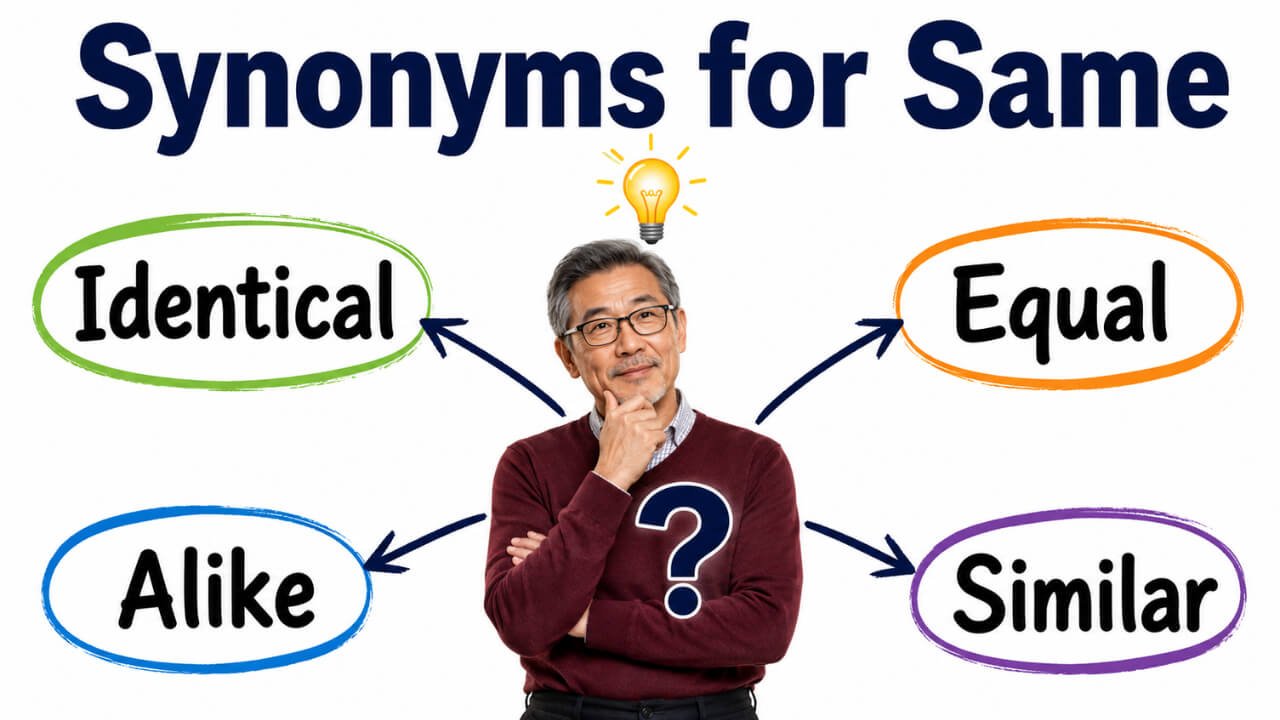
Quick Answer: Common synonyms for same include identical, equal, equivalent, matching, alike, unchanged, consistent, uniform, shared, and selfsame. Use identical when two things have no noticeable differences, equal for amounts or value, equivalent for meaning or function, matching for appearance, alike for general similarity, unchanged for something that remains as before, consistent for repeated quality, uniform for a common standard, and shared when something belongs to or affects several people.
Pronunciation and Word Details
Word: Same
Pronunciation: /seɪm/
Part of Speech: Adjective, pronoun, adverb, and noun
Meaning: Not different, unchanged, equal, or referring to one particular person or thing.
US Pronunciation:
UK Pronunciation:
What Does “Same” Mean?
Same means not different from another person, thing, idea, condition, amount, or time. It most commonly works as an adjective, as in “the same answer,” but it can also function as a pronoun, noun, or adverb in certain sentence patterns.
As an adjective, same describes two or more things that are identical or closely connected.
Example: We chose the same color for both rooms.
As a pronoun, it replaces a previously mentioned idea or thing.
Example: Her opinion changed, but mine remained the same.
As an adverb in informal expressions, same can show agreement or a shared feeling.
Example: I feel the same about the decision.
Same may describe identity, equality, similarity, continuity, repetition, or shared experience. The intended meaning depends on the surrounding sentence.
Meaning, Tone, and Context of “Same”
Same is a neutral and widely used word. It appears naturally in casual conversation, formal writing, academic discussion, business communication, descriptions, comparisons, and everyday instructions.
In casual speech, same often expresses agreement or a shared reaction.
Example: I thought the same when I heard the news.
In formal writing, more precise alternatives such as identical, equivalent, consistent, or unchanged may communicate the intended meaning more clearly.
Example: Both reports reached equivalent conclusions.
The tone of same is usually factual rather than emotional. However, expressions such as “the same old problem” can sound tired, critical, or frustrated.
In technical and academic contexts, same may be too broad. Writers often need to explain whether two things are identical in appearance, equal in value, equivalent in function, or merely similar.
When and How to Use “Same”
For Exact Identity
Use same when two references point to one person, object, place, or idea.
Example: We were speaking about the same person.
Here, same means that both speakers were referring to one particular individual.
For Matching Qualities
Use same when two or more things share an identical color, shape, design, pattern, or appearance.
Example: The two curtains are the same shade of blue.
For Equal Amounts
Same can describe equal numbers, prices, measurements, or quantities.
Example: Both containers hold the same amount of water.
In formal writing, equal may be more precise when discussing measurable quantities.
For an Unchanged Condition
Use same when a situation, condition, opinion, or object has not changed.
Example: The room looks the same after the repairs.
For Shared Experiences
Same can show that several people have a common feeling, experience, concern, or goal.
Example: We are facing the same challenge.
For Repeated Actions
Use same when an action, event, mistake, or pattern happens again without meaningful variation.
Example: He follows the same routine every morning.
For Agreement
Same can show that one person shares another person’s view or reaction.
Example: I feel the same about the proposed changes.
For Comparison
Same is useful when comparing two people, objects, or situations.
Example: These two methods produce the same result.
Best Synonyms for Same
Identical: Exactly alike in every important or visible detail.
Example: The twins wore identical jackets.
Equal: Having the same amount, value, size, level, or status.
Example: The two teams received equal funding.
Equivalent: Having the same meaning, value, purpose, or effect.
Example: The two qualifications are considered equivalent.
Matching: Having colors, patterns, designs, or features that go together.
Example: She bought matching curtains and cushions.
Alike: Similar in appearance, character, or behavior.
Example: The two brothers think alike.
Similar: Sharing important qualities without being completely identical.
Example: The two proposals contain similar ideas.
Unchanged: Remaining in the condition that existed before.
Example: The schedule remained unchanged.
Consistent: Staying at the same quality, level, style, or standard over time.
Example: Her performance has been consistent throughout the year.
Uniform: Following one common form, pattern, appearance, or standard.
Example: The company introduced uniform procedures for every department.
Shared: Used, experienced, owned, or understood by more than one person.
Example: Their shared goal helped them cooperate.
50 Synonyms for Same with Short Meanings
- Identical: Exactly alike in every detail.
- Equal: Having the same amount, value, or level.
- Equivalent: Equal in meaning, purpose, value, or effect.
- Matching: Having features or designs that correspond.
- Alike: Similar in appearance, nature, or behavior.
- Similar: Sharing important qualities or characteristics.
- Indistinguishable: So alike that no difference can be noticed.
- Selfsame: The exact person or thing already mentioned.
- Exact: Completely correct or identical in detail.
- Corresponding: Matching something else in position, function, or form.
- Comparable: Similar enough to allow a fair comparison.
- Parallel: Developing or existing in a similar way.
- Uniform: Having one consistent form or standard.
- Consistent: Remaining steady in quality, style, or behavior.
- Unchanged: Not altered from an earlier condition.
- Unaltered: Left in its original form or state.
- Constant: Continuing without meaningful change.
- Stable: Remaining steady and unlikely to change.
- Fixed: Set in one position, form, or condition.
- Repeated: Done, said, or experienced again.
- Recurring: Happening repeatedly over time.
- Duplicate: An exact or nearly exact copy.
- Replicated: Reproduced in the same form.
- Common: Shared by several people or things.
- Shared: Used, felt, or owned by more than one person.
- Mutual: Experienced or held equally by different people.
- Joint: Belonging to or involving two or more parties.
- Collective: Shared by all members of a group.
- Single: Referring to one particular person or thing.
- One: Referring to a single shared identity.
- Coinciding: Occurring at the same time or position.
- Coincident: Existing or happening together.
- Conforming: Following the same rule, form, or standard.
- Compatible: Able to work together because of shared qualities.
- Congruent: Agreeing or corresponding closely in form or meaning.
- Analogous: Similar in function, structure, or relationship.
- Related: Connected through shared qualities or ideas.
- Familiar: Recognized because it has been experienced before.
- Usual: Regularly experienced or commonly expected.
- Standard: Following an accepted and consistent form.
- Customary: Usually done in a particular way.
- Regular: Following a repeated or established pattern.
- Routine: Happening in the ordinary repeated way.
- Persistent: Continuing in the same condition or behavior.
- Continuous: Continuing without interruption.
- Invariable: Never changing in form or quality.
- Unvarying: Remaining the same without variation.
- Even: Equal, balanced, or level throughout.
- Level: Equal in height, amount, position, or status.
- One and the same: Referring to exactly one person or thing.
Read Also:
Synonyms for Consider
Synonyms for Same by Context
When Same Means Identical
Identical, exact, indistinguishable, and selfsame describe people or things that are completely alike or refer to one exact identity.
Identical Example: The two documents contain identical wording.
Exact Example: This is the exact design we approved.
Indistinguishable Example: The copies were almost indistinguishable from the original.
Selfsame Example: The selfsame issue appeared in both reports.
Use these words only when the differences are absent or extremely minor. Similar is better when some differences still exist.
When Same Means Equal in Value
Equal, equivalent, comparable, and corresponding are useful when discussing numbers, amounts, meanings, functions, or positions.
Equal Example: Each participant received an equal amount of time.
Equivalent Example: The replacement offers equivalent performance.
Comparable Example: Their responsibilities are comparable.
Corresponding Example: Enter each total in the corresponding column.
Equal focuses on quantity or status. Equivalent emphasizes similar value, purpose, or effect.
When Same Means Unchanged
Unchanged, unaltered, constant, stable, and fixed describe something that continues in its previous condition.
Unchanged Example: The final deadline remains unchanged.
Unaltered Example: The original wording was left unaltered.
Constant Example: The temperature remained constant.
Stable Example: Demand stayed stable throughout the month.
Fixed Example: The payment amount is fixed.
These alternatives are more precise than same when describing continuity.
When Same Means Shared
Common, shared, mutual, joint, and collective describe experiences, responsibilities, goals, interests, or possessions involving several people.
Common Example: The two groups have a common purpose.
Shared Example: They developed a shared understanding.
Mutual Example: Their success depended on mutual trust.
Joint Example: The departments issued a joint statement.
Collective Example: The decision reflected the collective opinion of the group.
When Same Means Similar
Alike, similar, matching, comparable, parallel, and analogous describe noticeable likeness without requiring total identity.
Alike Example: The two paintings look alike.
Similar Example: Their writing styles are similar.
Matching Example: He selected matching chairs.
Parallel Example: The two projects followed parallel paths.
Analogous Example: The human heart performs a function analogous to a pump.
Another Word for Same
Identical is often the strongest single replacement for same when two things have no meaningful differences. However, the best alternative depends on whether the sentence concerns appearance, quantity, meaning, function, experience, or an unchanged condition.
Original: Both forms contain the same information.
Better Option: Both forms contain identical information.
Original: The two products have the same value.
Better Option: The two products have equal value.
Original: Her opinion is still the same.
Better Option: Her opinion remains unchanged.
Original: We have the same objective.
Better Option: We have a shared objective.
When Not to Use “Same”
Same should not be used when it hides an important difference or creates uncertainty. A more specific synonym can make a sentence clearer and more accurate.
When Two Things Are Only Similar
Do not use same when two things share some qualities but are not identical.
Weak: The two houses have the same design, although one has an extra floor.
Better: The two houses have similar designs, although one has an extra floor.
When Discussing Numbers or Measurements
Equal is usually clearer than same for exact amounts.
Weak: Both containers have the same weight.
Better: Both containers have equal weight.
When Describing Meaning or Function
Equivalent is often more accurate when two expressions or systems produce a similar meaning or effect.
Weak: The two phrases have the same meaning in this context.
Better: The two phrases have equivalent meanings in this context.
When Describing Appearance
Identical or matching may provide a clearer visual description.
Weak: They wore the same shirts.
Better: They wore matching shirts.
The first sentence may suggest that they shared one physical shirt. The second clearly means that they wore separate shirts with the same design.
When Repetition Sounds Dull
Using same repeatedly can make writing feel vague or monotonous.
Weak: The same problem happened for the same reason during the same process.
Better: The recurring problem resulted from an identical error in the repeated process.
When Change Is the Main Point
Use unchanged, constant, or stable when emphasizing continuity.
Weak: The price stayed the same throughout the year.
Better: The price remained stable throughout the year.
Words Commonly Confused With Same
Same vs Similar: Same suggests no meaningful difference, while similar means that two things share qualities but still have differences.
Same vs Identical: Same is a general everyday word. Identical is stronger and states that two things match completely or almost completely.
Same vs Equal: Same may describe identity, appearance, condition, or experience. Equal usually refers to amount, value, size, level, status, or rights.
Same vs Equivalent: Same suggests direct identity. Equivalent means that two things have equal value, meaning, purpose, or effect even when their forms differ.
Same vs Alike: Same can come before a noun, as in “the same idea.” Alike usually appears after a verb, as in “the ideas are alike.”
Same vs Matching: Same may suggest one shared identity, while matching usually describes separate objects that coordinate in appearance or design.
Same vs Consistent: Same describes a direct lack of difference. Consistent describes steadiness across time, actions, results, or standards.
Which Synonym Should You Choose?
Choose identical when two objects, statements, designs, or results have no meaningful differences.
Choose equal when discussing quantities, measurements, prices, rights, levels, scores, or status.
Choose equivalent when two words, qualifications, methods, or systems have the same meaning, value, purpose, or effect.
Choose matching when separate objects have coordinated colors, patterns, shapes, or designs.
Choose alike in casual speech when people or things resemble one another.
Choose similar when some shared qualities exist but the items are not completely identical.
Choose unchanged when a plan, opinion, condition, rule, or schedule remains as it was before.
Choose consistent for performance, behavior, quality, style, evidence, or standards that remain steady.
Choose uniform when every member, item, or process follows one common form or standard.
Choose shared when several people have a common experience, responsibility, interest, concern, or goal.
Choose comparable in reports and essays when two things are similar enough to be assessed together.
Choose corresponding when discussing related sections, positions, numbers, parts, or entries.
Real Life Examples of “Same” in Sentences
Original: We arrived at the same conclusion.
Better Option: We arrived at an identical conclusion.
Original: The two bags are the same size.
Better Option: The two bags are equal in size.
Original: Their responsibilities are the same.
Better Option: Their responsibilities are equivalent.
Original: She wore the same color as her sister.
Better Option: She wore a matching color.
Original: The instructions remained the same.
Better Option: The instructions remained unchanged.
Original: We experienced the same problem.
Better Option: We experienced a common problem.
Original: His work has stayed the same in quality.
Better Option: His work has remained consistent in quality.
Original: The two neighborhoods look the same.
Better Option: The two neighborhoods look similar.
Original: Everyone followed the same procedure.
Better Option: Everyone followed a uniform procedure.
Original: They have the same interest in language.
Better Option: They have a shared interest in language.
Synonym Groups and Usage Differences
Identity Group
Identical, exact, selfsame, indistinguishable, duplicate, and one and the same express direct identity or an extremely close match.
Use this group when the difference between two references is absent or unimportant.
Example: Both files contain identical data.
Equality Group
Equal, equivalent, even, level, comparable, and congruent express equality in value, amount, status, meaning, or structure.
These words are especially useful in mathematical, academic, financial, legal, and analytical contexts.
Example: The two options provide equivalent benefits.
Similarity Group
Similar, alike, analogous, parallel, matching, and corresponding describe likeness without always suggesting complete identity.
This group works well when differences still exist.
Example: The two studies produced similar findings.
Stability Group
Unchanged, unaltered, constant, stable, fixed, invariable, and unvarying describe a condition that does not change.
These synonyms are useful for plans, prices, opinions, measurements, rules, and physical conditions.
Example: The policy remained unchanged.
Shared Experience Group
Common, shared, mutual, joint, and collective describe something connected to several people or groups.
These words often appear with goals, experiences, interests, responsibilities, concerns, and decisions.
Example: The members accepted collective responsibility.
Repetition Group
Repeated, recurring, routine, regular, usual, and customary describe actions or events that happen in the same way more than once.
Example: The recurring error delayed the process.
Antonyms of Same
The opposite of same changes according to its meaning. Different and distinct oppose identity, unequal opposes equality, changed opposes continuity, and separate opposes shared identity.
Different: Not the same in nature, form, quality, or appearance.
Distinct: Clearly separate or noticeably different.
Unequal: Not equal in amount, value, size, status, or level.
Opposite: Completely different in direction, meaning, or character.
Varied: Containing several different forms, types, or qualities.
Changed: Altered from a previous condition.
Modified: Adjusted or changed in some way.
Separate: Existing apart rather than together or as one.
Individual: Belonging to one person or thing rather than being shared.
Unrelated: Having no meaningful connection.
Inconsistent: Changing in quality, behavior, or standard.
Contrasting: Showing clear and noticeable differences.
Comparison: Same vs Related Words
Same vs Identical
Same is broader and more conversational. Identical is stronger and usually suggests a complete match in appearance, content, structure, or characteristics.
Example With Same: We selected the same design.
Example With Identical: The two documents contain identical designs.
Same vs Similar
Same suggests that no meaningful difference exists. Similar recognizes likeness while allowing differences.
Example With Same: Both keys open the same door.
Example With Similar: The two keys have similar shapes.
Same vs Equal
Same can describe identity, condition, experience, or appearance. Equal mainly describes quantity, value, level, rights, or status.
Example With Same: We chose the same route.
Example With Equal: The sections are equal in length.
Same vs Equivalent
Same often refers to one identity or form. Equivalent describes equal meaning, value, purpose, or effect despite possible differences in form.
Example With Same: They used the same method.
Example With Equivalent: The alternative method produces an equivalent result.
Same vs Alike
Same usually comes before a noun or follows linking expressions. Alike commonly appears after a verb and describes resemblance.
Example With Same: They have the same attitude.
Example With Alike: They think alike.
Same vs Matching
Same may be unclear when referring to clothing or separate objects. Matching clearly shows that different items have coordinated designs.
Example With Same: They bought the same chairs.
Example With Matching: They bought matching chairs.
Same vs Consistent
Same describes direct identity or lack of change. Consistent emphasizes reliability and steadiness over time.
Example With Same: Her answer stayed the same.
Example With Consistent: Her answers were consistent throughout the interview.
Common Phrases and Expressions With Same
Exactly the Same: Completely identical without any meaningful difference.
The Same Thing: One idea, object, action, or situation expressed in another way.
At the Same Time: During one shared moment or period.
In the Same Way: By using an identical or similar method.
The Same Person: One particular individual rather than two different people.
The Same Place: One shared location.
The Same as Before: Unchanged from an earlier condition.
All the Same: Despite what has been said or regardless of a difference.
Same Here: An informal expression showing shared feelings or agreement.
The Same Old Story: A familiar and often disappointing situation that keeps happening.
On the Same Page: Sharing the same understanding, plan, or opinion.
One and the Same: Two names or descriptions that refer to one person or thing.
Common Mistakes to Avoid
One common mistake is using same when similar is more accurate. Two objects may share a color, shape, or purpose without being completely identical. In such cases, similar gives the reader a more truthful description.
Another mistake is using same for measurable quantities when equal would be clearer.
Unclear: The two payments were the same.
Clearer: The two payments were equal.
Writers also confuse same and alike. Same normally appears before a noun with the word the.
Incorrect: They bought alike dresses.
Correct: They bought the same dresses.
Correct: Their dresses look alike.
Avoid writing “same like” in standard English. Use “the same as” for direct comparisons.
Incorrect: My answer is the same like yours.
Correct: My answer is the same as yours.
Do not repeat same several times within a short paragraph. Replace it with precise alternatives such as identical, equivalent, unchanged, shared, or consistent.
Be careful with matching. Saying that two people wore “the same jacket” can imply that they shared one physical jacket. “Matching jackets” clearly describes two separate jackets with a similar appearance.
Finally, consider the exact relationship you want to describe. Identity, equality, similarity, continuity, and shared experience are different meanings. Selecting the right synonym makes the sentence more precise.
Conclusion
Understanding synonyms for same helps writers describe identity, equality, similarity, continuity, and shared experiences more accurately. Choose identical for a complete match, equal for amounts or value, equivalent for meaning or function, matching for appearance, and similar when differences still exist. Unchanged and consistent are useful for stable conditions, while common and shared describe connected experiences or goals. The best choice depends on what is being compared and how exact the relationship is.
FAQs About Synonyms for Same
What Is the Best Synonym for Same?
Identical is often the best synonym when two things have no meaningful differences. Equal, equivalent, matching, similar, and unchanged may be better in specific contexts.
Are Same and Identical Always Interchangeable?
No. Identical strongly suggests a complete match, while same can also describe equal amounts, shared experiences, or an unchanged condition.
What Is a Formal Synonym for Same?
Equivalent, identical, corresponding, consistent, and uniform are useful formal alternatives. The correct choice depends on the sentence’s meaning.
What Is Another Word for the Same Amount?
Equal is the clearest replacement when two amounts, measurements, values, or quantities are the same.
What Is the Difference Between Same and Similar?
Same suggests no important difference. Similar means that two things share qualities but are not completely identical.
Can Alike Replace Same?
Alike can replace same when describing resemblance, but the sentence structure usually changes. Write “the objects are alike” rather than “alike objects.”
What Synonym Should Be Used for an Unchanged Situation?
Unchanged is the most direct choice. Stable, constant, fixed, unaltered, and consistent may also work depending on the exact context.
