
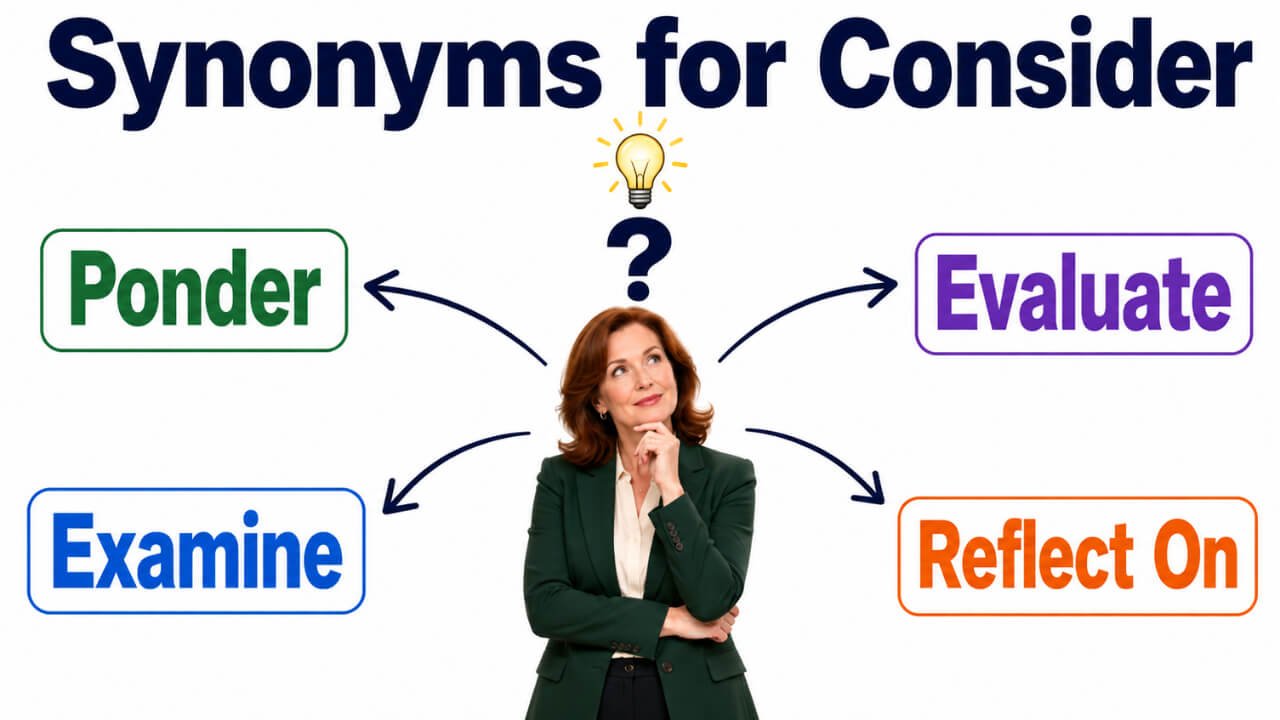
Quick Answer: The best synonyms for consider include contemplate, ponder, evaluate, assess, examine, reflect on, regard, deem, weigh, and take into account. Use contemplate or ponder for careful thought, evaluate or assess in formal writing and reports, and think about in casual speech. Regard and deem are useful when expressing an opinion or judgment. Weigh works well when comparing choices, while take into account is best when a decision must include a specific fact, condition, or detail.
Pronunciation and Word Details
Word: Consider.
Pronunciation: /kənˈsɪdər/
Part of Speech: Verb.
Meaning: To think carefully about something, form an opinion about it, or include it when making a decision.
US Pronunciation:
UK Pronunciation:
What Does “Consider” Mean?
Consider means to think carefully about a subject, possibility, person, or decision.
Consider is mainly used as a verb. It can describe careful thought, evaluation, judgment, opinion, or attention to another person’s needs and feelings.
When consider refers to careful thought, it means examining an idea before reaching a decision.
Example: We should consider every available option before choosing.
When it expresses an opinion, consider means to regard or believe someone or something to have a particular quality.
Example: Many people consider the plan practical.
Consider can also mean including a fact, cost, risk, or condition in a decision.
Example: You must consider the travel expenses when planning the budget.
In polite requests, consider can introduce a possible action without demanding it.
Example: Please consider submitting your application early.
The exact meaning depends on whether the sentence concerns thought, judgment, possibility, comparison, or respect for others.
Meaning, Tone, and Context of “Consider”
Consider usually has a neutral, thoughtful, and polite tone. It suggests that someone is giving attention to an idea rather than making a quick or careless choice.
In formal writing, consider commonly appears in reports, essays, proposals, reviews, instructions, and professional communication. It can introduce an issue that requires analysis.
Example: The report considers the effects of rising costs on small businesses.
In everyday conversation, consider often means think about.
Example: I will consider your suggestion.
The word can also sound polite and respectful when asking someone to review an opportunity or request.
Example: Would you consider joining the committee?
In academic contexts, consider may introduce a topic, argument, factor, or possible interpretation.
Example: The essay considers several explanations for the change.
When used to express an opinion, consider can sound more deliberate than think.
Example: I consider her an experienced leader.
Consider is rarely strongly emotional. Its tone is usually calm, reasonable, and measured.
When and How to Use “Consider”
For Careful Thought: Use consider when someone needs time to think about an idea, problem, or choice.
Example: She will consider the proposal before responding.
For Comparing Options: Use consider when examining several possible choices.
Example: We are considering three locations for the event.
For Making a Judgment: Use consider when expressing how someone views a person, object, or situation.
Example: The team considers the project a success.
For Evaluating Evidence: Use consider in reports, essays, and research when examining facts or arguments.
Example: The review considers all available evidence.
For Including Important Factors: Use consider when a decision must account for costs, risks, needs, or conditions.
Example: The schedule should consider the needs of every participant.
For Discussing Possibilities: Use consider when an action is possible but has not been decided.
Example: They are considering moving to a larger office.
For Showing Respect: Use consider when asking people to think about the feelings or needs of others.
Example: Please consider how your decision may affect the entire group.
For Polite Requests: Use consider to make a suggestion sound less forceful.
Example: Please consider revising the final paragraph.
Best Synonyms for Consider
Contemplate: To think deeply and carefully about something.
Example: She contemplated changing her career.
Ponder: To spend time thinking seriously about a question or possibility.
Example: He pondered the consequences of his decision.
Evaluate: To judge the quality, value, or effectiveness of something.
Example: The committee will evaluate each application.
Assess: To examine something and determine its condition, importance, or value.
Example: The manager assessed the risks before approving the plan.
Examine: To study something closely in order to understand it.
Example: The report examines several possible causes.
Reflect On: To think carefully about a past experience, idea, or decision.
Example: She reflected on the advice before replying.
Regard: To view or think of someone or something in a particular way.
Example: Many readers regard the book as an important work.
Deem: To formally judge or consider something to have a particular quality.
Example: The building was deemed safe for use.
Weigh: To compare the advantages and disadvantages of different choices.
Example: You should weigh the benefits against the possible risks.
Take Into Account: To include a fact or condition when making a decision.
Example: The final decision must take customer needs into account.
50 Synonyms for Consider with Short Meanings
- Contemplate: To think deeply about something.
- Ponder: To think carefully for a period of time.
- Reflect On: To think seriously about an idea or experience.
- Think About: To direct attention toward a subject.
- Think Over: To examine an idea before deciding.
- Mull Over: To think about something slowly and carefully.
- Deliberate On: To discuss or think carefully before deciding.
- Meditate On: To focus deeply on a subject or idea.
- Weigh: To compare advantages, disadvantages, or possibilities.
- Examine: To study something closely.
- Study: To give careful attention to a subject.
- Review: To examine something again or in detail.
- Analyze: To separate information into parts for careful study.
- Assess: To judge the condition, value, or importance of something.
- Evaluate: To determine quality, value, or effectiveness.
- Appraise: To judge the value or quality of something.
- Inspect: To look at something carefully.
- Investigate: To examine facts in order to discover the truth.
- Explore: To examine different ideas or possibilities.
- Scrutinize: To study something very closely.
- Judge: To form an opinion after careful thought.
- Estimate: To make a reasoned judgment about amount or value.
- Give Thought To: To spend time thinking about something.
- Reckon: To think or believe, especially in casual speech.
- Regard: To view someone or something in a particular way.
- View: To hold a particular opinion about something.
- See: To understand or regard something in a certain way.
- Deem: To formally judge something to be a certain way.
- Believe: To accept something as true or likely.
- Suppose: To think that something is probably true.
- Imagine: To form a mental idea of a possibility.
- Assume: To accept something as true without complete proof.
- Recognize: To acknowledge the importance or truth of something.
- Acknowledge: To accept that a fact or condition exists.
- Remember: To keep an important fact in mind.
- Bear in Mind: To remember something while making a decision.
- Keep in Mind: To continue thinking about an important detail.
- Take Into Account: To include a factor in a decision.
- Allow For: To include a possible condition or problem.
- Factor In: To include something as part of a calculation or decision.
- Account For: To include or explain a relevant factor.
- Entertain: To consider an idea or possibility.
- Envisage: To imagine or consider a future situation.
- Plan For: To consider something while preparing.
- Attend To: To give proper attention to something.
- Heed: To pay careful attention to advice or warnings.
- Respect: To consider the rights, needs, or feelings of others.
- Care About: To give importance or attention to something.
- Reconsider: To think about something again.
- Deliberate: To think or discuss carefully before deciding.
Read Also:
Synonyms for Explains
Synonyms for Consider by Context
When Consider Means Think Carefully
Contemplate, ponder, reflect on, think over, mull over, deliberate, and meditate on describe careful or extended thought.
Contemplate often suggests deep and serious thinking. Ponder has a thoughtful and slightly literary tone. Think over and mull over are more conversational.
Example: She contemplated the offer for several days.
Example: I need time to think over your suggestion.
Example: He pondered whether the change would improve the situation.
When Consider Means Evaluate
Evaluate, assess, examine, analyze, review, appraise, inspect, and scrutinize describe careful judgment based on information.
Evaluate focuses on quality or effectiveness. Assess focuses on condition, value, importance, or risk. Analyze involves studying separate parts in detail.
Example: The panel will evaluate the strength of each proposal.
Example: Doctors assessed the patient’s condition.
Example: The researcher analyzed the results carefully.
When Consider Means Regard
Regard, view, see, deem, judge, believe, and reckon describe forming or expressing an opinion about someone or something.
Regard and view are neutral. Deem is more formal and often appears in official or professional writing. Reckon is informal and more common in casual conversation.
Example: Most employees regard the new policy as fair.
Example: The area was deemed suitable for development.
Example: I reckon the journey will take about an hour.
When Consider Means Include a Factor
Take into account, bear in mind, keep in mind, factor in, allow for, account for, and remember describe including an important detail in a decision.
Take into account is common in formal and professional writing. Factor in is more concise and often relates to costs, time, risks, or calculations.
Example: We must take weather conditions into account.
Example: Remember the delivery cost when comparing the prices.
Example: The schedule allows for possible delays.
When Consider Means Explore a Possibility
Entertain, envisage, imagine, explore, suppose, plan for, and think about can describe a possible action or future situation.
Entertain means being willing to think about an idea. Envisage means imagining how a future situation might develop.
Example: The owners are entertaining the idea of expanding the business.
Example: Can you envisage living in a different country?
Example: The group explored several possible solutions.
When Consider Means Show Respect
Respect, heed, care about, attend to, and acknowledge can describe giving proper attention to another person’s needs, rights, feelings, or advice.
Respect emphasizes fair and thoughtful treatment. Heed is most appropriate for advice or warnings.
Example: Good leaders consider the needs of their teams.
Example: Please heed the safety instructions.
Example: The decision should respect the rights of every resident.
Another Word for Consider
Think about is the broadest everyday replacement for consider. It works naturally when discussing an idea, choice, possibility, or problem.
However, the best alternative depends on context. Use evaluate for formal judgment, contemplate for deep thought, regard for an opinion, and take into account for an important factor.
Original: We will consider your proposal.
Better Option: We will evaluate your proposal.
Original: She is considering a career change.
Better Option: She is contemplating a career change.
Original: Many people consider the area safe.
Better Option: Many people regard the area as safe.
Original: Consider the additional costs before deciding.
Better Option: Take the additional costs into account before deciding.
When Not to Use “Consider”
Do not use consider repeatedly when a more precise verb can show the exact type of thought or judgment involved.
Consider can sound vague if readers cannot tell whether someone is examining evidence, comparing choices, expressing an opinion, or thinking about a possibility.
Use analyze for detailed study, evaluate for quality, assess for risk or condition, contemplate for deep thought, and regard for an opinion.
Weak: The team considered the data and considered the possible risks.
Better: The team analyzed the data and assessed the possible risks.
Weak: She considered the offer for several weeks.
Better: She contemplated the offer for several weeks.
Weak: Experts consider the method effective.
Better: Experts regard the method as effective.
Weak: We should consider the price.
Better: We should take the price into account.
Avoid consider when the decision has already been made. The word normally suggests that thought or evaluation is still taking place.
Weak: After signing the agreement, they considered accepting its terms.
Better: Before signing the agreement, they considered accepting its terms.
Consider may also sound too formal in relaxed conversation.
Formal: I will consider where we should eat tonight.
Natural: I will think about where we should eat tonight.
Words Commonly Confused With Consider
Consider vs Contemplate: Consider is broad and can involve brief or careful thought. Contemplate usually suggests deeper or longer reflection.
Consider vs Think: Think is a general word for using the mind. Consider suggests more deliberate attention before forming an opinion or decision.
Consider vs Evaluate: Consider means giving attention to something. Evaluate means judging its quality, value, or effectiveness according to standards.
Consider vs Assess: Consider is broad, while assess focuses on determining condition, importance, risk, or value.
Consider vs Analyze: Consider may involve general thought. Analyze involves examining separate parts or details to understand a subject.
Consider vs Regard: Consider can mean thinking about a subject or viewing it in a particular way. Regard mainly expresses an opinion or attitude.
Consider vs Deem: Consider is suitable in formal and casual contexts. Deem is more formal and usually introduces an official judgment.
Consider vs Reconsider: Consider means thinking about something. Reconsider means thinking about it again, often because circumstances or opinions have changed.
Which Synonym Should You Choose?
Choose contemplate when describing deep, serious, or extended thought.
Choose ponder when someone is carefully thinking about a difficult question.
Choose think about in casual speech and everyday conversation.
Choose evaluate in formal writing when judging quality, success, usefulness, or performance.
Choose assess in reports, reviews, and professional communication when judging risks, needs, conditions, or importance.
Choose analyze in essays and research when studying facts, causes, patterns, or separate parts.
Choose examine when looking closely at evidence, details, or possible explanations.
Choose regard when explaining how a person or subject is viewed.
Choose deem for formal judgments, official decisions, and professional statements.
Choose weigh when comparing advantages, disadvantages, risks, and choices.
Choose take into account when a decision must include a specific fact or condition.
Choose factor in for concise professional writing about costs, time, risks, or practical limitations.
Choose mull over or think over in informal conversation when someone needs time before deciding.
Choose reflect on when discussing past experiences, lessons, actions, or personal development.
Real Life Examples of “Consider” in Sentences
Original: Please consider all the options before making a choice.
Better Option: Please weigh all the options before making a choice.
Original: She is considering applying for a new position.
Better Option: She is contemplating applying for a new position.
Original: The committee considered the quality of each proposal.
Better Option: The committee evaluated the quality of each proposal.
Original: We must consider the possible risks.
Better Option: We must assess the possible risks.
Original: Many people consider him a talented speaker.
Better Option: Many people regard him as a talented speaker.
Original: The researchers considered the available evidence.
Better Option: The researchers examined the available evidence.
Original: Consider the delivery time when placing your order.
Better Option: Take the delivery time into account when placing your order.
Original: He considered the advice before responding.
Better Option: He reflected on the advice before responding.
Original: The manager considered several solutions to the problem.
Better Option: The manager explored several solutions to the problem.
Original: The officials considered the building unsafe.
Better Option: The officials deemed the building unsafe.
Synonym Groups and Usage Differences
Deep Thought Group
Contemplate, ponder, reflect on, meditate on, mull over, and think over describe thoughtful mental attention.
Contemplate and meditate on suggest serious reflection. Mull over and think over sound more relaxed and conversational.
Example: She reflected on what she had learned from the experience.
Evaluation Group
Evaluate, assess, appraise, judge, review, and estimate involve forming a judgment.
Evaluate concerns quality or effectiveness. Assess often concerns condition or risk. Appraise commonly concerns value.
Example: The supervisor evaluated the employee’s performance.
Detailed Examination Group
Analyze, examine, inspect, investigate, study, and scrutinize involve close attention to facts or details.
Scrutinize suggests especially careful examination. Investigate usually seeks an explanation or truth.
Example: The team investigated the cause of the error.
Opinion Group
Regard, view, deem, see, believe, and reckon express how someone thinks about a person, object, or situation.
Deem is formal. Regard and view are neutral. Reckon is informal.
Example: The community regards the park as an important public space.
Decision Group
Weigh, deliberate, explore, entertain, and reconsider relate to choices or possible actions.
Weigh emphasizes comparison. Deliberate suggests careful thought or discussion. Reconsider means reviewing an earlier decision.
Example: The board deliberated before announcing its final choice.
Important Factor Group
Take into account, factor in, allow for, bear in mind, keep in mind, and account for describe including relevant information.
These expressions are useful when discussing costs, time, risks, conditions, and practical needs.
Example: The budget must account for unexpected expenses.
Antonyms of Consider
The opposite of consider depends on whether the word means think carefully, evaluate, include a factor, or show respect.
Ignore: To give no attention to something.
Disregard: To deliberately pay no attention to information or advice.
Dismiss: To reject an idea without giving it serious thought.
Overlook: To fail to notice or consider something important.
Neglect: To fail to give proper attention or care.
Forget: To fail to remember an important fact.
Exclude: To leave something out of consideration.
Reject: To refuse an idea, offer, or possibility.
Disbelieve: To refuse to accept something as true.
Misjudge: To form an incorrect opinion.
Underestimate: To judge something as less important or valuable than it is.
Rush: To act quickly without giving enough thought.
Assume: To accept something without carefully examining the evidence.
Ignore Advice: To refuse to consider guidance or recommendations.
Comparison: Consider vs Related Words
Consider vs Contemplate
Consider is a broad verb that can describe thought, judgment, or evaluation. Contemplate usually suggests deeper and more extended reflection.
Example With Consider: We will consider the request before Friday.
Example With Contemplate: She contemplated leaving her profession and starting again.
Consider vs Evaluate
Consider means giving attention to something. Evaluate means judging its quality, value, or effectiveness.
Example With Consider: The manager will consider the new proposal.
Example With Evaluate: The manager will evaluate whether the proposal is practical.
Consider vs Assess
Consider can refer to any form of careful thought. Assess usually involves judging condition, risk, importance, or need.
Example With Consider: We should consider the condition of the building.
Example With Assess: An engineer will assess the condition of the building.
Consider vs Regard
Consider can mean thinking about something or holding an opinion about it. Regard mainly means viewing someone or something in a particular way.
Example With Consider: She is considering a new career.
Example With Regard: Her colleagues regard her as a skilled professional.
Consider vs Analyze
Consider may involve broad thought. Analyze means examining information in detail to understand its parts, causes, or patterns.
Example With Consider: The researchers considered the results.
Example With Analyze: The researchers analyzed the results to identify patterns.
Common Phrases and Expressions With “Consider”
Consider Carefully: To think seriously before deciding.
Consider the Possibility: To think about whether something might happen or be done.
Consider the Options: To examine the available choices.
Consider the Evidence: To examine facts before forming a judgment.
Consider the Consequences: To think about the possible results of an action.
Consider It Done: An expression meaning that a request will be completed.
Consider Someone Suitable: To judge that a person has the required qualities.
Consider All Factors: To include every important detail in a decision.
Consider Doing Something: To think about taking a particular action.
Consider Yourself Lucky: To recognize that you are in a fortunate position.
Common Mistakes to Avoid
Using Consider With an Infinitive: Consider is normally followed by a noun, a question word, or a verb ending in ing. It is not usually followed by to plus a verb when discussing a possible action.
Incorrect: She is considering to change her job.
Correct: She is considering changing her job.
Using Consider About Unnecessarily: Consider normally takes a direct object, so about is often unnecessary.
Unnatural: We considered about the problem.
Natural: We considered the problem.
Natural Alternative: We thought about the problem.
Repeating Consider Too Often: Replace repeated uses with precise alternatives such as evaluate, assess, examine, regard, or contemplate.
Choosing the Wrong Synonym: Evaluate is not always suitable for personal reflection, and contemplate may sound too serious for a simple everyday choice.
Confusing Consider With Reconsider: Reconsider means to think again about a previous decision, opinion, or plan.
Forgetting the Meaning of Judgment: In a sentence such as “They consider him reliable,” consider means regard or believe, not simply think about.
Using Vague Language: Explain what must be considered whenever the meaning might be unclear.
Vague: We should consider everything.
Clear: We should consider the cost, timing, and possible risks.
Conclusion
The most useful synonyms for consider depend on the intended meaning. Contemplate, ponder, and reflect on describe careful thought, while evaluate, assess, and analyze suit reports, essays, and formal reviews. Regard and deem express an opinion or judgment. Weigh is ideal for comparing choices, and take into account introduces an important factor. Understanding these differences helps you choose clearer language and use synonyms for consider naturally in professional writing, academic work, emails, and everyday conversation.
FAQs About Synonyms for Consider
What is the best synonym for consider?
Think about is the broadest everyday synonym. Contemplate is better for deep thought, while evaluate works best for formal judgment.
What is a formal synonym for consider?
Evaluate, assess, examine, contemplate, and deliberate are useful formal alternatives, depending on the sentence.
What is another word for carefully consider?
Contemplate, ponder, deliberate, scrutinize, and weigh are strong choices for careful consideration.
Can regard replace consider?
Regard can replace consider when the sentence expresses an opinion about someone or something.
Example: They consider her reliable.
Alternative: They regard her as reliable.
What is a synonym for consider in an essay?
Analyze, examine, evaluate, explore, and assess are effective choices in academic writing.
Is think about the same as consider?
The meanings are often similar. Think about is more conversational, while consider usually sounds more deliberate or formal.
What is the opposite of consider?
Ignore, disregard, dismiss, overlook, and neglect are common opposites because they describe failing or refusing to give attention.
