
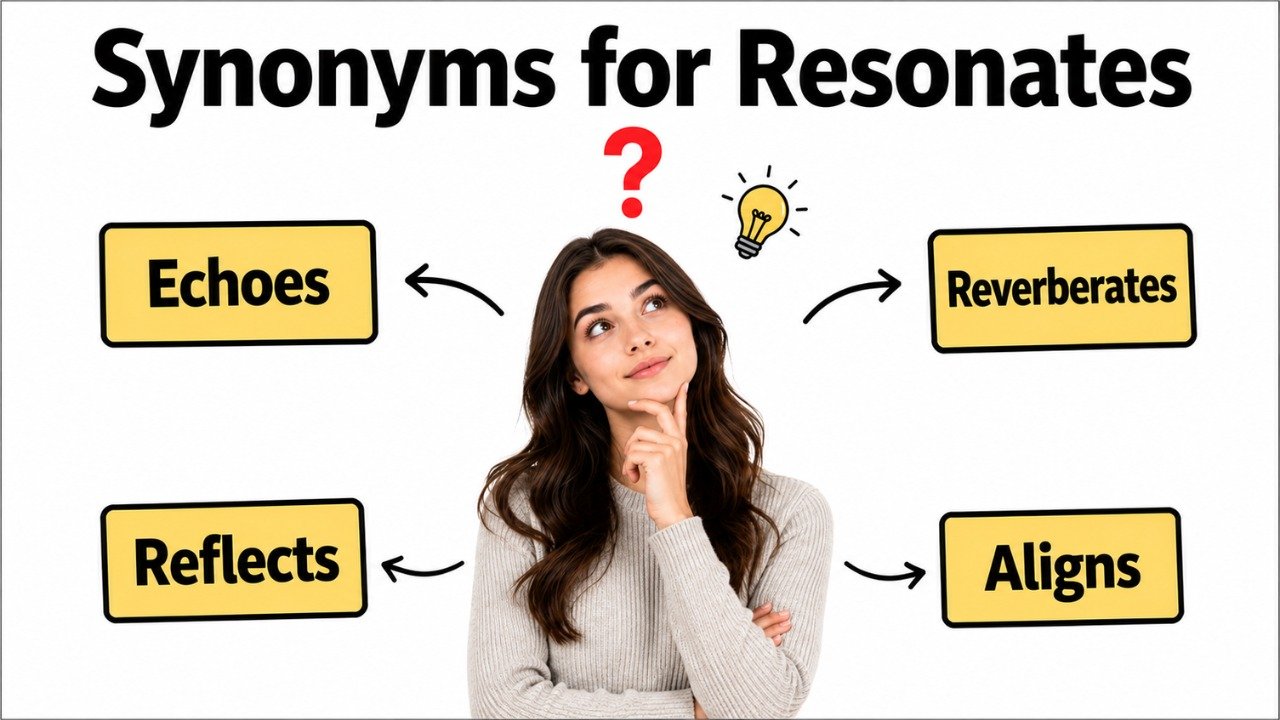
Quick Answer: The best synonyms for resonates include connects, strikes a chord, appeals, speaks to, echoes, rings true, relates, moves, reverberates, and has an impact. Use connects when an idea creates a personal bond, strikes a chord when something produces a strong emotional response, and rings true when a statement feels honest or accurate. Echoes and reverberates work best for repeated sounds or ideas, while appeals suits preferences, interests, and values. The right choice among synonyms for resonates depends on whether the context involves emotion, relevance, agreement, sound, memory, or influence.
Pronunciation and Word Details
Word: Resonates.
Pronunciation: /ˈrezəneɪts/.
Part of Speech: Verb.
Meaning: Produces a strong emotional, intellectual, or physical response, or continues as a deep repeated sound.
US Pronunciation:
UK Pronunciation:
What Does “Resonates” Mean?
Resonates means creates a strong connection, produces a meaningful response, or continues to sound deeply and clearly.
Resonates is the third person singular form of the verb resonate. It is used with singular subjects such as an idea, message, story, sound, experience, or statement.
Emotional meaning: A story resonates when it creates a strong emotional connection.
Intellectual meaning: An argument resonates when it feels relevant, convincing, or meaningful.
Literal sound meaning: A noise resonates when it echoes, vibrates, or continues through a space.
Cultural meaning: A message resonates when it reflects the experiences, beliefs, or concerns of a group.
Personal meaning: An idea resonates with someone when it feels familiar or closely connected to that person’s life.
The word often appears with the preposition “with.”
Example: Her message resonates with young readers.
It may also be used without naming the audience.
Example: The final scene resonates long after the story ends.
Meaning, Tone, and Context of “Resonates”
Resonates usually has a thoughtful, expressive, and positive tone. It is common in formal writing, essays, reviews, speeches, reports, conversations, and discussions about emotions, ideas, art, communication, and sound.
The word can sound more meaningful than simple verbs such as likes, understands, or agrees. It suggests that something reaches a deeper emotional or intellectual level.
Formal tone: Resonates is suitable for essays, reports, professional communication, and analytical writing.
Conversational tone: It can also appear naturally in everyday speech when people discuss ideas, experiences, and feelings.
Emotional tone: The word often describes messages, stories, memories, or experiences that create a personal response.
Academic tone: In essays, resonates may explain why an idea remains relevant across different periods or groups.
Creative tone: Writers use resonates when discussing music, art, literature, films, and performances.
Technical tone: In physics and acoustics, resonates describes an object or system vibrating strongly at a particular frequency.
Neutral tone: The word itself is neutral, but its context is often positive because it usually suggests relevance, understanding, or emotional power.
When and How to Use “Resonates”
For Emotional Connection
Use resonates when a story, message, image, or experience creates a strong emotional reaction.
Example: The poem resonates with readers who have experienced loss.
For Personal Relevance
Use the word when an idea feels closely connected to someone’s life, beliefs, needs, or experiences.
Example: Her advice resonates with people who are beginning new careers.
For Agreement
Resonates can show that a statement matches someone’s opinion or understanding.
Example: His explanation resonates with my own view of the problem.
For Truth or Authenticity
Use resonates when something feels honest, believable, or true to life.
Example: The character’s struggle resonates because it feels genuine.
For Cultural Significance
The word can describe an idea, symbol, or event that has meaning for a community or generation.
Example: The message of unity resonates across different cultures.
For Persuasive Communication
Use resonates when words successfully reach and influence an audience.
Example: Clear language resonates more strongly than complicated promises.
For Lasting Impact
Resonates may describe something that remains in a person’s thoughts or emotions.
Example: The teacher’s final advice still resonates years later.
For Repeated Sound
Use resonates literally when a sound echoes, vibrates, or continues through a space.
Example: The bell resonates throughout the empty hall.
For Music
The word can describe a sound that is full, rich, deep, or prolonged.
Example: The final note resonates inside the concert room.
For Ideas That Reflect Experience
Use resonates when an idea represents what people already feel, know, or have experienced.
Example: The discussion resonates with parents facing similar challenges.
Best Synonyms for Resonates
Connects
Synonym: Connects means creates a personal, emotional, or intellectual relationship.
Example: The speaker’s honest story connects with the audience.
Strikes a Chord
Synonym: Strikes a chord means produces a strong emotional or familiar response.
Example: Her description of childhood strikes a chord with many readers.
Appeals
Synonym: Appeals means attracts someone’s interest, values, emotions, or preferences.
Example: The simple design appeals to people who prefer practical solutions.
Speaks To
Synonym: Speaks to means feels directly relevant or meaningful to someone.
Example: The message speaks to anyone who has faced uncertainty.
Echoes
Synonym: Echoes means repeats a sound, idea, feeling, or experience.
Example: His argument echoes concerns raised by local residents.
Rings True
Synonym: Rings true means sounds honest, believable, or accurate.
Example: Her explanation rings true because it includes realistic details.
Relates
Synonym: Relates means connects with a person’s experience, situation, or understanding.
Example: The story relates to common struggles in family life.
Moves
Synonym: Moves means creates a strong emotional reaction.
Example: The final scene moves even the most reserved viewers.
Reverberates
Synonym: Reverberates means continues to echo physically or remains influential over time.
Example: The decision reverberates throughout the entire community.
Has an Impact
Synonym: Has an impact means produces a noticeable emotional, intellectual, or practical effect.
Example: The campaign has an impact because its message is clear and relevant.
50 Synonyms for Resonates with Short Meanings
- Connects: Creates a meaningful relationship or response.
- Strikes a chord: Produces a strong emotional reaction.
- Appeals: Attracts interest, emotion, or approval.
- Speaks to: Feels personally relevant or meaningful.
- Echoes: Repeats a sound, idea, feeling, or concern.
- Rings true: Sounds honest, believable, or accurate.
- Relates: Connects with an experience or situation.
- Moves: Produces a deep emotional response.
- Touches: Creates a gentle but meaningful feeling.
- Affects: Produces a change in emotion or thought.
- Engages: Holds attention and encourages involvement.
- Inspires: Creates motivation, hope, or new ideas.
- Reverberates: Continues to echo or influence.
- Resounds: Sounds loudly, clearly, or repeatedly.
- Vibrates: Moves rapidly and produces sound.
- Rings: Produces or continues a clear sound.
- Carries: Travels clearly through a space.
- Amplifies: Makes a sound, idea, or effect stronger.
- Harmonizes: Blends naturally or agrees well.
- Aligns: Matches beliefs, values, or goals.
- Corresponds: Closely matches or agrees with something.
- Matches: Fits an experience, idea, or expectation.
- Reflects: Shows or represents an idea or experience.
- Mirrors: Closely copies or represents something.
- Captures: Expresses an idea or feeling effectively.
- Represents: Stands for an experience, belief, or group.
- Embodies: Clearly expresses a quality or idea.
- Evokes: Brings a feeling, memory, or image to mind.
- Stirs: Awakens a strong feeling or response.
- Influences: Affects someone’s thoughts or actions.
- Impresses: Creates a strong or lasting effect.
- Persuades: Causes someone to accept an idea.
- Convinces: Makes an idea seem believable or correct.
- Registers: Becomes noticed or understood.
- Lands: Produces the intended effect on an audience.
- Carries weight: Has importance or influence.
- Makes an impression: Creates a memorable effect.
- Stays with: Remains in someone’s thoughts or feelings.
- Lingers: Continues in memory, feeling, or sound.
- Reminds: Brings a past idea or experience to mind.
- Recalls: Causes someone to remember something similar.
- Feels relevant: Seems connected to the present situation.
- Feels meaningful: Creates personal or emotional significance.
- Feels familiar: Connects with something already known.
- Finds an echo: Receives a similar response or agreement.
- Hits home: Creates a direct and powerful personal response.
- Reaches: Successfully affects or communicates with someone.
- Has meaning: Holds personal, emotional, or intellectual value.
- Has an impact: Produces a noticeable effect.
- Leaves an impression: Remains memorable after the experience ends.
Read Also:
Synonyms for Killer

Synonyms for Resonates by Context
When Resonates Means Creates an Emotional Connection
Connects, strikes a chord, moves, touches, stirs, hits home, and speaks to are strong choices when something causes an emotional response.
Strikes a chord suggests that the subject feels familiar or deeply personal. Moves and touches focus more directly on emotion. Hits home suggests that the message feels especially direct or powerful.
Example: The story strikes a chord with readers who have experienced separation.
Example: Her speech moved everyone in the room.
Example: The final paragraph hits home because it describes a common fear.
When Resonates Means Feels Relevant
Relates, speaks to, feels relevant, connects, aligns, corresponds, and matches work well when an idea applies to someone’s situation.
These alternatives are useful in essays, reports, professional writing, and discussions about shared experiences.
Example: The advice feels relevant to people working in changing industries.
Example: The research aligns with the concerns expressed by teachers.
Example: The discussion speaks to the needs of new parents.
When Resonates Means Sounds True
Rings true, feels authentic, convinces, carries weight, and seems believable describe statements that feel honest or accurate.
Rings true is especially useful when a statement matches real experience. Carries weight suggests importance or credibility.
Example: Her account rings true because it includes both success and failure.
Example: The argument carries weight because it is based on clear evidence.
When Resonates Means Produces Influence
Has an impact, influences, reaches, persuades, engages, impresses, and leaves an impression describe effects on thoughts, feelings, or behavior.
These alternatives are suitable for writing about communication, leadership, education, advertising, public messages, and speeches.
Example: The clear explanation reaches people with different levels of experience.
Example: The speaker’s confidence leaves an impression on the audience.
When Resonates Means Repeats an Idea
Echoes, reflects, mirrors, recalls, represents, and finds an echo describe ideas that resemble or repeat earlier thoughts, experiences, or concerns.
Echoes often suggests similarity rather than exact repetition. Reflects shows that something represents a wider reality.
Example: The report echoes concerns raised during the earlier meeting.
Example: Her experience reflects the difficulties faced by many workers.
When Resonates Means Produces a Lasting Effect
Stays with, lingers, makes an impression, leaves an impression, and reverberates describe something that remains important after the original moment.
Reverberates often suggests that the influence spreads widely or continues for a long period.
Example: The final image lingers in the reader’s memory.
Example: The effects of the decision reverberate throughout the community.
When Resonates Refers to Sound
Echoes, reverberates, resounds, rings, vibrates, carries, and amplifies are useful for literal sound.
Echoes means a sound repeats after reflecting from a surface. Reverberates suggests several repeated sounds blending together. Resounds describes a loud, clear sound filling a place.
Example: The music reverberates through the stone building.
Example: Her voice carries across the large room.
Example: The sound of the drum resounds through the valley.
When Resonates Means Matches Values
Aligns, harmonizes, corresponds, appeals, connects, and embodies describe ideas that fit someone’s values, goals, or identity.
Example: The proposal aligns with the group’s long term priorities.
Example: The message appeals to people who value independence.
Example: Her leadership style embodies fairness and patience.
Another Word for Resonates
Connects is often the best single replacement for resonates in emotional or personal contexts. It is natural, clear, and easy to understand. However, the best alternative depends on whether the sentence describes emotion, agreement, relevance, influence, memory, or sound.
Use strikes a chord for a deep emotional response, rings true for honesty, echoes for repeated ideas, and reverberates for continuing sound or influence.
Original: The story resonates with young adults.
Better Option: The story connects with young adults.
Original: Her description of failure resonates with many readers.
Better Option: Her description of failure strikes a chord with many readers.
Original: The speaker’s warning resonates because it feels realistic.
Better Option: The speaker’s warning rings true because it feels realistic.
Original: The sound resonates throughout the building.
Better Option: The sound reverberates throughout the building.
When Not to Use “Resonates”
Resonates is useful, but it can sound vague, repetitive, overly polished, or inaccurate when a more specific word would communicate the meaning better.
When You Mean Simple Agreement
Resonates suggests a deeper connection than basic agreement. Use agrees, accepts, or supports when the meaning is only approval.
Weak: Her manager resonates with the new schedule.
Better: Her manager agrees with the new schedule.
When You Mean Understanding
Understanding an idea does not always mean forming an emotional connection with it.
Weak: The student resonates with the instructions.
Better: The student understands the instructions.
When You Mean Enjoyment
Something can be enjoyable without feeling personally meaningful.
Weak: The audience resonates with the cheerful music.
Better: The audience enjoys the cheerful music.
When You Mean a Specific Physical Sound
Use echoes, rings, vibrates, or reverberates when you need to explain exactly how a sound behaves.
Weak: The alarm resonates in the hallway.
Better: The alarm echoes through the hallway.
When the Audience Is Unclear
The phrase resonates with audiences may be too broad if the intended group is not identified.
Weak: The message resonates with people.
Better: The message connects with first time parents who feel uncertain.
When Writing About Measurable Results
Resonates describes a response, but it does not explain a specific result.
Weak: The campaign resonates strongly.
Better: The campaign increases participation among younger residents.
When the Word Is Repeated Too Often
Using resonates in every paragraph can make writing sound mechanical.
Weak: The story resonates with readers, the theme resonates with families, and the ending resonates emotionally.
Better: The story connects with readers, the theme reflects family experiences, and the ending leaves a lasting impression.
When a Simpler Word Is Clearer
In casual conversation, connects, feels true, or makes sense may sound more natural.
Weak: That explanation resonates with me.
Better: That explanation makes sense to me.
Words Commonly Confused With Resonates
Resonates vs Relates: Resonates describes the effect that something has on a person. Relates usually describes a connection between two subjects or a person understanding an experience.
Example With Resonates: The message resonates with working parents.
Example With Relates: The message relates to the pressures working parents experience.
Resonates vs Echoes: Resonates means creates a response or continues strongly. Echoes means repeats a sound, idea, or concern.
Example With Resonates: Her speech resonates with the audience.
Example With Echoes: Her speech echoes the concerns of the audience.
Resonates vs Reverberates: Resonates may describe emotional meaning, relevance, or sound. Reverberates usually describes repeated sound or influence that continues and spreads.
Example With Resonates: The story resonates with readers.
Example With Reverberates: The effects of the decision reverberate across the region.
Resonates vs Connects: Resonates suggests a deeper emotional or intellectual response. Connects is broader, simpler, and more conversational.
Example With Resonates: The poem resonates because its message feels timeless.
Example With Connects: The poem connects with readers of different ages.
Resonates vs Appeals: Resonates suggests personal meaning or recognition. Appeals means attracts interest, approval, or preference.
Example With Resonates: The message resonates with people who value tradition.
Example With Appeals: The traditional style appeals to older customers.
Resonates vs Rings True: Resonates describes a strong response. Rings true specifically means sounds honest, accurate, or believable.
Example With Resonates: Her experience resonates with many students.
Example With Rings True: Her explanation rings true because it reflects everyday student life.
Resonates vs Reflects: Resonates describes an effect on an audience. Reflects means shows, represents, or mirrors something.
Example With Resonates: The film resonates with families.
Example With Reflects: The film reflects the challenges many families face.
Resonates vs Resounds: Resonates may be literal or figurative. Resounds usually describes a loud sound filling a place.
Example With Resonates: The message resonates beyond the meeting.
Example With Resounds: The applause resounds throughout the hall.
Which Synonym Should You Choose?
Choose connects when you need a clear and natural word for emotional or intellectual relationships.
Choose strikes a chord when a message creates a deep, familiar, or emotional response.
Choose speaks to when an idea directly addresses someone’s experience, identity, or concern.
Choose rings true when a statement feels honest, believable, or accurate.
Choose appeals when something attracts a person’s preferences, interests, or values.
Choose moves when a story, speech, image, or performance creates a strong emotional reaction.
Choose touches when the emotional response is gentle, sincere, or compassionate.
Choose echoes when an idea repeats or resembles an earlier thought, concern, or experience.
Choose reflects when something represents a wider situation, belief, or social experience.
Choose aligns when an idea matches goals, standards, values, or priorities.
Choose engages when a message captures attention and encourages involvement.
Choose has an impact when discussing a noticeable or measurable effect.
Choose leaves an impression when something remains memorable.
Choose reverberates when sound or influence continues and spreads.
Choose resounds when a loud, clear sound fills an area.
Choose carries when a voice or sound travels clearly through a space.
Choose lands in casual speech when a joke, message, or argument produces its intended effect.
Choose persuades when a message changes someone’s opinion.
Choose resonates in essays and reports when you want to emphasize deeper emotional, intellectual, cultural, or personal relevance.
Real Life Examples of “Resonates” in Sentences
Emotional Story
Original: The story resonates with people who have experienced loneliness.
Better Option: The story strikes a chord with people who have experienced loneliness.
Workplace Message
Original: The manager’s message resonates with new employees.
Better Option: The manager’s message connects with new employees.
Honest Explanation
Original: Her explanation resonates because it describes the situation honestly.
Better Option: Her explanation rings true because it describes the situation honestly.
Shared Concern
Original: The report resonates with concerns raised by local families.
Better Option: The report echoes concerns raised by local families.
Personal Values
Original: The proposal resonates with people who value simple living.
Better Option: The proposal appeals to people who value simple living.
Cultural Experience
Original: The novel resonates across different generations.
Better Option: The novel speaks to readers across different generations.
Lasting Advice
Original: His advice still resonates years after the conversation.
Better Option: His advice still stays with me years after the conversation.
Strong Influence
Original: The decision resonates throughout the organization.
Better Option: The effects of the decision reverberate throughout the organization.
Musical Sound
Original: The final note resonates through the hall.
Better Option: The final note reverberates through the hall.
Social Relevance
Original: The discussion resonates with current public concerns.
Better Option: The discussion reflects current public concerns.
Synonym Groups and Usage Differences
Emotional Connection Group
Connects, strikes a chord, moves, touches, stirs, and hits home describe emotional responses.
Connects is broad and natural. Strikes a chord suggests recognition and emotion. Moves describes a powerful feeling, while touches usually suggests a gentle emotional reaction.
Example: The final scene moves the audience because its message strikes a chord.
Relevance Group
Speaks to, relates, feels relevant, aligns, corresponds, and matches describe a connection to a situation, value, or experience.
Speaks to emphasizes direct personal meaning. Aligns is more formal and often refers to goals or values. Corresponds suggests a close match between facts or ideas.
Example: The proposal aligns with public needs and speaks to concerns about safety.
Authenticity Group
Rings true, feels authentic, convinces, and carries weight describe honesty, truth, or credibility.
Rings true focuses on believability. Carries weight suggests importance or authority. Convinces emphasizes successful persuasion.
Example: The explanation rings true because the supporting argument carries weight.
Influence Group
Has an impact, influences, reaches, persuades, impresses, and engages describe effects on an audience.
Engages means gains attention and participation. Persuades changes an opinion. Reaches means successfully communicates with someone.
Example: The presentation engages the audience and influences how they view the issue.
Reflection Group
Echoes, reflects, mirrors, recalls, represents, and embodies describe similarity or representation.
Echoes suggests repetition. Mirrors suggests a close similarity. Embodies means clearly expresses a quality or idea.
Example: The character embodies courage and reflects the experiences of many young people.
Lasting Effect Group
Stays with, lingers, leaves an impression, makes an impression, and reverberates describe continuing influence.
Lingers often refers to a memory, thought, feeling, smell, or sound. Reverberates suggests that effects continue to spread.
Example: The closing sentence lingers in the mind and leaves a lasting impression.
Sound Group
Echoes, reverberates, resounds, rings, vibrates, carries, and amplifies describe sound.
Echoes means a sound repeats. Reverberates suggests several reflected sounds continuing together. Carries means the sound travels clearly.
Example: The singer’s voice carries across the hall while the final note reverberates.
Antonyms of Resonates
The opposite of resonates depends on whether the word refers to emotion, relevance, agreement, influence, or sound.
Fails to connect: Does not create a meaningful response.
Alienates: Causes people to feel separated or excluded.
Repels: Creates dislike or rejection.
Confuses: Prevents clear understanding.
Misses the mark: Fails to produce the intended effect.
Falls flat: Produces little interest, emotion, or response.
Feels irrelevant: Does not connect with the subject or audience.
Contradicts: Expresses an opposing idea.
Conflicts: Fails to match beliefs, values, or facts.
Clashes: Disagrees strongly or fits poorly.
Disconnects: Creates separation rather than connection.
Leaves people unmoved: Produces no emotional reaction.
Fades: Gradually becomes weaker or less noticeable.
Dies away: Slowly becomes silent.
Is muted: Has reduced sound, strength, or effect.
Is forgotten: Does not remain in memory.
Comparison: Resonates vs Related Words
Resonates vs Connects
Resonates suggests a deep emotional, intellectual, or personal effect. Connects is broader and often sounds more natural in everyday language.
Example With Resonates: The message resonates with people who have faced rejection.
Example With Connects: The message connects with people from different backgrounds.
Resonates vs Strikes a Chord
Resonates is flexible and can describe relevance, sound, or influence. Strikes a chord focuses mainly on a strong emotional or familiar response.
Example With Resonates: The story resonates with older readers.
Example With Strikes a Chord: The story strikes a chord with readers who remember similar experiences.
Resonates vs Echoes
Resonates describes the effect something creates. Echoes describes repetition or similarity.
Example With Resonates: The argument resonates with the audience.
Example With Echoes: The argument echoes ideas discussed earlier.
Resonates vs Rings True
Resonates means creates a meaningful response. Rings true means sounds believable, honest, or realistic.
Example With Resonates: Her experience resonates with many parents.
Example With Rings True: Her description of parenting rings true.
Resonates vs Appeals
Resonates suggests deeper personal meaning. Appeals suggests attraction, interest, or preference.
Example With Resonates: The message resonates with people seeking change.
Example With Appeals: The simple plan appeals to busy workers.
Resonates vs Reflects
Resonates describes a response. Reflects describes representation.
Example With Resonates: The book resonates with young adults.
Example With Reflects: The book reflects the challenges young adults face.
Resonates vs Reverberates
Resonates can refer to emotion, meaning, relevance, or sound. Reverberates usually describes continuing sound or influence.
Example With Resonates: The message resonates throughout the community.
Example With Reverberates: The consequences reverberate throughout the community.
Resonates vs Relates
Resonates describes how something affects an audience. Relates describes how subjects connect or how a person understands an experience.
Example With Resonates: The theme resonates with modern readers.
Example With Relates: The theme relates to modern concerns.
Common Phrases and Expressions With Resonates
Resonates With Me: Feels personally meaningful or relevant.
Resonates With Readers: Creates a strong response among people reading a text.
Resonates With the Audience: Connects emotionally or intellectually with listeners or viewers.
Resonates Deeply: Produces a powerful and lasting response.
Resonates Emotionally: Creates a strong feeling or personal reaction.
Resonates Strongly: Has a clear and significant impact.
Resonates Across Generations: Remains meaningful to people of different ages.
Resonates With Experience: Matches what someone has personally lived through.
Resonates With Values: Aligns with a person’s principles or beliefs.
Resonates Long Afterward: Continues to influence thoughts or emotions after the original moment.
Common Mistakes to Avoid
Using the Wrong Subject Form
Resonates is used with a singular third person subject. Use resonate with plural subjects or with I, you, we, and they.
Incorrect: These ideas resonates with students.
Correct: These ideas resonate with students.
Correct: This idea resonates with students.
Forgetting the Preposition With
When naming the person or group affected, resonate is commonly followed by with.
Incorrect: The message resonates young readers.
Correct: The message resonates with young readers.
Using Resonates for Simple Understanding
Understanding information is not always the same as feeling a meaningful connection.
Incorrect: The instructions resonate with the students.
Better: The students understand the instructions.
Confusing Resonates With Relates
Resonates describes an effect, while relates usually describes a connection.
Unclear: The topic resonates to current events.
Better: The topic relates to current events.
Better: The topic resonates with people affected by current events.
Using Resonates When Appeals Is More Accurate
Resonates suggests personal significance, while appeals refers to attraction or preference.
Weak: The bright design resonates with children.
Better: The bright design appeals to children.
Using Resonates for Every Positive Reaction
People can enjoy, like, understand, or approve of something without forming a deep connection.
Weak: The meal resonates with the guests.
Better: The meal appeals to the guests.
Repeating the Word Too Often
Too much repetition makes writing sound artificial.
Weak: The message resonates with readers because the story resonates emotionally and its theme resonates widely.
Better: The message connects with readers because the story creates emotion and its theme remains widely relevant.
Using a Vague Audience
Identify the group whenever possible.
Weak: The idea resonates with everyone.
Better: The idea resonates with people who value flexible working arrangements.
Confusing Literal and Figurative Meanings
Choose sound related synonyms for physical noise and emotional synonyms for personal reactions.
Literal: The bell reverberates through the hall.
Figurative: The message strikes a chord with the audience.
Using Resonates Without Evidence
In formal writing, explain why or how something resonates.
Weak: The article resonates with readers.
Better: The article resonates with readers because it addresses common concerns about career uncertainty.
Conclusion
Synonyms for resonates help writers describe emotional connection, relevance, truth, influence, and sound more precisely. Use connects for a general personal response, strikes a chord for strong emotion, rings true for honesty, and speaks to for direct relevance. Echoes works for repeated ideas, while reverberates suits continuing sound or influence. Appeals is best for preferences, and aligns fits values or goals. Choosing the right alternative makes each sentence clearer and shows exactly how a message, idea, experience, or sound produces its effect.
FAQs About Synonyms for Resonates
What Is the Best Synonym for Resonates?
Connects is the best general synonym for resonates when something creates a personal or emotional response. The exact replacement depends on context.
What Is a Formal Synonym for Resonates?
Aligns, corresponds, reflects, has an impact, and reverberates are suitable formal alternatives. Choose the word that matches the intended meaning.
What Is an Emotional Synonym for Resonates?
Strikes a chord, moves, touches, stirs, speaks to, and hits home are strong emotional alternatives.
What Does “Resonates With Me” Mean?
It means an idea, message, story, or experience feels personally meaningful, familiar, true, or relevant.
Can “Relates” Replace “Resonates”?
Sometimes, but the meanings are different. Relates describes a connection, while resonates describes the response created by that connection.
What Is a Synonym for Resonates in Sound?
Echoes, reverberates, resounds, rings, vibrates, and carries are suitable alternatives for literal sound.
Is “Strikes a Chord” the Same as “Resonates”?
The expressions are similar in emotional contexts. Strikes a chord usually emphasizes a strong personal or familiar feeling, while resonates has broader emotional, intellectual, and literal meanings.
