
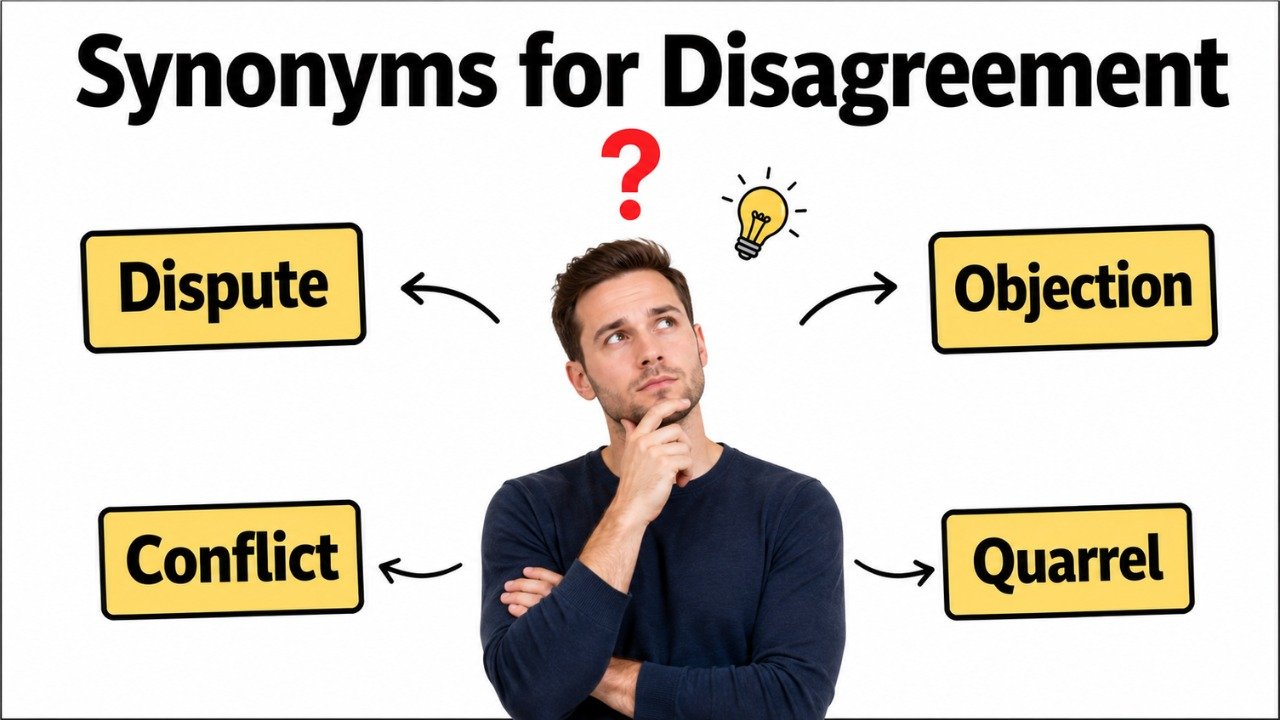
Quick Answer: The best synonyms for disagreement include conflict, dispute, difference, dissent, discord, opposition, debate, clash, controversy, and division. Use difference for a neutral contrast between opinions, dispute for a serious or formal disagreement, and argument for an emotional exchange. Dissent works well when someone publicly rejects a common view. Conflict and clash describe stronger opposition, while debate suggests an organized discussion between people who hold different positions.
Pronunciation and Word Details
Word: Disagreement.
Pronunciation: /ˌdɪsəˈɡriːmənt/.
Part of Speech: Noun.
Meaning: A situation in which two or more people have different opinions, beliefs, wishes, or decisions.
US Pronunciation:
UK Pronunciation:
What Does “Disagreement” Mean?
Disagreement means a difference in opinion, belief, judgment, or intention between two or more people.
The word disagreement is a noun. It can describe a small difference of opinion, a serious personal argument, a formal dispute, or a wider conflict between groups.
In a simple sentence, disagreement often refers to people not sharing the same view.
Example: The team had a disagreement about the new schedule.
In personal situations, disagreement may describe opposing preferences or decisions.
Example: Their disagreement concerned where they should live.
In professional or academic contexts, it can refer to different interpretations, conclusions, or recommendations.
Example: There was considerable disagreement among the researchers about the results.
The word does not always suggest anger. Two people can disagree politely while still respecting each other. However, words such as quarrel, clash, and altercation usually suggest stronger emotions.
Meaning, Tone, and Context of “Disagreement”
Disagreement is generally a neutral word. It states that people do not share the same opinion without automatically suggesting hostility.
Neutral Tone: Disagreement can describe a simple difference between ideas or preferences.
Example: We had a disagreement about which design was clearer.
Formal Tone: The word is common in reports, essays, meetings, negotiations, and professional communication.
Example: The report identifies areas of disagreement between the two departments.
Conversational Tone: It can also be used naturally in everyday speech.
Example: We had a small disagreement about dinner plans.
Emotional Context: A disagreement may become emotional when it involves personal beliefs, relationships, money, or important decisions.
Example: Their disagreement became more serious when neither person was willing to compromise.
Academic Context: In academic writing, disagreement often refers to competing interpretations, theories, or conclusions.
Example: Scholarly disagreement continues over the meaning of the historical document.
Public Context: In public discussions, disagreement may describe opposition between communities, organizations, leaders, or groups.
Example: Public disagreement grew after the policy was announced.
When and How to Use “Disagreement”
For Different Opinions
Use disagreement when people hold different views but are not necessarily angry.
Example: There was some disagreement about the best way to solve the problem.
For Workplace Decisions
Use disagreement when colleagues, managers, or teams support different plans.
Example: The disagreement was resolved during the weekly meeting.
For Personal Relationships
Use disagreement for differences between friends, relatives, partners, or family members.
Example: A minor disagreement should not damage a strong friendship.
For Formal Disputes
Use disagreement when two sides cannot accept the same terms, interpretation, or decision.
Example: The contract disagreement delayed the project.
For Academic Discussion
Use disagreement when experts reach different conclusions about evidence or theory.
Example: The study caused disagreement among specialists in the field.
For Polite Opposition
Use disagreement when expressing a different opinion respectfully.
Example: She expressed her disagreement without criticizing anyone personally.
For Public Controversy
Use disagreement when a subject creates divided opinions among many people.
Example: The proposal led to widespread disagreement within the community.
For Negotiations
Use disagreement when the participants cannot agree on conditions, costs, responsibilities, or deadlines.
Example: A disagreement over payment terms interrupted the negotiations.
Best Synonyms for Disagreement
Conflict: A serious opposition between ideas, interests, people, or groups.
Example: The conflict began when both departments requested control of the same resources.
Dispute: A formal or serious disagreement about facts, rights, responsibilities, or decisions.
Example: The payment dispute was settled through discussion.
Difference: A neutral variation between opinions, beliefs, or preferences.
Example: Their difference was minor and easily resolved.
Dissent: Open disagreement with an accepted opinion, decision, or authority.
Example: Several members expressed dissent during the meeting.
Discord: A lack of harmony caused by disagreement or tension.
Example: The decision created discord within the group.
Opposition: Active disagreement with an idea, proposal, person, or action.
Example: The plan faced strong opposition from local residents.
Debate: A discussion in which people present different opinions or arguments.
Example: The proposal started a lively debate among the students.
Clash: A strong and often emotional disagreement between people or ideas.
Example: Their clash over leadership styles affected the entire team.
Controversy: Public disagreement about an important or sensitive subject.
Example: The announcement caused considerable controversy.
Division: A separation between people who support different beliefs or positions.
Example: The issue created deep division within the community.
50 Synonyms for Disagreement with Short Meanings
- Conflict: Serious opposition between people, ideas, or interests.
- Dispute: A formal or continuing disagreement.
- Argument: An exchange of opposing opinions, often with emotion.
- Difference: A neutral variation in opinion or belief.
- Difference of Opinion: A situation in which people think differently.
- Dissent: Public or open disagreement with a common view.
- Discord: Lack of harmony between people or groups.
- Opposition: Active resistance to an idea, plan, or decision.
- Debate: An organized discussion of opposing viewpoints.
- Clash: A strong disagreement between people or ideas.
- Controversy: Widespread public disagreement about a subject.
- Division: Separation caused by opposing views.
- Dissension: Serious disagreement within a group.
- Friction: Tension caused by differences or repeated disagreement.
- Strife: Bitter or continuing conflict.
- Contention: Heated disagreement or a disputed claim.
- Variance: A formal difference between opinions or positions.
- Divergence: A movement toward different views or conclusions.
- Disunity: Lack of agreement or cooperation within a group.
- Disaccord: Absence of agreement or harmony.
- Objection: A statement showing disagreement or disapproval.
- Protest: A public expression of disagreement.
- Resistance: Refusal to accept or support something.
- Contradiction: Direct opposition between statements or ideas.
- Incompatibility: Inability of ideas, goals, or people to work together.
- Misunderstanding: A disagreement caused by incorrect interpretation.
- Altercation: A loud or angry verbal disagreement.
- Quarrel: An emotional argument between people.
- Squabble: A minor and often unnecessary argument.
- Feud: A long lasting and bitter conflict.
- Rift: A serious break in a relationship caused by disagreement.
- Impasse: A situation in which no agreement can be reached.
- Standoff: A situation in which opposing sides refuse to move.
- Deadlock: A complete failure to reach a decision.
- Confrontation: A direct and often tense disagreement.
- Disputation: Formal argument or debate about a subject.
- Disapproval: A negative opinion about an action or idea.
- Demur: A polite expression of doubt or objection.
- Exception: A formal objection to a statement or decision.
- Conflict of Views: A situation involving opposing opinions.
- Opposing View: An opinion that differs from another position.
- Contrary Opinion: A belief that directly challenges another belief.
- Dissenting Opinion: A formally expressed opposing judgment.
- Difference in Judgment: A contrast in decisions or conclusions.
- Lack of Agreement: The absence of a shared decision.
- Lack of Consensus: Failure of a group to reach general agreement.
- Point of Contention: A particular subject causing disagreement.
- Bone of Contention: An issue that repeatedly causes arguments.
- Split: A division between people with opposing positions.
- Schism: A serious division within a group or organization.
Read Also:
Synonyms for Resonates
Synonyms for Disagreement by Context
When Disagreement Means a Neutral Difference
Use these words when people think differently but remain calm and respectful.
Difference: A neutral contrast between opinions.
Example: We have a difference about how the project should be organized.
Difference of Opinion: A polite phrase for opposing views.
Example: The issue was simply a difference of opinion.
Variance: A formal word for a difference between positions.
Example: There was some variance in the experts’ recommendations.
Divergence: A gradual separation between ideas or conclusions.
Example: The data produced a divergence of opinion among the researchers.
When Disagreement Means a Serious Dispute
Use these words when the disagreement involves important decisions, rights, responsibilities, or formal claims.
Dispute: A serious disagreement requiring resolution.
Example: The ownership dispute continued for several months.
Conflict: Strong opposition between people, interests, or goals.
Example: A conflict developed between the two departments.
Contention: A disagreement that produces argument or tension.
Example: The budget became a major point of contention.
Impasse: A situation in which discussion cannot move forward.
Example: The negotiations reached an impasse.
When Disagreement Means an Emotional Argument
Use these alternatives when anger, frustration, or personal tension is involved.
Argument: A direct exchange of opposing opinions.
Example: They had an argument about household responsibilities.
Quarrel: A personal and emotional disagreement.
Example: A small misunderstanding led to a quarrel.
Altercation: A loud or aggressive verbal conflict.
Example: The discussion turned into an altercation.
Squabble: A minor argument about something unimportant.
Example: The children had a squabble over the last piece of cake.
When Disagreement Means Public Opposition
Use these words for public, political, social, or organizational disagreement.
Dissent: Open disagreement with an accepted decision.
Example: The committee allowed members to express dissent.
Opposition: Active resistance to a proposal or policy.
Example: The proposal received strong opposition.
Protest: A visible expression of disagreement.
Example: The decision caused public protest.
Controversy: Broad public disagreement about a sensitive issue.
Example: The change created controversy throughout the community.
When Disagreement Causes Division
Use these words when opposing views damage unity or relationships.
Discord: A lack of harmony among people.
Example: Poor communication created discord within the team.
Division: Separation into opposing sides.
Example: The issue caused division among the members.
Dissension: Strong disagreement inside a group.
Example: Internal dissension weakened the organization.
Rift: A serious break in a relationship.
Example: The disagreement created a lasting rift between the friends.
Another Word for Disagreement
The best general replacement for disagreement is difference. It is neutral, natural, and suitable when people simply hold different opinions.
However, the best alternative depends on the situation. Use dispute for formal conflict, argument for an emotional exchange, dissent for open opposition, and debate for a structured discussion.
Original: The managers had a disagreement about the deadline.
Better Option: The managers had a difference of opinion about the deadline.
Original: The two businesses could not resolve their disagreement.
Better Option: The two businesses could not resolve their dispute.
Original: The members voiced their disagreement with the decision.
Better Option: The members voiced their dissent against the decision.
Original: The topic produced disagreement among the students.
Better Option: The topic produced a lively debate among the students.
When Not to Use “Disagreement”
Do not use disagreement when a more precise word can explain the intensity, cause, or type of conflict.
When the Exchange Is Angry
Disagreement may sound too mild when people are shouting or behaving aggressively.
Weak: The two drivers had a disagreement in the parking area.
Better: The two drivers had a heated altercation in the parking area.
When the Matter Is Formal
Use dispute when the issue concerns contracts, money, ownership, responsibilities, or legal rights.
Weak: The businesses entered a disagreement about the payment.
Better: The businesses entered a dispute about the payment.
When the Discussion Is Organized
Use debate when people are formally presenting opposing arguments.
Weak: The students held a disagreement about the proposal.
Better: The students held a debate about the proposal.
When Someone Publicly Opposes a Decision
Use dissent when a person openly rejects the majority opinion.
Weak: Several members recorded their disagreement.
Better: Several members recorded their dissent.
When No Decision Can Be Reached
Use deadlock or impasse when both sides refuse to change their positions.
Weak: The negotiations ended in disagreement.
Better: The negotiations ended in a deadlock.
When the Problem Is Confusion
Use misunderstanding when the difference resulted from unclear communication.
Weak: Their disagreement happened because the instructions were unclear.
Better: Their misunderstanding happened because the instructions were unclear.
Words Commonly Confused With Disagreement
Disagreement vs Argument: Disagreement means people have different opinions. Argument usually suggests a direct exchange and may involve anger.
Example With Disagreement: We had a disagreement about the best route.
Example With Argument: We had an argument because neither person would listen.
Disagreement vs Debate: Disagreement is the difference itself, while debate is a structured discussion of that difference.
Example With Disagreement: There is disagreement about the proposal.
Example With Debate: The proposal became the subject of a public debate.
Disagreement vs Conflict: Disagreement may be calm and limited. Conflict is usually stronger and may involve competing goals, interests, or actions.
Example With Disagreement: The colleagues disagreed about the presentation style.
Example With Conflict: The departments were in conflict over control of the budget.
Disagreement vs Dispute: Disagreement is a broad and neutral term. Dispute often refers to a serious or formal matter.
Example With Disagreement: We had a disagreement about the meeting time.
Example With Dispute: The companies had a dispute over unpaid invoices.
Disagreement vs Dissent: Disagreement can be private or informal. Dissent is usually open opposition to an accepted decision or majority view.
Example With Disagreement: She explained her disagreement privately.
Example With Dissent: She publicly expressed her dissent.
Disagreement vs Misunderstanding: Disagreement involves genuinely different opinions. Misunderstanding happens when someone interprets information incorrectly.
Example With Disagreement: They understood the facts but reached different conclusions.
Example With Misunderstanding: They argued because one person misunderstood the instructions.
Which Synonym Should You Choose?
Choose difference when the situation is neutral and the people simply hold separate opinions.
Choose difference of opinion when you want to sound polite, balanced, or respectful.
Choose disagreement in general writing when the intensity or type of opposition does not need further explanation.
Choose dispute when writing about contracts, payments, ownership, responsibilities, formal claims, or serious negotiations.
Choose argument when describing an emotional verbal exchange between people.
Choose conflict when interests, goals, responsibilities, or actions directly oppose one another.
Choose debate when people discuss opposing positions in an organized or thoughtful way.
Choose dissent when someone publicly rejects a majority opinion, official decision, or accepted belief.
Choose opposition when people actively resist a proposal, plan, policy, or action.
Choose controversy when a subject creates widespread public disagreement.
Choose clash when personalities, ideas, values, or leadership styles strongly oppose each other.
Choose discord when disagreement damages harmony within a relationship, team, or community.
Choose impasse when negotiations stop because neither side will compromise.
Choose deadlock when a group cannot make a final decision.
Choose misunderstanding when unclear communication causes the problem.
Choose quarrel when describing a personal and emotional disagreement.
Choose squabble when the argument is minor or unimportant.
Real Life Examples of “Disagreement” in Sentences
Original: The family had a disagreement about their holiday plans.
Better Option: The family had a difference of opinion about their holiday plans.
Original: The companies could not settle their disagreement over payment.
Better Option: The companies could not settle their dispute over payment.
Original: The employees expressed disagreement with the new rule.
Better Option: The employees expressed opposition to the new rule.
Original: The discussion ended in a serious disagreement.
Better Option: The discussion ended in a serious argument.
Original: The researchers reported disagreement about the meaning of the results.
Better Option: The researchers reported a divergence of opinion about the meaning of the results.
Original: The decision caused disagreement within the committee.
Better Option: The decision caused dissension within the committee.
Original: Their disagreement damaged a close friendship.
Better Option: Their conflict damaged a close friendship.
Original: There was disagreement among residents about the construction plan.
Better Option: There was controversy among residents about the construction plan.
Original: The two sides remained in disagreement after several meetings.
Better Option: The two sides remained at an impasse after several meetings.
Original: The students discussed their disagreement about the issue.
Better Option: The students debated the issue and presented their opposing views.
Synonym Groups and Usage Differences
Neutral Difference Group
This group includes difference, difference of opinion, variance, divergence, and contrasting view.
These words describe opposing ideas without suggesting anger or hostility.
Example: The experts had a difference of opinion about the best treatment of the data.
Formal Dispute Group
This group includes dispute, contention, objection, impasse, and deadlock.
These words are useful in negotiations, contracts, workplace reports, and formal discussions.
Example: The payment dispute remained unresolved at the end of the meeting.
Emotional Conflict Group
This group includes argument, quarrel, clash, altercation, and squabble.
These alternatives describe direct verbal conflict and different levels of emotion.
Example: A minor disagreement developed into an unnecessary quarrel.
Public Opposition Group
This group includes dissent, opposition, protest, resistance, and controversy.
These words describe visible rejection of a policy, decision, belief, or proposal.
Example: The announcement faced immediate public opposition.
Division Group
This group includes discord, dissension, disunity, rift, and schism.
These words focus on the damage disagreement causes within a group or relationship.
Example: Repeated leadership disputes created serious discord within the organization.
Ongoing Conflict Group
This group includes friction, strife, feud, confrontation, and conflict.
These words suggest that disagreement has become serious, repeated, or difficult to resolve.
Example: Years of unresolved conflict created tension between the neighbors.
Discussion Group
This group includes debate, disputation, discussion, and exchange of views.
These words focus on communicating opposing opinions rather than personal hostility.
Example: The classroom debate allowed everyone to present a different perspective.
Antonyms of Disagreement
The opposite of disagreement depends on whether the word refers to opinions, relationships, decisions, or cooperation.
Agreement: A shared opinion, decision, or arrangement.
Consensus: General agreement among members of a group.
Accord: Formal or peaceful agreement.
Harmony: A state of peaceful cooperation and understanding.
Unity: The condition of being joined by common goals or beliefs.
Approval: Acceptance or support for an idea or action.
Acceptance: Willingness to agree with or receive something.
Concurrence: Formal agreement with an opinion or decision.
Alignment: A shared position, purpose, or direction.
Understanding: Mutual knowledge and acceptance between people.
Cooperation: The act of working together toward a common goal.
Consent: Permission or agreement given willingly.
Compromise: An agreement reached when both sides make concessions.
Reconciliation: The restoration of friendly relations after conflict.
Unanimity: Complete agreement among all members of a group.
Comparison: Disagreement vs Related Words
Disagreement vs Difference
Disagreement refers to opposing opinions or decisions. Difference is broader and can describe any contrast, even when no conflict exists.
Example With Disagreement: Their disagreement concerned how the money should be spent.
Example With Difference: There is a clear difference between the two designs.
Disagreement vs Dispute
Disagreement is neutral and can be minor. Dispute suggests a more serious or formal conflict that may require negotiation.
Example With Disagreement: We had a disagreement about the starting time.
Example With Dispute: The landlord and tenant had a dispute about repair costs.
Disagreement vs Argument
Disagreement describes different opinions. Argument emphasizes the exchange of opposing statements and may suggest anger.
Example With Disagreement: The friends had a polite disagreement.
Example With Argument: The friends had a loud argument.
Disagreement vs Conflict
Disagreement may involve only ideas. Conflict can involve opposing interests, actions, goals, or responsibilities.
Example With Disagreement: The editors disagreed about the article title.
Example With Conflict: The editors were in conflict over who had final authority.
Disagreement vs Debate
Disagreement is a state of not agreeing. Debate is an organized discussion in which different positions are presented.
Example With Disagreement: There is disagreement about the proposed change.
Example With Debate: The proposed change was examined during a formal debate.
Disagreement vs Dissent
Disagreement may be private, mild, or informal. Dissent usually involves openly rejecting an established opinion or official decision.
Example With Disagreement: He mentioned his disagreement during a private conversation.
Example With Dissent: He published a dissenting opinion explaining his objections.
Disagreement vs Opposition
Disagreement means not sharing the same view. Opposition involves active resistance or an effort to prevent something.
Example With Disagreement: Several residents disagreed with the plan.
Example With Opposition: Several residents organized opposition to the plan.
Disagreement vs Controversy
Disagreement can involve only two people. Controversy usually involves widespread public debate and strong competing opinions.
Example With Disagreement: The partners had a disagreement about the advertisement.
Example With Controversy: The advertisement created public controversy.
Disagreement vs Misunderstanding
Disagreement results from genuinely different beliefs or preferences. Misunderstanding results from confusion or incorrect interpretation.
Example With Disagreement: They understood each other but preferred different solutions.
Example With Misunderstanding: They selected different dates because the message was unclear.
Common Phrases and Expressions With Disagreement
Minor Disagreement: A small difference that is usually easy to resolve.
Serious Disagreement: An important conflict involving strongly held views.
Strong Disagreement: Firm opposition to an opinion, decision, or proposal.
Open Disagreement: Opposition that is expressed publicly or directly.
Fundamental Disagreement: A conflict involving basic principles or beliefs.
Personal Disagreement: A difference between individuals rather than organizations or ideas.
Political Disagreement: Opposition involving policies, leadership, or public decisions.
Professional Disagreement: A difference in judgment between colleagues or specialists.
Area of Disagreement: A subject on which people do not share the same view.
Point of Disagreement: A particular detail that causes opposing opinions.
Disagreement About Something: A difference concerning a subject, idea, or decision.
Disagreement Over Something: A conflict concerning control, responsibility, money, or another disputed matter.
Express Disagreement: To communicate that you do not accept an opinion or decision.
Resolve a Disagreement: To find a solution that ends the conflict.
Agree to Disagree: To accept that two sides will continue holding different opinions.
Common Mistakes to Avoid
Using Disagreement for Every Type of Conflict
Disagreement is broad, but it may not clearly show the seriousness of a situation.
Use argument for an emotional exchange, dispute for a formal issue, and conflict for stronger opposition.
Unclear: The countries had a disagreement over the border.
Clearer: The countries had a serious border dispute.
Confusing Disagreement With Misunderstanding
A disagreement means people understand the issue but hold different opinions. A misunderstanding means someone has interpreted the information incorrectly.
Incorrect: Our disagreement was caused by reading the wrong date.
Better: Our misunderstanding was caused by reading the wrong date.
Using Argument When the Situation Is Calm
Argument can sound emotional. Use difference of opinion when the conversation is respectful.
Too Strong: The colleagues had an argument about the font size.
Better: The colleagues had a difference of opinion about the font size.
Using Debate for a Private Conflict
Debate usually suggests a structured exchange of ideas. It may sound unnatural for an angry personal situation.
Unnatural: The couple had a debate about unpaid bills.
Better: The couple had an argument about unpaid bills.
Repeating Disagreement Too Often
Repeated use of the same word can make writing sound dull or imprecise.
Repetitive: The disagreement caused another disagreement, and the second disagreement increased the original disagreement.
Improved: The initial difference led to an argument, and the conflict became more difficult to resolve.
Choosing a Synonym Without Considering Intensity
Difference is mild, disagreement is neutral, argument is emotional, and conflict is strong. Select the word that matches the seriousness of the situation.
Weak: The violent confrontation was a small difference.
Better: The violent confrontation was a serious conflict.
Using Disagreeance in Formal Writing
Disagreeance exists but is uncommon and often sounds unnatural. Disagreement is the standard and widely accepted noun.
Unnatural: There was disagreeance among the members.
Better: There was disagreement among the members.
Forgetting the Correct Preposition
Use disagreement about when discussing a general subject. Use disagreement over when discussing something contested, such as money, authority, or ownership.
Example With About: They had a disagreement about the proposal.
Example With Over: They had a disagreement over control of the property.
Conclusion
The most useful synonyms for disagreement include difference, dispute, conflict, argument, dissent, opposition, debate, discord, and controversy. Difference suits neutral opinions, while dispute works for formal conflicts involving money, rights, or responsibilities. Argument and quarrel describe emotional exchanges, while dissent and opposition express rejection of a decision or belief. Choosing the right synonym depends on the seriousness, setting, and cause of the disagreement. A precise word helps readers understand whether the situation is calm, formal, public, personal, or difficult to resolve.
FAQs About Synonyms for Disagreement
What Is the Best Synonym for Disagreement?
Difference is the best neutral synonym. Dispute is better for a formal conflict, while argument suits an emotional exchange.
What Is a Polite Word for Disagreement?
Difference of opinion is a polite and respectful alternative. It shows that people think differently without suggesting anger.
What Is a Stronger Word for Disagreement?
Conflict, clash, confrontation, and dispute are stronger alternatives. They suggest greater tension or more serious opposition.
Is Dispute the Same as Disagreement?
Not exactly. Disagreement is a broad term, while dispute usually refers to a serious, continuing, or formal conflict.
What Is a Formal Synonym for Disagreement?
Dissent, variance, contention, dispute, and divergence are useful formal alternatives, depending on the context.
What Is a Synonym for a Small Disagreement?
Difference, minor dispute, difference of opinion, and squabble can describe a small disagreement. Squabble often suggests an unimportant argument.
What Is the Opposite of Disagreement?
Agreement is the most direct opposite. Other antonyms include consensus, harmony, accord, unity, acceptance, and concurrence.
