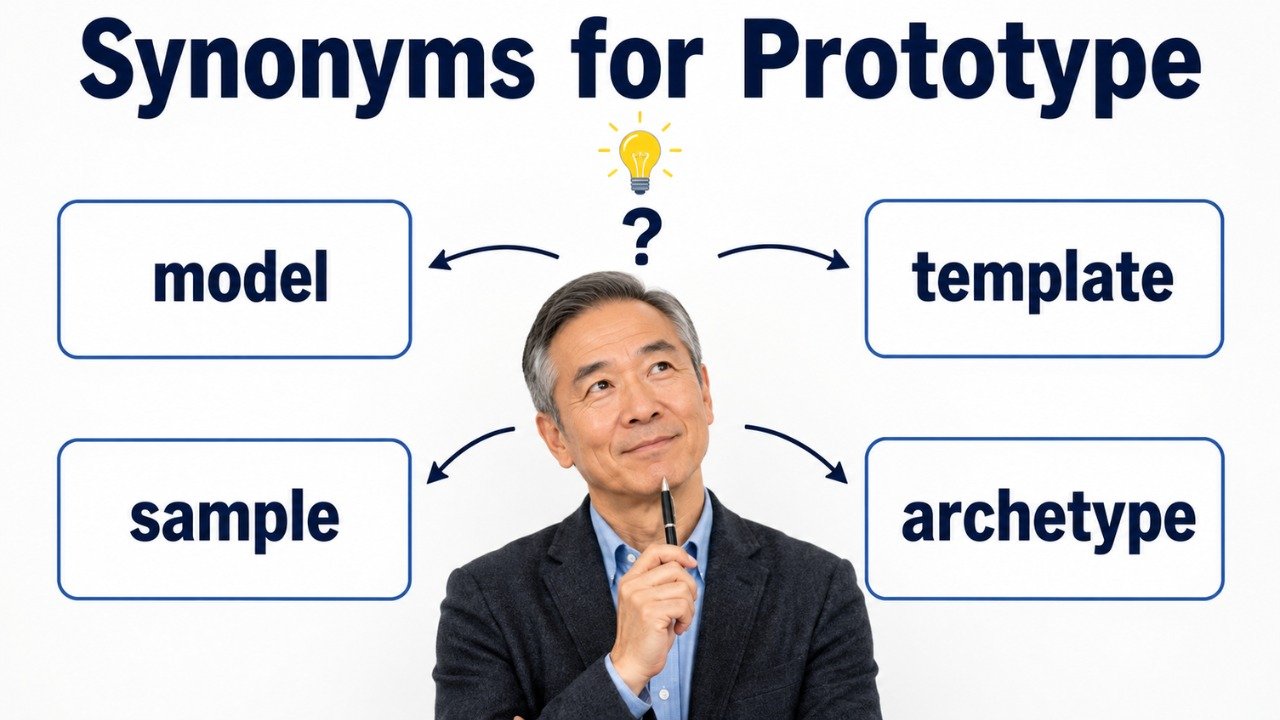
Quick Answer: Common synonyms for prototype include model, sample, mockup, pattern, archetype, blueprint, pilot, test version, demonstration model, and proof of concept. Use model for a physical or conceptual representation, sample for an example made for evaluation, mockup for a visual or structural representation, pilot for an early version tested before wider use, and proof of concept when the goal is to show that an idea can work. Archetype is better when prototype means the original or typical example of a class.
Pronunciation and Word Details
Word: Prototype
Pronunciation: /ˈproʊtətaɪp/
Part of Speech: Noun and verb
Meaning: An early, original, or experimental version of something created to test, demonstrate, or represent a final design.
US Pronunciation:
UK Pronunciation:
What Does “Prototype” Mean?
Prototype means an early or original version of a product, system, design, idea, or object that is created before the final version.
As a noun, prototype commonly refers to something built for testing, evaluation, demonstration, or improvement.
Example: The engineers created a prototype before beginning full production.
The word can also describe the first or typical example from which later versions develop.
Example: The early machine became the prototype for several later designs.
As a verb, prototype means to create an experimental or preliminary version of something.
Example: The design team prototyped several layouts before choosing the final one.
Prototype appears in engineering, product design, software development, manufacturing, architecture, research, education, and everyday discussions about new ideas.
The exact meaning depends on context. A physical prototype may be a working object, while a digital prototype may be an interactive representation. In another context, prototype can mean the original example of a broader type or category.
Meaning, Tone, and Context of “Prototype”
Prototype is a neutral and often technical word. It is common in professional, academic, engineering, design, manufacturing, and development contexts.
In technical writing, prototype usually refers to an early version created to test function, structure, performance, or usability.
Example: The prototype was tested under several operating conditions.
In design contexts, prototype may refer to a visual, physical, or interactive version that allows people to review how something may look or work.
Example: The designer presented an interactive prototype to the project team.
In manufacturing, a prototype may be produced before large scale production begins.
Example: The factory evaluated the prototype before approving the final design.
In general conversation, prototype can simply mean an early model.
Example: This is only a prototype, so the final version may look different.
Prototype can also have a more abstract meaning. It may describe the earliest, most representative, or original example of a particular type.
Example: The structure became a prototype for later buildings of the same style.
When and How to Use “Prototype”
For Early Product Development
Use prototype when describing an early product created before the finished version.
Example: The company tested the prototype before making the final product.
For Design Testing
Prototype is useful when a design is created so that its appearance, structure, or function can be evaluated.
Example: The team built a prototype to test the new control layout.
For Engineering
Use prototype for an experimental machine, device, component, or system that is evaluated before wider production.
Example: The engineers improved the prototype after discovering a structural weakness.
For Software and Digital Design
Prototype can describe an early digital version used to test navigation, interaction, layout, or user experience.
Example: The developers created a prototype to explore the new interface.
For Demonstrating an Idea
Use prototype when something is created to demonstrate how an idea might work.
Example: The prototype helped the team explain the concept to decision makers.
For Testing Feasibility
A prototype can help determine whether an idea is practical or technically possible.
Example: The researchers used the prototype to test whether the mechanism could operate reliably.
For an Original Example
Prototype can also refer to an original example that becomes the basis for later versions.
Example: The first device served as the prototype for an entire series.
Best Synonyms for Prototype
Model
Synonym: Model means a representation or version created to show the structure, appearance, or function of something.
Example: The team built a working model of the new device.
Sample
Synonym: Sample means an example produced for testing, inspection, evaluation, or demonstration.
Example: The manufacturer prepared a sample before starting production.
Mockup
Synonym: Mockup means a representation created mainly to show appearance, layout, or structure.
Example: The designer presented a mockup of the new interface.
Pattern
Synonym: Pattern means an original form or example that can be followed when producing similar versions.
Example: The first design became a pattern for later models.
Archetype
Synonym: Archetype means an original, typical, or ideal example of a particular type.
Example: The early structure became an archetype for later designs.
Pilot
Synonym: Pilot means an initial version, project, or program tested before wider introduction.
Example: The organization launched a pilot before expanding the system.
Test Version
Synonym: Test version means an early version created specifically for evaluation and experimentation.
Example: The team reviewed the test version before approving further development.
Demonstration Model
Synonym: Demonstration model means a version designed to show how a product or system looks or operates.
Example: The demonstration model helped explain the proposed mechanism.
Proof of Concept
Synonym: Proof of concept means an early demonstration created to show that an idea or method can work.
Example: The researchers developed a proof of concept before building a complete system.
Trial Version
Synonym: Trial version means a preliminary version used for testing before final release or production.
Example: The trial version revealed several problems that needed correction.
50 Synonyms for Prototype with Short Meanings
- Model: A representation of how something looks or works.
- Sample: An example produced for testing or inspection.
- Mockup: A visual or structural representation of a planned design.
- Pattern: An example used as a basis for later versions.
- Archetype: An original or typical example of a particular type.
- Pilot: An initial version tested before wider use.
- Test Version: An early version created for evaluation.
- Trial Version: A preliminary form used to test performance.
- Demonstration Model: A model created to show operation or appearance.
- Proof of Concept: A demonstration that an idea can work.
- Working Model: A functional representation used for testing.
- Experimental Model: A version created for experimentation.
- Preliminary Model: An early model developed before the final design.
- Initial Version: The first form of a product, design, or system.
- Early Version: A version created during the beginning stages of development.
- First Version: The earliest completed form of something.
- Original Model: The first model from which later versions develop.
- Reference Model: A model used as a standard or point of comparison.
- Concept Model: A model used to communicate or explore an idea.
- Concept Version: An early version showing a proposed idea.
- Experimental Version: A version created to test new features or methods.
- Development Model: A version used during the development process.
- Design Model: A representation used to evaluate a proposed design.
- Test Model: A model produced specifically for testing.
- Engineering Model: A version created to evaluate technical performance.
- Evaluation Model: A version used to assess quality, function, or suitability.
- Demonstrator: A working example used to demonstrate a concept or technology.
- Trial Model: An early model used for practical testing.
- Draft Model: An unfinished representation prepared for review.
- Draft Version: An early form that may still be revised.
- Conceptual Model: A representation of an idea, structure, or system.
- Representation: Something that shows the form or nature of another thing.
- Example: A particular case that illustrates a larger type or idea.
- Specimen: An example used for examination or study.
- Template: A basic form used as a guide for later versions.
- Blueprint: A detailed plan that guides later construction or development.
- Framework: A basic structure on which a fuller version can be developed.
- Form: A particular version, shape, or arrangement of something.
- Version: One particular form of a developing product or idea.
- Iteration: A revised version produced during repeated development.
- Precursor: An earlier form that comes before a later development.
- Forerunner: An earlier example that anticipates later versions.
- Original: The first form from which copies or later versions develop.
- Exemplar: A representative or typical example.
- Standard: A model or example used as a basis for comparison.
- Paradigm: A representative pattern or example.
- Trial Product: A product created for preliminary testing.
- Development Version: A version produced while something is still being improved.
- Preproduction Model: A model produced shortly before final production.
- Experimental Sample: A sample created to test a proposed idea or design.
Read Also:
Synonyms for Fit
Synonyms for Prototype by Context
When Prototype Means an Early Product
Model, test version, trial version, development model, experimental model, and preproduction model work well when prototype describes an early product.
Example: The team built a development model before finalizing the product.
Example: The preproduction model was examined for possible design problems.
Model is the broadest choice, while preproduction model is more specific to something created shortly before manufacturing.
When Prototype Means a Visual Representation
Mockup, design model, conceptual model, representation, and concept model are useful when the purpose is to show appearance, structure, or layout.
Example: The designer created a mockup to show the proposed screen layout.
Example: The architect presented a concept model during the review.
Mockup usually emphasizes visual appearance more than complete functionality.
When Prototype Means a Functional Test Version
Working model, test model, engineering model, experimental model, and demonstrator are useful when the version actually performs some or all of the intended functions.
Example: The engineers tested the working model under realistic conditions.
Example: The demonstrator showed that the new mechanism could operate successfully.
A working model suggests that at least important functions can be performed.
When Prototype Means Proof That an Idea Works
Proof of concept, demonstrator, experimental version, and concept model are suitable when the main purpose is to prove feasibility.
Example: The team created a proof of concept to show that the technology was practical.
Example: The experimental version confirmed that the proposed method could work.
Proof of concept focuses more on feasibility than appearance or final quality.
When Prototype Means an Original Example
Archetype, pattern, exemplar, original, precursor, forerunner, and paradigm are useful when prototype refers to an original or representative example.
Example: The early structure became an archetype for later buildings.
Example: The machine was a forerunner of modern automated systems.
Archetype emphasizes a typical or original pattern, while forerunner describes something that came earlier and anticipated later developments.
Another Word for Prototype
The best general replacement for prototype is often model because it works naturally in many design, engineering, product, and development contexts.
However, the strongest alternative depends on purpose. Use mockup when appearance matters, proof of concept when demonstrating feasibility, pilot when testing a project or system, and archetype when prototype means an original example.
Original: The engineers tested the prototype before production.
Better Option: The engineers tested the working model before production.
Original: The designer showed us a prototype of the new layout.
Better Option: The designer showed us a mockup of the new layout.
Original: The researchers created a prototype to prove the idea could work.
Better Option: The researchers created a proof of concept to show the idea could work.
Original: The first structure became the prototype for later buildings.
Better Option: The first structure became the archetype for later buildings.
When Not to Use “Prototype”
Prototype can be too broad when a more specific word would explain the purpose of an early version.
If the object only shows appearance and does not function, mockup may be more accurate.
Weak: The designer presented a prototype showing the page colors and layout.
Better: The designer presented a mockup showing the page colors and layout.
When something is created only to prove that an idea is technically possible, proof of concept may communicate the purpose more clearly.
Weak: The researchers built a prototype to show that the method could work.
Better: The researchers built a proof of concept to show that the method could work.
Prototype may also be inappropriate when describing a complete final product.
Weak: Customers purchased the finished prototype.
Better: Customers purchased the finished product.
Avoid calling every preliminary document a prototype. Draft is often more natural for written material.
Weak: She sent a prototype of the report for review.
Better: She sent a draft of the report for review.
Prototype can also sound unnecessarily technical in casual speech.
Weak: I made a prototype of the decoration idea on paper.
Better: I made a simple model of the decoration idea on paper.
If the meaning is an original or ideal example rather than a test version, archetype or exemplar may be more precise.
Weak: The building is a prototype of classical design.
Better: The building is an archetype of classical design.
Words Commonly Confused With Prototype
Prototype vs Model: A prototype is usually an early or experimental version created during development. A model can be any representation of an object, system, idea, or design and does not necessarily come before a final product.
Prototype vs Mockup: A prototype may test function as well as appearance. A mockup usually focuses more on visual appearance, layout, shape, or structure.
Prototype vs Sample: A prototype is generally created during development, while a sample is an example presented for testing, inspection, comparison, or selection.
Prototype vs Proof of Concept: A prototype explores how a product or design may actually work. A proof of concept primarily shows whether an idea or method is feasible.
Prototype vs Pilot: A prototype usually refers to an early product, design, or system. A pilot commonly refers to a trial project, service, program, process, or implementation.
Prototype vs Blueprint: A prototype is an actual or simulated early version. A blueprint is a plan or detailed guide used before construction or development.
Prototype vs Archetype: Prototype can mean an early experimental version, while archetype usually means an original, typical, or ideal example of a category.
Prototype vs Template: A prototype is created for testing or development. A template is a reusable pattern or structure used to create similar items.
Which Synonym Should You Choose?
Choose model when you need a broad and natural replacement for prototype.
Choose mockup when the version mainly demonstrates visual appearance, arrangement, layout, or structure.
Choose sample when an example is produced for inspection, evaluation, or approval.
Choose working model when the early version can perform important intended functions.
Choose test version when the main purpose is evaluation.
Choose trial version when something is being temporarily tested before a wider or final release.
Choose proof of concept when you need to show that an idea, method, or technology can work.
Choose pilot for an early test of a program, process, service, or system before wider implementation.
Choose archetype when prototype means the original or typical example of a category.
Choose precursor or forerunner when describing something that appeared before and influenced later developments.
Choose engineering model in technical reports that focus on mechanical, structural, or functional testing.
Choose concept model in design discussions where an idea is being explored rather than finalized.
For academic or professional writing, model, proof of concept, experimental model, archetype, and precursor can provide greater precision.
For casual conversation, model, sample, early version, or test version often sound more natural.
For reports and technical documents, choose the term that accurately communicates the prototype’s purpose rather than replacing the word only for variety.
Real Life Examples of “Prototype” in Sentences
Original: The engineers built a prototype of the device.
Better Option: The engineers built a working model of the device.
Original: The designer presented a prototype of the new interface.
Better Option: The designer presented a mockup of the new interface.
Original: The researchers developed a prototype to test the idea.
Better Option: The researchers developed a proof of concept to test the idea.
Original: The team created a prototype before beginning production.
Better Option: The team created a preproduction model before beginning production.
Original: The prototype was tested under realistic operating conditions.
Better Option: The test model was evaluated under realistic operating conditions.
Original: They produced a prototype to demonstrate the new mechanism.
Better Option: They produced a demonstrator to show the new mechanism.
Original: The first machine served as a prototype for later versions.
Better Option: The first machine served as a pattern for later versions.
Original: The building became a prototype for later structures.
Better Option: The building became an archetype for later structures.
Original: The developers changed the prototype after receiving feedback.
Better Option: The developers changed the development version after receiving feedback.
Original: A prototype helped the team identify problems before final production.
Better Option: A trial model helped the team identify problems before final production.
Synonym Groups and Usage Differences
Early Development Group
Model, early version, initial version, development model, preliminary model, and experimental version belong to this group.
These terms describe something created during the early stages of development.
Model is broad, while preliminary model emphasizes that major changes may still occur.
Example: The team reviewed the preliminary model before continuing development.
Visual Design Group
Mockup, design model, concept model, representation, and conceptual model focus on showing appearance or structure.
These words are useful when an object does not need to function completely.
Example: The designer prepared a mockup of the proposed layout.
Functional Testing Group
Working model, engineering model, test model, experimental model, and trial model describe versions made to evaluate actual performance.
These terms are useful in engineering, product development, and technical evaluation.
Example: The working model successfully completed the performance test.
Feasibility Group
Proof of concept, demonstrator, experimental version, and concept version are useful when the main purpose is to show whether an idea can work.
They do not necessarily represent the final appearance or full capabilities of the eventual product.
Example: The proof of concept confirmed that the approach was technically possible.
Original Example Group
Archetype, original, exemplar, pattern, paradigm, precursor, and forerunner relate to the sense of prototype as an original or representative example.
These words are more useful in historical, cultural, academic, or descriptive writing.
Example: The early machine became a forerunner of later automated equipment.
Production Preparation Group
Preproduction model, sample, trial product, evaluation model, and development version can describe items created before final manufacturing.
These terms help distinguish testing stages from the finished product.
Example: The manufacturer examined the preproduction model before approving production.
Antonyms of Prototype
The opposite of prototype depends on whether prototype means an unfinished test version, an original model, or an early stage of development.
Antonym: Final Product. The completed version ready for normal use.
Antonym: Finished Product. A product that has completed development and production.
Antonym: Final Version. The completed form after revisions and testing.
Antonym: Production Model. A version manufactured for regular use or sale.
Antonym: Finished Design. A design that has completed the development process.
Antonym: Completed Model. A model that no longer requires major development.
Antonym: Final Form. The completed form of something after changes are finished.
Antonym: Finished Version. A version considered complete and ready for use.
Antonym: End Product. The final result of a development or production process.
Antonym: Completed Product. A fully developed item rather than an experimental version.
Comparison: Prototype vs Related Words
Prototype vs Model
Prototype usually refers to an early version created during development. Model has a broader meaning and can describe any physical, visual, mathematical, or conceptual representation.
Example With Prototype: The engineers tested the prototype before approving production.
Example With Model: The engineers displayed a model to explain the machine’s structure.
Prototype vs Mockup
A prototype may test how something functions, while a mockup usually focuses on how something looks or is arranged.
Example With Prototype: The prototype allowed the team to test the controls.
Example With Mockup: The mockup showed where each control would appear.
Prototype vs Sample
Prototype usually describes an early version under development. Sample means an example selected or produced for evaluation, inspection, demonstration, or comparison.
Example With Prototype: The prototype still required several design changes.
Example With Sample: The manufacturer sent a sample for quality review.
Prototype vs Proof of Concept
Prototype generally explores the design and behavior of a proposed product. Proof of concept focuses mainly on showing that an idea is possible.
Example With Prototype: The prototype helped the team test the complete mechanism.
Example With Proof of Concept: The proof of concept showed that the mechanism could function.
Prototype vs Pilot
Prototype is common for products, designs, and technologies. Pilot is more natural for projects, programs, procedures, services, and systems tested on a limited scale.
Example With Prototype: The team developed a prototype of the device.
Example With Pilot: The organization introduced a pilot of the new training program.
Prototype vs Archetype
Prototype often means an early experimental version, whereas archetype describes an original, typical, or highly representative example.
Example With Prototype: The prototype was modified before production began.
Example With Archetype: The structure became an archetype for later designs.
Prototype vs Blueprint
A prototype is an early version that can be examined or tested. A blueprint is a plan that describes what should eventually be built.
Example With Prototype: The prototype revealed a problem with the mechanism.
Example With Blueprint: The blueprint showed where each component should be placed.
Prototype vs Template
A prototype helps test or develop a new product or idea. A template provides a reusable structure for creating similar items.
Example With Prototype: The designer tested the prototype with several users.
Example With Template: The designer used the template to create several similar pages.
Common Phrases and Expressions With Prototype
Working Prototype: An early version that can perform important intended functions.
Early Prototype: A version created near the beginning of development.
Initial Prototype: The first prototype developed for testing or evaluation.
Physical Prototype: A tangible version that can be handled and examined.
Digital Prototype: A computer based representation used to explore a digital product or system.
Functional Prototype: A version designed to test how something actually works.
Prototype Model: An early model used during design and development.
Prototype Design: A preliminary design created for testing and refinement.
Prototype Testing: The process of evaluating an early version before final production.
Build a Prototype: To create an early version for testing, demonstration, or improvement.
Common Mistakes to Avoid
One common mistake is treating prototype, model, mockup, and sample as exact synonyms in every sentence. They overlap, but their purposes can differ.
A prototype generally belongs to the development process. A model may simply represent something, while a mockup often focuses on appearance.
Unclear: The team created a prototype only to show the colors and page arrangement.
Better: The team created a mockup to show the colors and page arrangement.
Another mistake is using prototype for something that is already complete and in regular production.
Unnatural: Thousands of customers purchased the final prototype.
Better: Thousands of customers purchased the final product.
Do not assume that a prototype must be fully functional. Some prototypes test only one feature, one interaction, or one design idea.
Also avoid using proof of concept when you mean a nearly complete early product. Proof of concept focuses on feasibility rather than full design quality.
Unclear: The almost finished device was merely a proof of concept.
Better: The almost finished device was a functional prototype.
Avoid repeating prototype in every sentence of a technical paragraph.
Repetitive: The prototype was tested, and the prototype was changed after the prototype showed several weaknesses.
Better: The prototype was tested, and the working model was revised after the evaluation revealed several weaknesses.
Do not use archetype when discussing ordinary product testing. Archetype relates to an original or representative pattern, not necessarily an experimental development version.
Unnatural: The engineers tested the archetype before production.
Better: The engineers tested the prototype before production.
Finally, choose words based on function. Ask whether the early version is meant to show appearance, test performance, demonstrate feasibility, guide production, or represent an original pattern. That distinction usually reveals the best synonym.
Conclusion
Useful synonyms for prototype include model, sample, mockup, pilot, archetype, test version, working model, demonstration model, and proof of concept. Model is the broadest alternative, while mockup works best for visual design, proof of concept emphasizes feasibility, and working model suits functional testing. Use pilot for limited trials of programs or systems and archetype when referring to an original or representative example. Choosing the right synonym makes descriptions of design, testing, development, and experimentation clearer and more precise.
FAQs About Synonyms for Prototype
What Is the Best Synonym for Prototype?
Model is the best general synonym for prototype. More precise alternatives include mockup, test version, working model, pilot, and proof of concept.
What Is Another Word for a Product Prototype?
Working model, test model, development model, trial model, and preproduction model can describe a product prototype.
Is Mockup the Same as Prototype?
Not exactly. A mockup usually emphasizes appearance or layout, while a prototype may also test function, interaction, performance, or usability.
What Is a Formal Synonym for Prototype?
Experimental model, preliminary model, development model, proof of concept, archetype, and precursor can work in formal or technical writing.
What Is the Difference Between a Prototype and a Proof of Concept?
A prototype explores how a proposed product or design may work. A proof of concept mainly demonstrates that the underlying idea or method is feasible.
Can Archetype Be a Synonym for Prototype?
Yes, but only when prototype means an original or representative example. Archetype is not usually appropriate for an experimental product being tested.
What Is the Opposite of Prototype?
Common opposites include final product, final version, finished product, production model, completed design, and end product.
