
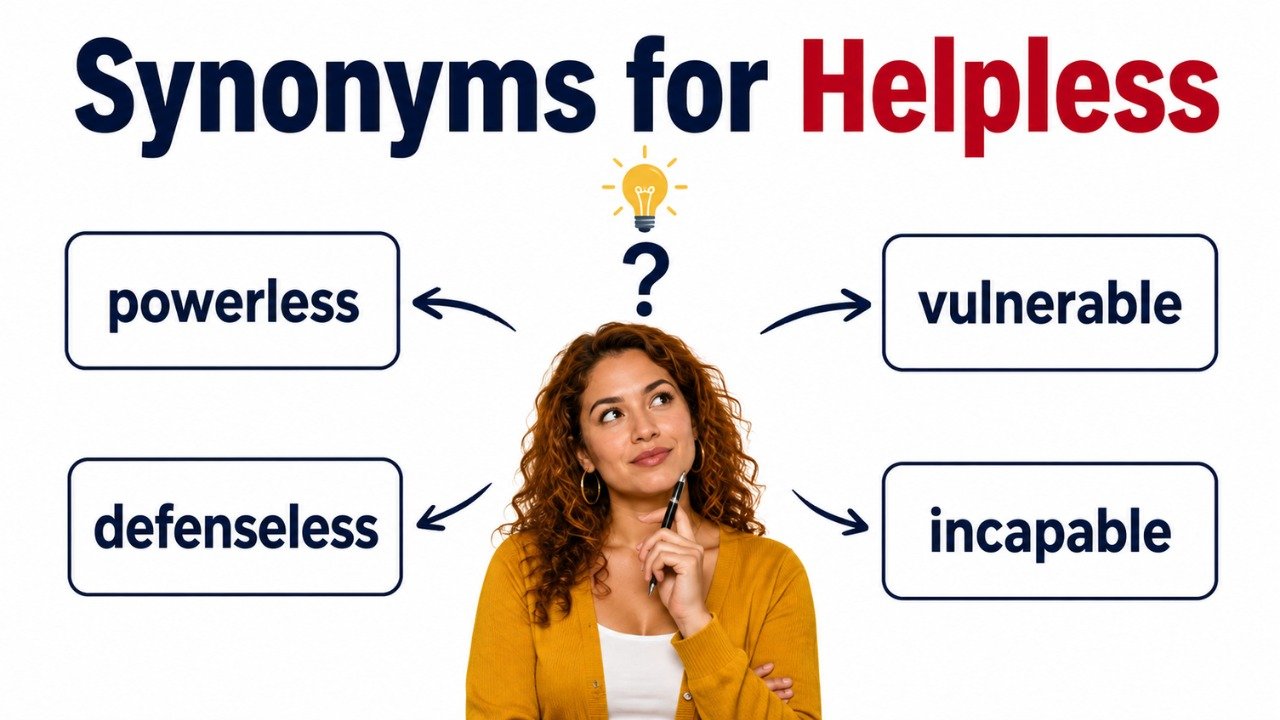
Quick Answer: The best synonyms for helpless include powerless, defenseless, vulnerable, incapable, dependent, weak, unable, impotent, stranded, and overwhelmed. The right choice among synonyms for helpless depends on context. Use powerless when someone lacks control or authority, defenseless when someone cannot protect themselves, vulnerable when exposed to harm, incapable or unable when a person cannot perform an action, dependent when assistance is necessary, stranded when someone cannot leave a difficult location, and overwhelmed when emotions or circumstances make effective action difficult.
Pronunciation and Word Details
Word: Helpless
Pronunciation: /ˈhelpləs/
Part of Speech: Adjective
Meaning: Unable to act, protect oneself, control a situation, or manage without assistance.
US Pronunciation:
UK Pronunciation:
What Does “Helpless” Mean?
Helpless means unable to act effectively, protect yourself, solve a problem, or control what is happening.
It is an adjective and can describe a person, animal, feeling, situation, or condition. Someone may be physically helpless because they cannot move, emotionally helpless because they feel unable to change a painful situation, or practically helpless because they lack the resources or knowledge needed to respond.
The word can also describe vulnerability. A helpless child, for example, depends heavily on others for protection and care.
In another context, a person may feel helpless while watching an event they cannot influence. Here, helpless refers less to physical weakness and more to a lack of control.
The precise meaning therefore depends on whether the sentence describes inability, dependence, vulnerability, lack of authority, emotional distress, or exposure to danger.
Meaning, Tone, and Context of “Helpless”
Helpless usually carries a negative or emotional tone because it suggests weakness, lack of control, dependence, danger, or inability to respond.
In everyday conversation, it can describe a temporary feeling.
Example: I felt helpless because there was nothing I could do to change the situation.
In serious or emotional writing, helpless often expresses vulnerability.
Example: The injured animal appeared helpless beside the road.
In formal writing, more specific words such as powerless, incapable, vulnerable, dependent, or defenseless may communicate the intended meaning more accurately.
Helpless is not always a judgment about a person’s abilities. Someone can be highly capable but still become helpless in a situation where circumstances are beyond their control.
For this reason, writers should consider whether the sentence means unable, unprotected, dependent, powerless, emotionally overwhelmed, or lacking resources before choosing a synonym.
When and How to Use “Helpless”
For Lack of Control
Use helpless when a person cannot influence what is happening.
Example: She felt helpless as the situation continued to worsen.
For Physical Inability
Use helpless when a person or animal cannot move, protect themselves, or perform necessary actions.
Example: The injured bird was helpless on the ground.
For Emotional Distress
Helpless can describe the feeling that no available action will improve a difficult situation.
Example: He felt helpless when he could not comfort his friend.
For Dependence
Use helpless when someone cannot manage basic needs without assistance.
Example: The newborn animals were completely helpless and depended on their mother.
For Vulnerability
Helpless can emphasize exposure to danger or harm.
Example: Without shelter, the animals were helpless against the severe weather.
For Lack of Knowledge
The word can describe someone who does not know how to respond or solve a particular problem.
Example: Without instructions, she felt helpless when the equipment stopped working.
For Difficult Circumstances
Use helpless when external conditions prevent meaningful action.
Example: The travelers felt helpless after becoming trapped by the storm.
For Strong Emotional Emphasis
Helpless can create emotional intensity in storytelling and descriptive writing.
Example: He watched helpless as the papers scattered into the river.
Best Synonyms for Helpless
Powerless
Synonym: Unable to control, influence, or change a situation.
Example: The residents felt powerless to stop the sudden changes.
Powerless is one of the strongest alternatives when helpless means lacking control, authority, or influence.
Defenseless
Synonym: Unable to protect oneself from attack, danger, or harm.
Example: The small animal was defenseless against larger predators.
Defenseless is best when protection and safety are the main concerns.
Vulnerable
Synonym: Exposed to possible harm, damage, or difficulty.
Example: Young plants are vulnerable during severe weather.
Vulnerable does not necessarily mean completely helpless. It means being more open to harm or risk.
Incapable
Synonym: Unable to perform a particular action or task.
Example: The damaged machine was incapable of operating safely.
Incapable is useful when the sentence focuses on ability rather than emotion.
Dependent
Synonym: Needing another person, resource, or condition for support or survival.
Example: The young animals remained dependent on their mother.
Dependent is more precise when helpless means requiring assistance.
Unable
Synonym: Not capable of doing a particular action.
Example: She was unable to open the damaged door.
Unable is neutral and direct. It is useful when helpless would sound unnecessarily emotional.
Weak
Synonym: Lacking physical strength, power, or effectiveness.
Example: He felt weak after several days of illness.
Weak may overlap with helpless, but it does not always mean completely unable to act.
Impotent
Synonym: Lacking the power or ability to produce a desired result.
Example: The committee appeared impotent in the face of the growing crisis.
Impotent is more formal and often describes a lack of effective power rather than physical weakness.
Stranded
Synonym: Left somewhere without a practical way to leave or obtain necessary help.
Example: The passengers were stranded after the road became blocked.
Stranded is useful when helplessness results from being trapped or isolated.
Overwhelmed
Synonym: So affected by emotions, demands, or difficulties that effective action becomes hard.
Example: She felt overwhelmed by the number of urgent problems.
Overwhelmed emphasizes emotional or practical pressure rather than complete inability.
50 Synonyms for Helpless with Short Meanings
- Powerless: Unable to control or influence a situation.
- Defenseless: Unable to protect oneself from harm.
- Vulnerable: Exposed to danger, damage, or difficulty.
- Incapable: Unable to perform a particular task or action.
- Dependent: Needing assistance or support from others.
- Unable: Not capable of doing something.
- Weak: Lacking sufficient strength or power.
- Impotent: Lacking effective power or ability.
- Stranded: Unable to leave a place or situation without help.
- Overwhelmed: Unable to cope effectively because of strong pressure or emotion.
- Unprotected: Lacking protection from danger or harm.
- Exposed: Left open to possible danger or damage.
- Susceptible: Easily affected, harmed, or influenced.
- At risk: In a position where harm or difficulty is possible.
- Needy: Requiring significant support or assistance.
- Reliant: Depending on someone or something for help.
- Infirm: Physically weak, often because of illness or age.
- Feeble: Lacking physical strength or effectiveness.
- Frail: Physically weak and easily harmed.
- Enfeebled: Made physically weak or less capable.
- Debilitated: Seriously weakened by illness, injury, or difficult conditions.
- Disabled: Prevented from functioning normally in a particular context.
- Immobilized: Prevented from moving or acting physically.
- Paralyzed: Unable to move or act, literally or figuratively.
- Trapped: Unable to escape from a place or situation.
- Stuck: Unable to move forward or solve a problem.
- Marooned: Left isolated without an easy means of leaving.
- Abandoned: Left without expected help, protection, or support.
- Forsaken: Left alone without help or support.
- Unsupported: Lacking necessary assistance or backing.
- Unassisted: Acting or existing without needed help.
- Desperate: Feeling that few useful options remain.
- Hopeless: Feeling or appearing to have no reasonable possibility of improvement.
- Overmatched: Facing an opponent or problem too powerful to handle effectively.
- Outmatched: Having less strength, skill, or ability than an opponent.
- Overpowered: Defeated or controlled by greater force.
- Subdued: Brought under control and made less able to resist.
- Submissive: Inclined or forced to accept another person’s control.
- Passive: Not taking active action or resistance.
- Ineffective: Unable to produce the intended result.
- Ineffectual: Lacking the ability to achieve a useful result.
- Inadequate: Not sufficient for the demands of a situation.
- Unprepared: Not ready to deal effectively with a situation.
- Unqualified: Lacking the skills or requirements needed for a task.
- Unskilled: Lacking necessary skill or training.
- Bewildered: Confused and unsure how to respond.
- Lost: Unsure what to do or how to proceed.
- Overburdened: Carrying more responsibility or difficulty than can be handled easily.
- Distressed: Experiencing severe worry, pain, or difficulty.
- At a loss: Unable to decide what to do or say.
Read Also:
Synonyms for Prototype
Synonyms for Helpless by Context
When Helpless Means Powerless
When helpless refers to having no control over events, powerless is usually the best synonym.
Other useful choices include impotent, ineffective, ineffectual, passive, and overpowered.
Example: The workers felt powerless to influence the final decision.
Example: Without legal authority, the group was ineffective in stopping the change.
When Helpless Means Defenseless
When a person or animal cannot protect itself from danger, defenseless is the clearest alternative.
Vulnerable, unprotected, exposed, susceptible, and at risk can also fit.
Example: The small animals were defenseless without shelter.
Example: The damaged structure remained vulnerable during the storm.
When Helpless Means Unable
Sometimes helpless simply means that a person cannot perform an action.
Unable, incapable, immobilized, unprepared, and unskilled may be more precise.
Example: She was unable to lift the heavy container.
Example: Without the required training, he was unprepared to repair the equipment.
When Helpless Means Dependent
When someone needs another person for assistance, dependent is often a better choice.
Reliant, needy, unassisted, unsupported, and infirm may work depending on the situation.
Example: The young bird remained dependent on its parents.
Example: The patient was reliant on others for transportation.
When Helpless Means Physically Weak
Weak, frail, feeble, infirm, enfeebled, and debilitated work when physical strength is the main issue.
Example: The exhausted traveler was too weak to continue walking.
Example: The animal appeared frail after several days without food.
When Helpless Means Trapped
Helplessness can result from being unable to escape or obtain assistance.
Stranded, trapped, stuck, and marooned fit this meaning.
Example: The travelers were stranded after the bridge closed.
Example: The climbers became trapped when the weather suddenly changed.
When Helpless Means Emotionally Overwhelmed
When helpless describes an emotional state, overwhelmed, distressed, desperate, bewildered, lost, and at a loss may sound natural.
Example: She felt overwhelmed by the sudden responsibilities.
Example: He was at a loss when every solution seemed to fail.
Another Word for Helpless
Another word for helpless is powerless when the sentence describes a lack of control. However, the best replacement depends on the reason the person is helpless. Defenseless fits danger, vulnerable fits exposure to harm, unable fits inability to act, and dependent fits a need for assistance.
Original: She felt helpless because she could not change the decision.
Better Option: She felt powerless because she could not change the decision.
Original: The animal was helpless against the predator.
Better Option: The animal was defenseless against the predator.
Original: He was helpless without assistance.
Better Option: He was dependent on assistance.
Original: They were helpless after their vehicle stopped working.
Better Option: They were stranded after their vehicle stopped working.
When Not to Use “Helpless”
Helpless can sound too emotional when a neutral description of inability would be clearer.
Weak: She was helpless to attend the meeting because she was ill.
Better: She was unable to attend the meeting because she was ill.
Do not use helpless when vulnerable is the intended meaning. A vulnerable person may still be capable of acting.
Weak: The system is helpless to security threats.
Better: The system is vulnerable to security threats.
Avoid helpless when the real issue is dependence.
Weak: The newborn animals were helpless on their mother for food.
Better: The newborn animals were dependent on their mother for food.
The phrase helpless on is unnatural in this meaning. Dependent on is the correct construction.
Do not describe someone as helpless simply because they need assistance. The word can imply complete inability and may be stronger than the situation requires.
Weak: He needed help carrying the box, so he was helpless.
Better: He needed assistance carrying the box.
Avoid repeating helpless several times when different types of difficulty are being described.
Weak: She felt helpless in a helpless situation while helping a helpless animal.
Better: She felt powerless in a difficult situation while helping a defenseless animal.
Words Commonly Confused With Helpless
Helpless vs Powerless: Helpless can involve inability, dependence, vulnerability, or lack of control. Powerless specifically emphasizes having little or no ability to influence an outcome.
Helpless vs Hopeless: Helpless means unable to act effectively. Hopeless means having little or no expectation that a situation will improve.
Helpless vs Vulnerable: Helpless suggests inability to protect oneself or act effectively. Vulnerable means exposed to possible harm but does not necessarily imply complete inability.
Helpless vs Defenseless: Helpless has a broad meaning. Defenseless specifically describes an inability to protect oneself from danger or attack.
Helpless vs Weak: Weak means lacking strength or effectiveness. A weak person may still be able to act, while a helpless person may be unable to act successfully at all.
Helpless vs Dependent: Helpless suggests inability without assistance. Dependent simply means relying on someone or something and does not necessarily suggest weakness.
Helpless vs Incapable: Helpless often has an emotional or situational meaning. Incapable focuses more specifically on inability to perform a task or function.
Helpless vs Overwhelmed: Helpless means unable to act or control a situation. Overwhelmed means struggling to cope because demands or emotions are too intense.
Which Synonym Should You Choose?
Choose powerless when someone lacks control, influence, authority, or the ability to change an outcome.
Choose defenseless when a person, animal, place, or object cannot adequately protect itself from harm.
Choose vulnerable when someone or something is exposed to risk but is not necessarily completely unable to act.
Choose unable for neutral everyday statements about something a person cannot do.
Choose incapable when formal writing needs to emphasize an inability to perform a particular function.
Choose dependent when someone relies on another person or resource for care, support, or assistance.
Choose weak, frail, or feeble when physical strength is the main concern.
Choose stranded when someone cannot leave a location because transportation, access, or assistance is unavailable.
Choose overwhelmed when pressure, responsibilities, or emotions make it difficult to cope.
Choose impotent in formal essays or reports when the intended meaning is lacking effective power. This word can sound stronger and more formal than powerless, so context matters.
Choose vulnerable, powerless, incapable, or dependent in professional and academic writing when you need greater precision than the broad word helpless provides.
Real Life Examples of “Helpless” in Sentences
Original: She felt helpless when the final decision was made without her input.
Better Option: She felt powerless when the final decision was made without her input.
Original: The young animal looked helpless without its mother.
Better Option: The young animal looked defenseless without its mother.
Original: He was helpless after injuring his leg.
Better Option: He was unable to walk after injuring his leg.
Original: The passengers were helpless when their vehicle stopped in a remote area.
Better Option: The passengers were stranded when their vehicle stopped in a remote area.
Original: She felt helpless under the pressure of several urgent responsibilities.
Better Option: She felt overwhelmed by several urgent responsibilities.
Original: The seedlings were helpless against the severe frost.
Better Option: The seedlings were vulnerable to the severe frost.
Original: The patient remained helpless without daily support.
Better Option: The patient remained dependent on daily support.
Original: The damaged machine was helpless to complete the task.
Better Option: The damaged machine was incapable of completing the task.
Original: He felt helpless because he did not know how to solve the problem.
Better Option: He felt lost because he did not know how to solve the problem.
Original: The small group seemed helpless against the much stronger opponent.
Better Option: The small group seemed outmatched by the much stronger opponent.
Synonym Groups and Usage Differences
Power and Control Group
Powerless, impotent, ineffective, ineffectual, and passive describe different forms of limited power or influence.
Powerless is the most natural choice for someone who cannot influence events. Impotent is more formal and emphasizes ineffective power.
Example: The residents felt powerless to reverse the decision.
Protection and Vulnerability Group
Defenseless, vulnerable, unprotected, exposed, susceptible, and at risk focus on possible harm.
Defenseless suggests a lack of protection. Vulnerable is broader and may refer to physical, emotional, financial, or practical risk.
Example: The damaged building remained vulnerable during the storm.
Physical Weakness Group
Weak, frail, feeble, infirm, enfeebled, and debilitated describe limited physical strength.
Frail often suggests delicate physical condition, while debilitated describes significant weakness caused by illness or difficult circumstances.
Example: He remained physically weak after the illness.
Dependence Group
Dependent, reliant, needy, unsupported, and unassisted relate to needing help or resources.
Dependent is neutral in many contexts. Needy can sound more emotional and should be used carefully.
Example: Young animals are dependent on adults for protection.
Inability Group
Unable, incapable, immobilized, unprepared, and unskilled describe specific reasons a person cannot perform an action.
Unable is the broadest and most neutral alternative.
Example: She was unable to reach the destination before dark.
Isolation and Entrapment Group
Stranded, trapped, stuck, and marooned describe situations where escape or movement is difficult or impossible.
Stranded is especially natural for travel problems.
Example: Several travelers were stranded after the road closed.
Emotional Distress Group
Overwhelmed, distressed, desperate, bewildered, lost, and at a loss express emotional difficulty.
These words help explain why someone feels helpless rather than simply labeling the person as helpless.
Example: He felt overwhelmed by responsibilities he had never handled before.
Antonyms of Helpless
The opposite of helpless depends on whether the original meaning involves power, independence, protection, ability, confidence, or control.
Powerful: Having considerable ability, strength, influence, or control.
Capable: Having the ability or skill needed to do something successfully.
Able: Having the power, skill, or opportunity to perform an action.
Independent: Able to function without relying heavily on others.
Self sufficient: Able to provide for one’s own needs.
Strong: Having sufficient physical or emotional strength.
Protected: Kept safe from danger or harm.
Secure: Safe and well protected from significant danger.
Competent: Having sufficient skill or knowledge to perform a task effectively.
Resourceful: Skilled at finding practical solutions to difficult problems.
Confident: Feeling certain about one’s abilities or decisions.
Empowered: Given or possessing greater control, authority, or confidence.
Comparison: Helpless vs Related Words
Helpless vs Powerless
Helpless can describe inability, dependence, weakness, vulnerability, or lack of control. Powerless focuses mainly on an inability to influence an outcome.
Example With Helpless: She felt helpless when she could not assist the injured animal.
Example With Powerless: She felt powerless to change the official decision.
Helpless vs Vulnerable
Helpless suggests limited ability to act or protect oneself. Vulnerable means exposed to possible harm, but the vulnerable person may still have considerable ability.
Example With Helpless: The injured bird was helpless on the ground.
Example With Vulnerable: Young birds are vulnerable to severe weather.
Helpless vs Defenseless
Helpless is broad, while defenseless specifically focuses on lacking protection.
Example With Helpless: He felt helpless during the emergency.
Example With Defenseless: The animals were defenseless against the approaching predator.
Helpless vs Hopeless
Helpless concerns ability and control. Hopeless concerns expectation and the possibility of improvement.
Example With Helpless: She felt helpless because she could not intervene.
Example With Hopeless: She believed the situation was hopeless because every attempt had failed.
Helpless vs Unable
Helpless often carries emotional weight. Unable is more neutral and simply states that an action cannot be performed.
Example With Helpless: He felt helpless as he watched the situation unfold.
Example With Unable: He was unable to attend the meeting.
Helpless vs Dependent
Helpless can suggest a complete inability to manage without support. Dependent simply means relying on someone or something.
Example With Helpless: The injured animal was temporarily helpless.
Example With Dependent: The young animal was dependent on its mother for food.
Helpless vs Weak
Weak refers to limited strength or effectiveness. Helpless suggests that effective action may be impossible.
Example With Helpless: The trapped passengers were helpless without assistance.
Example With Weak: He still felt weak after recovering from the illness.
Common Phrases and Expressions With “Helpless”
Feel Helpless: Experience the feeling that you cannot improve or control a situation.
Completely Helpless: Entirely unable to act effectively or protect oneself.
Utterly Helpless: Extremely powerless or unable to respond.
Seem Helpless: Appear unable to manage or control a situation.
Look Helpless: Appear vulnerable, unable, or in need of assistance.
Helpless Victim: Someone unable to protect themselves effectively from harm.
Helpless Child: A child who depends heavily on adults for protection or assistance.
Helpless Animal: An animal unable to protect or care for itself in a particular situation.
Helpless Situation: A circumstance in which useful action appears extremely difficult or impossible.
Stand Helpless: Remain unable to intervene while an event takes place.
Common Mistakes to Avoid
A common mistake is treating helpless, hopeless, and powerless as identical words. They overlap, but each emphasizes something different. Helpless concerns inability to act, hopeless concerns lack of hope, and powerless concerns lack of control or influence.
Another mistake is using helpless when unable would be clearer.
Incorrect Choice: She was helpless to complete the form because she did not have a pen.
Better Choice: She was unable to complete the form because she did not have a pen.
Avoid using helpless for every person who requires support. Dependence does not automatically mean complete helplessness.
Writers should also avoid insensitive or exaggerated descriptions. Calling a capable person helpless simply because they need assistance may misrepresent the situation.
Be careful with defenseless and vulnerable. Something can be vulnerable without being completely defenseless.
Do not use weak as an automatic replacement for helpless. Physical weakness is only one possible reason for helplessness.
Avoid unnatural combinations such as helpless of doing something. Use unable to do something or incapable of doing something instead.
Repetition is another common problem. If helpless appears several times in a paragraph, identify the exact meaning in each sentence and choose words such as powerless, vulnerable, stranded, dependent, or overwhelmed where appropriate.
Conclusion
Synonyms for helpless include powerless, defenseless, vulnerable, incapable, dependent, unable, weak, stranded, and overwhelmed. Choose powerless for lack of control, defenseless for inability to protect oneself, vulnerable for exposure to harm, dependent for reliance on support, and unable or incapable for specific limitations. Stranded works well for isolation, while overwhelmed describes emotional or practical pressure. Understanding these differences helps you choose a more precise word and express inability, vulnerability, dependence, or lack of control clearly.
FAQs About Synonyms for Helpless
What is the best synonym for helpless?
Powerless is one of the best general synonyms when helpless means unable to control a situation. Defenseless, vulnerable, unable, and dependent may be better in other contexts.
What is another word for feeling helpless?
Powerless, overwhelmed, lost, distressed, desperate, and at a loss can describe feeling helpless. The best word depends on the cause of the feeling.
What is a formal synonym for helpless?
Powerless, incapable, impotent, vulnerable, and dependent can work in formal writing. Choose the word that most precisely describes the type of inability.
Are helpless and hopeless the same?
No. Helpless means unable to act effectively or control a situation. Hopeless means lacking hope that a situation will improve.
Is vulnerable a synonym for helpless?
Vulnerable is a close alternative when helpless refers to being exposed to harm. However, a vulnerable person may still be fully capable of acting independently.
What is a synonym for helpless in a dangerous situation?
Defenseless, vulnerable, unprotected, exposed, and at risk are useful choices. Defenseless is especially strong when someone cannot protect themselves.
What is the opposite of helpless?
Common antonyms include powerful, capable, able, independent, strong, competent, resourceful, protected, and empowered.
