
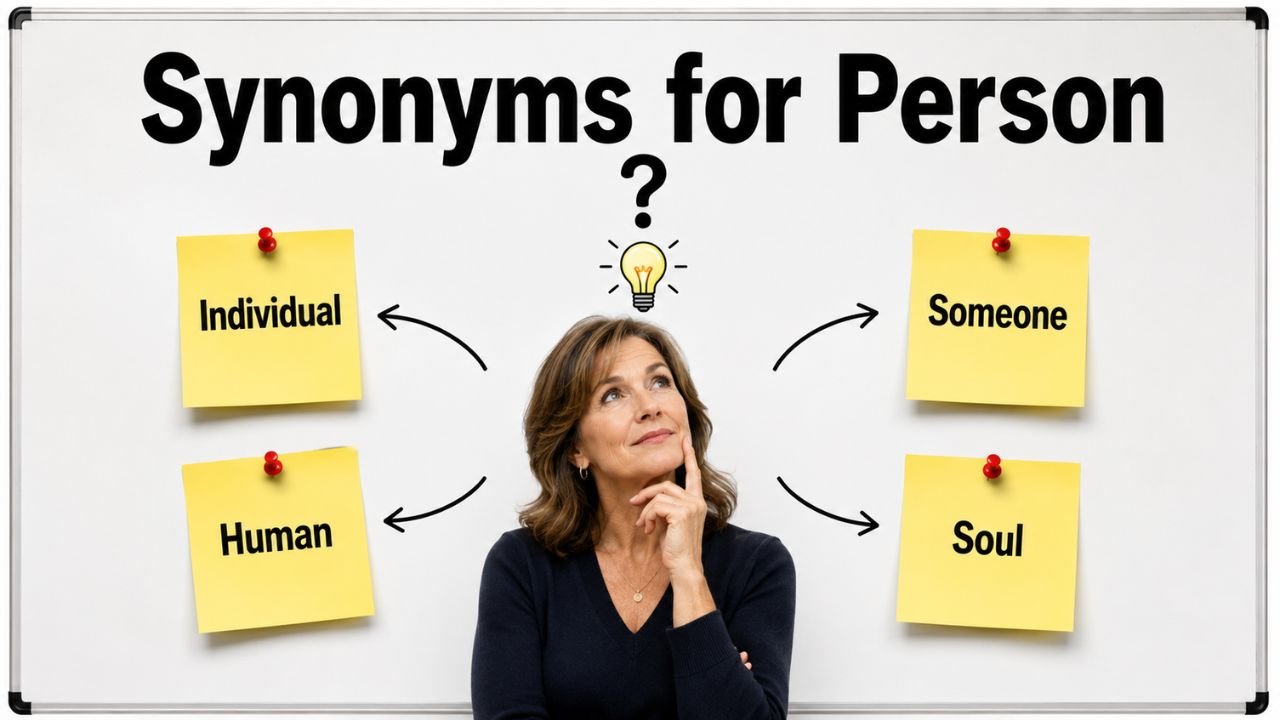
Quick Answer: The best synonyms for person include individual, human, human being, someone, somebody, figure, character, personality, citizen, and resident. Use individual in formal writing, human being when emphasizing humanity, and someone or somebody for an unidentified person in casual speech. Figure works for an important or recognized person, while character suits storytelling or a person with distinctive qualities. Citizen and resident are best when legal status or location matters.
Pronunciation and Word Details
Word: Person.
Pronunciation: /ˈpɜːrsən/
Part of Speech: Noun.
Meaning: A single human being considered as an individual.
US Pronunciation:
UK Pronunciation:
What Does “Person” Mean?
A person is an individual human being. The word is a countable noun and is commonly used to identify, describe, or refer to one human.
Person may refer to somebody whose name is known, an unidentified individual, or a human performing a particular role.
Known Individual: Maya is the person responsible for organizing the meeting.
Unknown Individual: A person left this package at the front desk.
General Human Reference: Every person deserves to be treated fairly.
Role Based Reference: The person in charge will answer your questions.
The plural of person is usually people. Persons may appear in formal notices, legal language, and situations where individuals are counted separately.
Person also has a grammatical meaning. First person refers to the speaker, second person refers to the listener, and third person refers to someone or something being discussed.
Meaning, Tone, and Context of “Person”
Person is a neutral and widely accepted word. It works in casual conversation, formal communication, academic writing, instructions, reports, descriptions, and public notices.
The word usually sounds respectful because it focuses on an individual without automatically identifying gender, age, occupation, or social position.
Neutral Tone: A person is waiting outside.
Formal Tone: Each person must complete the registration form.
Conversational Tone: She is such a kind person.
Academic Tone: The study examined how each person responded to the question.
Legal Tone: The notice applies to every person entering the property.
Grammatical Context: The sentence is written in the first person.
More specific alternatives may be better when the person’s role, location, relationship, or status is important. For example, participant is clearer in a study, resident is more accurate for someone living in an area, and customer is more useful in a business setting.
When and How to Use “Person”
For Referring to One Human
Use person when discussing one human being without emphasizing gender, age, occupation, or another characteristic.
Example: Only one person can enter the room at a time.
For an Unidentified Individual
Use person when you do not know someone’s identity or when the identity is not important.
Example: A person called the office and asked for you.
For Describing Character
Person can describe someone’s nature, behavior, or personality.
Example: Daniel is a thoughtful and dependable person.
For Assigning Responsibility
Use person when identifying someone who has a particular duty.
Example: The person responsible for the report should sign this page.
For Formal Instructions
Person is useful in rules, notices, applications, and instructions that apply to individuals.
Example: Each person must present valid identification.
For Discussing Human Rights
Use person when emphasizing an individual’s humanity, dignity, freedom, or personal needs.
Example: Every person has the right to express an opinion respectfully.
For Grammar
Person describes the relationship between a verb or pronoun and the speaker, listener, or subject being discussed.
Example: The pronoun “I” is written in the first person.
Best Synonyms for Person
Individual
Synonym: A single human considered separately from other people.
Example: Each individual received a copy of the instructions.
Human
Synonym: A member of the human species.
Example: Every human needs food, rest, and social connection.
Human Being
Synonym: A person, especially when emphasizing humanity or dignity.
Example: Every human being deserves compassion and respect.
Someone
Synonym: An unidentified or unspecified person.
Example: Someone left a notebook on the table.
Somebody
Synonym: An unidentified person, usually in conversational language.
Example: Somebody is waiting for you near the entrance.
Figure
Synonym: A person who is important, visible, or recognized in a particular field.
Example: She became a respected figure in education.
Character
Synonym: A person in a story or someone with noticeable qualities.
Example: The main character faces a difficult decision.
Personality
Synonym: A famous, recognizable, or socially prominent person.
Example: The event was attended by several television personalities.
Citizen
Synonym: A person who legally belongs to a particular country.
Example: Every citizen may apply for the public program.
Resident
Synonym: A person who lives in a particular place.
Example: Each resident received information about the road closure.
50 Synonyms for Person with Short Meanings
Not every word below can replace person in every sentence. Some are direct synonyms, while others are close alternatives for particular roles, relationships, or contexts.
- Individual: One person considered separately.
- Human: A member of the human species.
- Human Being: A person viewed as a living human.
- Someone: An unidentified or unspecified person.
- Somebody: An unknown person in casual language.
- One: A single person already understood from context.
- Being: A living creature, especially a human.
- Soul: A person, often in emotional or literary language.
- Mortal: A human who is subject to death.
- Character: A person in a story or a distinctive individual.
- Figure: An important or recognizable person.
- Personality: A famous or publicly recognized person.
- Personage: A notable or important individual.
- Adult: A fully grown person.
- Child: A young person.
- Man: An adult male person.
- Woman: An adult female person.
- Citizen: A person belonging legally to a country.
- Resident: A person who lives in a particular area.
- Inhabitant: A person who lives in a place.
- Occupant: A person currently using or staying in a place.
- Member: A person belonging to a group.
- Participant: A person taking part in an activity.
- Attendee: A person present at an event.
- Guest: A person invited to a place or event.
- Visitor: A person who temporarily goes somewhere.
- Stranger: A person who is not known.
- Acquaintance: A person known but not closely.
- Companion: A person who spends time with another.
- Friend: A person with whom someone has a close relationship.
- Colleague: A person who works with another person.
- Associate: A person connected through work or activity.
- Employee: A person paid to work for an organization.
- Worker: A person who performs work.
- Professional: A person trained in a particular occupation.
- Customer: A person who buys goods or services.
- Client: A person receiving professional services.
- Consumer: A person who purchases or uses products and services.
- Patient: A person receiving medical care.
- Applicant: A person who formally requests something.
- Candidate: A person being considered for a position.
- Representative: A person acting for another individual or group.
- Official: A person holding an authorized position.
- Leader: A person who guides other people.
- Speaker: A person who speaks or gives a presentation.
- Writer: A person who creates written material.
- Learner: A person gaining knowledge or skills.
- Party: A person or group involved in an agreement or dispute.
- Contact: A person known for communication or assistance.
- Face: A known or recognizable person in a place or group.
Read Also:
Synonyms for Purple
Synonyms for Person by Context
When Person Means One Individual
Individual is the strongest formal replacement when referring to one human separately from a group.
Synonyms: Individual, one, human, human being.
Example With Person: Each person completed the task independently.
Example With Individual: Each individual completed the task independently.
When Person Means an Unidentified Human
Someone and somebody are natural when the person’s identity is unknown or unimportant.
Synonyms: Someone, somebody, stranger, one.
Example With Person: A person called while you were away.
Example With Someone: Someone called while you were away.
When Person Means a Group Member
Member is more precise when the individual belongs to a club, team, committee, family, or organization.
Synonyms: Member, participant, attendee, associate.
Example With Person: Every person on the committee voted.
Example With Member: Every committee member voted.
When Person Means Someone Living Somewhere
Resident and inhabitant identify a person through location.
Synonyms: Resident, inhabitant, occupant, citizen.
Example With Person: Every person living in the building received a notice.
Example With Resident: Every resident received a notice.
When Person Means Someone at an Event
Participant, attendee, guest, and visitor provide more information about why someone is present.
Synonyms: Participant, attendee, guest, visitor.
Example With Person: Each person at the workshop received a workbook.
Example With Participant: Each workshop participant received a workbook.
When Person Means Someone Performing a Role
A role based noun is usually clearer than person when the activity or responsibility is known.
Synonyms: Employee, worker, customer, client, applicant, candidate, speaker.
Example With Person: The person applying for the role submitted a résumé.
Example With Candidate: The candidate submitted a résumé.
When Person Means a Notable Individual
Figure, personality, and personage describe someone important, famous, or widely recognized.
Synonyms: Figure, personality, personage, leader.
Example With Person: She was an important person in the movement.
Example With Figure: She was an important figure in the movement.
When Person Appears in Literary Language
Soul, mortal, being, and character can create a more expressive or imaginative tone.
Synonyms: Soul, mortal, being, character.
Example With Person: Not a single person entered the abandoned house.
Example With Soul: Not a single soul entered the abandoned house.
Another Word for Person
The best single replacement for person is individual. It is neutral, respectful, and suitable for formal writing. However, the best alternative depends on what the sentence communicates.
Someone is better for an unidentified person. Resident is clearer for someone who lives in a place. Participant is more accurate for someone taking part in an activity. Figure is useful for an important or recognizable person.
Original: Each person must complete the form.
Better Option: Each individual must complete the form.
Original: A person left a message for you.
Better Option: Someone left a message for you.
Original: Every person in the neighborhood received a notice.
Better Option: Every resident in the neighborhood received a notice.
Original: The person joined the research activity.
Better Option: The participant joined the research activity.
When Not to Use “Person”
Person is useful, but it can sound vague when a more specific noun is available. Repeated use can also make a paragraph feel plain or unclear.
When the Role Is Known
Use the person’s actual role when it adds useful information.
Weak: The person answered the customer’s question.
Better: The employee answered the customer’s question.
When Location Matters
Use resident, inhabitant, visitor, or occupant when the location explains the relationship.
Weak: Every person in the apartment building received a letter.
Better: Every resident in the apartment building received a letter.
When Participation Matters
Use participant, attendee, member, or guest when someone’s involvement is important.
Weak: Forty people joined the training session, and every person received a guide.
Better: Forty people joined the training session, and every participant received a guide.
When the Individual Is Unknown
Someone or somebody often sounds more natural in everyday conversation.
Weak: A person is knocking at the door.
Better: Someone is knocking at the door.
When Writing About a Famous Individual
Figure or personality may communicate public importance more clearly.
Weak: She was a major person in the history of the movement.
Better: She was a major figure in the history of the movement.
When Person Is Repeated Too Often
Replace some uses with names, pronouns, roles, or suitable synonyms.
Weak: The person entered the office. The person sat down. The person opened a folder.
Better: The visitor entered the office, sat down, and opened a folder.
Words Commonly Confused With Person
Person vs People: Person is normally singular, while people is the usual plural. One person may enter, but several people may enter.
Person vs Persons: People is the standard plural in most everyday contexts. Persons is more formal and may be used when individuals are counted or addressed separately.
Person vs Individual: Person is more natural in general communication. Individual sounds more formal and emphasizes one human separately from a group.
Person vs Human: Person focuses on individual identity. Human emphasizes membership in the human species and may sound more biological or philosophical.
Person vs Human Being: Human being strongly emphasizes humanity, dignity, existence, or moral value. Person is more concise and neutral.
Person vs Personality: A person is any individual human. A personality may mean someone famous, recognizable, or socially prominent. Personality also refers to someone’s characteristic way of thinking and behaving.
Person vs Persona: Person means an actual human individual. Persona means the identity, image, or character someone presents to others.
Person vs Character: Person refers to a real human in general. Character commonly refers to someone in a story or a person with distinctive behavior.
Person vs Citizen: Person is broad and does not indicate nationality. Citizen identifies someone with legal membership in a country.
Person vs Resident: Person can be anywhere, while resident specifically means someone who lives in a particular place.
Which Synonym Should You Choose?
Choose individual for reports, policies, instructions, essays, and formal explanations that focus on one human separately.
Choose human when discussing human nature, biology, behavior, or the difference between humans and other living beings.
Choose human being when emphasizing dignity, compassion, rights, emotional experience, or shared humanity.
Choose someone or somebody in casual speech when the person is unknown or unnamed.
Choose member when the person belongs to a group, team, club, committee, or organization.
Choose participant when the person actively takes part in a study, activity, competition, or program.
Choose attendee when the person is present at a meeting, conference, ceremony, class, or event.
Choose resident when the person lives in a particular building, city, region, or country.
Choose occupant when the person is currently inside or using a room, building, seat, or vehicle.
Choose citizen when nationality, legal membership, civic rights, or public duties matter.
Choose candidate when someone is being considered for a job, award, election, or opportunity.
Choose applicant when someone has submitted a formal request or application.
Choose client when someone receives professional advice or services.
Choose customer when someone purchases goods or services.
Choose figure when discussing a notable person in history, politics, education, art, or another field.
Choose character for a person in a book, film, play, or story.
Choose personality for a widely recognized person or someone with a strong public presence.
Choose soul in emotional, poetic, or expressive writing.
Real Life Examples of “Person” in Sentences
Original: Each person received a numbered ticket.
Better Option: Each individual received a numbered ticket.
Original: A person left an umbrella near the entrance.
Better Option: Someone left an umbrella near the entrance.
Original: Every person in the building must follow the safety rules.
Better Option: Every occupant in the building must follow the safety rules.
Original: The person attending the conference received a name card.
Better Option: The attendee received a name card.
Original: The person taking part in the survey answered ten questions.
Better Option: The participant answered ten questions.
Original: She became an influential person in modern education.
Better Option: She became an influential figure in modern education.
Original: The person applying for the position has relevant experience.
Better Option: The candidate has relevant experience.
Original: Every person living on this street received the announcement.
Better Option: Every resident on this street received the announcement.
Original: The person receiving treatment should rest for several hours.
Better Option: The patient should rest for several hours.
Original: He is the person who leads the project team.
Better Option: He is the project leader.
Synonym Groups and Usage Differences
General Identity Group
Individual, human, human being, one, and being identify a single human without describing a specific role.
Individual is formal and precise. Human may sound biological or philosophical. Human being is often used when discussing dignity, morality, or shared experience.
Example: Every individual deserves an opportunity to be heard.
Unidentified Person Group
Someone, somebody, stranger, and one refer to a person whose identity is unknown, unstated, or unimportant.
Someone is common in both speech and writing. Somebody is slightly more conversational. Stranger emphasizes that the person is not known.
Example: Someone left a message at the reception desk.
Formal and Official Group
Individual, citizen, party, representative, official, and candidate work well in formal, legal, administrative, or professional communication.
These terms should be selected according to the person’s exact status.
Example: Each applicant must provide accurate contact information.
Location Group
Resident, inhabitant, occupant, guest, and visitor describe a person’s relationship with a place.
Resident and inhabitant suggest living in a location. Occupant means someone currently using a space. Guest and visitor describe temporary presence.
Example: Every resident may use the shared garden.
Membership and Participation Group
Member, participant, attendee, associate, and companion describe involvement with a group, event, or activity.
Member indicates belonging. Participant suggests active involvement. Attendee focuses on presence.
Example: Each participant completed the activity.
Work and Service Group
Employee, worker, professional, colleague, client, customer, and consumer identify people through work or economic relationships.
These alternatives are more informative than person when the role is relevant.
Example: The customer requested a replacement.
Public Importance Group
Figure, personality, personage, leader, and official describe people with authority, recognition, influence, or public importance.
Figure is usually the most flexible choice. Personage sounds formal or literary.
Example: She became a respected figure in the local community.
Literary and Expressive Group
Soul, mortal, being, face, and character can create a more emotional, imaginative, or descriptive tone.
Soul emphasizes human presence. Mortal emphasizes human limitations. Face may represent a recognizable person within a group.
Example: Not a single soul knew the answer.
Antonyms of Person
Person has no perfect antonym because it names a type of being rather than a quality. However, several words can create an opposite or contrasting meaning in particular contexts.
Nobody: No person at all.
Group: Several individuals considered together rather than one person.
Crowd: A large collection of people rather than a single individual.
Organization: A structured collective rather than one human individual.
Object: A nonliving thing rather than a person.
Machine: A mechanical or electronic device rather than a human.
Animal: A nonhuman living creature in ordinary usage.
Nonhuman Being: A living or imagined being that is not human.
Absence: A situation in which no person is present.
Impersonal Entity: Something treated without individual human identity.
Comparison: Person vs Related Words
Person vs Individual
Person is the most natural general word for one human. Individual is more formal and emphasizes separation from a larger group.
Example With Person: She is a generous person.
Example With Individual: Each individual must submit a separate form.
Person vs Human
Person emphasizes identity and individuality. Human emphasizes species, nature, or human qualities.
Example With Person: The person at the desk offered assistance.
Example With Human: Humans communicate through complex language.
Person vs Human Being
Person is concise and neutral. Human being often sounds more thoughtful, ethical, emotional, or philosophical.
Example With Person: Every person needs a safe place to live.
Example With Human Being: Every human being deserves dignity and respect.
Person vs Someone
Person can refer to an identified or unidentified individual. Someone normally refers to an unspecified or unknown individual.
Example With Person: The person responsible has signed the document.
Example With Someone: Someone has signed the document.
Person vs People
Person is singular. People is the most common plural form.
Example With Person: One person answered correctly.
Example With People: Ten people answered correctly.
Person vs Character
Person usually refers to a real human. Character often refers to someone represented in a story, although it can also describe a distinctive individual.
Example With Person: She is a patient person.
Example With Character: The main character discovers a hidden room.
Person vs Personality
Person means any individual human. Personality may refer to a famous person or to the qualities that shape someone’s behavior.
Example With Person: A person entered the studio.
Example With Personality: The program featured a well known media personality.
Person vs Resident
Person is general. Resident specifically identifies someone who lives in a place.
Example With Person: A person reported the broken streetlight.
Example With Resident: A local resident reported the broken streetlight.
Person vs Citizen
Person applies to any human. Citizen describes a person with legal membership in a country.
Example With Person: Every person must follow the building rules.
Example With Citizen: Every citizen has certain civic responsibilities.
Person vs Participant
Person simply identifies a human. Participant shows that the human is actively involved in an event, activity, program, or study.
Example With Person: Each person received a questionnaire.
Example With Participant: Each participant completed the questionnaire.
Common Phrases and Expressions With “Person”
In Person: Physically present rather than communicating from another location.
Example: You must collect the document in person.
Person in Charge: The individual responsible for managing a task or situation.
Example: Please speak to the person in charge.
Person of Interest: Someone connected to an investigation or matter requiring attention.
Example: The investigators wanted to speak with a person of interest.
First Person: The grammatical perspective of the speaker or writer.
Example: The diary is written in the first person.
Second Person: The grammatical perspective used to address the listener or reader.
Example: Instructions are often written in the second person.
Third Person: The grammatical perspective used to discuss someone other than the speaker or listener.
Example: The report was written in the third person.
Missing Person: Someone whose location is unknown and whose absence causes concern.
Example: The authorities issued a missing person notice.
People Person: Someone who enjoys communicating and working with others.
Example: Nadia is a people person who makes guests feel welcome.
Person to Person: Directly between two individuals.
Example: The issue was resolved through a person to person conversation.
Person of Character: Someone known for honesty, strength, and good moral qualities.
Example: Everyone regarded him as a person of character.
Common Mistakes to Avoid
Using Person as a Regular Plural
People is normally the plural of person in everyday English.
Incorrect: Five person attended the meeting.
Correct: Five people attended the meeting.
Using Persons in Casual Sentences
Persons is grammatically possible, but it often sounds legal, official, or unusually formal.
Unnatural: Several persons were talking outside.
Natural: Several people were talking outside.
Choosing a Vague Word Instead of a Clear Role
Use a precise role when the context provides one.
Vague: The person explained the treatment plan.
Clear: The doctor explained the treatment plan.
Using Individual Too Often
Individual can sound formal, distant, or repetitive when person, someone, or a specific role would be more natural.
Awkward: I met an interesting individual at the party.
Natural: I met an interesting person at the party.
Confusing Person and Personality
Personality does not usually replace person unless it refers to a famous or recognizable individual.
Incorrect: A personality is waiting outside for you.
Correct: A person is waiting outside for you.
Confusing Person and Persona
Persona means a presented image or identity, not simply a human individual.
Incorrect: Three personas entered the room.
Correct: Three people entered the room.
Using Man When Gender Is Unknown
Use person, individual, someone, or a specific role when gender is unknown or irrelevant.
Less Inclusive: The delivery man should leave the package here.
Better: The delivery person should leave the package here.
Repeating Person in Every Sentence
Use names, pronouns, roles, and suitable synonyms to make writing smoother.
Repetitive: The person entered the room. The person spoke to the manager. The person then left.
Improved: The visitor entered the room, spoke to the manager, and then left.
Using Someone for a Known Individual
Someone suggests that the identity is unknown or unstated. Use the name, role, or person when the identity is clear.
Unclear: Someone named Omar will lead the session.
Better: Omar will lead the session.
Ignoring Context When Choosing a Synonym
A synonym should match the individual’s role and the sentence’s tone.
Weak: Every soul must submit an application.
Better: Every applicant must submit an application.
Conclusion
The best synonyms for person depend on the meaning and setting of the sentence. Individual is the strongest formal alternative, while someone and somebody are natural for an unidentified person. Human being emphasizes dignity and shared humanity. Figure and personality suit notable individuals, while resident, participant, member, customer, and candidate provide clearer role based meanings. When using synonyms for person, choose the word that accurately expresses identity, location, responsibility, relationship, or involvement without making the sentence vague or unnatural.
FAQs About Synonyms for Person
What Is the Best Synonym for Person?
Individual is the best general synonym for person, especially in formal writing. Someone is better when the individual is unknown.
What Is a Formal Word for Person?
Individual is the most common formal word. Party, representative, applicant, candidate, and participant may be better in specific professional contexts.
What Is a Casual Synonym for Person?
Someone and somebody are natural casual alternatives when the person is unidentified or unnamed.
Can Human Replace Person?
Human can replace person in some contexts, especially when discussing human nature or species. However, it may sound clinical in ordinary descriptions.
What Is Another Word for an Important Person?
Figure, personality, leader, official, and personage can describe an important or influential person.
What Is Another Word for a Person in a Group?
Member is usually the best choice. Participant, attendee, associate, or representative may be more accurate depending on the group.
What Is the Plural of Person?
People is the usual plural of person. Persons appears mainly in legal, official, or highly formal language.
