
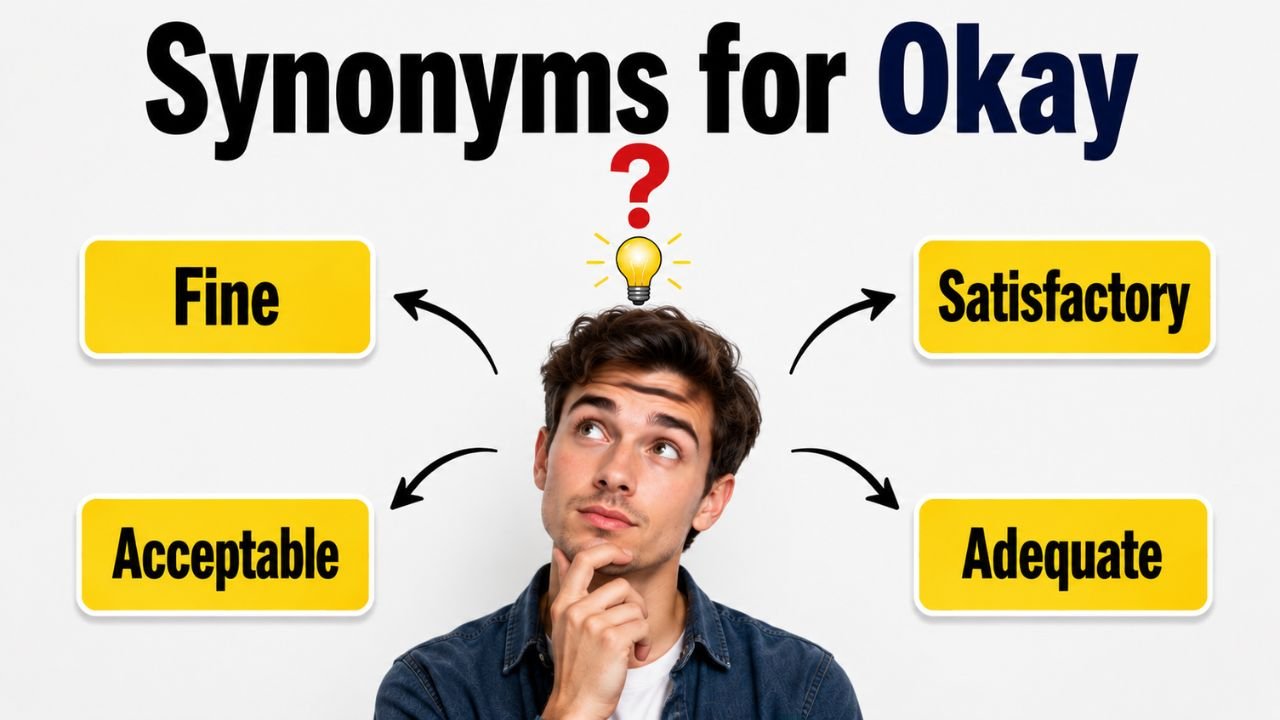
Quick Answer: The best synonyms for okay include acceptable, satisfactory, fine, adequate, suitable, approved, agreed, well, safe, and permitted. Use acceptable or satisfactory in formal writing, fine or all right in casual conversation, agreed when confirming a decision, approved when permission has been officially given, well when describing health, and safe when confirming that someone is not in danger. The best choice depends on whether okay expresses approval, agreement, wellbeing, permission, or moderate quality.
Pronunciation and Word Details
Word: Okay.
Pronunciation: /ˌoʊˈkeɪ/.
Part of Speech: Adjective, adverb, noun, verb, and interjection.
Meaning: Acceptable, satisfactory, safe, healthy, agreed upon, or approved.
US Pronunciation:
UK Pronunciation:
What Does “Okay” Mean?
Okay means acceptable, satisfactory, safe, healthy, permitted, or agreed upon.
The word is highly flexible and can function as an adjective, adverb, noun, verb, or interjection.
As an adjective, okay describes something that is acceptable but not necessarily excellent.
Example: The final draft looks okay.
In this sentence, okay means satisfactory or good enough.
As an adverb, okay describes an action completed in an acceptable manner.
Example: She performed okay during the interview.
Here, okay means reasonably well.
As an interjection, okay can express agreement, understanding, acceptance, or a transition to a new subject.
Example: Okay, I understand your concern.
As a verb, okay means to approve or authorize something.
Example: The director okayed the revised schedule.
As a noun, okay refers to approval or permission.
Example: We received the okay to begin the project.
Okay can also describe a person’s physical or emotional condition.
Example: Are you okay after the fall?
In this context, okay means safe, uninjured, calm, or emotionally stable.
The exact meaning depends on the situation, tone of voice, and sentence structure.
Meaning, Tone, and Context of “Okay”
Okay usually has a neutral, conversational, and informal tone. It is common in everyday speech, personal messages, workplace conversations, questions, and simple confirmations.
The word can communicate several different attitudes.
Neutral Acceptance: It may show that something meets basic expectations.
Example: The room is okay for one night.
Agreement: It can show that someone accepts a suggestion or decision.
Example: Okay, we will meet at noon.
Permission: It can mean that an action has been approved.
Example: The supervisor said it was okay to leave early.
Wellbeing: It can ask whether someone is healthy, safe, or emotionally comfortable.
Example: You seem worried. Are you okay?
Understanding: It can confirm that a message or instruction has been understood.
Example: Okay, I will send the form this afternoon.
Moderate Quality: It can mean neither very good nor very bad.
Example: The meal was okay, but the service was excellent.
Okay is suitable for casual conversation, but it may sound vague or overly informal in reports, essays, legal writing, technical instructions, or important professional communication. In such contexts, words such as acceptable, approved, satisfactory, suitable, or authorized are often clearer.
Tone also changes the meaning. A cheerful okay may communicate enthusiastic agreement, while a hesitant okay may suggest uncertainty, disappointment, or reluctant acceptance.
When and How to Use “Okay”
For Acceptability
Use okay when something meets the minimum standard or is good enough for a particular purpose.
Example: This seating arrangement is okay for a small meeting.
For Agreement
Use okay to show that you accept a suggestion, instruction, decision, or plan.
Example: Okay, I will join the discussion after lunch.
For Permission
Use okay when someone has allowed or approved an action.
Example: Is it okay if I open the window?
For Physical Wellbeing
Use okay to ask whether someone is healthy, safe, or uninjured.
Example: She slipped on the stairs, but she is okay.
For Emotional Wellbeing
Use okay when asking about someone’s mood, comfort, or emotional condition.
Example: Are you okay after receiving the news?
For Understanding
Use okay to show that information has been received and understood.
Example: Okay, I understand what needs to be changed.
For Moderate Performance
Use okay when someone performs adequately but not exceptionally.
Example: He did okay on the first part of the test.
For Reassurance
Use okay to tell someone that a situation is manageable or not serious.
Example: It is okay to make mistakes while learning.
For Official Approval
Use okay as a noun or verb when permission has been given.
Example: The manager gave the okay to publish the notice.
For Changing the Subject
Use okay as an interjection to move a discussion forward.
Example: Okay, let us consider the next option.
Best Synonyms for Okay
Acceptable
Synonym: Meeting the required or expected standard.
Example: The revised answer is acceptable for the assignment.
Satisfactory
Synonym: Good enough to meet a need, expectation, or condition.
Example: The inspection produced satisfactory results.
Fine
Synonym: Acceptable, healthy, or free from serious problems.
Example: Everything is fine with the updated plan.
Adequate
Synonym: Sufficient for a particular purpose or requirement.
Example: The available space is adequate for ten participants.
Suitable
Synonym: Appropriate for a particular person, situation, or purpose.
Example: This room is suitable for private meetings.
Approved
Synonym: Officially accepted or given permission.
Example: The proposed budget was approved yesterday.
Agreed
Synonym: Accepted by the people involved in a discussion or decision.
Example: We agreed to move the meeting to Friday.
Well
Synonym: Healthy, comfortable, or in a good condition.
Example: She is feeling well after several days of rest.
Safe
Synonym: Free from danger, harm, or serious risk.
Example: Everyone reached home safe after the storm.
Permitted
Synonym: Allowed according to a rule, decision, or authority.
Example: Visitors are permitted to enter after registration.
50 Synonyms for Okay with Short Meanings
- Acceptable: Good enough to meet a required standard.
- Satisfactory: Meeting expectations or basic requirements.
- Fine: Acceptable, healthy, or free from difficulty.
- All Right: Acceptable, safe, or in a good condition.
- Adequate: Sufficient for a particular purpose.
- Suitable: Appropriate for a specific situation or need.
- Appropriate: Right or fitting for the circumstances.
- Reasonable: Fair, sensible, or acceptable.
- Passable: Good enough to be accepted but not excellent.
- Tolerable: Acceptable despite some faults or discomfort.
- Decent: Fairly good or respectable in quality.
- Fair: Moderately good or acceptable.
- Sufficient: Enough to satisfy a need or requirement.
- Serviceable: Useful and good enough for practical purposes.
- Workable: Capable of functioning successfully.
- Manageable: Possible to handle without serious difficulty.
- Suitable Enough: Adequate for the intended purpose.
- Good Enough: Meeting the minimum expected standard.
- In Order: Correct, organized, or functioning properly.
- In Good Shape: Healthy, effective, or well maintained.
- Approved: Officially accepted or authorized.
- Authorized: Given formal permission by someone in authority.
- Permitted: Allowed under a rule or decision.
- Allowed: Given permission to happen or be done.
- Cleared: Officially approved to proceed.
- Accepted: Received or regarded as satisfactory.
- Confirmed: Established or agreed as definite.
- Endorsed: Publicly or officially supported.
- Agreed: Accepted by the people involved.
- Settled: Decided and no longer under discussion.
- Understood: Clearly received and comprehended.
- Acknowledged: Recognized or confirmed as received.
- Certainly: Used to express willing agreement.
- Sure: Used to show informal agreement or permission.
- Very Well: Used to accept a decision or instruction.
- Of Course: Used to express willing permission or agreement.
- No Problem: Used to show acceptance or reassurance.
- Noted: Used to confirm that information has been received.
- Well: Healthy or in a satisfactory condition.
- Healthy: Physically or mentally in good condition.
- Safe: Free from danger or injury.
- Unharmed: Not injured or damaged.
- Stable: Not becoming worse or changing dangerously.
- Comfortable: Physically or emotionally at ease.
- Calm: Free from worry, fear, or agitation.
- Untroubled: Not affected by serious worry or difficulty.
- Content: Peaceful and satisfied with a situation.
- Reassured: Made to feel less worried or afraid.
- Competent: Able to perform at an acceptable level.
- Moderate: Average or neither especially good nor bad.
Read Also:
Synonyms for Extraordinary

Synonyms for Okay by Context
When Okay Means Acceptable
Acceptable, satisfactory, adequate, passable, decent, tolerable, and good enough describe something that meets a basic standard.
Example With Okay: The first draft is okay, but it needs a stronger conclusion.
Example With Acceptable: The first draft is acceptable, but it needs a stronger conclusion.
Acceptable works well in formal and professional writing. Satisfactory suggests that requirements have been met. Passable often implies that the quality is only slightly above failure.
When Okay Means Appropriate
Suitable, appropriate, reasonable, fitting, and workable are useful when something matches a situation, need, or purpose.
Example With Okay: This time is okay for the interview.
Example With Suitable: This time is suitable for the interview.
Suitable is clearer when discussing schedules, clothing, locations, materials, or choices.
When Okay Means Agreement
Agreed, certainly, sure, very well, of course, and accepted can express agreement with a plan or suggestion.
Example With Okay: Okay, we will use the second option.
Example With Agreed: Agreed, we will use the second option.
Agreed sounds clear and decisive. Sure is more casual, while certainly sounds polite and confident.
When Okay Means Understanding
Understood, noted, acknowledged, confirmed, and clear show that information has been received.
Example With Okay: Okay, I will finish the work before noon.
Example With Understood: Understood, I will finish the work before noon.
Understood is useful in professional communication. Noted confirms receipt but does not always show agreement.
When Okay Means Permission
Approved, authorized, permitted, allowed, and cleared indicate that someone may proceed.
Example With Okay: The manager said it was okay to begin.
Example With Approved: The manager approved the request to begin.
Approved is best when a decision has been formally accepted. Permitted is useful when rules determine what is allowed.
When Okay Means Healthy
Well, healthy, stable, comfortable, and in good shape describe a person’s physical condition.
Example With Okay: He felt okay after resting.
Example With Well: He felt well after resting.
Well is the most natural replacement when discussing general health. Stable is more specific when a condition is not worsening.
When Okay Means Safe
Safe, unharmed, secure, stable, and out of danger describe freedom from injury or risk.
Example With Okay: The children are okay after the accident.
Example With Safe: The children are safe after the accident.
Safe is clearer when the main concern is danger. Unharmed confirms that no injury occurred.
When Okay Means Emotionally Comfortable
Calm, comfortable, content, reassured, and untroubled describe emotional wellbeing.
Example With Okay: She seemed okay after the conversation.
Example With Calm: She seemed calm after the conversation.
Calm focuses on the absence of agitation. Reassured means that a worry has been reduced.
When Okay Means Moderately Good
Fair, decent, passable, moderate, and competent describe quality or performance that is neither poor nor excellent.
Example With Okay: His presentation was okay.
Example With Decent: His presentation was decent.
Decent sounds mildly positive. Passable is less complimentary and may imply that the result barely met expectations.
Another Word for Okay
Acceptable is often the best general replacement for okay because it clearly communicates that something meets a required standard.
However, the strongest alternative depends on context. Use agreed for a shared decision, approved for official permission, well for health, and safe when confirming that someone is not in danger.
Original: The final version looks okay.
Better Option: The final version looks acceptable.
Original: Okay, we will proceed with the plan.
Better Option: Agreed, we will proceed with the plan.
Original: The supervisor said the change was okay.
Better Option: The supervisor approved the change.
Original: She is okay after the accident.
Better Option: She is safe and unharmed after the accident.
When Not to Use “Okay”
Okay may sound vague because it can communicate approval, moderate quality, health, agreement, permission, or reassurance.
When a Precise Standard Is Needed
Use a more exact word in evaluations, reports, inspections, or formal decisions.
Weak: The test results were okay.
Better: The test results were satisfactory and met the required standard.
When Official Permission Is Involved
Approved, authorized, or permitted is clearer than okay.
Weak: The director said the proposal was okay.
Better: The director approved the proposal.
When Discussing Health
Well, stable, safe, or unharmed may communicate the person’s condition more accurately.
Weak: The patient is okay.
Better: The patient is stable and recovering well.
When Describing Quality
Okay does not explain whether something is adequate, average, suitable, or only slightly acceptable.
Weak: The report was okay.
Better: The report was accurate but needed a clearer summary.
When Writing Formal Instructions
Okay may sound conversational or unclear in policies and procedures.
Weak: It is okay to use this entrance after six.
Better: Visitors are permitted to use this entrance after six.
When Agreement Must Be Clear
Okay can sometimes sound hesitant or reluctant.
Weak: Okay, I suppose we can accept the offer.
Better: We agree to accept the offer.
When the Word Is Repeated
Frequent use makes writing sound plain and imprecise.
Weak: The room was okay, the service was okay, and the food was okay.
Better: The room was comfortable, the service was satisfactory, and the food was decent.
Words Commonly Confused With Okay
Okay vs Acceptable: Okay is conversational and broad. Acceptable is more formal and usually means that a required standard has been met.
Okay vs Fine: Fine can mean acceptable, healthy, or free from problems. It may also sound defensive depending on tone.
Okay vs All Right: Both words can describe acceptance, safety, or wellbeing. All right is often slightly more conversational.
Okay vs Satisfactory: Satisfactory means that requirements or expectations have been met. It sounds more precise in evaluations and reports.
Okay vs Adequate: Adequate means sufficient for a purpose. It does not necessarily mean impressive or desirable.
Okay vs Good: Good communicates positive quality. Okay may suggest only average or moderate quality.
Okay vs Approved: Okay can casually give permission. Approved indicates a clear or official decision.
Okay vs Agreed: Okay may show acceptance or understanding. Agreed specifically confirms a shared decision.
Okay vs Well: Okay can describe health, quality, agreement, or permission. Well usually describes health or the manner in which something is done.
Okay vs Safe: Okay may imply that someone is not hurt, while safe directly confirms freedom from danger.
Which Synonym Should You Choose?
Choose Acceptable: When formal writing requires a clear statement that something meets a standard.
Choose Satisfactory: When discussing results, performance, inspections, reports, or completed work.
Choose Fine: When speaking casually about health, plans, or conditions.
Choose All Right: When reassuring someone or describing a generally acceptable situation.
Choose Adequate: When something is sufficient but not necessarily excellent.
Choose Suitable: When a choice fits a particular person, need, place, or purpose.
Choose Appropriate: When behavior, language, clothing, or action must match a situation.
Choose Reasonable: When describing a fair request, price, expectation, or decision.
Choose Passable: When something is barely good enough to be accepted.
Choose Decent: When giving mild praise in casual conversation.
Choose Approved: When official acceptance has been given.
Choose Authorized: When formal authority has granted permission.
Choose Permitted: When a rule or policy allows an action.
Choose Agreed: When two or more people have accepted the same plan.
Choose Understood: When confirming that instructions or information are clear.
Choose Noted: When acknowledging receipt of information in an email or report.
Choose Well: When describing physical health or general condition.
Choose Safe: When confirming that someone is free from danger.
Choose Unharmed: When confirming that no injury or damage occurred.
Choose Calm: When describing emotional control or reduced worry.
Real Life Examples of “Okay” in Sentences
Original: The revised design looks okay.
Better Option: The revised design looks acceptable.
Original: Her performance during the interview was okay.
Better Option: Her performance during the interview was satisfactory.
Original: This chair is okay for the waiting room.
Better Option: This chair is suitable for the waiting room.
Original: Okay, we will meet on Thursday.
Better Option: Agreed, we will meet on Thursday.
Original: The manager said it was okay to publish the notice.
Better Option: The manager approved the publication of the notice.
Original: Are you okay after the fall?
Better Option: Are you unharmed after the fall?
Original: The doctor said the patient was okay.
Better Option: The doctor said the patient was stable.
Original: Everything will be okay.
Better Option: Everything will be manageable.
Original: The meal was okay, but it was not memorable.
Better Option: The meal was decent, but it was not memorable.
Original: Okay, I understand the new instructions.
Better Option: Understood, I will follow the new instructions.
Synonym Groups and Usage Differences
Acceptability Group
Acceptable, satisfactory, adequate, passable, tolerable, and good enough describe something that meets a minimum standard.
Acceptable is neutral and formal. Satisfactory is common in assessments. Adequate emphasizes sufficiency. Passable suggests that quality is only slightly above failure.
Example: The final submission was satisfactory, though several details could be improved.
Suitability Group
Suitable, appropriate, reasonable, fitting, and workable describe something that matches a purpose or situation.
Suitable focuses on practical fit. Appropriate often relates to behavior or circumstances. Workable describes a plan that can function successfully.
Example: The proposed schedule is workable for everyone involved.
Agreement Group
Agreed, certainly, sure, very well, and of course communicate acceptance or willingness.
Agreed sounds direct and decisive. Certainly is polite and confident. Sure is casual. Very well may sound formal or slightly reluctant depending on context.
Example: Agreed, we will review the figures before making a decision.
Permission Group
Approved, authorized, permitted, allowed, and cleared describe permission to act.
Approved shows acceptance of a request or proposal. Authorized indicates formal power. Permitted often refers to rules. Cleared commonly means that barriers have been removed.
Example: The application was approved after the final review.
Understanding Group
Understood, noted, acknowledged, confirmed, and clear indicate that information has been received.
Understood confirms comprehension. Noted confirms receipt. Confirmed establishes that details are correct or definite.
Example: Understood, the completed form will be returned before noon.
Health Group
Well, healthy, stable, comfortable, and in good shape describe physical condition.
Well is general. Healthy suggests good overall health. Stable means that a condition is not getting worse. Comfortable describes the absence of serious pain or distress.
Example: She is recovering well and remains in a stable condition.
Safety Group
Safe, unharmed, secure, and out of danger describe freedom from injury or risk.
Safe is the broadest choice. Unharmed confirms that no injury occurred. Secure can describe protection from physical or practical threats.
Example: All passengers were safe and unharmed.
Emotional Condition Group
Calm, content, reassured, comfortable, and untroubled describe emotional wellbeing.
Calm means free from agitation. Content suggests peaceful satisfaction. Reassured means that fear or uncertainty has been reduced.
Example: The explanation left the worried customer feeling reassured.
Moderate Quality Group
Fair, decent, passable, competent, and moderate describe average or acceptable quality.
Decent is mildly positive. Fair often means average. Competent focuses on ability rather than excellence. Moderate means neither very high nor very low.
Example: She gave a competent presentation with clear supporting details.
Antonyms of Okay
The opposite of okay depends on whether the word refers to acceptability, agreement, permission, health, safety, or quality.
Unacceptable: Not meeting the required standard.
Unsatisfactory: Failing to meet expectations or requirements.
Inadequate: Not sufficient for a particular purpose.
Unsuitable: Not right for a person, situation, or need.
Inappropriate: Not fitting or proper for the circumstances.
Unreasonable: Not fair, sensible, or practical.
Poor: Low in quality or performance.
Deficient: Lacking something necessary or expected.
Rejected: Not accepted or approved.
Denied: Not given permission or acceptance.
Forbidden: Officially not allowed.
Unauthorized: Lacking formal permission.
Disagreed: Did not accept the same opinion or decision.
Unclear: Not understood or explained properly.
Unwell: Not healthy or feeling ill.
Injured: Physically harmed.
Unsafe: Exposed to danger or risk.
Unstable: Likely to change, worsen, or become dangerous.
Distressed: Experiencing serious worry, pain, or emotional discomfort.
Troubled: Worried or affected by difficulty.
Comparison: Okay vs Related Words
Okay vs Acceptable
Okay is broad and conversational. Acceptable is clearer in formal writing and means that a standard has been met.
Example With Okay: The revised paragraph is okay.
Example With Acceptable: The revised paragraph is acceptable for publication.
Okay vs Fine
Both words can describe acceptable conditions or wellbeing. Fine sometimes sounds more positive, but tone can make it seem dismissive or defensive.
Example With Okay: I feel okay after resting.
Example With Fine: I feel fine after resting.
Okay vs All Right
Okay and all right have similar meanings in casual conversation. All right is often used for reassurance, wellbeing, and acceptance.
Example With Okay: Is everyone okay?
Example With All Right: Is everyone all right?
Okay vs Satisfactory
Okay gives a general opinion. Satisfactory indicates that a requirement or expectation has been met.
Example With Okay: The results were okay.
Example With Satisfactory: The results were satisfactory and met the minimum target.
Okay vs Adequate
Okay can mean generally acceptable. Adequate means that there is enough for a specific purpose.
Example With Okay: The lighting is okay.
Example With Adequate: The lighting is adequate for reading.
Okay vs Good
Good expresses clear approval. Okay may suggest that something is merely average.
Example With Okay: The film was okay.
Example With Good: The film was good.
Okay vs Approved
Okay can casually express permission. Approved describes a definite or official decision.
Example With Okay: The supervisor said the request was okay.
Example With Approved: The supervisor approved the request.
Okay vs Agreed
Okay can express agreement, understanding, or simple acknowledgment. Agreed specifically confirms acceptance of a shared decision.
Example With Okay: Okay, we will select the first option.
Example With Agreed: Agreed, we will select the first option.
Okay vs Well
Okay has several meanings. Well mainly describes health, condition, or successful performance.
Example With Okay: She is okay after the operation.
Example With Well: She is recovering well after the operation.
Okay vs Safe
Okay may loosely suggest that someone is not harmed. Safe gives a direct statement about freedom from danger.
Example With Okay: The hikers are okay.
Example With Safe: The hikers are safe.
Common Phrases and Expressions With “Okay”
Are You Okay: A question about someone’s physical or emotional condition.
It Is Okay: A phrase used to give reassurance, acceptance, or permission.
Everything Is Okay: A statement that a situation is under control or free from serious problems.
Okay With Me: A phrase showing personal agreement or acceptance.
Okay to Proceed: Permission to continue with an action or process.
Give the Okay: To provide approval or permission.
Get the Okay: To receive approval or authorization.
Doing Okay: Performing adequately or managing reasonably well.
Feeling Okay: Experiencing acceptable physical or emotional wellbeing.
Okay for Now: Acceptable temporarily but possibly needing improvement later.
Common Mistakes to Avoid
Using Okay in Every Context
Okay has many meanings, but it is not always the clearest word.
Vague: The situation is okay.
Clearer: The situation is stable and manageable.
Using Okay in Formal Evaluations
Formal assessments usually require specific language.
Weak: The candidate’s written work was okay.
Better: The candidate’s written work was satisfactory but lacked supporting detail.
Confusing Approval With Agreement
Approved means that permission was granted. Agreed means that people accepted the same decision.
Incorrect: The two teams approved to change the date.
Correct: The two teams agreed to change the date.
Confusing Okay With Well
Use well when describing health or how an action is performed.
Less Precise: She completed the task okay.
Better: She completed the task well.
Giving an Unclear Health Update
Okay may not provide enough information when someone’s condition matters.
Vague: He is okay after the accident.
Clearer: He is safe, conscious, and unharmed after the accident.
Overusing Okay in Conversation
Repeated use can make responses sound uninterested or dismissive.
Repetitive: Okay, the plan is okay, and the date is okay.
Improved: Agreed, the plan is workable, and the date is suitable.
Assuming Okay Always Means Positive
Okay may express moderate approval rather than enthusiasm.
Example: Saying “The food was okay” usually means it was acceptable but not excellent.
Using Fine Without Considering Tone
Fine can sound annoyed or defensive when used as a short response.
Unclear: Fine.
Clearer: Yes, that arrangement works for me.
Writing Inconsistent Forms
Okay is the clearest standard spelling in general writing. Avoid switching between several forms within the same article or document.
Inconsistent: The first option is okay, but the second option is written with a different form.
Consistent: Use okay consistently throughout the document.
Using Okay as Empty Filler
Okay may add no useful meaning when a stronger transition is available.
Weak: Okay, the next section explains the results.
Better: The next section explains the results.
Conclusion
The most useful synonyms for okay depend on the intended meaning. Choose acceptable, satisfactory, or adequate for formal evaluations. Use fine or all right in casual conversation, agreed for shared decisions, and approved for official permission. Well describes health, while safe confirms freedom from danger. Suitable and appropriate clarify whether something fits a purpose or situation. Selecting a precise alternative makes sentences clearer and helps readers understand whether okay expresses approval, agreement, reassurance, wellbeing, or moderate quality.
FAQs About Synonyms for Okay
What Is the Best Synonym for Okay?
Acceptable is the best general synonym when okay means good enough. Other strong choices include satisfactory, fine, agreed, approved, well, and safe.
What Is a Formal Synonym for Okay?
Acceptable, satisfactory, adequate, suitable, approved, and authorized are suitable formal alternatives.
What Is Another Word for Okay in Conversation?
Fine, all right, sure, certainly, agreed, and no problem are natural conversational alternatives.
What Is a Synonym for Okay Meaning Agreement?
Agreed is the clearest synonym. Certainly, sure, very well, and accepted may also work depending on tone.
What Is a Synonym for Okay Meaning Permission?
Approved, authorized, permitted, allowed, and cleared can replace okay when someone has permission to proceed.
What Is the Difference Between Okay and Acceptable?
Okay is informal and has several meanings. Acceptable is more precise and usually means that something meets a required standard.
Can Okay Mean Healthy or Safe?
Yes. In questions such as “Are you okay?” the word may ask whether someone is healthy, emotionally comfortable, uninjured, or free from danger.
