
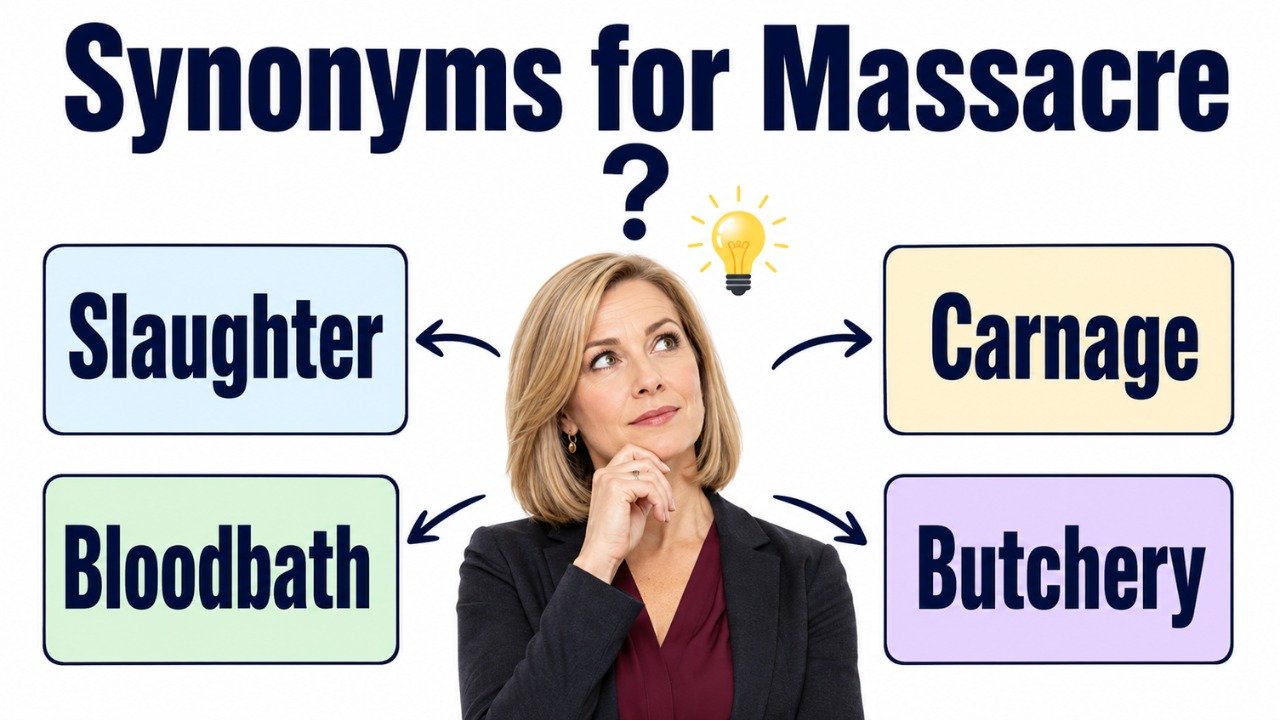
Quick Answer: The best synonyms for massacre include slaughter, mass killing, mass murder, bloodbath, carnage, butchery, extermination, annihilation, atrocity, and wholesale killing. Use slaughter for the violent killing of many people or animals, mass murder for a deliberate criminal act involving numerous victims, and carnage for the shocking physical results of severe violence. Genocide, pogrom, and mass execution fit only specific historical, political, or legal contexts. In figurative writing, rout or crushing defeat may replace massacre when no actual deaths occurred.
Pronunciation and Word Details
Word: Massacre.
Pronunciation: /ˈmæs.ə.kər/
Part of Speech: Noun and verb.
Meaning: The deliberate and violent killing of many people or animals, or an overwhelming defeat in a figurative context.
US Pronunciation:
UK Pronunciation:
What Does “Massacre” Mean?
Massacre means the violent killing of many people or animals, especially when the victims are defenseless, unprepared, or unable to resist effectively.
As a noun, massacre names the violent event.
Example: The villagers fled after hearing reports of a massacre nearby.
As a verb, massacre means to kill many people or animals cruelly and violently.
Example: The attackers massacred the unarmed group.
Massacre is most commonly associated with warfare, political violence, attacks on civilians, persecution, and serious historical events. It suggests extreme brutality and a large number of victims.
The word can also be used figuratively to describe an overwhelming defeat in sports, competition, business, or debate.
Literal Example: The investigation examined the massacre of civilians.
Figurative Example: The inexperienced team was massacred in the final match.
The figurative use does not describe actual killing. Instead, it emphasizes how completely one side defeated another. Because the literal meaning is extremely serious, figurative use may sound insensitive in certain situations.
The noun massacre is countable.
Singular Example: The attack became known as a massacre.
Plural Example: The report documented several massacres.
The verb changes according to tense.
Present Form: Massacre.
Third Person Form: Massacres.
Past Form: Massacred.
Continuous Form: Massacring.
Meaning, Tone, and Context of “Massacre”
Massacre is a very strong, emotional, and serious word. It is not a neutral replacement for killing, death, attack, or defeat.
The word usually expresses horror, cruelty, helplessness, and large scale loss of life. It often implies that the victims had little ability to defend themselves.
Formal Context: The inquiry investigated allegations of a massacre.
Historical Context: The chapter examines a massacre that changed the region’s political future.
Journalistic Context: Witnesses described scenes of widespread killing.
Emotional Context: Families continued to mourn the victims of the massacre.
Legal Context: The killings were examined as possible crimes against humanity.
In formal reports, writers should use massacre only when the available facts support such a strong description. Terms such as mass killing, mass murder, civilian slaughter, or lethal attack may provide greater precision.
Massacre can be used in academic and historical writing, but it often carries moral judgment. A historian may choose it when the scale, brutality, and vulnerability of the victims are central to the discussion.
In casual conversation, people sometimes use massacre dramatically for a severe defeat.
Casual Example: Our team was massacred in the second half.
This use is widely understood, but it may seem exaggerated or inappropriate when used near a discussion of real violence.
The word is not technical by itself. More specific terms may be required in law, history, military studies, or human rights writing.
More Specific Term: Genocide refers to acts committed with the intent to destroy a protected group, in whole or in part.
More Specific Term: Mass execution refers to the killing of multiple people under claimed or actual authority.
More Specific Term: Pogrom refers to an organized attack against a particular ethnic or religious community.
These words are not interchangeable in every sentence.
When and How to Use “Massacre”
For the Killing of Many People
Use massacre when many people are deliberately and violently killed.
Example: Survivors provided testimony about the massacre.
The word is especially appropriate when the victims were civilians, prisoners, captives, or other defenseless people.
For Extreme Brutality
Use massacre when the manner of killing was exceptionally cruel or merciless.
Example: The novel describes the massacre as an act of calculated brutality.
Slaughter and butchery can express a similar sense of cruelty.
For Historical Discussion
Use massacre when describing a recognized historical episode involving widespread killing.
Example: The essay explores the causes and consequences of the massacre.
Historical writing should provide enough context to explain who was involved, what occurred, and why the word is appropriate.
For Reports of Civilian Deaths
Use massacre carefully when reporting the intentional killing of civilians.
Example: Investigators collected evidence concerning the alleged massacre of civilians.
When facts remain disputed, terms such as alleged massacre or reported mass killing can prevent the sentence from presenting an unverified claim as established fact.
For the Killing of Animals
Massacre can describe the cruel killing of many animals.
Example: Conservationists condemned the massacre of protected animals.
In less emotional writing, mass killing or widespread slaughter may sound more objective.
For Planned or Systematic Killing
Use massacre when a group is intentionally attacked and many members are killed.
Example: The documents revealed preparations for a planned massacre.
If the violence was part of a broader attempt to destroy a particular group, genocide or extermination may be more precise.
For an Overwhelming Defeat
Massacre can be used figuratively when one side defeats another by a very large margin.
Example: The champions massacred their opponents in the final.
This use is informal and dramatic. Rout, crushing defeat, or overwhelming victory is often more suitable in professional writing.
For Strong Emotional Emphasis
Use massacre when the writer needs to communicate the horror and scale of an event.
Example: The memorial honors those who died in the massacre.
Do not use the word merely to make ordinary writing sound dramatic.
Best Synonyms for Massacre
Slaughter
Synonym: The violent or cruel killing of many people or animals.
Example: The commander was accused of ordering the slaughter of civilians.
Slaughter is one of the closest synonyms for massacre. It strongly emphasizes cruelty and helpless victims.
Mass Killing
Synonym: An incident in which many people are killed.
Example: Investigators examined the mass killing as part of a wider pattern of violence.
Mass killing is more neutral and descriptive than massacre. It works well in reports, essays, and careful factual writing.
Mass Murder
Synonym: The intentional murder of many people in one event or related series of events.
Example: The case was investigated as an act of mass murder.
Mass murder is useful in criminal and legal contexts. It stresses intentional unlawful killing.
Bloodbath
Synonym: An event involving extensive killing, injury, or bloodshed.
Example: Residents feared that the confrontation would become a bloodbath.
Bloodbath is vivid and emotional. It is also used figuratively for severe financial losses or an overwhelming defeat.
Carnage
Synonym: The killing, injury, and destruction left by extreme violence.
Example: Emergency workers were shocked by the carnage.
Carnage focuses more on the terrible results of violence than on the act itself.
Butchery
Synonym: Cruel, savage, and merciless killing.
Example: Witnesses described the attack as an act of butchery.
Butchery is highly emotional and condemning. It emphasizes the inhuman nature of the violence.
Extermination
Synonym: The planned destruction or killing of an entire group.
Example: The policy was designed to enable the extermination of the targeted population.
Extermination suggests systematic and complete destruction. It is stronger and more specific than massacre.
Annihilation
Synonym: Complete destruction of a group, force, or population.
Example: The community faced the threat of annihilation.
Annihilation emphasizes total destruction rather than one violent incident.
Atrocity
Synonym: An extremely cruel, violent, or shocking act.
Example: The massacre was remembered as one of the conflict’s worst atrocities.
Atrocity is broader than massacre. An atrocity may involve killing, torture, abuse, or another grave act.
Wholesale Killing
Synonym: Killing carried out on a very large and indiscriminate scale.
Example: The report condemned the wholesale killing of innocent people.
Wholesale killing is suitable when emphasizing scale and lack of discrimination between victims.
50 Synonyms for Massacre with Short Meanings
Some of these terms are direct synonyms, while others are narrower or broader alternatives suited to particular contexts.
- Slaughter: The cruel killing of many people or animals.
- Mass Killing: An event in which numerous people are killed.
- Mass Murder: The intentional murder of many victims.
- Bloodbath: An event involving extensive bloodshed and death.
- Carnage: The terrible killing and destruction caused by violence.
- Butchery: Savage and merciless killing.
- Extermination: The planned destruction of an entire group.
- Annihilation: Complete destruction of people, forces, or communities.
- Decimation: Severe destruction or reduction of a population or group.
- Atrocity: An extremely cruel and shocking act.
- Bloodshed: The killing or wounding of people during violence.
- Wholesale Killing: Killing carried out on a very large scale.
- Indiscriminate Killing: Killing without distinguishing between victims.
- Widespread Killing: Killing occurring across a large area or group.
- Systematic Killing: Planned killing carried out according to an organized method.
- Collective Killing: The killing of many members of a group.
- Mass Execution: The execution of many people together.
- Summary Execution: Killing carried out without a fair legal process.
- Large Scale Killing: The killing of a substantial number of people.
- Violent Slaughter: Brutal killing involving extreme force.
- Brutal Killing: Cruel and severe taking of life.
- Ruthless Killing: Killing performed without pity or restraint.
- Merciless Killing: Killing carried out without compassion.
- Deadly Assault: An attack that causes multiple deaths.
- Lethal Attack: An attack intended or likely to cause death.
- Killing Spree: A series of killings within a limited period.
- Devastation: Extreme destruction and loss caused by violence.
- Destruction: The act of completely ruining or eliminating something.
- Eradication: The complete removal or destruction of a group.
- Elimination: The removal or killing of targeted people.
- Genocide: Acts intended to destroy a protected group in whole or in part.
- Pogrom: An organized violent attack on an ethnic or religious community.
- Ethnic Cleansing: The forced removal of an ethnic group, sometimes involving mass violence.
- War Crime: A serious violation of the laws governing armed conflict.
- Crime Against Humanity: A widespread or systematic attack against civilians.
- Civilian Slaughter: The mass killing of people not taking part in combat.
- Human Slaughter: The brutal killing of human beings.
- Mass Casualty Attack: An attack causing many deaths or injuries.
- Mass Fatality Event: An event that causes a very high number of deaths.
- Wipeout: The complete destruction of a group or force.
- Butcher: To kill people cruelly and violently.
- Exterminate: To destroy or kill an entire population or group.
- Annihilate: To destroy completely.
- Wipe Out: To destroy or kill all or nearly all members of a group.
- Kill En Masse: To kill many people together or within one operation.
- Gun Down: To shoot and kill one or more defenseless people.
- Mow Down: To kill many people rapidly with weapons or vehicles.
- Put to Death: To deliberately cause someone’s death.
- Execute: To kill someone under actual or claimed authority.
- Liquidate: To eliminate or kill people, often as a cold euphemism.
Read Also:
Synonyms for Literature

Synonyms for Massacre by Context
When Massacre Means the Violent Killing of Many People
The strongest alternatives are slaughter, mass killing, mass murder, wholesale killing, and collective killing.
Original: The investigation focused on the massacre of local residents.
Alternative: The investigation focused on the mass killing of local residents.
Mass killing is more neutral. Slaughter is more emotional. Mass murder emphasizes criminal intent.
Original: Witnesses described the massacre of the prisoners.
Alternative: Witnesses described the slaughter of the prisoners.
Slaughter works especially well when the victims were defenseless.
When Massacre Emphasizes Brutality
Choose butchery, carnage, bloodbath, brutal killing, or merciless slaughter.
Original: The massacre shocked the entire community.
Alternative: The butchery shocked the entire community.
Butchery highlights cruelty. Carnage highlights the visible results. Bloodbath emphasizes extensive bloodshed.
Original: The street became the site of a massacre.
Alternative: The street became the scene of terrible carnage.
When Massacre Describes Planned Destruction
Choose extermination, annihilation, systematic killing, eradication, or wholesale killing.
Original: The leaders secretly prepared for a massacre of the minority population.
Alternative: The leaders secretly prepared for the systematic killing of the minority population.
Systematic killing emphasizes organization and planning.
Original: The community feared a massacre.
Alternative: The community feared complete annihilation.
Annihilation suggests that the entire community could be destroyed.
When Massacre Involves Government or Military Authority
Choose mass execution, summary execution, civilian slaughter, war crime, or crime against humanity when supported by the facts.
Original: The prisoners were killed in a massacre.
Alternative: The prisoners were killed in a mass execution.
Mass execution is more precise when people were killed together under official or claimed authority.
Original: The inquiry examined the massacre of civilians.
Alternative: The inquiry examined the civilian slaughter as a possible war crime.
War crime is a legal classification and should not be used casually.
When Massacre Targets a Particular Community
Choose pogrom, genocide, extermination, or ethnic cleansing only when the specific meaning applies.
Original: The book describes a massacre directed at a religious community.
Alternative: The book describes an organized pogrom against the religious community.
Pogrom identifies organized communal violence. It is narrower than massacre.
Original: The campaign included repeated massacres of the targeted group.
Alternative: The campaign formed part of an attempt at extermination.
Genocide requires a specific intent to destroy a protected group. Not every massacre is genocide.
When Massacre Refers to the Results of Violence
Choose carnage, bloodshed, devastation, or destruction.
Original: Medical workers arrived after the massacre.
Alternative: Medical workers arrived after the carnage.
Carnage focuses on what remained after the attack.
Original: The survivors struggled to understand the scale of the massacre.
Alternative: The survivors struggled to understand the scale of the devastation.
When Massacre Is Used Figuratively
Choose rout, crushing defeat, overwhelming defeat, complete defeat, or wipeout.
Original: The visiting team suffered a massacre in the final.
Alternative: The visiting team suffered a crushing defeat in the final.
Original: The debate became a massacre for the unprepared candidate.
Alternative: The debate became a complete rout for the unprepared candidate.
These alternatives avoid using a word associated with real mass killing.
Another Word for Massacre
The best single replacement for massacre is usually slaughter. Both words describe the cruel and violent killing of many people or animals.
However, the most accurate alternative depends on the context. Use mass killing for neutral factual writing, mass murder for criminal intent, carnage for the results of violence, and rout for a figurative defeat.
Original: The soldiers were accused of carrying out a massacre.
Better Option: The soldiers were accused of carrying out a slaughter.
Original: Researchers documented the massacre of civilians.
Better Option: Researchers documented the mass killing of civilians.
Original: The attack left scenes of massacre across the village.
Better Option: The attack left scenes of carnage across the village.
Original: The home team suffered a massacre in the championship match.
Better Option: The home team suffered a crushing defeat in the championship match.
When Not to Use “Massacre”
When the Number of Deaths Is Small
Massacre normally suggests numerous victims. Use murder, killing, or deadly attack when only one or a few people were killed.
Weak: The killing of one victim was described as a massacre.
Better: The killing of one victim was described as murder.
When the Deaths Were Accidental
Massacre usually implies intentional violence. It is generally unsuitable for accidents, natural disasters, or disease.
Weak: The earthquake caused a massacre.
Better: The earthquake caused widespread loss of life.
Weak: The transport accident became a massacre.
Better: The transport accident became a mass fatality event.
When the Facts Are Unconfirmed
Avoid presenting massacre as an established fact when reports remain disputed or incomplete.
Weak: The army committed a massacre.
Better: Witnesses alleged that the army carried out a massacre.
Better: Investigators are examining reports of a mass killing.
When a More Precise Term Exists
Use a narrower term when the legal, historical, or political distinction matters.
Weak: The prisoners died in a massacre.
Better: The prisoners were killed in a mass execution.
Weak: The campaign of forced removal was a massacre.
Better: The campaign involved ethnic cleansing and repeated attacks on civilians.
When Describing Ordinary Competition
Massacre may sound exaggerated in professional writing about sports, elections, business, or debates.
Weak: The company massacred its competitor in quarterly sales.
Better: The company significantly outperformed its competitor in quarterly sales.
When the Word Is Repeated Too Often
Repeated use can weaken the emotional effect and make a passage sound sensational.
Weak: The massacre began at dawn. The massacre continued for hours. The massacre caused widespread fear.
Better: The massacre began at dawn, continued for hours, and caused widespread fear.
Better: The slaughter began at dawn and continued for hours, causing widespread fear.
When a Neutral Tone Is Required
In research or official reporting, mass killing may be more objective.
Weak: The study examines the horrifying massacre in emotional detail.
Better: The study examines the documented mass killing and its consequences.
When Discussing Military Defeat Without Civilian Killing
Massacre may wrongly imply that defenseless people were deliberately killed.
Weak: The army suffered a massacre during the battle.
Better: The army suffered a devastating military defeat during the battle.
Words Commonly Confused With Massacre
Massacre vs Murder: Murder usually refers to the unlawful killing of one person, although it can involve several victims. Massacre specifically suggests the violent killing of many people or animals.
Massacre vs Mass Murder: Mass murder is a criminal description emphasizing intentional murder of numerous victims. Massacre adds a strong sense of brutality, helpless victims, and shocking violence.
Massacre vs Slaughter: Both words describe cruel mass killing. Slaughter can also refer to killing animals for food, while massacre more strongly suggests a shocking violent incident.
Massacre vs Genocide: A massacre is an incident involving many killings. Genocide involves intent to destroy a protected national, ethnic, racial, or religious group in whole or in part.
Massacre vs Carnage: Massacre describes the act or event. Carnage usually describes the resulting death, injury, bloodshed, and destruction.
Massacre vs Bloodbath: Both are emotional terms. Bloodbath emphasizes extensive bloodshed and may also be used figuratively for financial loss or severe defeat.
Massacre vs Execution: Execution is the deliberate killing of a person under actual or claimed authority. A mass execution involves multiple people. A massacre does not require any claimed legal process.
Massacre vs Atrocity: Atrocity is broader. It can include massacre, torture, abuse, forced displacement, or another extremely cruel act.
Massacre vs Pogrom: Pogrom refers to an organized attack on a particular ethnic or religious community. A massacre may occur during a pogrom, but the terms are not identical.
Massacre vs Battle: A battle is armed conflict between opposing forces. A massacre usually implies one sided killing or victims who were unable to defend themselves effectively.
Which Synonym Should You Choose?
Choose slaughter when you want the closest strong synonym for cruel mass killing.
Choose mass killing for neutral, factual, academic, or investigative writing.
Choose mass murder when emphasizing intentional criminal killing involving many victims.
Choose carnage when focusing on the terrible physical results of violence.
Choose bloodbath for vivid emotional writing about extensive death or injury.
Choose butchery when condemning extreme cruelty and inhuman violence.
Choose extermination when an organized effort aims to destroy an entire population or group.
Choose annihilation when emphasizing complete or near complete destruction.
Choose mass execution when many prisoners or captives are deliberately killed under actual or claimed authority.
Choose summary execution when victims are killed without a fair trial or legal procedure.
Choose civilian slaughter when emphasizing that the victims were not active combatants.
Choose pogrom when an organized attack targets an ethnic or religious community.
Choose genocide only when the required intent to destroy a protected group is relevant.
Choose war crime or crime against humanity only when discussing an appropriate legal classification.
Choose deadly assault or lethal attack when the number of victims is unclear or the focus is the attack itself.
Choose crushing defeat or rout in sports, debates, elections, or other figurative contexts.
In essays and reports, mass killing is often the safest neutral alternative. In historical narratives, slaughter, carnage, or atrocity may better communicate emotional and moral weight. In casual conversation, bloodbath may sound natural, but it remains highly dramatic.
Real Life Examples of “Massacre” in Sentences
Historical Writing
Original: The chapter examines the causes of the massacre.
Better Option: The chapter examines the causes of the mass killing.
Civilian Violence
Original: Witnesses reported a massacre of unarmed residents.
Better Option: Witnesses reported the slaughter of unarmed residents.
Criminal Investigation
Original: The authorities treated the massacre as a major criminal case.
Better Option: The authorities treated the mass murder as a major criminal case.
Aftermath of Violence
Original: Medical teams arrived at the scene of the massacre.
Better Option: Medical teams arrived at the scene of the carnage.
Planned Killing
Original: The documents revealed preparations for a massacre.
Better Option: The documents revealed preparations for systematic killing.
Prisoner Deaths
Original: The prisoners were victims of a massacre.
Better Option: The prisoners were victims of a mass execution.
Attack on Civilians
Original: The report condemned the massacre of civilians.
Better Option: The report condemned the civilian slaughter.
Destruction of a Community
Original: Residents feared that another massacre would occur.
Better Option: Residents feared that another bloodbath would occur.
Animal Protection
Original: Officials promised to prevent the massacre of protected animals.
Better Option: Officials promised to prevent the widespread slaughter of protected animals.
Sports Context
Original: The final match was a massacre.
Better Option: The final match was a complete rout.
Synonym Groups and Usage Differences
Direct Mass Killing Group
This group includes slaughter, mass killing, mass murder, wholesale killing, and collective killing.
Slaughter emphasizes cruelty. Mass killing is neutral and descriptive. Mass murder stresses criminal intent. Wholesale killing emphasizes scale. Collective killing focuses on many members of a group.
Example: The inquiry documented the mass killing of civilians.
Brutality Group
This group includes butchery, bloodbath, brutal killing, ruthless killing, and merciless killing.
These terms communicate moral condemnation and emotional force. Butchery is particularly strong. Bloodbath creates a vivid image of extensive violence.
Example: Survivors described the attack as an act of butchery.
Aftermath Group
This group includes carnage, bloodshed, devastation, and destruction.
Carnage describes the bodies, injuries, and destruction left behind. Bloodshed refers generally to violent killing or injury. Devastation includes broader physical and emotional damage.
Example: Rescue workers struggled to respond to the carnage.
Systematic Destruction Group
This group includes extermination, annihilation, eradication, systematic killing, and elimination.
Extermination suggests organized destruction of a population. Annihilation emphasizes completeness. Eradication and elimination may sound clinical or euphemistic when applied to people.
Example: The targeted community faced a campaign of systematic killing.
Authority Based Killing Group
This group includes mass execution, summary execution, put to death, and execute.
Mass execution describes the killing of many people under authority. Summary execution emphasizes the absence of a fair trial.
Example: The prisoners were killed in a summary execution.
Targeted Community Violence Group
This group includes pogrom, genocide, ethnic cleansing, crime against humanity, and war crime.
These are specialized terms with distinct meanings. They should not be treated as casual substitutes for massacre.
Example: The violence formed part of an organized pogrom against the community.
Attack Group
This group includes deadly assault, lethal attack, mass casualty attack, gun down, and mow down.
These alternatives focus on the method or immediate event rather than the broader historical meaning.
Example: The crowd was targeted in a mass casualty attack.
Figurative Defeat Group
This group includes rout, crushing defeat, overwhelming defeat, complete defeat, and wipeout.
These terms are better than massacre when describing sports, debates, elections, sales, or competitions.
Example: The inexperienced team suffered a complete rout.
Antonyms of Massacre
Massacre has no exact single antonym, but several words express the opposite ideas of killing, destruction, cruelty, and loss.
Rescue: The act of saving someone from danger or death.
Protection: The act of keeping people safe from harm.
Preservation: The act of keeping life, culture, or property from being destroyed.
Survival: The continuation of life after danger or violence.
Mercy: Compassion shown to someone who could be harmed or punished.
Peace: A condition without war, violence, or serious conflict.
Safety: Freedom from danger, injury, or death.
Evacuation: The organized removal of people from a dangerous place.
Safeguarding: Protecting vulnerable people from harm.
Defense: Action taken to protect people or places from attack.
Reconciliation: The restoration of peaceful relations after conflict.
Ceasefire: An agreement to stop fighting.
Compassion: Concern for suffering combined with a desire to help.
Humanity: Kind and compassionate treatment of other people.
Deliverance: Rescue from danger, suffering, or destruction.
Comparison of Massacre and Related Words
Massacre vs Slaughter
Massacre and slaughter both describe the cruel killing of many people or animals. Massacre often refers to a particular shocking event, while slaughter can describe either the event or the general act of killing.
Example With Massacre: The memorial honors the victims of the massacre.
Example With Slaughter: Witnesses condemned the slaughter of civilians.
Massacre vs Mass Killing
Massacre is emotionally powerful and suggests brutality. Mass killing is more neutral and factual.
Example With Massacre: Survivors spoke about the horror of the massacre.
Example With Mass Killing: The study documents the mass killing and its political consequences.
Massacre vs Mass Murder
Massacre emphasizes the violent nature and scale of the event. Mass murder emphasizes intentional criminal killing.
Example With Massacre: The village became the site of a massacre.
Example With Mass Murder: Prosecutors described the incident as mass murder.
Massacre vs Carnage
Massacre names the violent event. Carnage describes the death, injury, and destruction caused by it.
Example With Massacre: The massacre occurred before sunrise.
Example With Carnage: Emergency workers were unprepared for the carnage.
Massacre vs Bloodbath
Massacre is suitable for serious historical or factual description. Bloodbath is more vivid and dramatic.
Example With Massacre: The commission investigated the massacre.
Example With Bloodbath: Residents feared the protest would become a bloodbath.
Massacre vs Genocide
A massacre may be one incident. Genocide is a broader legal and historical concept involving intent to destroy a protected group.
Example With Massacre: Hundreds of residents fled after the massacre.
Example With Genocide: Investigators examined evidence of an intent to commit genocide.
Massacre vs Pogrom
A massacre focuses on mass killing. A pogrom is an organized attack on an ethnic or religious community and may include killing, destruction, and forced displacement.
Example With Massacre: The massacre left many civilians dead.
Example With Pogrom: The pogrom targeted homes, businesses, and places of worship.
Massacre vs Execution
A massacre involves widespread violent killing. An execution involves the deliberate killing of someone under actual or claimed authority.
Example With Massacre: The attack ended in a massacre.
Example With Execution: The prisoners faced execution without a fair trial.
Massacre vs Atrocity
Massacre is one type of violent event. Atrocity is a broader term for any extremely cruel act.
Example With Massacre: The massacre occurred during the occupation.
Example With Atrocity: The report documented torture, displacement, and other atrocities.
Massacre vs Rout
Massacre usually refers to real killing. Rout refers to an overwhelming defeat and is safer for figurative contexts.
Example With Massacre: The civilians were killed in a massacre.
Example With Rout: The visiting team suffered a rout in the final.
Common Phrases and Expressions With “Massacre”
Brutal Massacre: An extremely cruel and violent mass killing.
Bloody Massacre: A massacre involving extensive bloodshed.
Massacre of Civilians: The large scale killing of people not taking part in combat.
Massacre of Prisoners: The deliberate killing of people held in captivity.
Carry Out a Massacre: To commit or perform a mass killing.
Survive a Massacre: To remain alive after a mass killing.
Prevent a Massacre: To stop widespread killing before it occurs.
Victims of a Massacre: People killed, injured, or directly harmed in a mass killing.
Scene of a Massacre: The place where a mass killing occurred.
Account of a Massacre: A written or spoken description of the event.
Alleged Massacre: A reported mass killing that has not yet been fully verified.
Massacre an Opponent: To defeat an opponent by an overwhelming margin in informal language.
Common Mistakes to Avoid
Using Massacre for Any Death
Massacre does not mean every type of death or killing. It suggests many victims and severe violence.
Incorrect: The accidental death of one worker was a massacre.
Correct: The accidental death of one worker was a tragedy.
Treating Massacre and Genocide as Identical
A massacre may occur without genocidal intent. Genocide requires a specific intention directed against a protected group.
Incorrect: Every massacre is automatically genocide.
Correct: A massacre may form part of genocide, but the two terms are not identical.
Using Massacre for an Accident
The word usually implies deliberate human violence.
Incorrect: The flood massacred the residents.
Correct: The flood caused widespread loss of life.
Choosing an Overly Emotional Synonym
Bloodbath and butchery may sound sensational in a neutral report.
Too Emotional: The study analyzes the horrifying bloodbath.
More Neutral: The study analyzes the documented mass killing.
Using a Weak Alternative
Attack and incident may hide the scale or seriousness of a massacre.
Weak: The report described the event as an incident.
Better: The report described the event as a mass killing.
Confusing Carnage With the Event Itself
Carnage usually describes the destructive results rather than the organized act.
Less Precise: The leaders planned the carnage months earlier.
Better: The leaders planned the massacre months earlier.
Natural Use: Emergency workers encountered scenes of carnage.
Using Figurative Massacre Insensitively
The word may sound inappropriate when used for a minor defeat near discussion of real victims.
Insensitive: Our team’s loss was a massacre, just like the tragedy discussed earlier.
Better: Our team suffered a crushing defeat.
Repeating the Same Strong Word
Too much repetition can make serious writing feel dramatic rather than thoughtful.
Repetitive: The massacre caused fear. The massacre displaced families. The massacre changed the region.
Improved: The massacre caused fear, displaced families, and changed the region.
Using Legal Terms Without Evidence
Do not replace massacre with war crime, genocide, or crime against humanity merely for emphasis.
Weak: Every violent massacre is legally genocide.
Better: The massacre may require investigation under relevant criminal and international law.
Forgetting the Figurative Meaning
Massacre can mean an overwhelming defeat, but this meaning should be clear from context.
Unclear: The team experienced a massacre.
Clearer: The team suffered an overwhelming defeat in the final.
Conclusion
The best synonyms for massacre depend on the scale, purpose, victims, and tone of the sentence. Slaughter is the closest general replacement, while mass killing and mass murder suit factual or criminal contexts. Carnage describes the violent aftermath, and extermination suggests systematic destruction. Genocide, pogrom, and mass execution have narrower meanings and should be chosen carefully. For figurative competition, rout or crushing defeat is usually more accurate and respectful than massacre.
FAQs About Synonyms for Massacre
What Is the Best Synonym for Massacre?
Slaughter is usually the closest synonym because it describes the cruel killing of many people or animals. Mass killing is better for neutral factual writing.
Is Mass Murder the Same as Massacre?
Not exactly. Mass murder emphasizes intentional criminal killing, while massacre also conveys brutality, helpless victims, and extreme violence.
Can Carnage Replace Massacre?
Carnage can replace massacre when the focus is the death, injury, and destruction left by violence. It is less suitable when discussing the planning of the event.
Is Genocide a Synonym for Massacre?
Genocide is not a general synonym. It requires intent to destroy a protected group in whole or in part. A massacre may be part of genocide, but many massacres are not genocide.
What Is a Formal Alternative to Massacre?
Mass killing is a clear formal alternative. Civilian slaughter, mass execution, or systematic killing may be more precise in particular contexts.
What Is a Less Violent Alternative for Sports Writing?
Use rout, crushing defeat, overwhelming defeat, or one sided victory. These expressions communicate a decisive result without referring to mass killing.
What Is the Difference Between Massacre and Bloodbath?
Massacre describes the mass killing itself. Bloodbath emphasizes extensive bloodshed and is usually more dramatic or emotional.
