
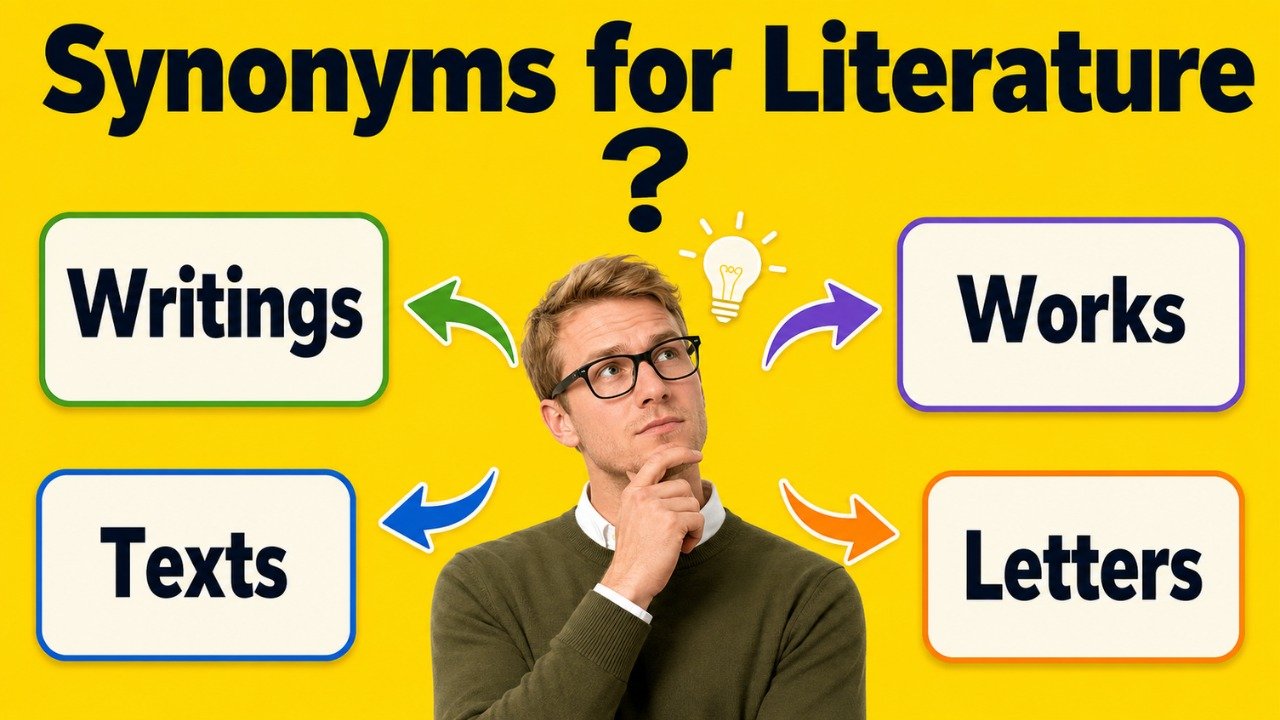
Quick Answer: The best synonyms for literature include writing, writings, books, texts, works, publications, prose, scholarship, research, and reading material. Use writing for written expression in general, books for published volumes, texts for works being studied, and scholarship for formal academic discussion. Publications suits professional or research contexts, while reading material is a natural choice for casual conversation. The best replacement among synonyms for literature depends on whether you mean creative works, academic sources, published information, or promotional documents.
Pronunciation and Word Details
Word: Literature.
Pronunciation: /ˈlɪtərətʃər/
Part of Speech: Noun.
Meaning: Written works considered collectively, especially those valued for artistic, cultural, academic, or informational importance.
US Pronunciation:
UK Pronunciation:
What Does “Literature” Mean?
Literature means written works considered as a group. It is a noun commonly used for novels, poetry, drama, essays, academic studies, professional publications, and informational materials.
In an artistic context, literature refers to creative works that express ideas, emotions, experiences, and cultural values. Novels, short stories, plays, and poems are common forms of literature.
In an academic context, literature refers to published research and scholarly writing about a subject. For example, a researcher may review the existing literature before beginning a new study.
In a practical or commercial context, literature can mean brochures, leaflets, manuals, or other written information distributed to readers.
Creative Use: Literature can describe imaginative and artistic writing.
Example: She studied modern literature at university.
Academic Use: Literature can refer to research and published knowledge within a field.
Example: The report examines the scientific literature on climate patterns.
Informational Use: Literature can mean printed or digital material that explains a product, service, program, or subject.
Example: Visitors received literature explaining the museum exhibition.
Meaning, Tone, and Context of “Literature”
Literature usually has a neutral, formal, or academic tone. Its exact meaning changes according to the subject and setting.
In education, literature often means creative works studied for their language, themes, characters, style, and cultural significance. Teachers may discuss English literature, world literature, classical literature, or contemporary literature.
In research, literature means the existing body of published studies, articles, reports, and theories about a particular topic. Expressions such as research literature, medical literature, and scientific literature are common in formal writing.
In everyday conversation, literature may sound more formal than books, writing, or reading material. A person is more likely to say, “I enjoy reading books,” while an academic discussion may use, “I study literature.”
The word can also refer to informational documents. In this sense, phrases such as product literature, campaign literature, and promotional literature describe brochures, pamphlets, and other materials prepared for distribution.
Formal Tone: Literature is appropriate in essays, reports, lectures, and professional discussions.
Academic Tone: It is frequently used when discussing research, scholarship, literary analysis, and education.
Artistic Tone: It can suggest writing that has cultural, intellectual, or creative value.
Conversational Tone: In casual speech, books, writing, or reading material may sound more natural.
Technical Tone: In professional fields, literature may describe all published information related to a specific subject.
When and How to Use “Literature”
For Creative Written Works
Use literature when referring collectively to novels, poems, stories, plays, and essays that have artistic or cultural importance.
Example: The course introduces students to African literature.
For Academic Research
Use literature when referring to existing studies, theories, articles, and research findings about a subject.
Example: The available literature supports the need for further investigation.
For Literary Education
Use literature when discussing the study, interpretation, and appreciation of written works.
Example: He teaches literature and creative writing.
For a Body of Published Knowledge
Use literature when describing everything published within a professional or academic field.
Example: The medical literature contains several studies on the treatment.
For Informational Materials
Use literature for brochures, pamphlets, guides, and printed information distributed by an organization.
Example: Please send me literature about the training program.
For Cultural Discussion
Use literature when discussing how written works reflect a society, period, tradition, or identity.
Example: Literature often preserves the beliefs and experiences of earlier generations.
For Formal Writing
Use literature in reports and essays when a broad or academic term is more suitable than books or writing.
Example: The essay explores the influence of war on twentieth century literature.
Best Synonyms for Literature
Writing: Written language considered generally or as a creative activity.
Example: Her writing explores memory, family, and identity.
Writings: A collection of works produced by a particular person, group, or period.
Example: The scholar examined the early writings of the philosopher.
Books: Published works, especially longer texts in printed or digital form.
Example: The library has many books about ancient history.
Texts: Written works studied, analyzed, or used as sources.
Example: Students compared several historical texts.
Works: Creative or intellectual products made by an author.
Example: His most famous works were published after his death.
Publications: Materials formally issued for public or professional use.
Example: The department produces publications on public health.
Prose: Written language arranged in sentences and paragraphs rather than verse.
Example: Her prose is clear, elegant, and emotionally powerful.
Scholarship: Serious academic study and published intellectual work.
Example: Recent scholarship has changed how the poem is interpreted.
Research: Organized investigation and the written findings produced from it.
Example: The research provides new evidence about language development.
Reading Material: Written content intended to be read for information, education, or enjoyment.
Example: The teacher provided additional reading material for the class.
50 Synonyms for Literature with Short Meanings
- Writing: Written expression in a general sense.
- Writings: Collected written works by a person or group.
- Books: Published works presented as volumes.
- Texts: Written works used for reading or study.
- Works: Creative or intellectual creations by an author.
- Publications: Materials formally issued for readers.
- Prose: Writing arranged in sentences and paragraphs.
- Poetry: Literary writing using rhythm, imagery, and expressive language.
- Drama: Literature written for theatrical performance.
- Verse: Writing composed in poetic lines.
- Fiction: Imaginative writing about invented people or events.
- Nonfiction: Writing based on facts, real events, or actual people.
- Creative Writing: Imaginative writing intended to express ideas or experiences.
- Literary Works: Written creations valued for artistic or cultural qualities.
- Written Works: Materials produced through writing.
- Printed Works: Written material published in physical form.
- Written Material: Any information or expression presented in writing.
- Published Material: Content formally made available to readers.
- Reading Material: Content provided for reading or study.
- Printed Matter: Documents and publications produced in printed form.
- Body of Writing: A collection of related written works.
- Body of Work: All significant works produced by a writer or group.
- Book Collection: A group of books gathered around a subject or purpose.
- Corpus: A complete collection of written or spoken material.
- Canon: Works widely accepted as important within a tradition.
- Letters: Written works or literary culture considered collectively.
- Belles Lettres: Artistic writing valued for elegance and style.
- Scholarship: Academic study and intellectual writing.
- Academic Writing: Formal writing produced for education or research.
- Scholarly Writing: Carefully researched writing by academic specialists.
- Critical Writing: Writing that analyzes and evaluates works or ideas.
- Research: Systematic investigation and its recorded findings.
- Studies: Published examinations of particular subjects.
- Published Research: Research findings formally shared with readers.
- Research Literature: Existing studies and publications about a topic.
- Academic Sources: Credible materials used in formal study.
- Professional Literature: Publications produced within a profession.
- Reference Material: Information used to check facts or understand a subject.
- Source Material: Original information used for study or writing.
- Documentation: Written records explaining facts, systems, or procedures.
- Documents: Written or recorded materials containing information.
- Records: Stored written evidence of events, facts, or activities.
- Bibliography: A list or collection of works related to a subject.
- Brochures: Short informational booklets used for explanation or promotion.
- Pamphlets: Small publications presenting information or arguments.
- Leaflets: Brief printed materials distributed to readers.
- Handouts: Documents given to an audience for information or instruction.
- Information Sheets: Short documents presenting essential facts.
- Promotional Material: Written content used to explain or promote something.
- Publicity Material: Information prepared for public awareness or attention.
Read Also:
Synonyms for Of
Synonyms for Literature by Context
When Literature Means Creative Writing
The best alternatives include writing, creative writing, literary works, fiction, prose, poetry, drama, and verse. These words relate to literature as an artistic form.
Example: The course explores literature from several cultural traditions.
Alternative: The course explores literary works from several cultural traditions.
Creative writing is useful when emphasizing the process of producing imaginative work. Literary works is better when referring to completed novels, poems, stories, or plays.
When Literature Means Books and Written Works
Useful synonyms include books, texts, writings, works, written works, printed works, and reading material.
Example: The library contains literature about medieval history.
Alternative: The library contains books about medieval history.
Books is the clearest choice when the collection mainly contains published volumes. Texts works well when the materials are being studied, compared, or interpreted.
When Literature Means Academic Research
The strongest alternatives include scholarship, research, studies, academic writing, scholarly writing, academic sources, and published research.
Example: The literature suggests that sleep affects memory.
Alternative: The published research suggests that sleep affects memory.
Scholarship emphasizes serious academic interpretation. Research emphasizes investigation, evidence, and findings.
When Literature Means a Collection of Sources
Suitable alternatives include corpus, body of writing, body of work, canon, bibliography, source material, and reference material.
Example: The researcher analyzed the literature produced during the period.
Alternative: The researcher analyzed the body of writing produced during the period.
Corpus is a formal term for a defined collection of material. Canon refers to works widely recognized as important or influential.
When Literature Means Informational Documents
Helpful alternatives include brochures, pamphlets, leaflets, handouts, information sheets, promotional material, and publicity material.
Example: The office provided literature about the available courses.
Alternative: The office provided brochures about the available courses.
Brochures is more precise when the material is attractively designed and informative. Handouts is suitable for documents distributed during lessons, meetings, or presentations.
Another Word for Literature
The best single alternative to literature is writing because it can refer broadly to creative, academic, professional, or personal written expression. However, writing does not suit every context.
Use books when referring to published volumes, texts when referring to works being studied, scholarship when referring to academic interpretation, and research when referring to evidence based studies.
Original: She has always loved literature.
Better Option: She has always loved books and creative writing.
Original: We reviewed the literature before conducting the experiment.
Better Option: We reviewed the existing research before conducting the experiment.
Original: The office sent literature about the program.
Better Option: The office sent brochures about the program.
Original: The course examines colonial literature.
Better Option: The course examines colonial writings.
When Not to Use “Literature”
Do not use literature when a more specific word would make the meaning clearer. The word can refer to creative writing, academic research, published documents, or promotional information, so an unclear context may confuse readers.
When You Mean Only Books
Literature may sound overly formal when you are simply talking about books for casual reading.
Weak: I packed some literature for the journey.
Better: I packed some books for the journey.
When You Mean Research Findings
In academic writing, research or studies may be more precise when referring to evidence and experiments.
Weak: The literature proved that the treatment always works.
Better: The available studies found that the treatment was effective in several cases.
When You Mean a Specific Document
Literature is too broad when you are referring to one brochure, guide, report, or manual.
Weak: Please read the literature before using the machine.
Better: Please read the instruction manual before using the machine.
When the Word Becomes Repetitive
Repeating literature throughout a paragraph can make academic writing sound mechanical.
Weak: The literature was reviewed because the literature contained important gaps in the literature.
Better: The existing research was reviewed because the published studies contained important gaps.
When Artistic Value Is Not Intended
Literature can suggest artistic, intellectual, or cultural importance. Use written material when no literary value is implied.
Weak: The storage box contained old office literature.
Better: The storage box contained old office documents.
Words Commonly Confused With Literature
Literature vs Writing: Literature usually refers to a body of written works, while writing can mean either written content or the activity of producing it.
Literature vs Literacy: Literature means written works. Literacy means the ability to read and write.
Literature vs Literary: Literature is a noun, while literary is an adjective describing writing, authors, style, or culture.
Literature vs Books: Books are physical or digital publications. Literature is a broader category that may include books, poems, plays, essays, and research.
Literature vs Fiction: Fiction is imaginative writing. Literature includes fiction but can also include poetry, drama, essays, and some forms of nonfiction.
Literature vs Prose: Prose is writing in ordinary sentence and paragraph form. Literature may include both prose and poetry.
Literature vs Research: Literature can mean all existing publications on a topic. Research is the process of investigation or the findings produced by it.
Literature vs Bibliography: Literature is the material itself. A bibliography is a list of sources or works.
Literature vs Documentation: Literature can be artistic or academic, while documentation usually records facts, instructions, processes, or technical details.
Which Synonym Should You Choose?
Choose writing when discussing written expression generally.
Choose writings when referring to the collected work of a particular author, thinker, group, or period.
Choose books when speaking casually about published volumes or reading choices.
Choose texts when discussing works being studied, interpreted, compared, or taught.
Choose works when referring respectfully to an author’s creative or intellectual creations.
Choose publications when discussing materials formally released by an institution, researcher, or professional body.
Choose prose when distinguishing ordinary written form from poetry or verse.
Choose literary works when emphasizing artistic, cultural, or intellectual value.
Choose scholarship when discussing formal academic interpretation and expert study.
Choose research when focusing on experiments, evidence, findings, and investigation.
Choose studies when referring to separate research projects or published examinations.
Choose corpus when describing a defined collection used for language or literary analysis.
Choose canon when referring to works widely recognized as important within a tradition.
Choose bibliography when referring to a list of relevant sources.
Choose reading material for natural, everyday discussion about content provided for reading.
Choose brochures, pamphlets, or leaflets when referring to short informational or promotional documents.
Choose documentation when discussing instructions, systems, technical processes, or formal records.
Real Life Examples of “Literature” in Sentences
Original: She enjoys reading literature from different countries.
Better Option: She enjoys reading literary works from different countries.
Original: The professor specializes in Victorian literature.
Better Option: The professor specializes in Victorian writing.
Original: The team reviewed the literature before designing the study.
Better Option: The team reviewed the existing research before designing the study.
Original: Students discussed the literature assigned for the course.
Better Option: Students discussed the texts assigned for the course.
Original: The library has a large collection of children’s literature.
Better Option: The library has a large collection of children’s books.
Original: Recent literature questions the earlier theory.
Better Option: Recent scholarship questions the earlier theory.
Original: The organization distributed literature about the campaign.
Better Option: The organization distributed pamphlets about the campaign.
Original: His literature reflects the political tensions of his time.
Better Option: His writings reflect the political tensions of his time.
Original: The medical literature contains conflicting conclusions.
Better Option: The published studies contain conflicting conclusions.
Original: Please examine the product literature before making a decision.
Better Option: Please examine the product information before making a decision.
Synonym Groups and Usage Differences
Creative Writing Group
This group includes creative writing, fiction, prose, poetry, drama, verse, and belles lettres. These terms focus on literature as an artistic or imaginative form.
Creative writing is broad and modern. Fiction refers to invented narratives. Prose describes the structure of writing, while poetry and verse describe poetic forms.
Example: Her creative writing combines family history with imagined events.
Published Works Group
This group includes books, publications, texts, printed works, written works, and published material. These alternatives emphasize that the material has been produced and made available to readers.
Books is specific and familiar. Publications is more formal. Texts is common in education and analysis.
Example: The instructor selected three texts for close study.
Academic Knowledge Group
This group includes scholarship, research, studies, academic writing, scholarly writing, and published research. These words suit academic, scientific, and professional contexts.
Scholarship often involves interpretation and intellectual discussion. Research focuses more strongly on investigation and evidence.
Example: Recent scholarship offers a different interpretation of the novel.
Collection Group
This group includes corpus, canon, body of writing, body of work, book collection, and bibliography.
Corpus describes a complete or defined collection. Canon describes works considered especially important. Body of work refers to everything produced by one creator.
Example: The archive preserves the author’s complete body of work.
Informational Material Group
This group includes brochures, pamphlets, leaflets, handouts, information sheets, promotional material, and publicity material.
These words are more precise than literature when the material is designed to inform, instruct, advertise, or raise awareness.
Example: Each visitor received an information sheet at the entrance.
Records and Sources Group
This group includes documents, records, documentation, source material, reference material, and academic sources.
These terms emphasize factual information, evidence, instructions, or materials used for further study.
Example: The historian examined original source material from the period.
Antonyms of Literature
Literature has no single perfect antonym because it has several meanings. Its opposites depend on whether it refers to writing, academic sources, creative expression, or published material.
Speech: Spoken communication rather than written expression.
Conversation: Informal spoken interaction between people.
Oral Tradition: Knowledge, stories, and customs passed through speech rather than writing.
Silence: The absence of spoken or written expression.
Illiteracy: The inability to read or write.
Unwritten Material: Information that has not been recorded in written form.
Improvisation: Expression created at the moment rather than written in advance.
Performance: A live presentation rather than a written work.
Visual Art: Creative expression through images rather than words.
Unpublished Work: Writing that has not been formally released to readers.
Original Research: New investigation rather than the existing literature on a subject.
Misinformation: False or misleading content rather than reliable scholarship or documentation.
Comparison of Literature and Related Words
Literature vs Writing
Literature usually refers to a collection or category of written works. Writing is broader and can describe the activity, style, or result of putting words into written form.
Example With Literature: She teaches modern literature.
Example With Writing: She teaches creative writing.
Literature vs Books
Books are specific published objects or digital volumes. Literature may include books, poems, essays, plays, stories, and academic publications.
Example With Literature: The course explores literature from the nineteenth century.
Example With Books: I borrowed three books from the library.
Literature vs Texts
Literature describes written works collectively. Texts usually refers to particular works selected for reading, analysis, or instruction.
Example With Literature: Medieval literature contains many heroic narratives.
Example With Texts: The students analyzed two medieval texts.
Literature vs Scholarship
Literature may include the full body of published material on a subject. Scholarship emphasizes expert academic study, interpretation, and intellectual contribution.
Example With Literature: The literature on the topic has expanded considerably.
Example With Scholarship: Recent scholarship challenges the traditional interpretation.
Literature vs Research
Literature refers to existing written knowledge. Research refers to the process of investigating a question or the findings that result.
Example With Literature: The researcher reviewed the literature before collecting data.
Example With Research: The researcher conducted interviews as part of the research.
Literature vs Fiction
Literature is a broad category of written works. Fiction is a specific category based mainly on invented characters, settings, and events.
Example With Literature: She has a degree in literature.
Example With Fiction: She mainly reads historical fiction.
Literature vs Prose
Literature concerns the content, tradition, or collection of written works. Prose describes writing arranged in normal sentences rather than poetic lines.
Example With Literature: The novel is an important work of modern literature.
Example With Prose: The author’s prose is direct and elegant.
Literature vs Documentation
Literature may be creative, cultural, academic, or informational. Documentation is usually practical writing that records facts or explains procedures.
Example With Literature: The course examines postcolonial literature.
Example With Documentation: The developer updated the technical documentation.
Common Phrases and Expressions With “Literature”
Classic Literature: Written works that have remained influential over time.
Modern Literature: Written works associated with relatively recent periods and styles.
World Literature: Important written works from different countries, languages, and cultures.
English Literature: Literature written in English or studied within English literary traditions.
Children’s Literature: Books, poems, and stories created for young readers.
Scientific Literature: Published research and discussion within scientific fields.
Medical Literature: Research articles, reviews, and professional writing about medicine.
Research Literature: Existing studies and publications about a research topic.
Review of the Literature: A structured examination of existing research and scholarship.
Body of Literature: A collection of published work related to a subject.
Literature Review: An organized analysis and summary of previous research.
Promotional Literature: Brochures, leaflets, and written materials used to promote something.
Common Mistakes to Avoid
Treating Literature as a Regular Countable Noun
Literature is usually an uncountable noun when referring to written works collectively. Avoid using literatures in ordinary sentences unless discussing distinct literary traditions in a specialized academic context.
Incorrect: I bought several literatures for the class.
Correct: I bought several books for the class.
Using Literature When Books Is Clearer
Literature can sound unnecessarily formal in casual situations.
Unnatural: I need some literature to read on holiday.
Natural: I need some books to read on holiday.
Confusing Literature With Literacy
These words have different meanings. Literature refers to written works, while literacy refers to reading and writing ability.
Incorrect: The school teaches children’s literature skills.
Correct: The school teaches children literacy skills.
Confusing Literature With Literary
Literature is a noun. Literary is an adjective.
Incorrect: She joined a literature society focused on poetry.
Better: She joined a literary society focused on poetry.
The first sentence may be grammatically possible, but literary society is the more natural phrase.
Calling Every Document Literature
A contract, receipt, instruction sheet, or technical manual is not normally called literature unless it belongs to a broader category of informational material.
Vague: Read the literature before signing.
Clear: Read the contract before signing.
Using Research and Literature as Exact Matches
Research may refer to new investigation, while literature usually refers to previously published material.
Unclear: We created literature through laboratory testing.
Clear: We conducted research through laboratory testing.
Repeating Literature Too Frequently
Vary the wording when the meaning remains clear. Suitable alternatives may include research, studies, publications, scholarship, sources, or texts.
Repetitive: The literature review examined literature that identified gaps in the literature.
Improved: The literature review examined studies that identified gaps in existing research.
Choosing an Overly Broad Synonym
Writing and material are broad alternatives, but they may remove an important academic or artistic meaning.
Weak: The scientist reviewed some writing.
Better: The scientist reviewed the published research.
Conclusion
The best synonyms for literature depend on what the word describes. Use writing, writings, books, texts, or literary works for creative and cultural material. Choose scholarship, research, studies, or academic sources when discussing published knowledge. Brochures, pamphlets, and information sheets are clearer for distributed materials. Understanding these differences helps you select accurate synonyms for literature in essays, reports, lessons, professional communication, and everyday conversation without making your meaning vague or overly formal.
FAQs About Synonyms for Literature
What Is the Best Synonym for Literature?
Writing is the broadest synonym for literature. Books, texts, works, scholarship, and research may be better in more specific contexts.
Is Books a Synonym for Literature?
Books can be a synonym when literature refers to published volumes. However, literature also includes poetry, drama, essays, research, and other written forms.
What Is Another Word for Literature in Academic Writing?
Research, scholarship, studies, published research, academic sources, and scholarly writing are strong choices in academic contexts.
What Is Another Word for Literature in an Essay?
Texts, writings, works, literary works, or scholarship may fit an essay. The best choice depends on whether you are discussing creative works or academic sources.
Can Research Replace Literature?
Research can replace literature when referring to published investigations or findings. It is less suitable when literature means novels, poetry, drama, or creative writing.
What Is a Synonym for Promotional Literature?
Brochures, pamphlets, leaflets, publicity material, information sheets, and promotional material are accurate alternatives.
Are Literature and Writing the Same?
They overlap, but they are not always identical. Writing is any written expression or the act of producing it, while literature usually refers to a recognized body of creative, cultural, academic, or published work.
