
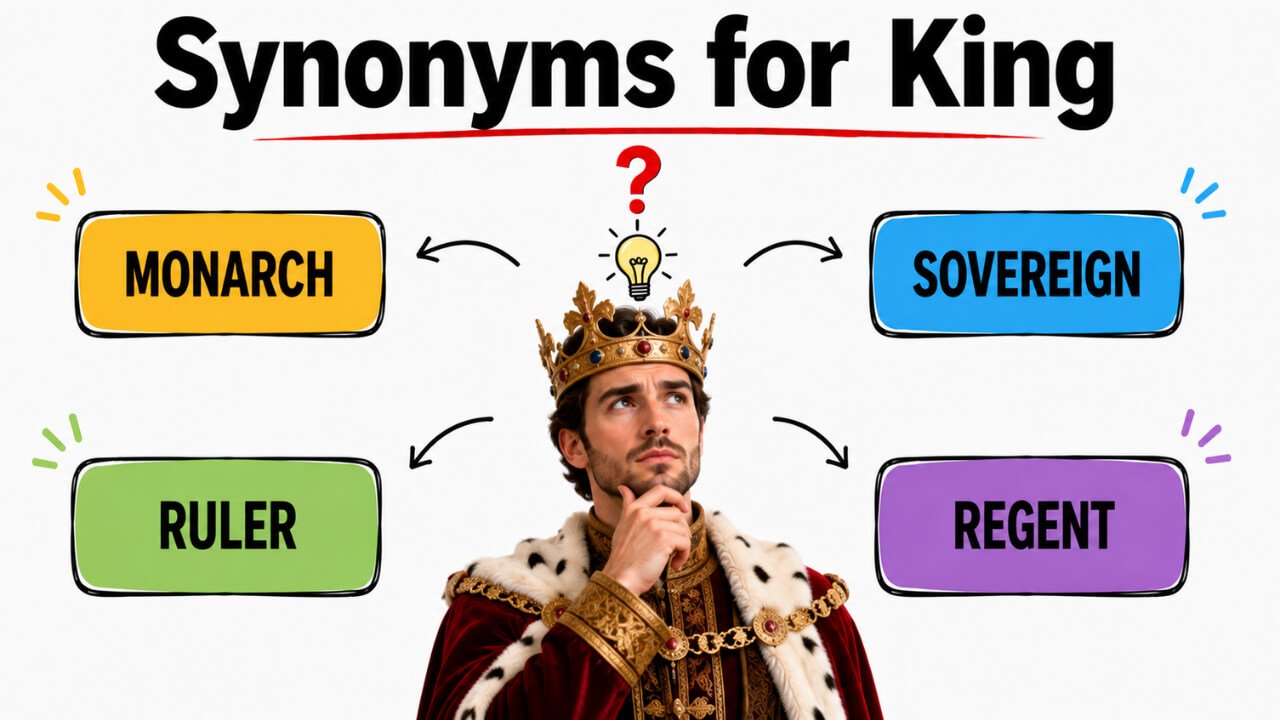
Quick Answer: Common synonyms for king include monarch, sovereign, ruler, emperor, potentate, crowned head, overlord, sultan, chief, and kingpin. Monarch is the best general replacement in formal writing when referring to a hereditary royal ruler. Sovereign emphasizes independent authority, while ruler is a broad and neutral term. Emperor describes someone who governs an empire. Chief and kingpin work better for influential leaders, while champion, master, or greatest can replace king in figurative contexts.
Pronunciation and Word Details
Word: King
Pronunciation: /kɪŋ/
Part of Speech: Noun
Meaning: A male monarch who rules a country or a person considered the most powerful or successful in a particular area.
US Pronunciation:
UK Pronunciation:
What Does “King” Mean?
King means a male monarch who holds the highest position in a kingdom. It is primarily a noun and is commonly used for a hereditary ruler who receives authority through a royal family line.
The word can also describe someone who is extremely powerful, successful, respected, or dominant in a particular activity. For example, a highly successful businessperson might be called a king of industry.
In games, king can refer to an important playing piece. In chess, the king is the central piece that each player must protect. In playing cards, a king is a high ranking court card.
The meaning therefore changes according to the sentence. It can refer to an actual royal ruler, an influential leader, the best person in a field, or an important game piece.
Meaning, Tone, and Context of “King”
King usually has a formal and powerful tone when it refers to royalty. It suggests authority, leadership, inheritance, status, and control. Historical writing, biographies, stories, political discussions, and royal descriptions commonly use the word in this sense.
In everyday conversation, king can have an admiring or playful tone. Calling someone a king may express praise, confidence, respect, or affection. In this context, it does not mean that the person rules a real kingdom.
The word may also sound critical when it describes someone who controls an industry, organization, or illegal operation. Terms such as kingpin or overlord may be more accurate in these negative situations.
Writers should consider whether they mean a royal title, political power, professional success, social importance, or personal admiration before selecting a synonym.
When and How to Use “King”
For Royal Authority: Use king when referring to a male hereditary ruler of a kingdom.
Example: The king addressed the nation from the royal palace.
For Historical Writing: Use king when discussing rulers, dynasties, royal succession, or important events involving a monarchy.
Example: The young king inherited the throne after his father died.
For Exceptional Success: Use king figuratively for someone who is considered the best or most successful in a particular field.
Example: His remarkable performances made him the king of comedy.
For Industry Leadership: Use king to describe someone who has great influence or control within a business or profession.
Example: The newspaper described him as the king of the local property market.
For Praise and Encouragement: Use king informally as a respectful or supportive name for a man.
Example: Keep believing in yourself, king.
For Games: Use king for the central royal piece in chess or a high ranking court card.
Example: She moved her king away from the attacking queen.
Best Synonyms for King
Monarch: A person who rules a kingdom, usually through hereditary succession.
Example: The monarch appeared before the public during the national ceremony.
Sovereign: A ruler who possesses supreme and independent authority.
Example: The sovereign approved the official declaration.
Ruler: A person who governs a country, territory, or group.
Example: The ruler introduced several reforms during his reign.
Emperor: A male ruler who governs an empire or several territories.
Example: The emperor controlled lands across a vast region.
Potentate: A formal word for a ruler with significant power.
Example: Foreign leaders gathered to meet the powerful potentate.
Crowned Head: A monarch or member of the highest level of royalty.
Example: Several crowned heads attended the formal celebration.
Overlord: A person who exercises authority over other rulers or territories.
Example: The regional overlord demanded loyalty from the smaller states.
Sultan: A traditional title for a ruler in certain Muslim countries and historical territories.
Example: The sultan welcomed the visitors into his court.
Chief: The person with the highest authority in a group, community, or organization.
Example: The chief made the final decision for the community.
Kingpin: The most important or powerful person within an activity or organization.
Example: Investigators identified him as the kingpin of the operation.
50 Synonyms for King with Short Meanings
- Monarch: A hereditary ruler of a kingdom.
- Sovereign: A ruler with supreme independent authority.
- Ruler: A person who governs people or territory.
- Emperor: A male ruler of an empire.
- Potentate: A powerful royal or political ruler.
- Crowned Head: A king, queen, or reigning monarch.
- Male Monarch: A man who rules through a monarchy.
- Royal Ruler: A ruler belonging to a royal family.
- Supreme Ruler: A person holding the highest governing authority.
- Head of State: The official leader representing a country.
- Overlord: A ruler who controls other rulers or territories.
- Autocrat: A ruler possessing unrestricted personal authority.
- Despot: A ruler who exercises power harshly or unfairly.
- Tyrant: A cruel ruler who abuses authority.
- Absolute Ruler: A leader whose political power has few limits.
- High King: A king holding authority over other kings or chiefs.
- Lord: A man with authority, rank, or control.
- Chief: The highest ranking leader of a group.
- Chieftain: The traditional leader of a tribe or clan.
- Paramount Chief: A chief with authority over other local chiefs.
- Warlord: A powerful military leader controlling a region.
- Commander: A person with authority over a force or organization.
- Governor: A person responsible for governing a territory.
- Regent: A person who rules temporarily for a monarch.
- Sultan: A traditional royal ruler in certain regions.
- Shah: A historical title used by Persian kings.
- Tsar: A traditional title for a Russian emperor or ruler.
- Khan: A title for a ruler or leader in parts of Asia.
- Rajah: A historical title for an Indian ruler.
- Maharaja: A title for a high ranking Indian ruler.
- Pharaoh: A ruler of ancient Egypt.
- Caliph: A historical religious and political ruler.
- Emir: A ruler, governor, or high ranking prince.
- Sheikh: A respected leader or hereditary ruler in some regions.
- Negus: A traditional title for an Ethiopian king.
- Basileus: An ancient Greek title for a king or emperor.
- Imperator: A Roman title associated with supreme command.
- Rex: The Latin term for a king.
- Kingpin: The most powerful person in an organization or activity.
- Supremo: The person with the highest authority or influence.
- Boss: The person who controls a group or operation.
- Top Dog: The most powerful or successful person in a group.
- Number One: The highest ranking or most successful person.
- Champion: A person recognized as the best in a competition.
- Ace: A person who is exceptionally skilled.
- Master: A person with great ability or control.
- Legend: A person admired for exceptional achievements.
- Greatest: The most successful or impressive person.
- Leading Figure: A highly important or influential person.
- Dominant Figure: A person who has the greatest power or influence.
Read Also:
Synonyms for Truth

Synonyms for King by Context
When King Means Monarch
Monarch, sovereign, crowned head, royal ruler, and male monarch are the strongest choices when king refers to an official royal title. Monarch is usually the most direct and neutral alternative.
Example: The monarch began his reign at a young age.
Sovereign places more emphasis on supreme authority and national independence.
Example: The sovereign performed several ceremonial duties.
When King Means Supreme Ruler
Ruler, potentate, overlord, autocrat, and absolute ruler describe someone who possesses major political or territorial power.
Example: The ruler maintained control over the region for many years.
Overlord suggests authority over other rulers or dependent territories, while autocrat suggests power concentrated in one individual.
Example: The autocrat refused to share authority with elected officials.
When King Means the Best
Champion, ace, master, legend, greatest, and number one can replace king when describing exceptional ability or success.
Example: After winning another title, he was considered the champion of the sport.
Master works well for expertise, while legend expresses lasting admiration.
Example: The experienced artist was a master of portrait painting.
When King Means a Powerful Leader
Chief, boss, supremo, kingpin, leading figure, and dominant figure describe someone with considerable influence within a group or activity.
Example: She became a leading figure in the national campaign.
Kingpin often has a negative meaning and may describe the leader of a secret or illegal operation.
Example: The police arrested the suspected kingpin.
Another Word for King
Monarch is usually the best single replacement for king when the sentence refers to an official royal ruler. However, the most accurate alternative depends on the type of authority, historical period, region, and intended tone.
Original: The king greeted the visiting representatives.
Better Option: The monarch greeted the visiting representatives.
Original: He became the king of a vast empire.
Better Option: He became the emperor of a vast empire.
Original: Everyone considered him the king of competitive racing.
Better Option: Everyone considered him the champion of competitive racing.
Original: He was known as the king of the criminal organization.
Better Option: He was known as the kingpin of the criminal organization.
When Not to Use “King”
Avoid using king when the exact position, type of authority, or historical title is important. Emperor, sultan, shah, chief, or regent may provide more accurate information.
Weak: The king ruled several separate empires.
Better: The emperor ruled several separate territories.
King can also sound exaggerated in formal reports, academic essays, professional emails, and factual descriptions when it is used figuratively.
Weak: He is the king of financial planning.
Better: He is a leading expert in financial planning.
Avoid using king as a general term for every powerful male leader. Presidents, governors, military commanders, religious leaders, and company directors do not necessarily hold royal authority.
Weak: The elected king introduced a new policy.
Better: The elected president introduced a new policy.
The word can also sound overly casual when used as praise in serious professional communication.
Weak: Great presentation, king.
Better: Your presentation was clear, confident, and persuasive.
Words Commonly Confused With King
King vs Monarch: King specifically refers to a male royal ruler, while monarch may refer to either a king or a queen.
King vs Emperor: A king traditionally rules a kingdom, while an emperor rules an empire that may include several nations, regions, or peoples.
King vs Sovereign: King is a royal title, while sovereign emphasizes supreme authority and independence.
King vs Ruler: King describes a particular kind of monarch, while ruler is a broad term for anyone who governs.
King vs Prince: A king is the reigning male monarch, while a prince is usually a male member of a royal family who may not yet rule.
King vs Regent: A king rules in his own right, while a regent governs temporarily for an absent, young, or incapable monarch.
King vs Lord: King is a specific royal title, while lord may describe a nobleman, landholder, master, or person with authority.
King vs Chief: King usually leads a kingdom through monarchy, while chief commonly leads a tribe, community, department, or organization.
Which Synonym Should You Choose?
Choose monarch when you need a neutral and formal alternative for a royal ruler.
Choose sovereign when you want to emphasize supreme authority, independence, or national leadership.
Choose ruler when the exact title is unknown or unimportant.
Choose emperor when describing a man who governs an empire or several territories.
Choose potentate in formal or historical writing about a powerful ruler.
Choose crowned head when referring collectively or ceremonially to royalty.
Choose chief when describing the highest leader of a tribe, community, or group.
Choose kingpin when discussing the central leader of a powerful organization, especially one involved in harmful or illegal activity.
Choose champion when someone is the winner or best performer in a competition.
Choose master when emphasizing exceptional skill, knowledge, or control.
Choose legend when praising someone whose achievements have earned lasting admiration.
Choose leading figure in reports, essays, and professional writing where king would sound too dramatic or informal.
Real Life Examples of “King” in Sentences
Original: The king spoke to the citizens during the national ceremony.
Better Option: The monarch spoke to the citizens during the national ceremony.
Original: The king controlled a large collection of territories.
Better Option: The emperor controlled a large collection of territories.
Original: The king held complete political power.
Better Option: The autocrat held complete political power.
Original: He became the king of professional tennis.
Better Option: He became the champion of professional tennis.
Original: The chef was known as the king of traditional cooking.
Better Option: The chef was known as a master of traditional cooking.
Original: He was the king of the entire organization.
Better Option: He was the dominant figure in the entire organization.
Original: The police searched for the king of the illegal network.
Better Option: The police searched for the kingpin of the illegal network.
Original: The tribal king met with local representatives.
Better Option: The tribal chief met with local representatives.
Original: The young king could not yet perform his royal duties.
Better Option: The young monarch could not yet perform his royal duties.
Original: Many fans called the musician the king of live performance.
Better Option: Many fans called the musician a legend of live performance.
Synonym Groups and Usage Differences
Royal Title Group
Monarch, sovereign, crowned head, male monarch, and royal ruler belong to the royal title group. These words are appropriate when discussing an official monarchy.
Monarch is broad and neutral, while sovereign highlights independent authority.
Example: The sovereign represented the kingdom during the international ceremony.
Political Power Group
Ruler, potentate, autocrat, despot, tyrant, and absolute ruler describe political authority. Their emotional meanings differ significantly.
Ruler is neutral, while despot and tyrant are strongly negative because they suggest cruelty or abuse of power.
Example: Citizens protested against the tyrant who had restricted their freedoms.
Historical Title Group
Sultan, shah, tsar, khan, rajah, maharaja, pharaoh, caliph, and basileus are connected with particular historical or regional systems of rule.
These terms should only be used when they accurately match the culture, period, and position being described.
Example: The pharaoh ordered the construction of a great monument.
Leadership Group
Chief, commander, governor, overlord, supremo, and leading figure describe people who direct or control others.
These alternatives do not always indicate royalty, but they may replace king when authority rather than inheritance is the main idea.
Example: The commander directed the forces during the emergency.
Excellence Group
Champion, ace, master, legend, greatest, top dog, and number one describe exceptional success or ability.
These words are useful when king is being used figuratively rather than as a royal title.
Example: Her skill and creativity made her a master of modern design.
Antonyms of King
King does not have one exact antonym because its opposite depends on whether the word refers to royalty, authority, status, or success.
Commoner: A person without royal or noble rank.
Subject: A person living under the authority of a monarch.
Follower: Someone who accepts another person’s leadership.
Subordinate: A person holding a lower position or level of authority.
Servant: A person who performs duties for someone else.
Underling: A person of lower rank within an organization.
Dependent: A person who relies on another person’s authority or support.
Citizen: An ordinary member of a country rather than its monarch.
Loser: A person who does not win a competition.
Inferior: A person considered lower in rank, quality, or importance.
Comparison: King vs Related Words
King vs Monarch
King refers specifically to a male ruler of a kingdom. Monarch is a broader word that can describe either a king or a queen.
Example With King: The king inherited the throne from his father.
Example With Monarch: The monarch performs important ceremonial duties.
King vs Sovereign
King identifies a particular royal position. Sovereign focuses on the ruler’s supreme and independent authority.
Example With King: The king welcomed the foreign visitors.
Example With Sovereign: The sovereign possessed final authority over the kingdom.
King vs Emperor
A king rules a kingdom, while an emperor traditionally rules an empire that may contain several regions, peoples, or smaller kingdoms.
Example With King: The king governed a prosperous island kingdom.
Example With Emperor: The emperor controlled a vast collection of territories.
King vs Ruler
King is a specific hereditary or royal title. Ruler is a general term that may describe a monarch, dictator, chief, emperor, or another governing leader.
Example With King: The king became the official head of the royal family.
Example With Ruler: The ruler introduced new laws across the region.
King vs Chief
King normally refers to a monarch who rules a kingdom. Chief describes the highest ranking leader of a tribe, community, department, or group.
Example With King: The king lived in the royal palace.
Example With Chief: The chief represented the community during the negotiations.
Common Phrases and Expressions With “King”
King of Kings: A title suggesting authority above all other rulers.
The King’s Speech: A formal address delivered by a reigning king.
Live Like a King: To live with exceptional comfort, wealth, or luxury.
Fit for a King: Good enough for someone of the highest status.
King for a Day: A person who receives special attention or authority for a short period.
King of the Castle: The person who has the greatest control in a place or situation.
King of the Hill: The most successful or dominant person in a group.
A King’s Ransom: An extremely large amount of money.
Crown a King: To officially recognize and install a male monarch.
King in His Own Right: A man who holds royal authority through his own legal claim.
Common Mistakes to Avoid
One common mistake is treating every leadership word as an exact synonym for king. A chief, governor, president, commander, and emperor may all possess authority, but their positions are different.
Writers should also avoid using king repeatedly when discussing royalty. Monarch, sovereign, ruler, and crowned head can create variety, but each replacement must still fit the intended meaning.
Another mistake is selecting a negative synonym without considering its tone. Despot and tyrant suggest cruelty or abusive leadership. They should not replace king in a neutral description.
Do not use emperor when the person rules only a kingdom. Likewise, do not use prince for a reigning king unless the official title is actually prince.
Figurative phrases can also sound exaggerated in academic or professional writing. Leading figure, expert, champion, and master are often clearer than king in reports, essays, and formal emails.
Historical titles should be used carefully. Sultan, shah, tsar, pharaoh, and maharaja belong to particular cultures and periods. They are not interchangeable labels for every monarch.
Conclusion
Learning synonyms for king helps writers describe royalty, leadership, authority, and excellence more accurately. Monarch is the strongest general replacement for a royal ruler, while sovereign emphasizes supreme authority. Emperor suits the ruler of an empire, and chief describes a community leader. In figurative contexts, champion, master, legend, and leading figure often sound more natural. Kingpin works for a central and powerful organizer, usually in a negative context. Always choose the alternative that matches the person’s actual position, tone, and level of authority.
FAQs About Synonyms for King
What is the closest synonym for king?
Monarch is the closest general synonym because it describes a person who rules through a monarchy. However, monarch can refer to either a king or a queen.
Is ruler another word for king?
Ruler can replace king in general descriptions of authority. However, ruler is broader because it may refer to many kinds of political leaders.
What is a formal synonym for king?
Sovereign, monarch, potentate, and crowned head are formal alternatives. Monarch is usually the clearest choice in formal writing.
Can emperor be used as a synonym for king?
Emperor is a related term, but it is not always interchangeable with king. An emperor traditionally governs an empire, while a king governs a kingdom.
What is a figurative synonym for king?
Champion, master, legend, greatest, top dog, and number one can replace king when describing someone who is highly successful or skilled.
What is a negative synonym for king?
Despot and tyrant are negative alternatives when the ruler is cruel or abuses power. Autocrat may also sound critical because it suggests unrestricted personal control.
What is another word for the king of an organization?
Chief, boss, leader, supremo, dominant figure, or kingpin may fit. Kingpin is especially suitable for the central leader of a secret or illegal operation.
