
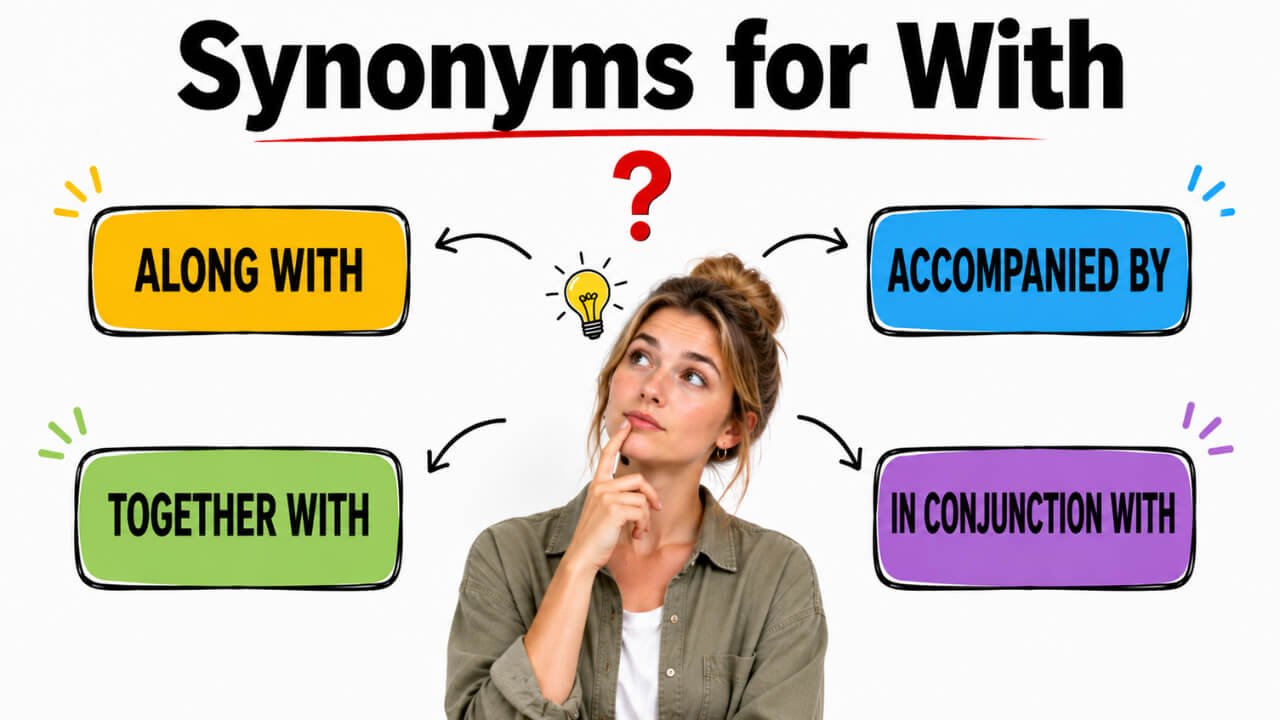
Quick Answer: Synonyms for with include alongside, together with, accompanied by, including, having, using, through, featuring, in agreement with, and despite. Alongside and together with are best for companionship or addition. Including works when introducing something as part of a group. Having and featuring describe possession or characteristics. Using and through explain a method or instrument. In agreement with expresses consistency, while despite replaces with when introducing a contrast.
Pronunciation and Word Details
Word: With.
Pronunciation: /wɪð/ or /wɪθ/
Part of Speech: Preposition.
Meaning: Used to connect someone or something to a companion, possession, instrument, condition, action, or relationship.
US Pronunciation:
UK Pronunciation:
What Does “With” Mean?
With is a preposition used to show that people, objects, actions, qualities, or circumstances are connected in some way.
Its exact meaning changes according to the sentence. It can show companionship, possession, inclusion, method, cause, agreement, opposition, manner, or condition.
When with shows companionship, it means that people or things are together.
Example: Maria went to the event with her sister.
When it shows possession or a feature, it means having or containing something.
Example: He bought a house with a large garden.
With can also introduce the instrument used to complete an action.
Example: She opened the package with a small knife.
It may describe a feeling, condition, or manner.
Example: The audience listened with interest.
It can also show agreement or opposition.
Example: I agree with your conclusion.
Example: The team competed with its strongest rival.
Because with has several grammatical functions, no single synonym can replace it in every sentence. The intended relationship must be understood before choosing an alternative.
Meaning, Tone, and Context of “With”
With has a neutral tone and is common in both formal and casual communication. It appears naturally in conversations, essays, reports, instructions, descriptions, emails, stories, and academic writing.
In everyday speech, with often describes companionship or participation.
Example: Are you coming with us?
In descriptive writing, it identifies features or possessions.
Example: She wore a dress with silver buttons.
In instructions, with explains the tool or method used to complete an action.
Example: Mix the ingredients with a wooden spoon.
In formal writing, with can introduce circumstances, relationships, or supporting details.
Example: The results are consistent with the original prediction.
The word itself is neither emotional nor forceful. Its tone comes from the surrounding language. With care sounds gentle, with urgency sounds serious, and with confidence sounds positive.
Although with is useful and flexible, repeating it too often can make sentences sound crowded. A more specific alternative can sometimes improve clarity.
When and How to Use “With”
For Companionship
Use with to show that one person or thing accompanies another.
Example: Daniel attended the meeting with his assistant.
For Possession
Use with to describe someone or something that has a particular feature, quality, or object.
Example: We selected the room with the larger windows.
For Inclusion
With can indicate that something is included as part of a product, group, service, or arrangement.
Example: The meal comes with a fresh salad.
For Tools and Instruments
Use with to identify the object used to perform an action.
Example: She signed the document with a black pen.
For Manner
With can describe how an action is performed.
Example: He answered the question with confidence.
For Feelings and Reactions
Use with before an emotion or physical reaction caused by a situation.
Example: Her hands shook with fear.
For Agreement
With can connect a person, opinion, result, or action to something it supports or matches.
Example: I agree with your recommendation.
For Opposition
With may describe conflict, competition, disagreement, or struggle.
Example: The company is competing with several experienced providers.
For Circumstances
Use with to introduce a situation that affects the main action.
Example: With the roads closed, we had to change our route.
For Relationships
With can describe how a person or organization deals, communicates, or works with another person or group.
Example: She has a positive relationship with her colleagues.
Best Synonyms for With
Alongside
Synonym: Alongside means next to or together with someone or something.
Example: She worked alongside several experienced designers.
Together With
Synonym: Together with means accompanied by or in addition to.
Example: The director, together with the senior staff, reviewed the proposal.
Accompanied By
Synonym: Accompanied by means having someone or something present at the same time.
Example: The announcement was accompanied by a detailed explanation.
Including
Synonym: Including introduces something as part of a larger group or amount.
Example: Several students, including Maya, joined the discussion.
Having
Synonym: Having describes possession, presence, or a particular feature.
Example: They wanted a vehicle having enough space for the equipment.
Using
Synonym: Using identifies the method, instrument, or resource employed for an action.
Example: She repaired the shelf using basic tools.
Through
Synonym: Through describes the method, process, or means by which something happens.
Example: The team improved its results through careful planning.
Featuring
Synonym: Featuring means presenting or containing an important person, quality, or element.
Example: They chose a design featuring natural materials.
In Agreement With
Synonym: In agreement with means sharing or supporting the same opinion, rule, or conclusion.
Example: The final decision was in agreement with the committee’s recommendation.
Despite
Synonym: Despite can replace with when with introduces a condition that contrasts with the main result.
Example: Despite limited time, the group completed the work.
50 Synonyms for With with Short Meanings
The following words and phrases are context specific alternatives. They cannot all replace with in every sentence.
- Alongside: Next to or together with.
- Together With: In the company of or in addition to.
- Along With: Accompanied by or added to.
- Accompanied By: Present together with someone or something.
- In the Company Of: Together with another person or group.
- Beside: At the side of someone or something.
- Next To: Immediately beside another person or object.
- Among: Surrounded by or included within a group.
- Amid: In the middle of a situation or condition.
- In Association With: Connected or involved with another party.
- In Conjunction With: Working or occurring together.
- In Collaboration With: Working jointly toward a shared result.
- In Partnership With: Cooperating through a formal or practical relationship.
- Including: Containing something as part of a group.
- Containing: Having something inside or within.
- Featuring: Presenting an important quality, person, or element.
- Having: Possessing or showing a feature.
- Possessing: Owning or holding a quality or object.
- Carrying: Having something on or within oneself.
- Bearing: Carrying, showing, or displaying something.
- Equipped With: Supplied with the necessary tools or features.
- Provided With: Given something needed or useful.
- Supplied With: Furnished with a required item or resource.
- Furnished With: Containing furniture, equipment, or useful features.
- Using: Employing a tool, method, or resource.
- By Means Of: Through a particular method or instrument.
- Through: By way of a method, process, or cause.
- Via: By way of a route, method, or channel.
- By: Through the action or use of something.
- Through the Use Of: By employing a particular resource or method.
- Assisted By: Helped by someone or something.
- Aided By: Supported in completing an action.
- Supported By: Helped, strengthened, or confirmed by something.
- Marked By: Having a noticeable quality or feature.
- Characterized By: Defined by a particular quality.
- Showing: Displaying a feeling, feature, or condition.
- Displaying: Presenting a visible quality or reaction.
- Experiencing: Going through a feeling, event, or condition.
- Affected By: Influenced or changed by something.
- Because Of: As a result of a cause.
- Due To: Caused by or resulting from something.
- From: Indicating the source or cause of a condition.
- In Agreement With: Sharing or supporting the same opinion.
- Consistent With: Matching a fact, standard, or expectation.
- Compatible With: Able to exist or work successfully together.
- Matching: Corresponding in appearance, quality, or meaning.
- According To: Following a rule, statement, or standard.
- Against: In opposition to or in competition with.
- Regarding: Concerning or relating to a subject.
- Despite: Without being prevented by a difficult condition.
Read Also:
Synonyms for Do
Synonyms for With by Context
When With Means Accompanied By
When with shows companionship, useful alternatives include alongside, together with, along with, accompanied by, beside, and in the company of.
Alongside suggests that people work, move, or remain next to one another.
Example: She trained alongside experienced athletes.
Together with often introduces an additional person or thing. It works in both formal and neutral writing.
Example: The manager, together with her assistant, prepared the report.
Accompanied by is more formal and may connect events, sounds, documents, symptoms, or people.
Example: The application must be accompanied by proof of identity.
In the company of is most natural when referring to people.
Example: He spent the afternoon in the company of close friends.
When With Means Having or Containing
When with identifies possession, contents, or features, alternatives include having, containing, featuring, possessing, carrying, bearing, and equipped with.
Having is a general alternative for possession or characteristics.
Example: They preferred an apartment having two separate bedrooms.
Containing focuses on what is inside something.
Example: The officer found a bag containing several documents.
Featuring highlights an important or attractive part of something.
Example: We attended a performance featuring local musicians.
Equipped with suggests that something has the tools or features required for a purpose.
Example: The laboratory is equipped with modern testing equipment.
When With Means Using
When with introduces a tool, instrument, or method, use using, by, through, via, or by means of.
Using is usually the clearest alternative when naming an instrument.
Example: He cut the material using a sharp blade.
Through is suitable for a process, method, or effort.
Example: They resolved the disagreement through honest discussion.
By means of has a formal tone and emphasizes the method used.
Example: The signal was transmitted by means of a small device.
Via is concise and commonly describes a route or communication method.
Example: The documents were delivered via a secure system.
When With Means Working Together
For cooperation and professional relationships, use in collaboration with, in partnership with, in association with, or in conjunction with.
In collaboration with emphasizes joint creative or professional work.
Example: The researcher completed the study in collaboration with several specialists.
In partnership with suggests an organized relationship involving shared responsibility.
Example: The school developed the program in partnership with local educators.
In conjunction with means that two actions, ideas, or resources operate together.
Example: The treatment is used in conjunction with regular exercise.
When With Means Agreement or Consistency
When with connects matching opinions, facts, standards, or results, alternatives include in agreement with, consistent with, compatible with, matching, and according to.
In agreement with refers directly to shared opinions or decisions.
Example: Her response was in agreement with the final recommendation.
Consistent with is useful in formal, academic, and analytical writing.
Example: The findings are consistent with the original theory.
Compatible with is commonly used for systems, ideas, plans, values, or personalities that can work together.
Example: The software is compatible with the existing equipment.
According to may replace expressions such as in accordance with.
Example: The work was completed according to the approved plan.
When With Means Cause or Emotion
When with introduces the cause of a feeling, reaction, or condition, possible alternatives include from, because of, due to, affected by, and experiencing.
From is natural when a physical or emotional reaction has a clear cause.
Example: Her voice trembled from nervousness.
Because of gives a direct explanation.
Example: The match was delayed because of heavy rain.
Affected by emphasizes the influence of a condition.
Example: Several areas were affected by flooding.
Experiencing focuses on the person or thing going through the condition.
Example: Customers experiencing technical difficulties should contact the support team.
When With Introduces a Contrast
Sometimes with introduces a condition that does not prevent the main action. In these sentences, despite may provide a clearer alternative.
Example: Despite all the difficulties, they completed the project.
Amid may work when the sentence describes an event happening in the middle of confusion, change, celebration, or conflict.
Example: The announcement was made amid growing concern.
When With Means Opposition
When with describes conflict, competition, or disagreement, against may be the clearest alternative.
Example: Our team will compete against the current champions.
With can sound more neutral, while against places greater emphasis on opposition.
Example: She argued with her colleague.
Alternative: She argued against her colleague’s proposal.
Another Word for With
Together with is one of the best general alternatives for with when the word expresses companionship or addition. However, no single replacement works in every context. The best alternative depends on whether with means accompanied by, containing, using, agreeing, or despite.
Original: She arrived with her parents.
Better Option: She arrived alongside her parents.
Original: We selected the report with several detailed charts.
Better Option: We selected the report containing several detailed charts.
Original: He opened the container with a metal tool.
Better Option: He opened the container using a metal tool.
Original: With all the delays, they still finished on time.
Better Option: Despite all the delays, they still finished on time.
When Not to Use “With”
Do not use with repeatedly when a more specific word can clarify the relationship between ideas.
Weak: The employee with the blue folder spoke with the manager with the financial report.
Better: The employee carrying the blue folder spoke to the manager who had the financial report.
Avoid with when the sentence needs to identify a precise method.
Weak: The team improved performance with training.
Better: The team improved performance through regular training.
Do not use with when including provides clearer information about membership in a group.
Weak: Five applicants, with Maria, reached the final stage.
Better: Five applicants, including Maria, reached the final stage.
Avoid with when it creates confusion about who owns or performs something.
Weak: I discussed the report with errors with the editor.
Better: I discussed the error filled report with the editor.
A clearer revision without a compound description is also possible.
Better: I discussed the report, which contained several errors, with the editor.
Do not replace with mechanically. Alongside works for companionship but not for instruments.
Weak: She wrote the note alongside a pencil.
Better: She wrote the note with a pencil.
Do not use a formal alternative in simple conversation when with is already natural.
Weak: Would you like to come in conjunction with us?
Better: Would you like to come with us?
Words Commonly Confused With With
With vs And: With connects one main person or thing to an additional element, while and usually gives both elements equal grammatical importance.
Example With With: The director, with two assistants, is attending the meeting.
Example With And: The director and two assistants are attending the meeting.
With vs By: With commonly identifies the instrument used in an action. By often identifies the person performing the action or the method used.
Example With With: She painted the wall with a brush.
Example With By: The wall was painted by a professional.
With vs Through: With often names a direct tool or accompanying feature. Through usually explains a process, effort, or method.
Example With With: He opened the door with a key.
Example With Through: He achieved success through consistent effort.
With vs Including: With broadly connects things. Including specifically identifies something as part of a larger group.
Example With With: The package comes with two cables.
Example With Including: Several accessories, including two cables, are provided.
With vs Among: With connects one person or thing directly to another. Among places someone or something inside a group.
Example With With: She spoke with her closest friend.
Example With Among: She felt comfortable among her closest friends.
With vs Within: With expresses connection, possession, or method. Within means inside a place, limit, period, or boundary.
Example With With: He traveled with his family.
Example With Within: Please respond within three days.
With vs Without: With shows presence, connection, or possession. Without shows absence or lack.
Example With With: The room comes with a private balcony.
Example With Without: The smaller room is available without a balcony.
Which Synonym Should You Choose?
Choose alongside when someone or something is physically or professionally next to another.
Choose together with when adding a person, object, action, or idea to something already mentioned.
Choose accompanied by for formal descriptions involving people, documents, symptoms, sounds, or events.
Choose including when naming one or more members of a larger group.
Choose containing when describing what is inside a document, object, package, or substance.
Choose featuring when highlighting an important, attractive, or noticeable element.
Choose having when describing possession or a general characteristic.
Choose equipped with when an object or place has tools or features needed for a purpose.
Choose using when identifying a tool, instrument, technique, or resource.
Choose through when explaining a process, method, effort, or cause.
Choose by means of in technical, formal, or instructional writing.
Choose in collaboration with for joint academic, professional, or creative work.
Choose in partnership with when two parties share responsibility or resources.
Choose in conjunction with when two methods, treatments, systems, or actions operate together.
Choose consistent with in reports, essays, research, and analytical writing when facts or results match.
Choose in agreement with when opinions, decisions, or recommendations support one another.
Choose against when describing direct competition, resistance, or opposition.
Choose despite when introducing a difficulty that does not prevent the main result.
Choose regarding when with appears in an expression about a topic, such as with regard to.
In casual speech, with is often clearer and more natural than a longer alternative. Replace it only when the alternative improves precision, flow, or variety.
Real Life Examples of “With” in Sentences
Original: She attended the workshop with her colleague.
Better Option: She attended the workshop alongside her colleague.
Original: The package comes with a printed guide.
Better Option: The package includes a printed guide.
Original: He repaired the chair with a basic tool kit.
Better Option: He repaired the chair using a basic tool kit.
Original: The room with the large windows is available.
Better Option: The room featuring the large windows is available.
Original: We completed the project with help from several volunteers.
Better Option: We completed the project through the support of several volunteers.
Original: The results agree with our earlier findings.
Better Option: The results are consistent with our earlier findings.
Original: She developed the course with a group of teachers.
Better Option: She developed the course in collaboration with a group of teachers.
Original: He shook with fear when he heard the noise.
Better Option: He shook from fear when he heard the noise.
Original: Our team will compete with the regional champions.
Better Option: Our team will compete against the regional champions.
Original: With very little preparation, she delivered an excellent speech.
Better Option: Despite very little preparation, she delivered an excellent speech.
Synonym Groups and Usage Differences
Companionship Group
Alongside, together with, along with, accompanied by, beside, and in the company of describe people or things that are present together.
Alongside often suggests equal participation.
Example: She worked alongside the project leader.
Accompanied by is more formal and can describe both people and things.
Example: The warning was accompanied by detailed instructions.
Possession and Feature Group
Having, possessing, containing, featuring, carrying, bearing, and equipped with describe ownership, contents, qualities, or visible features.
Containing focuses on contents.
Example: The folder contained several signed documents.
Featuring draws attention to a notable element.
Example: They chose a building featuring an open central courtyard.
Method and Instrument Group
Using, through, via, by, and by means of explain how an action is completed.
Using is direct and natural for physical tools.
Example: She measured the surface using a ruler.
Through works better for processes and abstract methods.
Example: They reached an agreement through negotiation.
Cooperation Group
In collaboration with, in partnership with, in association with, and in conjunction with describe shared work or connected activity.
In collaboration with highlights active joint effort.
Example: The article was prepared in collaboration with language specialists.
In conjunction with shows that separate things operate together.
Example: The medicine should be used in conjunction with a balanced diet.
Agreement Group
In agreement with, consistent with, compatible with, matching, and according to show support, similarity, or conformity.
Consistent with is common in objective analysis.
Example: The evidence is consistent with the witness’s account.
Compatible with describes things that can function or exist together successfully.
Example: The new system is compatible with the existing equipment.
Cause and Condition Group
Because of, due to, from, affected by, amid, and despite connect an action to a cause, condition, or surrounding situation.
Because of directly introduces a cause.
Example: The event was postponed because of heavy rain.
Despite introduces a contrast.
Example: Despite the rain, the event continued.
Opposition Group
Against is the strongest alternative when with means competing, fighting, arguing, or acting in opposition.
Example: The candidate competed against several experienced opponents.
With may describe interaction, while against emphasizes conflict.
Antonyms of With
With has several meanings, so it does not have one opposite that works in every sentence. The most common antonym is without.
Without: Lacking the presence, possession, or use of something.
Apart From: Separated from someone or something.
Separate From: Existing or functioning independently.
Away From: At a distance from someone or something.
Excluding: Leaving a person or thing out of a group.
Excepting: Not including a particular person or thing.
Lacking: Not having a needed quality or possession.
Absent: Not present in a place or situation.
Independently Of: Without help, control, or connection.
Free Of: Not containing an unwanted element.
Unlike: Different from another person or thing.
Opposed To: Against an idea, action, or position.
Against: In conflict with rather than in agreement with.
Alone: Without companionship.
Separately: Not together or in combination.
Example With With: She completed the assignment with assistance.
Example With an Antonym: She completed the assignment without assistance.
Comparison: With vs Related Words
With vs Alongside
With is a broad preposition that can express companionship, possession, tools, manner, and several other relationships. Alongside mainly means beside or together with.
Example With With: She traveled with her supervisor.
Example With Alongside: She worked alongside her supervisor.
With vs Together With
With is shorter and more natural in everyday language. Together with adds emphasis to companionship or addition.
Example With With: He submitted the form with the required documents.
Example With Together With: He submitted the form together with the required documents.
With vs Including
With can connect items without clearly stating whether they belong to a larger group. Including specifically introduces an example or member of a group.
Example With With: The team traveled with three coaches.
Example With Including: Ten staff members, including three coaches, traveled with the team.
With vs Using
With can identify a tool, but using often makes the method clearer.
Example With With: She cleaned the surface with a soft cloth.
Example With Using: She cleaned the surface using a soft cloth.
With vs Through
With usually identifies a direct tool, companion, or quality. Through describes a process or means of achieving a result.
Example With With: He solved the problem with a calculator.
Example With Through: He improved his skills through regular practice.
With vs By
With identifies an instrument in many active sentences. By can identify an agent, method, deadline, location, or means of transport.
Example With With: The artist created the pattern with a fine brush.
Example With By: The pattern was created by an experienced artist.
With vs Among
With describes a direct connection between people or things. Among describes someone or something surrounded by a group.
Example With With: She sat with her friends.
Example With Among: She felt relaxed among her friends.
With vs Without
With shows presence or possession. Without shows absence or lack.
Example With With: He entered the room with permission.
Example With Without: He entered the room without permission.
Common Phrases and Expressions With With
With Care: In a careful manner.
Example: Handle the glass with care.
With Confidence: In a certain and self assured manner.
Example: She answered each question with confidence.
With Respect: Politely and with consideration.
Example: The issue should be discussed with respect.
With Regard To: Concerning a particular subject.
Example: I am writing with regard to your recent request.
With the Help Of: Assisted by someone or something.
Example: She completed the task with the help of her classmates.
With Ease: Without difficulty.
Example: He solved the puzzle with ease.
With Pleasure: Happily or willingly.
Example: I will assist you with pleasure.
With Permission: After receiving approval.
Example: The document may be copied with permission.
With Immediate Effect: Starting at once.
Example: The revised rule applies with immediate effect.
With All Due Respect: A polite phrase used before expressing disagreement.
Example: With all due respect, I believe another approach would be more effective.
Common Mistakes to Avoid
A common mistake is assuming that every synonym for with can replace it in every context. The correct replacement depends on the relationship being expressed.
Incorrect: She opened the door alongside a key.
Correct: She opened the door using a key.
Avoid confusing with and within.
Incorrect: Please submit the form with three days.
Correct: Please submit the form within three days.
Use the object form of a pronoun after with.
Incorrect: The teacher spoke with James and I.
Correct: The teacher spoke with James and me.
Do not allow a phrase beginning with with to incorrectly control subject and verb agreement.
Incorrect: The manager, with two assistants, are attending.
Correct: The manager, with two assistants, is attending.
The main subject is manager, so the singular verb is correct.
Avoid repeating with several times in one sentence.
Weak: The woman with the folder spoke with the employee with the visitor list.
Better: The woman carrying the folder spoke to the employee who had the visitor list.
Do not confuse the tool used for an action with the person who performed it.
Incorrect: The picture was painted with the artist.
Correct: The picture was painted by the artist.
Correct: The picture was painted with a fine brush.
Avoid using with when including makes group membership clearer.
Unclear: Everyone with Daniel attended the training.
Clearer: Everyone, including Daniel, attended the training.
Be careful with introductory phrases beginning with with. Use a comma when the opening phrase provides background for the whole sentence.
Correct: With the final inspection complete, the building was opened.
Avoid vague possession when a relative clause would be clearer.
Vague: I spoke to the teacher with the complaint.
Clearer: I spoke to the teacher who had received the complaint.
Alternative: I spoke to the teacher about the complaint.
Conclusion
Synonyms for with depend on the relationship expressed in a sentence. Use alongside, together with, or accompanied by for companionship. Choose having, containing, or featuring for possession and description. Using, through, and by means of explain tools or methods, while consistent with shows agreement. Despite introduces contrast, and against expresses opposition. Since with has many grammatical functions, always examine the full sentence before replacing it. The most accurate alternative should clarify the connection without making the wording unnatural or unnecessarily formal.
FAQs About Synonyms for With
What Is the Best Synonym for With?
Together with is a useful general alternative when with means accompanied by or in addition to. Other meanings require more specific replacements.
What Can I Use Instead of With in Formal Writing?
Accompanied by, in conjunction with, in association with, in collaboration with, and consistent with are useful formal alternatives.
What Is Another Word for With When Describing Companionship?
Alongside, together with, accompanied by, beside, and in the company of can describe companionship.
What Is Another Word for With When Describing a Tool?
Using, through, by means of, or via may replace with when explaining how an action is completed.
Can Including Replace With?
Including can replace with only when the sentence identifies something as part of a larger group, package, or total.
What Is the Opposite of With?
Without is the most common opposite. Depending on the context, apart from, excluding, lacking, or independently of may also work.
Why Does With Have So Many Alternatives?
With expresses many relationships, including companionship, possession, method, agreement, cause, manner, and opposition. Each meaning requires a different context specific alternative.
