
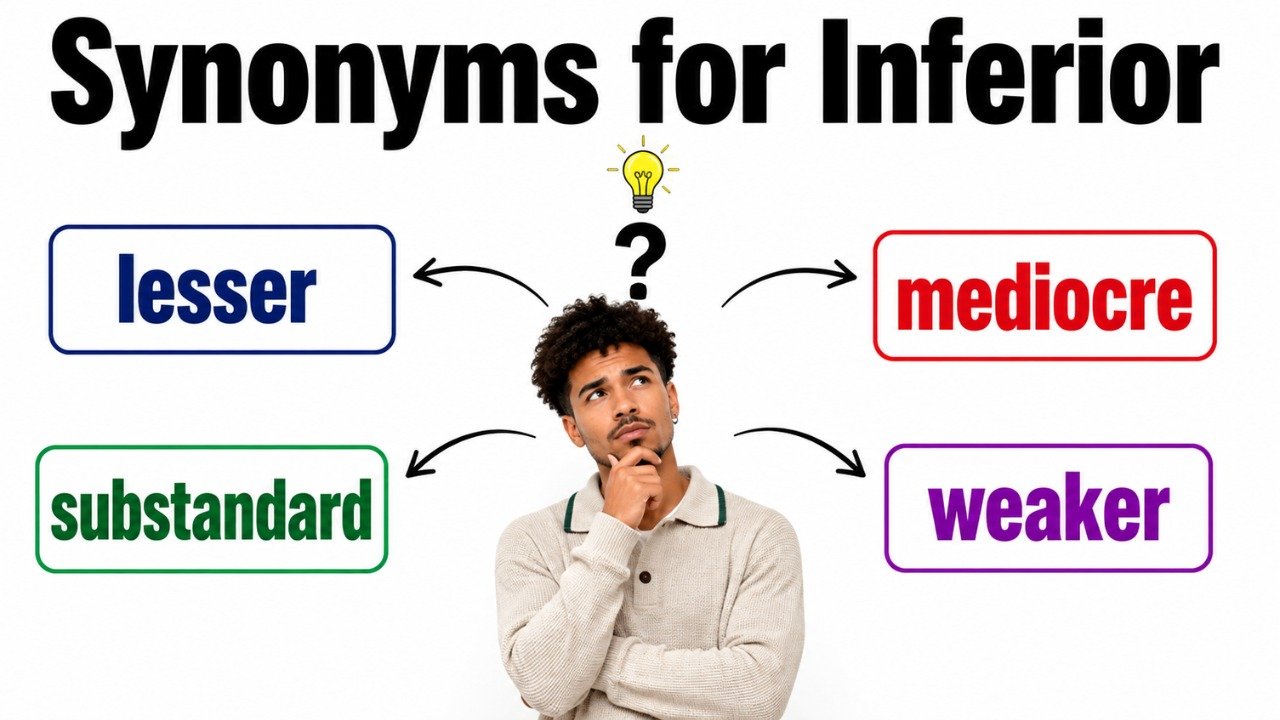
Quick Answer: The best synonyms for inferior include lower, lesser, substandard, mediocre, deficient, inadequate, second rate, poor, weak, and subordinate. Among these synonyms for inferior, lower works well for rank or position, substandard is best for quality below an expected level, inadequate fits insufficient performance, mediocre describes average or unimpressive quality, subordinate suits workplace hierarchy, and lesser is useful when comparing importance, value, or ability.
Pronunciation and Word Details
Word: Inferior.
Pronunciation: /ɪnˈfɪəriər/
Part of Speech: Adjective and noun.
Meaning: Lower in quality, rank, value, ability, position, or importance than something else.
US Pronunciation:
UK Pronunciation:
What Does “Inferior” Mean?
Inferior means lower in quality, rank, ability, value, importance, or position when compared with someone or something else.
As an adjective, inferior describes something judged to be below another thing in a particular respect. A product can be inferior in quality, an argument can be inferior in strength, and a position can be inferior in rank.
As a noun, inferior can refer to a person who holds a lower position or status, although this use can sound formal or outdated in ordinary conversation.
The meaning of inferior depends heavily on context. In a quality comparison, it can mean substandard or poorer. In a hierarchy, it can mean subordinate or lower ranking. In performance, it may mean weaker or less capable.
Because inferior often expresses an unfavorable comparison, careful wording is important when describing people. More specific terms such as less experienced, lower ranked, or less effective may sound clearer and more respectful.
Meaning, Tone, and Context of “Inferior”
Inferior usually has a negative or comparative tone because it places one person, object, idea, or result below another.
Formal Tone: Inferior is common in formal comparisons involving quality, rank, performance, or value.
Neutral Comparative Tone: It can be neutral when used objectively, especially in technical or factual descriptions.
Negative Tone: The word can sound critical when it refers to poor quality or weak performance.
Academic Context: Inferior may appear in essays, analysis, comparisons, research discussions, and evaluations.
Professional Context: It can describe a product, process, result, method, or performance that fails to match a better alternative.
Conversational Context: In everyday speech, words such as worse, lower quality, weaker, or not as good may sound more natural.
Sensitive Context: When used about a person, inferior can sound insulting because it may suggest that the person has less worth rather than simply less skill or experience.
The best synonym therefore depends on what is being compared and why.
When and How to Use “Inferior”
For Lower Quality: Use inferior when one product, material, or result is clearly poorer than another.
Example: The cheaper fabric proved inferior in durability.
For Lower Rank: Use inferior when describing a position that is below another in a hierarchy.
Example: The role was considered inferior in rank to the senior position.
For Weaker Performance: Use inferior when one method, strategy, or result performs worse than another.
Example: The older method produced inferior results.
For Lower Value: Use inferior when comparing worth, usefulness, or importance.
Example: The imitation was inferior in value to the original piece.
For Limited Ability: Use inferior carefully when comparing capability.
Example: The older device had inferior processing ability.
For Formal Comparison: Inferior works well when an objective comparison is being made.
Example: The analysis showed that the second option was inferior in efficiency.
Best Synonyms for Inferior
Lower: Below another in position, rank, amount, or level.
Example: The employee held a lower position within the department.
Lesser: Smaller or lower in importance, value, degree, or quality.
Example: The issue was considered of lesser importance.
Substandard: Below the level of quality that is normally expected.
Example: The inspection rejected the substandard materials.
Mediocre: Average or unimpressive rather than excellent.
Example: The performance was mediocre compared with earlier results.
Deficient: Lacking something necessary for acceptable quality or performance.
Example: The report was deficient in supporting evidence.
Inadequate: Not sufficient, suitable, or good enough for a particular purpose.
Example: The equipment was inadequate for the demanding task.
Second Rate: Lower in quality and not among the best.
Example: Customers refused to accept second rate workmanship.
Poor: Low in quality, condition, or performance.
Example: The project failed because of poor planning.
Weak: Lacking strength, effectiveness, quality, or influence.
Example: The argument was weak and poorly supported.
Subordinate: Lower in rank, position, or authority.
Example: She worked in a subordinate role before receiving a promotion.
50 Synonyms for Inferior with Short Meanings
- Lower: Below another in rank, position, level, or quality.
- Lesser: Lower in importance, degree, value, or quality.
- Substandard: Below the expected level of quality.
- Mediocre: Average and not especially good.
- Deficient: Lacking an important quality or requirement.
- Inadequate: Not good enough or sufficient for a purpose.
- Poor: Low in quality, ability, or effectiveness.
- Weak: Lacking strength, quality, or effectiveness.
- Subordinate: Lower in rank or authority.
- Second Rate: Of lower quality than the best available.
- Low Grade: Of poor or reduced quality.
- Low Quality: Not meeting a high standard.
- Unsatisfactory: Failing to meet expectations or requirements.
- Subpar: Below the usual or expected standard.
- Faulty: Containing defects or problems.
- Flawed: Imperfect because of weaknesses or mistakes.
- Defective: Not functioning or formed properly.
- Imperfect: Having faults or weaknesses.
- Unexceptional: Not especially good, impressive, or remarkable.
- Ordinary: Not outstanding or superior.
- Average: Typical rather than excellent.
- Second Best: Not the highest in quality or preference.
- Minor: Lower in importance, seriousness, or rank.
- Secondary: Less important or lower in priority.
- Junior: Lower in rank, experience, or seniority.
- Lower Ranking: Occupying a position below another in status.
- Lower Grade: Belonging to a poorer level or category.
- Lower Class: Belonging to a lower category or standard.
- Lower Level: Situated below another in rank, stage, or quality.
- Less Capable: Having less ability to perform effectively.
- Less Effective: Producing weaker results.
- Less Skilled: Having a lower level of skill.
- Less Advanced: Behind another in development or sophistication.
- Less Valuable: Having lower worth or usefulness.
- Less Important: Having reduced significance or priority.
- Less Powerful: Having reduced strength, authority, or influence.
- Less Reliable: Not as dependable as another option.
- Weaker: Having less strength or effectiveness.
- Poorer: Lower in quality or condition.
- Worse: Less good, effective, or desirable.
- Below Average: Lower than the typical standard.
- Below Standard: Failing to reach an accepted level.
- Below Par: Not reaching the expected standard.
- Inferior Grade: Belonging to a lower quality category.
- Low Caliber: Of limited quality or ability.
- Unimpressive: Failing to create a strong positive impression.
- Marginal: Barely acceptable or limited in quality.
- Insufficient: Not enough to meet a need or requirement.
- Uncompetitive: Not strong enough to compete successfully.
- Underperforming: Performing below expectations or comparison standards.
Read Also:
Synonyms for Exploring

Synonyms for Inferior by Context
When Inferior Means Lower in Quality
When inferior refers to something poorer in quality, useful alternatives include substandard, poor, low quality, subpar, defective, flawed, and second rate.
Substandard: Best when something fails to meet an established standard.
Example: The contractor replaced the substandard materials.
Poor: A simple and widely understood alternative.
Example: The poor construction became obvious after a few months.
Subpar: Useful in professional and conversational contexts for performance below expectations.
Example: The team delivered a subpar result.
Second Rate: Stronger and more critical, suggesting noticeably lower quality.
Example: The manager refused to approve second rate work.
When Inferior Means Lower in Rank
When inferior refers to hierarchy, position, or authority, lower, subordinate, junior, secondary, and lower ranking are better choices.
Subordinate: Best for formal descriptions of hierarchy.
Example: He initially worked in a subordinate position.
Junior: Best when rank or experience is lower.
Example: The junior analyst reported to the senior manager.
Lower Ranking: Clear when explaining organizational status.
Example: The lower ranking officer followed the command.
Secondary: Suitable when something has less importance or priority.
Example: Cost became a secondary concern after safety issues emerged.
When Inferior Means Less Capable
When discussing ability or performance, weaker, less capable, less skilled, inadequate, and underperforming can be more precise.
Weaker: Useful when comparing effectiveness or strength.
Example: The second proposal presented a weaker argument.
Less Capable: Appropriate when one person, system, or tool can do less than another.
Example: The older machine was less capable of handling large workloads.
Less Skilled: Best when the comparison specifically concerns skill.
Example: The less skilled worker required additional training.
Underperforming: Useful for results that fall below expectations.
Example: The underperforming unit was reviewed by management.
When Inferior Means Less Important
When inferior refers to significance, value, or priority, lesser, minor, secondary, less important, and less valuable can work.
Lesser: Suitable for formal comparisons of importance or value.
Example: The committee treated the issue as a lesser concern.
Minor: Best when something has limited importance.
Example: The report contained only a minor error.
Secondary: Useful when something is not the primary concern.
Example: Appearance was secondary to durability.
Less Valuable: Best when comparing worth or usefulness.
Example: The damaged item became less valuable.
When Inferior Means Below Standard
When inferior describes something that does not meet a requirement, inadequate, deficient, unsatisfactory, below standard, and insufficient are strong choices.
Inadequate: Best when something is not good enough for a particular purpose.
Example: The lighting was inadequate for detailed work.
Deficient: Useful when something important is missing.
Example: The proposal was deficient in financial detail.
Unsatisfactory: Best when expectations have not been met.
Example: The inspection found the workmanship unsatisfactory.
Below Standard: Clear and direct in evaluations.
Example: The final product was below standard.
Another Word for Inferior
The best general replacement for inferior is lower because it can describe reduced rank, level, quality, value, or position without always sounding strongly judgmental.
However, the most accurate choice depends on context. Use substandard for poor quality, subordinate for rank, inadequate for something not good enough, and weaker when comparing strength or performance.
Original: The second material was inferior in quality.
Better Option: The second material was substandard in quality.
Original: He held an inferior position in the organization.
Better Option: He held a subordinate position in the organization.
Original: The older model produced inferior results.
Better Option: The older model produced weaker results.
Original: Their preparation was inferior for such a demanding task.
Better Option: Their preparation was inadequate for such a demanding task.
When Not to Use “Inferior”
Inferior can sound too broad or harsh when a more precise description is available.
When talking about people, the word may sound insulting because it can suggest lower personal worth rather than a specific difference in experience, skill, or authority.
Weak: She is inferior to the other employees.
Better: She has less experience than the other employees.
In quality comparisons, inferior may be vague if the exact weakness can be identified.
Weak: The material is inferior.
Better: The material is less durable and more prone to damage.
In performance reports, a measurable term may be more useful.
Weak: The second system was inferior.
Better: The second system was less efficient and less reliable.
In casual conversation, inferior may sound overly formal.
Weak: This meal is inferior to yesterday’s meal.
Better: This meal is not as good as yesterday’s meal.
Avoid using inferior when the comparison concerns only one specific feature.
Weak: The phone is inferior.
Better: The phone has a weaker battery than the other model.
Words Commonly Confused With Inferior
Inferior vs Poor: Inferior is comparative and usually means lower than something else. Poor simply means low in quality and does not always require a direct comparison.
Inferior vs Substandard: Inferior means lower in quality than another option, while substandard specifically means below an accepted or expected standard.
Inferior vs Mediocre: Inferior means lower than another item or level. Mediocre means average or unimpressive rather than excellent.
Inferior vs Inadequate: Inferior focuses on comparison, while inadequate means something is not sufficient for a particular purpose.
Inferior vs Subordinate: Inferior can refer to quality, rank, or value. Subordinate specifically refers to lower rank, authority, or importance.
Inferior vs Lesser: Inferior often sounds more negative, while lesser commonly describes something lower in degree, importance, or value.
Inferior vs Worse: Worse is a broader everyday comparative meaning less good. Inferior is more formal and often used in objective evaluation.
Which Synonym Should You Choose?
Choose lower when describing rank, position, level, price, or general comparison.
Choose lesser when comparing importance, value, seriousness, or degree.
Choose substandard when a product, service, material, or result falls below an accepted quality level.
Choose mediocre when something is average and unimpressive rather than clearly bad.
Choose inadequate when something does not provide enough quality, ability, space, preparation, or resources for a purpose.
Choose deficient when something lacks a necessary feature, quality, or amount.
Choose weaker when comparing arguments, performance, strength, evidence, or results.
Choose subordinate when discussing organizational hierarchy, authority, or workplace rank.
Choose second rate in stronger criticism when something is clearly lower in quality.
Choose poor for simple, direct, everyday descriptions of low quality.
Choose less skilled or less experienced when discussing people because these terms are more precise and less judgmental.
Choose below standard in reports, assessments, inspections, and formal evaluations.
Real Life Examples of “Inferior” in Sentences
Original: The cheaper material was inferior in durability.
Better Option: The cheaper material was less durable.
Original: The second proposal was inferior to the first.
Better Option: The second proposal was weaker than the first.
Original: The equipment was inferior for professional use.
Better Option: The equipment was inadequate for professional use.
Original: The final batch was inferior in quality.
Better Option: The final batch was substandard in quality.
Original: He occupied an inferior position within the organization.
Better Option: He occupied a subordinate position within the organization.
Original: The older system provided inferior performance.
Better Option: The older system provided poorer performance.
Original: Their evidence was inferior to the evidence in the earlier report.
Better Option: Their evidence was less convincing than the evidence in the earlier report.
Original: The copy was inferior to the original.
Better Option: The copy was of lower quality than the original.
Original: The second candidate had inferior technical skills.
Better Option: The second candidate had weaker technical skills.
Original: This approach is inferior for long term planning.
Better Option: This approach is less effective for long term planning.
Synonym Groups and Usage Differences
Quality Group
Substandard, poor, subpar, low quality, second rate, flawed, and defective describe reduced quality.
Substandard and below standard are useful when a clear benchmark exists. Poor is broad and conversational. Defective is more specific because it suggests something does not function properly.
Example: The inspection identified several substandard components.
Performance Group
Weak, weaker, underperforming, less effective, less capable, and inadequate focus on reduced performance.
These words are often more precise than inferior when the comparison involves results or effectiveness.
Example: The older strategy was less effective in difficult conditions.
Rank Group
Lower, subordinate, junior, secondary, and lower ranking refer to position or authority.
Subordinate is formal, while junior often relates to experience or organizational level.
Example: She began in a junior position before moving into management.
Value Group
Lesser, less valuable, minor, secondary, and second best relate to reduced importance, worth, or priority.
Lesser is useful in formal writing, while minor is better for small differences in significance.
Example: Cost was treated as a lesser concern than safety.
Standard Group
Inadequate, deficient, unsatisfactory, insufficient, below standard, and below par describe failure to meet expectations.
Inadequate usually means not enough for a purpose. Deficient suggests something important is missing. Unsatisfactory focuses on unmet expectations.
Example: The report was deficient in supporting detail.
Antonyms of Inferior
The opposites of inferior vary according to whether the comparison concerns quality, rank, value, or ability.
Superior: Higher in quality, rank, value, or performance.
Better: More desirable, effective, or satisfactory.
Higher: Above another in rank, position, amount, or level.
Excellent: Extremely good in quality or performance.
Outstanding: Exceptionally good or impressive.
Exceptional: Unusually high in quality or ability.
Premium: Belonging to a higher quality category.
First Rate: Of excellent or top quality.
High Grade: Belonging to a superior quality level.
Advanced: More developed or sophisticated.
Senior: Higher in rank, position, or experience.
Leading: Among the strongest or most successful.
Dominant: More powerful or influential than others.
Preferred: Chosen as more desirable than another option.
Optimal: Best or most favorable for a particular purpose.
Comparison: Inferior vs Related Words
Inferior vs Substandard
Inferior means lower in quality or ability compared with something else. Substandard means below an accepted or expected standard.
Example With Inferior: The second material was inferior to the first.
Example With Substandard: The inspector rejected the substandard material.
Inferior vs Mediocre
Inferior makes a direct or implied comparison with something better. Mediocre describes something that is average and unimpressive.
Example With Inferior: The newer copy was inferior to the original.
Example With Mediocre: The performance was mediocre despite months of preparation.
Inferior vs Inadequate
Inferior means lower in quality, rank, or ability. Inadequate means not sufficient for the task or need.
Example With Inferior: The older system offered inferior performance.
Example With Inadequate: The older system was inadequate for the increased workload.
Inferior vs Poor
Inferior is more formal and comparative. Poor is a broad word describing low quality or weak performance.
Example With Inferior: The second design was inferior in durability.
Example With Poor: The second design showed poor durability.
Inferior vs Subordinate
Inferior can describe quality, ability, status, or rank. Subordinate is mainly used for lower authority, rank, or importance.
Example With Inferior: The material was inferior in quality.
Example With Subordinate: He served in a subordinate role.
Inferior vs Lesser
Inferior often implies poorer quality or lower status. Lesser usually refers to reduced importance, amount, value, or degree.
Example With Inferior: The cheaper material was inferior in strength.
Example With Lesser: The problem was considered of lesser importance.
Inferior vs Worse
Inferior is more formal and often appears in careful comparisons. Worse is common in everyday speech and simply means less good.
Example With Inferior: The second method produced inferior results.
Example With Worse: The second method produced worse results.
Common Phrases and Expressions With “Inferior”
Inferior Quality: Quality that is lower than another standard or product.
Inferior Product: A product that performs or compares poorly.
Inferior Material: Material of lower quality, strength, or value.
Inferior Performance: Performance that is weaker than another result or expected level.
Inferior Position: A role or status below another in rank.
Inferior Status: A lower social, organizational, or formal standing.
Inferior Results: Outcomes that are weaker or less desirable.
Inferior Design: A design judged to be less effective or successful.
Inferior Version: A version considered worse than another.
Feel Inferior: To believe oneself to be less capable, important, or worthy than others.
Common Mistakes to Avoid
A common mistake is using inferior without making the basis of comparison clear. Readers should understand whether something is inferior in quality, performance, value, rank, or another feature.
Avoid describing an entire person as inferior when the real difference concerns one specific ability. This can sound unnecessarily disrespectful.
Instead of saying someone is inferior, describe the exact difference with terms such as less experienced, less skilled, lower ranked, or less effective.
Do not confuse inferior with inadequate. Something can be inferior to a competing option while still being perfectly adequate for its purpose.
Do not confuse inferior with mediocre. Mediocre describes ordinary or unimpressive quality, while inferior requires an actual or implied comparison with something better.
Avoid repeatedly using inferior in the same paragraph. Alternate with precise words such as lower, weaker, substandard, poorer, subordinate, or inadequate when they accurately match the intended meaning.
Be careful with second rate because it carries stronger criticism and may sound dismissive.
Do not use subordinate as a quality synonym. It should mainly describe lower rank, authority, or importance.
Finally, avoid vague statements such as “the product is inferior” when you can explain the exact problem. Saying that it is less durable, slower, weaker, or less reliable gives readers more useful information.
Conclusion
The best synonyms for inferior depend on the type of comparison being made. Lower and lesser work for general comparisons, while substandard, poor, and second rate describe reduced quality. Use inadequate or deficient when something fails to meet a need, weaker for performance, and subordinate for lower rank. When describing people, specific phrases such as less experienced or less skilled are usually clearer and more respectful. Choosing synonyms for inferior by context makes writing more precise, natural, and informative.
FAQs About Synonyms for Inferior
What Is the Best Synonym for Inferior?
Lower is one of the most flexible synonyms for inferior. Substandard is better for poor quality, while subordinate works for lower rank.
What Is Another Word for Inferior Quality?
Substandard, poor, low quality, subpar, second rate, and below standard can all describe inferior quality.
Is Inferior the Same as Worse?
They are similar, but inferior is more formal and comparative. Worse is more common in everyday speech and means less good.
Is Substandard a Synonym for Inferior?
Yes, when inferior refers to quality below an expected standard. Substandard is especially useful for products, materials, services, and performance.
What Is a Polite Alternative to Inferior?
Less effective, less experienced, lower quality, less suitable, or less advanced can sound more precise and less judgmental.
Can Inferior Mean Lower in Rank?
Yes. Inferior can describe a lower position or status, although subordinate, junior, or lower ranking may be clearer in professional writing.
What Is the Opposite of Inferior?
Superior is the most direct opposite. Other antonyms include better, higher, excellent, first rate, advanced, senior, and premium.
