
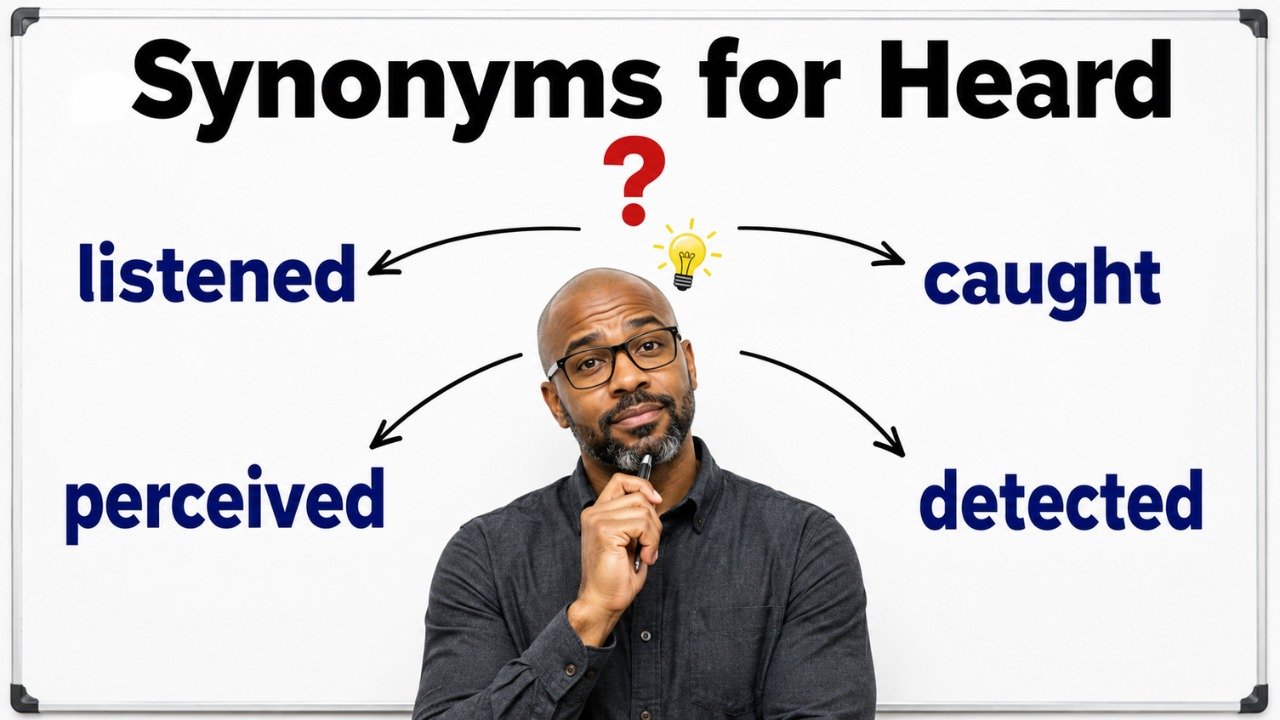
Quick Answer: Common synonyms for heard include listened to, perceived, detected, caught, overheard, learned, discovered, noticed, discerned, and received word. Among the best synonyms for heard, use listened to when someone intentionally paid attention to sound, perceived when sound reached the senses, detected for faint or difficult sounds, overheard for something heard unintentionally, learned or discovered when heard means received information, and discerned when a sound was recognized despite being unclear. The best replacement depends on whether heard refers to sound, conversation, information, awareness, or formal consideration.
Pronunciation and Word Details
Word: Heard.
Pronunciation: /hɜːrd/
Part of Speech: Verb, the past tense and past participle of hear.
Meaning: Perceived a sound through the ears, received information, listened to someone, or became aware of something.
US Pronunciation:
UK Pronunciation:
What Does “Heard” Mean?
Heard is the past tense and past participle of the verb hear. Its most basic meaning is to have perceived a sound through the ears.
For example, in “I heard the bell,” heard means that the sound of the bell reached the person’s ears.
The word can also describe receiving information. In “I heard about the new policy,” heard means learned, was told, or became aware of something.
Heard may refer to listening to a person or statement. In “The manager heard our concerns,” it suggests that the manager listened to what people said.
In formal or legal contexts, heard can mean officially considered or listened to. A case, complaint, argument, or appeal may be heard by someone with authority.
Because heard has several meanings, its best synonym depends strongly on context. Perceived, detected, learned, overheard, listened to, received, and considered are not interchangeable in every sentence.
Meaning, Tone, and Context of “Heard”
Heard is a common, neutral, and highly flexible English word. It appears naturally in everyday conversation, storytelling, professional communication, academic writing, reports, descriptions, and formal situations.
When heard refers to ordinary sound perception, its tone is neutral.
Example: I heard footsteps outside the room.
When it refers to receiving information, it is often conversational.
Example: I heard that the meeting was postponed.
When heard describes careful listening, a more precise term such as listened to, considered, or acknowledged may improve the meaning.
Example: She heard his explanation before making a decision.
In formal contexts, heard may describe an official process.
Example: The committee heard both arguments before voting.
Heard can also carry an emotional meaning. Saying “I want to be heard” does not simply mean producing audible words. It usually means wanting one’s ideas, feelings, or concerns to be listened to, understood, and taken seriously.
For precise writing, choose a synonym that reflects the intended meaning rather than replacing heard with the same alternative in every sentence.
When and How to Use “Heard”
For Perceiving Sound: Use heard when a sound reached someone’s ears.
Example: We heard thunder in the distance.
For Detecting a Quiet Sound: Heard can describe noticing a sound that was faint or difficult to identify.
Example: She heard a soft tapping at the window.
For Receiving Information: Use heard when someone learned something through another person, conversation, report, or message.
Example: I heard that the office will close early.
For Unintentional Listening: Heard may describe information that someone happened to hear without deliberately listening.
Example: He heard part of their conversation from the hallway.
For Listening to Someone: Heard can mean giving attention to what someone said.
Example: The supervisor heard both employees before responding.
For Understanding Concerns: Heard may express the idea that someone’s opinions or emotions were acknowledged.
Example: After the discussion, everyone felt heard.
For Formal Consideration: Use heard when a complaint, argument, case, or request was officially considered.
Example: The appeal was heard by the panel.
For Previous Awareness: Heard is common when discussing prior knowledge of a person, place, event, or idea.
Example: I had heard of the author before reading the book.
Best Synonyms for Heard
Listened To: Paid deliberate attention to sounds or someone’s words.
Example: She listened to every concern before answering.
Perceived: Became aware of a sound through the senses.
Example: He perceived a faint sound behind the wall.
Detected: Noticed or identified a sound that may have been difficult to hear.
Example: We detected a low buzzing near the machine.
Caught: Managed to hear or understand a sound, word, or remark.
Example: I caught the final part of the announcement.
Overheard: Heard something without being the intended listener.
Example: She overheard their conversation while walking past.
Learned: Received new information or knowledge.
Example: We learned that the schedule had changed.
Discovered: Became aware of information that was previously unknown.
Example: He discovered that the event had been canceled.
Discerned: Managed to recognize or distinguish a faint or unclear sound.
Example: She discerned a whisper through the noise.
Noticed: Became aware of a sound or spoken detail.
Example: I noticed a strange clicking sound nearby.
Received Word: Obtained information or news about something.
Example: We received word that the shipment had arrived.
50 Synonyms for Heard with Short Meanings
- Listened To: Paid attention to sound or speech.
- Perceived: Became aware of a sound through the senses.
- Detected: Noticed a sound that was difficult to identify.
- Caught: Managed to hear or understand what was said.
- Overheard: Heard something without being the intended listener.
- Discerned: Recognized a faint or unclear sound.
- Noticed: Became aware of a sound or spoken detail.
- Registered: Became mentally aware of a sound.
- Picked Up: Managed to hear or detect something.
- Made Out: Successfully recognized unclear words or sounds.
- Listened: Gave attention to sounds or speech.
- Attended To: Gave careful attention to what was being said.
- Took In: Absorbed or understood spoken information.
- Caught Wind Of: Became aware of information indirectly.
- Learned: Gained knowledge or information.
- Discovered: Found out information that was previously unknown.
- Found Out: Became aware of a fact or situation.
- Was Told: Received information from another person.
- Was Informed: Received information in a clear or formal way.
- Received Word: Obtained news or information.
- Got Word: Received information, usually informally.
- Became Aware: Came to know about something.
- Gathered: Understood or learned something from available information.
- Understood: Grasped the meaning of spoken words.
- Comprehended: Fully understood what was communicated.
- Recognized: Identified a sound, voice, or spoken idea.
- Acknowledged: Recognized and gave attention to what was said.
- Considered: Gave thought or attention to an argument or request.
- Entertained: Formally considered an idea, argument, or request.
- Received: Accepted or took in spoken information.
- Noted: Paid attention to something said or heard.
- Observed: Became aware of something and mentally noted it.
- Sensed: Became aware of a sound or presence.
- Distinguished: Identified one sound from others.
- Identified: Recognized the source or nature of a sound.
- Recognized The Sound: Correctly identified what was audible.
- Caught The Sound: Successfully noticed an audible signal.
- Picked Up On: Noticed a spoken detail, tone, or implication.
- Got The Message: Understood what someone was communicating.
- Took Notice Of: Gave attention to something audible or communicated.
- Paid Attention To: Deliberately focused on what was being said.
- Gave Ear To: Listened carefully to someone or something.
- Lent An Ear To: Listened sympathetically or attentively.
- Was Advised: Received information or guidance.
- Was Notified: Was officially informed about something.
- Was Alerted: Was made aware of something important.
- Was Briefed: Received organized information about a subject.
- Was Apprised: Was formally informed about a situation.
- Was Made Aware: Received information that created awareness.
- Came To Know: Eventually learned or became aware of something.
Read Also:
Synonyms for Calm Down

Synonyms for Heard by Context
When Heard Means Perceived a Sound
When heard simply means that sound reached someone’s ears, useful alternatives include perceived, detected, noticed, registered, sensed, and picked up.
Perceived: Best when describing sensory awareness in precise or formal writing.
Example: She perceived a faint humming sound.
Detected: Best when the sound is weak, hidden, or difficult to notice.
Example: He detected movement and a quiet rustling sound nearby.
Noticed: Natural when the emphasis is on becoming aware of a sound.
Example: I noticed someone calling my name.
Registered: Useful when emphasizing mental awareness after the sound was perceived.
Example: The warning did not register immediately.
When Heard Means Listened Carefully
When deliberate attention is important, listened to, attended to, paid attention to, gave ear to, and lent an ear to are stronger choices.
Listened To: The most natural replacement for intentional listening.
Example: She listened to his explanation carefully.
Attended To: More formal and useful when someone gave serious attention.
Example: The chairperson attended to each concern.
Paid Attention To: Clear when deliberate concentration matters.
Example: He paid attention to every instruction.
Lent An Ear To: Often suggests sympathetic listening.
Example: She lent an ear to her colleague’s concerns.
When Heard Means Received Information
When heard means learning something from another person or source, choose learned, was told, was informed, received word, found out, or became aware.
Learned: A broad and natural choice for acquiring information.
Example: We learned that the deadline had changed.
Was Told: Best when another person directly supplied the information.
Example: I was told that the room was unavailable.
Was Informed: More formal than was told.
Example: Employees were informed about the revised procedure.
Received Word: Useful for news or an update.
Example: The family received word that the travelers had arrived safely.
When Heard Means Accidentally Learned Something
For information heard unintentionally, overheard and caught are especially useful.
Overheard: Means hearing words that were not specifically intended for you.
Example: I overheard two customers discussing the event.
Caught: Means hearing only part of what was said.
Example: She caught a few words of the conversation.
Caught Wind Of: Means becoming aware of information indirectly.
Example: He caught wind of the proposed changes.
When Heard Means Understood Spoken Words
When the emphasis is not merely on sound but on understanding, use understood, comprehended, took in, made out, or got the message.
Understood: Best for grasping spoken meaning.
Example: I understood everything she explained.
Made Out: Useful when speech was difficult to hear clearly.
Example: We could barely make out his words through the noise.
Took In: Suggests mentally absorbing what was said.
Example: She quietly took in the instructions.
When Heard Means Formally Considered
In official settings, heard may mean that an argument, complaint, request, or case received formal attention.
Considered: Best when attention and evaluation are emphasized.
Example: The panel considered both arguments.
Entertained: Useful in formal writing for considering a proposal, request, or argument.
Example: The committee entertained several objections before deciding.
Received: May describe accepting a statement, testimony, or submission for consideration.
Example: The board received comments from all participants.
Another Word for Heard
The best single replacement for heard is often listened to when deliberate attention is intended, but perceived is more precise for sound perception and learned is usually better when heard means received information.
The strongest alternative therefore depends on what the sentence actually communicates.
Original: I heard a strange sound outside.
Better Option: I detected a strange sound outside.
Original: I heard everything she had to say.
Better Option: I listened to everything she had to say.
Original: We heard that the event was canceled.
Better Option: We learned that the event was canceled.
Original: I heard their conversation while passing the door.
Better Option: I overheard their conversation while passing the door.
When Not to Use “Heard”
Heard is useful, but it can sometimes be too general. A more specific word may explain whether someone intentionally listened, accidentally overheard something, detected a faint sound, received information, or formally considered an argument.
Avoid repeatedly using heard when several different meanings occur in the same passage.
Weak: I heard the noise, heard the announcement, and heard about the delay.
Better: I detected the noise, caught the announcement, and learned about the delay.
Do not use heard when intentional listening is the important idea.
Weak: The counselor heard everything I said carefully.
Better: The counselor listened carefully to everything I said.
Avoid heard when you need to emphasize that information was officially communicated.
Weak: Employees heard about the new procedure from management.
Better: Employees were informed about the new procedure.
Do not automatically use overheard as a synonym for heard. Overheard specifically means hearing something unintentionally or without being the intended listener.
Weak: I overheard the speaker’s presentation from my seat.
Better: I listened to the speaker’s presentation from my seat.
Use a precise alternative whenever the distinction between hearing, listening, understanding, and learning matters.
Words Commonly Confused With Heard
Heard vs Listened: Heard means perceived a sound, while listened means deliberately paid attention to it. You can hear music without intentionally listening to it.
Heard vs Overheard: Heard is general. Overheard means hearing words or information that were not directly intended for you.
Heard vs Learned: Heard can mean received information, but learned emphasizes acquiring knowledge rather than the act of hearing.
Heard vs Understood: Hearing concerns receiving sound. Understanding concerns grasping meaning. A person may hear every word without understanding the message.
Heard vs Detected: Heard is broad, while detected emphasizes noticing something faint, hidden, unusual, or difficult to perceive.
Heard vs Perceived: Heard is common and conversational. Perceived is more formal and emphasizes sensory awareness.
Heard vs Caught: Caught often suggests successfully hearing a word, phrase, announcement, or detail that might otherwise have been missed.
Heard vs Discerned: Discerned suggests identifying something despite difficulty, noise, distance, or lack of clarity.
Which Synonym Should You Choose?
Choose listened to when someone intentionally gave attention to another person’s words or to a sound.
Choose perceived when you want a precise or formal term for becoming aware of sound.
Choose detected when the sound was faint, hidden, unusual, or difficult to notice.
Choose overheard when someone unintentionally heard a conversation or information not directed at them.
Choose caught when someone successfully heard a brief word, statement, sound, or announcement.
Choose discerned when the sound was unclear but eventually recognizable.
Choose learned when heard means gaining new information.
Choose was informed for professional writing, reports, notices, and formal communication.
Choose received word when describing the arrival of news or an update.
Choose understood when the important point is comprehension rather than sound.
Choose considered when a complaint, argument, case, or request was officially examined.
In essays and reports, precise choices such as perceived, detected, learned, or considered often provide more detail than heard.
In casual conversation, heard, caught, learned, found out, and was told usually sound natural.
In professional emails, was informed, learned, received word, and understood can provide greater clarity depending on the intended meaning.
Real Life Examples of “Heard” in Sentences
Original: I heard a soft noise behind the door.
Better Option: I detected a soft noise behind the door.
Original: She heard everything the customer said.
Better Option: She listened to everything the customer said.
Original: We heard that the road had reopened.
Better Option: We learned that the road had reopened.
Original: He heard their private discussion by accident.
Better Option: He overheard their private discussion.
Original: I barely heard what the speaker said.
Better Option: I barely made out what the speaker said.
Original: She heard the sound of a phone ringing downstairs.
Better Option: She noticed the sound of a phone ringing downstairs.
Original: The committee heard both sides of the disagreement.
Better Option: The committee considered both sides of the disagreement.
Original: We heard about the schedule change this morning.
Better Option: We were informed about the schedule change this morning.
Original: He heard a familiar voice across the room.
Better Option: He recognized a familiar voice across the room.
Original: The manager heard my concerns and responded thoughtfully.
Better Option: The manager listened to my concerns and responded thoughtfully.
Synonym Groups and Usage Differences
Sound Perception Group
Perceived, detected, noticed, sensed, registered, and picked up describe becoming aware of audible information.
Use these alternatives when the physical experience of hearing is important.
Example: She detected a faint clicking sound near the window.
Intentional Listening Group
Listened to, attended to, paid attention to, gave ear to, and lent an ear to emphasize deliberate attention.
They are more suitable than heard when someone actively focused on another person’s speech.
Example: The supervisor listened to each employee’s concern.
Information Group
Learned, discovered, found out, was told, was informed, and received word refer to receiving knowledge or news.
Use these when heard does not literally refer to sound.
Example: We learned about the change before the meeting.
Accidental Hearing Group
Overheard, caught, caught wind of, and picked up on can describe receiving information unintentionally or indirectly.
The exact choice depends on how the information was obtained.
Example: She overheard a conversation in the hallway.
Recognition Group
Discerned, distinguished, identified, recognized, and made out emphasize successfully identifying a sound, voice, or spoken word.
These are useful when hearing requires effort or interpretation.
Example: He discerned her voice through the background noise.
Understanding Group
Understood, comprehended, took in, and got the message move beyond sound perception and focus on meaning.
Example: She understood the instructions after they were explained again.
Formal Consideration Group
Considered, entertained, received, and attended to may replace heard when an authority evaluates arguments, testimony, complaints, or requests.
Example: The committee considered every objection before reaching a decision.
Antonyms of Heard
The opposite of heard changes according to the meaning of the sentence. If heard refers to sound perception, the opposite may involve missing or failing to detect a sound. If it means receiving information or being listened to, different antonyms apply.
Missed: Failed to hear or notice something.
Ignored: Deliberately gave no attention to something said.
Disregarded: Treated information, advice, or concerns as unimportant.
Overlooked: Failed to notice or consider something.
Misheard: Heard something incorrectly.
Failed To Hear: Did not perceive an audible sound.
Tuned Out: Stopped paying attention to speech or sound.
Dismissed: Refused to give serious consideration to an argument or concern.
Unnoticed: Not perceived or recognized.
Uninformed: Not given relevant information.
Comparison: Heard vs Related Words
Heard vs Listened To
Heard describes receiving sound through the ears. Listened to describes intentionally directing attention toward sound or speech.
Example With Heard: I heard music coming from the next room.
Example With Listened To: I listened to the music for several minutes.
A person can hear something without choosing to listen to it.
Heard vs Overheard
Heard is a general term for perceiving sound. Overheard specifically means hearing words or information without being the intended listener.
Example With Heard: I heard her answer the question.
Example With Overheard: I overheard her discussing the surprise in the hallway.
Use overheard only when accidental or unintended listening is part of the meaning.
Heard vs Detected
Heard simply indicates sound perception. Detected suggests noticing something that may have been faint, hidden, unexpected, or difficult to identify.
Example With Heard: We heard a noise upstairs.
Example With Detected: We detected a faint scratching noise inside the wall.
Detected is more precise when difficulty or careful observation is involved.
Heard vs Perceived
Heard is the more common everyday term. Perceived is more formal and emphasizes sensory awareness.
Example With Heard: She heard footsteps approaching.
Example With Perceived: She perceived a faint sound from the corridor.
Perceived often suits descriptive, academic, or analytical writing.
Heard vs Learned
Heard can refer to receiving information, while learned focuses on gaining knowledge.
Example With Heard: I heard that the deadline was extended.
Example With Learned: I learned that the deadline was extended.
Learned is often clearer when the method of receiving the information is unimportant.
Heard vs Caught
Heard indicates general perception. Caught often implies that someone successfully heard a specific word, remark, message, or sound despite difficulty or limited opportunity.
Example With Heard: I heard the announcement.
Example With Caught: I caught the final sentence of the announcement.
Heard vs Understood
Heard concerns sound perception, while understood concerns meaning.
Example With Heard: I heard every word you said.
Example With Understood: I understood the point you were making.
Someone can hear a sentence clearly and still fail to understand it.
Heard vs Discerned
Heard is broad, while discerned emphasizes recognizing something that was difficult to distinguish.
Example With Heard: She heard a voice outside.
Example With Discerned: She discerned her brother’s voice through the crowd.
Common Phrases and Expressions With Heard
Heard About: Became aware of a person, event, idea, or situation.
Example: Have you heard about the schedule change?
Heard Of: Had previous knowledge or awareness of something.
Example: I have heard of that technique before.
Heard From: Received communication or information from someone.
Example: We have not heard from her this week.
Heard It Before: Encountered the same statement, excuse, story, or idea previously.
Example: I have heard that explanation before.
Heard Correctly: Accurately understood what was spoken.
Example: If I heard correctly, the meeting begins at ten.
Heard Clearly: Perceived speech or sound without difficulty.
Example: Her voice could be heard clearly throughout the room.
Heard Nothing: Did not perceive any sound or receive any information.
Example: We heard nothing after the door closed.
Heard A Noise: Perceived an unidentified or noticeable sound.
Example: She heard a noise outside the window.
Heard Someone Out: Listened to someone’s full explanation before judging or responding.
Example: He heard her out before giving his opinion.
Made Yourself Heard: Spoke strongly or clearly enough to receive attention.
Example: She made herself heard during the discussion.
Common Mistakes to Avoid
One common mistake is treating every synonym for heard as interchangeable. Heard has several meanings, so the correct replacement depends on whether the sentence describes sound, listening, information, understanding, or formal consideration.
Do not replace heard with listened to when there was no deliberate attention.
Incorrect: I listened to a sudden crash behind me.
Better: I heard a sudden crash behind me.
Avoid using overheard for ordinary intentional listening.
Incorrect: I overheard the teacher’s entire lesson from my desk.
Better: I listened to the teacher’s entire lesson from my desk.
Do not confuse hearing with understanding.
Incorrect: I understood a strange noise outside.
Better: I heard a strange noise outside.
Avoid repetitive use of heard when more precise vocabulary would improve the passage.
Repetitive: She heard a knock, heard a voice, and heard that someone was waiting.
Better: She detected a knock, recognized a voice, and learned that someone was waiting.
Be careful with vague information statements such as “I heard something about it” when the reader needs to know how the information was received. Learned, was informed, received word, or was told may be clearer.
Use formal alternatives carefully. Was apprised and entertained may suit formal contexts, but they can sound unnatural in ordinary conversation.
The goal is not simply to replace heard. The goal is to choose the word that communicates the exact kind of hearing, listening, learning, or understanding involved.
Conclusion
The best synonyms for heard depend on what the sentence means. Use listened to for deliberate attention, perceived for sensory awareness, detected for faint sounds, overheard for unintended listening, and discerned for sounds that are difficult to recognize. When heard means receiving information, learned, was informed, found out, and received word are often clearer choices. Understanding these differences makes it easier to use synonyms for heard accurately in conversation, essays, reports, descriptions, and professional writing while keeping your language natural and precise.
FAQs About Synonyms for Heard
What Is the Best Synonym for Heard?
The best synonym depends on context. Listened to works for deliberate attention, perceived for sound awareness, learned for receiving information, and overheard for accidental listening.
What Is Another Word for Heard a Sound?
Useful alternatives include detected, perceived, noticed, caught, sensed, registered, and discerned.
What Is Another Word for Heard About Something?
When heard means receiving information, good alternatives include learned, found out, was told, was informed, became aware, and received word.
What Is the Difference Between Heard and Listened?
Heard means a sound reached your ears. Listened means you deliberately paid attention to that sound or to someone’s words.
Can Overheard Replace Heard?
Only in certain contexts. Overheard means hearing something unintentionally or hearing a conversation that was not specifically directed toward you.
What Is a Formal Synonym for Heard?
Depending on the meaning, formal alternatives include perceived, discerned, was informed, was apprised, considered, and attended to.
Which Synonym for Heard Is Best in Writing?
Use the word that communicates the exact meaning. Detected works for faint sounds, learned for information, listened to for deliberate attention, discerned for difficult sounds, and considered for formal arguments or requests.
