
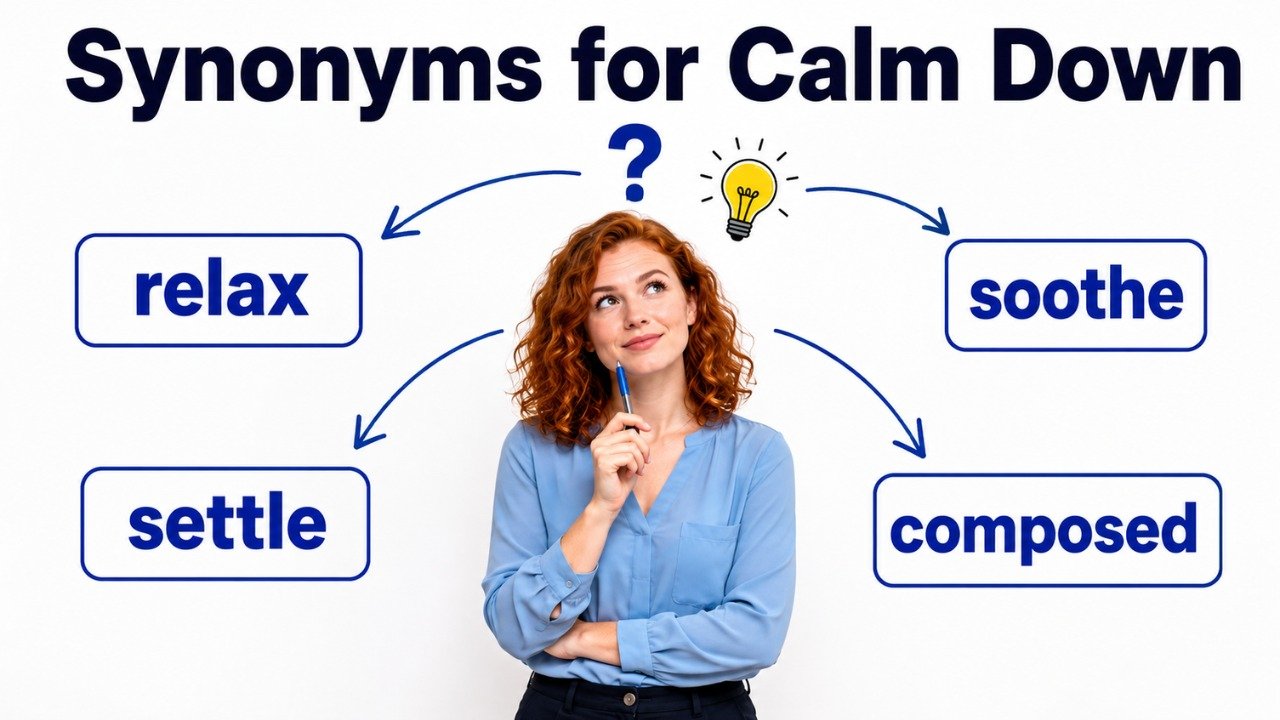
Quick Answer: Common synonyms for calm down include relax, settle down, cool off, compose yourself, unwind, ease up, regain control, steady yourself, take it easy, and become calm. Use relax for general tension, settle down for emotional or physical restlessness, cool off for anger, compose yourself in formal or serious situations, unwind after stress, ease up when reducing pressure, and regain control when emotions have become difficult to manage.
Pronunciation and Word Details
Word: Calm down
Pronunciation: /kɑːm daʊn/
Part of Speech: Phrasal verb
Meaning: To become less upset, angry, nervous, excited, or emotionally intense.
US Pronunciation:
UK Pronunciation:
What Does “Calm Down” Mean?
Calm down means to become less upset, anxious, angry, excited, or emotionally intense.
As a phrasal verb, it can describe a person becoming calmer naturally or someone helping another person become calmer. It is common in everyday conversation and can refer to emotions, behavior, physical excitement, or a tense situation.
For example, someone who is angry may calm down after taking time alone. A nervous person may calm down after receiving reassurance. A noisy group can also calm down when everyone becomes quieter and more controlled.
The phrase can be used without an object, as in “She eventually calmed down,” or with an object, as in “The music calmed him down.”
Meaning, Tone, and Context of “Calm Down”
Calm down is usually conversational and neutral, but its tone depends strongly on how it is used.
When describing someone rather than directly commanding them, the phrase is generally natural and harmless. For example, “He calmed down after a few minutes” simply describes a change in emotional state.
When spoken directly as “Calm down,” however, it can sometimes sound impatient, dismissive, or commanding, especially when someone is genuinely upset. In sensitive situations, alternatives such as “take your time,” “try to relax,” or “let us talk this through” may sound more considerate.
In formal writing, phrases such as compose yourself, regain composure, become calmer, ease tensions, or stabilize may sometimes be more appropriate.
The phrase is common when discussing anger, anxiety, excitement, arguments, stress, children, crowds, difficult conversations, and emotionally intense situations.
When and How to Use “Calm Down”
For Anger: Use calm down when someone is becoming less angry or emotionally heated.
Example: He walked outside for a few minutes to calm down.
For Anxiety: It can describe becoming less nervous or worried.
Example: She focused on her breathing until she began to calm down.
For Excitement: Calm down can also describe reducing excessive excitement or energy.
Example: The children needed a few minutes to calm down before the lesson started.
For Arguments: Use it when tension or conflict begins to decrease.
Example: Both sides calmed down and continued the discussion more respectfully.
For Stress: It can describe returning to a more relaxed mental state.
Example: A quiet evening helped him calm down after a demanding day.
For Reassurance: The phrase may describe helping another person feel safer or more settled.
Example: Her reassuring explanation helped everyone calm down.
For Behavior: Calm down can refer to becoming quieter and more controlled.
Example: The crowd gradually calmed down once the announcement was made.
Best Synonyms for Calm Down
Relax: To become less tense, worried, or physically stressed.
Example: Try to relax before giving your presentation.
Settle Down: To become quieter, calmer, or less restless.
Example: The students settled down when the lesson began.
Cool Off: To become less angry or emotionally heated.
Example: He went for a walk to cool off after the disagreement.
Compose Yourself: To regain control of your emotions or behavior.
Example: She took a moment to compose herself before entering the room.
Unwind: To relax after stress, pressure, or demanding activity.
Example: He likes to read in the evening to unwind.
Ease Up: To reduce tension, pressure, intensity, or effort.
Example: The atmosphere began to ease up after everyone understood the situation.
Regain Control: To recover command over emotions, thoughts, or behavior.
Example: She paused until she could regain control of her emotions.
Steady Yourself: To become mentally or emotionally more controlled.
Example: He took a slow breath to steady himself before speaking.
Take It Easy: To relax and avoid unnecessary stress or effort.
Example: You should take it easy after such a demanding week.
Become Calm: To move from an agitated or emotional state into a peaceful one.
Example: She gradually became calm after hearing the full explanation.
50 Synonyms for Calm Down with Short Meanings
- Relax: Become less tense or worried.
- Settle Down: Become quieter or less agitated.
- Cool Off: Become less angry.
- Compose Yourself: Regain emotional control.
- Unwind: Relax after stress or effort.
- Ease Up: Reduce tension or intensity.
- Regain Control: Recover control over emotions or behavior.
- Steady Yourself: Become emotionally more controlled.
- Take It Easy: Relax and reduce pressure.
- Become Calm: Enter a peaceful emotional state.
- Calm Yourself: Deliberately reduce your emotional intensity.
- Regain Composure: Recover a calm and controlled manner.
- Collect Yourself: Gather your thoughts and emotions.
- Settle Yourself: Bring yourself into a calmer state.
- Soothe Yourself: Comfort yourself and reduce distress.
- Quiet Down: Become less noisy or excited.
- Simmer Down: Become less angry or excited.
- Chill Out: Relax and become less emotionally intense.
- Take a Breath: Pause briefly to reduce emotional pressure.
- Take a Moment: Pause before reacting or continuing.
- Slow Down: Reduce speed, intensity, or emotional urgency.
- Loosen Up: Become less tense or rigid.
- Rest: Stop activity and recover calm or energy.
- Decompress: Relax after a stressful experience.
- Destress: Reduce feelings of stress.
- Recenter: Restore emotional or mental balance.
- Ground Yourself: Focus on the present and regain stability.
- Recover: Return to a more normal emotional state.
- Reassure Yourself: Reduce worry through comforting thoughts.
- Find Your Balance: Return to emotional stability.
- Get a Grip: Regain control over strong emotions.
- Pull Yourself Together: Recover emotional control.
- Take Control: Gain command over your reactions.
- Breathe Easily: Become less tense or worried.
- Release Tension: Let physical or emotional stress decrease.
- Let Go: Stop holding onto tension or emotional pressure.
- Wind Down: Gradually become more relaxed.
- Tone It Down: Reduce emotional or behavioral intensity.
- Ease Off: Reduce force, pressure, or intensity.
- Grow Calm: Gradually become peaceful.
- Become Composed: Reach a controlled emotional state.
- Find Calm: Reach a more peaceful state of mind.
- Restore Your Composure: Return to emotional control.
- Quiet Yourself: Reduce emotional or physical restlessness.
- Relax Yourself: Deliberately reduce tension.
- Settle Your Nerves: Reduce nervousness or anxiety.
- Clear Your Head: Reduce mental confusion or emotional pressure.
- Take a Pause: Stop briefly to regain control.
- Gather Yourself: Recover emotional and mental control.
- Return to Calm: Move back into a peaceful emotional state.
Read Also:
Synonyms for Permanent

Synonyms for Calm Down by Context
When Calm Down Means Become Less Angry
When anger is the main emotion, alternatives should emphasize reduced hostility or emotional heat.
Cool Off: Best for becoming less angry after conflict.
Example: Give him a few minutes to cool off before continuing the conversation.
Simmer Down: A casual expression for becoming less angry or excited.
Example: Everyone needed time to simmer down after the argument.
Regain Control: Useful when anger has affected someone’s behavior.
Example: She stepped away until she could regain control.
Compose Yourself: Suitable when calm behavior is required in a serious setting.
Example: He composed himself before returning to the meeting.
When Calm Down Means Relax
For stress, tension, or nervousness, relax is often the most natural replacement.
Relax: A broad term for becoming less physically or mentally tense.
Example: She listened quietly and gradually began to relax.
Unwind: Best for relaxation after work or prolonged stress.
Example: He went for a walk to unwind after a busy afternoon.
Decompress: Useful for recovering mentally after pressure or intense activity.
Example: She needed some quiet time to decompress.
Destress: Focuses specifically on reducing stress.
Example: Reading helps him destress at the end of the day.
When Calm Down Means Regain Emotional Control
These alternatives emphasize control rather than simple relaxation.
Compose Yourself: Regain outward emotional control.
Example: She composed herself before answering the difficult question.
Regain Composure: Return to a calm and controlled state.
Example: He paused briefly to regain his composure.
Collect Yourself: Pause and organize your emotions or thoughts.
Example: Give yourself a minute to collect yourself.
Pull Yourself Together: Regain control after becoming very emotional.
Example: She pulled herself together before continuing her speech.
When Calm Down Means Become Quieter
Calm down can also refer to behavior, noise, or excitement.
Quiet Down: Become less noisy.
Example: The group quieted down when the speaker entered.
Settle Down: Become calmer and less restless.
Example: The children settled down after a few minutes.
Tone It Down: Reduce excessive intensity.
Example: He was asked to tone it down during the discussion.
Slow Down: Reduce energetic or rushed behavior.
Example: Slow down and think before you answer.
When Calm Down Means Reduce Anxiety
For nervousness or fear, choose words that suggest emotional stability.
Steady Yourself: Gain emotional control before doing something difficult.
Example: She steadied herself before opening the results.
Settle Your Nerves: Reduce nervousness.
Example: A short walk helped settle his nerves.
Ground Yourself: Focus on the present to regain emotional stability.
Example: She focused on her surroundings to ground herself.
Recenter: Restore mental or emotional balance.
Example: He took a quiet moment to recenter before continuing.
Another Word for Calm Down
The best single replacement for calm down is usually relax, especially when the meaning involves reducing general stress or tension. However, the best alternative depends on the emotion involved. Use cool off for anger, compose yourself for emotional control, settle down for restlessness, and unwind for stress after activity.
Original: I need a few minutes to calm down.
Better Option: I need a few minutes to relax.
Original: He left the room so he could calm down after the argument.
Better Option: He left the room so he could cool off after the argument.
Original: She tried to calm down before answering the question.
Better Option: She tried to compose herself before answering the question.
Original: The children finally calmed down.
Better Option: The children finally settled down.
When Not to Use “Calm Down”
Calm down is useful in many situations, but it is not always the most precise or considerate expression.
Directly telling an upset person to “calm down” can sometimes sound dismissive because it focuses on controlling the person’s reaction rather than understanding the reason for it.
Weak: Calm down. You are getting too emotional.
Better: Take your time. We can discuss this when you feel ready.
In formal writing, calm down may sound too conversational.
Weak: The report explains how the market calmed down.
Better: The report explains how market volatility decreased.
When anger is the specific emotion, cool off can be more precise.
Weak: He went outside to calm down after becoming angry.
Better: He went outside to cool off after becoming angry.
When discussing recovery from visible emotion in a formal situation, regain composure may be stronger.
Weak: She calmed down before speaking to the audience.
Better: She regained her composure before speaking to the audience.
Avoid repeating calm down several times in the same paragraph when different emotional changes are being described.
Weak: He calmed down, helped her calm down, and waited for everyone else to calm down.
Better: He regained his composure, reassured her, and waited for everyone else to settle down.
Words Commonly Confused With Calm Down
Calm Down vs Relax: Calm down usually implies that someone was previously upset, excited, angry, or agitated. Relax can simply mean releasing tension even when no strong emotion was present.
Calm Down vs Settle Down: Calm down focuses mainly on emotional intensity. Settle down can also describe becoming quieter, less restless, or more orderly.
Calm Down vs Cool Off: Calm down can refer to many emotions, while cool off is most strongly associated with anger.
Calm Down vs Unwind: Calm down often describes an immediate emotional change. Unwind usually describes gradual relaxation after work, pressure, or activity.
Calm Down vs Compose Yourself: Calm down is conversational and broad. Compose yourself focuses on recovering visible emotional control and often sounds more formal.
Calm Down vs Quiet Down: Calm down concerns emotional or behavioral intensity. Quiet down specifically emphasizes reducing noise.
Calm Down vs Slow Down: Calm down relates mainly to emotion or behavior, while slow down relates primarily to pace or speed, although it can indirectly encourage calmer behavior.
Which Synonym Should You Choose?
Choose relax when referring to general stress, tension, anxiety, or physical tightness.
Choose settle down when someone is restless, noisy, overexcited, or emotionally unsettled.
Choose cool off when anger is the main emotion.
Choose compose yourself when emotional control is important in formal, professional, or serious situations.
Choose regain composure in essays, reports, narratives, or formal descriptions of emotional recovery.
Choose unwind when describing relaxation after work, pressure, travel, or another demanding activity.
Choose quiet down when the main problem is noise rather than emotion.
Choose steady yourself when someone needs confidence or control before a difficult action.
Choose recenter when discussing restoration of mental or emotional balance.
Choose take it easy in casual conversation when encouraging someone to relax or avoid unnecessary pressure.
Real Life Examples of “Calm Down” in Sentences
Original: She needed a few minutes to calm down after hearing the unexpected news.
Better Option: She needed a few minutes to collect herself after hearing the unexpected news.
Original: He went outside to calm down after the argument.
Better Option: He went outside to cool off after the argument.
Original: The children eventually calmed down before bedtime.
Better Option: The children eventually settled down before bedtime.
Original: I usually listen to quiet music to calm down after work.
Better Option: I usually listen to quiet music to unwind after work.
Original: She took several breaths to calm down before the interview.
Better Option: She took several breaths to steady herself before the interview.
Original: Everyone started to calm down once the problem was explained.
Better Option: Everyone started to relax once the problem was explained.
Original: He tried to calm down before continuing the conversation.
Better Option: He tried to regain his composure before continuing the conversation.
Original: The crowd slowly calmed down after the announcement.
Better Option: The crowd slowly quieted down after the announcement.
Original: She walked around the garden until she calmed down.
Better Option: She walked around the garden until she felt more relaxed.
Original: Give yourself some time to calm down before making a decision.
Better Option: Give yourself some time to recenter before making a decision.
Synonym Groups and Usage Differences
Relaxation Group
Relax, unwind, decompress, destress, and take it easy all focus on reducing stress or tension.
Relax is the broadest choice. Unwind and decompress are especially useful after demanding activity.
Example: She needed an hour to unwind after the long meeting.
Anger Reduction Group
Cool off, simmer down, ease up, and regain control can describe decreasing anger or emotional intensity.
Cool off is especially natural after an argument or confrontation.
Example: He decided to cool off before responding.
Emotional Control Group
Compose yourself, regain composure, collect yourself, gather yourself, and pull yourself together describe recovering control over emotions.
These expressions are useful when someone has become visibly emotional.
Example: She collected herself before continuing the conversation.
Quiet Behavior Group
Settle down, quiet down, tone it down, and slow down are useful when behavior has become noisy, restless, rushed, or excessive.
Example: The class settled down when the teacher began speaking.
Balance and Stability Group
Recenter, ground yourself, steady yourself, find your balance, and return to calm emphasize emotional stability.
These alternatives work particularly well when someone feels overwhelmed or mentally scattered.
Example: He took a few minutes alone to recenter.
Antonyms of Calm Down
The opposite of calm down depends on whether the context involves anger, anxiety, excitement, stress, or general emotional intensity.
Become Agitated: Grow more restless or emotionally disturbed.
Get Angry: Become increasingly angry.
Become Upset: Experience greater emotional distress.
Panic: Become overwhelmed by sudden fear or anxiety.
Lose Control: Become unable to manage emotions or behavior.
Get Excited: Become more emotionally energetic or enthusiastic.
Tense Up: Become physically or emotionally tense.
Overreact: Respond more strongly than a situation requires.
Escalate: Increase in seriousness or intensity.
Grow Restless: Become increasingly unable to remain calm or still.
Become Anxious: Grow more nervous or worried.
Lose Composure: Stop appearing calm and emotionally controlled.
Comparison: Calm Down vs Related Words
Calm Down vs Relax
Calm down suggests movement from emotional agitation toward calmness. Relax more generally means reducing tension.
Example With Calm Down: He needed a few minutes to calm down after the disagreement.
Example With Relax: She sat by the window and tried to relax.
Calm Down vs Settle Down
Calm down focuses on emotion, while settle down can also refer to noise, movement, or restlessness.
Example With Calm Down: She calmed down after hearing the explanation.
Example With Settle Down: The children settled down once the story began.
Calm Down vs Cool Off
Calm down works with many emotional states. Cool off is especially connected with anger.
Example With Calm Down: He calmed down once he understood what had happened.
Example With Cool Off: He left the room to cool off after the argument.
Calm Down vs Compose Yourself
Calm down is common in ordinary conversation. Compose yourself suggests deliberate emotional control and often sounds more formal.
Example With Calm Down: She took a moment to calm down.
Example With Compose Yourself: She composed herself before addressing the audience.
Calm Down vs Unwind
Calm down often follows a specific emotional event. Unwind describes gradual relaxation after pressure or activity.
Example With Calm Down: He calmed down after the misunderstanding was resolved.
Example With Unwind: He watched a quiet movie to unwind after work.
Calm Down vs Quiet Down
Calm down focuses primarily on emotional or behavioral intensity. Quiet down focuses mainly on noise.
Example With Calm Down: Everyone calmed down once the situation became clear.
Example With Quiet Down: The audience quieted down when the speaker appeared.
Common Phrases and Expressions With Calm Down
Calm Down a Little: Become somewhat less emotional or agitated.
Example: Give yourself a moment to calm down a little.
Calm Yourself Down: Deliberately make yourself less upset.
Example: She used slow breathing to calm herself down.
Help Someone Calm Down: Assist another person in becoming less distressed.
Example: His reassuring voice helped her calm down.
Try to Calm Down: Make an effort to control strong emotions.
Example: Try to calm down before you make your decision.
Need to Calm Down: Require time or effort to become less emotional.
Example: He needed to calm down before continuing the discussion.
Finally Calm Down: Eventually become peaceful after emotional intensity.
Example: The child finally calmed down after several minutes.
Start to Calm Down: Begin becoming less agitated.
Example: She started to calm down once she understood the situation.
Wait Until You Calm Down: Delay an action until emotions are more controlled.
Example: Wait until you calm down before responding.
Calm Down Completely: Return fully to a calm emotional state.
Example: It took him several minutes to calm down completely.
Calm Down and Think: Reduce emotional intensity before considering something carefully.
Example: Calm down and think about what you want to say.
Common Mistakes to Avoid
One common mistake is assuming that every synonym for calm down can be used in every situation. The correct replacement depends on the emotion and context.
Use cool off for anger, unwind for stress after activity, compose yourself for visible emotional control, and settle down for restlessness or excessive noise.
Another mistake is using very casual expressions in formal writing. Chill out and take it easy may sound natural in conversation but may be inappropriate in reports, academic writing, or professional communication.
Avoid telling a distressed person to calm down when the phrase could sound dismissive. A softer expression may communicate greater understanding.
Repetition is another issue. If calm down appears several times in one paragraph, replace some instances with relax, settle down, regain composure, or another context appropriate synonym.
Writers should also avoid confusing quiet down with calm down. A person can be quiet without being emotionally calm, and someone can become emotionally calm without becoming silent.
Finally, choose synonyms based on meaning rather than simply selecting a word that appears similar. Precise vocabulary makes writing clearer and more natural.
Conclusion
The best synonyms for calm down depend on what kind of emotional change you want to describe. Use relax for general tension, cool off for anger, settle down for restlessness, compose yourself or regain composure for emotional control, and unwind for relaxation after stress. Other useful alternatives include steady yourself, recenter, quiet down, and take it easy. Choosing the right expression makes conversations and writing more precise, natural, considerate, and appropriate for the situation.
FAQs About Synonyms for Calm Down
What Are the Best Synonyms for Calm Down?
The best synonyms include relax, settle down, cool off, compose yourself, unwind, steady yourself, regain composure, quiet down, recenter, and take it easy.
What Is Another Word for Calm Down?
Relax is the most versatile alternative. However, cool off is better for anger, settle down for restlessness, and compose yourself for emotional control.
What Is a Formal Synonym for Calm Down?
Compose yourself and regain composure are strong formal alternatives. Become calmer and regain control can also work in professional writing.
What Is a Casual Synonym for Calm Down?
Chill out, take it easy, simmer down, and cool off are casual alternatives, although their tone and meaning differ.
What Is a Synonym for Calm Down When Someone Is Angry?
Cool off is one of the most natural choices for anger. Simmer down, regain control, and compose yourself may also work depending on tone.
What Is a Synonym for Calm Down When Someone Is Anxious?
Relax, steady yourself, settle your nerves, ground yourself, and recenter are useful when anxiety or nervousness is involved.
Is “Calm Down” Polite to Say?
It depends on tone and context. Directly telling an upset person to calm down can sometimes sound dismissive. Softer alternatives such as “take your time,” “try to relax,” or “let us talk when you feel ready” may be more considerate.
