
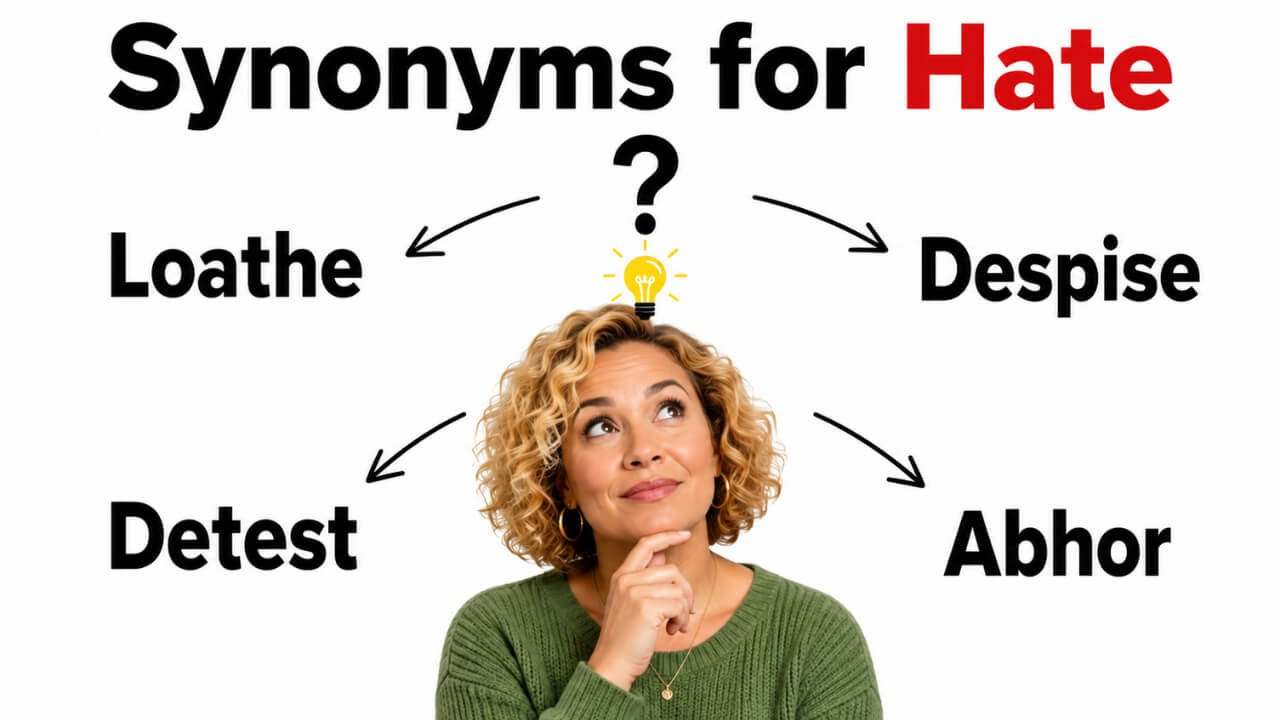
Quick Answer: Synonyms for hate include dislike, detest, loathe, despise, abhor, resent, disdain, scorn, revile, and have no love for. Use dislike for mild negative feeling, detest for strong everyday speech, loathe for intense emotion, despise for contempt, abhor for formal writing, resent for bitterness, and disdain when you mean disrespect or low opinion.
Pronunciation and Word Details
Word: Hate
Pronunciation: /heɪt/
Part of Speech: Verb and noun
Meaning: To feel very strong dislike, anger, disgust, or hostility toward someone or something.
US Pronunciation:
UK Pronunciation:
What Does “Hate” Mean?
Hate means: To feel intense dislike, anger, disgust, or strong opposition toward a person, thing, action, idea, or situation. Hate can work as a verb, as in I hate waiting, or as a noun, as in His words were full of hate.
As a verb: Hate describes a strong negative feeling.
Example: She hates rude behavior.
As a noun: Hate means a powerful feeling of hostility, anger, or dislike.
Example: Hate can damage relationships.
In casual speech: Hate is often used for strong preference, not always deep hostility.
Example: I hate cold coffee.
Meaning, Tone, and Context of “Hate”
Tone: Hate is strong, emotional, and direct. It can sound harsh if used carelessly.
Context: Hate is used in everyday speech, personal writing, arguments, emotional descriptions, opinion writing, and serious discussions about hostility or prejudice.
Formality: Hate is common in both casual and formal contexts, but formal writing may prefer words like oppose, reject, condemn, abhor, or strongly dislike.
Emotional Strength: Hate is stronger than dislike and avoid, but it may be less specific than resent, despise, or abhor.
Careful Use: Because hate is powerful, choose a softer synonym when you want to sound polite, balanced, or professional.
When and How to Use “Hate”
For Strong Dislike: Use hate when you mean a very strong negative feeling.
Example: I hate dishonesty in any form.
For Personal Preference: Use hate casually when something annoys or bothers you.
Example: He hates waking up early.
For Moral Rejection: Use hate when you strongly reject harmful behavior.
Example: They hate cruelty and unfair treatment.
For Emotional Conflict: Use hate when describing anger, bitterness, or deep hurt.
Example: She hated the way he ignored her feelings.
For General Statements: Use hate carefully because it can sound extreme.
Example: I hate when people make promises they do not keep.
Best Synonyms for Hate
Dislike: To not like someone or something.
Example: I dislike loud arguments.
Detest: To hate very strongly.
Example: She detests being lied to.
Loathe: To feel intense dislike or disgust.
Example: He loathes unfair behavior.
Despise: To hate someone or something with contempt.
Example: They despise corruption.
Abhor: To hate something because it feels morally wrong.
Example: Many people abhor cruelty.
Resent: To feel anger or bitterness because of unfair treatment.
Example: He resented being blamed for the mistake.
Disdain: To look down on something with dislike or disrespect.
Example: She disdains arrogance.
Scorn: To show strong dislike mixed with contempt.
Example: He scorned their selfish attitude.
Revile: To criticize or hate strongly, often openly.
Example: The crowd reviled the unfair decision.
Have no love for: To dislike someone or something.
Example: I have no love for unnecessary drama.
50 Synonyms for Hate with Short Meanings
- Dislike: To not like someone or something.
- Detest: To hate strongly.
- Loathe: To hate intensely.
- Despise: To hate with contempt.
- Abhor: To strongly hate or reject morally.
- Resent: To feel bitter anger about something.
- Disdain: To dislike with a sense of superiority.
- Scorn: To reject with contempt.
- Revile: To hate and criticize strongly.
- Execrate: To hate deeply and condemn.
- Abominate: To hate because something feels offensive.
- Deplore: To strongly disapprove of something.
- Condemn: To express strong disapproval.
- Reject: To refuse to accept or support.
- Oppose: To be against something.
- Disapprove of: To think something is wrong.
- Have no love for: To dislike clearly.
- Cannot stand: To strongly dislike or be unable to tolerate.
- Cannot bear: To find something very unpleasant.
- Be sick of: To be tired of something unpleasant.
- Be fed up with: To feel annoyed after too much of something.
- Be disgusted by: To feel strong dislike and revulsion.
- Be repelled by: To feel pushed away by disgust.
- Be appalled by: To feel shocked and strongly displeased.
- Be horrified by: To feel fear, shock, or disgust.
- Be angered by: To feel angry about something.
- Be irritated by: To feel annoyed by something.
- Be annoyed by: To feel bothered or displeased.
- Be offended by: To feel hurt or insulted.
- Be hostile to: To show opposition or anger.
- Be against: To oppose something.
- Disfavor: To not support or approve of something.
- Shun: To avoid someone or something deliberately.
- Avoid: To stay away from something.
- Spurn: To reject with dislike or contempt.
- Renounce: To reject or give up formally.
- Disown: To reject a connection with someone or something.
- Begrudge: To resent giving or allowing something.
- Envy bitterly: To resent someone’s advantage.
- Hold a grudge against: To keep anger toward someone.
- Bear ill will toward: To feel hostile feelings toward someone.
- Feel animosity toward: To feel strong hostility.
- Feel aversion to: To feel strong dislike or avoidance.
- Feel antipathy toward: To feel deep dislike.
- Feel hostility toward: To feel aggressive dislike.
- Feel contempt for: To dislike and look down on.
- Look down on: To view someone with disrespect.
- Turn against: To stop supporting and begin opposing.
- Take exception to: To strongly object to something.
- Strongly dislike: To dislike with clear intensity.
Read Also:
Synonyms For Unfortunately
Synonyms for Hate by Context
When Hate Means Strong Dislike
Use these when: You want to show a clear negative feeling without sounding too extreme.
Synonyms: Dislike, strongly dislike, cannot stand, cannot bear, have no love for.
Example: I strongly dislike unfair rules.
Example: She cannot stand rude comments.
When Hate Means Intense Disgust
Use these when: The feeling includes revulsion, disgust, or strong emotional rejection.
Synonyms: Loathe, detest, abhor, abominate, be disgusted by.
Example: He loathes cruelty to animals.
Example: They abhor dishonest behavior.
When Hate Means Contempt
Use these when: The feeling includes disrespect, judgment, or looking down on someone or something.
Synonyms: Despise, disdain, scorn, feel contempt for, look down on.
Example: She despises arrogance.
Example: He scorned their selfish actions.
When Hate Means Resentment
Use these when: The feeling comes from hurt, unfair treatment, jealousy, or bitterness.
Synonyms: Resent, begrudge, hold a grudge against, bear ill will toward, feel animosity toward.
Example: He resented being ignored.
Example: She held a grudge against him for years.
When Hate Means Opposition
Use these when: The meaning is closer to being against an idea, rule, action, or belief.
Synonyms: Oppose, reject, condemn, disapprove of, take exception to.
Example: They oppose unfair policies.
Example: She condemned the harmful decision.
Another Word for Hate
Best Single Replacement: The best single replacement for hate is often dislike for mild meaning and detest for strong meaning. The best alternative depends on whether you mean personal preference, moral rejection, anger, disgust, resentment, or contempt.
Original: I hate waiting in long lines.
Better Option: I dislike waiting in long lines.
Original: She hates being treated unfairly.
Better Option: She resents being treated unfairly.
Original: They hate corruption.
Better Option: They abhor corruption.
Original: He hates arrogance.
Better Option: He despises arrogance.
When Not to Use “Hate”
Avoid When You Need a Softer Tone: Hate can sound too harsh in polite or professional writing.
Weak: I hate your suggestion.
Better: I disagree with your suggestion.
Avoid When You Mean Mild Dislike: Hate may sound too dramatic for small preferences.
Weak: I hate this color.
Better: I do not prefer this color.
Avoid Repetition: Repeating hate too often makes writing sound emotional and limited.
Weak: I hate noise, I hate delays, and I hate confusion.
Better: I dislike noise, get frustrated by delays, and prefer clear communication.
Avoid When You Mean Moral Disapproval: A more specific word may sound stronger and clearer.
Weak: Many people hate cruelty.
Better: Many people abhor cruelty.
Avoid When You Mean Resentment: Use resent when the feeling comes from hurt or unfair treatment.
Weak: He hates her success.
Better: He resents her success.
Words Commonly Confused With Hate
Hate vs Dislike: Hate is stronger and more emotional. Dislike is milder and more neutral.
Hate vs Detest: Hate is general. Detest means very strong dislike and often sounds intense but natural.
Hate vs Loathe: Hate can be casual or serious. Loathe is stronger and often includes disgust.
Hate vs Despise: Hate means strong dislike. Despise means hate with contempt or disrespect.
Hate vs Resent: Hate is broad. Resent means bitter anger caused by unfairness, hurt, or jealousy.
Hate vs Abhor: Hate can describe personal feelings. Abhor often means moral disgust or deep rejection.
Hate vs Oppose: Hate is emotional. Oppose means to be against something, often without emotional intensity.
Which Synonym Should You Choose?
Choose dislike: When you want a softer and more polite word.
Choose detest: When you want a strong everyday synonym for hate.
Choose loathe: When the feeling is intense and includes disgust.
Choose despise: When the feeling includes contempt or disrespect.
Choose abhor: When writing formally about moral rejection.
Choose resent: When the feeling comes from unfair treatment, hurt, or bitterness.
Choose disdain: When someone looks down on something with dislike.
Choose scorn: When contempt is shown openly.
Choose oppose: When you are against an idea, rule, decision, or action.
Choose condemn: When you want to strongly criticize something as wrong.
Real Life Examples of “Hate” in Sentences
Original: I hate waking up early.
Better Option: I dislike waking up early.
Original: She hates being interrupted.
Better Option: She cannot stand being interrupted.
Original: They hate injustice.
Better Option: They abhor injustice.
Original: He hates people who lie.
Better Option: He despises dishonesty.
Original: I hate this constant noise.
Better Option: I am fed up with this constant noise.
Original: She hates how they treated her.
Better Option: She resents how they treated her.
Original: He hates arrogant behavior.
Better Option: He disdains arrogant behavior.
Original: They hate the new rule.
Better Option: They oppose the new rule.
Original: I hate seeing food wasted.
Better Option: I deplore seeing food wasted.
Original: She hates his rude attitude.
Better Option: She cannot bear his rude attitude.
Synonym Groups and Usage Differences
Mild Dislike Group
Use: This group works when hate sounds too strong or emotional.
Synonyms: Dislike, do not prefer, have no love for, avoid.
Example: I dislike crowded places.
Strong Dislike Group
Use: This group keeps the meaning close to hate but sounds more specific.
Synonyms: Detest, loathe, cannot stand, cannot bear.
Example: She detests being lied to.
Moral Rejection Group
Use: This group is useful for serious issues, values, and ethical judgment.
Synonyms: Abhor, condemn, deplore, reject.
Example: They abhor cruelty in any form.
Contempt Group
Use: This group shows dislike mixed with disrespect or low opinion.
Synonyms: Despise, disdain, scorn, feel contempt for.
Example: He despises selfish behavior.
Resentment Group
Use: This group shows anger caused by unfairness, hurt, or bitterness.
Synonyms: Resent, begrudge, hold a grudge against, bear ill will toward.
Example: She resented being left out of the decision.
Opposition Group
Use: This group works when the meaning is about disagreement rather than emotion.
Synonyms: Oppose, reject, disapprove of, take exception to.
Example: Many residents oppose the new rule.
Antonyms of Hate
Love: To feel deep affection or strong liking.
Like: To find someone or something pleasant.
Admire: To respect and appreciate someone or something.
Appreciate: To value or recognize worth.
Respect: To regard someone or something with honor.
Enjoy: To take pleasure in something.
Favor: To support or prefer something.
Accept: To receive or allow something without strong objection.
Approve: To consider something good or acceptable.
Cherish: To love and value deeply.
Adore: To love or admire greatly.
Embrace: To accept or support willingly.
Comparison: Hate vs Related Words
Hate vs Dislike
Difference: Hate is stronger, more emotional, and often more serious. Dislike is softer and more polite.
Example With Hate: I hate being treated unfairly.
Example With Dislike: I dislike being treated unfairly.
Hate vs Detest
Difference: Hate is a general strong negative feeling. Detest is very strong and often sounds more precise.
Example With Hate: She hates dishonesty.
Example With Detest: She detests dishonesty.
Hate vs Loathe
Difference: Hate can be casual or serious. Loathe suggests intense dislike, often with disgust.
Example With Hate: He hates cleaning the kitchen.
Example With Loathe: He loathes cleaning the kitchen.
Hate vs Despise
Difference: Hate shows strong dislike. Despise adds contempt and a low opinion of someone or something.
Example With Hate: They hate corruption.
Example With Despise: They despise corruption.
Hate vs Resent
Difference: Hate is broad. Resent means anger or bitterness because something feels unfair.
Example With Hate: He hates being corrected.
Example With Resent: He resents being corrected in front of others.
Hate vs Abhor
Difference: Hate can be personal or casual. Abhor is formal and often means strong moral disgust.
Example With Hate: I hate cruelty.
Example With Abhor: I abhor cruelty.
Common Phrases and Expressions With Hate
Hate to Say It: Used before saying something unpleasant.
Hate to Admit It: Used when accepting an uncomfortable truth.
Hate Doing Something: Used for an activity someone strongly dislikes.
Hate Someone’s Guts: A very informal phrase meaning to hate someone intensely.
Love Hate Relationship: A relationship that includes both attraction and strong frustration.
Filled With Hate: Full of anger or hostility.
Hate Speech: Harmful or hostile language toward a person or group.
Hate Crime: A crime motivated by hostility toward identity or group membership.
Hate Mail: Messages written with anger, hostility, or abuse.
I Hate It When: A common phrase used to introduce something annoying or upsetting.
Common Mistakes to Avoid
Using Hate for Every Preference: Hate can sound too strong for small likes and dislikes. Use dislike, do not prefer, or am not fond of when the feeling is mild.
Ignoring Tone: In polite writing, I hate your idea can sound rude. A better option is I disagree with your idea or I have concerns about your idea.
Choosing a Synonym That Is Too Strong: Words like abhor, loathe, and despise are intense. Do not use them for small annoyances unless you want dramatic emphasis.
Confusing Hate and Resentment: Use resent when the feeling comes from unfair treatment, jealousy, or hurt.
Confusing Hate and Opposition: Use oppose when you are against an idea or rule but do not feel personal anger.
Repeating the Same Word: Repeating hate can make writing sound harsh. Mix in more accurate words like dislike, detest, resent, oppose, or condemn.
Using Informal Phrases in Formal Writing: Phrases like cannot stand and be fed up with are natural in speech, but formal writing often needs disapprove of, oppose, or reject.
Conclusion
Synonyms for hate help you choose the right level of intensity for your sentence. Use dislike for mild feelings, detest for strong everyday dislike, loathe for deep disgust, despise for contempt, resent for bitterness, and abhor for formal moral rejection. Since hate is a powerful word, a more specific synonym can make your writing clearer, more polite, and more accurate. The best choice depends on tone, context, and the emotion you want to express.
FAQs About Synonyms for Hate
What is the best synonym for hate?
Answer: The best synonym for hate is detest when you mean strong dislike. Use dislike for a softer meaning.
What is a formal synonym for hate?
Answer: Formal synonyms for hate include abhor, condemn, deplore, and strongly disapprove of.
What is a softer word for hate?
Answer: Softer words for hate include dislike, do not prefer, avoid, and have no love for.
What is a stronger word than hate?
Answer: Stronger words include loathe, despise, abhor, and detest, depending on the context.
Is despise the same as hate?
Answer: Not exactly. Despise means to hate with contempt or disrespect, while hate is a broader word for strong dislike.
What is the difference between hate and resent?
Answer: Hate means strong dislike. Resent means bitter anger caused by unfair treatment, hurt, or jealousy.
What is the opposite of hate?
Answer: The opposite of hate is love. Other antonyms include like, admire, respect, appreciate, and cherish.
