
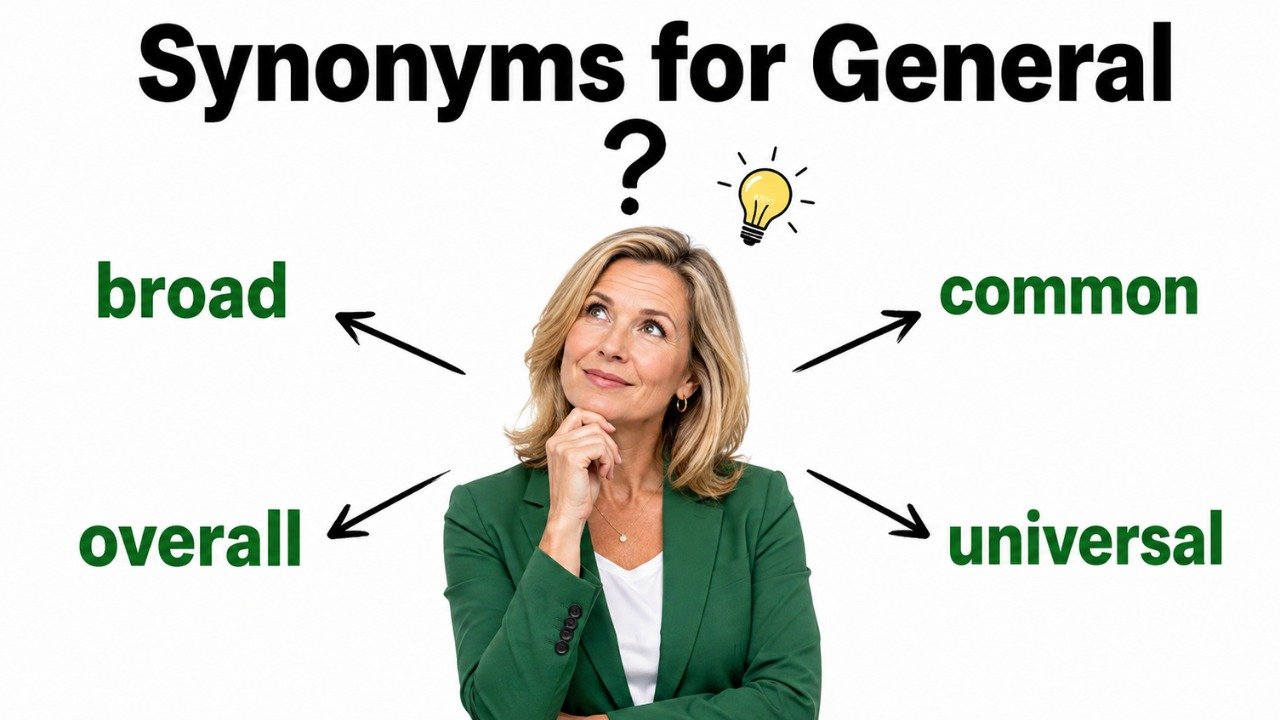
Quick Answer: The best synonyms for general include broad, overall, common, universal, widespread, typical, standard, generic, comprehensive, and nonspecific. Use broad when describing a large scope, overall when summarizing a complete situation, common for something frequently seen, universal for something applying to everyone, generic for something without distinctive qualities, and comprehensive for detailed coverage. The most suitable replacement depends on whether general refers to scope, frequency, public use, approximate information, ordinary qualities, or a military leader.
Pronunciation and Word Details
Word: General.
Pronunciation: /ˈdʒenərəl/.
Part of Speech: Adjective and noun.
Meaning: Broad, common, overall, or not limited to one specific person, subject, or detail.
US Pronunciation:
UK Pronunciation:
What Does “General” Mean?
General means broad, common, or related to a whole subject rather than one specific part.
As an adjective, general can describe information, opinions, rules, knowledge, conditions, or groups that are not limited to a particular detail. For example, a general overview presents the main points without explaining every small fact.
General can also mean common or widespread. A general belief is an opinion held by many people, while general knowledge includes information that an average person may be expected to know.
The word can also describe something that serves many purposes. A general tool, general service, or general guideline is designed for broad use rather than one specialized task.
As a noun, general refers to a high ranking military officer. In this sense, words such as commander or senior officer may work as alternatives.
Meaning, Tone, and Context of “General”
General usually has a neutral and flexible tone. It appears naturally in formal writing, academic explanations, workplace communication, reports, instructions, and everyday conversation.
In formal writing, general often introduces a broad statement before more specific details are provided. A report may begin with a general assessment and then examine individual results.
In conversation, general can describe an approximate opinion, impression, direction, or understanding. Someone may say they have a general idea of a plan even when they do not know every detail.
The word may also sound vague when greater precision is required. Saying that a problem is general may not explain its exact cause. In technical, legal, scientific, or professional contexts, a more precise word may communicate the intended meaning more effectively.
General is not usually emotional. Its meaning depends mainly on context, scope, and the noun it describes.
When and How to Use “General”
For Broad Scope: Use general when referring to an entire subject rather than one narrow part.
Example: The course provides a general introduction to modern literature.
For an Overall View: Use general when presenting the main impression without discussing every detail.
Example: My general impression of the proposal was positive.
For Common Conditions: Use general when something affects or applies to many people.
Example: There was general concern about the lack of preparation.
For Public Use: Use general when referring to ordinary members of a community rather than a specialized group.
Example: The information was written for the general public.
For Approximate Information: Use general when the details are not exact but still provide useful guidance.
Example: She gave us a general idea of the project timeline.
For Main Principles: Use general when discussing a broad rule that may have exceptions.
Example: As a general rule, important documents should be reviewed carefully.
For Nonspecialized Purposes: Use general when something is designed for several uses rather than one technical purpose.
Example: This guide offers general advice for new writers.
For Military Rank: Use general as a noun for a senior military officer.
Example: The general addressed the officers before the operation.
Best Synonyms for General
Broad: Covering a large area, range, or subject.
Example: The discussion gave students a broad understanding of the issue.
Overall: Considering everything together rather than individual parts.
Example: The overall performance of the team improved.
Common: Frequently found, experienced, or shared.
Example: This is a common mistake among new learners.
Universal: Applying to every person, place, or situation in a group.
Example: Respect is a universal human need.
Widespread: Existing or happening in many places or among many people.
Example: The policy received widespread support.
Typical: Showing the usual qualities of a person, group, or situation.
Example: This is a typical example of informal writing.
Standard: Commonly accepted, used, or expected.
Example: The document follows the standard format.
Generic: Lacking distinctive, specific, or unique qualities.
Example: The advertisement used a generic message.
Comprehensive: Covering nearly every important part of a subject.
Example: The report provides a comprehensive review of the results.
Nonspecific: Not referring to one exact person, detail, cause, or subject.
Example: His answer was too nonspecific to be useful.
50 Synonyms for General with Short Meanings
- Broad: Covering a wide range or large scope.
- Overall: Considering all parts together.
- Common: Frequently found or shared.
- Universal: Applying to everyone or everything concerned.
- Widespread: Existing across many places or groups.
- Typical: Showing usual or expected qualities.
- Standard: Commonly accepted or regularly used.
- Usual: Happening or appearing in the normal way.
- Ordinary: Not unusual, special, or distinctive.
- Generic: Without specific or unique characteristics.
- Nonspecific: Not clearly limited to one detail.
- Comprehensive: Covering all major parts thoroughly.
- Inclusive: Including many people, ideas, or categories.
- Extensive: Covering a large area, amount, or range.
- Global: Relating to the whole world or complete system.
- Collective: Shared by or involving a group.
- Public: Intended for or involving ordinary people.
- Shared: Held, experienced, or used by several people.
- Prevailing: Most common or influential at a particular time.
- Frequent: Happening regularly or many times.
- Regular: Normal, repeated, or commonly occurring.
- Customary: Commonly practiced or traditionally expected.
- Conventional: Following accepted customs or methods.
- Normal: Usual according to common expectations.
- Average: Typical rather than exceptional.
- Main: Most important or central.
- Principal: First in importance or influence.
- Chief: Most important among several possibilities.
- Central: Forming the main part of a subject.
- Primary: Most important or considered first.
- Whole: Including every part of something.
- Total: Relating to the complete amount or result.
- Complete: Containing all necessary parts.
- Blanket: Applying broadly without many exceptions.
- Sweeping: Affecting a wide area or many situations.
- Rough: Approximate rather than exact.
- Approximate: Close to the correct amount or idea.
- Summary: Presenting only the main points.
- Introductory: Providing basic information about a subject.
- Basic: Relating to the simplest or most important elements.
- Wide ranging: Covering many subjects, areas, or ideas.
- All purpose: Suitable for several different uses.
- Across the board: Applying to every part of a group or system.
- Indefinite: Not clearly fixed, limited, or defined.
- Vague: Lacking clear or specific detail.
- Generalized: Formed as a broad statement from several examples.
- Commander: A person who directs military forces.
- Officer: A person holding an official military rank.
- Leader: A person who guides or commands others.
- Strategist: A person skilled in planning actions or operations.
Read Also:
Synonyms for Clumsy
Synonyms for General by Context
When General Means Broad or Overall
Broad, overall, comprehensive, extensive, wide ranging, global, whole, and inclusive work when general refers to a large scope.
Broad emphasizes range. Overall emphasizes the complete impression. Comprehensive suggests detailed coverage of nearly every important part.
Example: The speaker provided a broad explanation of the economic changes.
Example: The overall response to the new schedule was positive.
Example: The guide offers a comprehensive introduction to grammar.
When General Means Common or Typical
Common, typical, usual, ordinary, standard, normal, customary, and conventional are useful when general refers to something regularly seen or expected.
Common emphasizes frequency. Typical describes expected characteristics. Standard refers to an accepted method, form, or level.
Example: Fatigue is a common result of insufficient rest.
Example: This sentence follows a typical conversational pattern.
Example: Please use the standard application format.
When General Means Nonspecific
Nonspecific, generic, vague, indefinite, rough, approximate, summary, and introductory can replace general when exact details are missing.
Nonspecific is neutral and direct. Generic may suggest that something lacks originality or distinction. Vague often carries a negative meaning because the information is not clear enough.
Example: The instructions were nonspecific and required clarification.
Example: She gave an approximate estimate of the total cost.
Example: The first page contains a summary explanation of the process.
When General Means Public or Shared
Public, collective, shared, universal, widespread, and prevailing work when general refers to a large group of people.
Public refers to ordinary members of society. Collective describes something experienced or decided by a group. Universal means that something applies to everyone within the stated context.
Example: The announcement was intended for the public.
Example: The decision reflected the collective opinion of the members.
Example: The proposal received widespread approval.
When General Means Main or Principal
Main, principal, chief, central, and primary are suitable when general refers to the most important person, idea, purpose, or concern.
Example: The main objective is to improve communication.
Example: Cost remains the principal concern.
Example: Safety is the primary consideration.
When General Refers to Military Leadership
Commander, senior officer, leader, and strategist may replace general when the word is used as a noun.
Commander is the closest broad replacement when emphasizing authority. Senior officer is more descriptive, while strategist emphasizes planning ability.
Example: The commander reviewed the operation with the officers.
Example: The senior officer approved the final plan.
Another Word for General
Broad is often the best single replacement for general when the word describes a large scope or an overview. However, the best alternative depends on the intended meaning.
Use overall for a complete impression, common for something frequently experienced, generic for something lacking distinctive details, and comprehensive for information that covers a subject thoroughly.
Original: The book provides a general introduction to psychology.
Better Option: The book provides a broad introduction to psychology.
Original: The general quality of the work was impressive.
Better Option: The overall quality of the work was impressive.
Original: This is a general problem among beginners.
Better Option: This is a common problem among beginners.
Original: The website contains general information about the program.
Better Option: The website contains comprehensive information about the program.
When Not to Use “General”
General should not be used when the reader needs exact measurements, names, dates, causes, procedures, or technical details. A more specific word will usually make the sentence clearer.
Weak: The machine has a general problem.
Better: The machine has an electrical fault in its control panel.
Avoid general when it makes an instruction too vague to follow.
Weak: Make some general improvements to the report.
Better: Improve the introduction, correct the figures, and shorten the conclusion.
Do not use general when you mean generic. General means broad or common, while generic often means ordinary and lacking distinctive qualities.
Weak: The design looks general.
Better: The design looks generic and lacks a distinctive identity.
Avoid general when making assumptions about every member of a group. A broad statement may ignore important differences.
Weak: The general customer dislikes detailed information.
Better: Some customers prefer shorter explanations.
Do not repeat general several times in one paragraph when more precise alternatives are available.
Weak: The general report gives a general view of the general situation.
Better: The summary report gives an overall view of the situation.
Words Commonly Confused With General
General vs Generic: General means broad, common, or not limited to a specific detail. Generic means lacking distinctive qualities or belonging to a broad category without a particular identity.
General vs Overall: General may describe broad information or common conditions. Overall refers to the complete result or impression after considering all parts.
General vs Common: General can mean broad or widespread. Common specifically means frequently found, experienced, or shared.
General vs Broad: General has several meanings, including common, overall, and nonspecific. Broad mainly emphasizes width, range, or scope.
General vs Universal: General may apply to most people or situations. Universal means applying to everyone or everything within the stated group.
General vs Comprehensive: General information may contain only the main ideas. Comprehensive information covers nearly all important details.
General vs Vague: General information can still be clear and useful. Vague information lacks enough clarity or detail to be understood properly.
General vs Specific: General refers to a broad subject or group. Specific identifies one exact person, detail, example, or condition.
Which Synonym Should You Choose?
Choose broad when discussing a large subject, range, audience, or area.
Choose overall when summarizing the complete quality, impression, result, or condition.
Choose common when something happens frequently or is shared by many people.
Choose typical when describing the expected qualities of a person, group, object, or situation.
Choose standard when referring to an accepted method, format, procedure, or level.
Choose universal when an idea, rule, or need applies to everyone in the stated context.
Choose widespread when something exists in many places or among many people.
Choose generic when something lacks a distinctive identity, style, or feature.
Choose nonspecific when a statement does not identify exact details.
Choose approximate when discussing a rough number, time, amount, or estimate.
Choose comprehensive for formal reports, essays, reviews, and guides that cover nearly every important part.
Choose public when referring to ordinary members of society rather than specialists or officials.
Choose collective when describing a shared group decision, feeling, opinion, or responsibility.
Choose main, principal, or primary when referring to the most important idea or concern.
Choose commander or senior officer when general is used as a military title.
Real Life Examples of “General” in Sentences
Original: The teacher gave a general explanation of the topic.
Better Option: The teacher gave a broad explanation of the topic.
Original: The general response to the event was positive.
Better Option: The overall response to the event was positive.
Original: Headaches are a general complaint during periods of stress.
Better Option: Headaches are a common complaint during periods of stress.
Original: The guide contains general information for visitors.
Better Option: The guide contains basic information for visitors.
Original: We discussed the general direction of the project.
Better Option: We discussed the main direction of the project.
Original: She gave a general estimate of the cost.
Better Option: She gave an approximate estimate of the cost.
Original: The rule applies to the general population.
Better Option: The rule applies to the wider population.
Original: His answer was too general to solve the problem.
Better Option: His answer was too nonspecific to solve the problem.
Original: The article presents a general review of the research.
Better Option: The article presents a comprehensive review of the research.
Original: There was general agreement among the participants.
Better Option: There was widespread agreement among the participants.
Synonym Groups and Usage Differences
Scope Group
Broad, extensive, wide ranging, comprehensive, inclusive, and global describe the size or coverage of a subject.
Broad is the most flexible choice. Extensive emphasizes a large amount. Comprehensive suggests that nearly all important parts are included.
Example: The course offers a broad overview of world history.
Overall Meaning Group
Overall, whole, total, complete, summary, and collective relate to a complete view or combined result.
Overall is especially useful for impressions, performance, quality, and results. Summary is better when only the main points are included.
Example: The overall outcome was better than expected.
Frequency Group
Common, widespread, frequent, prevailing, regular, and usual describe something that happens often or exists among many people.
Common is the most natural everyday choice. Widespread emphasizes geographic or social reach. Prevailing describes the most influential opinion or condition.
Example: Remote communication has become widespread.
Normality Group
Typical, standard, ordinary, normal, customary, conventional, and average describe expected qualities or accepted practices.
Typical describes a representative example. Standard refers to an accepted form. Customary relates to established practice or tradition.
Example: The request followed the standard procedure.
Precision Group
Nonspecific, generic, vague, indefinite, rough, and approximate describe information that is not fully exact.
Nonspecific is usually neutral. Vague suggests poor clarity. Approximate is appropriate for numbers, measurements, times, and estimates.
Example: We received an approximate delivery time.
Importance Group
Main, principal, chief, central, and primary identify the most important part of something.
Main is natural in most situations. Principal is more formal. Primary often refers to the first or highest priority.
Example: The primary purpose of the meeting is to approve the plan.
Public Group
Public, shared, collective, universal, and inclusive relate to people or groups.
Public refers to the community. Shared means held by more than one person. Collective emphasizes the group as a whole.
Example: The statement expressed a shared concern.
Leadership Group
Commander, officer, leader, and strategist relate to general when it is used as a military noun.
Commander emphasizes authority. Officer emphasizes rank. Strategist emphasizes planning and judgment.
Example: The commander presented the final strategy.
Antonyms of General
The opposite of general depends on whether the word means broad, common, public, approximate, or high ranking.
Specific: Clearly limited to one exact detail, person, or subject.
Particular: Referring to one individual example or case.
Precise: Clearly and exactly expressed.
Detailed: Containing many exact facts or features.
Narrow: Limited in range, scope, or purpose.
Specialized: Designed for one particular field or function.
Individual: Relating to one person or item rather than a group.
Private: Restricted to selected people rather than the public.
Rare: Uncommon or infrequently found.
Unusual: Different from what is normally expected.
Distinctive: Having qualities that make something clearly recognizable.
Definite: Clearly fixed, known, or decided.
Exact: Completely correct in detail or measurement.
Limited: Restricted in amount, range, or availability.
Subordinate: Lower in authority or rank.
Comparison: General vs Related Words
General vs Broad
General can mean broad, common, overall, or nonspecific. Broad mainly describes a large range, scope, or area.
Example With General: The guide gives general advice about writing.
Example With Broad: The course covers a broad range of writing styles.
General vs Overall
General may describe information that is not detailed. Overall describes a complete impression or result after considering all parts.
Example With General: I have a general understanding of the process.
Example With Overall: My overall impression of the process is positive.
General vs Common
General may refer to a whole group or broad condition. Common means frequently found or experienced.
Example With General: There was general concern about the delay.
Example With Common: Delays are common during busy periods.
General vs Generic
General means broad or nonspecific. Generic often suggests that something lacks originality, distinction, or a named identity.
Example With General: The document provides general information.
Example With Generic: The message sounds generic and impersonal.
General vs Universal
General may apply to many people or situations. Universal applies to everyone or everything within the relevant group.
Example With General: The general opinion was supportive.
Example With Universal: The need for safety is universal.
General vs Comprehensive
General information explains the main ideas. Comprehensive information covers nearly all important details.
Example With General: The article gives a general overview of the subject.
Example With Comprehensive: The book provides a comprehensive analysis of the subject.
General vs Specific
General refers to a broad subject, group, or idea. Specific identifies an exact detail, example, person, or requirement.
Example With General: The manager offered general guidance.
Example With Specific: The manager provided specific instructions for each task.
Common Phrases and Expressions With “General”
In General: Usually or when considering most situations.
General Idea: A basic understanding without every detail.
General Public: Ordinary members of society.
General Rule: A broad principle that usually applies.
General Knowledge: Information about many common subjects.
General Opinion: A view shared by many people.
General Overview: A summary of the main points.
General Direction: The broad path or purpose of a plan.
General Purpose: Suitable for several different uses.
General Agreement: Widespread acceptance of an idea or decision.
General Terms: Broad language without detailed conditions.
General Impression: An overall feeling or judgment.
Common Mistakes to Avoid
Using General Instead of Generic: Do not use general merely to describe something dull or unoriginal. Generic is usually the better word when something lacks distinctive qualities.
Being Too Vague: General can weaken a sentence when readers need clear information. Replace it with exact details whenever accuracy is important.
Repeating the Word: Using general several times in one paragraph can make the writing sound flat. Use broad, overall, common, public, or approximate when those words express the intended meaning more clearly.
Choosing an Overly Strong Synonym: Universal means that something applies to everyone. Do not use it when a belief or condition only affects many people.
Confusing Scope and Frequency: Broad describes range, while common describes frequency. A broad issue affects many areas, but a common issue occurs often.
Using Comprehensive Incorrectly: Comprehensive means detailed and complete. It is not suitable when the information only covers the main points.
Making Unsupported Generalizations: Avoid presenting a broad assumption as a fact about every member of a group. Use words such as many, often, some, or typically when exceptions exist.
Ignoring the Noun Meaning: General can refer to a military officer. In this context, broad or common cannot replace it. Use commander, senior officer, or leader instead.
Conclusion
Understanding synonyms for general helps you choose clearer and more accurate words for every context. Use broad for a wide scope, overall for a complete impression, common for frequent situations, and standard for accepted practices. Generic suits something without distinctive qualities, while comprehensive describes detailed coverage. Nonspecific and approximate are useful when information is not exact. When general refers to a military leader, commander or senior officer may be appropriate. The strongest choice always depends on the exact meaning you want to communicate.
FAQs About Synonyms for General
What Is the Best Synonym for General?
Broad is often the best synonym when general refers to a large scope. Overall, common, standard, or nonspecific may be better in other contexts.
Does General Mean Common?
General can mean common when describing a widespread opinion, condition, or experience. However, it can also mean broad, overall, or nonspecific.
What Is a Formal Synonym for General?
Overall, comprehensive, widespread, prevailing, and collective are useful formal alternatives. The correct word depends on the sentence.
What Is the Difference Between General and Generic?
General means broad, common, or not specific. Generic usually means lacking distinctive features, identity, or originality.
Can Broad Always Replace General?
No. Broad works for scope, range, and coverage, but it cannot replace general when the word means common, approximate, public, or a military officer.
What Is Another Word for General Knowledge?
Broad knowledge, common knowledge, basic knowledge, and wide ranging knowledge are possible alternatives, depending on the intended meaning.
What Is the Opposite of General?
Specific is the most common opposite. Other antonyms include particular, precise, detailed, narrow, specialized, private, and individual.
