
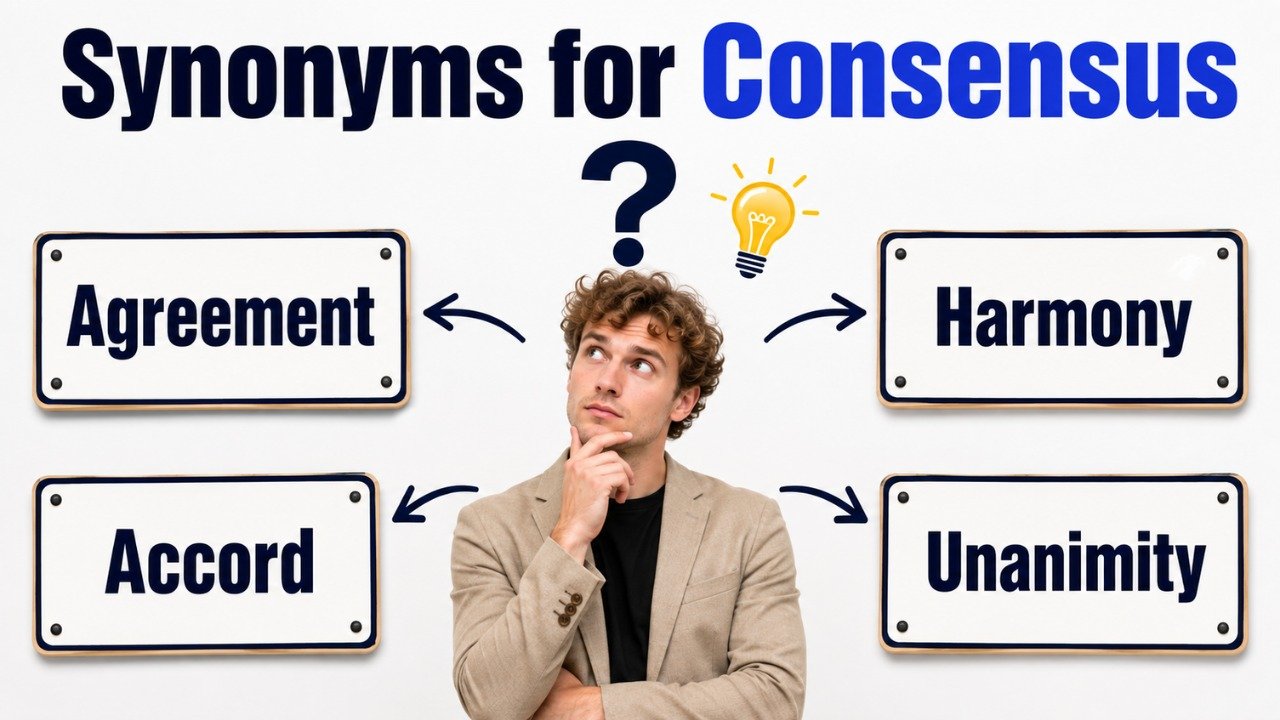
Quick Answer: The best synonyms for consensus include agreement, accord, unanimity, concurrence, common ground, shared understanding, collective agreement, unity, alignment, and meeting of minds. Agreement is the most flexible choice for everyday and formal writing. Accord suits diplomatic or official contexts, while unanimity means complete agreement without opposition. Common ground is useful when people share only certain beliefs. Shared understanding emphasizes mutual knowledge, and alignment works well when goals or opinions support one another. The best choice among synonyms for consensus depends on whether you mean general agreement, complete agreement, cooperation, approval, or a collective decision.
Pronunciation and Word Details
Word: Consensus.
Pronunciation: /kənˈsɛnsəs/
Part of Speech: Noun.
Meaning: A general agreement reached by the members of a group.
US Pronunciation:
UK Pronunciation:
What Does “Consensus” Mean?
Consensus means a general agreement among the members of a group. It is a noun commonly used when several people discuss an issue and arrive at a shared opinion, conclusion, or decision.
A consensus does not always mean that every person agrees completely. It usually means that most members support the decision and that serious objections have been resolved or accepted.
The word often appears in discussions about teamwork, research, public policy, education, planning, leadership, and community decisions.
Group Opinion: The committee reached a consensus about the new schedule.
Shared Decision: After several discussions, the residents formed a consensus on the proposed changes.
General Belief: There is a growing consensus that early preparation improves results.
Collective Support: The plan cannot proceed until there is sufficient consensus among the participants.
Consensus can describe an agreement, the process of reaching agreement, or a commonly accepted view.
Meaning, Tone, and Context of “Consensus”
Consensus has a neutral to formal tone. It is more common in professional, academic, political, organizational, and technical writing than in very casual conversation.
The word often suggests cooperation, discussion, and collective participation. It normally has a positive tone because it shows that people have found a position they can support together.
Formal Context: Consensus is frequently used in reports, meetings, policies, research papers, and official decisions.
Professional Context: Teams may seek consensus before choosing a strategy, assigning responsibilities, or approving a plan.
Academic Context: Researchers may describe a consensus when experts generally accept a theory or conclusion.
Community Context: Residents, families, or local groups may work toward consensus on shared concerns.
Political Context: Representatives may attempt to create consensus around a law, policy, or public issue.
Conversational Context: In everyday speech, people usually say agreement instead of consensus.
Consensus is not usually emotional. It emphasizes the final shared position rather than the feelings involved in reaching it.
When and How to Use “Consensus”
Use consensus when several people or groups reach a generally accepted decision or opinion.
For Group Agreement
Explanation: Use consensus when members of a group support the same general position.
Example: The team reached a consensus about the project deadline.
For Collective Decisions
Explanation: Use consensus when a decision results from discussion and shared participation.
Example: The council made its final choice through consensus.
For Expert Opinion
Explanation: Use consensus when most specialists accept the same explanation or conclusion.
Example: The scientific consensus supports the need for further investigation.
For Shared Goals
Explanation: Use consensus when people agree about priorities, objectives, or future plans.
Example: There was a clear consensus that customer safety should remain the main priority.
For Conflict Resolution
Explanation: Use consensus when opposing sides find a position they can all accept.
Example: Several meetings were required before the two groups achieved consensus.
For Public Opinion
Explanation: Use consensus when a large part of a community supports a particular view.
Example: A broad consensus developed around the proposed education reforms.
For Planning
Explanation: Use consensus when participants agree on what should happen next.
Example: The organizers reached consensus on the date and location of the event.
For Policy Discussions
Explanation: Use consensus when decision makers attempt to create broad support for a rule or policy.
Example: The proposal was delayed because there was no consensus among the representatives.
Best Synonyms for Consensus
Agreement
Agreement: A shared opinion, decision, or understanding between people.
Example: The committee finally reached an agreement on the new rules.
Accord
Accord: A formal or peaceful agreement between people, groups, or nations.
Example: The two sides signed an accord after months of negotiation.
Unanimity
Unanimity: Complete agreement among every member of a group.
Example: The proposal received the committee’s unanimous support and was approved with unanimity.
Concurrence
Concurrence: Agreement with an opinion, decision, or judgment.
Example: The plan was adopted with the concurrence of all department leaders.
Common Ground
Common Ground: Shared beliefs, interests, or opinions that allow people to cooperate.
Example: Although they disagreed on several details, they found common ground on safety.
Shared Understanding
Shared Understanding: A mutual awareness of facts, expectations, or meaning.
Example: The discussion created a shared understanding of everyone’s responsibilities.
Collective Agreement
Collective Agreement: An agreement supported or accepted by a group as a whole.
Example: The schedule represented the collective agreement of the entire team.
Unity
Unity: A state in which people are joined by a common purpose or belief.
Example: The decision brought greater unity to the organization.
Alignment
Alignment: A condition in which opinions, plans, or goals support one another.
Example: The meeting helped create alignment between the two departments.
Meeting of Minds
Meeting of Minds: A shared understanding or agreement between different people.
Example: After a long discussion, the negotiators finally reached a meeting of minds.
50 Synonyms for Consensus With Short Meanings
- Agreement: A shared opinion or accepted decision.
- Accord: A formal or peaceful agreement.
- Unanimity: Complete agreement among everyone involved.
- Concurrence: Agreement with an opinion or decision.
- Consent: Permission or willing acceptance.
- Assent: Formal approval or agreement.
- Approval: Acceptance of a plan, idea, or action.
- Acceptance: Willing recognition or support of something.
- Harmony: Peaceful agreement between people or ideas.
- Concord: Agreement and peaceful relations.
- Unity: Shared purpose, belief, or direction.
- Alignment: Agreement between goals, views, or plans.
- Solidarity: Unity based on shared interests or responsibilities.
- Common Ground: Shared beliefs or interests between different sides.
- Shared Understanding: Mutual knowledge of facts or expectations.
- Mutual Understanding: Agreement based on recognizing each other’s views.
- Meeting of Minds: A clear agreement between different people.
- Collective Agreement: An agreement supported by a whole group.
- General Agreement: Acceptance by most people involved.
- Common Agreement: An opinion or decision widely shared.
- Common Consent: Approval given by the members of a group.
- Mutual Consent: Willing agreement by all participating sides.
- Collective Consent: Approval expressed by a group.
- Group Agreement: A decision accepted by group members.
- Broad Agreement: Support shared across many people or groups.
- Broad Support: Widespread approval of an idea or decision.
- Common Opinion: A view held by many people.
- Shared Opinion: A belief held by more than one person.
- Collective Opinion: The combined view of a group.
- Common View: A belief generally held by a group.
- Shared View: An opinion accepted by several people.
- Prevailing View: The opinion most widely accepted.
- Majority View: The opinion supported by most members.
- Unified Position: One position presented by an entire group.
- Agreed Position: A viewpoint accepted after discussion.
- Collective Decision: A choice made or supported by a group.
- Joint Decision: A choice made together by two or more parties.
- Joint Conclusion: A conclusion reached by several people together.
- Common Understanding: A generally shared interpretation or expectation.
- Unity of Opinion: Agreement in beliefs or judgments.
- Concurrence of Views: Agreement between different opinions.
- Concurrence of Opinion: Shared acceptance of a particular judgment.
- Endorsement: Public or official expression of support.
- Ratification: Formal confirmation or approval of an agreement.
- Resolution: An agreed solution to a question or dispute.
- Compromise: An agreement reached through mutual concessions.
- Settlement: A final agreement that resolves a disagreement.
- Accommodation: An arrangement that recognizes different needs.
- Reconciliation: The restoration of agreement after conflict.
- Common Cause: A shared purpose that unites different people.
Read Also:
Synonyms for Accomplishment

Synonyms for Consensus by Context
When Consensus Means General Agreement
Agreement is the clearest replacement when most people accept a shared decision or opinion.
Useful alternatives include general agreement, broad agreement, common agreement, common opinion, and shared view.
Example With Consensus: There was a consensus that the meeting should begin earlier.
Example With Agreement: There was general agreement that the meeting should begin earlier.
Example With Broad Support: The proposal received broad support from the committee.
When Consensus Means Complete Agreement
Unanimity is the strongest synonym when every member agrees without exception.
Other useful alternatives include unity of opinion, complete agreement, common consent, and collective consent.
Example With Consensus: The judges reached a consensus on the winner.
Example With Unanimity: The judges selected the winner with complete unanimity.
Consensus and unanimity are not always interchangeable. Consensus may allow minor objections, while unanimity requires agreement from everyone.
When Consensus Means Shared Understanding
Shared understanding is best when people agree about facts, expectations, responsibilities, or meaning.
Other alternatives include mutual understanding, common understanding, meeting of minds, and alignment.
Example With Consensus: The training created consensus about the new procedure.
Example With Shared Understanding: The training created a shared understanding of the new procedure.
Example With Alignment: The discussion brought the managers into alignment on their responsibilities.
When Consensus Means Collective Decision
Collective decision is useful when the focus is on a choice made by the whole group.
Other alternatives include joint decision, agreed position, unified position, and collective agreement.
Example With Consensus: The final policy reflected the consensus of the committee.
Example With Collective Decision: The final policy reflected the committee’s collective decision.
When Consensus Means Formal Approval
Assent, approval, endorsement, consent, and ratification are suitable when people formally accept a proposal or decision.
Example With Consensus: The plan moved forward after gaining consensus from the board.
Example With Approval: The plan moved forward after receiving the board’s approval.
Example With Endorsement: The plan gained the endorsement of several community leaders.
When Consensus Means Peaceful Cooperation
Accord, harmony, concord, unity, and solidarity emphasize peaceful relationships or cooperation.
Example With Consensus: The talks produced consensus between the two groups.
Example With Accord: The talks produced an accord between the two groups.
Example With Harmony: The new arrangement restored harmony within the community.
When Consensus Results From Compromise
Compromise, settlement, accommodation, resolution, and reconciliation describe agreements that resolve disagreement.
Example With Consensus: The parties achieved consensus after several negotiations.
Example With Compromise: The parties reached a compromise after several negotiations.
Example With Settlement: The dispute ended when both sides accepted a settlement.
Another Word for Consensus
The best single replacement for consensus is agreement. It is natural, clear, and suitable for both formal and everyday contexts.
However, the best alternative depends on the intended meaning. Use unanimity for complete agreement, accord for a formal agreement, common ground for shared beliefs, and alignment for compatible goals or plans.
Original: The team reached a consensus about the launch date.
Better Option: The team reached an agreement about the launch date.
Original: The representatives are trying to build consensus.
Better Option: The representatives are trying to find common ground.
Original: The experts reached a complete consensus.
Better Option: The experts reached unanimity.
Original: The discussion created consensus between the departments.
Better Option: The discussion brought the departments into alignment.
When Not to Use “Consensus”
Consensus is useful when describing group agreement, but it is not always the clearest or most accurate word.
When Only Two People Agree
Agreement often sounds more natural when only two individuals are involved.
Weak: The two friends reached a consensus about where to eat.
Better: The two friends reached an agreement about where to eat.
When Everyone Agrees Completely
Use unanimity when there is no opposition at all.
Weak: The vote showed a complete consensus among all members.
Better: The vote showed complete unanimity among all members.
When Permission Is the Main Meaning
Use consent when someone gives permission.
Weak: The doctor requested the patient’s consensus before the procedure.
Better: The doctor requested the patient’s consent before the procedure.
When an Official Decision Is Approved
Use approval, assent, endorsement, or ratification when formal authorization is more important than group discussion.
Weak: The policy received consensus from the director.
Better: The policy received approval from the director.
When a Dispute Ends Through Concessions
Use compromise or settlement when opposing sides give up part of what they want.
Weak: The two sides reached consensus by accepting reduced demands.
Better: The two sides reached a compromise by accepting reduced demands.
In Very Casual Conversation
Agreement usually sounds more natural than consensus in ordinary speech.
Weak: We had a consensus to watch the same film.
Better: We agreed to watch the same film.
When the Shared Opinion Is Only a Majority View
Do not use consensus when a group remains sharply divided.
Weak: The narrow vote created a consensus.
Better: The narrow vote reflected the majority view.
Words Commonly Confused With Consensus
Consensus vs Agreement: Agreement is a broad term for any shared opinion or arrangement. Consensus usually refers to general agreement within a group after discussion.
Consensus vs Unanimity: Consensus means broad or general agreement. Unanimity means that every person agrees without exception.
Consensus vs Consent: Consensus is a shared group opinion. Consent is permission or willing acceptance given by a person or group.
Consensus vs Compromise: Consensus is the resulting shared position. Compromise is an agreement reached when each side gives up something.
Consensus vs Majority: Consensus seeks broad support across a group. A majority requires support from more than half, even when many members strongly disagree.
Consensus vs Accord: Consensus often develops through group discussion. Accord is commonly used for a formal agreement between parties.
Consensus vs Harmony: Consensus concerns agreement about a decision or opinion. Harmony describes peaceful and cooperative relationships.
Consensus vs Approval: Consensus involves collective agreement. Approval may come from a single person with authority.
Consensus vs Alignment: Consensus means people accept the same general position. Alignment means their goals, plans, or interests are compatible.
Consensus vs Common Ground: Consensus is the final shared agreement. Common ground is the area of agreement that helps people begin cooperating.
Which Synonym Should You Choose?
Choose agreement for the clearest and most flexible replacement in everyday or formal writing.
Choose accord for formal agreements between organizations, groups, representatives, or nations.
Choose unanimity when every member agrees without opposition.
Choose concurrence when someone formally agrees with an opinion, judgment, or decision.
Choose common ground when people disagree overall but share certain beliefs or interests.
Choose shared understanding when people agree about responsibilities, facts, expectations, or meaning.
Choose alignment when goals, strategies, priorities, or plans support one another.
Choose unity when agreement creates a sense of togetherness or common purpose.
Choose consent when the intended meaning is permission.
Choose approval when a proposal requires authorization from a leader or responsible group.
Choose compromise when each side makes concessions to settle a disagreement.
Choose settlement when an agreement formally ends a dispute.
Choose collective decision when a choice was made through group participation.
Choose majority view when most people agree but significant disagreement remains.
Choose prevailing view when describing the most widely accepted belief in a field or community.
Real Life Examples of “Consensus” in Sentences
Original: The committee reached a consensus on the new hiring process.
Better Option: The committee reached an agreement on the new hiring process.
Original: The teachers formed a consensus about the revised timetable.
Better Option: The teachers developed a shared view of the revised timetable.
Original: The researchers reached a consensus after reviewing the evidence.
Better Option: The researchers reached a common conclusion after reviewing the evidence.
Original: The family could not reach a consensus about the holiday destination.
Better Option: The family could not agree on the holiday destination.
Original: The meeting helped build consensus between the two departments.
Better Option: The meeting helped create alignment between the two departments.
Original: There is a broad consensus that the old system needs improvement.
Better Option: There is broad agreement that the old system needs improvement.
Original: The negotiations ended when both sides reached consensus.
Better Option: The negotiations ended when both sides reached a settlement.
Original: The members reached a complete consensus on the proposal.
Better Option: The members reached unanimity on the proposal.
Original: The leaders are attempting to create consensus around the new policy.
Better Option: The leaders are attempting to build broad support for the new policy.
Original: The discussion produced consensus on the main priorities.
Better Option: The discussion produced a collective agreement on the main priorities.
Synonym Groups and Usage Differences
General Agreement Group
This group includes agreement, general agreement, broad agreement, common agreement, and group agreement.
These words describe a position accepted by most or all members of a group. Agreement is the most versatile option.
Example: The participants reached broad agreement on the main objectives.
Complete Agreement Group
This group includes unanimity, unity of opinion, common consent, and collective consent.
These alternatives are stronger than consensus because they suggest that everyone agrees.
Example: The final decision was supported with complete unanimity.
Shared Understanding Group
This group includes shared understanding, mutual understanding, common understanding, and meeting of minds.
Use these expressions when agreement concerns expectations, meaning, responsibilities, or knowledge.
Example: The conversation produced a mutual understanding of the project requirements.
Formal Agreement Group
This group includes accord, concurrence, assent, ratification, endorsement, and approval.
These words suit official, professional, diplomatic, legal, or administrative contexts.
Example: The proposal received formal approval from the committee.
Cooperation Group
This group includes harmony, concord, unity, solidarity, alignment, and common cause.
These words emphasize cooperation, compatible interests, or shared purpose rather than a single decision.
Example: The crisis created a sense of solidarity among the residents.
Opinion Group
This group includes common opinion, shared opinion, collective opinion, common view, prevailing view, and majority view.
Use these alternatives when discussing beliefs rather than official decisions.
Example: The prevailing view is that the policy should be reviewed annually.
Decision Group
This group includes collective decision, joint decision, agreed position, unified position, and joint conclusion.
These expressions focus on the outcome of group discussion.
Example: The final schedule was a collective decision.
Conflict Resolution Group
This group includes compromise, settlement, accommodation, reconciliation, and resolution.
These words describe agreements that reduce or end disagreement.
Example: Both parties accepted a compromise that addressed their main concerns.
Antonyms of Consensus
The opposite of consensus depends on whether the intended meaning is agreement, unity, cooperation, or shared opinion.
Disagreement: A lack of shared opinion.
Dissent: Open expression of a different opinion.
Discord: Serious disagreement or lack of harmony.
Conflict: Active opposition between people, groups, or ideas.
Division: Separation caused by opposing views.
Disunity: A lack of shared purpose or agreement.
Opposition: Resistance to an idea, plan, or decision.
Dispute: An argument about facts, rights, or decisions.
Controversy: Widespread public disagreement.
Deadlock: A situation in which no decision can be reached.
Dissension: Strong disagreement within a group.
Polarization: Division into strongly opposing sides.
Objection: A stated reason for disagreeing.
Rejection: Refusal to accept a proposal or idea.
Resistance: Unwillingness to support or accept something.
Comparison of Consensus and Related Words
Consensus vs Agreement
Consensus usually involves general group support reached through discussion. Agreement is broader and can involve any number of people.
Example With Consensus: The committee reached a consensus after discussing every concern.
Example With Agreement: The two managers reached an agreement about the schedule.
Consensus vs Unanimity
Consensus allows the possibility of minor disagreement. Unanimity means that everyone agrees fully.
Example With Consensus: The group supported the proposal despite a few concerns.
Example With Unanimity: Every member voted for the proposal with complete unanimity.
Consensus vs Accord
Consensus often refers to a shared group opinion. Accord usually refers to a formal agreement between separate parties.
Example With Consensus: The committee developed a consensus on the new policy.
Example With Accord: The two organizations entered into an accord.
Consensus vs Consent
Consensus is collective agreement. Consent is permission to do something.
Example With Consensus: The group reached consensus on the meeting date.
Example With Consent: The participant gave consent to use the information.
Consensus vs Compromise
Consensus describes the shared position reached by a group. Compromise describes an agreement in which people make concessions.
Example With Consensus: The members agreed that safety should be the first priority.
Example With Compromise: One side accepted a later date, while the other accepted a smaller budget.
Consensus vs Majority View
Consensus seeks broad acceptance. A majority view may exist even when a large minority strongly disagrees.
Example With Consensus: Almost every member supported the decision.
Example With Majority View: Fifty five percent of the members supported the decision.
Consensus vs Common Ground
Consensus is a final general agreement. Common ground is a shared belief or interest that may help people move toward agreement.
Example With Consensus: The representatives agreed on the full proposal.
Example With Common Ground: The representatives agreed only on the need for better safety.
Consensus vs Alignment
Consensus concerns acceptance of a shared opinion or decision. Alignment concerns compatibility between goals, plans, or priorities.
Example With Consensus: The group agreed to approve the proposal.
Example With Alignment: The departments adjusted their plans to support the same objective.
Common Phrases and Expressions With “Consensus”
Reach Consensus: Successfully arrive at a general agreement.
Build Consensus: Gradually create support for a shared position.
Achieve Consensus: Complete the process of reaching agreement.
Seek Consensus: Try to find a position that most participants can support.
Broad Consensus: Agreement shared by many people or groups.
General Consensus: A view accepted by most members of a group.
Strong Consensus: Clear and widespread agreement.
Growing Consensus: Agreement that is becoming more widely accepted.
Emerging Consensus: A shared view that is beginning to develop.
Consensus View: An opinion generally accepted by a group.
Consensus Decision: A choice supported through general group agreement.
Consensus Building: The process of creating broad agreement.
Lack of Consensus: A situation in which people cannot reach general agreement.
Consensus Among Experts: A conclusion accepted by most specialists in a field.
Consensus on an Issue: General agreement concerning a particular subject.
Common Mistakes to Avoid
Assuming Consensus Always Means Unanimity
Consensus does not necessarily mean that every person agrees completely. It usually means that a group has reached a position that most members can accept.
Unclear: Every member had a different concern, but there was complete consensus.
Better: Despite several concerns, the members reached a general consensus.
Use unanimity when every person agrees without exception.
Using Consensus for Permission
Consensus is not the correct word when someone gives permission.
Incorrect: The patient gave consensus for the treatment.
Correct: The patient gave consent for the treatment.
Using Consensus as a Verb
Consensus is normally a noun. Use agree, reach agreement, or reach consensus instead of treating it as a verb.
Incorrect: The team consensused on the final design.
Correct: The team reached consensus on the final design.
Repeating the Same Word Too Often
Repeated use of consensus can make writing sound stiff.
Repetitive: The group sought consensus, reached consensus, and recorded the consensus.
Improved: The group sought common ground, reached an agreement, and recorded its final decision.
Choosing Majority When Broad Agreement Is Intended
A majority and a consensus are not the same. A majority may win a vote even when the group remains divided.
Incorrect: The vote passed by one person, showing complete consensus.
Correct: The vote passed by a narrow majority.
Using Unanimity When Minor Objections Remain
Unanimity requires complete agreement.
Incorrect: The members reached unanimity, although three members objected.
Correct: The members reached a broad consensus, although three members objected.
Adding Unnecessary Words
The phrase general consensus is common, but consensus already implies general agreement. In concise writing, consensus alone is often enough.
Wordy: The general consensus was that the plan needed revision.
Concise: The consensus was that the plan needed revision.
Confusing Agreement With Approval
People may agree with an idea without having the authority to approve it.
Unclear: The staff gave final consensus to the budget.
Better: The staff supported the budget, and the director gave final approval.
Using Consensus for a Personal Opinion
Consensus refers to a group, not one person.
Incorrect: My personal consensus is that the plan will succeed.
Correct: My personal opinion is that the plan will succeed.
Using a Weak Alternative
Choose a synonym that matches the precise situation. Agreement is broad, consent means permission, unanimity means complete agreement, and compromise involves concessions.
Conclusion
Synonyms for consensus include agreement, accord, unanimity, concurrence, common ground, shared understanding, unity, and alignment. Agreement is the most useful general replacement, while unanimity expresses complete support from everyone. Accord works well for formal arrangements, common ground highlights shared beliefs, and alignment suits compatible goals or plans. Use consent for permission, compromise for an agreement involving concessions, and collective decision for a choice made by a group. Selecting the right synonym makes your meaning clearer and shows exactly how people reached or expressed agreement.
FAQs About Synonyms for Consensus
What Is the Best Synonym for Consensus?
Agreement is the best general synonym for consensus. It is clear, natural, and suitable for most formal and everyday contexts.
Does Consensus Mean Everyone Agrees?
Not always. Consensus normally means broad general agreement, while unanimity means that every person agrees completely.
What Is a Formal Synonym for Consensus?
Accord, concurrence, collective agreement, and unified position are strong formal alternatives.
What Is a Casual Alternative to Consensus?
Agreement is the most natural casual alternative. In conversation, you can also say that everyone agreed.
What Is the Difference Between Consensus and Consent?
Consensus is a shared group opinion or decision. Consent is permission given willingly by a person or group.
Can Consensus Be Used for Expert Opinions?
Yes. Consensus is often used to describe a conclusion or view accepted by most experts in a particular field.
What Is the Opposite of Consensus?
Common opposites include disagreement, dissent, discord, division, conflict, opposition, and deadlock.
