
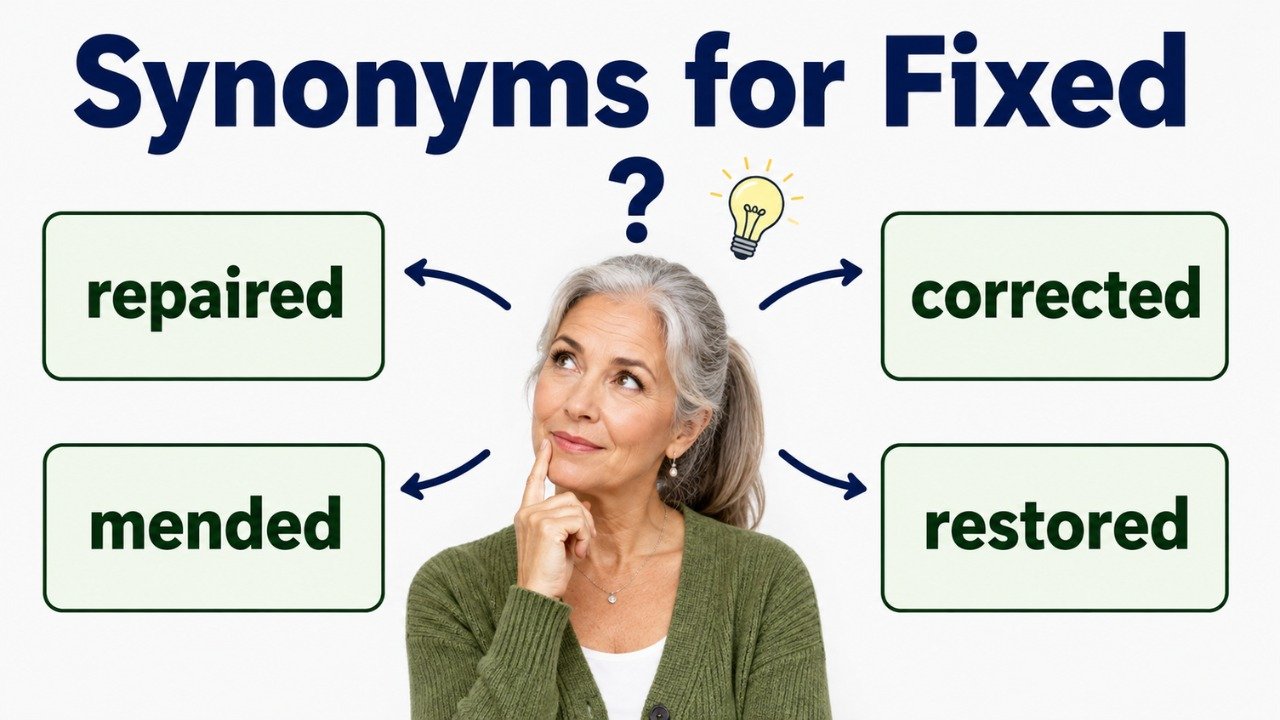
Quick Answer: The best synonyms for fixed include repaired, corrected, resolved, secured, stationary, established, determined, scheduled, permanent, and rigid. Use repaired for a broken object, corrected for an error, and resolved for a problem. Secured works when something is firmly attached, while stationary describes something that cannot move. Established and determined fit decisions or rules. Scheduled is best for an arranged time, permanent describes something lasting, and rigid suggests something that cannot bend or change.
Pronunciation and Word Details
Word: Fixed.
Pronunciation: /fɪkst/
Part of Speech: Adjective and the past tense and past participle of the verb “fix.”
Meaning: Repaired, firmly attached, unable to move, officially decided, arranged, or unlikely to change.
US Pronunciation:
UK Pronunciation:
What Does “Fixed” Mean?
Fixed means repaired, secured in one position, decided in advance, arranged for a particular time, or unable to change.
As an adjective, fixed often describes something that is stable, definite, or permanently placed. For example, “The shelf is fixed to the wall” means the shelf is firmly attached and cannot easily be moved.
Fixed is also the past tense and past participle of the verb “fix.” In the sentence “She fixed the broken handle,” it means she repaired the handle.
When fixed describes a problem, error, or difficult situation, it usually means corrected or resolved. “The issue has been fixed” means the cause of the problem has been identified and dealt with.
Fixed can also describe an amount, price, time, rule, or schedule that has already been decided. A fixed price does not change, while a fixed appointment has been arranged for a specific time.
In less positive contexts, fixed may mean dishonestly arranged or manipulated. A fixed competition is one in which the outcome has been unfairly decided in advance.
The meaning therefore depends on whether fixed refers to repair, position, stability, decisions, schedules, concentration, or manipulation.
Meaning, Tone, and Context of “Fixed”
Fixed is a common, neutral, and flexible word. It appears in everyday conversation, professional communication, technical writing, business documents, legal discussions, repair instructions, schedules, and descriptions.
When fixed means repaired, its tone is usually practical and conversational. Someone may say, “The sink is fixed,” to explain that it now works properly.
When fixed describes a rule, price, date, or condition, it sounds more formal and precise. A fixed deadline, fixed rate, or fixed term suggests that the detail has been officially established and is not expected to change.
In technical contexts, fixed may describe a component that remains in one position. It may also identify a setting, value, structure, or measurement that does not vary.
Fixed can carry a strong tone when it means rigid, permanent, or inflexible. Describing someone as having fixed ideas may suggest that the person is unwilling to consider alternatives.
In phrases such as “a fixed gaze,” the word describes steady concentration. The person continues looking at one point without turning away.
When fixed means manipulated or dishonestly arranged, it has a clearly negative meaning. Context should make this sense obvious to avoid confusion.
When and How to Use “Fixed”
For Repairs: Use fixed when a broken or damaged object has been restored to working condition.
Example: The technician fixed the damaged cable.
For Correcting Errors: Use fixed when a mistake, fault, or inaccurate detail has been corrected.
Example: The editor fixed the spelling error before publication.
For Solving Problems: Use fixed when a difficulty has been resolved successfully.
Example: The team fixed the payment problem within an hour.
For Securing Objects: Use fixed when something is firmly attached to a surface or structure.
Example: The sign was fixed securely above the entrance.
For Stationary Objects: Use fixed when an object remains in one position and cannot move freely.
Example: The camera remained fixed throughout the recording.
For Decisions: Use fixed when a plan, rule, or arrangement has already been decided.
Example: The final order of events is now fixed.
For Schedules: Use fixed when an event has been arranged for a specific time or date.
Example: The interview is fixed for Monday morning.
For Prices and Amounts: Use fixed when a value remains the same.
Example: The service is offered at a fixed price.
For Permanent Conditions: Use fixed when something is expected to remain unchanged.
Example: The room has a fixed seating arrangement.
For Concentration: Use fixed when someone keeps their eyes, attention, or thoughts directed toward one point.
Example: Her eyes were fixed on the doorway.
For Dishonest Arrangements: Use fixed when an outcome has been manipulated unfairly.
Example: Officials discovered that the contest had been fixed.
Best Synonyms for Fixed
Repaired: Restored after being broken or damaged.
Example: The repaired appliance is working properly again.
Corrected: Changed to remove an error, fault, or inaccuracy.
Example: The corrected report includes the right figures.
Resolved: Successfully dealt with or brought to an end.
Example: The resolved complaint required no further action.
Secured: Firmly attached, protected, or held in position.
Example: The ladder was secured against the wall.
Stationary: Remaining in one place without moving.
Example: The vehicle stayed stationary near the gate.
Established: Officially created, accepted, or decided.
Example: The established procedure applies to every employee.
Determined: Decided or settled after consideration.
Example: The final date was determined during the meeting.
Scheduled: Arranged to happen at a particular time.
Example: The inspection is scheduled for next week.
Permanent: Intended to remain for a long time without change.
Example: The organization found a permanent solution.
Rigid: Unable or unwilling to bend, move, or change.
Example: The rigid structure could not be adjusted.
50 Synonyms for Fixed with Short Meanings
- Repaired: Restored to proper working condition.
- Corrected: Changed to remove an error.
- Mended: Repaired after being torn or broken.
- Restored: Returned to an earlier good condition.
- Resolved: Successfully settled or solved.
- Remedied: Corrected to remove a problem.
- Adjusted: Changed slightly to improve accuracy or function.
- Set: Placed, arranged, or decided in a particular way.
- Secured: Firmly fastened or protected.
- Fastened: Attached firmly to another object.
- Attached: Joined or connected to something.
- Anchored: Held firmly in one position.
- Stationary: Not moving from one place.
- Immobile: Unable to move.
- Motionless: Completely still.
- Stable: Firm and unlikely to move or change.
- Permanent: Intended to last without ending.
- Constant: Remaining at the same level or condition.
- Unchanging: Staying the same over time.
- Settled: Decided, resolved, or established.
- Established: Officially accepted or put in place.
- Definite: Clearly decided and not uncertain.
- Determined: Decided after careful consideration.
- Decided: Chosen or settled conclusively.
- Arranged: Organized or planned in advance.
- Scheduled: Planned for a particular time.
- Appointed: Officially arranged for a specific time or role.
- Specified: Clearly stated or identified.
- Preset: Set in advance.
- Predetermined: Decided before an event happens.
- Firm: Strong, stable, or not likely to change.
- Rigid: Unable to bend or adapt easily.
- Inflexible: Unwilling or unable to change.
- Locked: Secured or unable to be altered.
- Frozen: Temporarily prevented from changing or moving.
- Unwavering: Firm and consistent without change.
- Steadfast: Strongly fixed in purpose or belief.
- Exact: Clearly defined and precise.
- Certain: Definite and free from doubt.
- Final: Fully decided and not open to revision.
- Agreed: Accepted by all relevant people.
- Standardized: Made consistent according to a standard.
- Regulated: Controlled according to rules.
- Controlled: Directed or kept within set limits.
- Marked: Clearly identified or indicated.
- Focused: Directing full attention toward one point.
- Intent: Showing steady and serious concentration.
- Rigged: Dishonestly arranged to produce a chosen result.
- Manipulated: Unfairly controlled or influenced.
- Prearranged: Organized or decided in advance.
Read Also:
Synonyms for Intimidating

Synonyms for Fixed by Context
When Fixed Means Repaired
Repaired, mended, restored, remedied, corrected, and adjusted are useful when fixed describes something that was damaged, broken, inaccurate, or faulty.
Repaired is the broadest alternative for physical objects. Mended is common for clothing, fabric, fences, and relationships. Restored suggests returning something to its earlier condition.
Fixed: The mechanic fixed the damaged engine.
Repaired: The mechanic repaired the damaged engine.
Fixed: She fixed the torn curtain.
Mended: She mended the torn curtain.
Fixed: The specialist fixed the old photograph.
Restored: The specialist restored the old photograph.
When Fixed Means Corrected
Corrected, remedied, adjusted, revised, and resolved work when fixed describes an error, fault, or inaccurate detail.
Corrected is best for mistakes in writing, calculations, records, or information. Adjusted suggests a smaller change, while remedied focuses on removing a harmful condition.
Fixed: The accountant fixed the incorrect total.
Corrected: The accountant corrected the incorrect total.
Fixed: The technician fixed the screen settings.
Adjusted: The technician adjusted the screen settings.
When Fixed Means a Problem Was Solved
Resolved, remedied, settled, handled, and addressed work when a difficulty has been dealt with successfully.
Resolved is more formal than fixed and works well in reports, professional messages, and formal explanations.
Fixed: The delivery problem has been fixed.
Resolved: The delivery problem has been resolved.
Fixed: The disagreement was fixed during the discussion.
Settled: The disagreement was settled during the discussion.
When Fixed Means Secured in Position
Secured, fastened, attached, anchored, mounted, and set are suitable when an object is firmly connected or held in place.
Secured emphasizes safety and stability. Fastened describes the act of joining objects, while anchored suggests strong support.
Fixed: The shelf was fixed to the wall.
Secured: The shelf was secured to the wall.
Fixed: The rope was fixed to the post.
Fastened: The rope was fastened to the post.
Fixed: The structure was fixed firmly in the ground.
Anchored: The structure was anchored firmly in the ground.
When Fixed Means Stationary
Stationary, immobile, motionless, stable, and still work when fixed describes something that does not move.
Stationary is common for vehicles, machines, cameras, and equipment. Immobile emphasizes an inability to move.
Fixed: The camera stayed fixed during the experiment.
Stationary: The camera stayed stationary during the experiment.
Fixed: His body remained fixed in place.
Immobile: His body remained immobile in place.
When Fixed Means Established or Decided
Established, determined, decided, settled, definite, and final are useful when fixed describes a rule, plan, amount, or decision.
Established works well for procedures and principles. Determined emphasizes that a decision was reached after consideration.
Fixed: The rules have already been fixed.
Established: The rules have already been established.
Fixed: The final number was fixed after the review.
Determined: The final number was determined after the review.
When Fixed Means Scheduled
Scheduled, arranged, appointed, set, and planned fit when fixed refers to a time, date, meeting, or event.
Scheduled is the clearest option for professional calendars and formal arrangements.
Fixed: The meeting is fixed for Thursday.
Scheduled: The meeting is scheduled for Thursday.
Fixed: They fixed an appointment for the afternoon.
Arranged: They arranged an appointment for the afternoon.
When Fixed Means Unchanging
Permanent, constant, stable, unchanging, rigid, inflexible, and locked describe something that does not vary or is difficult to alter.
Permanent emphasizes duration. Constant refers to a level or condition that remains the same. Rigid often carries a negative sense of limited flexibility.
Fixed: The agreement includes a fixed monthly payment.
Constant: The agreement includes a constant monthly payment.
Fixed: The building has a fixed internal structure.
Permanent: The building has a permanent internal structure.
Fixed: The manager followed a fixed approach.
Rigid: The manager followed a rigid approach.
When Fixed Means Focused
Focused, intent, concentrated, steady, and directed work when fixed describes attention, thought, or vision aimed at one point.
Fixed: Her gaze was fixed on the entrance.
Focused: Her gaze was focused on the entrance.
Fixed: His attention remained fixed on the task.
Concentrated: His attention remained concentrated on the task.
When Fixed Means Dishonestly Arranged
Rigged, manipulated, controlled, prearranged, and engineered may replace fixed when an outcome has been unfairly decided.
Rigged is the clearest informal synonym. Manipulated emphasizes improper control over the process.
Fixed: The investigation showed that the result was fixed.
Rigged: The investigation showed that the result was rigged.
Fixed: They suspected that the vote had been fixed.
Manipulated: They suspected that the vote had been manipulated.
Another Word for Fixed
Repaired is usually the best single replacement for fixed when describing a broken object that now works correctly. However, the best alternative depends on whether fixed means corrected, resolved, secured, decided, scheduled, permanent, or manipulated.
Original: The worker fixed the broken door.
Better Option: The worker repaired the broken door.
Original: The error was fixed before the report was shared.
Better Option: The error was corrected before the report was shared.
Original: The shelf is fixed to the wall.
Better Option: The shelf is secured to the wall.
Original: The appointment is fixed for nine in the morning.
Better Option: The appointment is scheduled for nine in the morning.
When Not to Use “Fixed”
Fixed is useful, but it may be too general when the reader needs to understand exactly what changed or what kind of action occurred.
When the Type of Repair Matters
Use repaired, mended, restored, adjusted, or replaced when a more specific description is available.
Weak: The damaged painting was fixed.
Better: The damaged painting was restored.
Weak: The torn sleeve was fixed.
Better: The torn sleeve was mended.
When Describing a Solved Problem
Resolved is often clearer and more professional than fixed when discussing complaints, system failures, disputes, or administrative issues.
Weak: The account problem has been fixed.
Better: The account problem has been resolved.
When Describing an Error
Corrected is more precise when the problem involves inaccurate information, grammar, spelling, or calculations.
Weak: The incorrect date was fixed.
Better: The incorrect date was corrected.
When Describing a Schedule
Scheduled or arranged is clearer when referring to meetings, interviews, visits, or events.
Weak: The review is fixed for Tuesday.
Better: The review is scheduled for Tuesday.
When Describing an Object’s Position
Secured, mounted, attached, or anchored may explain how the object is held.
Weak: The panel is fixed near the entrance.
Better: The panel is mounted near the entrance.
When Fixed Sounds Too Informal
In formal reports, use resolved, established, determined, secured, or corrected when they communicate the intended meaning more accurately.
Weak: The team fixed the policy details.
Better: The team finalized the policy details.
When Fixed Sounds Too Strong
Fixed may suggest that something cannot change. Use stable, planned, expected, or current when some flexibility remains.
Weak: The completion date is fixed, although it may change.
Better: The completion date is currently planned, although it may change.
When the Meaning Could Be Negative
Fixed may suggest manipulation when used with contests, results, prices, or votes. Choose arranged, established, or set when no dishonesty is involved.
Weak: The committee fixed the final result.
Better: The committee determined the final result.
Words Commonly Confused With Fixed
Fixed vs Repaired: Fixed is broad and may describe repair, position, schedule, or certainty. Repaired specifically means restored after damage.
Fixed vs Corrected: Fixed can refer to many kinds of improvement. Corrected focuses on removing an error or inaccuracy.
Fixed vs Resolved: Fixed is common in conversation. Resolved is more precise for problems, complaints, disputes, and difficult situations.
Fixed vs Set: Both words can describe something arranged or decided. Set is often shorter and more natural for times, prices, limits, and positions.
Fixed vs Secured: Fixed may mean attached or unable to move. Secured emphasizes that something has been safely and firmly fastened.
Fixed vs Stationary: Fixed can mean attached, decided, or unchanging. Stationary only means remaining in one place without movement.
Fixed vs Stable: Fixed suggests little or no movement or change. Stable means unlikely to change suddenly, but some movement or adjustment may still be possible.
Fixed vs Permanent: Fixed may describe a current arrangement that cannot easily change. Permanent means intended to continue indefinitely.
Fixed vs Rigid: Fixed means established or immovable. Rigid adds the idea that something cannot bend, adapt, or allow flexibility.
Fixed vs Settled: Fixed may describe a repair, position, or decision. Settled usually means decided, resolved, calm, or established.
Fixed vs Scheduled: Fixed can mean arranged for a time. Scheduled states this meaning more directly and clearly.
Fixed vs Rigged: Fixed has several neutral meanings. Rigged specifically means unfairly manipulated to produce a desired result.
Which Synonym Should You Choose?
Choose repaired when describing a broken machine, appliance, tool, vehicle, or physical object.
Choose mended when writing about clothing, fabric, fences, or something joined after tearing.
Choose restored when an old, damaged, or valuable object is returned to an earlier condition.
Choose corrected when discussing spelling, grammar, calculations, records, data, or factual errors.
Choose adjusted when a small change improves position, performance, comfort, or accuracy.
Choose resolved in reports, emails, and professional communication about problems, complaints, or disputes.
Choose remedied when emphasizing that an undesirable condition has been corrected.
Choose secured when an object is firmly attached or protected from movement.
Choose fastened when explaining how two things are physically joined.
Choose anchored when an object is strongly held in place.
Choose stationary for vehicles, equipment, cameras, or objects that are not moving.
Choose immobile when something or someone is unable to move.
Choose established when discussing accepted rules, systems, practices, or procedures.
Choose determined when a value, date, or decision has been reached after review.
Choose settled when an argument, decision, or uncertain matter has been concluded.
Choose scheduled for appointments, meetings, events, inspections, and planned activities.
Choose arranged when people have organized the details in advance.
Choose permanent when something is intended to remain for a long time.
Choose constant when a rate, amount, level, or condition remains the same.
Choose rigid when an approach, structure, or belief cannot adapt easily.
Choose focused when describing attention, vision, or thought directed toward one point.
Choose rigged or manipulated only when the outcome was dishonestly controlled.
Real Life Examples of “Fixed” in Sentences
Original: The mechanic fixed the damaged brakes.
Better Option: The mechanic repaired the damaged brakes.
Original: The editor fixed the punctuation error.
Better Option: The editor corrected the punctuation error.
Original: The support team fixed the login problem.
Better Option: The support team resolved the login problem.
Original: The mirror was fixed to the wall.
Better Option: The mirror was secured to the wall.
Original: The camera remained fixed during the test.
Better Option: The camera remained stationary during the test.
Original: The final price is fixed.
Better Option: The final price is set.
Original: The appointment has been fixed for Friday.
Better Option: The appointment has been scheduled for Friday.
Original: She kept her eyes fixed on the road.
Better Option: She kept her eyes focused on the road.
Original: The organization follows a fixed procedure.
Better Option: The organization follows an established procedure.
Original: Investigators believed that the result had been fixed.
Better Option: Investigators believed that the result had been manipulated.
Synonym Groups and Usage Differences
Repair Group
Repaired, mended, restored, remedied, adjusted, and corrected describe actions that improve something faulty or damaged.
Repaired is broad and practical. Mended is common for tears and breaks. Restored suggests returning something to an earlier state, while corrected focuses on errors.
Example: The damaged clock was repaired and returned to its owner.
Problem Solving Group
Resolved, remedied, settled, addressed, and handled describe problems that have been dealt with.
Resolved is suitable for formal writing. Settled often relates to disputes or uncertain matters.
Example: The billing issue was resolved before the deadline.
Attachment Group
Secured, fastened, attached, anchored, mounted, and locked describe objects held in a position.
Secured emphasizes safety. Anchored suggests strong support, while mounted often describes equipment placed on a surface.
Example: The screen was mounted securely above the desk.
Stillness Group
Stationary, immobile, motionless, stable, and still describe limited or absent movement.
Stationary simply means not moving. Immobile suggests that movement is impossible, while stable means unlikely to shift unexpectedly.
Example: The vehicle remained stationary near the entrance.
Decision Group
Established, determined, decided, settled, definite, final, and agreed describe matters that are no longer uncertain.
Established is useful for rules and practices. Determined works for values and dates, while final indicates that no further change is expected.
Example: The final order was determined after careful review.
Schedule Group
Scheduled, arranged, appointed, planned, set, and prearranged describe events organized in advance.
Scheduled is best for formal calendars. Arranged emphasizes that people agreed on the details.
Example: The inspection is scheduled for Wednesday morning.
Stability Group
Permanent, constant, unchanging, stable, firm, rigid, and inflexible describe limited change.
Permanent concerns duration. Constant refers to a value that stays the same. Rigid and inflexible can suggest an undesirable lack of adaptability.
Example: The agreement provides a constant monthly payment.
Attention Group
Focused, intent, concentrated, steady, and directed describe attention or vision held on one point.
Focused is the broadest and most natural alternative. Intent often suggests serious concentration.
Example: His attention remained focused on the instructions.
Manipulation Group
Rigged, manipulated, controlled, engineered, and prearranged can describe an outcome influenced in advance.
Rigged and manipulated usually imply unfairness. Prearranged is neutral unless the context suggests deception.
Example: The inquiry found that the competition had been rigged.
Antonyms of Fixed
The opposite of fixed depends on whether the word means repaired, stable, decided, attached, scheduled, or unchanging.
Broken: Damaged and not working correctly.
Damaged: Harmed physically or functionally.
Faulty: Containing a defect or problem.
Incorrect: Containing an error.
Unresolved: Not yet solved or settled.
Loose: Not firmly attached or secured.
Detached: Separated from another object.
Movable: Able to be moved.
Mobile: Capable of changing position.
Moving: Currently changing position.
Unstable: Likely to move, fail, or change suddenly.
Temporary: Intended to last for a limited time.
Variable: Able to change in amount or condition.
Flexible: Able to bend, adapt, or change.
Uncertain: Not decided or known clearly.
Undecided: Not yet settled.
Adjustable: Able to be changed or repositioned.
Optional: Not required or permanently established.
Unscheduled: Not arranged for a specific time.
Spontaneous: Happening without prior planning.
Comparison: Fixed vs Related Words
Fixed vs Repaired
Fixed is a broad word with several meanings. Repaired specifically describes something restored after damage or failure.
Example With Fixed: The worker fixed the broken lock.
Example With Repaired: The worker repaired the broken lock.
Fixed vs Corrected
Fixed may describe any successful improvement. Corrected specifically means that an error or inaccurate detail has been changed.
Example With Fixed: The editor fixed the date in the report.
Example With Corrected: The editor corrected the date in the report.
Fixed vs Resolved
Fixed is natural in casual speech. Resolved is often better in professional writing about issues, complaints, or disputes.
Example With Fixed: The access problem has been fixed.
Example With Resolved: The access problem has been resolved.
Fixed vs Secured
Fixed may mean attached in one position. Secured emphasizes firm attachment, protection, or safety.
Example With Fixed: The railing was fixed to the steps.
Example With Secured: The railing was secured to the steps.
Fixed vs Stationary
Fixed may describe something attached or unable to change. Stationary only describes something that is not moving.
Example With Fixed: The camera was fixed above the doorway.
Example With Stationary: The camera remained stationary during the test.
Fixed vs Stable
Fixed suggests that movement or change is prevented. Stable suggests balance and reliability, but not necessarily complete immobility.
Example With Fixed: The platform is fixed to the floor.
Example With Stable: The platform is stable under heavy weight.
Fixed vs Permanent
Fixed may describe an established arrangement. Permanent emphasizes that the arrangement is intended to last indefinitely.
Example With Fixed: The office has fixed seating positions.
Example With Permanent: The office installed a permanent dividing wall.
Fixed vs Set
Fixed and set can both mean decided or arranged. Set is often more concise for prices, times, values, and limits.
Example With Fixed: The fee is fixed at a specific amount.
Example With Set: The fee is set at a specific amount.
Fixed vs Scheduled
Fixed may describe a time that has been arranged. Scheduled is clearer in calendars, notices, and professional communication.
Example With Fixed: The interview is fixed for Tuesday.
Example With Scheduled: The interview is scheduled for Tuesday.
Fixed vs Rigid
Fixed means stable, decided, or immovable. Rigid suggests that something cannot bend or adapt and may sound critical.
Example With Fixed: The structure has a fixed frame.
Example With Rigid: The organization follows a rigid approval process.
Fixed vs Rigged
Fixed is usually neutral when it means repaired or decided. Rigged means dishonestly controlled to produce a chosen result.
Example With Fixed: The final schedule was fixed in advance.
Example With Rigged: The competition was rigged in advance.
Common Phrases and Expressions With “Fixed”
Fixed Price: A price that does not change.
Fixed Rate: A rate that remains constant for a stated period.
Fixed Cost: An expense that stays the same despite changes in activity.
Fixed Term: A period with a definite beginning and ending.
Fixed Date: A date that has already been decided.
Fixed Time: A specific time that is not expected to change.
Fixed Position: A place or arrangement that remains unchanged.
Fixed Point: A particular location, value, or reference that remains constant.
Fixed Amount: A quantity that does not vary.
Fixed Schedule: A timetable that follows established times.
Fixed Idea: A belief that someone is unwilling to reconsider.
Fixed Gaze: A steady look directed toward one point.
Fixed Asset: A long lasting physical resource used for operations.
Fixed Income: Regular income that remains at an established amount.
Fixed in Place: Firmly attached or unable to move.
Common Mistakes to Avoid
Using Fixed Without Clarifying the Meaning: Fixed can mean repaired, attached, scheduled, permanent, or manipulated. Add enough context to show the intended sense.
Vague: The result was fixed.
Clear: The incorrect result was corrected.
Clear: The competition result was manipulated.
Using Fixed for Every Repair: Choose a more exact verb when the type of work is known.
General: She fixed the old painting.
Precise: She restored the old painting.
Confusing Fixed With Permanent: A fixed arrangement may still be changed later. Permanent suggests that it is intended to last indefinitely.
Incorrect: The temporary desk has a permanent position for this week.
Better: The temporary desk has a fixed position for this week.
Using Fixed Instead of Stationary: Fixed may suggest attachment, while stationary simply means not moving.
Unclear: The vehicle was fixed outside.
Better: The vehicle was stationary outside.
Using Fixed Instead of Scheduled: Scheduled is clearer for meetings, appointments, and events.
Less Precise: The interview is fixed for Monday.
More Precise: The interview is scheduled for Monday.
Confusing Fixed and Set: Both can describe an established value, but set often sounds more natural with prices, limits, and targets.
Awkward: The maximum amount was fixed at ten units.
Natural: The maximum amount was set at ten units.
Using Fixed for a Flexible Plan: Fixed suggests certainty. Do not use it when dates, prices, or arrangements may still change.
Misleading: The date is fixed, but it may be moved.
Clearer: The proposed date may still be moved.
Ignoring the Negative Meaning: Fixed can imply dishonesty when describing votes, contests, or outcomes. Use determined or finalized when no manipulation occurred.
Unclear: The judges fixed the result.
Better: The judges finalized the result.
Repeating Fixed Too Often: Replace repeated uses with repaired, resolved, secured, established, or scheduled when appropriate.
Repetitive: The fixed machine was placed in a fixed position at a fixed time.
Improved: The repaired machine was secured in its assigned position at the scheduled time.
Using the Wrong Verb Form: Fixed is the past tense and past participle of fix.
Incorrect: The worker has fix the broken handle.
Correct: The worker has fixed the broken handle.
Conclusion
Synonyms for fixed vary according to whether the word means repaired, corrected, secured, decided, scheduled, stationary, or unchanging. Repaired is best for damaged objects, while corrected suits errors and resolved fits problems. Secured describes firm attachment, stationary describes a lack of movement, and scheduled fits arranged events. Established, determined, permanent, and rigid work for decisions or conditions that resist change. Choosing the most precise alternative makes each sentence clearer and prevents confusion between repair, stability, certainty, and manipulation.
FAQs About Synonyms for Fixed
What Is the Best Synonym for Fixed?
Repaired is the best general synonym when fixed describes a broken object. Corrected, resolved, secured, scheduled, or established may be better in other contexts.
What Is Another Word for Fixed a Problem?
Resolved is the clearest formal alternative. Corrected, remedied, addressed, and solved may also work depending on the problem.
What Is a Formal Synonym for Fixed?
Resolved, corrected, established, determined, secured, scheduled, and finalized are useful formal alternatives.
What Is a Synonym for Fixed in Place?
Secured, fastened, attached, anchored, mounted, stationary, and immobile can describe something fixed in place.
What Is a Synonym for a Fixed Date?
Scheduled date, set date, appointed date, arranged date, and predetermined date are suitable alternatives.
Does Fixed Mean Permanent?
Fixed can mean stable or unlikely to change, but it does not always mean permanent. A fixed arrangement may still be changed later.
Can Fixed Have a Negative Meaning?
Yes. When a contest, vote, or result is fixed, it may mean the outcome was dishonestly arranged or manipulated.
