
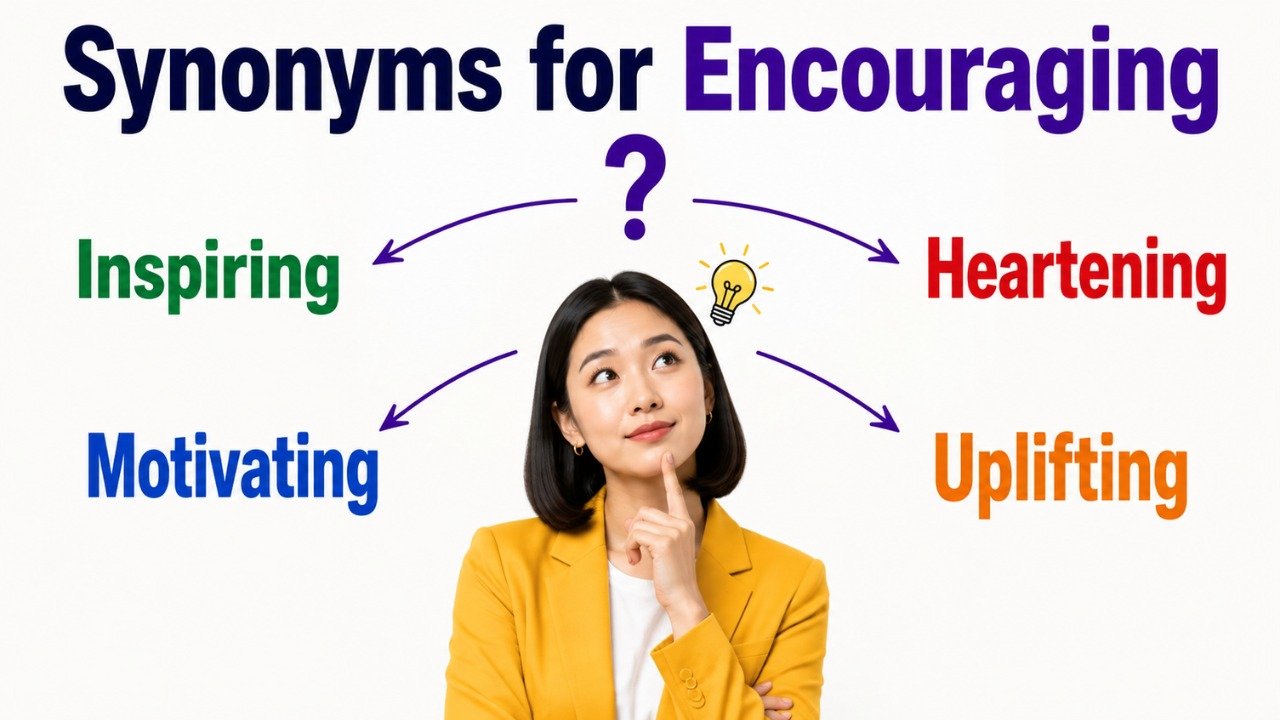
Quick Answer: The best synonyms for encouraging include supportive, motivating, inspiring, reassuring, uplifting, hopeful, positive, heartening, promising, and confidence building. Among these synonyms for encouraging, supportive is the most flexible choice when describing helpful words or behavior. Use motivating when something inspires action, reassuring when reducing worry, uplifting for improving someone’s mood, promising for favorable signs or results, inspiring for creating enthusiasm, and heartening when something strengthens hope or confidence.
Pronunciation and Word Details
Word: Encouraging.
Pronunciation: /ɪnˈkʌr.ɪ.dʒɪŋ/
Part of Speech: Adjective and present participle of the verb encourage.
Meaning: Giving someone confidence, hope, motivation, or support, or showing signs that a positive result is likely.
US Pronunciation:
UK Pronunciation:
What Does “Encouraging” Mean?
Encouraging means giving someone confidence, hope, motivation, or emotional support, or showing that a situation may develop positively.
As an adjective, encouraging can describe words, behavior, signs, progress, news, results, or circumstances that make someone feel more hopeful or confident.
Personal Use: An encouraging friend may offer support when someone feels uncertain.
Emotional Use: Encouraging words can help a person feel more hopeful or confident.
Professional Use: Encouraging feedback can motivate someone to improve their work.
Academic Use: Encouraging results may suggest that research, testing, or progress is moving in a positive direction.
Situational Use: An encouraging sign suggests that something favorable may happen.
The exact meaning depends on whether encouraging refers to emotional support, motivation, reassurance, positive evidence, or favorable progress.
Meaning, Tone, and Context of “Encouraging”
Encouraging usually has a positive, supportive, and hopeful tone. It can be used naturally in both casual conversation and formal writing.
In personal communication, encouraging often describes words or actions that strengthen confidence.
Example: Her encouraging message helped him continue.
In professional communication, the word may describe helpful feedback, positive progress, or favorable results.
Example: The early performance figures were encouraging.
In academic and analytical writing, encouraging can describe evidence that suggests positive development without claiming that success is certain.
Example: The preliminary findings were encouraging.
The word can also carry an emotional tone when describing reassurance, hope, or confidence.
Example: His encouraging smile made her feel more comfortable.
Encouraging is generally polite and positive. However, more precise synonyms can improve clarity when the intended meaning is specifically supportive, motivating, reassuring, inspiring, or promising.
When and How to Use “Encouraging”
For Emotional Support
Use encouraging when words or actions help someone feel stronger, calmer, or more confident.
Example: Her encouraging comments helped him overcome his doubts.
For Motivation
Encouraging can describe something that makes a person want to continue, improve, or take action.
Example: The coach gave an encouraging speech before the competition.
For Reassurance
Use encouraging when information or behavior reduces worry and gives someone hope.
Example: The doctor’s encouraging explanation helped the family feel calmer.
For Positive Progress
Encouraging can describe developments that suggest improvement.
Example: The student’s recent progress has been encouraging.
For Favorable Results
Use encouraging for results, evidence, or findings that suggest a positive outcome may be possible.
Example: The early test results were encouraging.
For Helpful Feedback
Encouraging can describe comments that recognize progress while motivating someone to continue improving.
Example: The teacher provided encouraging feedback on the assignment.
For Hopeful Signs
Use encouraging when a situation contains positive signs without guaranteeing success.
Example: The increase in participation was an encouraging sign.
For Building Confidence
Encouraging can describe speech or behavior that helps someone believe more strongly in their abilities.
Example: Her encouraging attitude gave the new employee greater confidence.
Best Synonyms for Encouraging
Supportive: Giving help, approval, confidence, or emotional strength.
Example: Her supportive words helped me remain calm.
Motivating: Creating enthusiasm or a desire to take action.
Example: The speaker gave a motivating presentation about personal growth.
Inspiring: Making someone feel enthusiastic, hopeful, or eager to achieve something.
Example: His inspiring story encouraged others to keep trying.
Reassuring: Reducing worry, fear, or uncertainty.
Example: Her reassuring voice made the child feel safe.
Uplifting: Making someone feel happier, more hopeful, or more positive.
Example: The uplifting message improved everyone’s mood.
Hopeful: Giving or expressing confidence that something positive may happen.
Example: The latest developments provide a hopeful sign of improvement.
Positive: Showing approval, optimism, progress, or favorable qualities.
Example: She received positive feedback about her performance.
Heartening: Making someone feel more hopeful, confident, or cheerful.
Example: The community’s response was heartening.
Promising: Showing signs that future success or improvement is likely.
Example: The team’s early results look promising.
Confidence Building: Helping someone develop greater belief in their abilities.
Example: The activity created a confidence building experience for the students.
50 Synonyms for Encouraging with Short Meanings
- Supportive: Providing help, approval, or emotional strength.
- Motivating: Inspiring someone to take action or continue.
- Inspiring: Creating enthusiasm, hope, or ambition.
- Reassuring: Making someone feel less worried or uncertain.
- Uplifting: Improving someone’s mood or sense of hope.
- Hopeful: Giving reason to expect a positive outcome.
- Positive: Showing optimism, approval, or favorable progress.
- Heartening: Making someone feel more hopeful or confident.
- Promising: Showing signs of likely future success.
- Confidence Building: Helping someone develop greater self belief.
- Cheering: Making someone happier or more hopeful.
- Comforting: Giving emotional relief or reassurance.
- Helpful: Providing useful support or assistance.
- Optimistic: Expressing confidence about a positive future.
- Stimulating: Encouraging interest, thought, energy, or action.
- Energizing: Giving someone greater enthusiasm or energy.
- Empowering: Helping someone feel capable and confident.
- Affirming: Showing approval, support, or confirmation.
- Assuring: Giving confidence that something is true or likely.
- Buoying: Raising someone’s confidence or spirits.
- Cheerful: Creating or expressing a positive mood.
- Constructive: Helpful in promoting improvement or progress.
- Enthusiastic: Showing strong positive interest or excitement.
- Favorable: Suggesting a positive or beneficial result.
- Gratifying: Giving satisfaction or pleasure.
- Helpful Minded: Showing a desire to support someone.
- Hope Giving: Providing a reason to remain hopeful.
- Inspirational: Having the power to inspire or motivate.
- Invigorating: Giving renewed energy, enthusiasm, or confidence.
- Motivational: Designed to inspire effort or action.
- Nurturing: Helping someone develop through care and support.
- Optimism Building: Strengthening confidence about future possibilities.
- Positive Minded: Showing an optimistic and constructive attitude.
- Productive: Contributing to useful progress or improvement.
- Reinforcing: Strengthening confidence, behavior, or belief.
- Reviving: Renewing hope, enthusiasm, or energy.
- Rewarding: Providing satisfaction that encourages continued effort.
- Spirit Lifting: Making someone feel happier or more hopeful.
- Strengthening: Increasing confidence, courage, or determination.
- Sustaining: Helping someone continue through support or motivation.
- Welcoming: Creating a friendly and supportive feeling.
- Approving: Showing acceptance or favorable judgment.
- Compassionate: Showing care and understanding that offers support.
- Confidence Inspiring: Making someone feel more certain or capable.
- Enabling: Providing the support or conditions needed for progress.
- Fortifying: Increasing emotional strength or determination.
- Progressive: Showing movement toward improvement.
- Upbeat: Cheerful, optimistic, and positive in tone.
- Validating: Recognizing someone’s feelings, efforts, or experiences as meaningful.
- Hope Inspiring: Creating stronger expectations of a positive outcome.
Read Also:
Synonyms for Achieving Success

Synonyms for Encouraging by Context
When Encouraging Means Supportive
Supportive, helpful, nurturing, affirming, compassionate, and validating work well when encouraging describes emotional or practical support.
Example: Her supportive response made him feel understood.
Example: The teacher’s affirming comments gave the student greater confidence.
When Encouraging Means Motivating
Motivating, inspirational, inspiring, stimulating, energizing, invigorating, and empowering are useful when something creates enthusiasm or action.
Example: The training session was highly motivating.
Example: Her inspiring story encouraged others to pursue their goals.
When Encouraging Means Reassuring
Reassuring, comforting, assuring, confidence inspiring, and hope giving work best when something reduces anxiety or uncertainty.
Example: His reassuring tone helped everyone remain calm.
Example: The update was comforting after several uncertain weeks.
When Encouraging Means Promising
Promising, favorable, positive, hopeful, progressive, and productive fit situations where results or signs indicate possible improvement.
Example: The early results appear promising.
Example: The latest figures show positive progress.
When Encouraging Means Uplifting
Uplifting, cheering, upbeat, heartening, spirit lifting, and cheerful are useful when something improves mood or emotional energy.
Example: Her uplifting words changed the mood of the room.
Example: The response from the community was heartening.
When Encouraging Means Building Confidence
Empowering, strengthening, reinforcing, confidence building, confidence inspiring, and fortifying fit situations where someone becomes more confident or determined.
Example: The experience was empowering for the new participants.
Example: Constructive feedback can be confidence building when delivered thoughtfully.
Another Word for Encouraging
The best single replacement for encouraging is often supportive when describing words, behavior, or a person. However, the best alternative depends on context.
Use motivating when encouraging creates action, reassuring when it reduces worry, promising when describing positive signs, and uplifting when it improves someone’s mood.
Original: She gave me an encouraging response.
Better Option: She gave me a supportive response.
Original: His encouraging speech made everyone want to work harder.
Better Option: His motivating speech made everyone want to work harder.
Original: The early results were encouraging.
Better Option: The early results were promising.
Original: Her encouraging voice helped him relax.
Better Option: Her reassuring voice helped him relax.
When Not to Use “Encouraging”
Encouraging is useful, but it can become vague when a more precise word explains exactly what made something positive.
Avoid encouraging when you specifically mean motivational, reassuring, promising, supportive, or uplifting.
Weak: The results were encouraging.
Better: The results were promising.
Promising explains more specifically that the results suggest future success.
Weak: She gave him an encouraging hug.
Better: She gave him a comforting hug.
Comforting is more natural when physical reassurance is the main idea.
Weak: The manager gave an encouraging presentation about reaching our goals.
Better: The manager gave a motivating presentation about reaching our goals.
Motivating is stronger when the purpose is to inspire action.
Weak: His encouraging explanation made her less afraid.
Better: His reassuring explanation made her less afraid.
Reassuring directly expresses the reduction of fear or worry.
Encouraging can also become repetitive when used several times in one paragraph.
Weak: The teacher gave encouraging feedback, used encouraging language, and created an encouraging environment.
Better: The teacher gave supportive feedback, used motivating language, and created a positive environment.
Choose the alternative that communicates the exact type of encouragement being provided.
Words Commonly Confused With Encouraging
Encouraging vs Supportive: Encouraging focuses on increasing confidence, hope, or motivation, while supportive more broadly means providing help, approval, or emotional assistance.
Encouraging vs Motivating: Encouraging may provide hope or confidence, while motivating more specifically creates a desire to take action.
Encouraging vs Inspiring: Encouraging helps someone continue or feel confident, while inspiring often creates stronger enthusiasm, admiration, or ambition.
Encouraging vs Reassuring: Encouraging increases hope or confidence, while reassuring specifically reduces fear, worry, or uncertainty.
Encouraging vs Positive: Encouraging describes something that creates hope or confidence, while positive can more broadly mean favorable, optimistic, beneficial, or approving.
Encouraging vs Promising: Encouraging can describe words, people, actions, or results. Promising usually describes signs or developments suggesting future success.
Encouraging vs Uplifting: Encouraging strengthens confidence or motivation, while uplifting specifically improves mood or emotional well being.
Encouraging vs Heartening: Both can mean giving hope, but heartening often describes news, events, or responses that create emotional encouragement.
Which Synonym Should You Choose?
Choose supportive when writing about helpful people, comments, behavior, relationships, or environments.
Choose motivating when something encourages someone to act, improve, work harder, or continue pursuing a goal.
Choose inspiring when something creates enthusiasm, admiration, ambition, or a strong desire to achieve.
Choose reassuring when the main purpose is to reduce fear, anxiety, doubt, or uncertainty.
Choose uplifting when something makes a person feel happier or more hopeful.
Choose heartening when news, behavior, or a response strengthens hope.
Choose promising for results, evidence, progress, signs, research findings, or developments that suggest future success.
Choose positive when you need a broad and neutral word for favorable feedback, attitudes, developments, or outcomes.
Choose constructive in professional or academic writing when feedback is useful and designed to promote improvement.
Choose empowering when support helps someone feel more capable, independent, or confident.
In reports and formal writing, promising, favorable, constructive, positive, and reassuring often provide useful precision.
In essays, supportive, motivating, inspiring, hopeful, and empowering may be appropriate depending on the argument.
In emails, supportive, positive, reassuring, and helpful usually sound natural and professional.
In casual conversation, uplifting, supportive, inspiring, motivating, and reassuring are easy and natural alternatives.
Real Life Examples of “Encouraging” in Sentences
Original: Her encouraging words helped me continue.
Better Option: Her supportive words helped me continue.
Original: The early results are encouraging.
Better Option: The early results are promising.
Original: He gave the team an encouraging speech.
Better Option: He gave the team a motivating speech.
Original: The teacher wrote an encouraging comment on my assignment.
Better Option: The teacher wrote a positive comment on my assignment.
Original: His encouraging voice helped her stop worrying.
Better Option: His reassuring voice helped her stop worrying.
Original: The progress we have seen this month is encouraging.
Better Option: The progress we have seen this month is heartening.
Original: She shared an encouraging story about overcoming difficulty.
Better Option: She shared an inspiring story about overcoming difficulty.
Original: The manager created an encouraging atmosphere for new employees.
Better Option: The manager created a supportive atmosphere for new employees.
Original: The encouraging message improved everyone’s mood.
Better Option: The uplifting message improved everyone’s mood.
Original: The latest evidence is encouraging for the project.
Better Option: The latest evidence is favorable for the project.
Synonym Groups and Usage Differences
Support Group
Supportive, helpful, nurturing, compassionate, affirming, and validating describe encouragement based on care, approval, or assistance.
These words work well when people need emotional or practical support.
Example: Her supportive attitude helped the new employee feel comfortable.
Motivation Group
Motivating, inspirational, inspiring, stimulating, energizing, and invigorating describe encouragement that creates action or enthusiasm.
These words are particularly useful for goals, performance, education, leadership, and personal development.
Example: His motivating advice helped the students remain focused.
Reassurance Group
Reassuring, comforting, assuring, hope giving, and confidence inspiring focus on reducing worry and restoring confidence.
Example: The reassuring update reduced everyone’s concerns.
Hope Group
Hopeful, heartening, promising, favorable, positive, and optimism building describe signs that create expectations of a better result.
Example: The increase in participation was a heartening development.
Confidence Group
Empowering, strengthening, reinforcing, fortifying, confidence building, and confidence inspiring describe encouragement that increases self belief or determination.
Example: The workshop was empowering for participants who lacked confidence.
Mood Group
Uplifting, upbeat, cheering, cheerful, spirit lifting, and reviving focus on improving someone’s emotional state.
Example: Her uplifting message brought some much needed optimism to the group.
Antonyms of Encouraging
The opposite of encouraging depends on whether the meaning involves support, hope, motivation, reassurance, or favorable signs.
Discouraging: Making someone lose confidence, enthusiasm, or hope.
Demotivating: Reducing someone’s desire to act or continue.
Disheartening: Causing someone to lose hope or confidence.
Depressing: Creating feelings of sadness or reduced optimism.
Negative: Expressing criticism, pessimism, or unfavorable judgment.
Unpromising: Showing little indication of future success.
Pessimistic: Expecting unfavorable results.
Disappointing: Failing to meet expectations or hopes.
Critical: Expressing faults or negative judgments, especially when support is absent.
Deterring: Making someone less willing to act.
Doubtful: Suggesting uncertainty about a positive outcome.
Alarming: Creating concern, fear, or worry instead of reassurance.
Unsupportive: Failing to provide needed approval, assistance, or encouragement.
Deflating: Reducing confidence, enthusiasm, or excitement.
Hopeless: Providing little or no reason for optimism.
Comparison: Encouraging vs Related Words
Encouraging vs Supportive
Encouraging focuses on giving confidence, hope, or motivation. Supportive emphasizes providing assistance, approval, understanding, or emotional help.
Example With Encouraging: Her encouraging words helped him keep practicing.
Example With Supportive: Her supportive attitude helped him feel less alone.
Encouraging vs Motivating
Encouraging can increase confidence or hope without necessarily producing immediate action. Motivating specifically creates a desire to do something.
Example With Encouraging: The teacher’s encouraging comments increased her confidence.
Example With Motivating: The teacher’s motivating speech inspired her to study harder.
Encouraging vs Inspiring
Encouraging often helps someone continue or believe in themselves. Inspiring tends to create stronger enthusiasm, admiration, creativity, or ambition.
Example With Encouraging: His encouraging advice helped me finish the project.
Example With Inspiring: His inspiring story made me reconsider what I could achieve.
Encouraging vs Reassuring
Encouraging gives confidence or hope, while reassuring specifically reduces worry, uncertainty, or fear.
Example With Encouraging: The coach gave the player an encouraging smile.
Example With Reassuring: The coach gave the injured player a reassuring explanation.
Encouraging vs Promising
Encouraging can describe people, messages, behavior, news, or results. Promising usually describes evidence or signs that suggest future success.
Example With Encouraging: The teacher gave an encouraging response.
Example With Promising: The student’s recent improvement looks promising.
Encouraging vs Uplifting
Encouraging strengthens hope, confidence, or determination. Uplifting focuses more specifically on improving someone’s mood or emotional state.
Example With Encouraging: Her encouraging advice helped me keep trying.
Example With Uplifting: Her uplifting message made everyone smile.
Encouraging vs Positive
Encouraging specifically creates hope, confidence, or motivation. Positive is broader and can mean favorable, optimistic, beneficial, or approving.
Example With Encouraging: The latest progress is encouraging.
Example With Positive: The latest report contains several positive developments.
Encouraging vs Heartening
Both words express increased hope. Encouraging is more general, while heartening often emphasizes an emotional sense of renewed hope or confidence.
Example With Encouraging: The increase in applications was encouraging.
Example With Heartening: The overwhelming willingness to help was heartening.
Common Phrases and Expressions With Encouraging
Encouraging Words: Supportive language that increases confidence or hope.
Encouraging Sign: An indication that something may improve or succeed.
Encouraging Results: Outcomes that suggest favorable progress.
Encouraging News: Information that creates hope or optimism.
Encouraging Feedback: Helpful comments that support improvement and confidence.
Encouraging Response: A reaction that shows approval, hope, or positive interest.
Encouraging Progress: Improvement that suggests continued success may be possible.
Encouraging Development: A positive change that creates hope for future improvement.
Encouraging Attitude: A supportive manner that helps others feel more confident.
Encouraging Message: Communication intended to provide hope, motivation, reassurance, or support.
Common Mistakes to Avoid
One common mistake is assuming that every synonym for encouraging can replace it in every sentence.
Supportive works naturally for people, words, environments, and behavior, but it does not always work for evidence or results.
Unnatural: The test results were supportive.
Better: The test results were promising.
Another mistake is using motivating when reassurance is actually intended.
Less Precise: His motivating voice made her feel less worried.
Better: His reassuring voice made her feel less worried.
Motivating is associated with action, while reassuring is associated with reducing concern.
Writers may also confuse encouraging with positive. Positive is broader and does not always imply active encouragement.
Example: A positive result is favorable, while an encouraging comment is intended to build confidence.
Avoid excessive repetition.
Repetitive: The encouraging teacher gave encouraging feedback in an encouraging way.
Better: The supportive teacher gave constructive feedback in a reassuring way.
Another mistake is using promising for a person who is actively giving emotional support.
Unnatural: My friend was very promising when I felt discouraged.
Better: My friend was very supportive when I felt discouraged.
Promising generally describes future potential or favorable signs rather than emotional support.
Avoid choosing a more formal synonym when simple language communicates the idea more naturally. In everyday conversation, supportive, positive, inspiring, reassuring, and motivating are usually clearer than uncommon alternatives.
The best synonym should match the specific reason something is encouraging.
Conclusion
The most useful synonyms for encouraging include supportive, motivating, inspiring, reassuring, uplifting, hopeful, positive, heartening, promising, and empowering. The best choice depends on context. Use supportive for emotional help, motivating for action, reassuring for reducing worry, inspiring for enthusiasm, uplifting for improving mood, and promising for favorable signs or results. Understanding these differences makes it easier to choose natural, precise language in essays, reports, emails, professional communication, and everyday conversation.
FAQs About Synonyms for Encouraging
What Is the Best Synonym for Encouraging?
Supportive is one of the best general synonyms for encouraging when describing words, behavior, or people. Promising is usually better for results, signs, or future potential.
What Is Another Word for Encouraging Someone?
Supporting, motivating, inspiring, reassuring, empowering, and uplifting are useful alternatives. The best choice depends on whether you are giving confidence, motivation, hope, or emotional comfort.
What Is a Formal Synonym for Encouraging?
Promising, favorable, constructive, reassuring, and supportive can all work in formal writing. Promising is especially useful when describing results or evidence.
What Is a Synonym for Encouraging Words?
Supportive words, reassuring words, motivating words, inspiring words, uplifting words, and affirming words are natural alternatives.
Is Inspiring the Same as Encouraging?
Not exactly. Encouraging usually gives someone confidence or support, while inspiring often creates stronger enthusiasm, ambition, creativity, or admiration.
What Word Means Encouraging and Positive?
Uplifting is a strong choice when something is both encouraging and emotionally positive. Heartening, hopeful, inspiring, and upbeat may also fit depending on context.
What Is the Best Synonym for Encouraging Results?
Promising is usually the strongest alternative for encouraging results. Favorable, positive, hopeful, and heartening can also work depending on how certain or emotional the statement should sound.
