
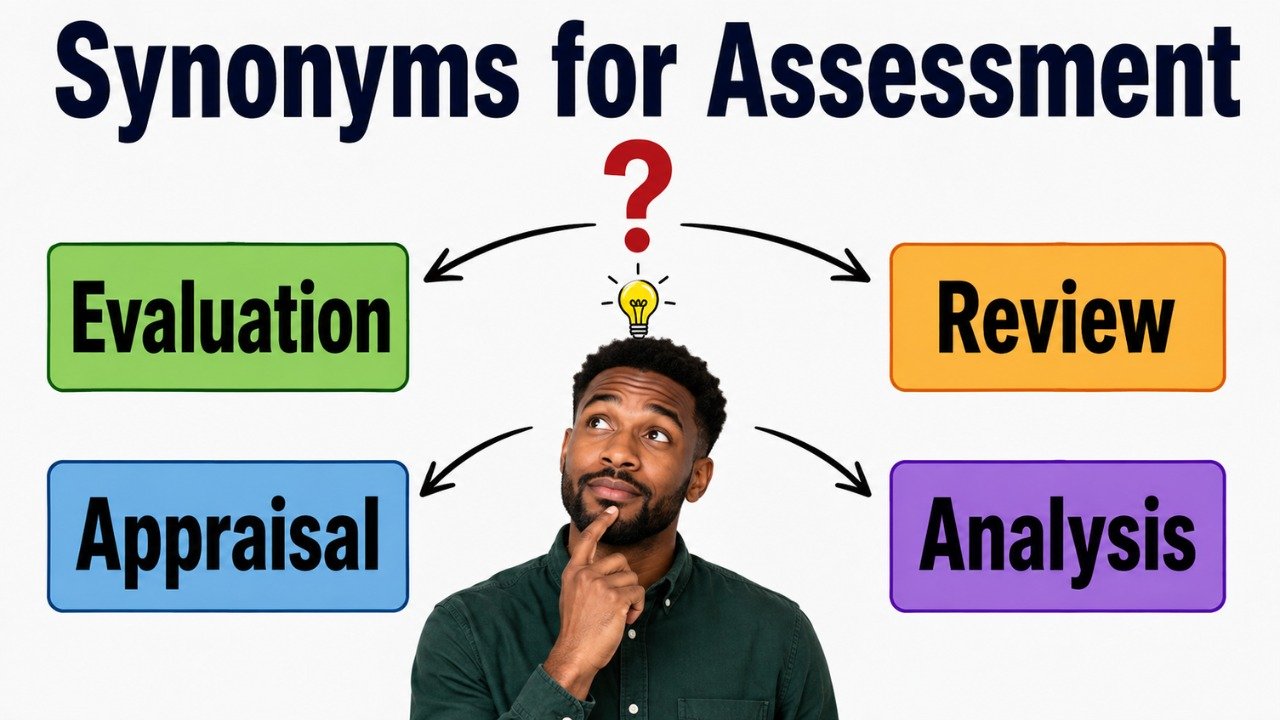
Quick Answer: The best synonyms for assessment include evaluation, appraisal, review, analysis, examination, judgment, estimate, inspection, test, and measurement. Among these synonyms for assessment, evaluation is the most flexible choice for formal, academic, and professional writing. Use appraisal when judging quality or value, review for checking performance or information, analysis for detailed examination, examination for careful investigation, judgment for forming an opinion, estimate for approximate value, and test for measuring knowledge or ability.
Pronunciation and Word Details
Word: Assessment.
Pronunciation: /əˈses.mənt/
Part of Speech: Noun.
Meaning: Assessment means the process of examining, measuring, judging, or estimating the quality, value, condition, ability, or importance of something.
US Pronunciation:
UK Pronunciation:
What Does “Assessment” Mean?
Assessment means a careful examination or judgment used to understand the quality, value, condition, ability, performance, or importance of something.
Assessment is a noun. It commonly refers to a process in which information is collected and considered before a conclusion is reached.
In education, assessment may refer to a test, assignment, observation, or other method used to measure knowledge or ability.
Example: The final assessment measured the students’ understanding of the course material.
In professional settings, assessment can describe an evaluation of performance, risk, skills, needs, or results.
Example: The manager completed an assessment of the team’s performance.
In finance or property contexts, assessment can refer to an estimate of value.
Example: The property assessment showed that the building had increased in value.
In health, safety, planning, and technical contexts, assessment often means a structured examination of a situation before action is taken.
Example: A careful risk assessment was completed before the project began.
The meaning of assessment therefore changes slightly depending on whether the focus is evaluation, testing, analysis, measurement, judgment, or estimation.
Meaning, Tone, and Context of “Assessment”
Assessment is generally a neutral to formal word. It is common in academic, professional, technical, administrative, educational, financial, and analytical writing.
In everyday conversation, people may use simpler alternatives such as review, check, test, or evaluation.
Example: We need an assessment of the current situation.
This sentence sounds professional and deliberate.
Assessment often suggests that a person is using evidence, criteria, observation, measurement, or expert judgment.
It can therefore sound more systematic than a simple opinion.
Example: Her assessment was based on several months of data.
In education, assessment is a standard term for measuring learning or progress.
Example: The course includes written and practical assessments.
In business, assessment may refer to performance, risk, needs, opportunities, or capabilities.
Example: The company conducted a skills assessment before assigning new responsibilities.
In technical or scientific contexts, assessment may involve careful measurement and analysis.
Example: The environmental assessment examined possible effects on the surrounding area.
The word is usually objective and professional, although it can also describe a personal judgment.
Example: His assessment of the situation proved accurate.
Overall, assessment works best when a process involves examining evidence and reaching a reasoned conclusion.
When and How to Use “Assessment”
For Evaluating Performance
Use assessment when measuring how well a person, team, process, or system is performing.
Example: The annual assessment showed significant improvement in productivity.
For Measuring Knowledge
Assessment is common in educational contexts when knowledge, understanding, or ability is being measured.
Example: The teacher used a written assessment to measure reading comprehension.
For Reviewing Quality
Use assessment when determining how good, effective, suitable, or reliable something is.
Example: The quality assessment identified several areas for improvement.
For Estimating Value
Assessment can refer to determining or estimating the value of property, assets, or other items.
Example: The latest assessment placed the property at a higher value.
For Analyzing Risk
Use assessment when evaluating possible dangers, problems, or uncertainties.
Example: The team completed a risk assessment before beginning construction.
For Identifying Needs
Assessment can describe the process of determining what resources, support, or changes are required.
Example: A needs assessment revealed a shortage of training opportunities.
For Making a Judgment
Assessment can mean a considered opinion formed after examining available information.
Example: Her assessment of the situation was accurate and balanced.
For Examining Condition
Use assessment when evaluating the physical or operational condition of something.
Example: The engineer completed an assessment of the building’s condition.
Best Synonyms for Assessment
Evaluation: A careful judgment of quality, effectiveness, performance, or value.
Example: The evaluation showed that the new process was more efficient.
Appraisal: A formal judgment of quality, performance, condition, or value.
Example: Her annual appraisal highlighted several strengths.
Review: An examination of information, performance, or results.
Example: The team conducted a review of the completed project.
Analysis: A detailed study used to understand something more clearly.
Example: The analysis revealed several important patterns.
Examination: A careful inspection or investigation of something.
Example: A detailed examination of the records uncovered several errors.
Judgment: An opinion or conclusion formed after considering information.
Example: His judgment of the situation was based on experience.
Estimate: An approximate calculation or judgment of quantity, cost, or value.
Example: The estimate placed the repair cost at a reasonable amount.
Inspection: A careful check of condition, quality, or compliance.
Example: The safety inspection identified two problems.
Test: A method used to measure knowledge, ability, quality, or performance.
Example: The reading test measured each student’s comprehension.
Measurement: The process of determining size, amount, level, quality, or performance.
Example: Accurate measurement helped the team compare the results.
50 Synonyms for Assessment with Short Meanings
- Evaluation: A judgment of quality, performance, or value.
- Appraisal: A formal evaluation of worth or performance.
- Review: A careful examination of information or results.
- Analysis: Detailed study of something to understand it.
- Examination: Careful investigation or inspection.
- Judgment: A conclusion formed after considering evidence.
- Estimate: An approximate calculation or evaluation.
- Inspection: A careful check of condition or quality.
- Test: A method for measuring ability or knowledge.
- Measurement: The process of determining level, amount, or performance.
- Evaluation Process: A structured process for judging quality or results.
- Audit: A formal examination of records, systems, or performance.
- Check: A simple examination for accuracy or condition.
- Study: A careful investigation of a subject.
- Investigation: A detailed examination used to discover facts.
- Survey: A systematic collection and examination of information.
- Rating: A score or classification based on quality or performance.
- Scoring: The process of assigning points or values.
- Grading: The process of judging work according to standards.
- Testing: The process of measuring ability, knowledge, or performance.
- Screening: An initial examination used to identify possible concerns.
- Diagnosis: Identification of a problem through examination.
- Determination: A conclusion reached after consideration.
- Valuation: An estimate of financial or practical worth.
- Estimate of Value: An approximate judgment of worth.
- Opinion: A personal or professional judgment.
- Conclusion: A decision or judgment reached after analysis.
- Finding: A result discovered through examination.
- Interpretation: An explanation of the meaning of information.
- Observation: Information gained through careful watching or examination.
- Consideration: Careful thought before reaching a conclusion.
- Assessment Review: A reconsideration of an earlier evaluation.
- Performance Review: An evaluation of work or achievement.
- Performance Evaluation: A formal judgment of effectiveness or results.
- Needs Analysis: Examination used to identify required support or resources.
- Risk Evaluation: A judgment of possible danger or uncertainty.
- Risk Analysis: Detailed study of potential problems or threats.
- Quality Review: Examination of standards or overall quality.
- Quality Evaluation: Judgment of how well something meets expectations.
- Progress Review: Examination of development or improvement over time.
- Capability Review: Evaluation of ability or capacity.
- Competency Evaluation: Measurement of skill or professional ability.
- Skill Evaluation: Judgment of a person’s level of skill.
- Performance Check: A review of how well something is functioning.
- Status Review: Examination of the current condition or position.
- Condition Review: Evaluation of physical or operational condition.
- Needs Evaluation: Judgment of what support or resources are required.
- Diagnostic Review: Examination used to identify a problem.
- Benchmarking: Comparison of performance against a standard.
- Verification: Confirmation that something meets expected requirements.
Read Also:
Synonyms for Improving

Synonyms for Assessment by Context
When Assessment Means Evaluation
When assessment means judging quality, effectiveness, value, or performance, useful synonyms include evaluation, appraisal, review, judgment, rating, and performance evaluation.
Example: The manager completed an assessment of employee performance.
Alternative: The manager completed an evaluation of employee performance.
Evaluation is usually the strongest general alternative because it works naturally in professional, educational, academic, and technical contexts.
Appraisal is particularly useful for formal reviews of value or performance.
Example: The employee appraisal focused on strengths and areas for improvement.
When Assessment Means Examination
When assessment refers to careful examination, useful alternatives include review, examination, inspection, audit, investigation, study, and check.
Example: The safety assessment identified several concerns.
Alternative: The safety inspection identified several concerns.
Inspection is appropriate when physical condition or compliance is being checked.
Examination is broader and may involve studying documents, evidence, systems, or physical conditions.
Example: A detailed examination of the equipment revealed the source of the problem.
When Assessment Means Educational Testing
In education, assessment may refer to testing or measuring knowledge, skills, understanding, or progress.
Useful alternatives include test, examination, evaluation, grading, scoring, measurement, and progress review.
Example: Students completed an assessment at the end of the lesson.
Alternative: Students completed a test at the end of the lesson.
Test is usually more specific when students answer questions or perform tasks to demonstrate knowledge.
Evaluation is broader because it may include several methods rather than one test.
When Assessment Means Judgment
When assessment means a conclusion or considered opinion, useful alternatives include judgment, opinion, conclusion, determination, interpretation, and finding.
Example: Her assessment of the situation was realistic.
Alternative: Her judgment of the situation was realistic.
Judgment emphasizes the conclusion reached by a person.
Conclusion is useful when the opinion results from analysis.
Example: The final conclusion was based on all available evidence.
When Assessment Means Estimating Value
When assessment refers to determining monetary or practical worth, useful alternatives include valuation, appraisal, estimate, estimate of value, and evaluation.
Example: The property assessment showed an increase in value.
Alternative: The property valuation showed an increase in value.
Valuation is particularly precise when financial worth is being determined.
Appraisal is also common when property, assets, or valuable objects are examined.
When Assessment Means Risk Analysis
When assessment describes the examination of danger, uncertainty, or possible negative outcomes, useful alternatives include risk analysis, risk evaluation, review, investigation, and examination.
Example: A risk assessment was completed before work began.
Alternative: A risk analysis was completed before work began.
Risk analysis often focuses on identifying and studying possible risks, while risk evaluation may focus more strongly on judging their seriousness.
When Assessment Means Identifying Needs
When assessment is used to determine what a person, organization, or community requires, useful alternatives include needs analysis, needs evaluation, review, study, and investigation.
Example: The training assessment showed that employees needed additional instruction.
Alternative: The training needs analysis showed that employees needed additional instruction.
Needs analysis is often the clearest choice when identifying gaps between current and desired conditions.
Another Word for Assessment
Evaluation is often the best single replacement for assessment because both words can describe a structured process of examining information and making a judgment.
However, the best alternative depends on context. Use appraisal for formal judgments of value or performance, review for general checking, analysis for detailed study, and test when knowledge or ability is being measured.
Original: The manager completed an assessment of the employee’s performance.
Better Option: The manager completed an evaluation of the employee’s performance.
Original: The building requires a safety assessment.
Better Option: The building requires a safety inspection.
Original: The students completed an assessment after the lesson.
Better Option: The students completed a test after the lesson.
Original: The property assessment was higher than expected.
Better Option: The property valuation was higher than expected.
When Not to Use “Assessment”
Assessment is useful in formal and professional writing, but it may sound unnecessarily formal in simple everyday situations.
Weak: I made an assessment of which shirt looked better.
Better: I decided which shirt looked better.
Avoid assessment when a more precise word explains exactly what happened.
Weak: The teacher gave us an assessment this morning.
Better: The teacher gave us a test this morning.
If the activity was specifically a test, test is clearer.
Avoid assessment when referring only to approximate financial value if estimate or valuation is more precise.
Weak: The contractor provided an assessment of the repair cost.
Better: The contractor provided an estimate of the repair cost.
Avoid repeating assessment several times in a paragraph.
Weak: The assessment began with a risk assessment and ended with an assessment of performance.
Better: The review began with a risk analysis and ended with a performance evaluation.
Assessment can also sound vague when the type of evaluation is not explained.
Weak: We completed an assessment.
Better: We completed a safety inspection of the equipment.
A specific term usually gives the reader more useful information.
Words Commonly Confused With Assessment
Assessment vs Evaluation: Assessment involves collecting and examining information to understand quality, ability, condition, or performance. Evaluation often places stronger emphasis on making a final judgment about quality or effectiveness.
Assessment vs Appraisal: Assessment is broad and may involve many types of examination. Appraisal usually refers to judging value, quality, or performance.
Assessment vs Review: Assessment often suggests systematic measurement or judgment. Review can simply mean examining something again or considering it carefully.
Assessment vs Analysis: Assessment usually leads to a judgment. Analysis focuses on breaking information into parts to understand relationships, causes, or patterns.
Assessment vs Examination: Assessment includes judgment or measurement, while examination emphasizes careful inspection or investigation.
Assessment vs Test: Assessment is a broad process that may include tests, observations, projects, interviews, or other methods. A test is one specific method of assessment.
Assessment vs Estimate: Assessment is a broad evaluation. Estimate refers specifically to an approximate amount, value, quantity, cost, or result.
Assessment vs Inspection: Assessment can involve many types of evidence, while inspection usually involves checking something directly for condition, quality, safety, or compliance.
Which Synonym Should You Choose?
Choose evaluation when you need a broad, formal alternative for assessment in academic, professional, or analytical writing.
Choose appraisal when judging performance, value, quality, or worth.
Choose review when you are examining work, information, progress, or results without necessarily using formal measurement.
Choose analysis when the task involves studying details, patterns, causes, or relationships.
Choose examination when something is being inspected or investigated carefully.
Choose judgment when the focus is the conclusion or opinion reached after considering evidence.
Choose estimate when dealing with approximate cost, value, quantity, time, or size.
Choose inspection when checking physical condition, quality, safety, or compliance.
Choose test when measuring knowledge, skills, ability, or performance through specific questions or tasks.
Choose measurement when a result is being expressed using values, scores, levels, or quantities.
Choose audit when records, processes, finances, or compliance are being examined formally.
Choose valuation when determining monetary worth.
Choose screening when performing an initial check to identify possible problems.
Choose diagnosis when identifying the cause or nature of a specific problem.
For reports and formal documents, evaluation, analysis, review, appraisal, and examination are usually strong choices.
For essays, evaluation, judgment, analysis, interpretation, and conclusion may work naturally.
For professional emails, review, evaluation, estimate, and analysis are often clearer than highly technical alternatives.
For casual conversation, review, check, test, and opinion usually sound more natural than assessment.
Real Life Examples of “Assessment” in Sentences
Original: The teacher completed an assessment of each student’s reading skills.
Better Option: The teacher completed an evaluation of each student’s reading skills.
Original: We need an assessment of the building before repairs begin.
Better Option: We need an inspection of the building before repairs begin.
Original: Her assessment of the situation was accurate.
Better Option: Her judgment of the situation was accurate.
Original: The company ordered an assessment of its financial records.
Better Option: The company ordered an audit of its financial records.
Original: The students will complete an assessment on Friday.
Better Option: The students will complete a test on Friday.
Original: The property assessment was completed last month.
Better Option: The property valuation was completed last month.
Original: The project began with an assessment of possible risks.
Better Option: The project began with an analysis of possible risks.
Original: His assessment of the proposal was generally positive.
Better Option: His evaluation of the proposal was generally positive.
Original: The team conducted an assessment of customer needs.
Better Option: The team conducted a needs analysis.
Original: The mechanic performed an assessment of the vehicle’s condition.
Better Option: The mechanic performed an inspection of the vehicle’s condition.
Synonym Groups and Usage Differences
Evaluation Group
Evaluation, appraisal, review, judgment, rating, and performance evaluation belong to the evaluation group.
These words involve judging quality, effectiveness, value, or performance.
Evaluation is broad and formal. Appraisal often concerns value or professional performance. Rating involves assigning a level or score.
Example: The final evaluation showed strong overall performance.
Examination Group
Examination, inspection, investigation, audit, review, study, and check belong to the examination group.
These words focus on looking closely at something to understand its condition, accuracy, or quality.
Inspection often refers to physical checking. Audit is more formal and commonly involves records, processes, or compliance.
Example: The inspection found several safety problems.
Measurement Group
Measurement, test, testing, scoring, grading, rating, and benchmarking belong to the measurement group.
These terms are useful when performance, knowledge, quality, or ability must be measured against a standard.
Example: The test provided a clear measurement of reading ability.
Judgment Group
Judgment, opinion, conclusion, interpretation, determination, and finding belong to the judgment group.
These words describe conclusions reached after evidence has been considered.
Judgment focuses on the decision itself, while interpretation focuses on explaining what information means.
Example: Her judgment was supported by the available evidence.
Value Group
Valuation, appraisal, estimate, estimate of value, and evaluation can describe the process of determining worth.
Valuation is especially useful for financial value. Estimate suggests an approximate figure rather than an exact amount.
Example: The valuation placed the property above its previous price.
Risk Group
Risk analysis, risk evaluation, inspection, review, and investigation can replace assessment when potential problems or dangers are being examined.
Risk analysis focuses on understanding possible threats. Risk evaluation focuses on judging their significance.
Example: The risk analysis identified several possible delays.
Education Group
Test, examination, grading, scoring, evaluation, progress review, and competency evaluation are common alternatives in educational contexts.
Test and examination refer to specific methods. Evaluation and assessment are broader and may include several forms of evidence.
Example: The final examination measured understanding of the entire course.
Antonyms of Assessment
The opposite of assessment depends on whether the word refers to examination, judgment, measurement, or careful consideration.
Neglect: Failure to examine or consider something properly.
Guesswork: Judgment made without sufficient evidence or analysis.
Assumption: A belief accepted without proper examination.
Disregard: Lack of attention or consideration.
Oversight: Failure to notice or evaluate something.
Ignorance: Lack of knowledge or understanding.
Uncertainty: Lack of a clear conclusion or judgment.
Indifference: Lack of interest in evaluating or considering something.
Misjudgment: An incorrect judgment or evaluation.
Inattention: Failure to examine something carefully.
Comparison: Assessment vs Related Words
Assessment vs Evaluation
Assessment often emphasizes collecting information and understanding performance or condition. Evaluation more strongly emphasizes judging quality, value, or effectiveness.
Example With Assessment: The teacher used several activities for the assessment of reading skills.
Example With Evaluation: The final evaluation showed that the reading program was effective.
Assessment vs Appraisal
Assessment is a general term for examining or judging something. Appraisal usually refers to judging value, quality, or professional performance.
Example With Assessment: The team completed an assessment of the project’s risks.
Example With Appraisal: The employee received a positive performance appraisal.
Assessment vs Review
Assessment often involves defined criteria or measurement. Review is broader and may simply involve looking over information or progress.
Example With Assessment: The skills assessment measured technical ability.
Example With Review: The manager completed a review of the employee’s recent work.
Assessment vs Analysis
Assessment focuses on forming a judgment about something. Analysis focuses on studying its parts, patterns, relationships, or causes.
Example With Assessment: The assessment concluded that the plan was practical.
Example With Analysis: The analysis explained why costs had increased.
Assessment vs Examination
Assessment commonly includes measurement or judgment. Examination emphasizes close inspection or investigation.
Example With Assessment: The assessment measured the condition of the system.
Example With Examination: The examination revealed damage inside the system.
Assessment vs Test
Assessment is a broad process that can use many methods. A test is a specific tool used to measure knowledge, ability, or performance.
Example With Assessment: The course uses several forms of assessment.
Example With Test: Students completed a vocabulary test.
Assessment vs Estimate
Assessment can involve detailed examination and judgment. Estimate refers to an approximate quantity, value, cost, time, or result.
Example With Assessment: The engineer completed an assessment of the damage.
Example With Estimate: The engineer provided an estimate of the repair cost.
Assessment vs Inspection
Assessment may involve documents, measurements, opinions, and data. Inspection usually involves directly checking something for condition or compliance.
Example With Assessment: The assessment considered the building’s overall safety.
Example With Inspection: The inspection found damage near the entrance.
Common Phrases and Expressions With “Assessment”
Risk Assessment: An examination of possible dangers or uncertainties.
Performance Assessment: An evaluation of how well a person, team, or system performs.
Needs Assessment: A process used to identify required resources, support, or improvements.
Skills Assessment: An evaluation of a person’s abilities or competencies.
Initial Assessment: The first evaluation conducted before further action.
Final Assessment: An evaluation completed at the end of a process, course, or project.
Self Assessment: A person’s evaluation of their own abilities, performance, or progress.
Quality Assessment: An examination of how well something meets expected standards.
Safety Assessment: An evaluation of possible risks or safety concerns.
Overall Assessment: A general judgment formed after considering several factors.
Common Mistakes to Avoid
One common mistake is treating all synonyms for assessment as interchangeable.
Evaluation, test, appraisal, analysis, review, and estimate each have different meanings.
Use test when a person’s knowledge or skill is being measured through a specific activity.
Unclear: Students completed an appraisal after the lesson.
Better: Students completed a test after the lesson.
Use appraisal when value, quality, or professional performance is being judged.
Unclear: The expert completed a test of the property’s value.
Better: The expert completed an appraisal of the property’s value.
Avoid using assessment repeatedly when several more specific terms are available.
Repetitive: The assessment included a risk assessment, a cost assessment, and a performance assessment.
Better: The review included a risk analysis, a cost estimate, and a performance evaluation.
Do not confuse analysis with assessment. Analysis studies information in detail, while assessment usually makes a judgment based on that information.
Example: The analysis identified the causes, and the assessment determined their importance.
Avoid unnecessarily formal language in casual situations.
Unnatural: I completed an assessment of the restaurant before choosing dinner.
Natural: I looked over the menu before choosing dinner.
Be specific whenever the reader needs to know what was measured.
Vague: The organization completed an assessment.
Clearer: The organization completed a safety assessment of its facilities.
Do not use estimate when the process produced a careful final evaluation rather than an approximate figure.
Finally, select the synonym that describes the exact activity being performed instead of choosing a word only because it sounds similar.
Conclusion
The best synonyms for assessment depend on what is being examined and why. Evaluation is the strongest general alternative, while appraisal works for value or performance, review for general examination, analysis for detailed study, inspection for condition or safety, test for knowledge or ability, and estimate for approximate value. Other useful synonyms for assessment include judgment, examination, measurement, audit, and valuation. Choosing the right word makes academic, professional, technical, and everyday writing clearer and more precise.
FAQs About Synonyms for Assessment
What Is the Best Synonym for Assessment?
Evaluation is usually the best general synonym for assessment. It works well when judging quality, performance, value, effectiveness, or results.
What Is Another Word for Assessment in Education?
Test, examination, evaluation, grading, measurement, and progress review are useful alternatives. The best word depends on how learning is being measured.
What Is a Formal Synonym for Assessment?
Evaluation, appraisal, examination, analysis, audit, and review are strong formal alternatives.
What Is the Difference Between Assessment and Evaluation?
Assessment often focuses on gathering and examining information, while evaluation focuses more strongly on judging quality, value, or effectiveness.
What Is Another Word for Risk Assessment?
Risk analysis and risk evaluation are the strongest alternatives. Safety review and risk review may also work depending on the context.
What Is a Synonym for Assessment in Business?
Evaluation, appraisal, review, analysis, audit, performance review, and needs analysis are useful business related alternatives.
Can Review Be a Synonym for Assessment?
Yes. Review can replace assessment when the meaning is a general examination of performance, information, progress, or results. Assessment may sound more systematic when formal criteria or measurements are involved.
