
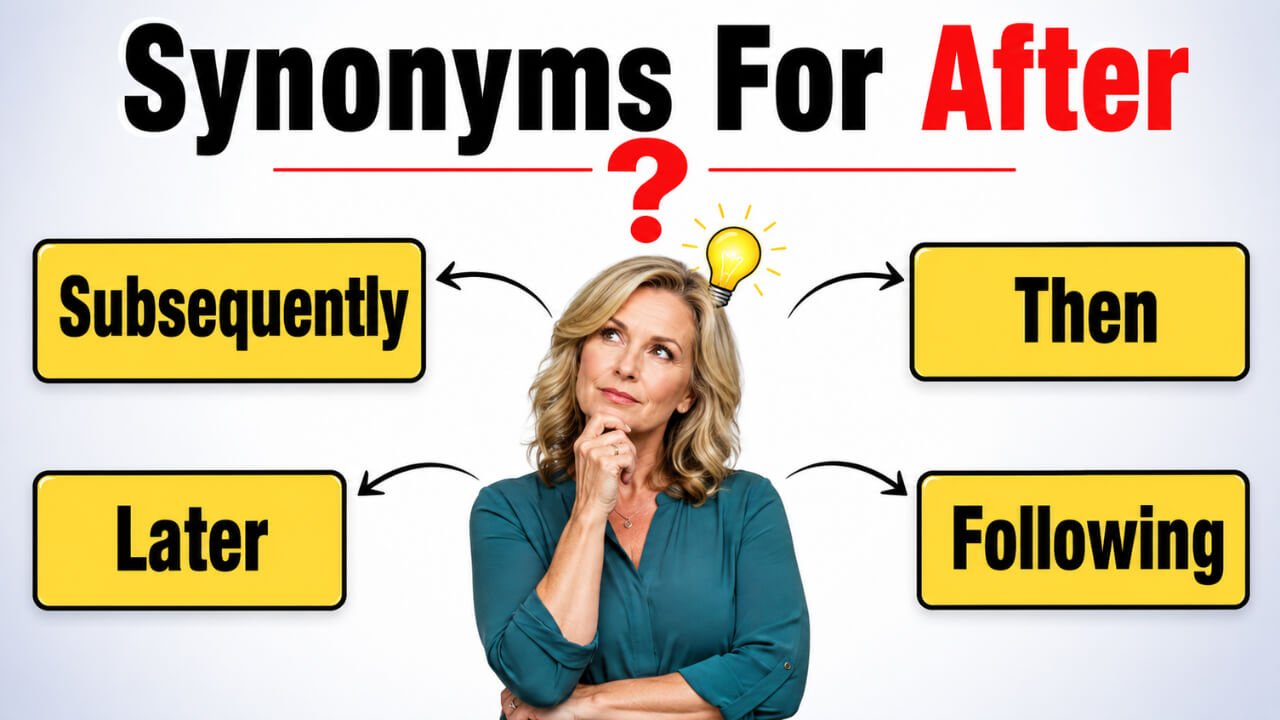
Quick Answer: The best synonyms for after include following, later than, subsequent to, afterward, thereafter, subsequently, next, then, behind, and in the wake of. The best choice depends on context. Use following for general order, later than for time, subsequent to for formal writing, afterward for events that happen later, behind for position, and in the wake of when something happens as a result of an event.
Pronunciation and Word Details
Word: After.
Pronunciation: /ˈæf.tər/.
Part of Speech: Preposition, adverb, conjunction, and adjective.
Meaning: After means later than something in time, following something in order, behind something in position, or seeking something.
US Pronunciation:
UK Pronunciation:
What Does “After” Mean?
After means later than, following, or behind something. It is a flexible word used for time, order, position, sequence, pursuit, and naming.
As a preposition, after connects a noun to another idea, as in “after dinner.” As an adverb, it means later, as in “soon after.” As a conjunction, it connects clauses, as in “after we arrived.” As an adjective, it can describe something that comes later, as in “the after effects.”
The word after is common in everyday speech, essays, instructions, stories, reports, schedules, and grammar examples.
Meaning, Tone, and Context of “After”
After has a neutral tone. It is neither too formal nor too casual, which makes it useful in most writing and conversation.
In formal writing, after often appears in timelines, processes, reports, and academic explanations. In casual speech, it is used for everyday actions, such as “after lunch,” “after school,” or “after work.”
After can also show emotional or practical meaning. For example, “after the accident” suggests a later result or consequence. “After the prize” means trying to get something. “Named after her grandmother” means named in honor of someone.
When and How to Use “After”
For Time: Use after when one thing happens later than another thing.
Example: We went home after the meeting.
For Order: Use after when something comes next in a sequence.
Example: The letter B comes after the letter A.
For Position: Use after when something is behind another thing in a line, list, or physical place.
Example: The child stood after his brother in the queue.
For Pursuit: Use after when someone wants, seeks, or follows something.
Example: She is after a better job.
For Naming: Use after when someone or something is named in honor of another person or thing.
Example: The baby was named after her aunt.
For Consequence: Use after when one situation follows from an event.
Example: After the storm, many roads were closed.
Best Synonyms for After
Following: Coming later in time or order.
Example: Following the announcement, the team answered questions.
Later Than: Happening at a time beyond another time.
Example: Please arrive later than noon.
Subsequent To: Formal phrase meaning after something.
Example: Subsequent to the review, changes were made.
Afterward: At a later time.
Example: We had dinner and talked afterward.
Thereafter: From that time forward.
Example: The rule changed, and thereafter the process became simpler.
Subsequently: Later in a sequence of events.
Example: The report was submitted and subsequently approved.
Next: Immediately after something in order.
Example: Read the next paragraph carefully.
Then: After that time or action.
Example: Finish your notes, then begin the quiz.
Behind: At the back of something or someone.
Example: The car behind us slowed down.
In the Wake of: Happening after and often because of an event.
Example: In the wake of the flood, many families needed help.
50 Synonyms for After with Short Meanings
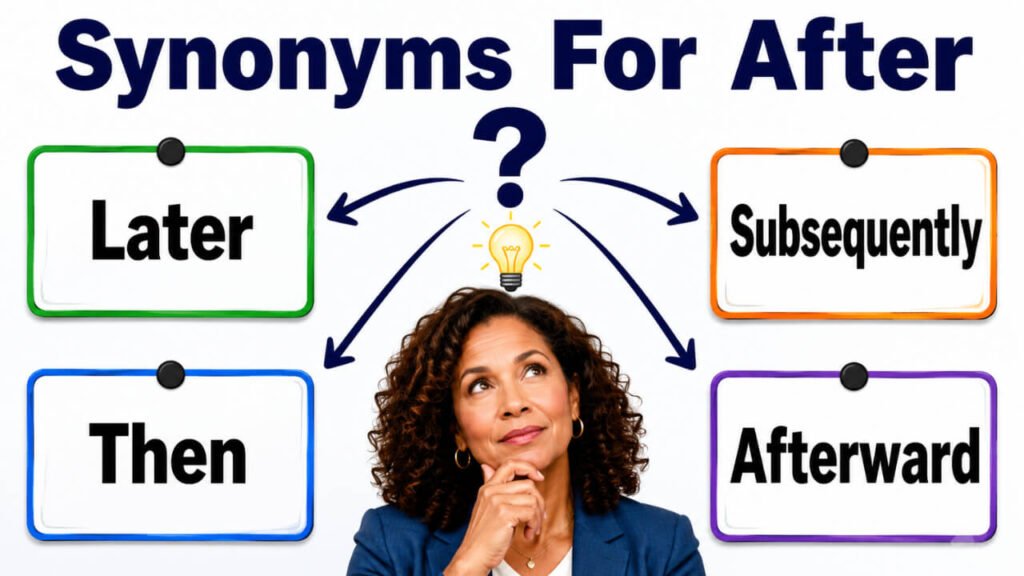
- Following: Coming later in time or order.
- Later Than: Happening beyond a specific time.
- Subsequent To: Formal way to say after.
- Afterward: At a later time.
- Afterwards: Later, especially in common British usage.
- Thereafter: From that time forward.
- Subsequently: Later in a sequence.
- Later: At a future time.
- Then: After that.
- Next: Immediately following.
- Succeeding: Coming after in order.
- Ensuing: Happening immediately after.
- Coming After: Following in time, order, or position.
- In the Wake of: After and usually because of something.
- In the Aftermath of: After a major or difficult event.
- Past: Beyond a point in time or position.
- Beyond: Farther than a point, time, or limit.
- Behind: At the back of someone or something.
- At the Back of: Positioned behind something.
- Following On From: Continuing after a previous point.
- Later On: At a later time.
- From Then On: Starting after that time.
- From That Point: Beginning after a certain moment.
- Once: After something has happened.
- When: At the time after something happens.
- As Soon As: Immediately after something happens.
- Upon: At the time of or just after.
- On Completion Of: After finishing something.
- On Conclusion Of: After something ends.
- Post: After, often in formal or technical wording.
- Subsequent: Coming after something else.
- Future: Coming after the present time.
- Upcoming: Coming soon after now.
- In Pursuit Of: Trying to get or reach something.
- Chasing: Following to catch or get something.
- Seeking: Trying to find or obtain something.
- Looking For: Trying to find something.
- In Search Of: Seeking or trying to find.
- Trying For: Attempting to get something.
- Wanting: Desiring or seeking something.
- Named For: Given a name in honor of someone.
- In Honor Of: Done to respect or remember someone.
- In Memory Of: Done to remember someone who has died.
- In the Style Of: Made like another person or thing.
- In the Manner Of: Done in a similar way.
- Like: Similar to or following the style of.
- According To: Following a rule, plan, or source.
- Based On: Developed from something earlier.
- Because Of: As a result of something.
- Considering: Taking something into account after it happens.
Read Also:
Synonyms for Food

Synonyms for After by Context
When After Means Later in Time
Use these synonyms when something happens at a later time.
Following: Following the lecture, students asked questions.
Later Than: The package arrived later than expected.
Afterward: We cleaned the room afterward.
Subsequently: The issue was reported and subsequently fixed.
Thereafter: She moved abroad and thereafter worked as a teacher.
When After Means Next in Order
Use these alternatives when talking about sequence, lists, steps, or ranking.
Next: Read the next sentence.
Following: The following chapter explains the rule.
Succeeding: The succeeding pages give more examples.
Ensuing: The ensuing discussion was helpful.
Coming After: The section coming after this one includes practice sentences.
When After Means Behind in Position
Use these synonyms when after refers to place or position.
Behind: The second car was behind the first.
At the Back of: He stood at the back of the line.
Past: Walk past the gate and turn right.
Beyond: The office is beyond the main hall.
When After Means Seeking or Trying to Get
Use these options when after means wanting, chasing, or pursuing something.
Seeking: She is seeking a new role.
Looking For: They are looking for a solution.
In Search Of: He traveled in search of better opportunities.
Trying For: The athlete is trying for another medal.
In Pursuit Of: They worked hard in pursuit of success.
When After Means Named in Honor Of
Use these alternatives when a person, place, or thing receives a name because of someone else.
Named For: The school was named for a respected teacher.
In Honor Of: The award was created in honor of her work.
In Memory Of: The garden was planted in memory of a loved one.
When After Means Resulting From an Event
Use these phrases when something happens because of an earlier event.
In the Wake of: In the wake of the decision, many rules changed.
In the Aftermath of: In the aftermath of the fire, families needed support.
Because Of: Because of the delay, the event started late.
Considering: Considering what happened, the response was fair.
Another Word for After
The best single replacement for after is often following because it works for time, order, and events. However, the best alternative depends on the sentence. Use afterward when you mean later, behind when you mean position, and seeking when after means trying to get something.
Original: We spoke after the class.
Better Option: We spoke following the class.
Original: She called me after.
Better Option: She called me afterward.
Original: The dog ran after the ball.
Better Option: The dog chased the ball.
Original: He is after a promotion.
Better Option: He is seeking a promotion.
When Not to Use “After”
Do not use after when a more specific word would make the meaning clearer. After can sound weak if the sentence needs exact timing, formal sequence, position, or cause.
Weak: After the problem, the system changed.
Better: Following the problem, the system changed.
Weak: She came after.
Better: She came afterward.
Weak: He stood after me.
Better: He stood behind me.
Weak: The company acted after the complaint.
Better: The company acted in response to the complaint.
Weak: She is after a scholarship.
Better: She is seeking a scholarship.
Words Commonly Confused With After
After vs Later: After usually needs a reference point, while later can stand alone. Say “after dinner” or “later in the evening.”
After vs Following: After is more common in speech, while following can sound smoother in formal writing.
After vs Subsequently: After is simple and direct, while subsequently is formal and often used in reports or chronological explanations.
After vs Behind: After can mean behind in order or position, but behind is clearer for physical place.
After vs Since: After means later than an event, while since means from a past time until now.
After vs Afterwards: After often connects to a noun or clause, while afterwards means later and usually stands alone.
After vs Next: After can refer to any later point, while next usually means immediately following.
Which Synonym Should You Choose?
Choose following when writing about events, steps, meetings, decisions, or formal sequence.
Choose later than when you need to show exact time comparison.
Choose afterward when the meaning is simply later.
Choose subsequently when writing formal reports, research style content, or ordered events.
Choose thereafter when you mean from that time forward.
Choose next when something comes immediately after another item.
Choose behind when talking about position or place.
Choose seeking when after means trying to get something.
Choose in the wake of when something happens after and because of an important event.
Choose named for when after means named in honor of someone.
Real Life Examples of “After” in Sentences
Original: We left after the ceremony.
Better Option: We left following the ceremony.
Original: She called after lunch.
Better Option: She called later than lunch.
Original: The team improved after the training.
Better Option: The team improved following the training.
Original: He stood after his friend in line.
Better Option: He stood behind his friend in line.
Original: The company changed its rules after the complaint.
Better Option: The company changed its rules in the wake of the complaint.
Original: She is after a better opportunity.
Better Option: She is seeking a better opportunity.
Original: The baby was named after his grandfather.
Better Option: The baby was named for his grandfather.
Original: Finish the first task after the second one.
Better Option: Finish the first task following the second one.
Original: They discussed the matter after.
Better Option: They discussed the matter afterward.
Original: After the storm, the roads were blocked.
Better Option: In the aftermath of the storm, the roads were blocked.
Synonym Groups and Usage Differences
Time Group
This group includes later, afterward, subsequently, thereafter, and later on. Use these words when one action happens at a later time.
Example: She finished her work and afterward went for a walk.
Order Group
This group includes following, next, succeeding, ensuing, and coming after. Use these words for lists, steps, chapters, rankings, and sequences.
Example: The following section explains the answer.
Position Group
This group includes behind, at the back of, past, and beyond. Use these words when after means location or physical position.
Example: The library is beyond the main entrance.
Pursuit Group
This group includes seeking, looking for, chasing, in search of, and in pursuit of. Use these when after means wanting or trying to get something.
Example: She is in pursuit of a meaningful career.
Result Group
This group includes in the wake of, in the aftermath of, because of, and considering. Use these when one event leads to another situation.
Example: In the wake of the change, the process became easier.
Naming Group
This group includes named for, in honor of, and in memory of. Use these when after means giving a name because of respect, memory, or family connection.
Example: The park was named for a local leader.
Antonyms of After
Antonyms of after depend on the meaning. If after means later in time, the opposite is before. If after means behind, the opposite is ahead or in front of. If after means seeking, the opposite may be avoiding or ignoring.
Before: Earlier than something.
Earlier: Happening before a later time.
Prior To: Formal way to say before.
Previously: At an earlier time.
Ahead Of: In front of someone or something.
In Front Of: Positioned before someone or something.
Preceding: Coming before in order.
Former: Existing before the current one.
Avoiding: Staying away from something.
Ignoring: Not paying attention to something.
Comparison: After vs Related Words
After vs Following
After is common and simple. Following is smoother and more formal in writing.
Example With After: We met after the event.
Example With Following: We met following the event.
After vs Later
After needs a reference point more often. Later can stand alone when the time is already understood.
Example With After: She arrived after dinner.
Example With Later: She arrived later.
After vs Subsequently
After is everyday language. Subsequently is formal and better for reports, timelines, and ordered explanations.
Example With After: The form was reviewed after submission.
Example With Subsequently: The form was reviewed and subsequently approved.
After vs Behind
After can show order, but behind is clearer for physical position.
Example With After: He was after me in line.
Example With Behind: He was behind me in line.
After vs Since
After points to a later time. Since shows a period from the past until now.
Example With After: She changed jobs after graduation.
Example With Since: She has worked there since graduation.
After vs Afterwards
After often connects to a noun or clause. Afterwards usually means later and stands alone.
Example With After: We talked after the meeting.
Example With Afterwards: We talked afterwards.
Common Phrases and Expressions With After
After All: Used when giving a reason or final point.
Day After Day: Repeatedly over many days.
After Hours: Outside normal working time.
After School: Later than the school day.
After Work: Later than the workday.
After Dinner: Later than the evening meal.
After a While: Later, but not immediately.
After the Fact: After something has already happened.
Named After: Given the same name as someone or something.
Run After: Chase or follow quickly.
Common Mistakes to Avoid
One common mistake is using after when the sentence needs a clearer time word. If you mean later by itself, afterward may be better.
Another mistake is using after for physical position when behind sounds more natural. Say “behind me in line” instead of “after me in line” when talking about placement.
Writers also overuse after in repeated sentences. Instead of writing “after this” again and again, use following this, next, then, or subsequently.
Avoid choosing a formal synonym in casual speech. Subsequent to lunch sounds unnatural in everyday conversation. After lunch is better.
Also avoid using weak alternatives that change the meaning. Because of is not always a synonym for after. It only works when the sentence shows cause or result.
Conclusion
Learning synonyms for after helps you write with clearer time, order, position, and meaning. Use following for a strong general replacement, afterward for later actions, subsequently for formal sequence, behind for position, and seeking when after means trying to get something. The best synonym depends on context, so always match the word to the sentence. Clear word choice makes grammar, vocabulary, and writing easier to understand.
FAQs About Synonyms for After
What are the best synonyms for after?
The best synonyms for after are following, later than, subsequent to, afterward, thereafter, subsequently, next, and then.
What is another word for after in formal writing?
A good formal synonym for after is following. You can also use subsequent to or subsequently in reports, essays, and professional writing.
Can I use following instead of after?
Yes, following can replace after in many sentences. It works well when talking about events, meetings, rules, steps, or decisions.
What is the difference between after and afterward?
After usually connects to a noun or clause, as in “after dinner.” Afterward means later and often stands alone, as in “We talked afterward.”
What is a synonym for after when talking about position?
Use behind when after means physical position. For example, “He stood behind me” is clearer than “He stood after me.”
What is a synonym for after when talking about pursuit?
Use seeking, looking for, chasing, or in pursuit of when after means trying to get something.
What is the opposite of after?
The main opposite of after is before. Other antonyms include earlier, prior to, preceding, ahead of, and in front of, depending on the context.
