
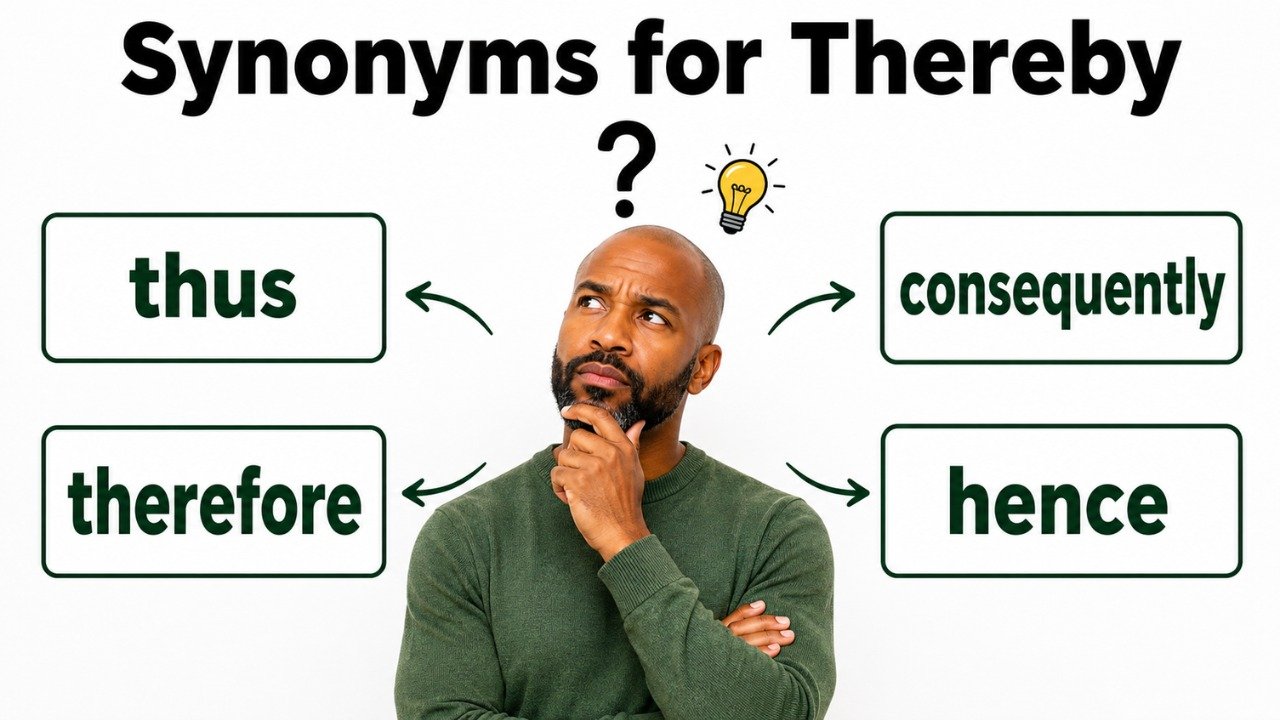
Quick Answer: The best synonyms for thereby include therefore, thus, consequently, hence, accordingly, as a result, by that means, in this way, by doing so, and for that reason. Use therefore, thus, or consequently in formal writing to show a result. Use by that means or in this way when explaining a method. In casual language, as a result and by doing so often sound more natural and direct.
Pronunciation and Word Details
Word: Thereby.
Pronunciation: /ˌðerˈbaɪ/
Part of Speech: Adverb.
Meaning: By that action, method, or circumstance, or as a result of it.
US Pronunciation:
UK Pronunciation:
What Does “Thereby” Mean?
Thereby means by that means or as a result of a particular action, event, or situation. It is an adverb commonly used to connect an action with its consequence.
The word combines two ideas. It can explain how something happens, or it can show what result follows from an action.
Method Meaning: The new system reduced manual work, thereby saving employees several hours.
In this sentence, thereby means by doing that.
Result Meaning: The company lowered its prices, thereby attracting more customers.
Here, thereby introduces the result of lowering the prices.
Thereby often appears after a comma and before a verb ending in ing. This structure allows writers to connect an action and its result without creating a separate sentence.
Example: She completed the training, thereby improving her professional skills.
The word is especially useful in formal, academic, legal, technical, and professional writing. In ordinary conversation, people are more likely to use phrases such as as a result, by doing so, or in this way.
Meaning, Tone, and Context of “Thereby”
Thereby has a formal, neutral, and logical tone. It does not usually express emotion. Instead, it clearly explains a relationship between an action and an outcome.
Formal Context: Thereby is common in essays, reports, contracts, policies, instructions, and professional documents.
Academic Context: Researchers use thereby when explaining how one action affects a process, result, or conclusion.
Technical Context: The word can connect a procedure with the effect it produces.
Legal Context: Thereby may explain what becomes possible, valid, required, or established through a particular action.
Professional Context: It helps writers describe benefits, consequences, responsibilities, and improvements concisely.
Conversational Context: Thereby can sound unusually formal in casual speech. As a result, by doing so, and in this way usually sound more natural.
Tone: The word is objective and precise rather than emotional or persuasive.
Main Function: It shows that one event happens through, because of, or as a consequence of another event.
When and How to Use “Thereby”
To Show a Direct Result
Use thereby when one action directly produces an outcome.
Explanation: The word helps readers see a clear connection between a cause and its consequence.
Example: The team simplified the process, thereby reducing unnecessary delays.
To Explain a Method
Use thereby when something is achieved through a particular action.
Explanation: In this use, thereby means by that means or through that action.
Example: She signed the agreement, thereby confirming her acceptance.
To Connect Related Actions
Use thereby to combine two closely related actions in one sentence.
Explanation: This avoids writing two separate sentences when the second action is a natural result of the first.
Example: He shared the updated schedule, thereby keeping everyone informed.
To Describe an Improvement
Use thereby when an action improves a condition, process, or result.
Explanation: It is useful for explaining benefits in reports and professional writing.
Example: The school added more study spaces, thereby improving the learning environment.
To Explain a Consequence
Use thereby when an action creates a positive, negative, or neutral consequence.
Explanation: The consequence should follow logically from the first action.
Example: She ignored the warning, thereby increasing the risk of failure.
To Express Enablement
Use thereby when one action makes another action possible.
Explanation: In this context, enabling or allowing may also work as alternatives.
Example: The software stores the information securely, thereby allowing users to retrieve it later.
To Present a Formal Conclusion
Use thereby in formal explanations that move from an action to its logical outcome.
Explanation: Therefore, thus, and consequently can sometimes replace it, although the sentence structure may need to change.
Example: The applicant met every requirement, thereby becoming eligible for consideration.
Best Synonyms for Thereby
Therefore
Synonym: Therefore means for that reason or as a logical result.
Example: The evidence was incomplete. Therefore, no final conclusion was reached.
Thus
Synonym: Thus means in this way or as a result.
Example: The instructions were clarified, thus preventing further confusion.
Consequently
Synonym: Consequently means as a consequence of something previously mentioned.
Example: The roads were flooded. Consequently, several journeys were delayed.
Hence
Synonym: Hence means for this reason or from this point.
Example: The material is highly durable, hence its popularity in construction.
Accordingly
Synonym: Accordingly means in a way that is appropriate to the facts or as a result.
Example: The deadline was extended, and the schedule was adjusted accordingly.
As a Result
Synonym: As a result introduces an outcome caused by an earlier action or event.
Example: The company improved its service. As a result, customer satisfaction increased.
By That Means
Synonym: By that means explains the method through which something is achieved.
Example: She organized the information carefully and, by that means, made the report easier to understand.
In This Way
Synonym: In this way means through this method or action.
Example: The teacher divided the lesson into smaller parts. In this way, the students understood it more easily.
By Doing So
Synonym: By doing so refers directly to the result of an action just mentioned.
Example: He checked every figure twice. By doing so, he avoided several mistakes.
For That Reason
Synonym: For that reason introduces a conclusion based on a previous fact.
Example: The equipment was unsafe. For that reason, its use was prohibited.
50 Synonyms for Thereby With Short Meanings
- Therefore: For that reason or as a logical result.
- Thus: In this manner or as a consequence.
- Consequently: As a result of what happened.
- Hence: For this reason.
- Accordingly: As a suitable or logical result.
- As a Result: Because of the action or situation mentioned.
- For That Reason: Because of the stated fact.
- By That Means: Through the method just described.
- In This Way: Through this particular action or method.
- By Doing So: As a result of performing that action.
- As a Consequence: As an outcome of something.
- Because of That: Due to the previous action or situation.
- Due to That: Caused by the matter already mentioned.
- Owing to That: Resulting from the previous circumstance.
- On That Account: For the reason already stated.
- Through That: By means of the action mentioned.
- Through This: By using the present method or action.
- By This Means: Through the method currently being discussed.
- Using That Method: By following the stated process.
- Through That Action: As a result of the action described.
- In Doing So: While performing that action and producing a result.
- In Consequence: As a result of a previous event.
- With That Result: Producing the stated outcome.
- With the Result That: Leading directly to a particular consequence.
- Resulting In: Producing a particular outcome.
- Leading To: Causing something to happen afterward.
- Which Causes: Introducing the effect of an earlier action.
- Which Leads To: Showing the outcome created by something.
- Giving Rise To: Causing a situation or condition to develop.
- Bringing About: Making a result happen.
- Producing: Creating a particular effect or outcome.
- Creating: Causing something new to exist or happen.
- Generating: Producing a result, response, or effect.
- Yielding: Producing a result after an action or process.
- Causing: Making something happen.
- Prompting: Causing a reaction or further action.
- Triggering: Starting a process, reaction, or event.
- Enabling: Making an action or result possible.
- Allowing: Making it possible for something to occur.
- Facilitating: Making a process easier or more achievable.
- Ensuring: Making a particular result certain or likely.
- Achieving: Successfully producing the intended result.
- Accomplishing: Completing or bringing about an aim.
- Attaining: Reaching a desired condition or result.
- Effecting: Causing a planned change to happen.
- Making Possible: Creating the conditions needed for something.
- Making It Possible To: Allowing a later action to happen.
- In Turn: Introducing a result that follows from another result.
- So: Introducing a consequence in informal language.
- Whereby: Through which a result is achieved in a related sentence structure.
Read Also:
Synonyms for She

Synonyms for Thereby by Context
When Thereby Means As a Result
Use result based synonyms when the sentence focuses on the consequence of an action.
Useful choices include therefore, consequently, hence, accordingly, as a result, and for that reason.
Example With Thereby: The company improved its delivery process, thereby increasing customer satisfaction.
Example With As a Result: The company improved its delivery process. As a result, customer satisfaction increased.
Example With Consequently: The company improved its delivery process. Consequently, customer satisfaction increased.
Therefore and consequently usually begin a new independent clause or sentence. Thereby normally introduces a phrase connected to the first clause.
When Thereby Means By That Means
Use method based alternatives when the sentence explains how a result was achieved.
Useful choices include by that means, in this way, through that action, by this means, and using that method.
Example With Thereby: She created a detailed budget, thereby controlling unnecessary spending.
Example With In This Way: She created a detailed budget. In this way, she controlled unnecessary spending.
Example With By That Means: She created a detailed budget and, by that means, controlled unnecessary spending.
These options are especially helpful when the method is more important than the general result.
When Thereby Means By Doing So
Use by doing so or in doing so when the action has just been clearly stated.
Example With Thereby: He reviewed the contract carefully, thereby avoiding an expensive mistake.
Example With By Doing So: He reviewed the contract carefully. By doing so, he avoided an expensive mistake.
Example With In Doing So: He reviewed the contract carefully and, in doing so, avoided an expensive mistake.
By doing so sounds natural in professional and conversational writing. In doing so often fits smoothly within one sentence.
When Thereby Introduces a Consequence
Use resulting in, leading to, causing, producing, or giving rise to when the sentence emphasizes what the first action created.
Example With Thereby: The storm damaged the power lines, thereby leaving the area without electricity.
Example With Resulting In: The storm damaged the power lines, resulting in a loss of electricity across the area.
Example With Causing: The storm damaged the power lines, causing a widespread power failure.
These alternatives can make the specific relationship between the action and its outcome more vivid.
When Thereby Means Making Something Possible
Use enabling, allowing, facilitating, or making it possible to when the first action creates an opportunity or ability.
Example With Thereby: The new bridge connects the two towns, thereby allowing residents to travel more easily.
Example With Allowing: The new bridge connects the two towns, allowing residents to travel more easily.
Example With Enabling: The new bridge connects the two towns, enabling residents to travel more easily.
Enabling is often more formal than allowing. Facilitating is useful when an action makes a process easier rather than directly causing it.
When Thereby Appears in Academic Writing
Academic alternatives include thus, consequently, resulting in, leading to, and in consequence.
Example With Thereby: The treatment reduced inflammation, thereby improving the participants’ mobility.
Example With Thus: The treatment reduced inflammation, thus improving the participants’ mobility.
Example With Resulting In: The treatment reduced inflammation, resulting in improved mobility among the participants.
Thus is concise and formal. Resulting in often provides a clearer description of an observed outcome.
Another Word for Thereby
The best single word replacement for thereby is often thus. Both words can express a method or result, and both suit formal writing.
However, thus is not always grammatically interchangeable with thereby. The best alternative depends on whether the sentence emphasizes a consequence, a method, or an opportunity created by an action.
Original: The organization reduced waste, thereby lowering its operating costs.
Better Option: The organization reduced waste, thus lowering its operating costs.
Original: She explained every stage clearly, thereby helping the audience follow the process.
Better Option: She explained every stage clearly, which helped the audience follow the process.
Original: The application stores files online, thereby allowing access from different devices.
Better Option: The application stores files online, enabling access from different devices.
Original: He submitted the required documents, thereby completing the application process.
Better Option: He submitted the required documents and, by doing so, completed the application process.
When Not to Use “Thereby”
Thereby is useful, but it can sound stiff, repetitive, or unclear when used in the wrong setting.
In Very Casual Conversation
Thereby may sound overly formal in ordinary speech.
Weak: I left home early, thereby getting to the café before everyone else.
Better: I left home early, so I reached the café before everyone else.
When the Result Is Not Direct
Do not use thereby when the second event is only loosely connected to the first.
Weak: She bought a new notebook, thereby receiving an unexpected phone call.
Better: She bought a new notebook, and later she received an unexpected phone call.
The phone call was not caused by buying the notebook, so thereby creates a false relationship.
When a More Specific Verb Is Clearer
A precise word such as enabling, causing, preventing, or allowing can communicate the relationship more effectively.
Weak: The password protects the account, thereby stopping unauthorized access.
Better: The password protects the account, preventing unauthorized access.
When It Creates an Awkward Sentence
Thereby should normally connect a clear action to a logical result.
Weak: The report was detailed, thereby the manager approved it.
Better: The report was detailed. Therefore, the manager approved it.
Thereby cannot normally replace therefore directly before a complete independent clause.
When It Is Repeated Too Often
Repeated use can make formal writing sound mechanical.
Weak: The company hired more staff, thereby increasing production, thereby improving delivery times, thereby raising customer satisfaction.
Better: The company hired more staff, which increased production and improved delivery times. As a result, customer satisfaction rose.
When the Meaning Is Vague
Readers should be able to identify exactly which action created the result.
Weak: Several changes were introduced, thereby improving it.
Better: The revised scheduling system reduced delays, thereby improving service efficiency.
Words Commonly Confused With Thereby
Thereby vs Therefore: Thereby usually means by that action or as a result of doing something. Therefore means for that reason and often introduces a complete conclusion.
Example With Thereby: She accepted the conditions, thereby completing the agreement.
Example With Therefore: She accepted the conditions. Therefore, the agreement was completed.
Thereby vs Thus: Both words can show a result. Thus can also mean in this manner and is often more flexible in formal writing.
Example With Thereby: The device uses less energy, thereby reducing operating costs.
Example With Thus: The device uses less energy, thus reducing operating costs.
Thereby vs Consequently: Consequently emphasizes a consequence and commonly begins a new sentence or independent clause. Thereby usually connects the result directly to the action within the same sentence.
Example With Thereby: Demand increased, thereby raising prices.
Example With Consequently: Demand increased. Consequently, prices rose.
Thereby vs Hence: Hence means for this reason and often introduces a conclusion. Thereby more clearly expresses that a result occurs through an action.
Example With Thereby: She completed the course, thereby gaining the required qualification.
Example With Hence: She had the required qualification, hence her eligibility for the position.
Thereby vs Whereby: Thereby means by that means or as a result. Whereby means by which and normally introduces a method, arrangement, or system.
Example With Thereby: He transferred the ownership, thereby ending his legal responsibility.
Example With Whereby: They created an arrangement whereby ownership could be transferred.
Thereby vs Thereafter: Thereby shows method or result. Thereafter means after that time.
Example With Thereby: The policy was revised, thereby improving clarity.
Example With Thereafter: The policy was revised, and all later decisions were made thereafter.
Thereby vs Therein: Thereby means by that action. Therein means in that place, document, situation, or matter.
Example With Thereby: She signed the form, thereby giving her consent.
Example With Therein: The contract and the conditions stated therein were reviewed.
Thereby vs Therefrom: Thereby means through that action or as a result. Therefrom means from that source, place, or fact.
Example With Thereby: The rule was clarified, thereby preventing confusion.
Example With Therefrom: The rule was clarified, and several conclusions followed therefrom.
Which Synonym Should You Choose?
Choose therefore when introducing a logical conclusion in a separate sentence or complete clause.
Choose thus when you need a concise, formal replacement that can express either manner or result.
Choose consequently when you want to emphasize the consequence of an earlier event.
Choose hence when presenting a compact formal conclusion or explaining why something follows.
Choose accordingly when an action is taken in response to a fact, instruction, or situation.
Choose as a result when you want a clear and natural expression that works in both formal and general writing.
Choose by that means when the sentence focuses on the method used to achieve a result.
Choose in this way when explaining a process, instruction, or practical method.
Choose by doing so when referring directly to an action mentioned in the previous sentence.
Choose resulting in when the second part of the sentence describes a measurable or visible outcome.
Choose leading to when the action begins a process that ends in a particular result.
Choose enabling when an action gives someone the ability or opportunity to do something.
Choose allowing when you want a simpler and more natural alternative to enabling.
Choose preventing when the first action stops an unwanted result.
Choose causing when the relationship is direct and the effect is clearly produced by the first action.
Real Life Examples of “Thereby” in Sentences
Original: She turned off unnecessary lights, thereby reducing her electricity use.
Better Option: She turned off unnecessary lights, thus reducing her electricity use.
Original: The manager clarified each responsibility, thereby preventing confusion among the staff.
Better Option: The manager clarified each responsibility, which prevented confusion among the staff.
Original: He saved part of his income every month, thereby building an emergency fund.
Better Option: He saved part of his income every month and, by doing so, built an emergency fund.
Original: The city expanded its bus service, thereby giving residents more travel options.
Better Option: The city expanded its bus service, giving residents more travel options.
Original: The student checked her calculations, thereby identifying two errors.
Better Option: The student checked her calculations and, as a result, identified two errors.
Original: The website simplified its navigation, thereby improving the visitor experience.
Better Option: The website simplified its navigation, resulting in a better visitor experience.
Original: The doctor adjusted the treatment, thereby reducing the patient’s discomfort.
Better Option: The doctor adjusted the treatment, which reduced the patient’s discomfort.
Original: The business introduced flexible hours, thereby allowing employees to manage their time more effectively.
Better Option: The business introduced flexible hours, enabling employees to manage their time more effectively.
Original: The committee published the criteria, thereby making the selection process more transparent.
Better Option: The committee published the criteria and, in this way, made the selection process more transparent.
Original: The engineer strengthened the structure, thereby increasing its resistance to heavy pressure.
Better Option: The engineer strengthened the structure, consequently increasing its resistance to heavy pressure.
Synonym Groups and Usage Differences
Result Group
This group includes therefore, consequently, hence, accordingly, as a result, and for that reason.
These words explain that one fact, action, or situation produces a conclusion or outcome. They often work best at the beginning of a new sentence.
Example: The original plan was too expensive. Consequently, a less costly option was selected.
Method Group
This group includes by that means, in this way, by this means, through that action, and using that method.
These alternatives explain how a goal or outcome is achieved.
Example: The instructor demonstrated each step slowly. In this way, every learner could follow the process.
Action Reference Group
This group includes by doing so, in doing so, and through this.
These phrases refer back to a clearly stated action.
Example: She organized all the records by date. By doing so, she made future searches much easier.
Consequence Phrase Group
This group includes resulting in, leading to, giving rise to, causing, and producing.
These alternatives fit naturally before a noun phrase and describe the specific outcome of an action.
Example: The river overflowed, resulting in damage to several nearby roads.
Enablement Group
This group includes enabling, allowing, facilitating, and making possible.
These words show that an action creates an opportunity, ability, or easier process.
Example: The new entrance includes a ramp, enabling more visitors to enter the building safely.
Achievement Group
This group includes achieving, attaining, accomplishing, and effecting.
These alternatives emphasize the result successfully produced by an action.
Example: The team reorganized its workflow, achieving a significant improvement in efficiency.
Informal Result Group
This group includes so, because of that, and as a result.
These choices are clearer and more natural than thereby in everyday communication.
Example: The train was delayed, so we arrived later than expected.
Antonyms of Thereby
Thereby has no single exact antonym because it describes either a method or a result. Its contextual opposites are words and phrases that deny a result, show contrast, or indicate that an action failed to produce an expected effect.
Nevertheless: In spite of what happened.
Nonetheless: Despite the previous fact.
However: Used to introduce a contrasting result.
Even So: Despite that situation.
Despite That: Without being prevented or changed by the earlier fact.
In Spite of That: Contrary to the expected result.
Independently: Without depending on the stated action or method.
Unrelatedly: Without a meaningful connection to the previous action.
Without Effect: Producing no result.
Unsuccessfully: Without achieving the intended outcome.
Preventing: Stopping a result rather than producing it.
Hindering: Making a result harder to achieve.
Obstructing: Blocking a process or outcome.
Failing to Enable: Not creating the ability or opportunity needed.
Regardless: Without being affected by the stated fact or action.
Comparison of Thereby With Related Words
Thereby vs Therefore
Thereby links an action directly to the method or result it produces. Therefore introduces a conclusion based on a previous statement.
Example With Thereby: The company reduced packaging, thereby lowering its material costs.
Example With Therefore: Packaging costs had become excessive. Therefore, the company reduced its use of materials.
Thereby vs Thus
Thereby strongly suggests through that action. Thus can mean either in this manner or as a result.
Example With Thereby: He followed the safety procedure, thereby avoiding injury.
Example With Thus: He followed the safety procedure, thus avoiding injury.
Thus is usually the closest one word alternative, but it may sound slightly more general.
Thereby vs Consequently
Thereby often appears within the same sentence as the action. Consequently commonly introduces a separate statement about the result.
Example With Thereby: The temperature fell sharply, thereby increasing the demand for heating.
Example With Consequently: The temperature fell sharply. Consequently, the demand for heating increased.
Thereby vs As a Result
Thereby is compact and formal. As a result is clearer and more natural across a wider range of contexts.
Example With Thereby: The company expanded its support team, thereby reducing response times.
Example With As a Result: The company expanded its support team. As a result, response times decreased.
Thereby vs By Doing So
Thereby usually connects two ideas within one sentence. By doing so often begins a new sentence and refers back to the previous action.
Example With Thereby: She recorded every expense, thereby improving her financial awareness.
Example With By Doing So: She recorded every expense. By doing so, she improved her financial awareness.
Thereby vs Resulting In
Thereby emphasizes the connection between an action and a result. Resulting in places greater attention on the outcome itself.
Example With Thereby: The machine overheated, thereby damaging several internal parts.
Example With Resulting In: The machine overheated, resulting in damage to several internal parts.
Thereby vs Enabling
Thereby can introduce any type of result. Enabling specifically means making an action or condition possible.
Example With Thereby: The new system shares information instantly, thereby improving coordination.
Example With Enabling: The new system shares information instantly, enabling teams to coordinate more effectively.
Thereby vs Whereby
Thereby refers to a result created by an action. Whereby introduces a method or arrangement through which something happens.
Example With Thereby: They changed the agreement, thereby removing the restriction.
Example With Whereby: They created an agreement whereby either party could request a change.
Common Phrases and Expressions With Thereby
Thereby Causing: Producing a particular effect through an earlier action.
Example: The blockage restricted the flow, thereby causing pressure to increase.
Thereby Allowing: Making a later action possible.
Example: The door was widened, thereby allowing larger equipment to pass through.
Thereby Enabling: Giving someone or something the ability to act.
Example: The course teaches practical skills, thereby enabling learners to work independently.
Thereby Reducing: Causing an amount, risk, cost, or problem to become smaller.
Example: The insulation retains heat, thereby reducing energy use.
Thereby Increasing: Causing a quantity, level, chance, or effect to become greater.
Example: The campaign reached new audiences, thereby increasing public awareness.
Thereby Improving: Producing a positive change in quality, performance, or condition.
Example: The team reviewed its procedures, thereby improving overall efficiency.
Thereby Preventing: Stopping an unwanted event or result.
Example: The files were backed up regularly, thereby preventing permanent data loss.
Thereby Ensuring: Making a desired result more certain.
Example: Every application was checked twice, thereby ensuring a fair review.
Thereby Creating: Producing a new situation, condition, or opportunity.
Example: The walls were removed, thereby creating a larger working area.
Thereby Making: Causing something to become different or possible.
Example: The instructions were simplified, thereby making the task easier to complete.
Common Mistakes to Avoid
Using Thereby Before a Complete Clause
Thereby does not normally connect two complete clauses in the same way as therefore.
Incorrect: The road was closed, thereby we took another route.
Correct: The road was closed, so we took another route.
Correct: The road was closed, thereby forcing us to take another route.
Confusing Thereby With Therefore
Therefore means for that reason. Thereby means by that action or as a result of it.
Incorrect: The machine was damaged. Thereby, it could not be used.
Correct: The machine was damaged. Therefore, it could not be used.
Using an Unclear Reference
The action connected to thereby should be easy to identify.
Unclear: Several things changed, thereby improving the situation.
Clear: The company shortened its approval process, thereby improving response times.
Suggesting a False Cause
Do not use thereby when the second event is unrelated to the first.
Incorrect: He opened the window, thereby receiving an email.
Correct: He opened the window and then received an email.
Choosing a Word That Is Too Formal
Thereby may sound unnatural in friendly messages or everyday conversation.
Too Formal: I brought an umbrella, thereby staying dry.
Natural: I brought an umbrella, so I stayed dry.
Repeating Thereby
Using the word repeatedly can make writing feel rigid and mechanical.
Repetitive: The system saves time, thereby reducing costs and thereby improving productivity.
Improved: The system saves time, reduces costs, and improves productivity.
Using Thereby Without a Logical Result
The second part should express a direct method, effect, opportunity, or consequence.
Weak: The book was long, thereby having a blue cover.
Better: The book included detailed examples, thereby helping readers understand the subject.
Choosing an Inaccurate Synonym
Therefore, thus, whereby, and thereby are related, but they do not always follow the same grammar.
Advice: Check whether the sentence needs a result connector, a method phrase, or a word showing enablement before choosing a replacement.
Conclusion
Synonyms for thereby include therefore, thus, consequently, hence, as a result, by that means, in this way, and by doing so. Choose therefore or consequently for a logical conclusion, thus for concise formal writing, and as a result for clear general communication. Use by that means or in this way when explaining a method. Enabling, allowing, resulting in, and causing are stronger choices when the exact relationship between an action and its outcome needs to be stated clearly.
FAQs About Synonyms for Thereby
What Is the Best Synonym for Thereby?
Thus is often the closest one word synonym. However, as a result, by doing so, or thereby may be better depending on the sentence structure and intended meaning.
Can Therefore Replace Thereby?
Therefore can replace the result meaning of thereby, but the sentence usually needs to be rewritten. Therefore commonly introduces a complete clause, while thereby often introduces a phrase.
Is Thereby a Formal Word?
Yes. Thereby has a formal and neutral tone. It is common in academic, legal, technical, and professional writing.
What Is a Casual Alternative to Thereby?
So, as a result, by doing so, and in this way are natural alternatives for casual or everyday communication.
What Is the Difference Between Thereby and Thus?
Thereby means by that action or as a result of it. Thus can mean in this way or therefore. Thus is often more flexible, while thereby more directly refers to the action just mentioned.
Can Thereby Begin a Sentence?
Thereby can begin a sentence, but this use is uncommon and often sounds legal or highly formal. In most writing, therefore, as a result, or by doing so sounds more natural at the beginning.
What Part of Speech Is Thereby?
Thereby is an adverb. It modifies a phrase or statement by showing the method or result connected to an earlier action.
