
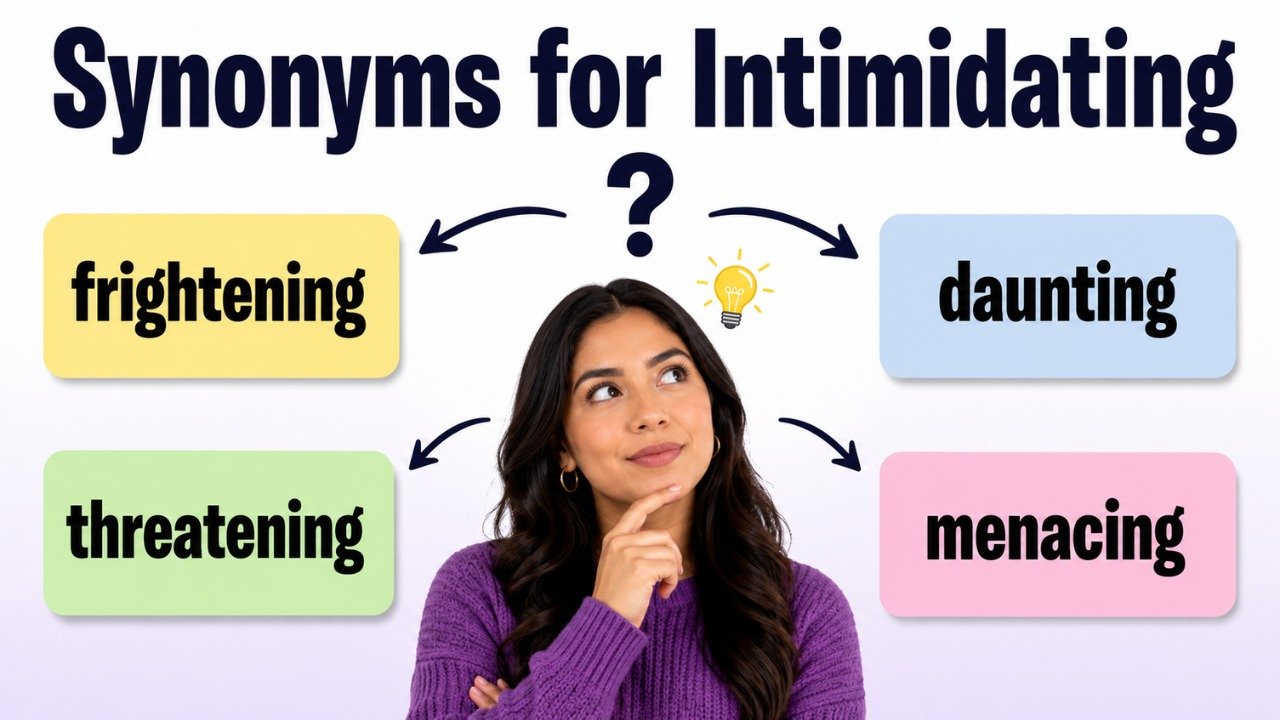
Quick Answer: The best synonyms for intimidating include daunting, threatening, formidable, imposing, menacing, frightening, unnerving, overwhelming, forbidding, and commanding. Use daunting for a difficult task, challenge, or responsibility. Choose threatening or menacing when a person or action suggests possible harm. Formidable suits a powerful opponent, obstacle, or competitor, while imposing describes an impressive appearance, size, or presence. Unnerving works for situations that reduce confidence, and overwhelming fits experiences that feel emotionally or mentally difficult to manage.
Pronunciation and Word Details
Word: Intimidating.
Pronunciation: /ɪnˈtɪmədeɪtɪŋ/
Part of Speech: Adjective and present participle of the verb intimidate.
Meaning: Making someone feel nervous, afraid, less confident, or unwilling to act.
US Pronunciation:
UK Pronunciation:
What Does “Intimidating” Mean?
Intimidating means causing someone to feel afraid, nervous, uncertain, or less confident. It usually describes a person, appearance, action, place, task, or situation that seems difficult to face.
As an adjective, intimidating describes the source of fear or pressure. For example, an intimidating manager causes employees to feel nervous, while an intimidating examination appears difficult or stressful.
The word can describe direct behavior, such as aggressive language, threats, a severe expression, or an attempt to control someone. It can also describe something that is not intentionally frightening. A large building, complex project, talented opponent, or unfamiliar process may feel intimidating even when no one is trying to create fear.
Intimidating often works before a noun, as in intimidating presence, intimidating challenge, or intimidating expression. It can also appear after a linking verb.
Example: The interview process seemed intimidating.
The meaning changes slightly according to context. A person may be intimidating because of authority, confidence, physical size, reputation, or aggressive behavior. A task may be intimidating because it appears complicated, demanding, or difficult to complete.
Meaning, Tone, and Context of “Intimidating”
Intimidating has a negative or uneasy tone because it describes something that reduces confidence or creates fear. However, it does not always suggest cruelty, danger, or deliberate aggression.
In everyday conversation, intimidating commonly describes people, social situations, difficult tasks, competitive environments, and unfamiliar experiences. Someone might describe a confident speaker, strict teacher, crowded event, or complex form as intimidating.
In professional writing, intimidating may describe leadership behavior, workplace culture, communication style, authority, or pressure. In academic writing, it can describe difficult subjects, complicated theories, demanding assignments, or barriers that discourage participation.
The word is emotional because it describes how something affects another person. However, it is less intense than terrifying in many situations. Intimidating usually suggests nervousness, reduced confidence, pressure, or fear of failure rather than extreme terror.
When describing a powerful person or object, intimidating can sometimes suggest respect as well as fear. An intimidating competitor may be highly skilled and difficult to defeat without being aggressive or dangerous.
When and How to Use “Intimidating”
For a Powerful Person: Use intimidating when someone’s appearance, confidence, position, reputation, or behavior makes others feel nervous.
Example: The experienced attorney seemed intimidating during the meeting.
For Aggressive Behavior: Use intimidating when actions, gestures, language, or expressions appear threatening or controlling.
Example: His intimidating tone made the discussion uncomfortable.
For a Difficult Task: Use intimidating when an assignment, project, examination, or responsibility appears hard to begin or complete.
Example: Writing the full report seemed intimidating at first.
For an Impressive Opponent: Use intimidating when a competitor has exceptional strength, skill, experience, or influence.
Example: The defending champion was an intimidating opponent.
For an Unfamiliar Situation: Use intimidating when a new environment or experience causes uncertainty and reduced confidence.
Example: Entering a large university can feel intimidating for a new student.
For Physical Appearance: Use intimidating when someone or something appears powerful, severe, large, or difficult to approach.
Example: The building had an intimidating stone entrance.
For Authority: Use intimidating when a person’s status, control, or formal manner makes communication difficult.
Example: Some employees found the director’s formal style intimidating.
For Complexity: Use intimidating when information, instructions, technology, or a process looks too complicated.
Example: The application form appeared intimidating because of its technical language.
Best Synonyms for Intimidating
Daunting: Making a task or challenge appear difficult to begin or complete.
Example: Organizing the entire conference was a daunting responsibility.
Threatening: Suggesting possible harm, punishment, danger, or unwanted consequences.
Example: The message sounded threatening rather than helpful.
Formidable: Inspiring respect or concern because of great strength, skill, size, or difficulty.
Example: She faced a formidable opponent in the final round.
Imposing: Impressive and possibly intimidating because of size, appearance, authority, or dignity.
Example: The courthouse was an imposing structure.
Menacing: Appearing likely to cause harm or danger.
Example: The stranger gave them a menacing look.
Frightening: Causing fear or strong nervousness.
Example: The sudden noise was frightening.
Unnerving: Making someone lose confidence, calmness, or emotional control.
Example: The long silence during the interview was unnerving.
Overwhelming: Feeling too powerful, difficult, emotional, or complicated to manage.
Example: The number of choices seemed overwhelming.
Forbidding: Appearing unfriendly, severe, dangerous, or difficult to enter or approach.
Example: The abandoned house had a forbidding appearance.
Commanding: Strong, confident, and authoritative enough to attract attention and obedience.
Example: Her commanding presence made everyone listen carefully.
50 Synonyms for Intimidating with Short Meanings
- Daunting: Seeming difficult to face or complete.
- Frightening: Causing fear or nervousness.
- Threatening: Suggesting danger, punishment, or harm.
- Menacing: Appearing likely to cause harm.
- Formidable: Powerful or difficult enough to inspire concern.
- Imposing: Impressive and possibly frightening in appearance.
- Fearsome: Creating fear because of strength or danger.
- Terrifying: Causing extreme fear.
- Alarming: Causing sudden worry or concern.
- Unnerving: Making someone lose confidence or calmness.
- Overwhelming: Feeling too powerful or difficult to manage.
- Discouraging: Reducing hope, confidence, or willingness.
- Disconcerting: Making someone feel confused or uncomfortable.
- Disturbing: Causing worry, discomfort, or emotional unease.
- Unsettling: Making someone feel uncertain or nervous.
- Chilling: Causing a strong feeling of fear.
- Scary: Causing fear in an informal context.
- Startling: Causing sudden surprise or nervousness.
- Ominous: Suggesting that something unpleasant may happen.
- Sinister: Appearing harmful, evil, or dangerous.
- Forbidding: Appearing unfriendly, dangerous, or difficult to approach.
- Stern: Strict, serious, and lacking softness.
- Severe: Very strict, harsh, or serious.
- Commanding: Showing confidence, control, and authority.
- Authoritative: Having a strong and confident manner.
- Imperious: Acting as though obedience is expected.
- Overbearing: Trying to control others in an unpleasant way.
- Dominant: Having greater power, control, or influence.
- Forceful: Strong and confident in expression or action.
- Powerful: Possessing great strength, authority, or influence.
- Aggressive: Acting in a forceful or hostile manner.
- Hostile: Unfriendly and possibly ready for conflict.
- Coercive: Using pressure or fear to control behavior.
- Bullying: Using power to frighten or control others.
- Oppressive: Creating a feeling of pressure, control, or discomfort.
- Unapproachable: Appearing difficult or unpleasant to speak to.
- Austere: Severe, plain, and lacking friendliness.
- Grim: Serious, unpleasant, and lacking hope or warmth.
- Redoubtable: Inspiring respect or fear because of ability or strength.
- Difficult: Requiring considerable effort or skill.
- Challenging: Testing someone’s ability, confidence, or determination.
- Demanding: Requiring significant effort, attention, or skill.
- Arduous: Requiring prolonged and difficult effort.
- Taxing: Requiring considerable mental or physical energy.
- Stressful: Causing worry, pressure, or emotional strain.
- Complex: Containing many parts that are difficult to understand.
- Intense: Extremely strong, serious, or concentrated.
- Staggering: So great that it is difficult to process or manage.
- Nerve Racking: Causing strong nervousness or anxiety.
- Fear Inducing: Creating fear, worry, or hesitation.
Read Also:
Synonyms for Protocol
Synonyms for Intimidating by Context
When Intimidating Means Difficult to Face
Daunting, challenging, demanding, arduous, taxing, stressful, overwhelming, and difficult work well for tasks, responsibilities, projects, examinations, or major decisions.
Daunting is usually the strongest natural replacement when something appears difficult before a person begins it. Challenging is more positive because it suggests difficulty that may encourage growth. Overwhelming suggests that the task feels too large or complicated to manage.
Example: Completing the project alone seemed intimidating.
Better Option: Completing the project alone seemed daunting.
Example: The training program was intimidating but valuable.
Better Option: The training program was challenging but valuable.
Example: The amount of paperwork looked intimidating.
Better Option: The amount of paperwork looked overwhelming.
When Intimidating Means Threatening
Threatening, menacing, aggressive, hostile, sinister, ominous, coercive, and bullying describe behavior or appearances that suggest danger, control, or harm.
Threatening directly suggests possible harm or punishment. Menacing describes a look, movement, tone, or presence that creates fear. Coercive is more formal and describes pressure used to make someone act against their wishes.
Example: His intimidating message caused immediate concern.
Better Option: His threatening message caused immediate concern.
Example: The guard gave us an intimidating stare.
Better Option: The guard gave us a menacing stare.
Example: The intimidating tactics forced employees to remain silent.
Better Option: The coercive tactics forced employees to remain silent.
When Intimidating Means Impressive and Powerful
Formidable, imposing, commanding, powerful, dominant, authoritative, forceful, and redoubtable describe strength, skill, size, confidence, or authority.
These alternatives do not always suggest harmful intent. Formidable often expresses respect for an opponent’s ability. Imposing usually describes appearance, size, or dignity. Commanding emphasizes confidence and control.
Example: She was an intimidating competitor.
Better Option: She was a formidable competitor.
Example: The entrance had an intimidating appearance.
Better Option: The entrance had an imposing appearance.
Example: The speaker had an intimidating presence.
Better Option: The speaker had a commanding presence.
When Intimidating Means Emotionally Uncomfortable
Unnerving, unsettling, disconcerting, disturbing, alarming, stressful, and nerve racking describe experiences that create anxiety or reduce emotional comfort.
Unnerving suggests a loss of confidence. Unsettling creates unease without necessarily causing direct fear. Disconcerting often describes something unexpected that causes confusion or discomfort.
Example: The interviewer’s silence was intimidating.
Better Option: The interviewer’s silence was unnerving.
Example: The empty hallway felt intimidating at night.
Better Option: The empty hallway felt unsettling at night.
Example: Her unexpected question was intimidating.
Better Option: Her unexpected question was disconcerting.
When Intimidating Means Strict or Unfriendly
Stern, severe, forbidding, austere, unapproachable, imperious, and overbearing describe a person, expression, place, or style that lacks warmth and makes interaction difficult.
Stern emphasizes seriousness and strictness. Unapproachable suggests that someone appears unwilling to communicate. Overbearing describes a person who controls others too strongly.
Example: The manager had an intimidating expression.
Better Option: The manager had a stern expression.
Example: The director appeared intimidating during the meeting.
Better Option: The director appeared unapproachable during the meeting.
Example: His intimidating management style affected morale.
Better Option: His overbearing management style affected morale.
When Intimidating Means Frightening
Frightening, fearsome, terrifying, chilling, scary, and fear inducing focus directly on fear.
Frightening is a common neutral choice. Terrifying is much stronger and should be used only when the fear is extreme. Scary is conversational and less suitable for formal reports or academic writing.
Example: The sound was intimidating in the dark.
Better Option: The sound was frightening in the dark.
Example: The creature had an intimidating appearance.
Better Option: The creature had a fearsome appearance.
Example: The experience was extremely intimidating.
Better Option: The experience was terrifying.
Another Word for Intimidating
Daunting is often the best single replacement for intimidating when describing a task, challenge, process, or responsibility. However, the best alternative depends on the source of the fear or nervousness.
Use threatening for behavior that suggests harm, formidable for a powerful opponent, imposing for an impressive appearance, and unnerving for something that reduces confidence.
Original: The assignment looked intimidating at first.
Better Option: The assignment looked daunting at first.
Original: The man’s behavior became intimidating.
Better Option: The man’s behavior became threatening.
Original: She was an intimidating opponent.
Better Option: She was a formidable opponent.
Original: The silence in the room felt intimidating.
Better Option: The silence in the room felt unnerving.
When Not to Use “Intimidating”
Do not use intimidating when a more precise word can explain why something causes fear or nervousness. The reader may need to know whether the subject is threatening, difficult, severe, powerful, unfriendly, or simply unfamiliar.
Avoid using intimidating for every difficult task. Challenging may be better when the experience is demanding but useful. Daunting is more accurate when a task seems difficult before it begins.
Do not use terrifying as an automatic replacement. Terrifying expresses much stronger fear than intimidating and can exaggerate an ordinary situation.
Avoid describing confident people as intimidating without explaining the behavior that caused the reaction. Strong confidence, direct communication, and professional authority are not always attempts to frighten others.
Do not repeat intimidating several times in the same paragraph. Use specific alternatives such as daunting, menacing, imposing, unnerving, or formidable.
Weak: The intimidating project had an intimidating schedule and intimidating requirements.
Better: The daunting project had a demanding schedule and complex requirements.
Weak: The manager was intimidating because she spoke clearly.
Better: The manager appeared authoritative because she spoke clearly and directly.
Weak: The difficult worksheet was terrifying.
Better: The difficult worksheet was daunting.
Weak: His intimidating behavior made her uncomfortable.
Better: His aggressive behavior made her uncomfortable.
Words Commonly Confused With Intimidating
Intimidating vs Intimidated: Intimidating describes the person, thing, or situation that causes fear. Intimidated describes the person who experiences the fear.
Example: The interviewer was intimidating, and the applicant felt intimidated.
Intimidating vs Threatening: Intimidating may create nervousness without suggesting actual harm. Threatening more directly suggests danger, punishment, or harmful consequences.
Intimidating vs Daunting: Intimidating can describe people, behavior, places, or tasks. Daunting usually describes something difficult to begin, face, or complete.
Intimidating vs Frightening: Intimidating often reduces confidence or creates hesitation. Frightening focuses more directly on fear.
Intimidating vs Imposing: Intimidating describes the emotional effect on someone. Imposing describes an impressive size, appearance, authority, or presence that may create that effect.
Intimidating vs Formidable: Intimidating focuses on fear or nervousness. Formidable emphasizes strength, skill, difficulty, or power and may express respect.
Intimidating vs Aggressive: Intimidating describes the effect of behavior. Aggressive describes forceful, confrontational, or hostile behavior itself.
Intimidating vs Overwhelming: Intimidating causes hesitation or reduced confidence. Overwhelming suggests that something feels too great, emotional, difficult, or complicated to manage.
Which Synonym Should You Choose?
Choose daunting when describing a project, task, examination, responsibility, decision, or unfamiliar process that appears difficult.
Choose threatening when a person, message, action, or situation suggests danger, punishment, or harm.
Choose menacing for a frightening look, gesture, voice, movement, or physical presence.
Choose formidable when describing an opponent, challenge, obstacle, competitor, or organization with impressive strength or ability.
Choose imposing when referring to large buildings, formal spaces, physical appearance, dignity, size, or authority.
Choose unnerving when a situation causes someone to lose confidence, calmness, or emotional control.
Choose unsettling when something creates mild or continuing unease without direct danger.
Choose overwhelming when a task, emotion, amount, or situation feels too difficult to manage.
Choose commanding when describing confident authority, strong leadership, or a powerful presence.
Choose stern when a person’s expression, voice, or manner appears strict and serious.
Choose coercive in formal reports when pressure, fear, or authority is used to control someone’s decision.
Choose aggressive when behavior is hostile, forceful, or confrontational.
Choose challenging when the difficulty may be useful, motivating, or possible to overcome.
Choose frightening for a direct and general expression of fear.
Choose scary in casual conversation, especially when the tone is informal.
Choose terrifying only when describing extreme fear.
In essays and formal reports, daunting, formidable, threatening, coercive, imposing, and unnerving are often precise choices. In emails and professional communication, challenging, demanding, stern, or authoritative may sound more balanced. In casual speech, scary, stressful, overwhelming, or difficult may feel more natural.
Real Life Examples of “Intimidating” in Sentences
Original: Speaking in front of the large audience was intimidating.
Better Option: Speaking in front of the large audience was daunting.
Original: The new manager seemed intimidating during the first meeting.
Better Option: The new manager seemed stern during the first meeting.
Original: The opposing team looked intimidating.
Better Option: The opposing team looked formidable.
Original: The dark building had an intimidating entrance.
Better Option: The dark building had a forbidding entrance.
Original: His intimidating tone ended the conversation.
Better Option: His threatening tone ended the conversation.
Original: The complicated instructions were intimidating.
Better Option: The complicated instructions were overwhelming.
Original: Her intense eye contact felt intimidating.
Better Option: Her intense eye contact felt unnerving.
Original: The judge had an intimidating presence.
Better Option: The judge had a commanding presence.
Original: Starting a new career can be intimidating.
Better Option: Starting a new career can be challenging.
Original: The dog gave the visitor an intimidating stare.
Better Option: The dog gave the visitor a menacing stare.
Synonym Groups and Usage Differences
Difficulty Group
Daunting, challenging, demanding, arduous, taxing, difficult, stressful, complex, and overwhelming describe tasks or situations that require effort, skill, confidence, or persistence.
Daunting focuses on the fear of beginning. Challenging is usually more positive. Arduous emphasizes prolonged effort, while complex describes something containing many difficult parts.
Example: Preparing the legal documents was a daunting task.
Threat Group
Threatening, menacing, sinister, ominous, aggressive, hostile, coercive, and bullying describe possible danger, conflict, control, or harmful behavior.
Threatening is direct, while ominous suggests that something unpleasant may happen. Coercive is appropriate when fear or pressure is used to influence a decision.
Example: The message contained threatening language.
Authority Group
Commanding, authoritative, forceful, dominant, imperious, stern, severe, and overbearing describe power, leadership, control, or strictness.
Commanding and authoritative can be positive. Imperious and overbearing are negative because they suggest excessive control or an expectation of obedience.
Example: Her authoritative manner kept the meeting focused.
Powerful Appearance Group
Imposing, formidable, fearsome, powerful, redoubtable, forbidding, and austere describe an impressive, severe, or powerful appearance.
Imposing often relates to size or dignity. Formidable highlights strength or ability. Austere describes a severe appearance with little warmth or decoration.
Example: The castle looked imposing above the valley.
Emotional Discomfort Group
Unnerving, unsettling, disconcerting, disturbing, alarming, chilling, and nerve racking describe different levels of emotional discomfort.
Unnerving reduces confidence. Disconcerting creates confusion or unease. Chilling suggests a strong and sudden feeling of fear.
Example: The unexpected silence was deeply unsettling.
Direct Fear Group
Frightening, scary, terrifying, fearsome, chilling, and fear inducing focus directly on causing fear.
Scary is informal. Frightening is neutral and widely useful. Terrifying expresses extreme fear and should not be used for minor nervousness.
Example: The sudden crash was frightening.
Antonyms of Intimidating
The opposite of intimidating depends on whether the word describes a person, appearance, task, situation, or behavior. The most useful antonyms suggest safety, friendliness, encouragement, ease, or emotional comfort.
Reassuring: Making someone feel less worried or afraid.
Approachable: Friendly and easy to speak to.
Welcoming: Showing warmth and acceptance.
Friendly: Kind, pleasant, and not threatening.
Comforting: Reducing sadness, fear, or nervousness.
Encouraging: Increasing confidence, hope, or motivation.
Calming: Helping someone become peaceful and relaxed.
Inviting: Appearing pleasant, attractive, and easy to enter or approach.
Harmless: Unable or unlikely to cause harm.
Gentle: Calm, mild, and not forceful.
Supportive: Providing help, confidence, or understanding.
Manageable: Easy enough to control or complete.
Simple: Easy to understand or perform.
Easy: Requiring little effort or causing little difficulty.
Familiar: Well known and therefore less likely to cause nervousness.
Comparison: Intimidating vs Related Words
Intimidating vs Daunting
Intimidating can describe a person, task, place, appearance, or behavior that causes fear or hesitation. Daunting mainly describes a challenge or responsibility that appears difficult to face.
Example With Intimidating: The examiner’s severe manner was intimidating.
Example With Daunting: The three hour examination looked daunting.
Intimidating vs Threatening
Intimidating describes something that makes a person nervous or less confident. Threatening suggests possible harm, punishment, or danger.
Example With Intimidating: His confidence seemed intimidating to the new employees.
Example With Threatening: His message contained threatening language.
Intimidating vs Imposing
Intimidating describes the effect something has on a person. Imposing describes an impressive size, appearance, dignity, or authority that may produce that effect.
Example With Intimidating: The large courtroom felt intimidating.
Example With Imposing: The courthouse was an imposing stone building.
Intimidating vs Formidable
Intimidating emphasizes fear, nervousness, or reduced confidence. Formidable emphasizes strength, skill, power, or difficulty and may express admiration.
Example With Intimidating: The experienced athlete seemed intimidating.
Example With Formidable: The experienced athlete was a formidable competitor.
Intimidating vs Frightening
Intimidating often causes hesitation or a loss of confidence. Frightening causes a more direct feeling of fear.
Example With Intimidating: The interview panel seemed intimidating.
Example With Frightening: The sudden explosion was frightening.
Intimidating vs Unnerving
Intimidating describes something that creates fear or pressure. Unnerving focuses on the loss of calmness, confidence, or emotional control.
Example With Intimidating: The formal ceremony felt intimidating.
Example With Unnerving: The unexplained whisper was unnerving.
Intimidating vs Overwhelming
Intimidating causes nervousness before or during an experience. Overwhelming suggests that the amount, emotion, complexity, or pressure is too great to manage.
Example With Intimidating: The first day in the new role was intimidating.
Example With Overwhelming: The number of urgent tasks was overwhelming.
Common Phrases and Expressions With “Intimidating”
Intimidating Presence: A manner or appearance that makes others feel nervous.
Intimidating Person: Someone whose behavior, confidence, reputation, or appearance causes fear.
Intimidating Task: A responsibility that appears difficult to begin or complete.
Intimidating Challenge: A demanding situation that tests confidence or ability.
Intimidating Opponent: A competitor who appears powerful, skilled, or difficult to defeat.
Intimidating Appearance: A look that seems severe, powerful, unfriendly, or frightening.
Intimidating Behavior: Actions intended or likely to make others feel afraid or controlled.
Intimidating Tone: A manner of speaking that creates pressure, fear, or discomfort.
Intimidating Environment: A place or situation that makes people feel nervous or unwelcome.
Intimidating Experience: An event that causes anxiety, hesitation, or reduced confidence.
Common Mistakes to Avoid
A common grammar mistake is confusing intimidating with intimidated. Intimidating describes the cause of fear, while intimidated describes the person experiencing it.
Incorrect: I was very intimidating during the interview.
Correct: I was very intimidated during the interview.
The incorrect sentence means the speaker made other people nervous. The corrected sentence means the speaker felt nervous.
Do not use intimidating and threatening as though they always have the same meaning. A talented competitor may be intimidating without making threats. Threatening should be used when harm, danger, or punishment is suggested.
Avoid replacing intimidating with terrifying when the fear is mild. Terrifying expresses extreme fear and may make an ordinary situation sound exaggerated.
Do not use daunting for a person’s behavior. Daunting usually describes tasks, responsibilities, challenges, or processes.
Unnatural: The manager gave me a daunting look.
Natural: The manager gave me an intimidating look.
Avoid using aggressive when you only mean confident or authoritative. Aggressive has a stronger negative meaning and suggests hostility or confrontation.
Do not describe a person as intimidating without enough context when the statement could seem unfair or vague. Explain whether the effect comes from the person’s tone, status, expression, size, reputation, or behavior.
Avoid unnecessary repetition. Instead of writing intimidating several times, choose alternatives that explain the exact cause of discomfort.
Use an intimidating before a singular countable noun because intimidating begins with a vowel sound.
Correct: It was an intimidating experience.
Incorrect: It was a intimidating experience.
Conclusion
Learning synonyms for intimidating helps you describe fear, difficulty, authority, pressure, and powerful appearances more precisely. Use daunting for difficult tasks, threatening or menacing for possible harm, and formidable for a strong opponent. Imposing suits impressive buildings or appearances, while unnerving describes something that reduces confidence. Choose challenging for manageable difficulty and overwhelming when a situation feels too great to handle. The best alternative depends on what causes the fear and how intense that feeling is.
FAQs About Synonyms for Intimidating
What Is the Best Synonym for Intimidating?
Daunting is the best general alternative for a difficult task. Threatening, formidable, imposing, or unnerving may be more accurate in other contexts.
What Is a Synonym for an Intimidating Person?
Formidable, imposing, commanding, stern, unapproachable, overbearing, and menacing can describe an intimidating person, depending on the behavior involved.
Is Daunting the Same as Intimidating?
Not exactly. Daunting usually describes a difficult task or challenge, while intimidating can describe people, behavior, places, appearances, and situations.
What Is a Positive Synonym for Intimidating?
Formidable, commanding, impressive, powerful, and authoritative can express strength or ability without necessarily suggesting harmful intent.
What Is the Difference Between Intimidating and Intimidated?
Intimidating describes what causes fear. Intimidated describes the person who feels afraid, nervous, or less confident.
What Is a Formal Word for Intimidating?
Formidable, imposing, coercive, forbidding, authoritative, and disconcerting are useful formal alternatives, depending on the intended meaning.
What Is the Opposite of Intimidating?
Approachable, reassuring, welcoming, friendly, comforting, encouraging, calming, and manageable are common opposites of intimidating.
