
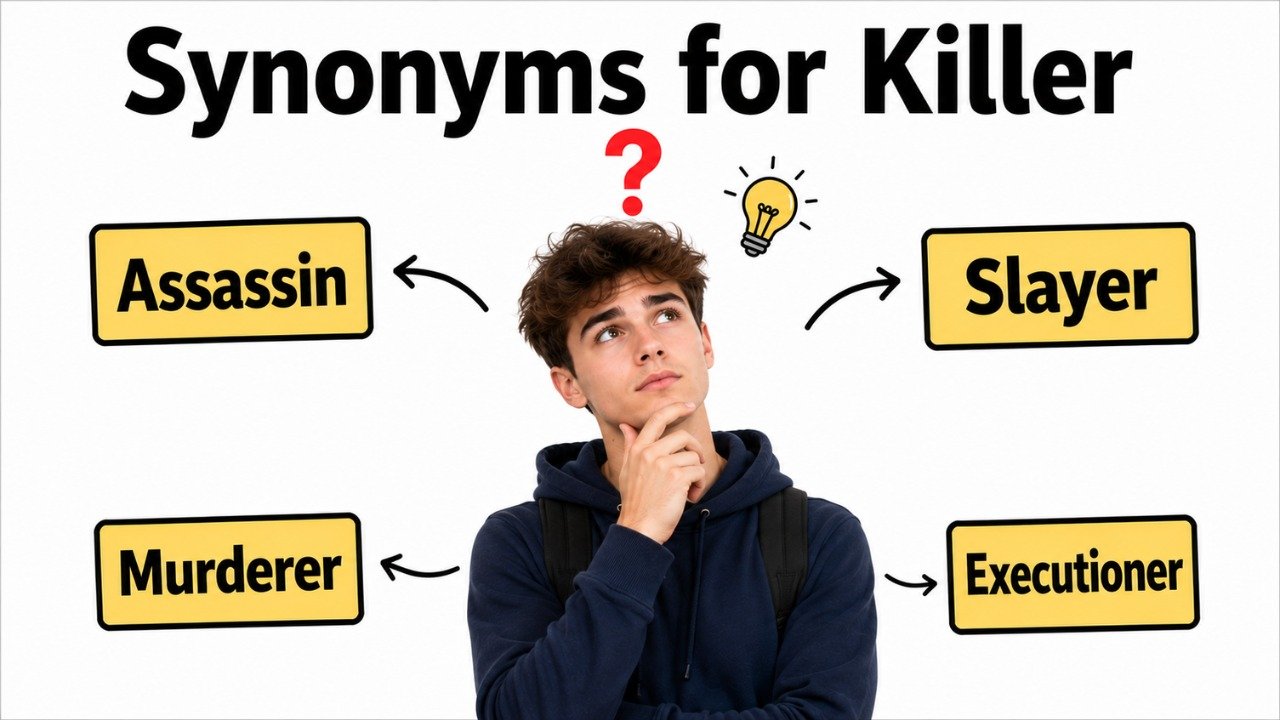
Quick Answer: The best synonyms for killer include murderer, assassin, slayer, executioner, attacker, destroyer, lethal agent, deadly threat, knockout, and showstopper. Use murderer for a person who unlawfully causes another person’s death, assassin for someone who deliberately kills an important person, and executioner for someone who carries out an official death sentence. Lethal agent suits scientific or technical writing. In informal language, knockout, showstopper, and stunner can replace killer when it means something extremely impressive.
Pronunciation and Word Details
Word: Killer.
Pronunciation: /ˈkɪlər/.
Part of Speech: Noun and adjective.
Meaning: A person or thing that causes death, or informally, something extremely impressive, powerful, or difficult.
US Pronunciation:
UK Pronunciation:
What Does “Killer” Mean?
Killer means a person, animal, substance, disease, or object that causes death.
As a noun, killer most commonly refers to someone who has killed another person. However, its exact meaning depends on the circumstances. The word may describe an unlawful offender, a dangerous animal, a deadly illness, or a harmful substance.
Example: Investigators searched for the killer.
Killer can also describe something that causes death without human intention.
Example: The untreated disease can be a silent killer.
In informal speech, killer may mean excellent, powerful, impressive, exhausting, or extremely difficult.
Example: She gave a killer performance at the event.
Example: That final examination was a killer.
As an adjective, killer often appears before a noun to emphasize strength, quality, danger, or difficulty.
Example: The team presented a killer idea.
Because killer has several meanings, writers should select a synonym that clearly matches the intended context.
Meaning, Tone, and Context of “Killer”
Killer is a strong word whose tone changes significantly according to context.
Serious Tone: When referring to a person who causes death, killer is direct, severe, and emotionally powerful.
Example: The police continued their search for the killer.
Legal Context: Killer is less precise than legal terms such as murderer, offender, suspect, or perpetrator. A person should not be called a murderer unless guilt has been legally established.
Example: The report referred to the arrested person as a suspect rather than a killer.
Technical Context: In medicine, science, and safety writing, killer may describe a disease, toxin, hazard, or lethal substance. More precise terms are usually better in formal material.
Example: The report identified the chemical as a lethal substance.
Conversational Context: In casual speech, killer can describe something very good, exciting, or impressive.
Example: That was a killer presentation.
Difficult Context: Killer can informally describe something exhausting, demanding, or painful.
Example: The morning workout was a killer.
Dramatic Tone: The word often adds emotional force. It may sound too dramatic in neutral, academic, or professional writing.
Example: The deadline was challenging is usually more professional than the deadline was a killer.
When and How to Use “Killer”
For a Person Who Causes Death
Use killer when speaking generally about someone responsible for causing another person’s death.
Example: The novel follows an investigator searching for a killer.
For Unlawful Killing
Use murderer when the meaning specifically involves an unlawful and intentional killing.
Example: The convicted murderer received a prison sentence.
For a Planned Attack
Use assassin when describing someone who deliberately kills a prominent or politically important person.
Example: Security officers stopped the suspected assassin.
For an Official Execution
Use executioner for a person whose official role is to carry out a death sentence.
Example: The historical account described the work of the executioner.
For a Deadly Disease
Use killer informally for a disease that causes many deaths, but use fatal disease or deadly condition in formal writing.
Example: The illness was once considered a major killer.
For a Dangerous Substance
Use lethal agent, toxin, poison, or deadly substance when identifying something capable of causing death.
Example: The laboratory identified the material as a lethal agent.
For an Impressive Performance
Use killer casually when something is exceptionally good.
Example: She delivered a killer speech.
For a Difficult Experience
Use killer informally for an exhausting task, schedule, examination, or workout.
Example: The final section of the test was a killer.
For a Powerful Feature
Use killer feature to describe the most impressive or valuable part of a product, plan, or idea.
Example: Simplicity was the proposal’s killer feature.
Best Synonyms for Killer
Murderer: A person who unlawfully and intentionally kills another person.
Example: The murderer was convicted after a lengthy trial.
Assassin: A person who deliberately kills an important or prominent individual.
Example: The guards prevented the assassin from reaching the official.
Slayer: A person or creature that kills, especially in literary or dramatic language.
Example: The legend described the warrior as a dragon slayer.
Executioner: A person officially responsible for carrying out a death sentence.
Example: The executioner appeared in the historical account.
Attacker: A person who uses violence against another person.
Example: Witnesses described the attacker to the authorities.
Destroyer: A person, force, or thing that causes complete ruin or destruction.
Example: The spreading fire became a destroyer of homes and forests.
Lethal Agent: A substance, organism, or force capable of causing death.
Example: The chemical acted as a lethal agent when inhaled.
Deadly Threat: A person, object, illness, or condition that creates a serious risk of death.
Example: The infection became a deadly threat to vulnerable patients.
Knockout: Informal language for a person or thing that is extremely impressive.
Example: Her final design was a knockout.
Showstopper: Something so impressive that it attracts immediate attention.
Example: The dramatic centerpiece was a showstopper.
50 Synonyms for Killer with Short Meanings
- Murderer: A person who unlawfully and intentionally kills someone.
- Assassin: Someone who deliberately kills an important person.
- Slayer: A person or creature that kills.
- Executioner: Someone officially responsible for carrying out a death sentence.
- Manslayer: A person who causes the death of another human being.
- Homicide Offender: A person responsible for causing another person’s death.
- Perpetrator: A person who commits a harmful or criminal act.
- Attacker: Someone who violently assaults another person.
- Assailant: A person who physically attacks someone.
- Gunman: A person carrying or using a gun during an attack.
- Shooter: A person who fires a weapon at someone or something.
- Poisoner: Someone who harms or kills by using poison.
- Strangler: A person who kills or attacks by restricting breathing.
- Predator: A dangerous person or animal that hunts or exploits others.
- Destroyer: Someone or something that causes severe destruction.
- Exterminator: A person or force that completely eliminates living pests or threats.
- Butcher: A harsh figurative term for someone who kills cruelly.
- Hitman: A person paid to kill someone.
- Contract Killer: Someone hired to carry out a planned killing.
- Multiple Murderer: A person responsible for more than one unlawful killing.
- Mass Murderer: A person who kills several people during one event or connected event.
- Life Taker: A general phrase for someone or something that causes death.
- Death Dealer: A dramatic phrase for a person or force that brings death.
- Lethal Agent: A substance, organism, or force capable of causing death.
- Deadly Force: Force likely to cause death or severe injury.
- Fatal Substance: A material capable of causing death.
- Poison: A substance that can cause illness, injury, or death.
- Toxin: A poisonous substance produced by a living organism.
- Pathogen: An organism or agent capable of causing disease.
- Disease: An illness that may cause serious harm or death.
- Infection: The invasion of the body by harmful organisms.
- Fatal Condition: A medical condition likely to result in death.
- Deadly Weapon: An object capable of causing fatal injury.
- Lethal Threat: A danger capable of causing death.
- Hazard: Something that presents a risk of harm.
- Menace: A person or thing that presents serious danger.
- Danger: A person, condition, or object likely to cause harm.
- Eliminator: Someone or something that removes a person, problem, or competitor.
- Finisher: A person or force that brings something decisively to an end.
- Crusher: Informal language for someone or something overwhelmingly powerful.
- Knockout: Something or someone exceptionally attractive or impressive.
- Showstopper: Something that attracts attention because it is highly impressive.
- Stunner: A person, object, or performance that creates strong admiration.
- Standout: Someone or something noticeably better than others.
- Winner: A highly successful or appealing person, plan, or idea.
- Powerhouse: A person or thing with exceptional strength or influence.
- Masterpiece: A work of outstanding quality or skill.
- Game Changer: An idea or development that causes a major improvement.
- Nightmare: An extremely difficult, unpleasant, or stressful experience.
- Ordeal: A painful, exhausting, or demanding experience.
Read Also:
Synonyms for Depth
Synonyms for Killer by Context
When Killer Means a Murderer
Use these alternatives when referring to a person who unlawfully causes another person’s death.
Murderer: A person who intentionally and unlawfully kills someone.
Example: The murderer was found guilty after the evidence was reviewed.
Manslayer: A formal or literary word for someone who causes another person’s death.
Example: The ancient text described him as a manslayer.
Homicide Offender: A neutral formal phrase for someone responsible for a homicide.
Example: The study examined patterns among homicide offenders.
Perpetrator: A general term for the person responsible for a crime.
Example: Investigators worked to identify the perpetrator.
When Killer Means an Assassin
Use these alternatives when the killing is planned, targeted, or connected to payment or public importance.
Assassin: Someone who deliberately kills a prominent person.
Example: The assassin planned the attack carefully.
Hitman: An informal term for someone paid to kill.
Example: The fictional story involved a hitman hired by a criminal group.
Contract Killer: A more descriptive term for a person hired to commit a killing.
Example: Investigators believed that a contract killer had been employed.
Gunman: A person armed with a gun during an attack.
Example: Security officers searched the building for the gunman.
When Killer Means a Dangerous Cause of Death
Use these alternatives for illnesses, chemicals, organisms, objects, or environmental threats.
Lethal Agent: Something capable of causing death.
Example: The gas can act as a lethal agent in enclosed spaces.
Deadly Threat: A severe danger to life.
Example: The rapidly spreading infection became a deadly threat.
Fatal Substance: A material that can cause death.
Example: The container held a fatal substance.
Toxin: A poisonous substance produced by a living organism.
Example: The toxin can damage the nervous system.
When Killer Means Something Excellent
In informal speech, killer can describe something exceptionally impressive.
Knockout: Something outstanding or visually impressive.
Example: Her final outfit was a knockout.
Showstopper: Something that immediately captures attention.
Example: The opening performance was a showstopper.
Stunner: Something that surprises people through its quality or beauty.
Example: The completed garden was an absolute stunner.
Standout: A person or thing noticeably better than others.
Example: Her proposal was the standout of the meeting.
When Killer Means Something Difficult
Use these alternatives for an exhausting, painful, or stressful experience.
Nightmare: An extremely difficult or unpleasant situation.
Example: Organizing the records without a system was a nightmare.
Ordeal: A long and difficult experience.
Example: The journey became an exhausting ordeal.
Challenge: A demanding task requiring effort or skill.
Example: Completing the project in one day was a major challenge.
Crusher: Informal language for a task or result that feels overwhelming.
Example: The unexpected workload was a real crusher.
Another Word for Killer
Murderer is the best direct replacement for killer when the word refers to someone who intentionally and unlawfully causes another person’s death.
However, the best alternative depends on context. Assassin fits a targeted killing, lethal agent suits a deadly substance, showstopper describes something impressive, and nightmare describes something extremely difficult.
Original: The police were searching for the killer.
Better Option: The police were searching for the suspected murderer.
Original: The chemical can be a silent killer.
Better Option: The chemical can be a lethal agent.
Original: She delivered a killer performance.
Better Option: She delivered a showstopping performance.
Original: The final examination was a killer.
Better Option: The final examination was an exhausting ordeal.
When Not to Use “Killer”
Do not use killer when a more precise word can identify the person, danger, quality, or difficulty being described.
When Guilt Has Not Been Established
Calling someone a killer may sound accusatory when the facts have not been legally proven.
Weak: The killer was arrested yesterday.
Better: The suspect was arrested yesterday in connection with the death.
When Writing Formal Reports
Killer may sound dramatic or imprecise in academic, medical, legal, and technical writing.
Weak: The report examined a major environmental killer.
Better: The report examined a major environmental cause of death.
When Describing a Specific Crime
Use a precise term when the nature of the act is known.
Weak: The killer was hired to target the official.
Better: The contract killer was hired to target the official.
When Describing Disease
Use fatal disease, deadly condition, or leading cause of death when clarity matters.
Weak: The illness is a dangerous killer.
Better: The illness is a potentially fatal condition.
When Describing Something Impressive
Killer is informal and may not suit professional communication.
Weak: The team submitted a killer proposal.
Better: The team submitted an outstanding proposal.
When Describing Difficulty
Killer may sound exaggerated when the task is merely demanding.
Weak: Preparing the report was a killer.
Better: Preparing the report was a demanding task.
Words Commonly Confused With Killer
Killer vs Murderer: Killer is a broad word for anyone or anything that causes death. Murderer specifically refers to a person who unlawfully and intentionally kills another person.
Example With Killer: The disease remains a major killer.
Example With Murderer: The murderer was convicted in court.
Killer vs Assassin: Killer is general, while assassin describes someone who deliberately targets a prominent or politically important person.
Example With Killer: Investigators searched for the killer.
Example With Assassin: The assassin targeted a senior official.
Killer vs Executioner: A killer causes death, while an executioner officially carries out a legally ordered death sentence.
Example With Killer: The killer escaped before the authorities arrived.
Example With Executioner: The executioner appears in the historical record.
Killer vs Slayer: Slayer is more literary, dramatic, or legendary than killer.
Example With Killer: The detective identified the killer.
Example With Slayer: The hero became known as the beast slayer.
Killer vs Attacker: An attacker uses violence, but the attack does not necessarily cause death.
Example With Killer: The killer was responsible for the victim’s death.
Example With Attacker: The attacker injured the victim before escaping.
Killer vs Perpetrator: Perpetrator refers to someone who commits any crime or harmful act, while killer specifically suggests causing death.
Example With Killer: The killer left evidence at the scene.
Example With Perpetrator: The perpetrator damaged several vehicles.
Killer vs Lethal: Killer is usually a noun or an informal adjective. Lethal is an adjective meaning capable of causing death.
Example With Killer: The infection became a silent killer.
Example With Lethal: The chemical can be lethal in high amounts.
Killer vs Deadly: Killer can name the cause of death, while deadly describes something capable of causing death.
Example With Killer: The disease is a major killer.
Example With Deadly: The disease can be deadly without treatment.
Which Synonym Should You Choose?
Choose murderer when referring to a person legally established as having committed an intentional unlawful killing.
Choose suspect when guilt has not been proven.
Choose assassin when the act is targeted, planned, and directed at an important person.
Choose contract killer when someone is hired to kill another person.
Choose executioner when referring to a person who carries out an official death sentence.
Choose slayer in literary, mythical, historical, or dramatic writing.
Choose attacker or assailant when violence occurs but death is not confirmed.
Choose perpetrator when identifying the person responsible for a crime without specifying the exact offense.
Choose lethal agent in scientific, medical, or technical writing about a dangerous substance or organism.
Choose deadly threat when describing a serious danger to life.
Choose poison or toxin when discussing a harmful substance.
Choose showstopper, knockout, or stunner in casual conversation when killer means impressive.
Choose outstanding, exceptional, or remarkable in professional writing when describing high quality.
Choose nightmare or ordeal when killer refers to an extremely difficult experience.
Choose challenge when the situation is demanding but manageable.
Choose powerhouse when killer describes a highly capable person, team, or system.
Choose game changer when referring to an idea that causes an important improvement.
Real Life Examples of “Killer” in Sentences
Original: Investigators continued searching for the killer.
Better Option: Investigators continued searching for the suspected murderer.
Original: The killer entered the building through a rear door.
Better Option: The attacker entered the building through a rear door.
Original: The illness is sometimes called a silent killer.
Better Option: The illness is sometimes described as a hidden deadly threat.
Original: The chemical acted as a killer in the enclosed space.
Better Option: The chemical acted as a lethal agent in the enclosed space.
Original: She gave a killer presentation at the conference.
Better Option: She gave an outstanding presentation at the conference.
Original: The new design is a killer.
Better Option: The new design is a showstopper.
Original: That final workout was a killer.
Better Option: That final workout was an exhausting challenge.
Original: The project deadline was a killer.
Better Option: The project deadline created a stressful ordeal.
Original: The application’s killer feature is its simplicity.
Better Option: The application’s standout feature is its simplicity.
Original: The team developed a killer strategy.
Better Option: The team developed a powerful strategy.
Synonym Groups and Usage Differences
Criminal Person Group
This group includes murderer, assassin, hitman, contract killer, and homicide offender.
Murderer is the most direct term for unlawful intentional killing. Assassin suggests a planned target, while contract killer and hitman involve payment.
Example: Investigators believed that the murderer had planned the crime in advance.
Attack Group
This group includes attacker, assailant, gunman, shooter, poisoner, and strangler.
These terms identify the method or nature of an attack. They should only be used when the relevant facts are known.
Example: Witnesses described the attacker but could not identify the person.
Literary Group
This group includes slayer, manslayer, destroyer, butcher, life taker, and death dealer.
These words often sound dramatic, historical, symbolic, or emotional. They are less suitable for neutral reporting.
Example: The ancient poem described the warrior as a monster slayer.
Deadly Substance Group
This group includes lethal agent, poison, toxin, pathogen, fatal substance, and deadly weapon.
These alternatives describe substances, organisms, or objects capable of causing death.
Example: The laboratory confirmed that the sample contained a dangerous toxin.
Danger Group
This group includes menace, hazard, danger, lethal threat, and deadly threat.
These words focus on risk rather than a completed death.
Example: The damaged structure became a serious hazard to the public.
Excellence Group
This group includes knockout, showstopper, stunner, standout, winner, and masterpiece.
These informal or positive alternatives describe something exceptionally impressive.
Example: The final painting was the standout piece in the exhibition.
Power Group
This group includes powerhouse, crusher, eliminator, destroyer, and finisher.
These words emphasize strength, dominance, or the ability to defeat competition.
Example: The experienced player became the team’s most reliable finisher.
Difficulty Group
This group includes nightmare, ordeal, challenge, and crusher.
These alternatives describe tasks or experiences that are stressful, exhausting, or difficult.
Example: Repairing the damage without the proper equipment became an ordeal.
Antonyms of Killer
The opposite of killer depends on whether the word refers to a person, a deadly threat, an impressive thing, or a difficult experience.
Protector: A person who keeps others safe from harm.
Rescuer: Someone who saves a person from danger.
Lifesaver: A person or thing that prevents death or serious harm.
Defender: Someone who protects another person, place, or principle.
Guardian: A person responsible for protecting someone or something.
Healer: A person or treatment that helps restore health.
Caregiver: Someone who provides support and care to another person.
Preserver: A person or thing that protects life, value, or condition.
Savior: Someone who rescues another person from danger or destruction.
Benefactor: A person who provides help or support.
Harmless Person: Someone who presents no danger to others.
Safe Substance: A material that does not create a serious health risk.
Remedy: Something that corrects, treats, or improves a problem.
Solution: An answer that resolves a difficulty.
Relief: Something that reduces pain, pressure, or difficulty.
Comparison: Killer vs Related Words
Killer vs Murderer
Killer is a broad term that can refer to a person, animal, disease, substance, or object. Murderer specifically refers to someone who intentionally and unlawfully kills another person.
Example With Killer: The infection remains a serious killer in some regions.
Example With Murderer: The convicted murderer received a lengthy sentence.
Killer vs Assassin
Killer is general, while assassin refers to a person who deliberately targets an important or prominent individual.
Example With Killer: The authorities searched for the killer.
Example With Assassin: The assassin planned to target the political leader.
Killer vs Attacker
A killer causes death, but an attacker may only threaten or injure someone.
Example With Killer: The killer was linked to the victim’s death.
Example With Attacker: The attacker fled after causing minor injuries.
Killer vs Slayer
Killer is common in everyday language. Slayer is more literary, dramatic, or associated with legends and heroic stories.
Example With Killer: The detective identified the killer.
Example With Slayer: The warrior was celebrated as a giant slayer.
Killer vs Executioner
Killer describes someone who causes death. Executioner refers to someone officially appointed to carry out a death sentence.
Example With Killer: The killer acted outside the law.
Example With Executioner: The executioner followed an official order.
Killer vs Perpetrator
Killer identifies someone associated with causing death. Perpetrator can refer to the person responsible for any crime or harmful act.
Example With Killer: Evidence connected the killer to the scene.
Example With Perpetrator: Investigators identified the perpetrator of the theft.
Killer vs Lethal
Killer is generally a noun, though it can be used informally as an adjective. Lethal is an adjective meaning capable of causing death.
Example With Killer: The untreated condition can become a killer.
Example With Lethal: The untreated condition can become lethal.
Killer vs Deadly
Killer names a person or thing that causes death. Deadly describes something highly dangerous or capable of causing death.
Example With Killer: The virus became a major killer.
Example With Deadly: The virus can be deadly for vulnerable patients.
Killer vs Showstopper
Killer can informally mean impressive. Showstopper specifically describes something that attracts strong attention because of its quality or appearance.
Example With Killer: She wore a killer outfit.
Example With Showstopper: Her outfit was the showstopper of the evening.
Common Phrases and Expressions With Killer
Silent Killer: A disease or danger that causes harm without obvious warning signs.
Serial Killer: A person who commits separate killings over a period of time.
Contract Killer: A person hired to kill someone.
Killer Instinct: A strong desire and ability to succeed or defeat competition.
Killer Idea: An exceptionally strong or creative idea.
Killer Feature: The most attractive or valuable feature of something.
Killer Look: An informal phrase for a highly impressive appearance.
Killer Performance: An exceptionally strong or memorable performance.
Killer Workout: A very intense and exhausting exercise session.
Killer Schedule: A demanding timetable that creates pressure or exhaustion.
Killer Question: A particularly difficult or decisive question.
Killer Combination: A highly effective or powerful mixture of qualities.
Common Mistakes to Avoid
Using Killer Before Guilt Is Proven
Do not label a suspect as a killer when guilt has not been established. Use suspect, accused person, or alleged offender when appropriate.
Incorrect: The killer appeared in court for the first time.
Better: The suspect appeared in court for the first time.
Treating Killer and Murderer as Exact Synonyms
A killer may be a person, animal, disease, substance, or object. A murderer is specifically a person who unlawfully and intentionally kills someone.
Incorrect: The disease is a common murderer.
Better: The disease is a common killer.
Using Assassin for Every Murderer
Assassin usually involves a planned attack against a prominent or politically important person.
Incorrect: The assassin killed a stranger during an argument.
Better: The murderer killed a stranger during an argument.
Using Killer in Formal Writing Without Clarification
Killer can sound emotional, vague, or conversational. Use precise terms in reports and academic writing.
Vague: Air pollution is a dangerous killer.
Better: Air pollution is a serious cause of premature death.
Using Informal Killer in Professional Communication
Killer can mean excellent in casual speech, but it may sound inappropriate in a formal report or email.
Too Casual: We have created a killer proposal.
Better: We have created a persuasive proposal.
Choosing a Violent Synonym for a Figurative Meaning
Do not replace informal killer with murderer or assassin when it means impressive.
Incorrect: She delivered a murderer presentation.
Better: She delivered an outstanding presentation.
Ignoring the Meaning of the Full Phrase
The meaning of killer changes in expressions such as silent killer, killer feature, and killer workout. Replace the whole phrase rather than the single word.
Weak: The design has a murderer feature.
Better: The design has a standout feature.
Repeating Killer Too Often
Frequent repetition can make writing sound dramatic or unclear.
Repetitive: The killer disease is a major killer because it has several killer effects.
Improved: The deadly disease is a major cause of death because it produces several severe effects.
Using Dramatic Words Without Evidence
Words such as butcher, death dealer, and destroyer carry strong emotional meaning. Use them mainly in literary, historical, or clearly figurative contexts.
Overstated: The careless employee was a destroyer of the entire organization.
Better: The employee’s repeated mistakes caused serious problems for the organization.
Conclusion
The most accurate synonyms for killer depend on the intended meaning. Murderer suits an unlawful intentional killing, while assassin describes a planned attack on a prominent person. Attacker and assailant are better when death is not confirmed. Lethal agent, toxin, and deadly threat fit scientific or safety contexts. In informal language, knockout, showstopper, and standout describe something impressive, while nightmare and ordeal describe something difficult. Choosing among synonyms for killer carefully makes writing clearer, more accurate, and appropriate for its tone.
FAQs About Synonyms for Killer
What Is the Best Synonym for Killer?
Murderer is the best direct synonym when killer refers to a person who intentionally and unlawfully causes another person’s death.
What Is a Formal Word for Killer?
Homicide offender, perpetrator, lethal agent, or cause of death may be suitable, depending on whether the subject is a person, substance, disease, or condition.
What Is Another Word for a Paid Killer?
Contract killer and hitman are common terms for a person hired to kill someone. Contract killer is more descriptive and less conversational.
Is Assassin the Same as Killer?
Not exactly. Every assassin is a killer, but not every killer is an assassin. Assassin usually refers to someone who deliberately targets an important person.
What Is a Synonym for Killer Meaning Excellent?
Showstopper, knockout, stunner, standout, winner, masterpiece, and powerhouse can replace killer when it means highly impressive.
What Is a Synonym for Killer Meaning Difficult?
Nightmare, ordeal, challenge, crusher, and exhausting experience can replace killer when describing something very difficult.
What Is the Opposite of Killer?
Protector, rescuer, lifesaver, guardian, defender, healer, and savior are useful opposites when killer refers to a person or force that causes death.
