
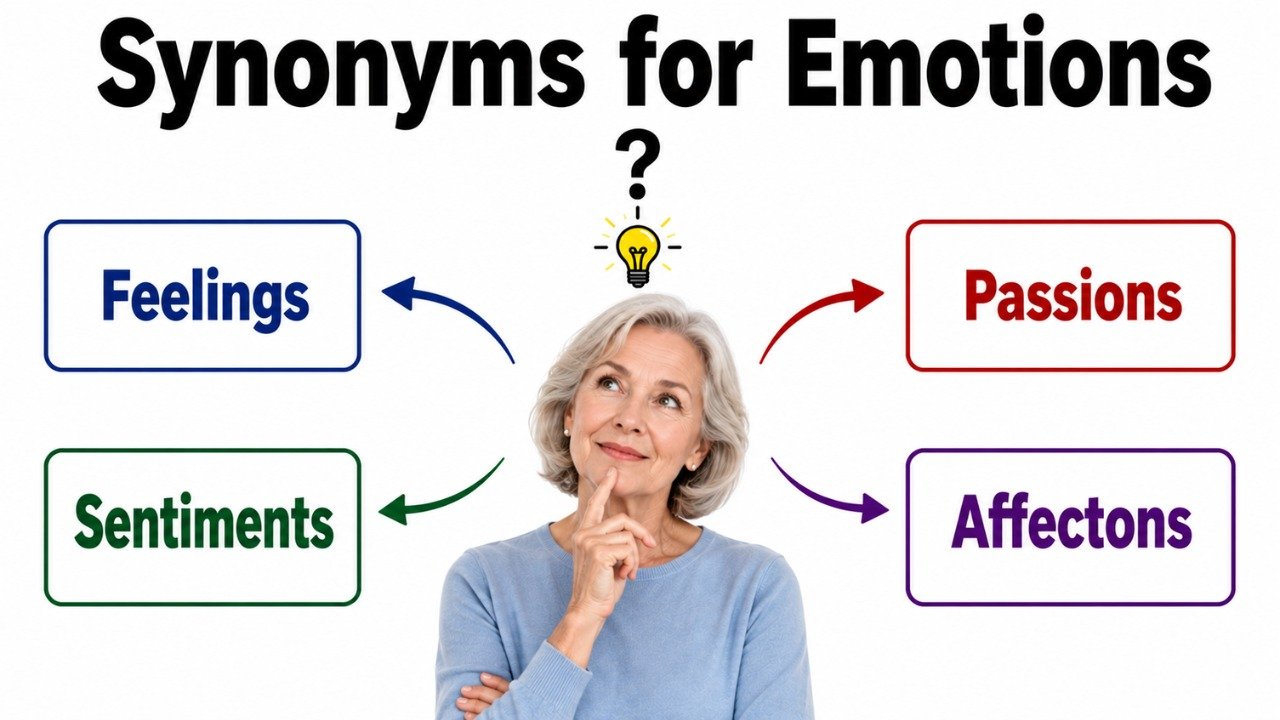
Quick Answer: The best synonyms for emotions are feelings, sentiments, moods, passions, reactions, responses, sensations, affect, impressions, and states of mind. Use feelings in everyday conversation, sentiments for thoughtful opinions, moods for temporary emotional conditions, passions for powerful feelings, and reactions for emotions caused by an event. Affect is more suitable for academic or psychological writing, while emotional responses works well in reports, essays, and formal explanations.
Pronunciation and Word Details
Word: Emotions.
Pronunciation: /ɪˈmoʊʃənz/.
Part of Speech: Plural noun.
Meaning: Strong or noticeable feelings that develop in response to thoughts, experiences, people, or situations.
US Pronunciation:
UK Pronunciation:
What Does “Emotions” Mean?
Emotions are feelings such as happiness, sadness, anger, fear, excitement, affection, and surprise.
The word emotions is a plural noun. Its singular form is emotion. It describes mental and physical responses that arise when a person experiences, remembers, or thinks about something meaningful.
Emotions may be pleasant, unpleasant, mild, intense, brief, or lasting. Someone may experience joy after receiving good news, fear during a dangerous situation, or sadness after losing something important.
The word works in several sentence contexts. It can describe a person’s private feelings, visible reactions, emotional condition, or response to an event.
Personal Context: She found it difficult to explain her emotions.
Social Context: His emotions influenced the way he responded to the disagreement.
Psychological Context: The study examined how people recognize emotions in facial expressions.
Creative Context: The story creates powerful emotions in the reader.
Physical Context: Strong emotions can affect a person’s voice, posture, and facial expression.
Meaning, Tone, and Context of “Emotions”
Emotions is generally a neutral word. It can appear in casual conversation, formal writing, education, psychology, health discussions, literature, relationships, and workplace communication.
In everyday speech, emotions usually means personal feelings. People may talk about expressing emotions, hiding emotions, understanding emotions, or managing emotions.
In formal writing, the word may describe psychological responses, internal experiences, or patterns of behavior. Terms such as affect, emotional states, and emotional responses may be preferred when greater precision is needed.
The word can also carry an emotional or serious tone when discussing grief, anxiety, love, fear, conflict, or personal experiences. However, emotions itself is not automatically positive or negative. Its tone depends on the surrounding context.
Casual Tone: I had many emotions when I heard the news.
Formal Tone: Participants reported several emotional responses during the experiment.
Literary Tone: The character’s emotions shifted between hope and despair.
Professional Tone: Effective communication requires awareness of other people’s feelings and concerns.
Technical Tone: Affect refers to the observable expression of emotion in certain academic contexts.
When and How to Use “Emotions”
For Personal Feelings
Use emotions when discussing a person’s inner experiences, especially when several feelings are involved.
Example: She wrote in her journal to understand her emotions.
For Reactions to Events
Use emotions to describe feelings produced by an experience, decision, memory, or situation.
Example: The announcement caused a mixture of emotions among the employees.
For Relationships
Use emotions when discussing affection, disappointment, trust, jealousy, empathy, or conflict between people.
Example: Honest conversations helped them express their emotions more clearly.
For Mental and Emotional Awareness
Use emotions when talking about recognizing, understanding, or managing feelings.
Example: Children often need guidance when learning how to identify their emotions.
For Creative Writing
Use emotions when explaining how a book, speech, film, painting, or performance affects an audience.
Example: The final scene filled the audience with powerful emotions.
For Formal Analysis
Use emotions in essays, reports, or discussions about human behavior. More precise alternatives may be useful when the context is technical.
Example: The report explores how emotions influence decision making.
For Difficult Experiences
Use emotions when referring to grief, fear, frustration, anger, anxiety, or disappointment.
Example: He needed time to process his emotions after the sudden change.
For Positive Experiences
Use emotions when discussing happiness, gratitude, affection, excitement, pride, or hope.
Example: Her graduation brought strong emotions of joy and pride.
Best Synonyms for Emotions
Feelings
Synonym: Personal emotional experiences or reactions.
Example: She shared her feelings with a trusted friend.
Sentiments
Synonym: Thoughts or opinions influenced by emotion.
Example: His speech expressed warm sentiments of gratitude.
Moods
Synonym: Temporary emotional conditions that may last for a period of time.
Example: The gloomy weather affected everyone’s moods.
Passions
Synonym: Powerful feelings, interests, or desires.
Example: Her passions guided many of her life choices.
Reactions
Synonym: Responses caused by an event, statement, or experience.
Example: Their reactions showed how surprising the decision was.
Responses
Synonym: Emotional or behavioral results produced by something.
Example: The announcement created different responses among the listeners.
Sensations
Synonym: Physical or emotional experiences that a person notices.
Example: The music produced pleasant sensations of calm and comfort.
Affect
Synonym: The experience or visible expression of emotion, especially in formal or academic contexts.
Example: The researcher observed changes in the participants’ affect.
Impressions
Synonym: Feelings or opinions formed after an experience.
Example: Her first impressions of the new environment were positive.
States of Mind
Synonym: Particular mental or emotional conditions.
Example: Stress can influence people’s states of mind.
50 Synonyms for Emotions with Short Meanings
- Feelings: Personal experiences of happiness, sadness, anger, fear, or affection.
- Sentiments: Opinions or attitudes shaped by emotion.
- Moods: Temporary emotional conditions.
- Passions: Strong and powerful feelings or desires.
- Reactions: Emotional responses caused by events or experiences.
- Responses: Feelings or actions produced by a situation.
- Sensations: Noticeable physical or emotional experiences.
- Affect: Experienced or visibly expressed emotion.
- Impressions: Feelings or opinions formed from an experience.
- States of Mind: Particular mental or emotional conditions.
- Emotional States: Specific conditions of feeling.
- Inner States: Private mental and emotional conditions.
- Mental States: Conditions affecting thought, awareness, and feeling.
- Feeling States: Particular emotional experiences at a given time.
- Affective States: Emotional conditions described in formal writing.
- Emotional Responses: Feelings produced by a person, event, or situation.
- Emotional Reactions: Immediate feelings caused by an experience.
- Inner Feelings: Private emotions that may not be openly expressed.
- Personal Feelings: Individual emotional opinions or experiences.
- Heartfelt Responses: Sincere reactions that come from deep feeling.
- Emotional Experiences: Events or conditions involving noticeable feelings.
- Psychological Responses: Mental and emotional reactions to a situation.
- Psychological States: Conditions involving thought, feeling, and awareness.
- Subjective Experiences: Personal experiences understood from an individual viewpoint.
- Internal Reactions: Private responses occurring within a person.
- Human Feelings: Emotional experiences commonly felt by people.
- Emotional Impulses: Sudden urges created by strong feelings.
- Impulses: Immediate urges that may arise from emotion.
- Inclinations: Natural preferences or emotional tendencies.
- Affections: Feelings of love, warmth, or fondness.
- Attachments: Strong emotional connections to people, places, or things.
- Sympathies: Feelings of understanding, support, or shared concern.
- Concerns: Feelings of worry, care, or interest.
- Sensibilities: Abilities to feel, notice, and respond emotionally.
- Sensitivities: Strong awareness of emotional experiences or influences.
- Disposition: A person’s usual emotional nature or attitude.
- Temperament: A person’s natural pattern of emotional behavior.
- Frame of Mind: A person’s mental or emotional condition at a particular time.
- Attitudes: Ways of thinking or feeling about something.
- Stirrings: Early or gentle signs of emotion.
- Excitements: Strong feelings of enthusiasm or eagerness.
- Agitations: Disturbed or restless emotional states.
- Affectionate Feelings: Experiences of love, warmth, or tenderness.
- Heartfelt Sentiments: Deep and sincere emotional opinions.
- Emotional Currents: Continuing feelings beneath visible behavior.
- Emotional Tones: General feelings created by words, events, or situations.
- Emotional Conditions: Particular states involving feelings.
- Affective Responses: Formal term for reactions involving emotion.
- Affective Experiences: Emotional experiences described in academic language.
- Inner Experiences: Private thoughts, feelings, and emotional reactions.
Read Also:
Synonyms for Phenomenon
Synonyms for Emotions by Context
When Emotions Means Personal Feelings
Feelings is the clearest and most natural synonym when discussing private experiences, relationships, or personal reactions.
Other useful alternatives include inner feelings, personal feelings, affections, and inner experiences.
Example With Emotions: She spoke honestly about her emotions.
Example With Feelings: She spoke honestly about her feelings.
Feelings sounds more conversational, while emotions may sound slightly broader or more serious.
When Emotions Means Temporary Conditions
Moods, frame of mind, emotional states, and states of mind describe conditions that may continue for minutes, hours, or days.
Example With Emotions: His emotions changed throughout the afternoon.
Example With Moods: His moods changed throughout the afternoon.
Moods is most suitable when the emotional condition lasts for a period rather than appearing as one immediate reaction.
When Emotions Means Strong Feelings
Passions, excitements, agitations, and emotional impulses can describe intense emotional experiences.
Example With Emotions: The debate stirred powerful emotions.
Example With Passions: The debate stirred powerful passions.
Passions suggests stronger and more energetic feelings than the general word emotions.
When Emotions Means Reactions
Reactions, responses, emotional responses, and psychological responses are useful when feelings result from a particular event.
Example With Emotions: The decision produced different emotions among the team members.
Example With Reactions: The decision produced different reactions among the team members.
Reactions may include feelings, behavior, facial expressions, and spoken responses.
When Emotions Means Affection
Affections, attachments, sympathies, and heartfelt sentiments are useful when the context involves love, care, warmth, or concern.
Example With Emotions: Her emotions for her family remained strong.
Example With Affections: Her affections for her family remained strong.
Affections is more specific because it usually refers to fondness or love.
When Emotions Means Formal Psychological Experiences
Affect, affective states, psychological states, and subjective experiences are useful in academic, medical, or research based discussions.
Example With Emotions: The researchers studied emotions during stressful tasks.
Example With Affect: The researchers studied affect during stressful tasks.
Affect is more technical and should not replace emotions in every everyday sentence.
When Emotions Means Opinions Shaped by Feeling
Sentiments, attitudes, impressions, and sympathies are suitable when emotion influences a person’s opinion or judgment.
Example With Emotions: Public emotions about the proposal were mixed.
Example With Sentiments: Public sentiments about the proposal were mixed.
Sentiments works particularly well when describing the feelings or opinions of a group.
Another Word for Emotions
Feelings is usually the best single replacement for emotions because it is natural, familiar, and suitable for most personal or conversational contexts.
However, the best alternative depends on the meaning. Use moods for temporary emotional conditions, sentiments for emotional opinions, reactions for responses to events, and affect for technical discussions.
Original: She could not explain her emotions.
Better Option: She could not explain her feelings.
Original: The announcement created several emotions in the audience.
Better Option: The announcement created several reactions in the audience.
Original: The survey measured the emotions of the participants.
Better Option: The survey measured the emotional responses of the participants.
Original: His emotions changed during the week.
Better Option: His moods changed during the week.
When Not to Use “Emotions”
Emotions may be too broad when the sentence refers to one specific feeling. Naming the exact feeling often creates clearer and stronger writing.
Weak: She experienced many emotions after receiving the letter.
Better: She experienced relief, gratitude, and excitement after receiving the letter.
Avoid emotions when you mean a temporary mood rather than a specific response.
Weak: His emotions remained gloomy all morning.
Better: His mood remained gloomy all morning.
Do not use emotions when describing opinions that are influenced by feeling. Sentiments may be more precise.
Weak: Community emotions about the decision were divided.
Better: Community sentiments about the decision were divided.
In technical writing, emotions may lack the precision required for a specific process or observation.
Weak: The researcher recorded the subjects’ emotions.
Better: The researcher recorded the subjects’ emotional responses.
Avoid repeating emotions several times within the same paragraph.
Weak: Her emotions were intense, and those emotions affected how she expressed her emotions.
Better: Her feelings were intense, and they affected how she expressed herself.
Do not replace emotions with a formal synonym in casual speech when the result sounds unnatural.
Weak: I need time to understand my affective states.
Better: I need time to understand my feelings.
Words Commonly Confused With Emotions
Emotions vs Feelings: Emotions are mental and physical responses to meaningful situations. Feelings are the personal awareness or interpretation of those responses. In everyday conversation, the words are often used in similar ways.
Emotions vs Moods: Emotions are usually connected to a particular cause, while moods may last longer and may not have an obvious cause.
Emotions vs Sentiments: Emotions are internal responses such as joy, fear, or anger. Sentiments are feelings or opinions about a subject, person, or situation.
Emotions vs Reactions: Emotions are feelings, while reactions may include feelings, actions, words, expressions, or physical responses.
Emotions vs Sensations: Emotions involve psychological responses, while sensations usually involve something physically noticed through the body or senses.
Emotions vs Affect: Emotions is the general everyday term. Affect is a formal term that can refer to emotional experience or its visible expression.
Emotions vs Passions: Emotions may be mild or strong. Passions are usually intense feelings, interests, or desires.
Emotions vs Attitudes: Emotions may change quickly in response to events. Attitudes are more settled ways of thinking or feeling about something.
Which Synonym Should You Choose?
Choose feelings for everyday conversations, personal writing, relationships, and simple explanations.
Choose sentiments when describing emotional opinions, public views, thoughtful messages, or expressions of gratitude.
Choose moods when describing emotional conditions that continue for a period of time.
Choose passions when referring to powerful feelings, strong interests, ambition, or enthusiasm.
Choose reactions when describing what people feel or do after an event.
Choose responses when the sentence includes both emotional and behavioral results.
Choose emotional responses in reports, essays, formal emails, and professional explanations.
Choose affect in psychological, clinical, or academic contexts where technical language is appropriate.
Choose sensations when the experience has a noticeable physical quality.
Choose affections when referring specifically to love, warmth, or fondness.
Choose concerns when the emotions involve worry, care, or serious interest.
Choose states of mind when discussing broader mental and emotional conditions.
Choose impressions when describing feelings or opinions formed after an initial experience.
Choose temperament when referring to a person’s usual emotional nature.
Choose disposition when describing a person’s general attitude or emotional tendency.
Real Life Examples of “Emotions” in Sentences
Original: She struggled to control her emotions during the meeting.
Better Option: She struggled to control her feelings during the meeting.
Original: The news caused strong emotions throughout the community.
Better Option: The news caused strong reactions throughout the community.
Original: He expressed his emotions through music.
Better Option: He expressed his inner feelings through music.
Original: Her emotions changed from excitement to disappointment.
Better Option: Her mood changed from excitement to disappointment.
Original: The speech awakened emotions of gratitude and hope.
Better Option: The speech awakened sentiments of gratitude and hope.
Original: Children need safe ways to communicate their emotions.
Better Option: Children need safe ways to communicate their feelings.
Original: The researchers observed the participants’ emotions.
Better Option: The researchers observed the participants’ emotional responses.
Original: His emotions for the old house remained powerful.
Better Option: His attachment to the old house remained powerful.
Original: The novel explores complex human emotions.
Better Option: The novel explores complex human feelings.
Original: She experienced mixed emotions before beginning her new job.
Better Option: She experienced mixed feelings before beginning her new job.
Synonym Groups and Usage Differences
Personal Feeling Group
Feelings, inner feelings, personal feelings, and inner experiences describe emotions from an individual viewpoint.
Feelings is the most natural everyday choice. Inner feelings emphasizes privacy, while inner experiences may include both thoughts and emotions.
Example: He shared his feelings after remaining silent for several weeks.
Temporary Condition Group
Moods, emotional states, frame of mind, and states of mind describe emotional conditions at a particular time.
Mood often refers to a condition that lasts longer than one immediate emotion. Frame of mind includes both thought and feeling.
Example: A short walk improved her mood.
Strong Emotion Group
Passions, excitements, agitations, and emotional impulses describe feelings with noticeable energy or intensity.
Passions can be positive or negative. Agitations usually suggest uneasiness or disturbance.
Example: The discussion awakened strong passions on both sides.
Reaction Group
Reactions, responses, emotional reactions, and psychological responses describe results caused by an experience.
Reaction is broad and conversational. Emotional response is more precise in formal writing.
Example: The unexpected change produced anxious reactions among the staff.
Affection Group
Affections, attachments, sympathies, and heartfelt sentiments relate to care, fondness, emotional connection, or concern.
Affection suggests warmth and love. Attachment emphasizes a continuing emotional bond.
Example: Her attachment to her childhood home remained strong.
Formal and Academic Group
Affect, affective states, affective responses, and subjective experiences are useful in research and academic writing.
These terms should be used carefully because they may sound overly technical in normal conversation.
Example: The study measured affective responses to different images.
Opinion and Attitude Group
Sentiments, attitudes, impressions, and inclinations describe emotional opinions or tendencies.
Sentiment often refers to a feeling about a subject. Attitude is usually more stable and may include beliefs and judgments.
Example: Public sentiment became more positive after the announcement.
Antonyms of Emotions
There is no single perfect opposite of emotions because emotions include many different positive and negative feelings. The most suitable antonym depends on the intended meaning.
Apathy: Lack of interest, concern, or emotional involvement.
Indifference: Absence of care or preference.
Numbness: Inability or reduced ability to feel emotion.
Detachment: Emotional separation from a person or situation.
Impassivity: Absence of visible emotional reaction.
Composure: Calm control during an emotional situation.
Calmness: A peaceful state without strong disturbance.
Unemotionality: Lack of visible or expressed emotion.
Disinterest: Lack of interest or emotional concern.
Insensitivity: Limited awareness of other people’s feelings.
Emotional Distance: A condition of remaining personally uninvolved.
Restraint: Control over the expression of strong feelings.
Comparison: Emotions vs Related Words
Emotions vs Feelings
Emotions are responses involving mental and physical changes. Feelings are the personal experience or awareness of those responses.
In ordinary speech, feelings is often the simpler replacement.
Example With Emotions: Fear is one of the strongest human emotions.
Example With Feelings: She described her feelings of fear and uncertainty.
Emotions vs Moods
Emotions often arise because of a particular event. Moods may last longer and may not have one clear cause.
Example With Emotions: He felt strong emotions after hearing the result.
Example With Moods: His mood remained cheerful for the rest of the day.
Emotions vs Sentiments
Emotions are experiences such as anger, joy, fear, and sadness. Sentiments are emotional opinions or attitudes toward a subject.
Example With Emotions: The reunion brought back powerful emotions.
Example With Sentiments: The letter expressed warm sentiments about their friendship.
Emotions vs Reactions
Emotions are feelings within a person. Reactions include the ways a person feels, speaks, acts, or responds physically.
Example With Emotions: Her emotions included surprise and relief.
Example With Reactions: Her reaction included a smile and a deep breath.
Emotions vs Passions
Emotions may vary in strength. Passions are especially strong feelings, desires, or interests.
Example With Emotions: The story explores emotions such as love and fear.
Example With Passions: His passions included music, education, and public service.
Emotions vs Sensations
Emotions are psychological responses. Sensations are experiences noticed through the body or senses, although they may accompany emotion.
Example With Emotions: Excitement was one of the emotions she experienced.
Example With Sensations: She noticed a warm sensation in her chest.
Emotions vs Affect
Emotions is suitable for general communication. Affect is mainly used in technical, psychological, or academic language.
Example With Emotions: The event influenced the children’s emotions.
Example With Affect: The event influenced the children’s affect during the observation.
Emotions vs Attitudes
Emotions are often temporary responses. Attitudes are more established ways of thinking or feeling about people, ideas, or situations.
Example With Emotions: His emotions changed after hearing the explanation.
Example With Attitudes: His attitude toward the proposal became more positive.
Common Phrases and Expressions With Emotions
Strong Emotions: Feelings experienced with great intensity.
Mixed Emotions: Positive and negative feelings experienced at the same time.
Express Emotions: Communicate feelings through words, behavior, art, or facial expressions.
Control Emotions: Prevent feelings from directing actions or speech.
Manage Emotions: Understand and respond to feelings in a healthy and thoughtful way.
Hide Emotions: Prevent other people from noticing personal feelings.
Process Emotions: Take time to understand and accept emotional experiences.
Overwhelming Emotions: Feelings that seem difficult to control or understand.
Positive Emotions: Pleasant feelings such as joy, hope, gratitude, and affection.
Difficult Emotions: Uncomfortable feelings such as fear, anger, guilt, or sadness.
Human Emotions: Feelings commonly experienced as part of human life.
Range of Emotions: A variety of different feelings.
Common Mistakes to Avoid
Repeating the Same Word
Using emotions repeatedly can make a paragraph sound dull or mechanical. Replace some uses with feelings, reactions, moods, or emotional responses when the meaning allows it.
Incorrect: Her emotions were intense, and her emotions affected how she described her emotions.
Correct: Her feelings were intense, and they affected how she described her experience.
Using a Broad Word for a Specific Feeling
Emotions may be too general when the writer knows the exact feeling.
Unclear: He experienced several emotions after the decision.
Clear: He experienced disappointment, anger, and confusion after the decision.
Confusing Emotions With Moods
An emotion is often a response to a clear cause. A mood may continue for a longer time without one obvious cause.
Incorrect: Her emotion remained gloomy throughout the week.
Correct: Her mood remained gloomy throughout the week.
Using Affect in Casual Conversation
Affect may sound unnatural outside academic, psychological, or medical contexts.
Unnatural: I need to talk about my affect.
Natural: I need to talk about my feelings.
Treating Reactions as Exact Synonyms
A reaction may involve an emotion, but it can also include behavior, speech, or physical movement.
Unclear: His emotions were to leave the room.
Clear: His reaction was to leave the room.
Confusing Sentiments With Immediate Feelings
Sentiments are usually considered feelings or opinions rather than sudden emotional responses.
Incorrect: She felt a sentiment of fear when the door opened.
Correct: She felt an emotion of fear when the door opened.
Choosing an Overly Formal Alternative
Technical alternatives may reduce readability when simple language is enough.
Overly Formal: The child communicated several affective states.
Natural: The child communicated several feelings.
Using the Singular and Plural Forms Incorrectly
Use emotion for one feeling or the general concept. Use emotions when referring to several feelings.
Incorrect: Happiness and sadness are a powerful emotion.
Correct: Happiness and sadness are powerful emotions.
Conclusion
Understanding synonyms for emotions helps you choose words that match the exact meaning and tone of a sentence. Feelings is the best everyday alternative, while sentiments suits emotional opinions and moods describes temporary conditions. Reactions and responses work well for feelings caused by events. Passions expresses intensity, affections suggests warmth, and affect is useful in technical writing. Choose a synonym according to whether you are discussing personal feelings, temporary moods, strong experiences, formal analysis, or visible reactions.
FAQs About Synonyms for Emotions
What Is the Best Synonym for Emotions?
Feelings is the best general synonym for emotions. It is natural, clear, and appropriate for most personal and conversational contexts.
Are Feelings and Emotions the Same?
They are closely related and often interchangeable in everyday speech. Emotions are responses, while feelings are a person’s awareness or experience of those responses.
Can Moods Be Used as a Synonym for Emotions?
Moods can replace emotions when discussing emotional conditions that last for a period of time. It is less suitable for immediate reactions to specific events.
What Is a Formal Synonym for Emotions?
Emotional responses, affective states, psychological states, and affect are formal alternatives. The best choice depends on the academic or professional context.
What Is Another Word for Strong Emotions?
Passions, intense feelings, agitations, and powerful reactions can describe strong emotions. Passions is especially suitable for deep enthusiasm or desire.
What Is Another Word for Positive Emotions?
Positive feelings, pleasant emotions, affections, joys, and uplifting sentiments may be used. The exact replacement depends on the type of positive experience.
What Is the Difference Between Emotions and Sentiments?
Emotions are internal responses such as joy, fear, or anger. Sentiments are feelings or opinions about a person, idea, event, or subject.
